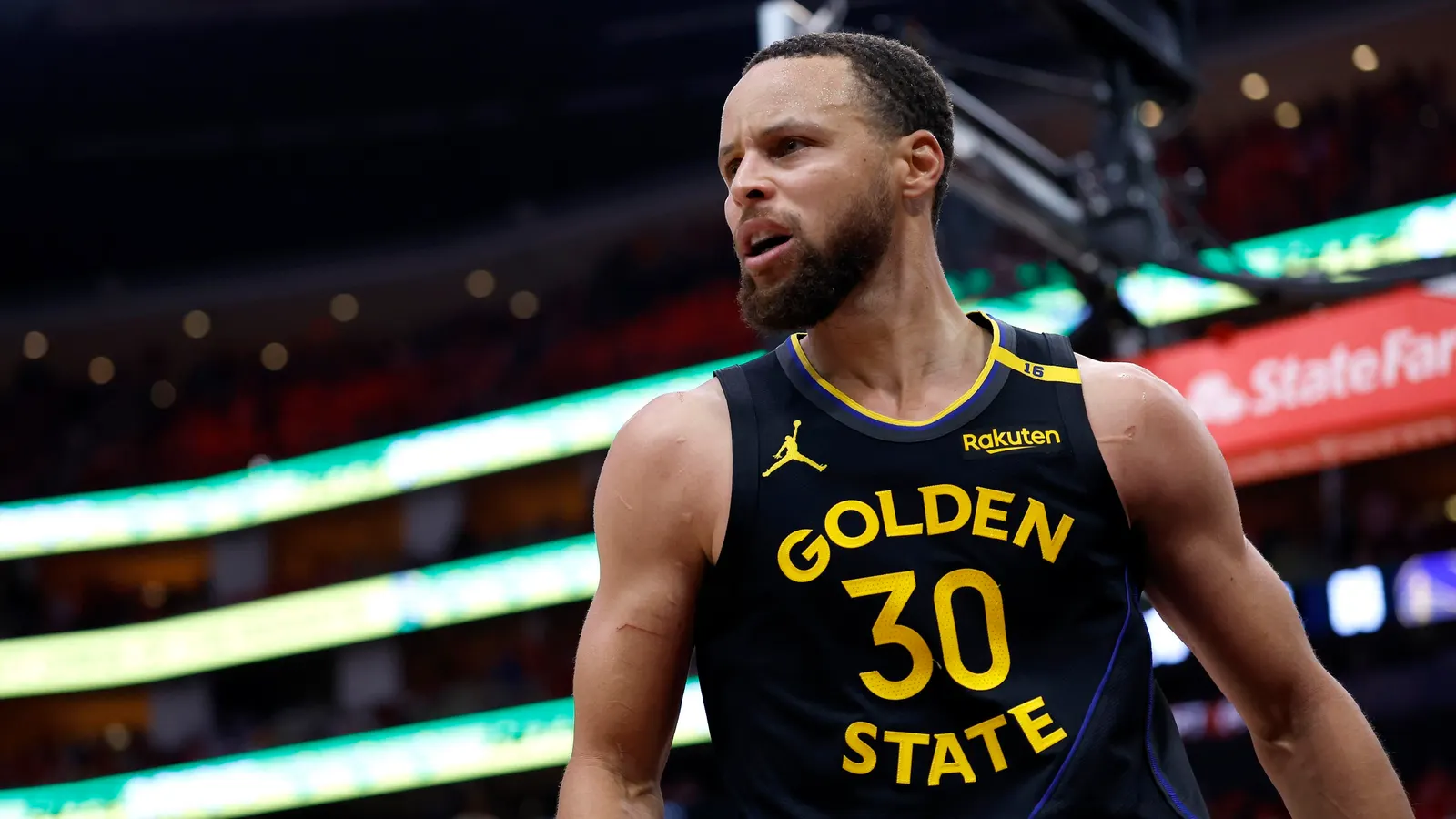
SAN FRANCISCO, CALIFORNIA – JANUARY 19: Stephen Curry #30 of the Golden State Warriors reacts after he had an assist to Gary Payton II #0 in the third quarter of their game against the Miami Heat at Chase Center on January 19, 2026 in San Francisco, California. NOTE TO USER: User expressly acknowledges and agrees that, by downloading and/or using this photograph, user is consenting to the terms and conditions of the Getty Images License Agreement. (Photo by Ezra Shaw/Getty Images)
Getty Images
NBA star Steph Curry recently appeared at a golf event in California, wearing Li-Ning red Hare 9 ultra running shoes, which he described as being “like On [Running Shoes] and those HOKAs [having] a baby.”
Last November, Curry’s 12-year relationship with America’s Under Armour came to an end, sparking a social media frenzy about which apparel brand he would sign with next.
In June this year, it was announced that the basketball player would be switching to China’s Li Ning, one of the East Asian nation’s biggest and most successful sports apparel brands.
Table of Contents
From the Beijing Olympics to Sports Apparel Growth
Li Ning is a former athlete who many people may remember as the guy who circled the roof of Beijing’s Olympic Stadium when the city hosted the Games in 2008; he’s nowadays an icon and a hero for many people across China.
There has been considerable discussion about Curry’s contract with Li Ning, with some speculating that it has given him one last big payday before his playing career comes to an end, though it will also help him to diversify his business interests into golf and lifestyle products.
The deal also draws on Curry’s popularity in China – a basketball-crazy nation of 500 million fans, 150 million of whom are characterized as being “hardcore” fans – which will add some longevity to his stellar career.
It will help that Li Ning has 7,000 stores across China, though Curry’s status will also enable the sportswear brand to gain traction in the US as the company seeks to expand its overseas presence.
The Golden State Warriors Point Guard isn’t the only NBA player who nowadays wears Chinese sneakers; for instance, in 2023, Kyrie Irving, of the Dallas Mavericks, left Nike to sign with ANTA, which saw him take on the role of Chief Creative Officer for ANTA Basketball.
Founded in 1991, ANTA has grown to become one of the largest athletic footwear and apparel companies in the world by revenue and market capitalization.
None of this is accidental; rather, the rise of Li Ning, Anta and others such as 361 Degrees, Dearway and Xtep is due to the ambitions and goals of China’s government, which, as in most other industries, wants its sports apparel sector to be a global leader.
According to Euromonitor, Chinese brands account for 6% of global sports apparel sales, though when the contribution of Chinese-acquired brands overseas is factored in, that number rises sharply.
Indeed, the aggressive acquisition of stakes in non-Chinese businesses such as Puma and Arc’teryx has been a defining feature of the sports apparel industry over recent years.
Fujian – the new global capital of sports apparel?
Driving this growth are places such as Jinjiang, Quanzhou, and Xiamen, cities in Fujian, a Southeastern province with almost 4,000 kilometres of coastline, from which it is easy to export sneakers, T-shirts, and caps, as well as to import raw materials.
This is one reason why, in the early 1980s, the Chinese government identified Fujian as the location for creating a sports apparel ecosystem, which it now sees as a global capital of sports apparel innovation, production, and marketing.
The ecosystem initially grew during the 1990s, as some domestic consumers switched from buying international brands such as Nike and Adidas towards locally produced alternatives, though more
Later, during the 2000s and after, the Fujian cluster began turning outward, seeking to establish itself in new markets, in part through early endorsement relationships with the likes of San Antonio Spurs star Tony Parker, who signed with Peak Sport in 2013.
Qiaodan goes head-to-head with Nike
However, the strategy stuttered because Chinese brands lacked the cool factor and the design and quality standards of their overseas rivals, which is likely one reason Xiamen-based Qiaodan adopted Michael Jordan’s leaping red basketball player logo for its own branding.
A Qiaodan brand shoe is displayed at a Qiaodan store in Hangzhou in China’s Zhejiang province on December 8, 2016. Basketball mega-star Michael Jordan won part of his trademark suit against a China-based sportswear company December 8, following a years-long struggle for control over the rights to his Chinese name. In a ruling by the Chinese Supreme Court, Qiaodan Sports Co, based in southeastern Fujian province, must stop using the Chinese characters “Qiaodan” on its merchandise, according to a transcript of court records posted on an official website. (Photo by CN-STR / AFP via Getty Images) / China OUT
AFP via Getty Images
Despite a long and fractious legal dispute with Nike, Qiaodan (which translates as “Jordan”) has persevered and, alongside other Chinese brands, now poses an increasing threat to its Oregon-based rival and to Germany’s Adidas.
As with other sports apparel companies and brands from Fujian, meticulous, often stringent, and highly target-driven state planning has driven performance improvements that are now driving that threat.
Having initially experimented with technologies such as 3-D printing, China’s sportswear businesses have since upped their game, adopting more innovative approaches to design, manufacturing and marketing, with Steph Curry’s signing with Li Ning epitomizing this.
Of late, Nike has been struggling in China; indeed, its sales there have fallen by 30% since 2021 amid pivotal market changes that are further emboldening domestic producers.
China’s pivot towards domestic brands
Guochao (which translates as “China-chic”) and Zìxìn, which means (“self-confidence”), have become prominent cultural and consumer movements characterized by a surge in Chinese national pride and the blending of traditional Chinese heritage with contemporary design, streetwear, and modern technology.
Adidas has understood these changes, delivering products heavily influenced by Guochao and Zìxìn, which helped drive a 6% increase in sales last year despite difficult trading conditions, whereas Nike is still struggling to craft an appropriate response.
Either way, there are two strong messages to draw from this: first, China’s rise as a sports apparel producer is not just economic in nature it is also helping the East Asian nation boost its soft power credentials; second, as we have seen with electric vehicles and digital technology, China’s industrial ascent seems inexorable.
It may seem like a long way from California to Fujian, but endorsement deals such as Steph Curry’s are quickly shortening the travel time for Chinese brands seemingly intent on seizing an ever-larger share of the global sports apparel market.