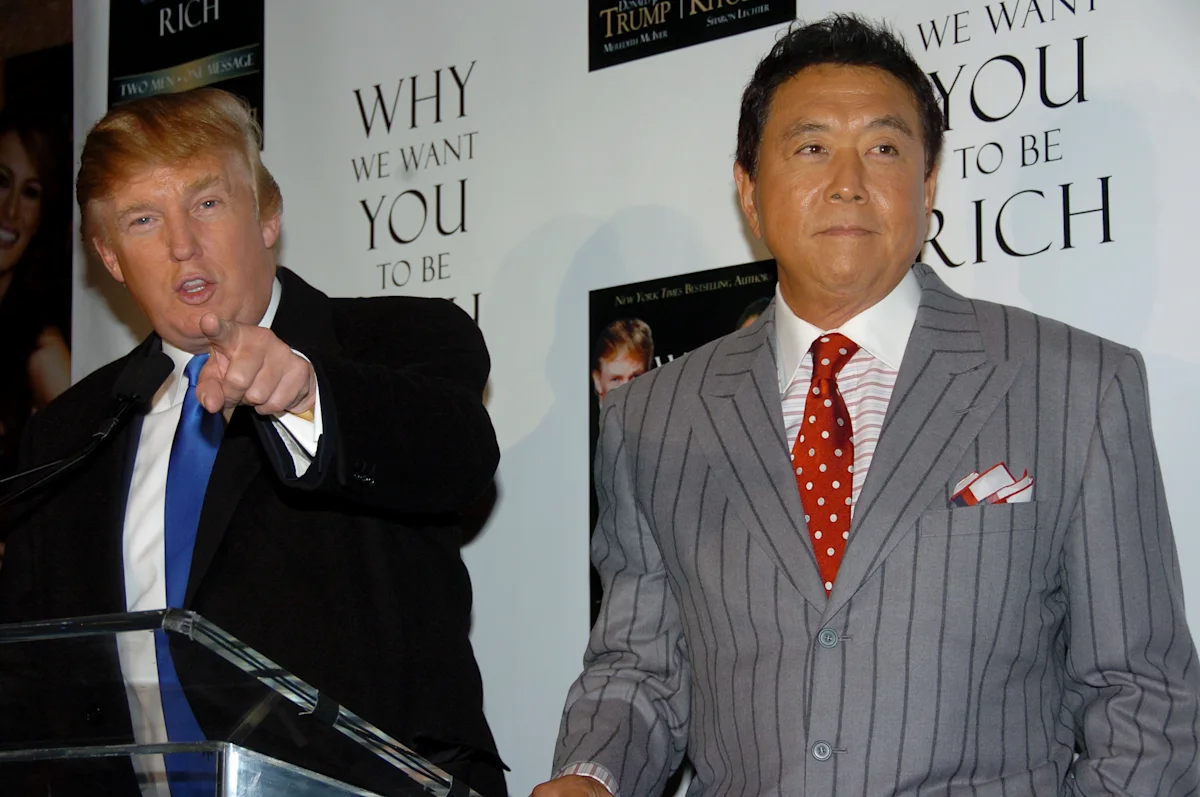
Robert Kiyosaki, author of the 1997 bestseller “Rich Dad, Poor Dad,” often says his $1.2 billion debt is part of a wealth-building strategy, and his philosophy rejects the “live below your means” advice common in personal finance. Kiyosaki’s book famously proclaimed that the rich don’t work for money, savers are “losers,” and your house is not an asset.
“I teach people how to use debt, and Dave Ramsey says don’t use debt. Most people should listen to Dave Ramsey,” Kiyosaki said in June on the “Get Rich Education” podcast.
His “Rich Dad” strategy advocates using debt to expand income by acquiring cash-producing investments. Kiyosaki’s ex-wife and longtime business partner, Kim Kiyosaki, told Vanity Fair that the $1.2 billion isn’t money Robert personally owes. Instead, it represents debt held by a group of real estate investors on a portfolio that includes roughly 1,500 apartment units. The partners hold the debt in a legal arrangement that removes most of their personal responsibility, she told the magazine.
Critics warn of the dangers of taking on heavy debt, while Kiyosaki advocates using leverage to acquire cash-producing assets. Can his approach still work today for investors seeking income-producing investments?
Read more: How to invest in real estate: 8 ways to get started
Table of Contents
The $1.2 billion figure needs context
Chris Galeski, a wealth advisor and partner at Morton Wealth in Calabasas, Calif., says Kiyosaki’s book was foundational to his own investing education, as he discussed in an episode of “The Financial Commute” podcast. But he believes the attention surrounding the 10-figure debt can be misleading.
“My frustration with how the $1.2 billion figure gets covered is that it’s presented as if it’s a forward-looking strategy, when really it’s a description of what worked for Kiyosaki looking backward, over a uniquely favorable stretch for real estate,” Galeski said in an email to Yahoo Finance. “Someone starting today is working with a very different set of conditions. The headline number gets all the attention, but the discipline behind it is what actually matters.”
Read more: How does fractional ownership work in real estate investing?
Knowing ‘good debt’ from bad
Kiyosaki defines “good debt” as an asset that produces sufficient income to cover the loan payment, with cash left over. He lists rental properties, dividend-producing stocks, and options strategies as possible examples.
“Instead of cutting $300 per month from a budget to afford something, a Rich Dad investor asks what asset they could acquire that generates $300 in monthly cash flow. Once the asset is in place, the $300 is no longer a budget sacrifice. It arrives every month from the asset while the asset also continues appreciating,” Kiyosaki wrote in a blog post.
Brock Harris, a real estate agent and investor in Los Angeles, says he embraces the Rich Dad definition of debt.
“I have been helping clients get started as real estate investors for decades,” Harris said in an email. “And when I do, I remind them of one of Kiyosaki’s key distinctions — there is good debt and bad debt. You tell the difference by asking who is paying it down. If it’s not you, it’s good debt. So if tenants are paying down the debt, it’s good debt, and borrow as much as you can.”
Read more: How real estate investment groups make money
A strategy that may be harder to copy today
Yet using the Rich Dad advice today may be harder than in past years.
“Kiyosaki isn’t wrong that leverage can build wealth, but he’s describing a strategy that worked beautifully in a specific 20-to-30-year window, not something you can just copy today,” Galeski cautioned. “He built his real estate portfolio over decades at a low cost basis, then rode the 2009 to 2022 near-zero-rate environment, refinancing again and again as property values climbed. That’s a completely different setup than what someone faces buying property today, with prices still elevated and rates much higher.”
However, Galeski is not in the Dave Ramsey debt-free camp either.
“Honestly, it’s not realistic for most people anyway. Going fully debt-free on real estate takes a lot of upfront capital, most investors just don’t have sitting around. The real choice isn’t debt-free versus Kiyosaki’s playbook, it’s disciplined leverage versus reckless leverage.”
The cash flow generated from real estate investments needs to cover every cost of owning — and then some, he added, with enough equity cushion so that “a downturn doesn’t wipe you out. That cushion is the difference between riding out a recession and handing your keys back to the bank.”
Real estate investor Harris also doesn’t advocate a Ramsey-like debt-free lifestyle.
“The bank is an incredible partner. They will put up 80% of the money to help you buy a piece of real estate, and how much of the profit do they get? None,” Harris said. “They only ask that they get paid back, over time, with a reasonable interest rate. My kind of partner.”
Read more: Is it worth buying an investment property right now?
‘Living below your means’
On his website, Kiyosaki claims that “‘living below your means’ is one of the most repeated pieces of financial advice in America” — and it keeps frugal people poor.
“A scarcity mindset masquerading as financial responsibility has kept generations of hardworking, educated people from ever building real wealth,” Kiyosaki wrote.
“I’d push back on that,” Galeski countered. “There’s nothing wrong with living below your means. The problem is when that turns into just sitting on cash. Living below your means is what frees up the capital to invest in the first place, but the money still needs to go to work. If you’re saving diligently but never putting that money into something that grows, you’re not building real wealth; you’re just delaying spending it.”
Harris added, “You can’t retire on coupons, and you can’t cut expenses to zero. To build real wealth, you have to focus on buying assets that go up in value, preferably with borrowed money.”