“It’s just an additional weight on young people’s shoulders. It’s something else we’re having to consider,” Sewanee student Grace Olson shared with me last fall when I asked her about climate anxiety.
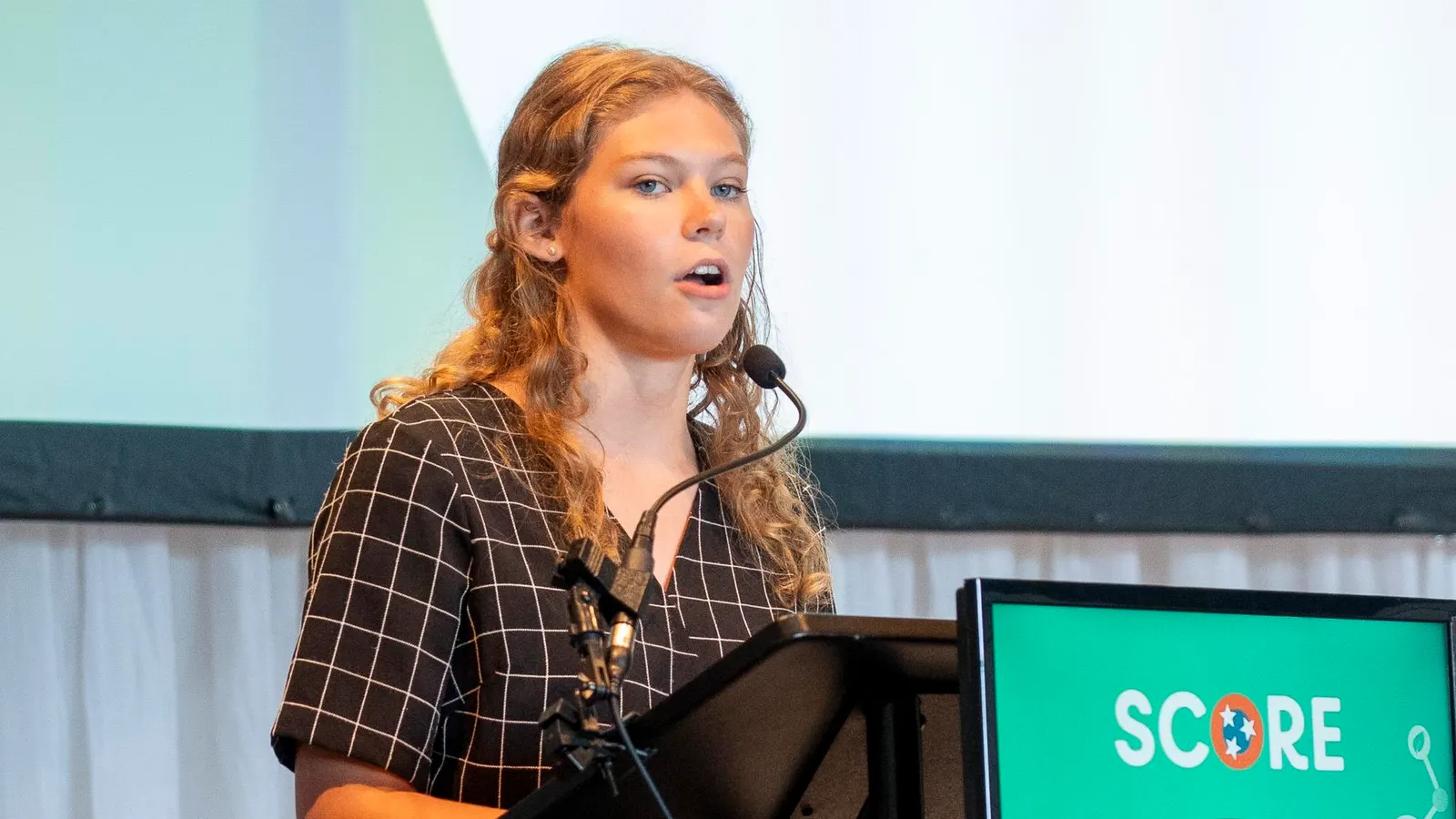
Sewanee student Grace Olson shares her perspective as a young sustainability and conservation advocate at the Tennessee SCORE Connecting the Dots Symposium on The Environment’s Impact on Student Success.
© Mark Mosrie 2025
We’d just participated in the State Collaborative on Reforming Education’s (SCORE) symposium on “Connecting the Dots: The Environment’s Impact on Student Success,” where we considered how environmental factors, from extreme weather to workforce shifts, are shaping student learning, health, and opportunity.
Grace, an impassioned student active in her college’s sustainability organizations and co-editor of the Sustain Sewanee magazine and newsletter, explained how her personal experiences fueled her motivation to act. She spent part of her childhood in Kingston, Tennessee when the town was devastated by the 2008 Kingston Fossil Plant failure, the largest industrial spill in U.S. history. It spread toxic coal ash across 300 acres, leaving many properties uninhabitable and contaminating the waterways. “We were drinking out of plastic water bottles because of the water effects from that event,” she recounted. It would take years to remediate, and the cleanup process exposed hundreds of workers to poisonous materials that have since been linked to cancer and other illnesses.
As a physician, policymaker, and founder of SCORE, I have long spoken about how the environment around us shapes the physical health within us. But there is another dimension we must take just as seriously: the mental health of our young people.
This generation is navigating overlapping pressures of pandemic-era disruption, the constant pull of social media, the rapid advance of artificial intelligence, in addition to a changing environment defined by increased extreme weather events. Across the country, anxiety and depression among adolescents are rising, affecting their readiness to learn and their personal well-being.
At the same time, today’s youth are emerging as some of the most influential voices in today’s climate conversation. They are organizing, proposing solutions, and pressing leaders to act.
It may be that these two developments are more connected than we realize. What if harnessing the next generation’s conviction and passion — and creating meaningful pathways for their leadership and agency — is not only good for our communities and planet, but also one of the most powerful ways to strengthen their mental health? Increasingly, the evidence shows when our youth have agency – the personal autonomy to shape their own life and the environment around them – it can counteract fears and negative thoughts arising from external pressures.
SCORE research into the impact of extreme weather on student learning found multiple peer-reviewed studies that chronicled the negative effects. Sources: Kraft, Malik, and Falken, Brookings (2025); Kuhfeld, NWEA (2024); McCormack, Resources for the Future; Kraft, Malik, and Falken, EdWorkingPaper No. 25-1238 (2025); Walker, NEA Today (2023); Park et al., American Economic Journal: Economic Policy (2020); U.S. GAO-20-494 (2020). Learning estimate reflects school-year temperatures in schools without air conditioning. HVAC figure reflects the share of school districts needing to update or replace systems in at least half their schools.
SCORE
Rising Anxiety and Its Real Consequences
The National Survey of Children’s Health found that between 2016 and 2023, diagnosed anxiety among adolescents ages 12-17 rose from 10.0% to 16.1%, and depression rose from 5.8% to 8.4%. While many factors contribute to this trend, concern about our future environment has become a recurring theme in conversations among the younger generation.
Researchers are now documenting what many clinicians and educators have been hearing firsthand, describing rising levels of “climate anxiety,” “eco-distress,” and “eco-grief” among young people. A major international study in The Lancet found that a majority of youth surveyed across ten countries reported being very or extremely worried about climate change, with nearly half saying those concerns affected their daily lives.
Young people are highly aware of the world around them. They have lived through intensifying storms, and see social media posts with images of natural disasters that devolve into acrimonious, tribalistic debates instead of words of compassion and shared visions for solutions. For some, that exposure creates a sense that the challenges ahead are overwhelming and beyond their control. Anxiety of this kind can affect sleep and concentration, which can impact academic performance. It can dampen motivation and narrow a young person’s sense of possibility. One recent study found that roughly one in five young adults say they hesitate to have children because they are uncertain about the future of the planet. That is a striking reflection of how deeply these concerns are shaping young people’s outlook and expectations.
For many, these feelings are intensified by a perception of intergenerational unfairness, or a belief that older generations have not acted with sufficient urgency and that the burden now rests disproportionately on those who are young.
As physicians, we are trained to look for protective factors alongside these risk factors. In the case of youth anxiety, one protective factor stands out: a sense of agency.
The author, Senator Bill Frist, visiting the Tennessee Nature Academy, a free nature-based public charter school in the Antioch-Cane Ridge community in Middle Tennessee. The school’s research-based model uses nature-based learning and play to support students’ academic success, build students’ social and community connections, and promote students’ well-being.
Bill Frist, MD
The Mental Health–Agency Connection
Peer-reviewed studies in pediatric and adolescent mental health point to a consistent finding: when young people feel powerless, anxiety intensifies. When they experience agency — the belief that their actions matter — their well-being improves.
Building that sense of agency starts with understanding the coping strategies young people naturally reach for. Research on youth and climate anxiety, including work highlighted in Harvard Medicine Magazine, identifies three common patterns. The first is problem-focused coping, where students channel anxiety into action but risk burnout when the problem feels too large for any individual effort. The second is emotion-focused coping, where students disengage to avoid distress, which can halt meaningful action altogether. The third is meaning-focused coping, where students act on what’s within their reach while trusting that others are working on the rest. That combination lets them carry worry and hope at the same time.
It is this last approach that the data most consistently links to wellbeing, allowing students to hold on to optimism while staying engaged.
Adults have a direct role in which pattern takes hold. Validating students’ emotions is the starting point; the next step is giving them meaningful ways to live out their values in response. My friend, Dr. Lisa Patel, and other pediatric leaders have pointed to research on climate-related distress among youth suggesting that how adults frame young people’s capacity to act shapes how they cope. In one experimental study with young people ages 15 to 25, those who received a message affirming their agency were more likely to engage in meaning-focused coping, while those given a low-agency message used less meaning-focused and problem-focused coping, and did not show the decline in anxiety that other participants did. In practice, that means giving students real responsibility, not just encouragement. When students are invited to lead school sustainability initiatives, plant gardens, or help shape environmental priorities in their schools, they learn that effort produces results, and they build both resilience and confidence.
Acting alongside others matters, too, and helps build trust that others are working on these issues. A Yale study found that students who participate in collective action — like joining advocacy groups or educating others about climate change — report lower levels of climate anxiety than those who only take individual actions like recycling or saving energy.
These actions do not solve every global challenge. But they do something equally important: they restore a sense of control. And when young people experience that sense of agency, many begin stepping forward in ways that reshape their communities and the conversations around them.
Youth Leadership Is Already Making an Impact
We are already seeing what youth leadership can look like.
Young advocates in their twenties on both sides of the political aisle, such as Swedish activist Greta Thunberg, and conservative American environmentalist Benji Backer, have drawn national and global attention to environmental challenges, urging leaders to consider the long-term consequences of present-day decisions. Their determination reflects a deep sense of responsibility for the future, and it demonstrates that care and concern for the places we live and raise our families can transcend political ideologies.
On college campuses, students are engaging in thoughtful dialogue about practical solutions. As Grace confidently explained, “I think the time for action is now, and I think that is shared across my generation… I think that’s where the younger generation can come in and make that change through having conversations.” (You can watch our full conversation here.)
Student leader Grace Olson speaks with Senator Bill Frist about her conservation efforts.
Bill Frist, MD
Grace and her peers are not simply raising concerns; they are proposing ideas and exploring how institutions can think creatively about infrastructure, conservation, and long-term planning.
In high schools in my home state of Tennessee, programs such as the Cumberland River Compact Youth Climate Program are equipping students to shape priorities, educate their communities, and take ownership of local stewardship efforts.
Many of these leadership opportunities are supported not only by schools, but also by youth organizations and community-based programs that help students connect environmental learning with real-world experience. One of the most enduring examples is 4-H, the nationwide youth development program that for more than a century has helped young people learn leadership and stewardship through hands-on work with the land and their communities. Through projects such as raising animals, tending gardens, studying soil and water, and caring for local ecosystems, young people develop both practical skills and a deep sense of responsibility for the land. (My wife Tracy and I recently held a 4-H camp on our southwest Virginia farm, and the deep respect these children had for the land and nature’s creatures was truly inspiring.)
Even elementary students are stepping forward. At Julia Green Elementary School in Nashville, students have launched sustainability initiatives that are shaping school practices and sparking broader conversations among families and staff. Their “Green Team” joined us at SCORE’s September 2025 Connecting the Dots symposium, leading by example by organizing composting during the event lunch. When children propose reducing waste or planting trees, they begin to see themselves as contributors to the well-being of their communities.
SCORE Vice President of Advocacy and Communications Nicole Floyd Smith introduces the Julia Green Elementary School’s “Green Team,” a student sustainability organization that is shaping school practices like encouraging composting of cafeteria meals.
© Mark Mosrie 2025
What Adults Must Do
Young people are already stepping forward with ideas, energy, and a willingness to lead. Our responsibility as adults, including educators, school leaders, parents, and community leaders, is to ensure they have meaningful opportunities to participate. Too often, adults try to solve complex challenges on their own, unintentionally leaving out some of the voices most invested in the future. When young people are invited into the conversation and given real opportunities to contribute, we arrive at better solutions, and they gain the sense of agency that strengthens both confidence and mental well-being.
Here are three ways adults can help empower young leaders:
- First, Listen. Parents, educators, and community leaders do not need to agree with every proposal young people bring forward. But listening signals that their perspectives matter — and that their fears are valid. Young people need space to process emotions like despair, grief, and anger before they can move into meaningful action. When students feel heard, they are far more likely to stay engaged and channel concern into positive change.
- Second, create authentic opportunities for engagement. Schools and community organizations can establish student advisory groups, sustainability initiatives, project-based learning experiences, and partnerships with local governments or conservation organizations. These opportunities build research, collaboration, and civic leadership skills while showing students that their efforts can produce tangible results. Tools such as the Youth Climate Action Toolkit, developed by This Is Planet Ed in partnership with The Nature Conservancy, offer practical frameworks for action.
- Third, affirm shared values rather than sharpen divisions. Activities such as recycling programs, school gardens, and student-led conservation efforts often bring communities together. Parents and community members who may hold different views on climate policy frequently support initiatives that teach responsibility, stewardship, and care for the community.
The author, Senator Bill Frist, engages with the Julia Green Elementary School’s “Green Team” after they led composting efforts at the Connecting the Dots Symposium luncheon in Nashville, Tennessee.
© Mark Mosrie 2025
A Future They Help Build
Our changing environment presents real challenges. As a heart and lung surgeon, I remain attentive to the physical health consequences. But as a grandfather and public servant, I am equally attentive to the emotional and psychological well-being of our young people.
We cannot allow a generation to believe their future is beyond their influence.
The young leaders I have met give me reason for optimism. They are pragmatic and determined, organizing community cleanups, planting gardens, educating their peers and elders, and finding ways through personal activism and through career choice to make a difference. They understand what is at stake. Sewanee student Grace Olson lived through a major environmental disaster that contaminated her home with over 1 billion gallons of toxic coal ash sludge, and turned it into motivation to make a difference in her community and beyond.
When young people are given the chance to lead in shaping solutions, something important happens. Stress turns into motivation. Agency replaces anxiety. And we reinforce a simple truth: the future is not something that happens to them. It is something they help build.
The next generation is ready. Our responsibility is to ensure they have the opportunity to lead.