Quant [QNT] has entered a sharp price discovery phase after breaking out of its weeks-long consolidation zone around the $60–65 level. The move accelerated once buyers pushed above $100, turning the earlier recovery into a vertical rally toward $330.
The surge was backed by high volumes as well. This showed that demand was supporting the move, rather than just thin activity influencing price movement.
However, the rejection near $330 prompted a pullback down to $242, where buyers stepped in around the 50% retracement level of the recent advance from $149 to $330.
This implies that bulls are currently looking to defend the broad breakout pattern established so far, given QNT was trading near $267 at press time.
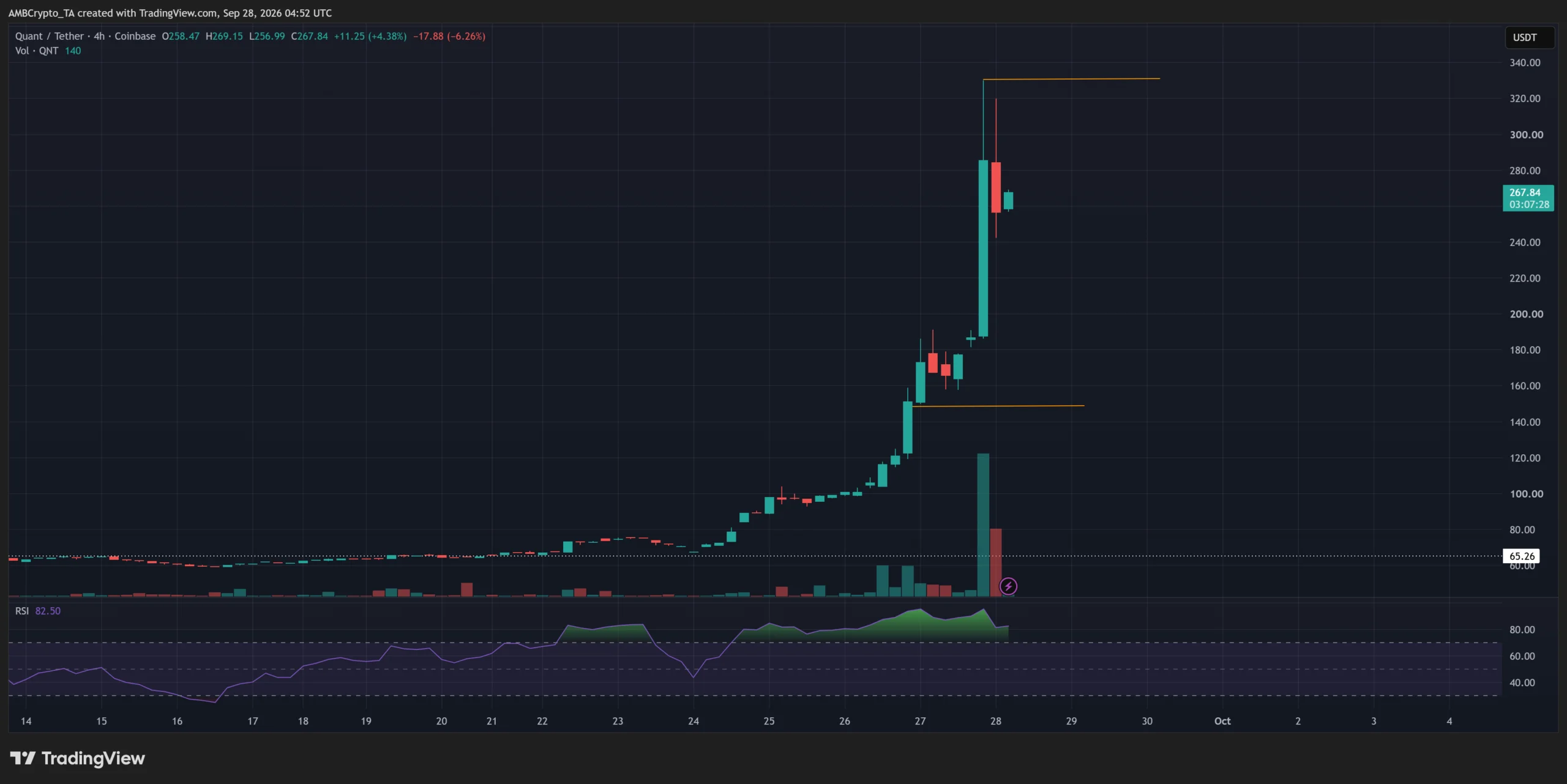
Meanwhile, RSI remained extremely high at 82.50, indicating extremely overstretched momentum. If buyers can hold onto $240, then the overall bullish structure will be maintained.
Additionally, if buyers can retake the resistance area at $286, then there may be enough support for another attempt at $330.
Conversely, if buyers cannot keep the price above $240, then there is potential for a drop toward $185-$190 and an even deeper retracement.
Quant enters U.S. payment infrastructure
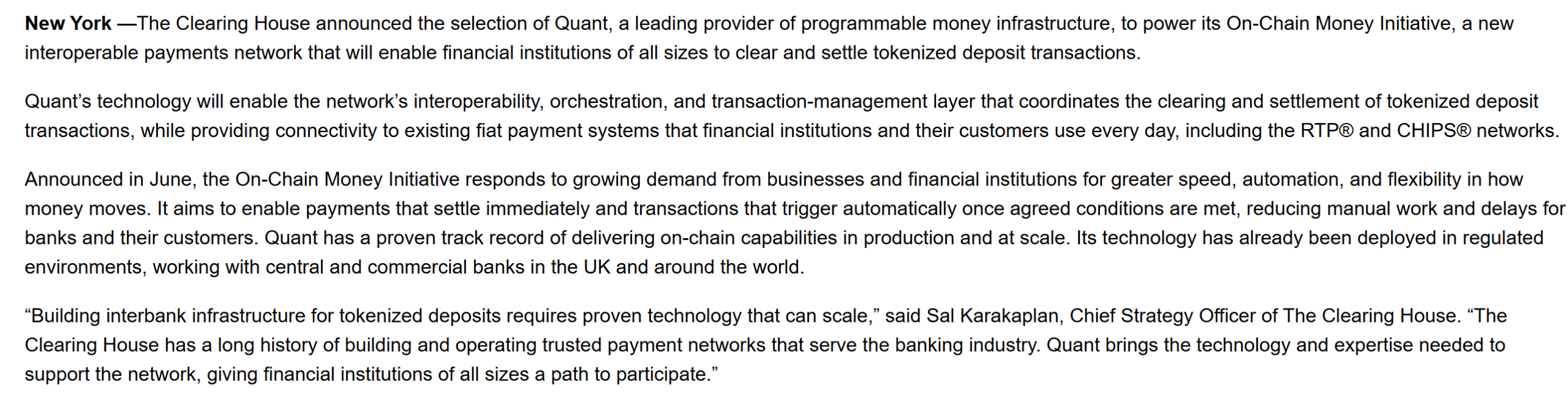
Quant’s institutional opportunity is transitioning from a token-driven narrative toward a potential role in U.S. payment infrastructure. This is because The Clearing House announced the selection of Quant to power its ‘On-Chain Money Initiative.’
The key is how Quant’s technology connects tokenized deposits with existing settlement rails rather than replacing them.
Through the Clearing House framework, banks could move deposits while still having access to RTP and CHIPS. This will lower the operational barrier for institutions that are already using these networks. It also provides a pathway for Quant’s technology to enter institutional financial flows.
 The Clearing House processes more than $2 trillion in daily settlements, highlighting the scale of the payment flows that Quant could potentially access if the system achieves meaningful adoption. However, it is dependent on actual use post-2027.
If there is meaningful bank participation and increasing volumes of tokenized deposits, then the institutional opportunity would represent measurable demand for the network.
Can institutional use drive QNT demand?
QNT’s institutional narrative now faces a test of whether adoption can translate into sustained token demand.
While Overledger provides some utility with QNT licenses, the overall volume of required licenses is much smaller than the total number of available QNT.
Therefore, increased institutional use does not automatically reduce circulating supply or create sustained upward pressure on QNT’s price.
In fact, the increase in institutional use at best represents a potential future source of institutional buyers. Notably, daily active users increased by 2,064 on the 24th of September after QNT increased 27%.
This represents a large increase in user activity. However, it also represents increased user activity based upon positioning rather than actual bank settlement.
Therefore, QNT’s rally still depends heavily on expectations, while measurable institutional usage remains the key catalyst for longer-term demand.