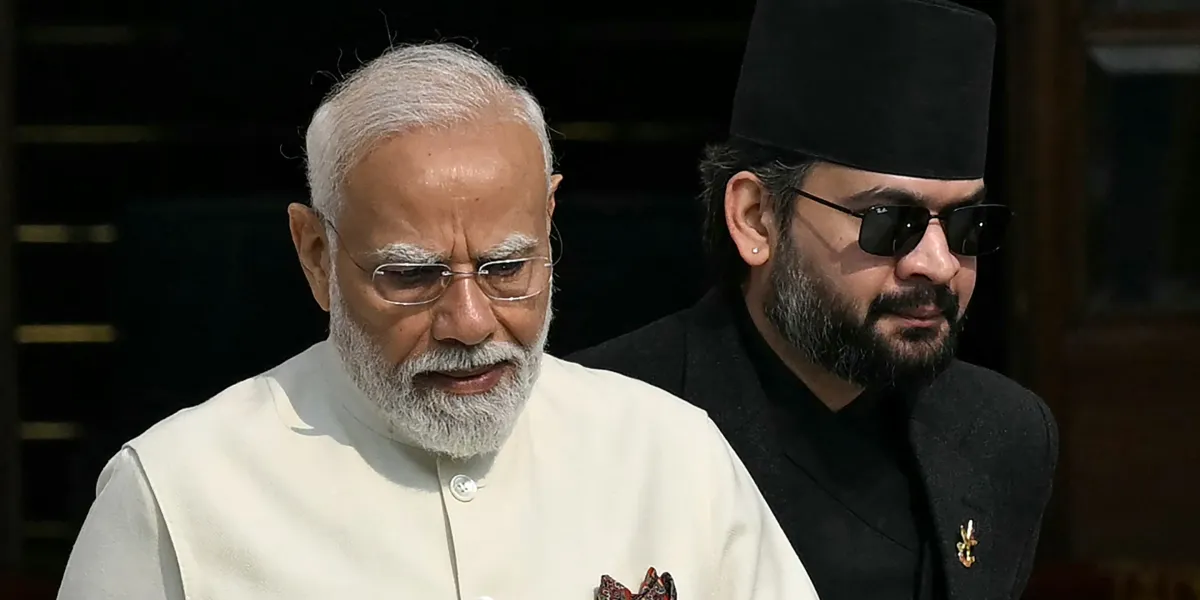
India announced a $1.62 billion economic package for flood-hit Nepal on Nov. 23, pairing reconstruction grants with a credit line for energy projects, the latest move in a decades-old contest with China over the Himalayan country’s future.
The floods that hit Nepal in late August were among the worst disasters in the country’s recorded history, killing at least 1,300 people. An estimated 84,270 people, including over 32,000 children, were affected by the floods, according to UNICEF.
“It has been three months and families are still working hard to rebuild, but efforts are hampered by the loss of assets and livelihoods they depend on,” Andrea Berardo, the World Food Programme’s deputy country director in Nepal, said in a Nov. 24 statement. “With winter approaching in Nepal’s highlands, many families are still living in temporary shelters and are facing increasingly harsh conditions.”
The money is about more than rebuilding damaged roads and homes. India—already Nepal’s largest trading partner—is using disaster aid to reinforce its ties with a neighbor that China has courted for years, and to keep Nepal’s economic future closely linked to its own, analysts say.
What’s in the package?
India’s package to Nepal includes a $377 million grant for post-disaster reconstruction and new infrastructure projects, along with a $1.24 billion line of credit for energy projects, according to a joint statement by the two countries.
Nepal is likely to use the grant for reconstruction and the credit line—which carries preferential terms and sourcing requirements from India—for infrastructure, notes Constantino Xavier, a nonresident fellow at the Brookings Institution’s foreign policy program. The credit line could also foster cross-border supply chains and support Nepal’s industrialization and manufacturing ambitions, which are essential to creating jobs in one of Asia’s youngest countries.
The announcement followed talks in New Delhi between Indian Prime Minister Narendra Modi and Nepalese Prime Minister Balendra Shah. It was the first official bilateral trip abroad for the 36-year-old rapper-turned-politician since he took office in March, after 2025’s youth-led protests against corruption.
“Our commitment will be to help affected families get their lives back on track, create new opportunities and further strengthen Nepal’s capacity to deal with future disasters,” Modi said to reporters.
Shah thanked India for consistently acting as a first responder to Nepal during “times of natural disasters and difficult hours”, and invited Modi to visit Nepal. India was the first foreign government to respond to the August floods, sending relief supplies and helping restore communications.
A Post-Disaster Needs Assessment released this month by Nepal’s National Planning Commission estimates recovery and reconstruction will cost 706.65 billion Nepali rupees ($5.2 billion)—more than 10% of Nepal’s 2025 GDP of $45.49 billion, according to the World Bank.
Has India done this before?
India and Nepal have maintained close economic, diplomatic and security ties since they signed the 1950 Treaty of Peace and Friendship; bilateral trade reached $9.38 billion in the 2025–26 fiscal year.
After a 2015 earthquake in Nepal that killed more than 8,000 people, India donated $1 billion for post-earthquake reconstruction. Yet five months later, many Nepalis blamed India for a fuel shortage, accusing New Delhi of imposing an undeclared blockade after Nepal adopted a new constitution. India denied responsibility, saying protests on the Nepali side of the border were blocking its trucks.
India has long used money to play a central role in South Asia. It provided nearly $4 billion in aid to Sri Lanka in 2022, as the tourism-dependent island nation faced its worst economic crisis in more than seven decades.
“It reflects India’s growing geoeconomic engagement with its neighbors, especially in times of crises, as also during Sri Lanka’s 2022 financial default,” Xavier says of the Nepal pledge.
There may also be a geopolitical motivation behind India’s generosity. Kunda Dixit, former editor of the Nepali Times, told Reuters that India “may be trying to ensure that [Shah] does not lean too much towards China.”
What about China?
China and Nepal share an 878-mile border across the Himalayas. China accounts for nearly half of Nepal’s foreign direct investment and is the country’s second-largest trading partner, though trade is heavily skewed in Beijing’s favor.
Beijing has also identified 10 projects for potential joint implementation under its Belt and Road Initiative, including a proposed railway linking Kathmandu with Tibet, road corridors and a cross-border electricity transmission line. China also responded to the floods by providing cash and relief supplies, and sending more than 20 rescue and forensic experts.
In Nepal, India disbursed more than four times as much aid as China in the 2024–25 fiscal year, according to Nepali government data cited by Reuters.
“I don’t think China will launch a checkbook competition with India in Nepal,” Yun Sun, a senior fellow and co-director of the China Program at the Stimson Center, says. “Influence and presence are measured by long-term, consistent involvement, not a one-time deal. The region would benefit from contributions from all great powers, instead of a single package.”
“Many of the smaller South Asian states, including Nepal, rely substantively on India for development and humanitarian assistance,” Michael Kugelman, a resident senior fellow for South Asia at the Atlantic Council, says. “India’s new aid package is the latest reminder that even with China deepening its footprint in South Asia, New Delhi continues to leverage reliance on its largesse to ensure ties with its neighbors—or at least most of them—remain in a good place.”