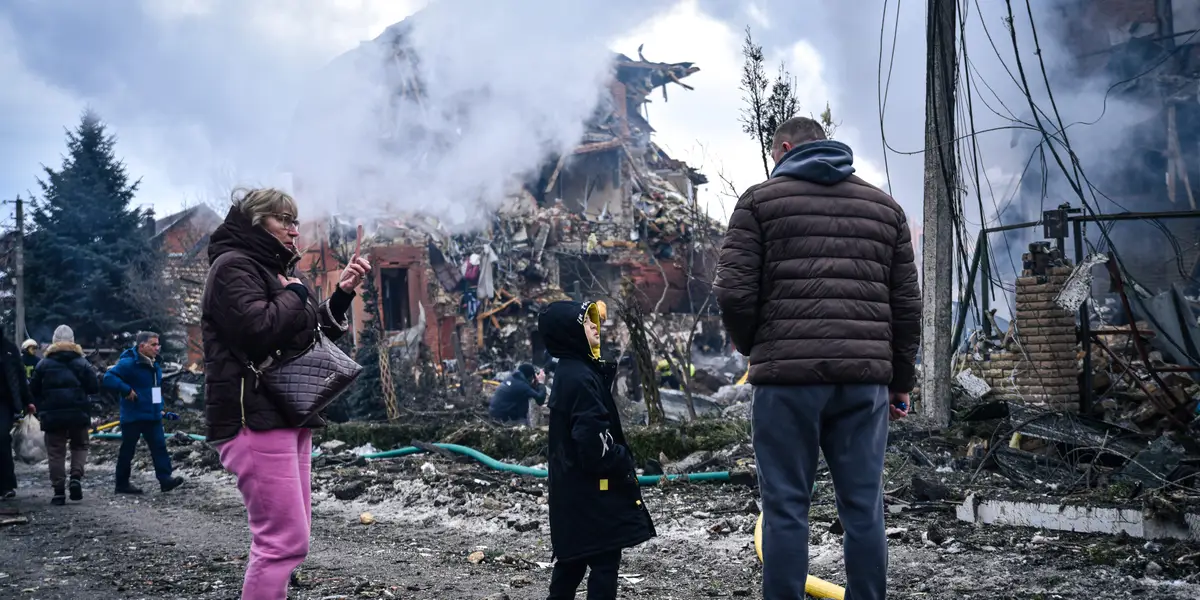
US special ops veterans are training Ukrainian civilians to keep each other alive when ambulances, medics, and rescuers cannot reach them quickly.
In Ukraine, Russia’s drones and missiles hit homes, towns, hospitals, and ambulances, and medics responding to an initial strike may themselves become targets. Civilians close to the fighting might have to treat battlefield-style injuries while waiting hours, or longer, for help.
It is a civilian survival problem in Ukraine, but it echoes a military one. Soldiers in the field often cannot count on the life-saving “golden hour” that Western forces could in recent wars, when quick evacuation and treatment increased the chances of survival.
In Ukraine’s chaotic fight, on and off the front lines, the wounded can end up on their own for long stretches.
Mark Antal, who spent 12 years in the US Army’s 1st Special Forces Operational Detachment-Delta, told Business Insider that “this war is a little different than what we’re used to. We used to control everything.”
In recent wars, Western forces generally fought with air superiority, evacuation networks, and rear areas that were safer than what Ukraine faces now. And Western civilians were far from harm’s way. In Ukraine, by contrast, every part of the country has been struck by missiles and drones, so “no one is safe at any time,” Antal said. And the West worries the same may be true for it in future wars.
Mark and his wife, Christine Quinn Antal, a US veteran and a former Army advisor on security to Ukraine, founded Task Force Antal as a nonprofit organization that has US special operations forces veterans bring life-saving supplies, including medical gear, to conflict zones, including Ukraine, where they train civilians in front-line emergency medicine.
Christine told BI that the purpose is to educate regular people who “never thought that they would be” in a situation where they’re “packing a wound from shrapnel or from an explosion in their neighbor’s apartment.”
Oleksandr Klymenko/Ukrinform/NurPhoto via Getty Images
The goal is to teach civilians to keep each other alive as long as possible, until more help can arrive.
A new type of war
Jeffrey Wells, a US Navy veteran with experience in Afghanistan and Iraq, now working with Task Force Antal in Ukraine, described this war to Business Insider as “very different, first and foremost, than the last 25 years of Western conflict.”
In the wars in the Middle East, the West has had enough control that if someone was injured, “you could get a helicopter there pretty quickly and get them to a hospital.”
Ukraine doesn’t control the sky the way the West did in Iraq and Afghanistan, where US forces still faced serious danger but often had air cover, evacuation routes, and more secure bases behind them. War in Ukraine is a brutal slog, and the same safety nets often are not there for soldiers or civilians.
Wells said that “the airspace is incredibly important to the survivability from a traumatic wound,” but Ukraine shows that control isn’t guaranteed in the future. “I think the last 25 years may be over from commanding the airspace, just from an observation of Ukraine.”
For civilians, that lack of control can result in long waits for help after an attack. “For Ukrainians, especially in the front-line cities, how soon an ambulance might get there, it could be an hour, it could be 12 hours,” Wells said.
Christine said that this war is different from what the West is used to because Russian targets are “just so blatantly civilian.” There are attacks not solely on military targets but also on Ukrainian cities. “Generally speaking, I don’t think we’ve seen such large-scale deliberate targeting of civilian structures or infrastructure,” she said.
In Ukraine, civilians often suffer the same types of injuries as soldiers, often fragmentation injuries from drones and missiles. Task Force Antal initially prepared for gunshots, but that’s no longer the focus. Instead, it’s shrapnel.
Diego Herrera Carcedo/Anadolu via Getty Images
A wait for safety
The West is used to being able to offer quick treatment to soldiers, but in Ukraine, the intense fighting means injured troops can be stuck waiting for days, with only their comrades’ medical skills keeping them alive.
For civilians, the same lesson applies: the first person able to help may be a neighbor, not a medic.
Civilians need to be trained for long wait times and to be patient rescuers, Mark said. Observation, patience, and skill are all necessary. Rushing out into a barrage can be costly. If “you become a victim,” he said, “you can’t help anyone else.”
“We’re seeing more and more of the secondary follow-up attacks,” where Russia targets responders in what are called double-tap strikes.
Yan Dobronosov/Global Images Ukraine via Getty Images
Wells said that Russia increasingly launches an attack, “and then kind of waits for emergency services to head on-site and then launch another attack.” Emergency services are having to wait longer before responding, putting more of the first response on civilians already there.
That’s been a learning process for everyone involved in building these skills. “I wouldn’t have realized, even having been in the Army, how important it is to keep your patient warm” through improvisations like pulling curtains down or using bedsheets to pack wounds, Christine said.
She said Ukrainian soldiers and civilians need to know more about medical treatment than what many of their NATO counterparts typically learn. “It’s an anathema in most NATO countries that you would allow or teach laypeople that level of medical care.”
Ukrainian civilians help each other under the threat of secondary attacks, of falling buildings and infrastructure, in the dark and without heat or light sources, and without being able to move with the injured person for long periods, as attacks and targeting continue. To help, Task Force Antal says it distributes items such as battery-operated headlamps, along with medical gear.
Christine said that her organization has “a long waiting list of folks that want us to come to their town or their community.” She said, “These are people like all of us, and their hometowns are under attack.”