Vacation-home demand was expected to remain sluggish, as the broader housing market was marred by elevated mortgage rates and weaker transaction activity.
However, according to new Redfin data, there’s an unexpected shift in one corner of the housing market, breaking a trend that has held up since the pandemic boom.
Though at first it looks like the beginnings of a recovery, the underlying data paints a more complicated story.
The change comes from one of the market’s weakest starting points and is spearheaded by a remarkably narrow group of buyers.
Rather than indicating whether housing affordability has improved, the shift reveals where purchasing power is returning first and which Americans remain shut out.
Redfin says affluent buyers are returning to America’s vacation-home market again Thomas Northcut
What the vacation-home rebound really says about housing
Redfin found that demand for vacation homes jumped in 2025 for the first time since the pandemic boom, as second-home mortgages grew more quickly than loans for primary residences.
More Economy:
Naturally, stronger vacation-home demand indicates improving consumer confidence, with households usually making such decisions when they’re feeling much more secure about their income, wealth, and the economy.
However, if we dig into the numbers, that rebound could be much smaller than the headline numbers suggest.
Second-home originations rose from 86,870 to 90,413, so the entire gain was basically just 3,543 additional mortgages. Activity remained about 50% below 2019 levels and roughly 65% beneath the 2021 peak.
Additionally, second homes formed just 2.7% of all mortgage originations, compared with 5.1% in 2021.
So basically, the gain has just recovered about 2% of the drop from 2021 to 2024.
Put simply, it indicates that the affluent buyers have become more active again, while ordinary households still remain priced out of buying even one home.
It’s worth noting, though, that HMDA covers mortgage originations, not necessarily every home purchase.
It excludes those paying entirely in cash, which is highly relevant when analyzing affluent buyers. National Association of Realtors data shows 57% of vacation-home buyers paid entirely in cash, compared with just 18% of primary-residence buyers.
Also, the report measures the financed second-home market, not the full vacation-home market.
America’s housing recovery is increasingly reserved for the wealthy
The “K-shaped economy” discussion has gained a ton of steam lately, and Redfin’s report essentially throws more fuel on that debate.
In fact, I recently covered a Bank of America research note on the economy. In its midyear outlook, the bank described the U.S. economy as K-shaped, calling it “reflation for higher income, stagflation for lower income.”
For perspective, Redfin found that 85.2% of second-home mortgages were attributed to high earners boasting a median income of $294,000.
That is a remarkable 3.3 times the overall U.S. household median of $88,000.
The typical financed second home was worth $515,000, about 30% more than the $395,000 typical primary home. Buyers aged 45 to 64 received nearly 59% of the loans, which added more colour to the picture of older households with accumulated income, stocks, and financial assets.
Additionally, the broader market confirms that split.
Luxury home prices shot up 4.7% year-over-year in May, compared to 1.5% for non-luxury homes, backed up by demand from affluent buyers. Consequently, the national median sale price reached a record $408,776 in June.
The financing calculation adds more weight to that argument.
So, for a 20% down payment on a $515,000 property, a buyer will need to finance approximately $412,000. At the recent average 30-year mortgage rate of 6.58%, as reported by Freddie Mac, the principal and interest would be about $2,626 per month, before taxes, insurance, maintenance, and association fees.
Additionally, even with modest estimates for those, there are additional costs that could push the annual carrying cost above $40,000, excluding the initial $103,000 down payment and closing costs.
If we take a 3% pandemic-era rate, that same loan would cost nearly $1,737, which means today’s payment is roughly 51% higher.
The comeback is selective, not a nationwide vacation-home boom
Redfin’s metro-level data shows that the recovery in second-home demand is quite uneven.
For perspective, West Palm Beach recorded the highest concentration of second-home mortgages, at 5.5% of all local originations. New Brunswick, which includes the Jersey Shore, followed at 4.6%, while Riverside, which includes Palm Springs, stood at 3.8%.
It’s important to note that these markets are best described as established seasonal luxury destinations, where affluent buyers often view a second home primarily as a lifestyle purchase.
The motivations for buying these properties may have less to do with rental income and more to do with privacy, family access, and seasonal use.
Moreover, some of the fastest-growing metros look less impressive once the numbers are put into context.
Montgomery County, Pennsylvania, posted a 28.8% increase but recorded only 103 second-home mortgages in total (implying just 23 additional loans). Indianapolis rose 26.6%, but the increase amounted to only about 58 mortgages.
Meanwhile, several recognized vacation and investor markets moved sharply in the opposite direction:
Las Vegas: down 20.9%.
Los Angeles: down 19.8%.
Orlando: down 14.5%.
Tampa: down 13.8%.
Miami: down 10.5%.
Markets like Orlando, Las Vegas, and Tampa usually attract buyers who’re expecting short-term or long-term rental income to offset mortgage payments, insurance, taxes, maintenance, and association fees.
When those costs jump, or we see a slowdown in rental returns, the investment case deteriorates quickly.
High-profile purchases in affluent vacation-home markets
What buyers and sellers should watch
The data is clearly showing that the market isn’t improving evenly.
For affluent buyers in Florida, New Jersey, and California, competition is likely to remain elevated in lifestyle markets such as West Palm Beach, the Jersey Shore, and Palm Springs. On the flipside, lower- and middle-income buyers are unlikely to gain much from this supposed rebound, as they remain remarkably exposed to mortgage rates, down payment constraints, and monthly ownership expenses.
Sellers in wealth-driven destinations might find enough buyers who are willing to pay for scarcity and personal use.
However, sellers in investor-heavy markets should be cautious, and those properties might require a lot more realistic pricing or concessions.
The broader housing market remains restricted. According to NAR reporting, existing-home sales ran at a 4.09 million annual pace in June, while the median price surged to $440,600, and available supply stood at 4.6 months.
Relief depends a ton on borrowing costs. The average 30-year mortgage rate stood at 6.58% on July 23, making the Fed’s July 29 decisionand the subsequent bond-market reaction important catalysts.
Buyers should monitor mortgage rates, local inventory, price reductions, and insurance quotes. Sellers need to track competing listings and days on market.
Until rates decline or incomes catch up, wealthy buyers seem to have all the flexibility, while everyone else might need to negotiate harder or wait.
Pi Network [PI] launched a liquidity pool containing SLICE and Test-Pi, using an automated market maker to calculate swaps based on the amount of both tokens in the pool.
After introducing the model, the PI team distributed 10 million SLICE test tokens. The token distribution provided pioneers with firsthand experience with the liquidity pools and token swaps before the mainnet.
How the SLICE liquidity pool works
According to the core team, the launchpad sends Pi proceeds into the token liquidity pool. The model pairs the ecosystem token with the project tokens. For the SLICE test launch, the pool contains SLICE and Test-Pi.
Therefore, the SLICE liquidity pool functions as a decentralized mechanism to facilitate token swaps and establish market pricing. The SLICE test launch uses an automated market maker alongside the Pi DEX order book.
Swaps are priced based on the balances held in the liquidity pool. Prices increase when pioneers use Test-Pi to buy SLICE and decrease when pioneers swap SLICE for Test-Pi.
How did the PI market react?
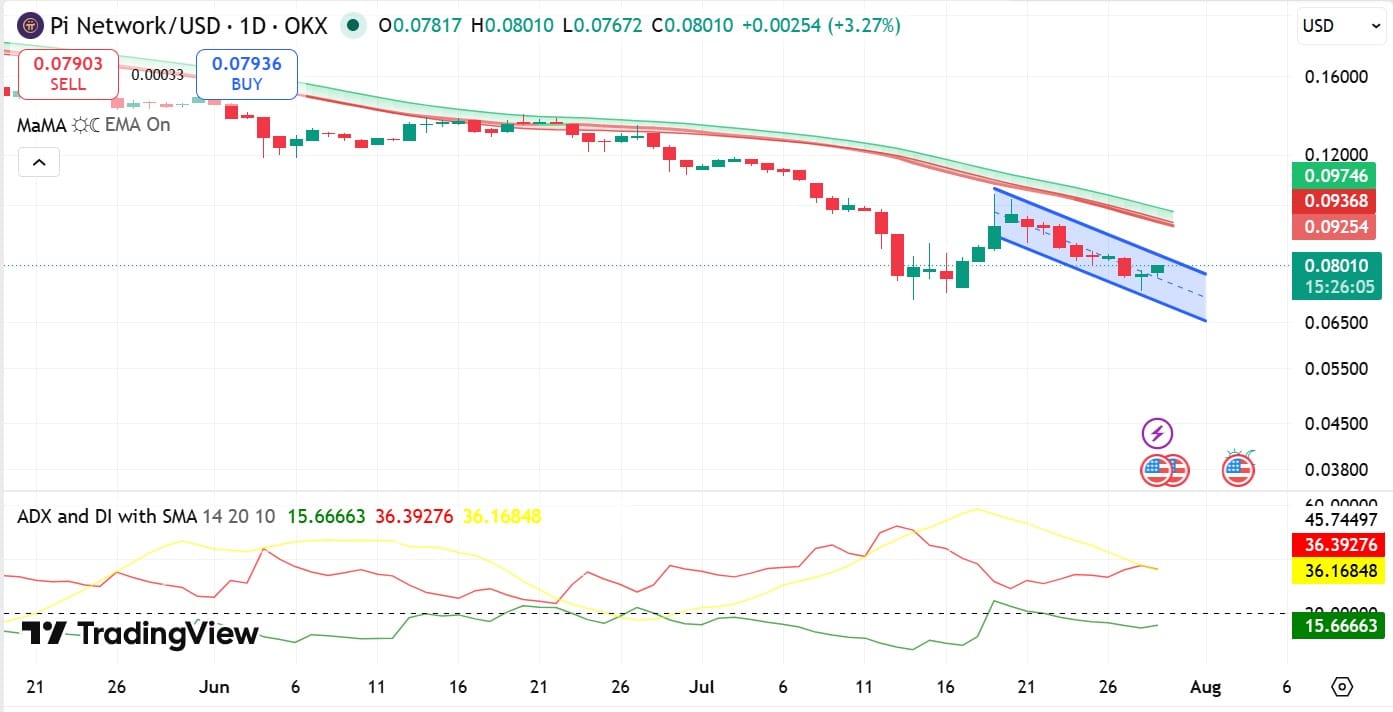
After a successful completion of the second launchpad test, PI reacted positively. In fact, the altcoin reclaimed the $0.08 resistance after rising by 5.8% on the daily charts.
Despite these gains, the altcoin’s market momentum remains weak. In fact, the crypto’s ADX SMA indicator continued to decline.
Source: TradingView
At press time, the +DI sat around, while the negative index and the ADX both remained elevated at 36. Such a setup suggests the downside momentum is strong and most likely to continue. The Momentum Adjusted Moving Average (MaMa) confirms this downward pressure, as it hovered above the price.
Therefore, the recent gains were sparked with the launchpad launch, and once this fades, another dip will fall. Thus, the trend is likely to continue and fall below $0.08, with $0.076 as the next support level.
Why does PI remain weak?
Despite the recent market activity, PI’s demand remains weak as whales have remained bearish and aggressively selling.
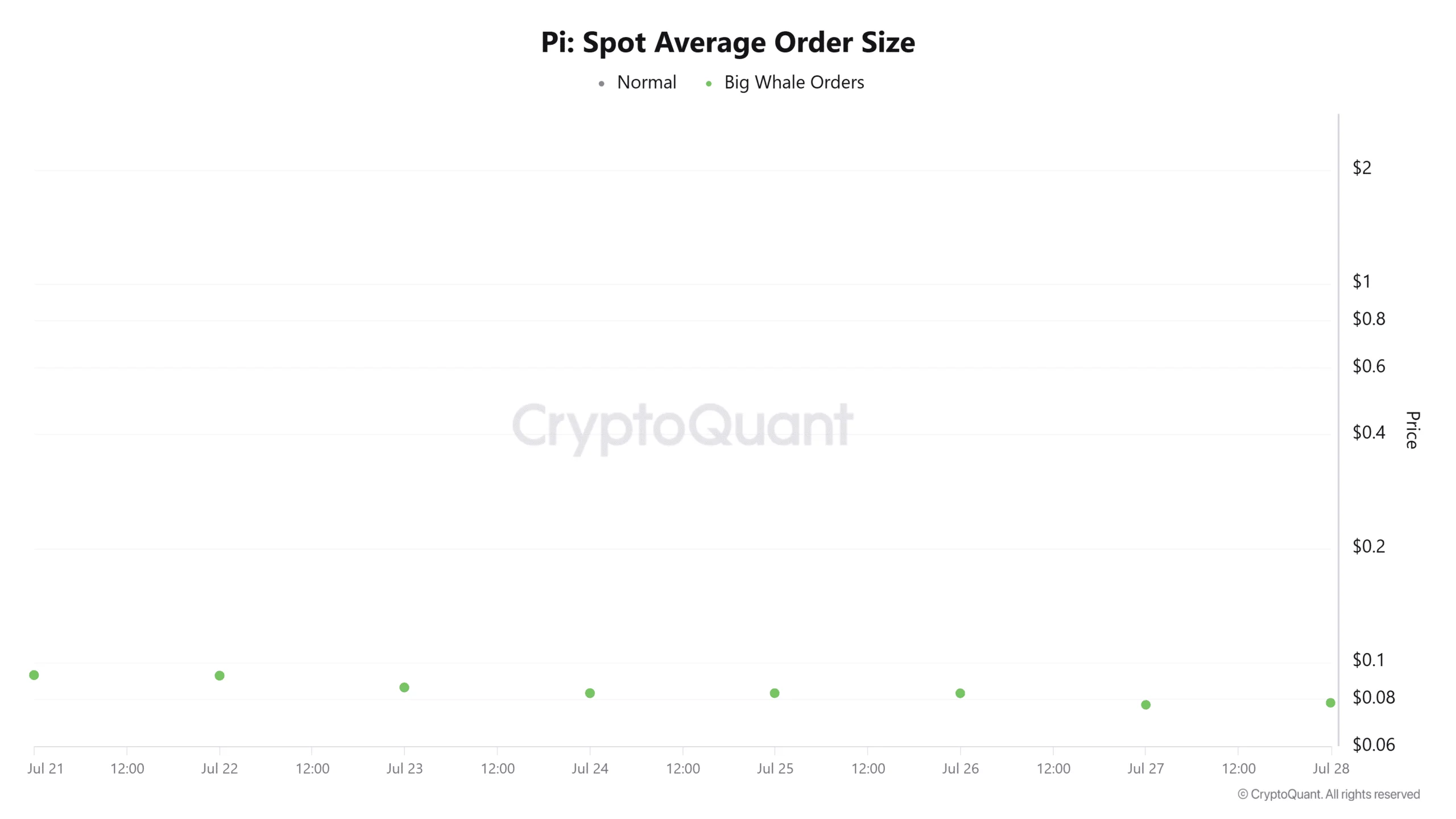
A look at the Spot Average Order Size data from CryptoQuant showed whale activity has remained elevated over the past week.
Source: CryptoQuant
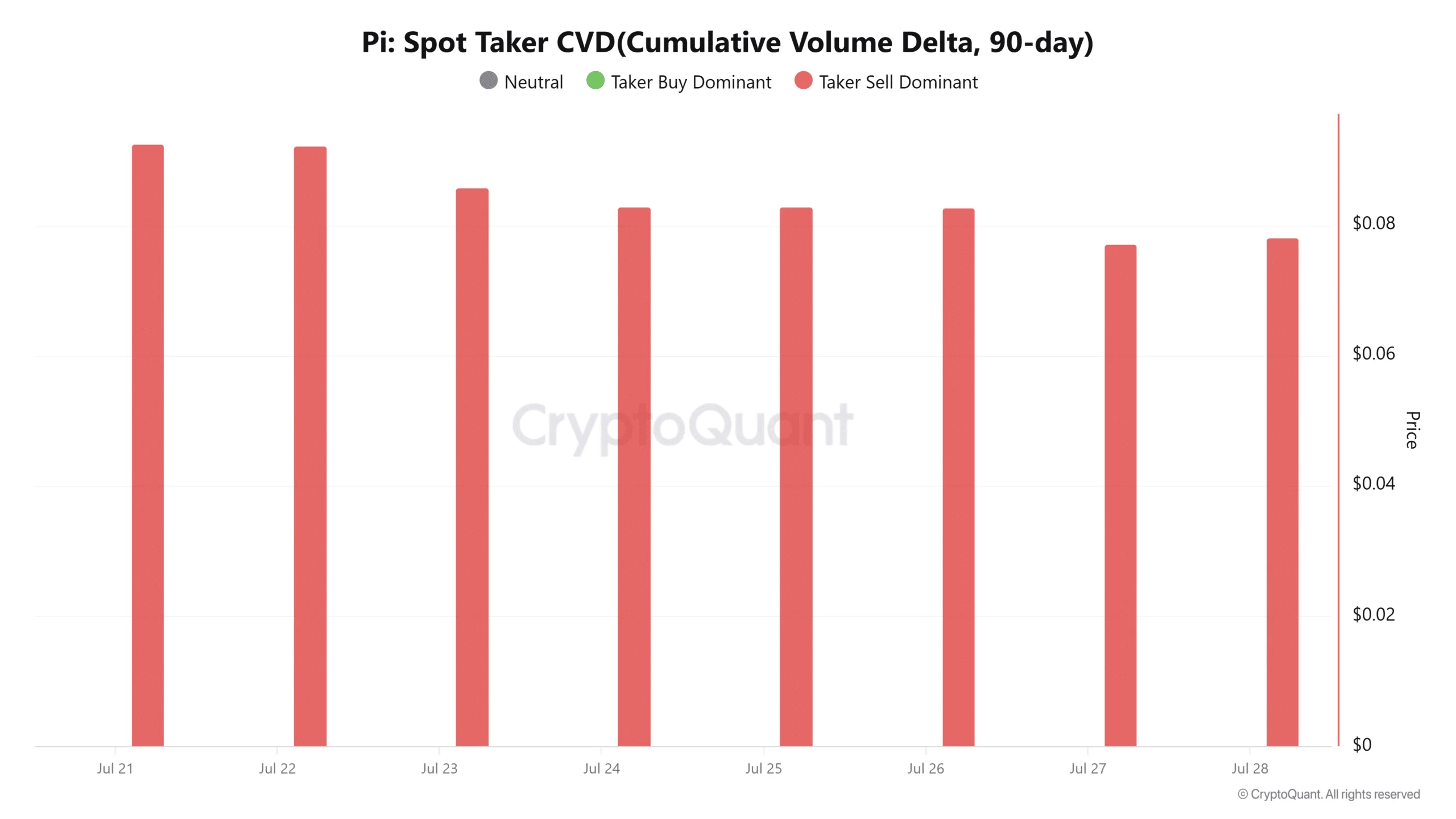
The metric revealed large whale orders, indicating either heightened buying or selling activity. Throughout this period, the Spot Taker CVD stayed red, underscoring sellers’ dominance.
Thus, sellers are extremely active on the spot, suggesting whales have been mostly selling.
Source: CryptoQuant
With whales selling at even the slightest of gains, PI is unlikely to make a significant recovery in the short term.
Final Summary
PI Network announced the launch of the SLICE Test-Pi liquidity pool on the testnet.
PI climbed 5.8% to reclaim $0.08 following increased market activity, but whales continue to sell, weakening the market.
“I think we’re going to see a lot of mainstream impact from something tokenized that people can buy that they used to have a hard time getting access to,” Galindo said.
“I think that’ll probably be the first way crypto hits the people that aren’t just in it all the time and thinking about it all the time. It’s going to be some kind of tokenized product.”
Galindo also said wealth management clients are becoming more comfortable with digital assets as investment options continue to expand beyond bitcoin.
“A lot of people just stopped at bitcoin and said, ‘I’ve got that covered. I don’t want to get it more complicated,'” he said. As more exchange-traded funds and tokenized products become available, he expects investors to spend more time deciding how digital assets fit within broader portfolios.
Ali Wallace, Morgan Stanley Investment Management’s global head of capital markets and ETF strategy, said product development is already evolving in response to investor demand. She pointed to growing interest in multi-currency digital asset ETFs as the next stage of innovation.
“There really is an interest for multi-currency, multi-product” ETFs, Wallace said, describing them as the next evolution of digital asset investment products.
Graseck expects the transition to take years rather than months. Still, she believes the direction is clear.
LONDON, July 29 (Reuters) – Apple said on Wednesday that proposed UK rules governing its App Store would amount to price regulation, arguing that plans to loosen its control over in-app payments could undermine innovation and investment.
In a submission to Britain’s Competition and Markets Authority, the iPhone maker said proposed “steering” requirements would go beyond promoting competition and give the regulator a “highly intrusive” role in managing its business.
The CMA’s consultation, which closed on Monday, is part of its efforts to boost competition and consumer choice. Its proposed measures would allow app developers to direct users to payment options outside Apple’s App Store and Google’s Play Store and require any fees charged for such steering to be fair and reasonable.
Apple said the App Store facilitated more than £46.5 billion ($61.8 billion) in UK billings and sales in 2025, with commissions accounting for less than 3.5% of the total. It added that there was no evidence changes to its payment model would lower prices for consumers.
“Under the (consultation), the CMA would not only regulate Apple’s prices, but also restrict the products and services for which Apple can charge a commission,” the company said in its submission.
Gene Burrus, global policy counsel for the Coalition for App Fairness, which has long campaigned for restrictions on Apple and Google app store practices, said Apple’s arguments overlooked the barriers developers face.
“Apple is using its position as the dominant platform gatekeeper to give itself unfair and unwarranted competitive advantages,” Burrus said.
Apple has previously said developers already have multiple ways to transact with users outside its platform.
The CMA consultation is part of Britain’s new digital markets regime, which gives the watchdog powers to impose tailored requirements on companies designated as having “strategic market status”.
Apple and Google were designated under the regime last year.
($1 = 0.7521 pounds)
(Reporting by Sam Tabahriti. Editing by Mark Potter)
Unibase [UB] extended its bullish advance after posting a 25.4% daily gain as of writing, pushing its market capitalization to $355.6 million as buyers regained control.
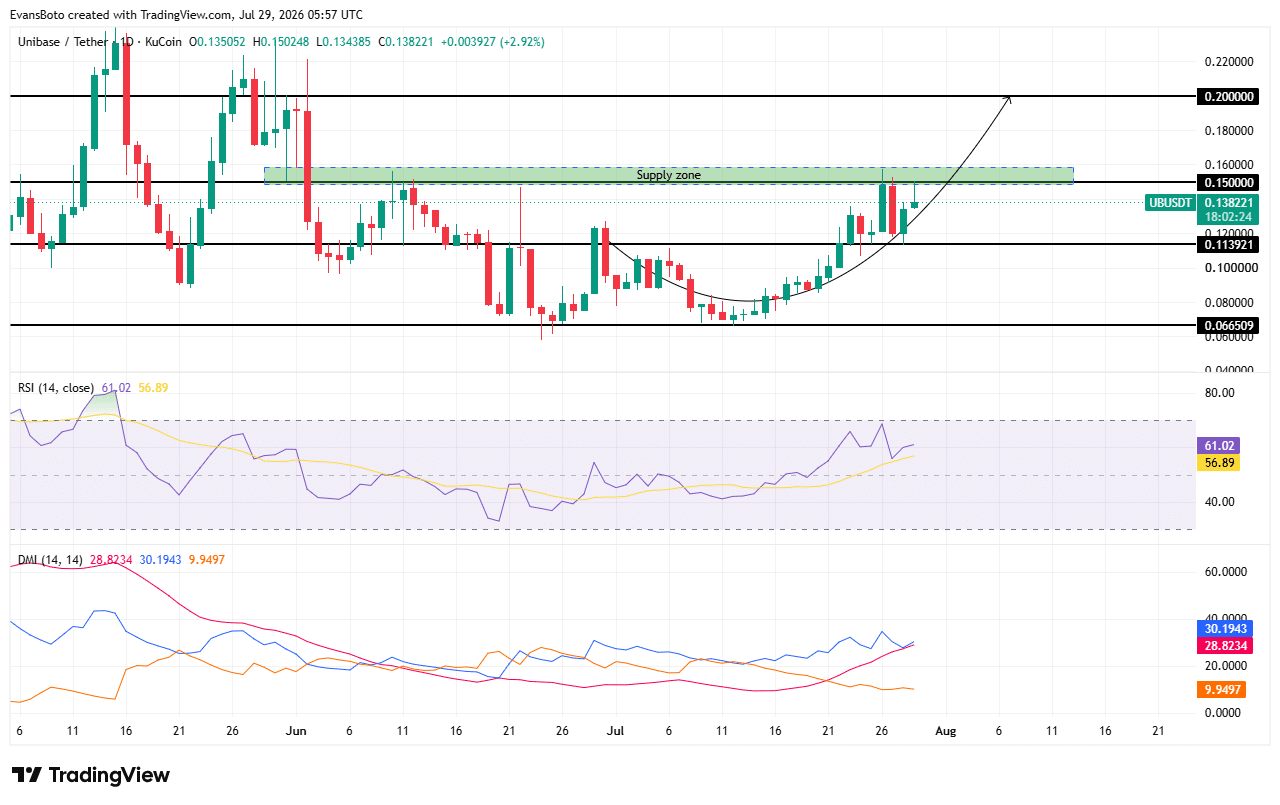
The rally also lifted 24-hour trading volume to $19.23 million, reflecting stronger market participation. Price recovered into a major supply zone near $0.15, an area that previously rejected several breakout attempts.
The latest advance revived speculation that Unibase could finally clear this ceiling if buying demand remained intact. However, the nearby resistance also increased the probability of profit-taking after the rapid appreciation.
Traders returned with fresh leveraged conviction
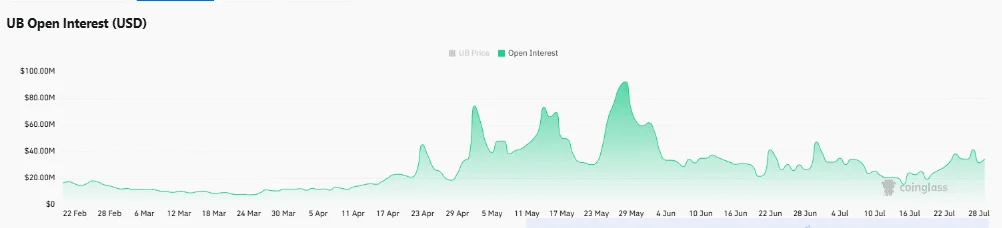
At press time, speculative participation strengthened as Open Interest (OI) climbed 25.91% to $37.66 million, matching the sharp appreciation in price.
The parallel increase in both metrics suggested that fresh capital entered the derivatives market instead of existing traders merely closing positions. This activity reflected growing confidence among leveraged participants who anticipated additional upside beyond the recent rally.
However, higher OI also raised liquidation risks because crowded positioning often amplified price swings. If buyers maintain control above current levels, those new positions could continue supporting the advance.
Meanwhile, any sharp rejection near resistance could expose leveraged traders to rapid unwinding, creating short-term volatility across the market.
Source: CoinGlass
Exchange flows continued favoring accumulation
Spot market activity painted a different picture despite the strong rally.
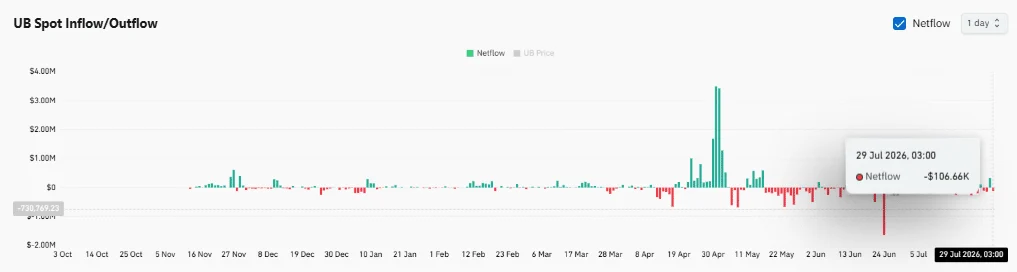
Netflows remained negative, with the latest reading showing approximately -$106.66K, indicating that more UB tokens left exchanges than entered them. The pattern suggested holders continued reducing immediately available exchange supply instead of preparing tokens for sale.
Although the latest outflow appeared relatively modest compared with earlier spikes, it still aligned with a broader accumulation narrative rather than aggressive distribution.
The declining exchange balances also complemented the recent price appreciation because reduced exchange supply often eased immediate selling pressure. However, sustained demand would still need to absorb profit-taking if the price revisited the heavy resistance overhead.
Source: CoinGlass
Can Unibase turn resistance into support?
Unibase returned to the $0.15 supply zone, a level that repeatedly rejected previous recovery attempts.
Unlike earlier rallies, buyers approached resistance after establishing a steady sequence of higher lows, reflecting stronger market conviction rather than a brief speculative spike. Price also held comfortably above the $0.114 support, allowing bulls to maintain control as the advance unfolded.
The RSI reached 61.02, indicating healthy buying strength without entering overbought territory, at the time of writing. Meanwhile, the Directional Movement Index reinforced the bullish structure, with +DI at 30.19 comfortably above -DI at 9.95.
Additionally, the ADX climbed to 28.82, signaling that the uptrend had strengthened and gained directional conviction. If buyers push through the $0.15 supply zone with sustained demand, UB could extend its advance toward $0.20.
Otherwise, another rejection would likely send the price back to retest $0.114 before any fresh breakout attempt.
Source: TradingView
Final Summary
Unibase approached major resistance as buyers strengthened while exchange supply remained limited.
Rising Open Interest reflected stronger trader participation, making the $0.15 level increasingly important.
The Ethereum Foundation (EF) has appointed longtime ecosystem contributor pcaversaccio (known as “pc”) to its board, expanding the group’s leadership as it continues to refine the governance of the organization behind the world’s second-largest blockchain.
pc, a security researcher and co-founder of the emergency response initiative SEAL 911, joins the board for an initial one-year voluntary term. He has also served on the EF’s Silviculture Society, an advisory group that provides informal guidance on preserving the foundation’s core principles, including censorship resistance, open source development, privacy and security.
The appointment brings the Ethereum Foundation’s board to four members: President Aya Miyaguchi, Ethereum co-founder Vitalik Buterin, Swiss legal counsel Patrick Storchenegger and pcaversaccio.
The board is responsible for setting the EF’s strategic vision and ensuring management’s decisions remain aligned with the organization’s values, accordinfg to the Foundation. It also serves as a “security council” tasked with safeguarding the foundation’s mission and ensuring compliance with the laws of Switzerland, where it is currently based.
The reaction to SK Hynix’s (SKHY) capex guidance on Wednesday only highlights the stunning summer rout in semiconductor stocks.
Shares of the South Korean chip play tanked as the company said it expects its capital expenditures to surge 50% this year to at least $31 billion. The company is attempting to meet the strong demand for its memory chips, which are playing a key role in the AI boom.
Quick insight: The SK Hynix rout will unlikely do anything to reawaken animal spirits in the chips space. All the stocks of the closely watched Philadelphia Semiconductor Index (^SOX) are now trading below their 50-day moving averages, the first such occurrence since April 2025, according to FactSet data.
The SOX has declined 18.9% so far in July, and is on track for its largest monthly loss since 2008.
“Chip stocks are becoming oversold,” strategists at The Kobeissi Letter wrote in a note.
AlphaSpace intel: One of 2026’s hottest stocks is going up in flames.
Sandisk (SNDK) shares plunged 17% on Tuesday and are now down 30% in five days. The stock has crashed about 55% from its record high in late June.
The stock looks to be on a collision course to test its 200-day moving average around $832, per Yahoo Finance AlphaSpace data. That would be a roughly 24% drop from current trading levels.
SanDisk bulls have been crushed. ·Yahoo Finance AlphaSpace
The bottom line: Semiconductor stocks are under intense pressure as investors have begun questioning whether the artificial intelligence spending boom has become overheated and have grown more concerned about rising competition from China.
Until these concerns quiet down a bit, it’s unlikely that beaten-up semi stocks will see meaningful buying. The declines are happening at a fierce pace, they are spreading, and sentiment has been crushed. Why step in front of this flaming train?