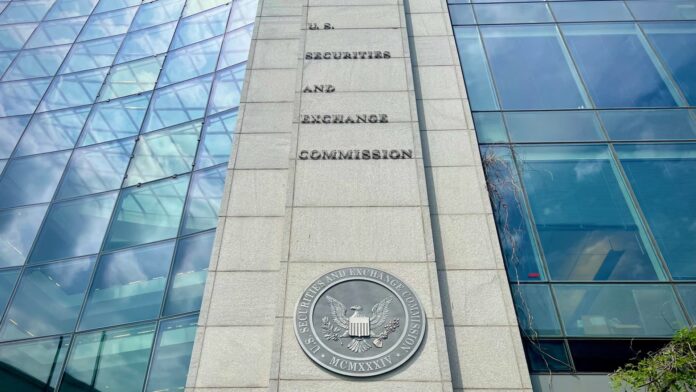
Wall Street isn’t waiting around! Despite the CLARITY Act being stalled until September, the bigger hands are moving ahead with their crypto ambitions.
Here’s the breakdown.
NASDAQ files for standardised crypto ETF listings
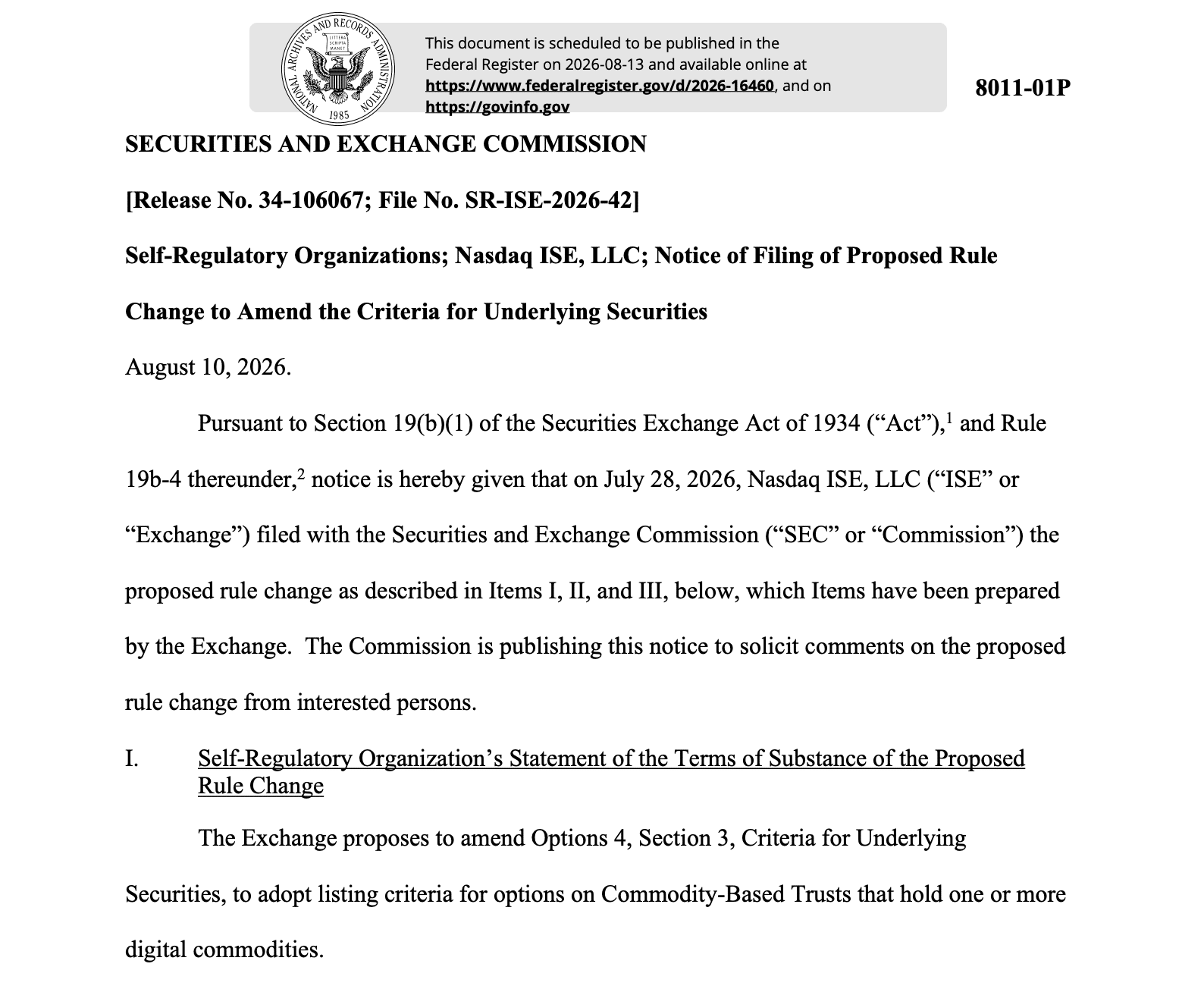
Nasdaq is asking the SEC to make it easier to launch options on crypto-backed ETFs. Under the proposed rule change, certain ETFs holding “digital commodities” could qualify for options listings based on a set of standard requirements. This would essentially negate the separate approval process each time.
Interestingly, this comes at a time of limbo for the industry, with the CLARITY Act being delayed at the Senate. AMBCrypto previously reported that the SEC also has plans for a “Regulation Crypto” agenda. This would be a framework for tailored rules around certain cryptocurrency investment contracts.
The plan will offer the industry much needed immediate clarity, as the act itself lies in wait.
While others sell, Blackrock stays
It’s also worth noting that institutional interest in Bitcoin is nowhere close to slowing down.
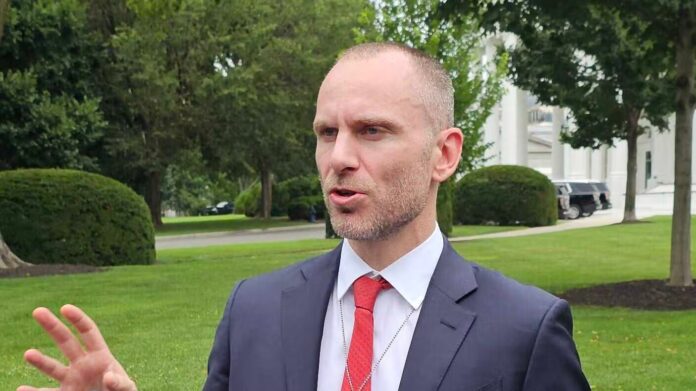
BlackRock’s Robert Mitchnick recently stated that BTC’s decoupling from equities is a healthy development. The argument is that its performance during July’s AI-led pullback means it is a great portfolio diversifier and potential hedge.
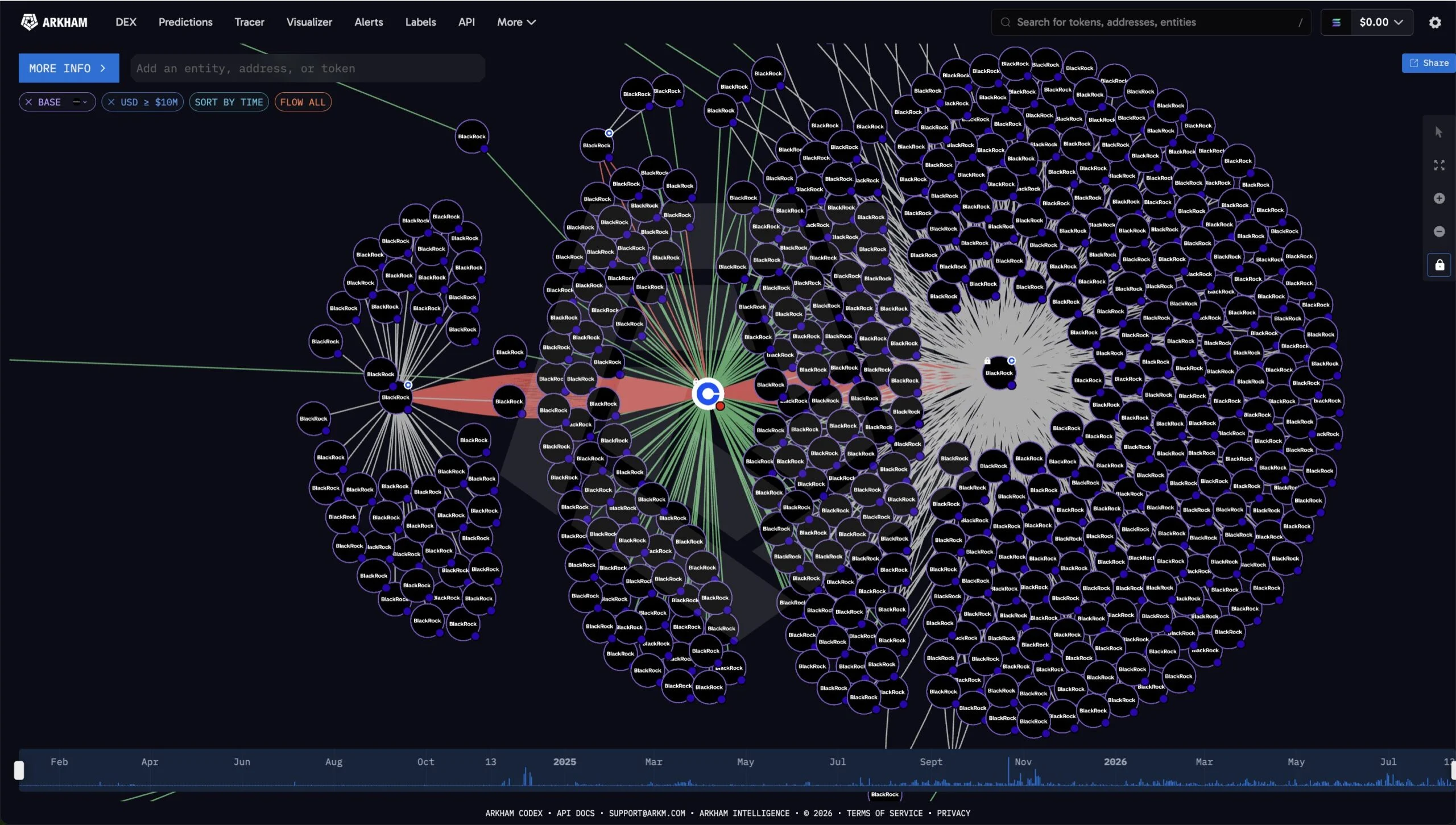
That view can also be evidenced by the ETF flows. Over the last 24 hours alone, BlackRock’s Bitcoin ETF saw enough buying from clients to outweigh the combined selling from several other major funds. Including those linked to Fidelity, ARK, and VanEck.
Source: Arkham Intelligence
This contrast is peculiar, but important. Even though regulation is on shaky ground, some of the biggest names in TradFi are still treating Bitcoin as an asset worth holding.
Final Summary
Nasdaq is pushing to streamline crypto ETF options as the CLARITY Act remains stalled.
Blackrock has continued to back BTC despite other funds selling.
The results of the Democratic primary delivered a blow to the progressive wing of the party, but also to Polymarket and Kalshi—popular prediction market platforms that had gained a near-infallible reputation after accurately forecasting the outcome of every state in the 2024 presidential election.
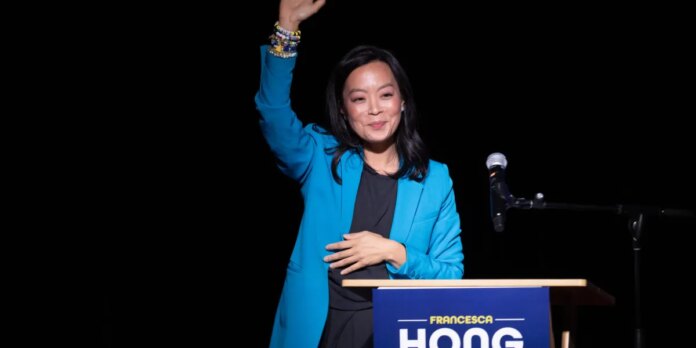
Polymarket and Kalshi event contracts on the outcome of the Wisconsin governor’s primary aligned with the sentiments of traditional polling firms, which had predicted an easy win for progressive candidate Francesca Hong. Both platforms gave Francesca Hong roughly a 95% chance of winning, but when the votes were counted, her rival, David Crowley, prevailed by less than half a percentage point.
The surprise loss led Polymarket to delete one of its more boastful posts on X, which said Hong had a 96% chance of winning the primary, despite Hong’s lack of endorsements from prominent Democratic socialists such as Bernie Sanders and Alexandria Ocasio-Cortez.
In response to criticism of the market’s accuracy, Kalshi’s founders argued that the outcome did not, on its own, invalidate the forecast. In a social media post, Kalshi CEO Tarek Mansour said the 95% probability assigned to Hong still implied that the underdog had roughly a one-in-20 chance of winning—a low-probability outcome, but one the market had explicitly allowed for. “5% is not 0%,” wrote Kalshi founder Luana Lopes Lara.
The misstep comes as prediction markets are increasingly seen as a complement to traditional polls and surveys for forecasting elections and other real-world events. Their credibility surged in the final stretch of the 2024 presidential campaign and in the aftermath of Election Day, when Polymarket and Kalshi were widely credited with giving Donald Trump an edge in a race that many conventional polls portrayed as a tossup. Their influence has since extended to mainstream media, with CNN naming Kalshi its official prediction-markets partner and Dow Jones planning to incorporate Polymarket data across The Wall Street Journal, Barron’s and MarketWatch.
Yet Crowley’s victory this week was not the first time prediction markets had mispriced an election, though the probabilities in those cases left more room for an upset. In June, Kalshi and Polymarket gave reality-TV personality Spencer Pratt about a 75% chance of advancing from Los Angeles’s nonpartisan mayoral primary to the general election. He instead finished third. The month before, Kalshi gave Rep. Thomas Massie a similar chance of winning the Republican primary in Kentucky’s 4th Congressional District. Massie lost to Trump-backed challenger Ed Gallrein.
For some, however, this week’s result was a reminder that prediction markets are not foolproof substitutes for polls. They are forecasting tools, not crystal balls. Statistician and political forecaster Nate Silver made that point in a recent social media post. “I think prediction markets are cool. But people should stop treating them as magic, and I don’t think they’re a good substitute for polls, or belong in models,” he said.
On August 6, Carlisle Companies Incorporated (NYSE:CSL) announced that its Board of Directors approved a 14% increase in its regular quarterly dividend. The dividend will rise from $1.10 to $1.25 per share, which works out to $5.00 annually.
The increase also makes Carlisle a “Dividend King.” This group includes US publicly traded companies that have increased their annual dividends for at least 50 consecutive years. Fewer than 60 listed companies currently have that record, so Carlisle is now part of a fairly exclusive group of dividend-paying companies.
Carlisle Companies Incorporated (CSL)’s New Dividend King Status Comes With Higher Expectations
Bull Case: Strong Results Give Carlisle Room to Raise Its Dividend
The latest dividend increase comes at a time when Carlisle Companies Incorporated (NYSE:CSL)’s business is performing well. That makes the increase more meaningful than simply raising the payout to keep its 50-year streak alive.
Carlisle reported record revenue of $1.6 billion in the second quarter, an 8% increase from the same period last year. Adjusted diluted EPS rose 12% to $7.03. Management also raised its full-year 2026 revenue outlook to mid-single-digit growth.
Cash generation gives the company another reason to remain confident about its dividend. In the first six months of 2026, Carlisle generated $199.6 million in operating cash flow from continuing operations and $129.6 million in free cash flow. It also returned $590 million to shareholders through dividends and share repurchases.
The dividend has grown at a double-digit compound annual rate since 2022. That growth has been supported by pricing power in Carlisle’s construction-materials businesses, tighter cost controls and changes to the company’s portfolio under its Vision 2030 strategy.
Bear Case: Falling Free Cash Flow Is Worth Watching
The biggest concern is the decline in free cash flow. Carlisle Companies Incorporated (NYSE:CSL) generated $129.6 million in free cash flow from continuing operations during the first half of 2026, compared with $227.6 million a year earlier. That decline stands out because revenue and earnings both increased during the period.
Carlisle also spent $70 million on capital expenditures and returned $590 million to shareholders through dividends and share repurchases. With the company investing heavily across several areas, there is less room for free cash flow to support every use of capital at the same pace. The company has to balance dividends and buybacks with organic investments, acquisitions, and its Vision 2030 plans. If construction markets slow down, maintaining dividend increases in the double-digit range could become more difficult.
The Dividend King status adds another layer of pressure. Investors who see a 50-year dividend growth record may expect Carlisle to keep raising the payout every year. During a prolonged downturn, though, management could decide that protecting the balance sheet and investing in the business are more important than keeping dividend growth at its recent pace.
Comparative Valuation & Peer Context
Carlisle Companies Incorporated (NYSE:CSL) is trading at a forward multiple of 19.23x, while A. O. Smith Corporation (NYSE:AOS), a leading global water technology and manufacturing company, trades at around 15.9x to 16.5x. The gap reflects Carlisle’s transformation into a higher-margin, pure-play building products company and its new Dividend King status. AOS continues to face near-term cyclical pressure in residential and commercial water heating demand, which has weighed on its valuation.
Conclusion
Carlisle Companies Incorporated (NYSE:CSL)’s 50th consecutive dividend increase is a good sign for income investors. The 14% increase comes with record second-quarter revenue, higher earnings and a better 2026 revenue outlook, giving the company a solid base for continued dividend growth.
The bigger issue is the pace of future increases. The current $1.25 quarterly dividend looks well supported, but free cash flow has fallen from a year ago while Carlisle continues to spend on capital projects, acquisitions, buybacks and dividends.
Another 14% increase next year is possible, but it should not be taken for granted. Going forward, dividend growth will likely depend on how well earnings and free cash flow hold up, especially if conditions in the construction market become less favorable.
While we acknowledge the potential of CSL as an investment, we believe certain AI stocks offer greater upside potential and carry less downside risk. If you’re looking for an extremely undervalued AI stock that also stands to benefit significantly from Trump-era tariffs and the onshoring trend, see our free report on thebest short-term AI stock.
The audit is a step up from the quarterly attestations Tether has published for years after settling an investigation with the New York Attorney General’s office. An attestation checks specific information, such as the amount and composition of reserves at a given date. A financial audit takes a broader look at a company’s books, testing transactions, assets, liabilities, income, cash flows and the evidence supporting them.
Tether said in March that it had hired a “Big Four” accounting firm to conduct its first full audit. KPMG is one of the Big Four, the group of accounting giants that also includes Deloitte, EY and PwC and audits many of the world’s largest companies.
KPMG examined Tether’s transactions, systems, valuations, counterparties and ownership records, according to the company. Auditors also physically counted and inspected its gold bars.
Tether has repeatedly promised a full audit while relying on reserve attestations, leaving critics asking why a company of its size hadn’t undergone the same level of scrutiny common among large financial firms.
Concerns about the stability and backing of its USDT token, a key piece of infrastructure for crypto trading and markets, have surfaced from time to time as a potential systemic risk for digital assets. The recurring debate became so familiar in crypto circles that it earned its own shorthand as “Tether FUD.”
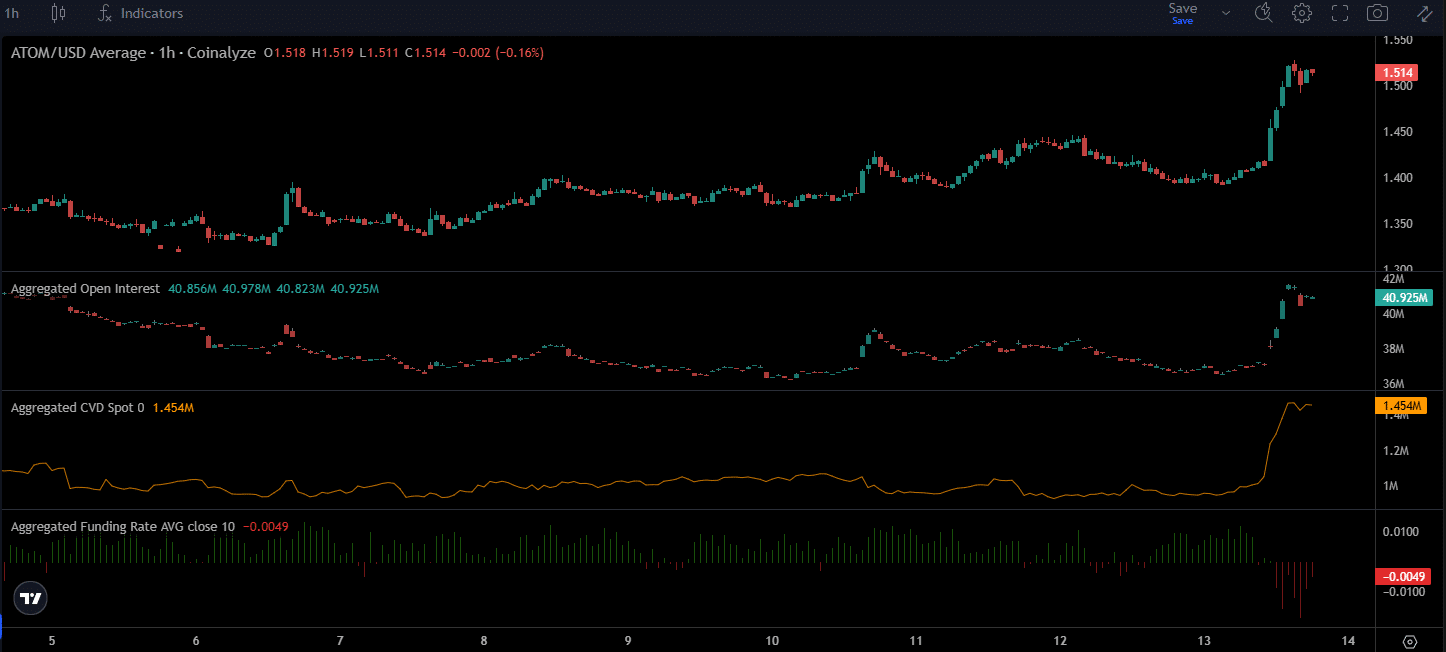
Cosmos [ATOM] has rallied 8.3% over the past 24 hours, with a 91.9% surge in daily trading volume. The uptick in volume was accompanied by speculative interest, too, but there could be a warning sign in the short-term.
Source: Coinalyze
The Open Interest has climbed 11.3% in the past 24 hours. This signaled heavy speculative activity, and the spot demand was also high, as demonstrated by the uptick in trading volume as well as the spot CVD spike in recent hours.
However, the negative funding rate was a sobering thought for the bulls. The market was betting on a price reversal, and short positions were willing to pay a fee to keep their positions open.
Here’s what the price action has to say about the upcoming ATOM trends.
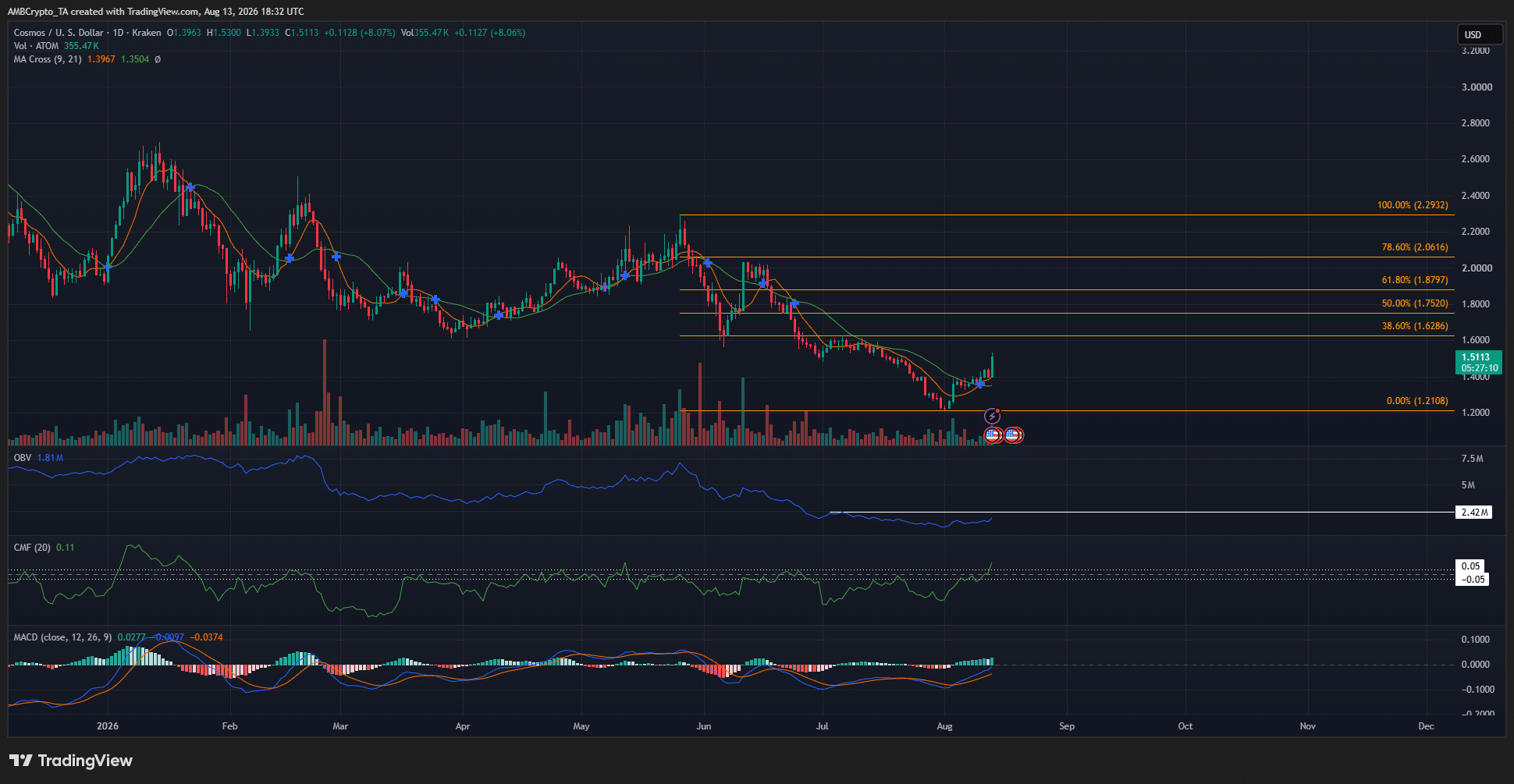
Bullish moving average crossover foretells bullish ATOM momentum
Source: ATOM/USDT on TradingView
The swing move down from $2.29 to $1.21 began in late May. The structure was clearly bearish, but it does not rule out a short-term bounce.
At the time of writing, the moving averages formed a bullish crossover, and the Cosmos crypto price has also climbed above the averages.
The MACD was also climbing toward the zero line, showing weakening bearish momentum and a potential recovery higher.
While the MACD was unable to climb toward the early July highs, the CMF managed to break out past the +0.05 mark to signal strong capital inflows.
Despite the mixed signals on the daily timeframe, there was one warning sign to watch out for.
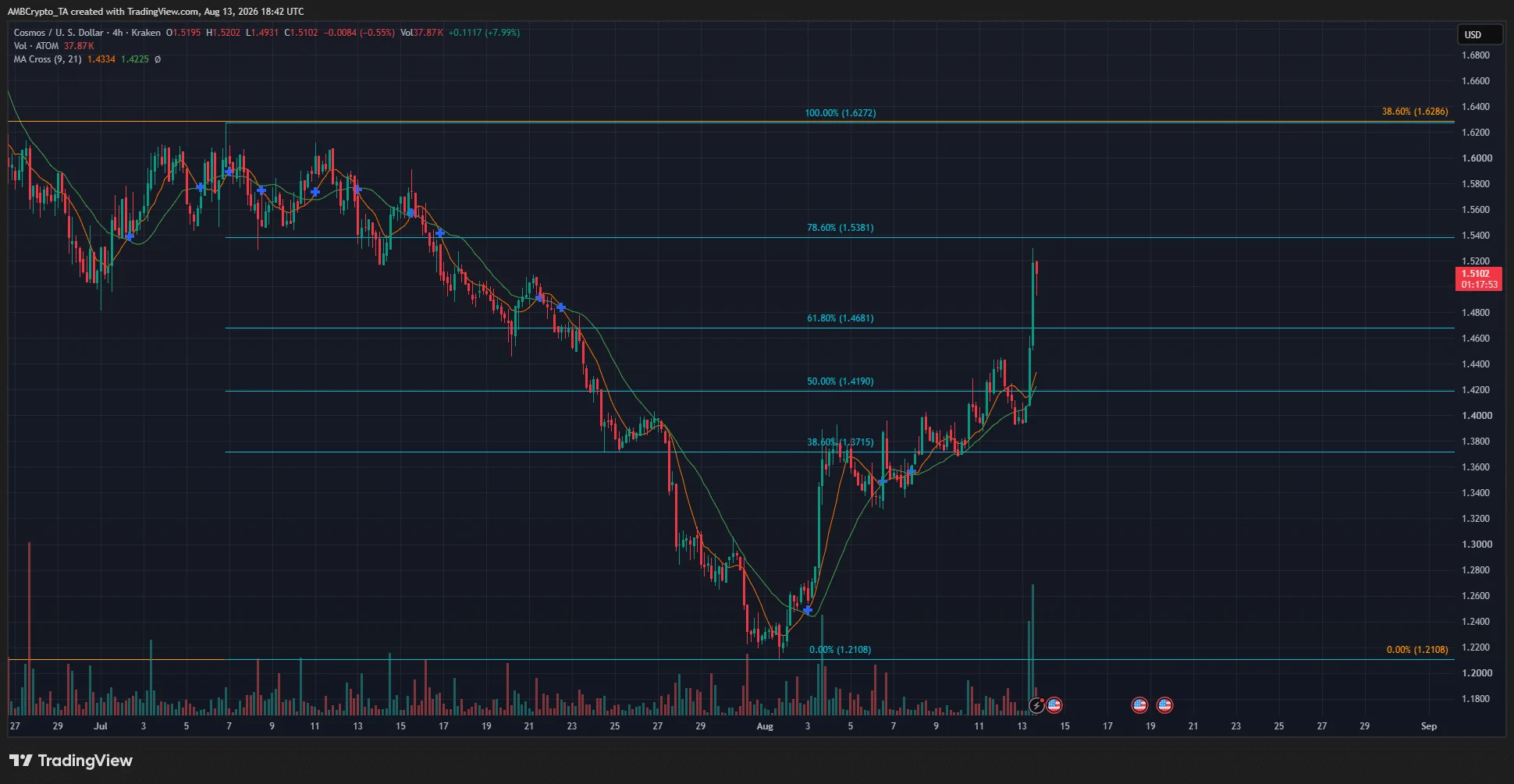
Traders’ call to action- Beware of a liquidity sweep
Source: ATOM/USDT on TradingView
The 4-hour chart’s structure was also bearish. The Fibonacci retracement levels showed that the Cosmos crypto token was trading within the golden pocket between $1.46 and $1.53.
A rejection from the $1.50 resistance zone is expected, based on this structure.
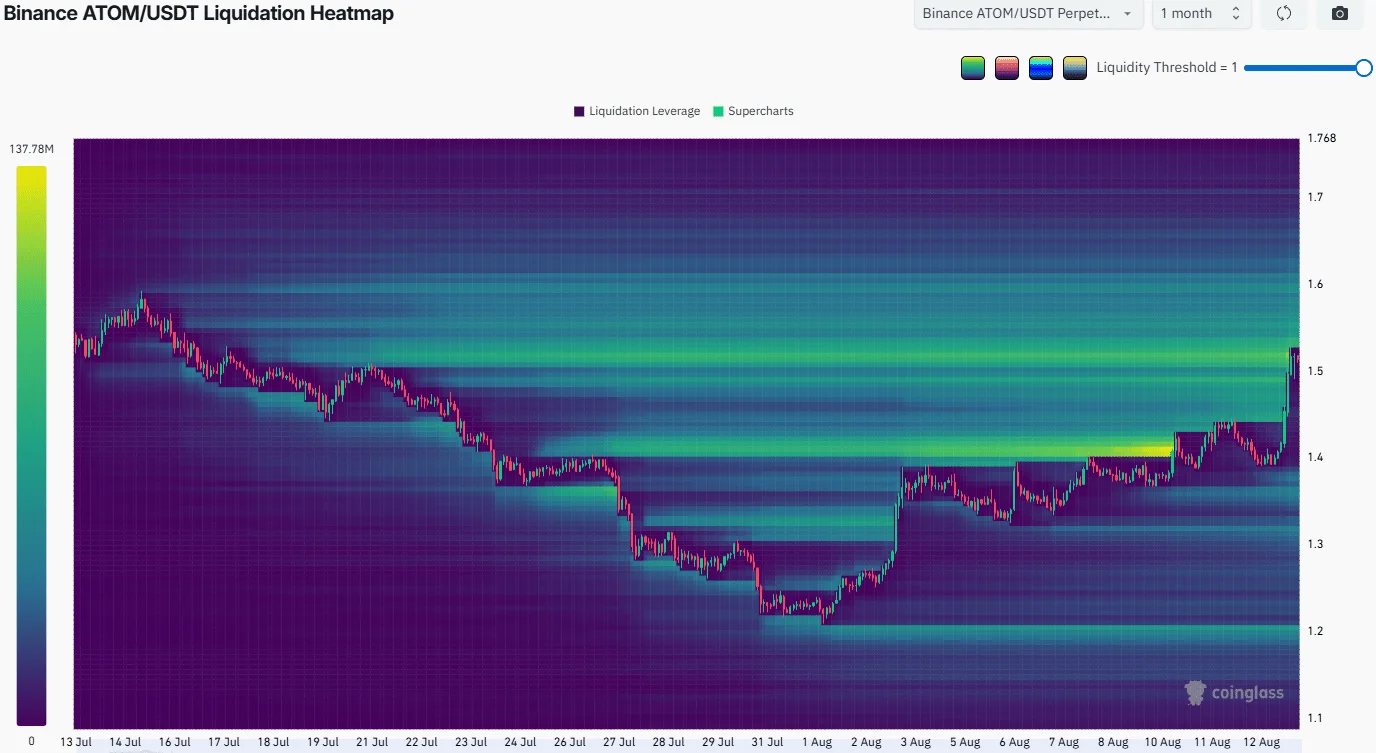
Source: CoinGlass
The 1-month liquidation heatmap also highlighted the cluster of short liquidations around the $1.50 area. The recent rally higher has swept this magnetic zone.
Based on the evidence at hand, a bearish trend continuation appeared likely. Sustained buying pressure and a rally past the $1.62 level is needed to signal a potential rally toward the psychological $2 resistance.
Final Summary
The Cosmos crypto token has rallied by just over 8% in 24 hours, with a 91.3% daily trading volume spike and an 11% Open Interest surge.
While the short-term momentum appeared bullish, ATOM would likely struggle to clear the $1.50 supply zone.
Hyperliquid (CRYPTO: $HYPE) is exploring a path into the U.S. perpetual futures market as its policy group presses federal regulators for rules that could bring onchain derivatives under a regulated domestic framework.
With a Senate vote on the CLARITY Act delayed, the decentralized exchange is looking for a route through existing regulatory authority rather than waiting for broader crypto legislation. Hyperliquid does not currently offer its trading platform to U.S. users.
Hyperliquid Policy Center CEO Jake Chervinsky said the goal is for regulators to interpret existing rules favourably or create new ones that would allow regulated firms to offer perpetual futures using markets built on Hyperliquid.
More From Cryptoprowl:
The effort has already reached the Commodity Futures Trading Commission. In July, the Hyperliquid Policy Center and Phantom asked the agency to clarify that developers of onchain software should not automatically face exchange or clearinghouse registration requirements. They also urged regulators to let registered firms use blockchain infrastructure for execution, margining, clearing and settlement.
The groups argued that self-custodial markets do not fit neatly into rules written for traditional intermediaries because users retain control of their own funds. Their filing said the current framework leaves “American users” walled off from onchain derivatives while development continues offshore.
That distinction becomes more complicated as Hyperliquid moves beyond crypto-native contracts. About 32% of the platform’s second-quarter trading volume was linked to stocks and other real-world assets, potentially placing parts of the business across both CFTC and Securities and Exchange Commission jurisdiction.
Real-world asset markets have already become a larger part of Hyperliquid’s trading mix, with contracts tied to stocks and other traditional assets expanding alongside its core crypto derivatives business.
A regulated U.S. route would bring Hyperliquid closer to traditional derivatives infrastructure while preserving the self-custody model behind its onchain markets.
Hyperliquid (CRYPTO: HYPE) is currently trading at $55.80 U.S. per digital token.
The U.S. Securities and Exchange Commission was on the verge of revealing its first major rulemaking effort in the digital assets sphere, having been set to propose its “Regulation Crypto,” but the agency cancelled the Friday meeting in an end-of-day statement on Thursday.
“Due to an unforeseen scheduling issue,” the SEC is moving the meeting to “a later date,” according to a statement from an agency spokesperson.
In the absence of progress in the Senate’s Digital Asset Market Clarity Act, the legislation that would establish a legal foundation for crypto market activity in the U.S., the industry had looked to the SEC to pick up the baton. The so-called Reg Crypto is expected to open a limited framework for issuing crypto securities without triggering agency registration requirements, and also to be able to later transition out of management of the project and, as a result, out of the SEC’s regulatory radar.
The sector will instead have to sit back again and see which branch of the government delivers first: SEC or Congress.