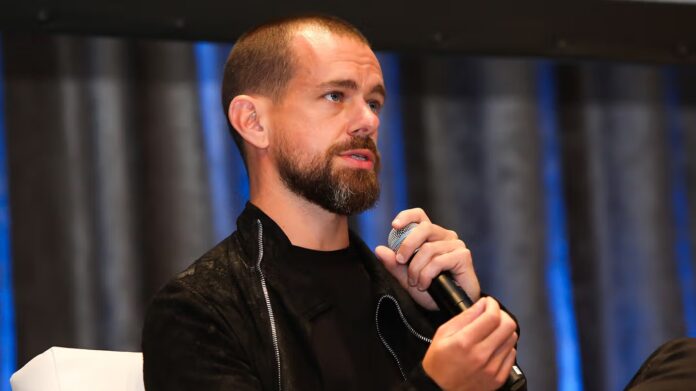
India’s top cybercrime watchdog has ordered GitHub to take down Bitchat, the offline messaging app built by Block chief executive and bitcoin advocate Jack Dorsey, as anti-government protesters in Delhi adopt mesh-networking tools to communicate through repeated internet shutdowns.
The Indian Cyber Crime Coordination Centre, part of the Home Ministry, issued the order late Thursday under Section 79(3)(b) of the IT Act, naming three GitHub repositories tied to Bitchat and giving the platform three hours to disable access.
The notice, reviewed by CoinDesk, says the app enables anonymous communication without registration, phone numbers or centralized logging, and that its architecture “significantly impedes lawful interception, attribution, and investigation by law enforcement agencies.”
Bitchat is a decentralized messaging app that relays encrypted messages between phones over Bluetooth mesh networks, requiring no internet, servers or accounts. Dorsey released it as open-source software in July 2025.
Bitchat is built to relay bitcoin transactions offline, passing them phone to phone through the mesh until a device with connectivity broadcasts them to the network, a design meant to keep payments alive during blackouts, disasters or state-imposed shutdowns.
For Canopy Growth (NASDAQ: CGC), as with most cannabis stocks, the next key catalyst has nothing to do with the industry or the economy. Instead, what will likely cause marijuana stocks to surge or sink from here has to do with an upcoming decision from the U.S. Drug Enforcement Administration (DEA).
This decision wouldn’t resolve all of Canopy’s regulatory headwinds, but since it could spark another round of bullishness, let’s dive into the latest.
Missed Nvidia in 2009? This Rare Signal Is Flashing Again. In 2009, a “Double Down” signal flashed for a little-known chipmaker called Nvidia. For the first time in years, that same “Total Conviction” signal is flashing for a company 1/100th the size of Nvidia. Continue »
Image source: Getty Images.
The DEA, Schedule III, and what it could mean for Canopy Growth
The DEA’s efforts to reschedule marijuana to Schedule III have been months in the making, with hearings on the matter only taking place recently. Legal experts seem confident that these hearings will lead to a decision that bodes well for the cannabis industry, but it’s unclear whether a final decision will finally arrive.
Still, given President Donald Trump’s executive order issued last December, which called for reclassification to occur “in the most expeditious manner possible,” a final decision could arrive far sooner. While it’s not a solution for all regulatory hurdles, it would signal that Canopy is moving closer toward consolidating its U.S. affiliate, Canopy USA, into the parent company. Canopy USA itself would benefit by being no longer subject to the deduction limitations imposed by section 280E of the Internal Revenue Code.
Buy now, or watch and wait?
So, is it time to buy Canopy ahead of the Rescheduling decision, or to watch and wait? Based on past price performance, I would go with the latter. Remember that in April, following the last bit of DEA-related legalization news, Canopy and peers surged briefly, then sank back down.
The same thing could repeat itself if the U.S. Federal Government moves ahead with a broad rescheduling of cannabis. Investors could bid shares up on the headlines at first, then retreat upon reading the details. As the best approach entails holding cannabis stocks as a long-term wager on legalization, not a short-term binary bet, waiting for the next round of regulatory progress to take shape remains your best move.
Should you buy stock in Canopy Growth right now?
Before you buy stock in Canopy Growth, consider this:
The Motley Fool Stock Advisor analyst team just identified what they believe are the 10 best stocks for investors to buy now… and Canopy Growth wasn’t one of them. The 10 stocks that made the cut could produce monster returns in the coming years.
Consider when Netflix made this list on December 17, 2004… if you invested $1,000 at the time of our recommendation, you’d have $377,990!* Or when Nvidia made this list on April 15, 2005… if you invested $1,000 at the time of our recommendation, you’d have $1,269,518!*
Now, it’s worth noting Stock Advisor’s total average return is 896% — a market-crushing outperformance compared to 206% for the S&P 500. Don’t miss the latest top 10 list, available with Stock Advisor, and join an investing community built by individual investors for individual investors.
Thomas Niel has no position in any of the stocks mentioned. The Motley Fool has no position in any of the stocks mentioned. The Motley Fool has a disclosure policy.
Just another normal day in crypto, and the exploit season never ends.
Triple-A, a payment protocol that enables businesses to pay and get paid globally, has become a victim of yet another cryptocurrency hack. The exploit resulted in a loss of more than $9.70 million on multiple chains.
This exploit comes two days after the crypto space saw $35 million vanish in three separate exploits in a single day. Are hackers outwitting the existing blockchain ecosystem?
Triple-A loses $9.7M in crypto to a hack
As per PeckShieldAlert, Triple-A wallets lost more than $9.7 million after hackers drained tokens across 4 chains and the amount could be more. These chains exploited in the Triple-A hack included TRON [TRX],Ethereum [ETH], Polygon [POL], and Arbitrum [ARB].
Notably, the bridge on the Arbitrum chain continues to be involved in most of these hacks.
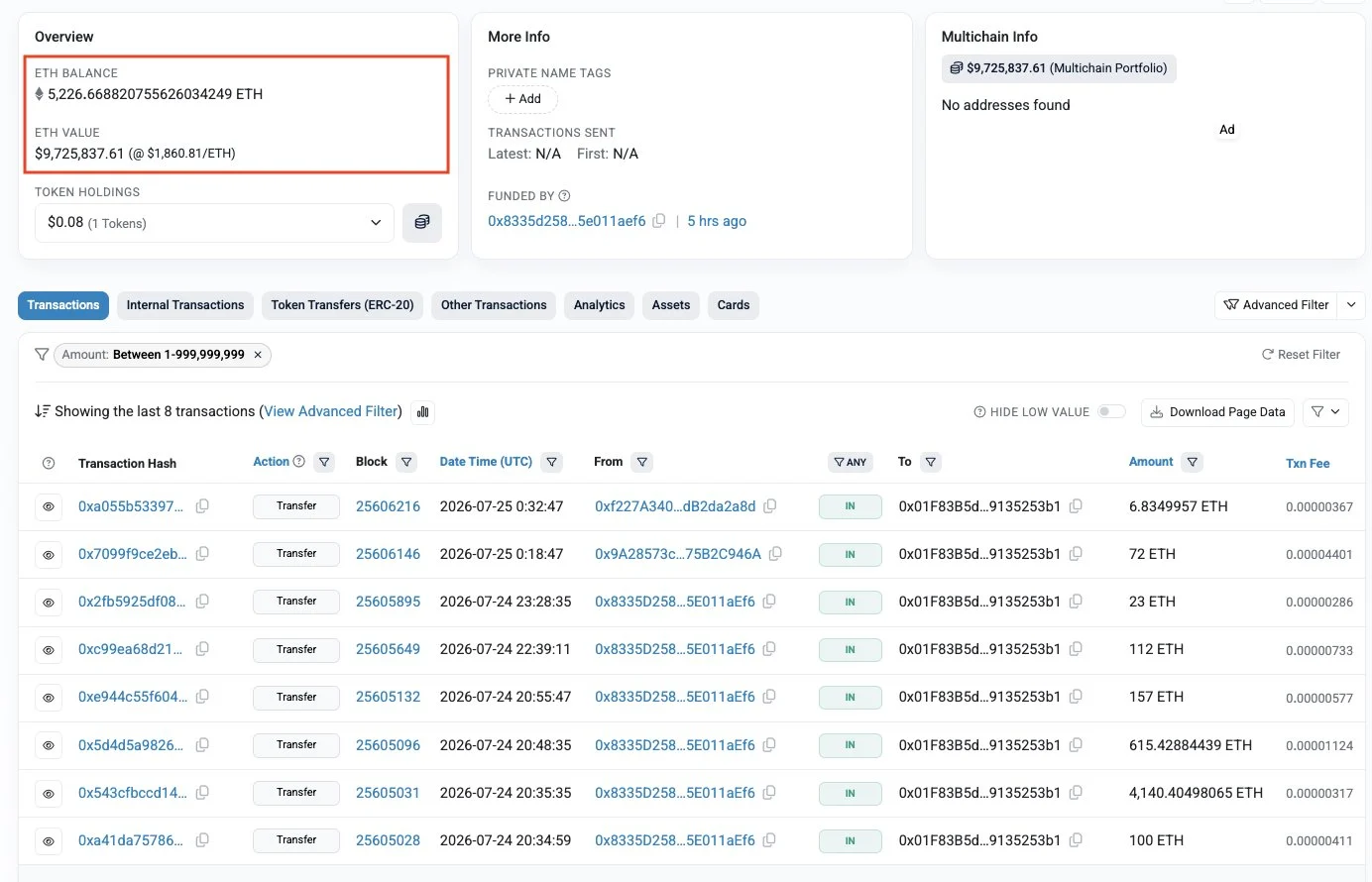
The exploiter bridged the stolen funds to Ethereum, as in almost every other hack. Currently, the funds have been consolidated in an address containing 5,227 ETH, equivalent to $9.696 million.
Source: PeckShieldAlert
What is worrying is the fact that Triple-A is yet to acknowledge the attack. Deposits are still live, and new funds continue to be drained, a classic hot wallet custody failure.
Users have criticized the silence of the Triple-A team, which is acting like it is not happening. However, some users suggest that it could be a developer rather than a hacker.
Crypto hacks skyrocket in July
The hack is an indication that hackers could be outwitting the existing blockchain infrastructure. Some recovery attempts have been successful, but most of the hacks have left institutions counting losses.
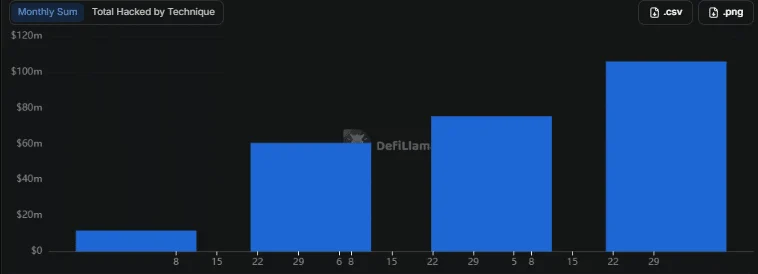
Two days ago, there were three crypto attacks on BSquared Network, AFX Trade, and the Verus-Ethereum bridge. The new hack takes the total hacked capital to $41.83 million this week, as per DefiLlama.
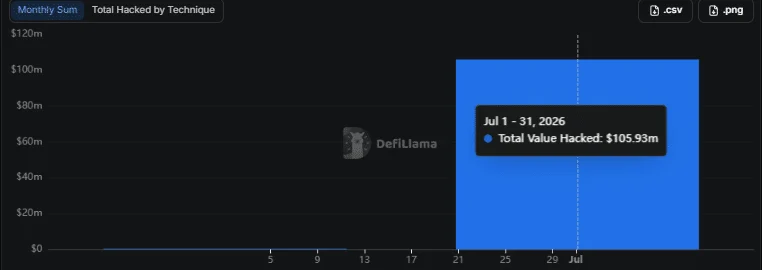
By extension, crypto has lost about $106 million to hacks this month of July, with still 6 days to go. Bonzo Lend leads in the largest funds lost this week, at about $10.05 million.
Source: DeFiLlama
In the past 90 days, $264 million has been extracted from crypto through exploits. On average, that is $2.90 million per day across 94 exploits. The pace appears to be increasing with each new generation of more capable AI models.
Source: DeFiLlama
These hacks reinforce the sentiment that DeFi could be bracing for another FUD cycle similar to the one seen in Q1 and Q2.
Final Summary
Triple-A lost $9.70 million to an exploit that affected the TRON, Ethereum, Polygon, and Arbitrum chains.
The exploiter bridges funds to Ethereum as the weekly total value hacked reaches $41.83 million.
Close-up of a person’s hand holding an iPhone and using Google AI Mode, an experimental mode utilizing artificial intelligence and large language models to process Google search queries, Lafayette, California, March 24, 2025. (Photo by Smith Collection/Gado/Getty Images)
Gado via Getty Images
Apple’s Siri AI isn’t very smart. That’s why future iPhones will pair Siri with Google’s highly regarded Gemini AI.
Seemingly what you’ve just read has been glossed over by the European Union (EU). As news accounts the last few days indicate, the EU has fined Google $1 billion for “unfairly” favoring “its own services on its widely used search engine.”
Except that Google’s “widely used search engine” is widely used for many reasons, including that Google’s services are unrivaled. In other words, Google could deemphasize its services only if it wanted to drive users away from its own “widely used search engine.”
This is worth remembering with a deeper look into the EU’s fine top of mind. It’s not so much about Google as it’s about third-party entities that want their products and services more heavily emphasized on Google’s “widely used search engine.”
Ok, but the third parties can’t have it both ways. Neither can EU regulators.
What makes favoring on Google’s “widely used search engine” so desirable for entities outside Google is how popular Google is among individuals the world over. Which means that Google, to remain Google, must continue to not just meet, but lead the needs of users who have myriad choices. This includes prominently featuring its unrivaled products. About this, Apple instructs.
Popular as the iPhone is, Apple has never hidden from Siri’s limitations. It similarly hasn’t hidden from the fact that at least at present, it doesn’t have a ChatGPT, Copilot, Gemini, Grok, or Meta AI equivalent. Has the latter signaled Apple’s decline? Far from it.
As was argued here in March, and surely without knowing what’s ahead in AI or anything else (how many inside and outside technology predicted the before and after of November 30, 2022?), Apple has positioned itself brilliantly for the potential commoditization of AI. Rather than spend copious sums developing it, Apple opened its iPhones and other devices up to the genius of others. This once again includes Google and its Gemini AI.
Fully cognizant that the utility of its products is quite a bit greater when paired with technological advances achieved outside its own Cupertino walls, Apple is actively opening its “widely used” devices to non-Apple technology. Which is something EU regulators plainly glossed over in foisting the $1 billion fine on Google.
Really, what is Google supposed to do? Do EU regulators seriously expect it to favor the technology of others on its widely used search engine, particularly if what’s produced by others doesn’t measure up to what’s been developed inside Google? EU regulators aren’t just demanding that Google choose a path of self-harm that is anti-consumer, they’re also demanding that it harm itself in such a way that will imperil the commercial development of the very third parties intent on utilizing Google’s popularity as their own growth strategy.
Which requires a look at the accusatory core of the EU’s case and its $1 billion fine of Google. Implied in the latter is that in favoring its own services over those of outside providers, Google has been restraining the development and growth of outside providers. Nothing could be further from the truth. See Apple again.
As evidenced by Apple’s incorporation of Google’s Gemini into its Siri product, no business can remain great by providing a subpar product. Google’s Gemini will immediately make Apple’s products a great deal more appealing in the marketplace, and so will Google’s suite of products and services be much more appealing the better they are, and regardless of where the improvements come from. Fines aren’t the answer to the EU’s laments, but better third parties are.
Democratizing weather derivatives with tokenization
This is where tokenization enters, and where I think the crypto industry has a genuinely important role to play in democratizing weather risk hedging. It’s an initiative that I think is significantly more important than simply offering traditional yield-generating assets like bonds onchain.
The core advantages of putting weather derivatives on a blockchain are not theoretical. Smart contracts can automatically trigger payouts when verified weather data crosses a predetermined threshold, while bypassing manual processing, disputes, delays, and counterparty risk. With tokenized weather derivatives, a farmer in a rain-dependent economy no longer needs a Goldman Sachs relationship to hedge against a failed monsoon. A parametric insurance product built on a smart contract that reads verified rainfall data and pays out automatically is, in principle, exactly the kind of market that properly prices and distributes climate risk.
In Value(s), Carney puts it well: “We need financial markets to work alongside climate policies in order to maximize their impact. With the right foundations, the financial system can build a virtuous circle of better understanding of tomorrow’s risks, better pricing for investors, better decisions by policymakers and a smoother transition to a lower-carbon economy.”
Tokenization also addresses the liquidity and accessibility problems that have stunted the traditional market. Fractional ownership allows weather risk to be divided into smaller units.and the resulting composability facilitates integration of weather derivatives with lending protocols, insurance products and yield-generating instruments. Transparency on every trade, every position, every settlement recorded on a public blockchain addresses the opacity that has historically made price discovery poor and participation limited.
On July 29th, the Federal Reserve will hold its seventh meeting of the year, the second since new chair Kevin Warsh took over from Jerome Powell.
Throughout 2026, the Fed has kept the federal funds rate in the 3.50% to 3.75% range, trying to strike a careful balance between controlling inflation and avoiding a more significant economic slowdown.
Missed Nvidia in 2009? This Rare Signal Is Flashing Again. In 2009, a “Double Down” signal flashed for a little-known chipmaker called Nvidia. For the first time in years, that same “Total Conviction” signal is flashing for a company 1/100th the size of Nvidia. Continue »
Image source: Official White House Photo by Daniel Torok.
The July meeting, however, is going to be complicated by a couple of factors:
Warsh said in recent comments before Congress that he has “no tolerance” for high inflation and vowed to make it “a thing of the past.” That suggests a firmly hawkish stance that could lead to rate hikes at some point in 2026.
Even though the Fed members voted unanimously to hold rates steady at the June meeting, the Fed dot plot shows a clear split over where policy should head next. Half saw a rate hike by year-end, while half saw no hike. Even in 2027, roughly half of members see higher rates and half see lower rates.
For the first time in a while, there’s genuine uncertainty about what will happen to interest rates. Given that Warsh himself didn’t offer his own projection and has generally advocated for less future-looking transparency, it doesn’t appear this situation will resolve itself soon.
July 29th could yield clues on the future path of rates, or it could offer nothing at all. That’s why this meeting is particularly critical for the markets.
Missed Nvidia in 2009? This Rare Signal Is Flashing Again
In 2009, a “Double Down” signal flashed for a little-known chipmaker called Nvidia. If you’d invested $5,000 then, you’d be sitting on $2,710,632 today.*
Now, for the first time in years, that same “Total Conviction” signal is flashing for a company 1/100th the size of Nvidia. It’s a key player in the $1.8 trillion space race, and with the stock recently sitting 20% off its highs, the window to get in early is closing fast.
Total value locked has roughly tripled since mid-July to about $312 million, according to DefiLlama, and Robinhood Chain is now clearing more than $600 million in daily decentralized-exchange volume, putting it among the more active networks in crypto.
Robinhood Chain’s locked value has more than doubled since mid-July. (Shaurya Malwa/CoinDesk)
Its transaction count has also drawn attention, with more than 138 million in 30 days, per Token Terminal. But the chain’s most-traded tokens are still overwhelmingly memecoins.
On DEX Screener, the top of Robinhood Chain’s trending list is filled with tokens like “Hoodrat,” “Vladhood” and “Swole Doge,” not the tokenized equities the network was built for, which trade on Uniswap but rank well down the volume rankings.
Volumes of Robinhood Chain tokens across DEXs. (DEXScreener)
The tokenized stocks generate roughly $55 million in daily volume, under a tenth of the chain’s nearly $600 million in total DEX trading, the data shows. The rest is dominated by memecoins.
Stablecoins remain the single largest presence on the chain, with a combined market value in the hundreds of millions of dollars, and memecoins, such as the Robinhood mascot-themed CASHCAT, that defined the chain’s first weeks, are still active and heavily traded.
The critique three weeks ago was that Robinhood had built expensive infrastructure and attracted only speculation, with little sign that the tokenized-stock business it pitched would materialize.