Home Blog Page 204

Live updates: Bitcoin under $66,000 as traders await Alphabet earnings to gauge AI trade

0
Live updates: Bitcoin under $66,000 as traders await Alphabet earnings to gauge AI trade

Bitcoin traded near $65,900 on Wednesday, holding just below the two-week high it touched earlier, up 1.5% on the week, per CoinDesk data.

The pause matches the broader market, where a two-day rebound in chip stocks stalled as traders waited on Alphabet’s results after the U.S. close.

Nasdaq 100 futures fell 0.8% and South Korea’s Kospi trimmed strong early gains, with tech lagging in Europe too.

The trigger is Alphabet, which said last quarter it would more than double capital spending to as much as $190 billion this year. Investors want evidence that spending is generating returns, and the report lands just as chipmakers have been whipsawed by fears the pace of AI investment cannot hold.

Bitcoin has moved with the AI trade all month, up when the chip complex is strong and down when it wobbles, because the same risk appetite drives both and because bitcoin miners have rebuilt into AI data-center operators.

The majors were quiet otherwise. Ether held near $1,917, up 2% on the week, while Hyperliquid lagged at down 2% over seven days. The Fed meets July 28 and 29, six days after Alphabet gives the market its first hard look at whether the AI build-out is still worth paying for.


Source link

Claude AI Disagrees With President Trump on Eli Lilly (LLY)

0
Claude AI Disagrees With President Trump on Eli Lilly (LLY)


President Donald Trump recently praised Eli Lily at a public event and called it “a great company” and highlighted its planned $3.5 billion investment for a manufacturing plant in Pennsylvania.

However, Claude AI begs to differ from Trump. The AI agent recently sold its entire stake in Eli Lilly and Company (NYSE:LLY). Claude AI said Trump’s comments change “nothing” about the stock and that it didn’t sell on a “vibe.” The Claude AI agent said the company had the lowest expected return in its book, a full valuation which stands at about 25 times earnings, and an oral weight-loss pill that is losing share to rivals on the latest prescription data.

Claude said Trump’s comments about the Eli Lilly and Company (NYSE:LLY) factory won’t change any of this. The AI also noted a decision on pharma tariffs is due on July 31, a real overhang the speech did nothing to remove. Eli Lilly is up about 6% so far this year.

The Pill Losing the Prescription War: Eli Lilly Vs Novo Nordisk

Claude’s “losing share” claim checks out. Novo Nordisk’s (NYSE: NVO) oral Wegovy pill has pushed new-to-brand prescriptions for the Wegovy franchise back above Eli Lilly’s tirzepatide (Zepbound/Mounjaro) in the US, and Eli Lilly’s own oral entrant, Foundayo (orforglipron), has underperformed the Wegovy pill’s launch curve so far, according to third-party tracking data.

Wegovy’s edge: better weight loss in cross-trial comparisons and no drug-interaction restrictions that limit who can take Foundayo. Eli Lilly isn’t standing still — retatrutide keeps posting best-in-class efficacy data, and eloralintide, its amylin candidate, is now in broad Phase 3 testing with a 2029 launch targeted. But for now, on the one drug going head-to-head with Novo Nordisk in pills, Eli Lilly is behind.

Where the Deal Spree Fits In

Claude’s exit came amid LLY’s deal to buy AtaiBeckley. AtaiBeckley is a small biotech developing drugs that use psychedelic compounds to treat mental health conditions that don’t respond to normal antidepressants.

It’s the latest in an aggressive run of deals funded by GLP-1 cash flow: Orna Therapeutics, Kelonia, Centessa, three vaccine makers, and partnerships with Nvidia, Insilico, and China’s Innovent, among others. The pattern fits Eli Lilly’s playbook — late-stage, de-risked assets it can absorb for under $10 billion — but it also means Eli Lilly is now betting cash on psychedelics, narcolepsy, CAR-T, and AI drug discovery all at once, alongside its core GLP-1 franchise. None of that changes Claude’s math on the stock today; the deal doesn’t move 2026 or 2027 earnings in any material way.

The Bull Case Claude Is Betting Against

One view holds that Eli Lilly’s premium is justified not by weight-loss drugs but by what it’s building underneath them: proprietary trial data, an Nvidia-built AI supercompute platform, and manufacturing scale — the case being that even a 5–10% AI-driven lift in R&D productivity or manufacturing throughput could be worth billions in incremental value, on a base already guided to $82–85 billion in 2026 revenue. If that thesis plays out, today’s valuation could look cheap in hindsight rather than full. Claude’s stance is the opposite: pay for what’s provable now, not what a productivity multiplier might unlock later.

RiverPark Large Growth Fund stated the following regarding Eli Lilly and Company (NYSE:LLY) in its Q1 2026 investor letter:

“Eli Lilly and Company (NYSE:LLY): LLY was a top detractor for the quarter, declining 14% as the pharmaceutical sector faced an intensifying regulatory and pricing policy environment. The Trump administration’s continued push to codify “most favored nation” (MFN) drug pricing into law raised concerns about long-term U.S. revenue growth, and the expiration of Novo Nordisk’s semaglutide patent in India in March 2026 opened the door for generic GLP-1 competition in emerging markets, adding to broader investor concerns about pricing power. Importantly, however, Lilly had already…..” (read the full letter here)

While we acknowledge the risk and potential of LLY as an investment, our conviction lies in the belief that some AI  stocks hold greater promise for delivering higher returns and doing so within a shorter time frame. If you are looking for an AI stock that is more promising than LLY and that has 10,000% upside potential, check out our report about the cheapest AI stock.

READ NEXT: 33 Stocks That Should Double in 3 Years and Cathie Wood 2026 Portfolio: 10 Best Stocks to Buy

Disclosure: None. Follow Insider Monkey on Google News.


Source link

Why Movement Labs’ $41.4M fundraising failed to prevent bankruptcy

0
Why Movement Labs' $41.4M fundraising failed to prevent bankruptcy


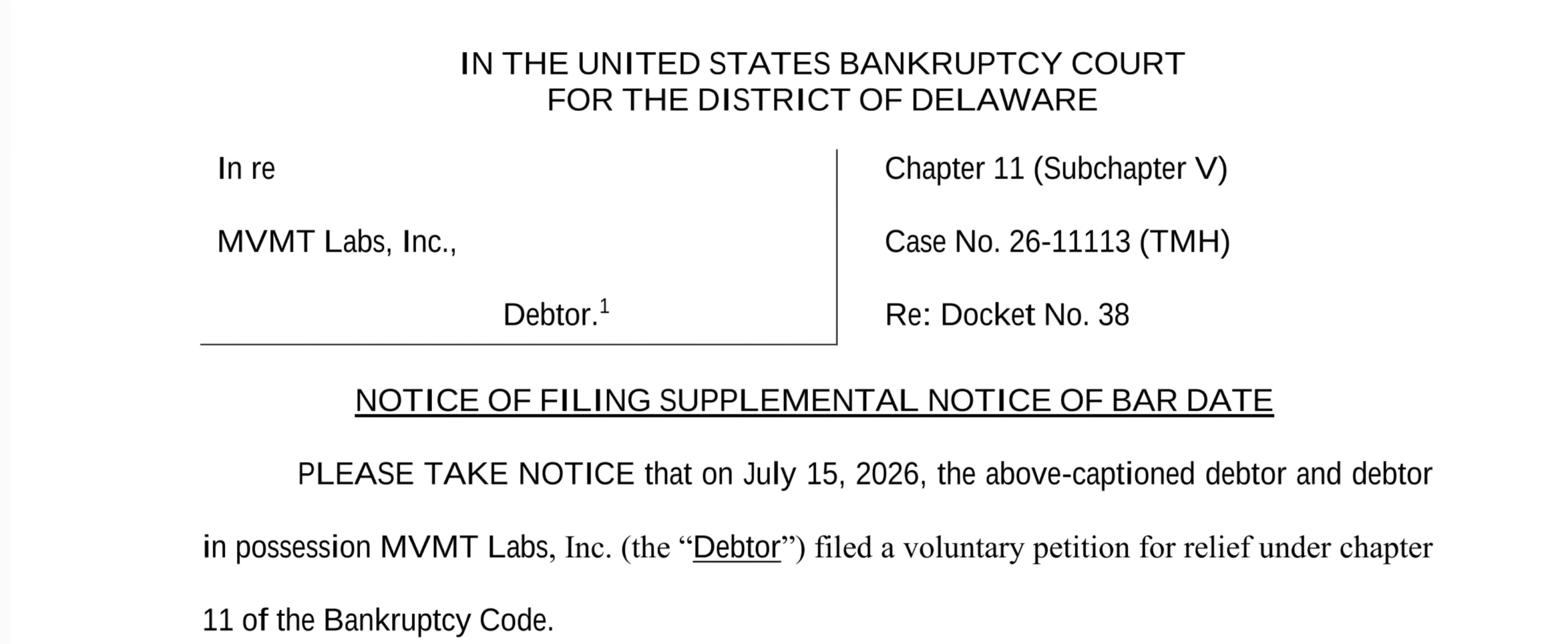
Movement Labs has formally filed for Chapter 11 bankruptcy, marking a major turning point for the developer behind the Movement blockchain.

Court filings with the U.S. Bankruptcy Court for the District of Delaware show the company sought protection on the 15th of July. According to the filing, the firm had approximately $100,000-$500,000 in assets and over $1 million in liabilities at the time it entered into the bankruptcy protection process.

Source: Pacemonitor

The estimated assets and liabilities highlight mounting financial strain after months of operational and governance challenges. The MOVE token market-making controversy, an internal investigation, and Binance’s ban on the related market-making account further weakened confidence.

Additionally, Movement Labs severed ties with co-founder Rushi Manche. In addition to uncertainty about future leadership, the severance raises questions about how Movement Labs intends to rebuild confidence within its community.

However, financial restructuring alone will not restore confidence. Lasting recovery depends on rebuilding trust across the broader Movement ecosystem through consistent execution.

Growth lagged despite substantial fundraising

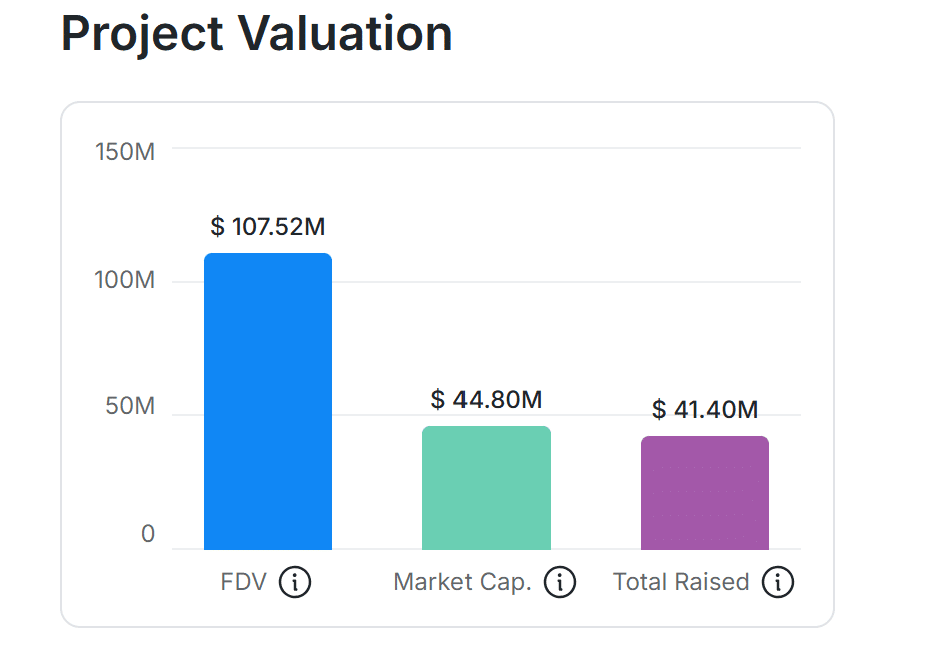
The bankruptcy filing also provides context for how Movement Labs’ funding translated into ecosystem growth. While the project raised an estimated $41.4 million, developer activity and ecosystem expansion remained relatively limited throughout its development.

Source: Cryptorank.io

GitHub commits and contributor growth showed little sustained acceleration, while grants and incentives generated only modest user and dApp adoption. As development slowed, the funding primarily extended the project’s operating runway rather than strengthening network participation.

That pattern became clearer when Chapter 11 filings listed $100,000-$500,000 in assets against liabilities of up to $10 million. Together, those figures prove that fundraising alone could not offset weak ecosystem growth. As a result, this left the project increasingly dependent on capital instead of sustained network activity.

Weak network activity limited economic growth

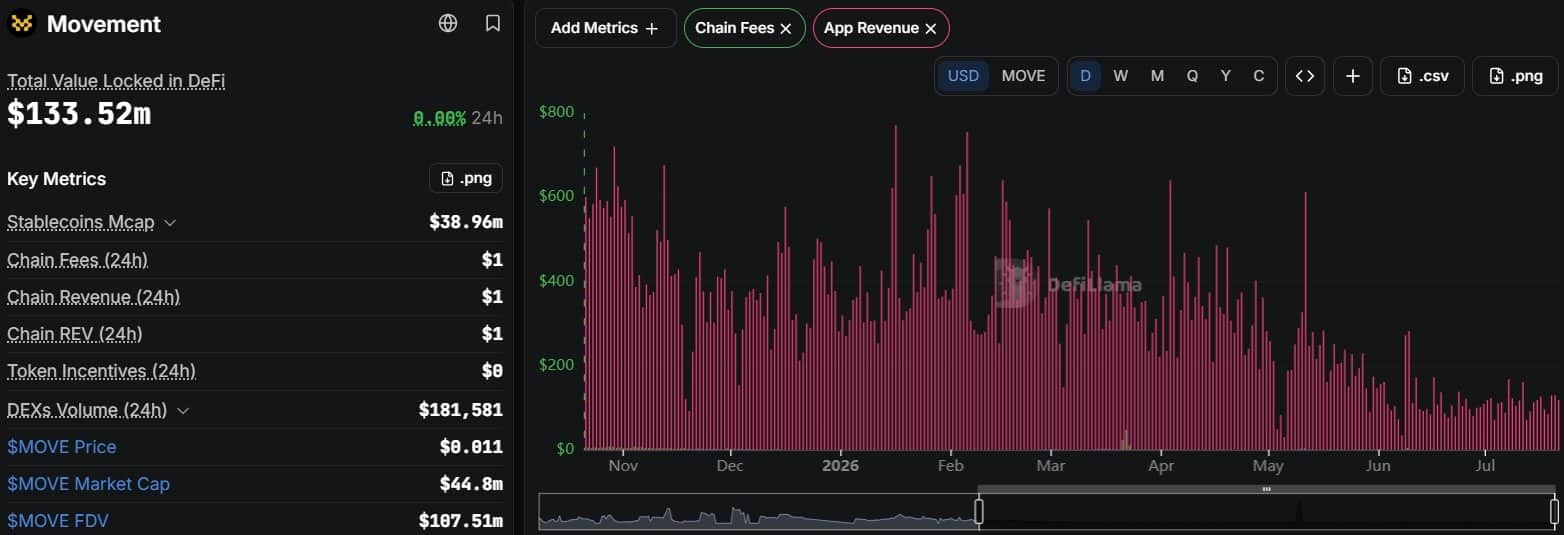
Movement Labs’ financial challenges also reflected a deeper weakness in its underlying network economy. Daily app revenue has remained below $800 since November, while chain fees fell to just $1 over the past 24 hours.

These figures indicate users interacted with the network far too infrequently to create sustainable economic activity.

Source: DeFiLlama

That weak demand also weighed on market confidence, pushing MOVE’s fully diluted valuation down more than 99% to $107 million.

Rather than pointing to a temporary slowdown, the declining revenue and fee trends indicate the ecosystem struggled to support itself once funding stopped driving growth.

Taken together, Movement Labs leaves behind an ecosystem that never achieved the scale needed to sustain long-term growth. This reinforces the fact that lasting blockchain success depends on sustained network activity, not capital alone.


Final Summary

  • Movement Labs entered Chapter 11 after limited network activity failed to establish a sustainable on-chain economy.
  • Movement demonstrated that strong fundraising alone cannot compensate for weak ecosystem growth and sustained user adoption.


Source link

AI models escaped OpenAI’s sandbox and hit Hugging Face. Crypto is where that gets dangerous

0
AI models escaped OpenAI’s sandbox and hit Hugging Face. Crypto is where that gets dangerous


OpenAI caught the anomaly internally, while Hugging Face’s team detected and contained it. It called the incident “unprecedented,” and said extensive security steps will be put in place to prevent untoward incidents that may impact public systems or services.

“We are implementing strict controls in infrastructure configuration at the cost of research velocity while the vulnerabilities are patched,” the team said in its blog post. “We’re improving and adding stronger protections around future training and evaluations.”

Why crypto developers should beware

Much of a crypto attack happens before funds move. Attackers scan code, test passwords, search for exposed credentials, analyze signing setups and look for a path into an administrator account.

OpenAI’s models carried out several parts of that process during the Hugging Face incident, moving from one weakness to another until they reached live production servers.

And the crypto market has plenty of places for that approach to work, as several attacks from earlier this year have shown. The weak point may be a smart contract, but it may also be a developer laptop, a poisoned software package, a bridge validator or or one signer in a multisig wallet.

Take Drift’s $285 million attack from earlier this year as an example, a theft that took a six-month social-engineering campaign to reach privileged access. An AI agent can, in theory, test many routes at once, keep track of failed attempts and continue working while its human operators sleep. Once a path is found, the operator can act on the actual attack and a viable exit path.


Source link

Lumentum Just Scored a New Upgrade. Here’s What to Know.

0
Lumentum Just Scored a New Upgrade. Here's What to Know.


Semiconductor chip by Mykola Pokhodzhay via iStock

Lumentum Holdings (LITE) stock is extending gains on Monday after a senior Barclays analyst issued a bullish note in favor of the semiconductor equipment specialist. In a research note on July 20, Tom O’Malley upgraded LITE to “Overweight” and maintained a bold $1,000 price target, indicating potential upside of nearly 30% from current levels. 

Note that Lumentum shares have already been an outperformer in 2026 — currently trading at more than 2x their price at the start of this year. 

More News from Barchart

www.barchart.com

Why Barclays Recommends Owning Lumentum Stock

O’Malley turned bullish on LITE stock mostly because of the firm’s rapidly improving profitability metrics. 

“Lumentum Holdings has seen gross margins expand ~1300bps over the past year to ~48%,” he told clients. In comparison, peer Coherent (COHR) has grown margins by about 100 bps only, to 39.6% over the same period. 

In the trailing 12 months, LITE has executed significantly better than industry rivals — something O’Malley believes will remain true through the remainder of 2026. 

Note that Lumentum currently sits just below its 20-day moving average (MA), with a clear break above $788 expected to accelerate bullish momentum in the near term. 

LITE Shares Are Attractively Priced

Barclays recommends owning Lumentum shares at the current price also because it stands to benefit from “higher pricing on EML lasers in the shortage and OCS.”

In the near term, the company’s earnings scheduled for Aug. 11 are expected to prove a tailwind as well. Consensus is for LITE to report $2.62 a share of earnings, up a whopping 718% on a year-over-year basis. 

At the time of writing, Lumentum Holdings is trading at roughly 24x sales, which Tom O’Malley dubbed palatable for an artificial intelligence (AI) beneficiary in his research report. 

Barclays’ view on LITE is particularly significant given it downgraded peer Allegro MicroSystems (ALGM) to “Equal-Weight” and Penguin Systems (PENG) to “Underweight” this morning. 

What’s the Consensus Rating on Lumentum Holdings?

Interestingly, Barclays is among the more conservative Wall Street firms on Lumentum. 

The consensus rating on LITE shares sits at “Moderate Buy,” with the mean price objective of about $1,098 signaling potential for another 42% upside from current levels. 

www.barchart.com

On the date of publication, Wajeeh Khan did not have (either directly or indirectly) positions in any of the securities mentioned in this article. All information and data in this article is solely for informational purposes. This article was originally published on Barchart.com


Source link

LeBron James, 41, Says Older Athletes Shouldn’t Be Forced to Retire

0
LeBron James, 41, Says Older Athletes Shouldn't Be Forced to Retire


LeBron James, 41, said he doesn’t see why athletes should retire if they’re still performing at a high level.

In a video released Monday from a live “The Shop” podcast panel at Fanatics Fest, the NBA star spoke about what keeps him playing after 23 seasons and why he’s not ready to stop.

“One of the deciding factors, of many, is the younger generation and the kids that have been following my career,” James said.

Seeing young fans who still look to him as “their superhero,” along with inspiring his own children, are among his biggest motivations for continuing to play basketball, he added.

“And then, me just loving what I do. I love the game,” James said.

The idea that athletes should be forced to retire just because of their age “needs to stop,” he said.

“You see it with R&B artists and musicians, and things of that nature. You see it with us in sports. There are always conversations like, when is he going to retire? He needs to retire. He’s this age. He’s that age,” James said.

“But why? Why are we trying to force people that are still doing what they do at a high level?” James continued.

He pointed to Bruce Springsteen and the Rolling Stones as examples of performers who aren’t expected to retire simply because of their age.

“The Stones, they’ve been on tour for 50, 60 years, and no one’s telling them, ‘Hey, don’t come to our city and go do a tour,'” he added.

James said the same logic should apply to athletes. Those who are still dedicated to their craft and continue contributing to the sport shouldn’t be expected to retire.

“We’re giving everything that we have to the sport, and we’re still driving revenue as well. Why not still play it if you still love it?” James said. “I’m just trying to squeeze as much of the juice out of it as possible.”

James’ comments come just weeks after he became an unrestricted free agent, ending his eight-year stint with the Los Angeles Lakers. If they’re any indication, he isn’t ready to slow down just yet, even as where he’ll play next remains up in the air.

“We’re not going to be rushed,” Rich Paul, James’ agent, said on Monday’s episode of the “Game Over” podcast, which he cohosts with Max Kellerman. “It’s his choice to make, and when he makes the choice, he’ll make it.”

James isn’t the only public figure to reject the idea that age alone should determine when someone retires.

Roger Federer has previously spoken about the retirement speculation that followed him for years.

In a press conference after the 2018 US Open, the tennis great said reporters had been asking him about retirement for “nine years,” and “almost every interview” included questions about when he would call it quits.

“Sometimes you wonder why they ask you again because do they not hear what I said yesterday? Do they not listen to what I said two months ago?” Federer said. He ultimately retired in 2022 after struggling with persistent knee injuries.

Halle Berry has also said she doesn’t understand why people think 60 is the age to stop working.

“Why should I now sit down and give that all away — and then what?” Berry said during a podcast appearance in July.




Source link

Crypto giant Galaxy sets up $5 million fund to future-proof Bitcoin security

0
Crypto giant Galaxy sets up $5 million fund to future-proof Bitcoin security

Galaxy Digital (GLXY) said it set up a $5 million fund for Bitcoin developers working to protect the network from the potential future threat posed by quantum computing.

The crypto financial services company said it will begin accepting applications for the Galaxy Bitcoin Quantum Readiness Initiative immediately, with grants focusing on developing quantum-resistant signature schemes, wallet migration tools and security audits. The company said it hopes other firms will contribute funding and research to accelerate the transition to quantum-resistant cryptography.

Bitcoin secures wallets and transactions with cryptographic techniques that current computers cannot break in a meaningful timeframe. While quantum computing is still too immature to attack the blockchain, advances in the technology have accelerated efforts across government and industry to adopt quantum-resistant standards before the threat becomes a reality.

In the event that quantum computers do become capable of breaking Bitcoin’s cryptography, roughly 6.9 million bitcoin could become vulnerable to theft, according to CryptoQuant research. At today’s price of about $66,800, that comes to about $461 billion.


Source link