Home Blog Page 321

Cathie Wood dumps nearly $60 million in popular growth stocks

0
Cathie Wood dumps nearly $60 million in popular growth stocks


On June 18, Cathie Wood‘s ARK Invest showed off a notable rotation following a superb run in two of the most popular high-growth stocks.

Investors had been rewarding Robinhood (HOOD) for its cost-cutting plan and Roku (ROKU) for its takeover-driven rally, but ARK moved in the opposite direction.

Wood took profits in both stocks after the catalysts lifted sentiment, turning both into sources of cash. 

Those adjustments land against a far more buzzworthy story. 

Wood recently built a major post-IPO position in SpaceX, with ARK buying nearly 3.3 million shares that were worth about $531 million by the end of the stock’s first trading day, adding to her reputation among fans and investors as a big-name, high-risk, high-reward stock picker.

On top of that, the ARK Invest boss didn’t just move to the sidelines. 

The firm added to Eli Lilly, Coinbase, and other big names linked to new catalysts, pointing to a major shift from completed or mature rallies toward fresh upside stories. 

However, the question now beckons whether Wood is taking profits early or getting ahead of a momentum fade.

Cathie Wood’s ARK sold Robinhood and Roku after sharp stock ralliesJose Sarmento Matos/Bloomberg via Getty Images

Why Cathie Wood sold Robinhood and Roku after their rallies 

Wood’s Robinhood and Roku sales point to a classic case of profit-taking after sudden catalysts.

More AI:

Robinhood became one of ARK’s largest trims of the day.

The firm sold off 275,572 shares through the ARK Innovation ETF, worth $26.65 million. According to Reuters, the sale came just after Robinhood said it would cut about 10% of its full-time workforce, or roughly 290 jobs, as CEO Vlad Tenev pushed the company to stay lean and focused. 

The cost-cutting offered investors a cleaner margin story, and the stock jumped as analysts lifted price targets. For Wood, that rally created an easy window to lock in gains.

Roku offered a different kind of catalyst. 

ARK sold 239,267 shares across ARKK, ARKW, and ARKF, worth about $33.01 million, after Fox agreed to buy Roku in a $22 billion deal valued at $160 per share. 

The deal gave Roku shareholders a defined takeover price and pushed the stock close to that level. That reduced the upside case for ARK, turning Roku into a source of cash rather than a fresh growth bet.

Why Eli Lilly led ARK’s latest round of growth-stock buying

Eli Lilly led ARK’s buying as Wood shifted cash from stocks to the most in-demand healthcare player. 


Source link

Ethereum’s exchange supply shrinks again – Is ETH setting up for a recovery?

0
Ethereum's exchange supply shrinks again - Is ETH setting up for a recovery?


A major Ethereum whale intensified its accumulation activity after purchasing 7,000 ETH worth $11.8 million. The latest acquisition lifted the wallet’s total purchases to 17,800 ETH valued at approximately $29.76 million over the previous ten days. 

Such sustained buying activity highlighted growing conviction from large holders despite Ethereum’s recent price struggles.

Notably, the whale accumulated ETH at an average price of $1,672, a level close to the asset’s current market value. This positioning suggested that large investors continued to view current prices as attractive. 

Exchange supply keeps shrinking

Beyond whale activity, exchange flow data revealed a notable shift in Ethereum’s circulating supply. 

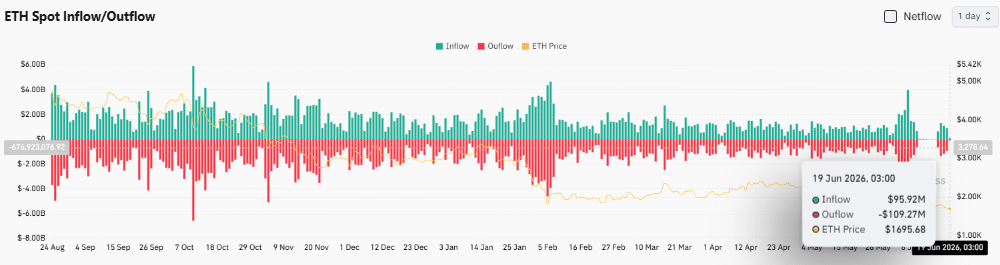
During the latest trading session, Ethereum recorded $95.92 million in inflows against $109.27 million in outflows. This imbalance produced a net outflow of roughly $13.35 million.

The persistent outflow trend indicated that more ETH left exchanges than entered them. 

Since exchange-held assets typically represent readily available selling supply, the decline suggested reduced immediate sell-side pressure. 

Source: CoinGlass

Why has ETH stalled below resistance?

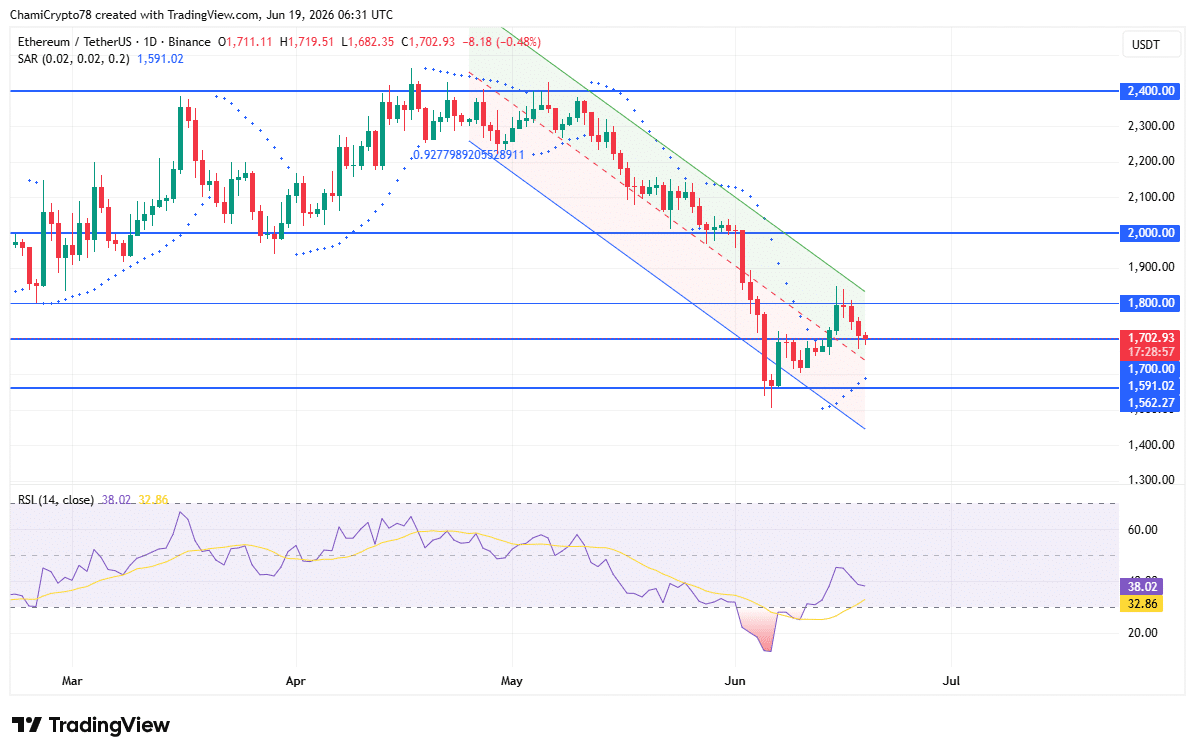
Ethereum’s [ETH] recovery attempt lost pace after the price approached the $1,800 resistance level and failed to establish a sustained breakout. 

The daily chart showed that ETH traded near $1,703 at the time of observation, while maintaining support above the key $1,700 region.

Technical indicators reflected a market that had attempted to recover but had not fully regained strength. The Relative Strength Index climbed from deeply oversold conditions and reached 38.02, while remaining below the neutral 50 threshold. 

This reading suggested that buyers had regained some control, though bullish strength remained limited. 

Meanwhile, the Parabolic SAR flipped beneath price during the recent rebound, signaling that short-term conditions had improved following the sharp decline earlier in June. 

However, ETH remained below both the descending trendline and the $1,800 resistance level. Unless buyers reclaimed these barriers, recovery attempts could continue facing resistance.

If bullish pressure strengthens, ETH could challenge $1,800 again. Otherwise, support around $1,700 and $1,590 could attract renewed attention.

ETH price actionETH price action
Source: TradingView

Liquidity map highlights Ethereum’s next battleground

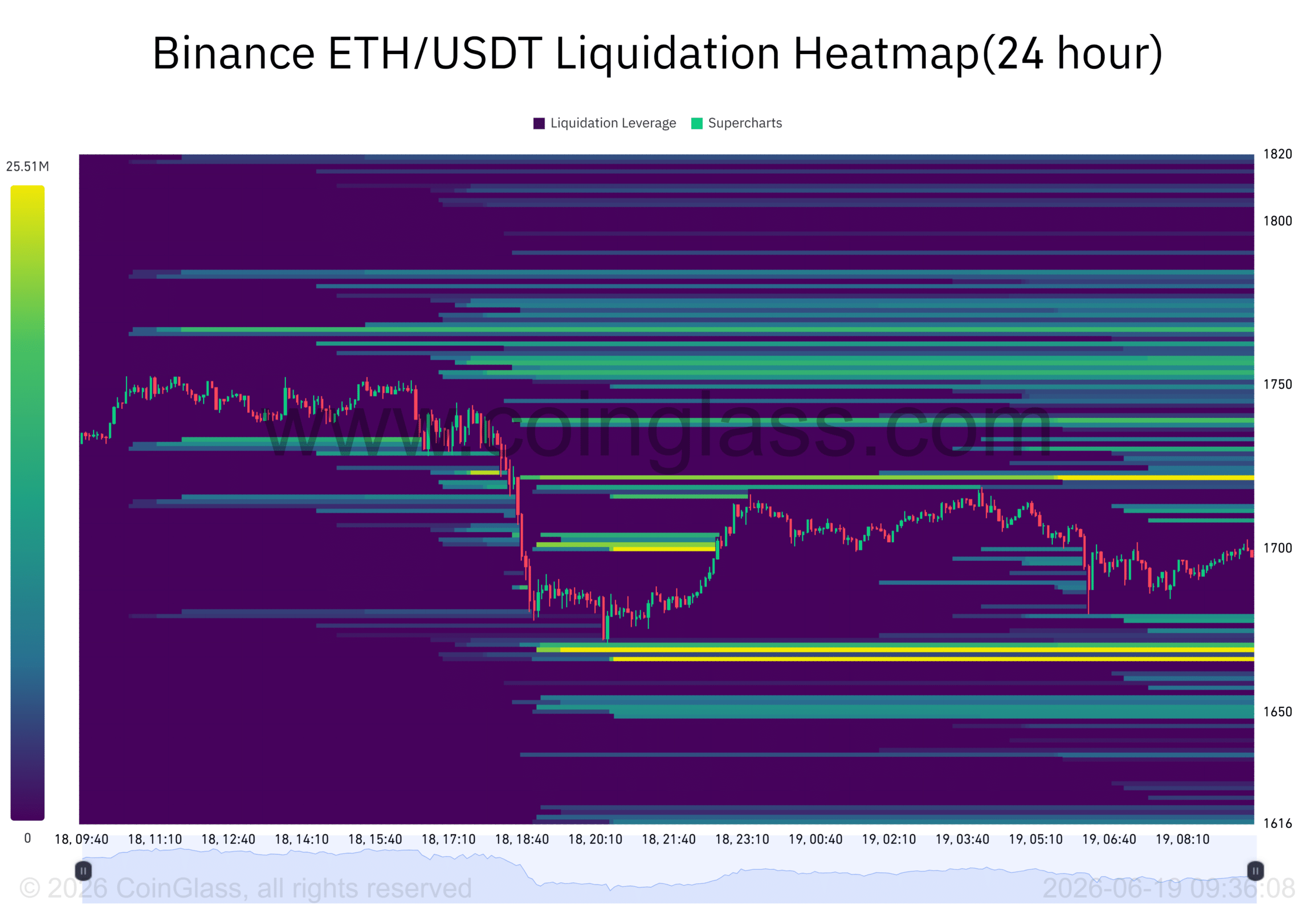
Liquidation data revealed several high-interest zones that could influence Ethereum’s next move. The Binance Liquidation Heatmap showed a notable concentration of liquidity around the $1,720 to $1,730 region. 

Since large liquidation clusters often attract price action, this zone emerged as a key area to monitor in the short term.

Below the current price, another significant liquidity pocket appeared between $1,665 and $1,675. 

This cluster provided an important downside reference if Ethereum lost support near $1,700. Elsewhere, additional liquidity concentrations extended toward $1,750 and above $1,800, indicating areas where leveraged positions had accumulated.

As traders continued targeting liquidity-rich zones, Ethereum’s price action could remain drawn toward these levels before establishing a clearer directional move.

Source: CoinGlass

Final Summary

  • Whale accumulation and exchange outflows continued reducing Ethereum’s available trading supply.
  • ETH held above key support, though resistance still limited recovery efforts.


Source link

Aster (ASTER) popped over 10% on radical ‘buyback and burn’ upgrade. But gains were short-lived

0
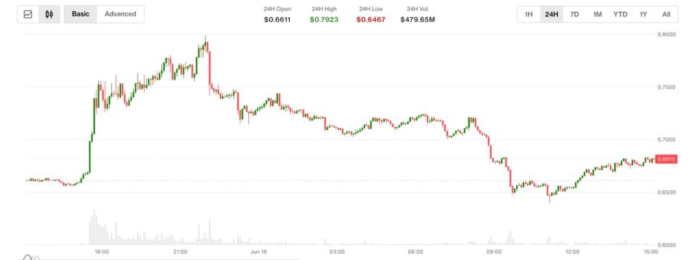
Aster (ASTER) popped over 10% on radical 'buyback and burn' upgrade. But gains were short-lived

The upgrade marks a shift away from the protocol’s previous linear vesting model, in which tokens were auto-released to market regardless of demand, and it concluded earlier this year, in January 2026.

“Aster’s tokenomics upgrade puts the platform’s own activity to work,” the protocol noted, highlighting that the new rewards are settled on-chain with “no discretionary reserve.”

The token’s bullish price action, however, was short-lived as the Federal Reserve’s hawkish turn sent the dollar higher and weighed on risk assets, including cryptocurrencies.

As of writing, ASTER traded near 68 cents, down 5% on the day.


Source link

Equinix Is Now Becoming a Key Stop in the AI Supply Chain. How to Play EQIX Stock Here.

0
Equinix Is Now Becoming a Key Stop in the AI Supply Chain. How to Play EQIX Stock Here.


Business woman greeting a client by insta_photos via Shutterstock

Equinix (EQIX) is not just renting space anymore. It is becoming a key stop on the AI supply chain. That matters. Big tech does not want random data centers. It wants secure, connected, high-performance sites that can handle huge AI workloads. 

That is where Equinix keeps winning. Its ties with Nvidia and Cisco only sharpen that story. The company recently said it is partnering with Nvidia (NVDA) and Cisco (CSCO) to help deploy secure AI factories across its global network of data centers. 

More News from Barchart

Despite this boost, the real question remains. The stock has already had a big run, so the real question is not whether the AI story is real. The question is whether investors are paying too much for it now. 

The Stock Has Already Done a Lot of Heavy Lifting

EQIX has been strong over the past year. The stock climbed from the low $700s in mid 2025 to about $1,089 in June 2026, a gain of roughly 43.2% year-to-date (YTD). Investors have chased anything tied to AI infrastructure. The big catalyst has been the idea that Equinix is not just benefiting from AI demand, but it is helping shape where that demand lives.

This is where investors need to be careful. Equinix looks expensive on traditional metrics. Its price-to-earnings ratio is 71.54 times, while the broader REIT sector is much lower, closer to 30.45 times. Its EV to EBITDA multiple is 30.21 times, which is also rich versus most peers in the sector at 16.96 times.

That premium can make sense for a company with durable growth and a strong AI position. But it also means the market is already paying up for a lot of good news. This is not a bargain stock. It is a quality stock priced like one.

www.barchart.com

Nvidia and Cisco Add Credibility to the AI Story

The latest headline is important because it shows Equinix is getting pulled deeper into the AI buildout. Its expanded work with Nvidia, and Cisco is aimed at secure AI factories across its data center footprint. That means Equinix wants to be the place where enterprise AI gets deployed, tested, and scaled.

Investors liked that. The stock popped on the announcement. That reaction makes sense because deals like this validate Equinix’s role in AI infrastructure. They also strengthen its pitch to large customers who want trusted partners, not just raw capacity. The impact is bigger than a one-day move. Rather, it gives Equinix more credibility in front of customers, and more optionality for future service revenue.


Source link

Can Singapore become Asia’s neutral AI hub? U.S., China firms set up shop in the country

0
Can Singapore become Asia's neutral AI hub? U.S., China firms set up shop in the country

Singapore has spent decades selling the world on the promise that it can be trusted by all sides. For a new generation of AI companies, that pledge has never been more valuable.

OpenAI and Google DeepMind both established applied AI labs in the city-state over the past year, while Anthropic began advertising local positions in finance, product support, and economic research. Chinese firms like Tencent have also deepened their investment in the country.

“All the AI companies I work with, whether they’re from China, Korea or Japan, all use Singapore as a hub,” Gunja Gargeshwari, the chief revenue officer of Israel-headquartered web scraping firm Bright Data, told Fortune on the sidelines of the SuperAI summit in Singapore. “It’s easiest to operate in the region if I have people in Singapore—it’s where conversations are happening, and where the innovation hubs for different providers are being set up.” Bright Data, for instance, has chosen to position Singapore as its APAC headquarters, even though 60% of its Asian customer base hails from China and India.

“We have the chance to stand out here,” said Nathan Xu, the CEO of San Francisco-based AI notetaker company Plaud. “Unlike many companies that originate entirely from the U.S., if Plaud can position ourselves aggressively in Singapore, then we’re a cool company to prospective users across the globe.”

Plaud hired its first Singapore-based employee in 2024. On June 10, the company said it would spend 10 million Singapore dollars ($7.8 million) to expand its local operations. It also plans to grow its headcount from 100 to 150 by the end of the year. 

Singapore’s appeal to the AI industry is as much due to geopolitics as economics. The country markets itself as an economic safe haven, with a long track record of regulatory clarity and strong governance. 

“Some say we are boring, and we will never have the same offerings as New York and Paris,” Singapore Prime Minister Lawrence Wong said during a policy conference last July. “But at the same time, we are stable, we are predictable. We are reliable and we are trusted, and these are intangible assets that others would die to have.”

Founders like Xu also point to the country’s rigorous education system as an incubator for tech talent. “The biggest pain for me and the company is hiring the best engineers, and what’s interesting about Singapore is that it’s home to some of the best universities in the world,” Xu explains. (In this year’s QS World University Rankings, the National University of Singapore ranked #8, while the country’s Nanyang Technological University came in at #12.) “It’s a place which curates generations of talents around software engineering, computer science, AI, data science and operations.”

AI firms go global

The AI build-out in Singapore reflects a broader change across the industry. Global AI firms are shifting away from training massive models to instead figuring out how to monetize their work in the real world.

“The defining feature of the AI cycle through 2025 was capital expenditure… while this has expanded capacity and driven technology leadership, it has also invited skepticism,” wrote BNY’s wealth analysts in a March report. “Attention has now turned decisively from scale to return on investment.”

For firms of Chinese origin, like Manus AI, Tencent, and Alibaba, Singapore often serves as a first and crucial step in going global. To build out their presence in the country, Chinese tech giants are dangling hefty annual pay packages: Singapore-based roles for holders of PhDs in AI can range between $150,000 to $273,000.

“For some of my Chinese customers, the researchers can’t leave the country without telling the government—I kid you not,” said Gargeshwari. “So opening an office in Singapore and having local employees is a necessity for them to do business.”

For U.S. AI firms, overseas markets like those in Asia Pacific represent a massive untapped customer base. 

OpenAI opened a regional office in Singapore in 2024. Last month, the firm committed 300 million Singapore dollars ($234 million) to growing the country’s AI ecosystem. It also announced the opening of an applied AI lab—the first outside of the U.S.—which is set to make Singapore one of its hubs for forward deployed engineers: specialized software engineers who embed directly within customer organizations to customize and deploy tech solutions.

Notion, the AI-powered productivity platform, opened a Singapore office in mid-2025. “Our number one priority is to meet and interface with current and potential customers,” said Randy Hunt, the company’s head of design. “I could do a demo for you over video, and while that may be effective, if I can do it sitting next to you, it resonates better.”

Anthropic is betting on enterprise AI instead of the consumer market, which makes Singapore, where many MNCs house their APAC headquarters, a natural choice.

Cracks in the system

Yet, foreign governments are starting to challenge Singapore’s neutrality.

Manus AI and its parent company, Butterfly Effect, relocated its global headquarters to Singapore in mid-2025 to both avoid Western regulatory scrutiny and better access global capital. In December, it sold itself to Meta for $2 billion. Beijing quickly moved to block the deal, and in April ordered the acquisition to be unwound

In the end, Manus’s legal status as a Singapore company didn’t matter: its continued footprint in China was enough for Beijing to decide it had jurisdiction. 

“Regulators looked straight through the Singapore holding structure to the technology’s Chinese origin,” Sebastian Wiendieck, the head of legal practice in China at law firm ROEDL, told CNA. “This marks a new normal: any China-founded AI startup, regardless of its offshore domicile, will face intense national security scrutiny if it tries to sell to a U.S. buyer.”

The U.S., too, could hurt Singapore’s AI ambitions. Last week, the U.S. government barred non-U.S. individuals from using Anthropic’s powerful Mythos model. Singapore could end up losing access to powerful frontier models from U.S. companies like Anthropic and OpenAI.  

Still, AI firms remain positive about expanding into Singapore. The country released its national AI R&D plan in January, alongside a 1 billion Singapore dollar injection to fund the buildout of AI-related infrastructure and capabilities. The country also set out plans to build an AI industrial park called Kampong AI, set to open in 2028 with workspaces and housing facilities to woo AI start-ups.

“We feel like we are welcomed here,” Xu said. “We didn’t know we’d be able to set up such a big and meaningful presence here; a year ago, we had zero people here, but now we have close to a hundred.”


Source link

BTC, ETH, SOL price news: Bitcoin falls below $63,000 as risk assets sell off

0
BTC, ETH, SOL price news: Bitcoin falls below $63,000 as risk assets sell off

The pressure came from a wider retreat in markets. Global equities slipped in holiday-thinned trading, with US, Chinese, Hong Kong and Taiwanese markets closed, and a gauge of Asian shares falling 0.6% after a five-day run to record highs. Brent crude traded around $79 a barrel, down about 9% on the week, as shipping through the Strait of Hormuz returned to normal under the signed US-Iran deal and eased what had been a historic supply shock.

Attention now turns to talks over Iran’s nuclear program, with Vice President JD Vance saying a 60-day clock to settle the deal’s details has started.

The bigger question hanging over the market is where this cycle goes, and whether the altcoins that usually rally late in a bull run get their turn at all. Michael Egorov, founder of Curve Finance, told CoinDesk he thinks bitcoin is behaving differently this cycle because spot ETFs were approved just before the 2024 halving, the roughly four-yearly event that cuts the rate of new bitcoin issuance, pulling in institutional demand that did not exist before and breaking the old pattern.

The speculative energy that once flowed into altcoins, he said, went instead into “useless memecoins” right after the ETFs launched.


Source link

Is Everest Group Stock Underperforming the Nasdaq?

0
Is Everest Group Stock Underperforming the Nasdaq?


Woman holding chart of prices by Vetkit via iStock

Hamilton, Bermuda-based Everest Group, Ltd. (EG) specializes in property, casualty, and specialty insurance and reinsurance solutions designed to manage complex, large-scale risk. It is valued at a market cap of $13.4 billion. 

Companies valued at $10 billion or more are typically classified as “large-cap stocks,” and EG fits the label perfectly, with its market cap exceeding this threshold, underscoring its size, influence, and dominance within the insurance – reinsurance industry. Backed by a high-grade investment portfolio exceeding $45 billion, the company writes multi-billion-dollar policy volumes across crucial protective spaces, including property catastrophe, environmental liability, maritime cargo, financial lines, and specialized aerospace risk.

More News from Barchart

The company had dipped 9% from its 52-week high of $368.29, reached on Oct. 8, 2025. Shares of EG have gained 5% over the past three months, considerably underperforming the Nasdaq Composite’s ($NASX) 19.1% uptick during the same time frame. 

www.barchart.com

In the longer term, EG has gained marginally over the past 52 weeks, notably lagging NASX’s 34.9% return over the same time period. Moreover, on a YTD basis, shares of EG are down 1.1%, compared to NASX’s 13.5% rise. 

To confirm its bearish trend, EG has been trading below its 50-day moving average since late May. However, it has remained above its 200-day moving average since mid-June. 

www.barchart.com

On Apr. 30, EG shares gained 3.7% following its mixed Q1 2026 earnings release. Its revenue declined 4.6% year over year to $4.1 billion, falling short of analysts’ expectations. However, its adjusted EPS came in at $16.08, exceeding Wall Street’s forecasts and highlighting the company’s ability to maintain strong profitability despite softer top-line performance.

EG has also underperformed its peer, Reinsurance Group of America, Incorporated (RGA), which has gained 7.3% over the past 52 weeks and 3.1% on a YTD basis. 

Despite EG’s recent underperformance, analysts remain moderately optimistic about its prospects. The stock has a consensus rating of “Moderate Buy” from the 19 analysts covering it, and the mean price target of $385.25 suggests a 15.1% premium to its current price levels. 

On the date of publication, Neharika Jain did not have (either directly or indirectly) positions in any of the securities mentioned in this article. All information and data in this article is solely for informational purposes. This article was originally published on Barchart.com


Source link