Home Blog Page 335

Silver prices today, Monday, June 15, 2026: Silver prices moving up following U.S., Iran ceasefire deal

0
Silver prices today, Monday, June 15, 2026: Silver prices moving up following U.S., Iran ceasefire deal


Silver (SI=F) July futures opened at $68.90 per ounce on Monday, 1.4% higher than Friday’s closing price of $67.97. The price of silver continued to move higher in early trading to $70.75 by 7:16 a.m. ET.

Like gold, silver prices are up this morning following the announcement of a ceasefire deal between the U.S. and Iran, setting the stage for a formally signed agreement that could be reached as soon as this week.

This most significant step toward long-term peace in the Middle East has prompted oil prices (BZ=F) to fall and inflation concerns to ebb at least somewhat. With the Fed almost certainly keeping rates unchanged this week, the prospects for higher precious metal prices improved a great deal.

Read more: US, Iran agree to ceasefire, sending stock futures higher and oil lower

The opening price of silver futures on Monday was up 1.4% compared to Friday’s close. Here’s how the opening silver price has changed versus last week, month, and year:

  • One week ago: +2.1%

  • One month ago: -14.5%

  • One year ago: +90.3%

For context, silver’s year-over-year growth was 173.3% on May 14.

24/7 silver price tracking: Don’t forget you can monitor the current price of silver on Yahoo Finance 24 hours a day, seven days a week.

Want to learn more about the current top-performing companies in the silver industry? Explore a list of the top-performing companies in the silver industry using the Yahoo Finance Screener. You can create your own screeners with over 150 different screening criteria.

There are several ways to invest in silver, from buying the metal itself to choosing financial products tied to its price. Here’s how each option works.

The most direct way to invest in silver is to buy it in physical form, either as bullion bars or government-minted coins. This gives you direct ownership of the metal, with no counterparty risk from an exchange or financial institution.

The trade-off is logistics. You’ll need to think about storage, security, and potentially insurance. Dealers also charge a markup above the spot price, which means prices need to rise enough to cover that premium before you’re in profit. Still, for investors who want tangible ownership of their assets, physical silver is a straightforward option.

Silver exchange-traded funds (ETFs) trade on stock exchanges the same way individual stocks do. Some ETFs hold physical silver directly, giving shareholders fractional ownership of real metal. Others invest in silver mining companies rather than the commodity itself.

ETFs are generally the most accessible and liquid way to get silver exposure. You can buy and sell them through any standard brokerage account, and there’s no storage or insurance to worry about.

Keep in mind, though, that some silver funds are taxed as collectibles rather than investments, which can mean a higher tax rate. It’s worth confirming the tax treatment with a professional before investing. You’ll also have to keep an eye on expense ratios.

Read more: 5 ways to invest in silver for beginners

Whether you’re tracking the price of silver since last month or last year, the price-of-silver chart below shows the precious metal’s value journey so far this year.

More silver coverage from the Yahoo Finance team: 



Source link

Bitcoin’s ETF era enters new phase as BITA targets 25% yield – Details

0
Bitcoin’s ETF era enters new phase as BITA targets 25% yield - Details


Are “yields” becoming a defining driver of the 2026 cycle?

At a structural level, the CLARITY Act is under scrutiny partly because it introduces the concept of yield-bearing stablecoins. If stablecoins begin to generate yield, capital could flow into DeFi-native rails, raising competitive pressure on traditional finance and contributing to the ongoing regulatory hesitation.

btc
Source: X

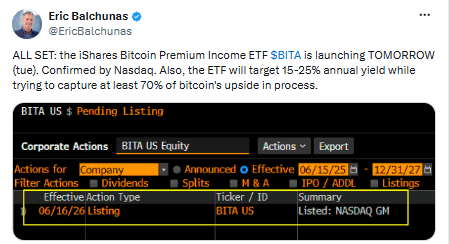
In parallel, yield is being absorbed into institutional crypto products. BlackRock’s iShares Bitcoin Premium Income ETF (BITA), set to launch on Tuesday, the 16th of June, reflects this shift as it monetizes volatility via options on IBIT.

Put simply, instead of pure spot Bitcoin exposure, BITA generates yield by selling options on iShares Bitcoin Trust for steady income. It targets a 15-25% yield while still aiming to capture 70% of BTC’s upside.

Basically, the fee it collects from selling those options becomes the income paid out to investors. 

In terms of flow, if demand for BITA grows, it buys more IBIT shares, which can lead IBIT to hold more Bitcoin to back them. So the BTC doesn’t go to BlackRock.

Instead, it stays inside IBIT, but demand for BITA can indirectly increase Bitcoin held in the ETF system. 

In essence, the shift signals something bigger: Crypto exposure is moving away from pure directional bets toward structured income products built on top of Bitcoin [BTC] volatility. So, instead of “just holding BTC,” issuers are offering investors ways to actively monetize it.

But looking at recent ETF sentiment, this move is clearly more strategic than random.

Bitcoin ETFs enter a new phase as yield becomes the core narrative 

Looking at ETF flows, it’s clear investors are moving away from pure speculation toward more stability.

Yield is becoming the bridge in this shift.

Unlike traditional ETFs that provide direct Bitcoin exposure, BlackRock’s BITA targets stability by generating income from Bitcoin volatility instead of just tracking price. While this looks like a structural upgrade, it also reflects rising FUD around both BTC and its ETF ecosystem.

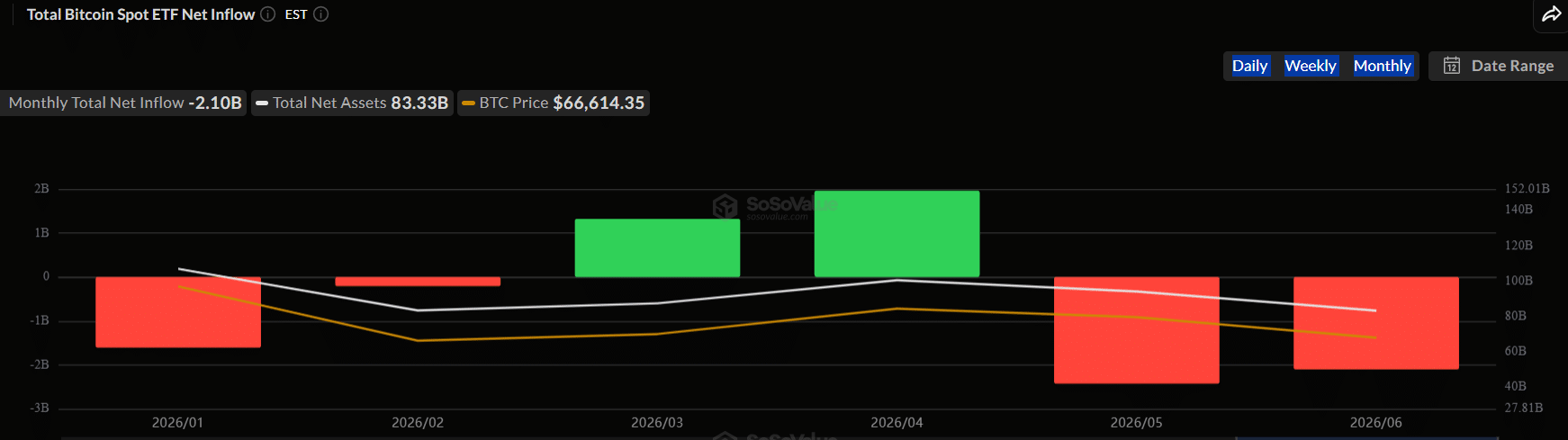
From a technical standpoint, BTC has pulled back over 25% this year. That move has weighed on iShares Bitcoin Trust, with shares dropping from around $50 to roughly $37 at press time.

That weakness has also shown up in sentiment, with Bitcoin ETFs seeing about $2.5 billion in net outflows in Q2, which has in turn added pressure on Bitcoin itself, creating a feedback loop where price weakness triggers outflows, and outflows reinforce further downside.

Bitcoin Bitcoin
Source: SoSoValue

Against this backdrop, BlackRock’s launch of an income-based Bitcoin ETF is clearly a strategic move. 

The logic is simple: By linking returns to options on iShares Bitcoin Trust, the structure shifts Bitcoin exposure away from pure price speculation and toward yield generation, where volatility itself becomes the source of income rather than just risk. 

Therefore, this could mark a key inflection point for the entire ETF ecosystem, as Bitcoin transitions from a directional asset into a volatility-backed income engine.


Final Summary

  • BITA makes yield by selling options on iShares Bitcoin Trust, giving up some upside in return for income.
  • If more people buy BITA, it buys more IBIT, which can lead to more BTC being held inside the ETF system.


Source link

Tether Gold now has a dedicated options market on Bybit

0
Tether Gold now has a dedicated options market on Bybit

Bybit, one of the world’s top cryptocurrency exchanges by trading volume, has launched options trading on Tether Gold (XAUT), a token that provides you ownership of real physical gold.

The XAUT options are now live and allow traders to hedge risk, speculate on gold price movements, trade volatility, and build custom strategies through Bybit’s Request for Quote (RFQ) system for over-the-counter (OTC) deals.

Bybit partnered with Orbit Markets, a leading crypto options market maker, to ensure deep liquidity from the start. Orbit’s team brings significant expertise, including former senior executives from precious metals trading desks, notably the ex-APAC Head of Currencies and Precious Metals at Deutsche Bank.

“As tokenization accelerates, we believe the distinction between crypto and TradFi will continue to narrow,” said Jimmy Yang, co-founder of Orbit Markets. “Gold options are a cornerstone of traditional derivatives markets, and we are excited to see growing interest in TradFi derivatives within crypto.”

The XAUT options are European-style contracts settled in dollar-pegged stablecoin USDT, with each options contract corresponding to one XAUT token, which itself represents one troy ounce of physical gold.

What Are Options?

Options are derivative contracts that give the buyer the right, but not the obligation, to buy or sell the underlying asset at a set price before or on a specific date. A call option gives the right to buy, while a put option gives the right to sell.


Source link

Global-e Online Ltd. (GLBE) Shows How Cross-Border Logistics Can Extend E-Commerce Growth

0
Global-e Online Ltd. (GLBE) Shows How Cross-Border Logistics Can Extend E-Commerce Growth


Global-e Online Ltd. (NASDAQ:GLBE) is one of the best e-commerce stocks to buy as global sales hit records. The company powers cross-border direct-to-consumer e-commerce for brands and retailers, making it a direct play on merchants selling to international shoppers. On May 26, Global-e announced a definitive agreement to acquire Passport Global Inc., a U.S.-based cross-border e-commerce logistics and solutions company. The deal is expected to deepen Global-e’s standard logistics capabilities through asset-light carrier services, direct injection, consolidated returns, customs brokerage, and domestic and last-mile delivery support.

The transaction also expands Global-e’s addressable merchant base because Passport will continue offering a non-Merchant of Record solution. Global-e agreed to pay $350 million upfront, funded roughly equally through cash and ordinary shares, with up to $75 million in additional contingent consideration tied to Passport’s 2026 financial results. Passport is expected to generate about $100 million in revenue in calendar 2026.

Global-e Online Ltd. (GLBE) Shows How Cross-Border Logistics Can Extend E-Commerce Growth

India Picture/Shutterstock.com

Global-e’s latest quarterly results support the growth case. On May 13, the company reported first-quarter GMV of $1.74 billion, up 40% year-over-year, while revenue rose 33% to $252.1 million. Adjusted EBITDA increased 59% to $50.2 million, and Global-e raised its full-year 2026 outlook across GMV, revenue, and adjusted EBITDA.

Global-e Online Ltd. (NASDAQ:GLBE) enables brands and retailers to sell internationally by offering localized checkout, logistics, and cross-border e-commerce services.

While we acknowledge the potential of GLBE as an investment, we believe certain AI stocks offer greater upside potential and carry less downside risk. If you’re looking for an extremely undervalued AI stock that also stands to benefit significantly from Trump-era tariffs and the onshoring trend, see our free report on the best short-term AI stock.

READ NEXT: 33 Stocks That Should Double in 3 Years and Cathie Wood 2026 Portfolio: 10 Best Stocks to Buy

Disclosure: None. Follow Insider Monkey on Google News.


Source link

Perplexity CEO Shares 2 Lessons He Learned From Jensen Huang and Musk

0
Perplexity CEO Shares 2 Lessons He Learned From Jensen Huang and Musk


Perplexity’s CEO shared two unusual pieces of advice he learned from the leaders of two of the world’s biggest companies.

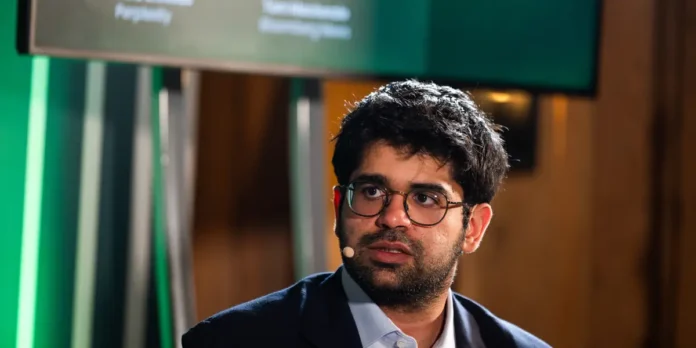
On an episode of the “20VC” podcast released on Monday, Aravind Srinivas said Nvidia CEO Jensen Huang and Tesla CEO Elon Musk taught him two important entrepreneurship lessons that stuck with him.

Srinivas cofounded AI search engine Perplexity in 2022 after working as a researcher at Google’s DeepMind and OpenAI. In August, Business Insider reported that the company was seeking fresh funding at a $20 billion post-money valuation. The startup’s investors include SoftBank, Nvidia, and Jeff Bezos.

On Monday’s podcast, he said that he learned the importance of always staying on your toes from Huang.

“Think about it. $5 trillion, guaranteed to make $500 billion in revenue in the next two years. He has the most advanced chips in the world,” he said, about Nvidia. “And he operates with the mentality that he could be 30 days away from going out of business. That is what it takes to be Jensen Huang.”

Srinivas added that Huang also tells others around him that the chip company is a month away from going out of business.

From Musk, he took away the importance of working for more than the money.

“If you look at his pay package for SpaceX, it’s structured around creating a colony on Mars with a million inhabitants,” the Perplexity CEO said. “It’s not motivating to be worth 10 trillion in net worth or something.”

‘Work forever’

Srinivas said that he doesn’t agree with the entrepreneurship mindset of founding a company, selling it, and then staying home once you have generational wealth. He said that it allows children of founders to have trust funds, but it does not set a good example for them to see their dads sitting at home.

“You always need to be doing something,” he said. “You need to work forever.”

His take on entrepreneurship and work contradicts the rapidly growing financial independence, retire early (FIRE) movement. The concept is seen as an ultimate goal by many in the tech community and revolves around retiring in your 30s or 40s after accumulating a net worth sufficient to live off.

Shark Tank judge and investor Kevin O’Leary is another vocal opponent of the FIRE philosophy. He retired for a few years after selling his first company and described it as a period when he was “bored out of my mind.”

“Working is not just about money. People don’t understand this very often, until they stop working,” he said in a 2019 CNBC interview. “Work defines who you are.”


Source link

BTC, ETH, SOL price news: Bitcoin back under $67,000 as traders warn of Trump reversal

0
Hyperliquid loses Anthropic, OpenAI markets as creator shuts down project

Bitcoin briefly traded above $67,000 late Monday before slipping back under $66,000 in a move that is indicative of how cautiously crypto is treating the Iran peace deal that has rallied other markets.

The token changed hands at $65,845 on Tuesday, up 0.3% over 24 hours and 4.8% on the week, per CoinDesk data. It touched a 24-hour high of $67,217 before fading. Ether held up better, rising 2.8% on the day to $1,764 and 5.8% on the week. Solana gained 3.2% to $73, XRP added 3.2% to $1.22 and Hyperliquid’s HYPE led the majors again, up 6.3% to $69.

The macro backdrop turned sharply friendlier on Monday. President Donald Trump and Vice President JD Vance signed an electronic copy of a memorandum of understanding with Iran, and Trump said the Strait of Hormuz, already partially open, will fully reopen on Friday.

Brent crude slipped below $83 a barrel after its biggest drop in more than two weeks. The S&P 500 added 1.7% on Monday and the Nasdaq 100 rose 3.1%.

Yet bitcoin has not moved like an asset pricing in relief.


Source link

Is Solana emerging as market’s new risk-on leader heading into Q3?

0
Is Solana emerging as market's new risk-on leader heading into Q3?


Altcoin rallies tend to accelerate once capital starts rotating back into the crypto market.

That is particularly relevant here because Bitcoin has been the primary driver of this cycle. As BTC reclaimed $65k, capital naturally spilled over into higher-beta sectors, pushing altcoins through key resistance zones.

Solana’s 3.4% daily close above $71 on the 14th of June further reinforced that bullish structure.

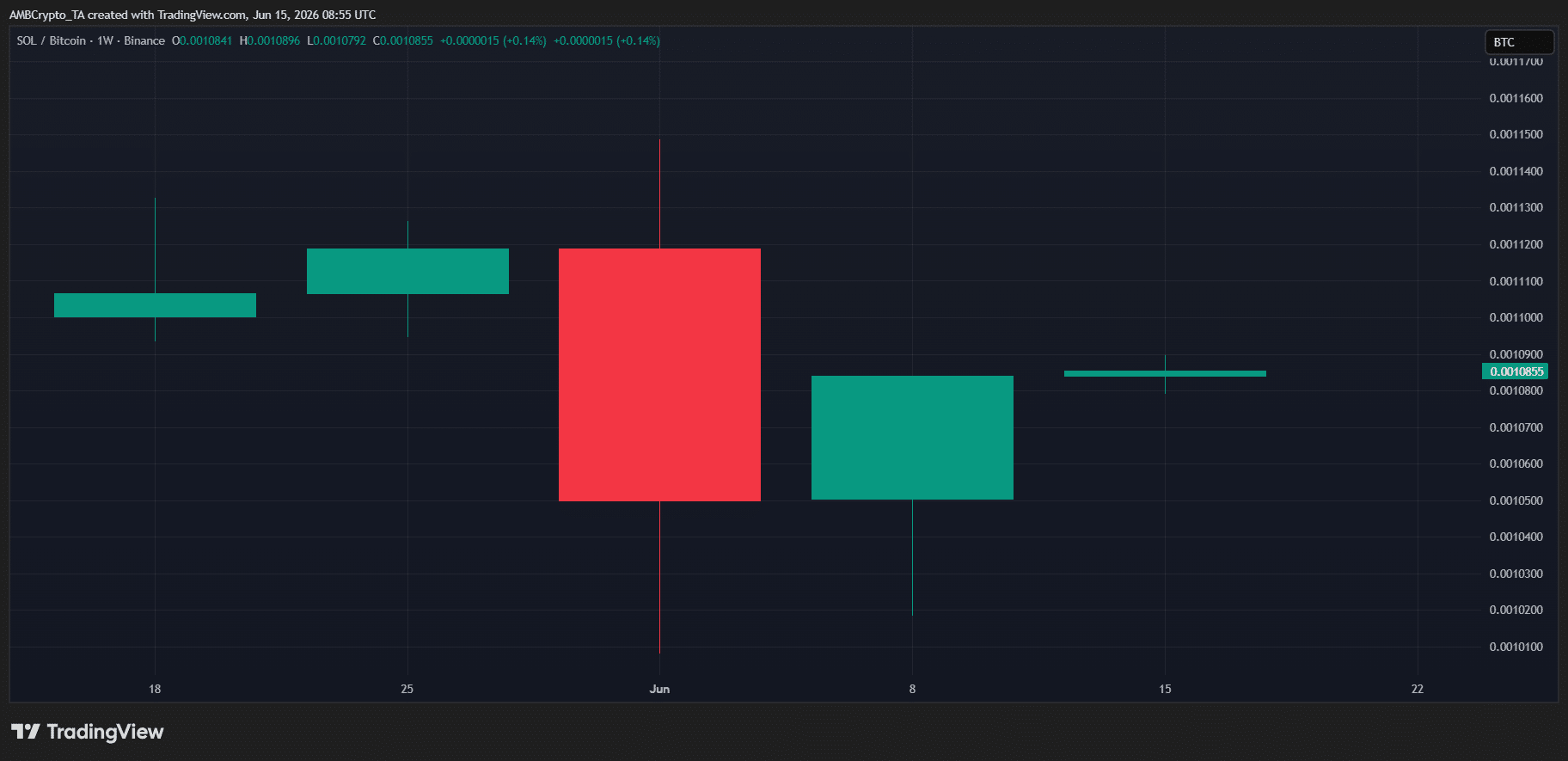
However, the more important signal is coming from the SOL/BTC ratio.

As the chart shows, the pair continues to build on last week’s 3.4% advance, extending its relative-strength breakout.

What’s more, the move marked the strongest weekly close since early May, suggesting that Solana may be starting to outperform Bitcoin on both weekly and daily timeframes as capital rotates further out the risk curve.

Solana
Source: TradingView (SOL/BTC)

The setup becomes even more interesting when compared with the ETH/BTC ratio.

Historically, strong altcoin rallies have usually been preceded by Ethereum outperforming Bitcoin during risk-on periods.

As the largest altcoin, ETH often acted as the bridge between Bitcoin and the rest of the market, with inflows into Ethereum eventually spilling over into smaller-cap assets. This cycle, however, looks different, with ETH/BTC on track for its tenth consecutive weekly decline. 

Against that backdrop, Solana’s [SOL] relative strength carries greater significance. Combined with strong on-chain activity around the SPCX launch, the move appears less like a short-term spike and more like the early stages of a broader trend heading into Q3.

On-chain activity suggests Solana’s rally is backed by fresh demand 

The past 24 hours have seen a fresh wave of capital and attention flow into Solana. 

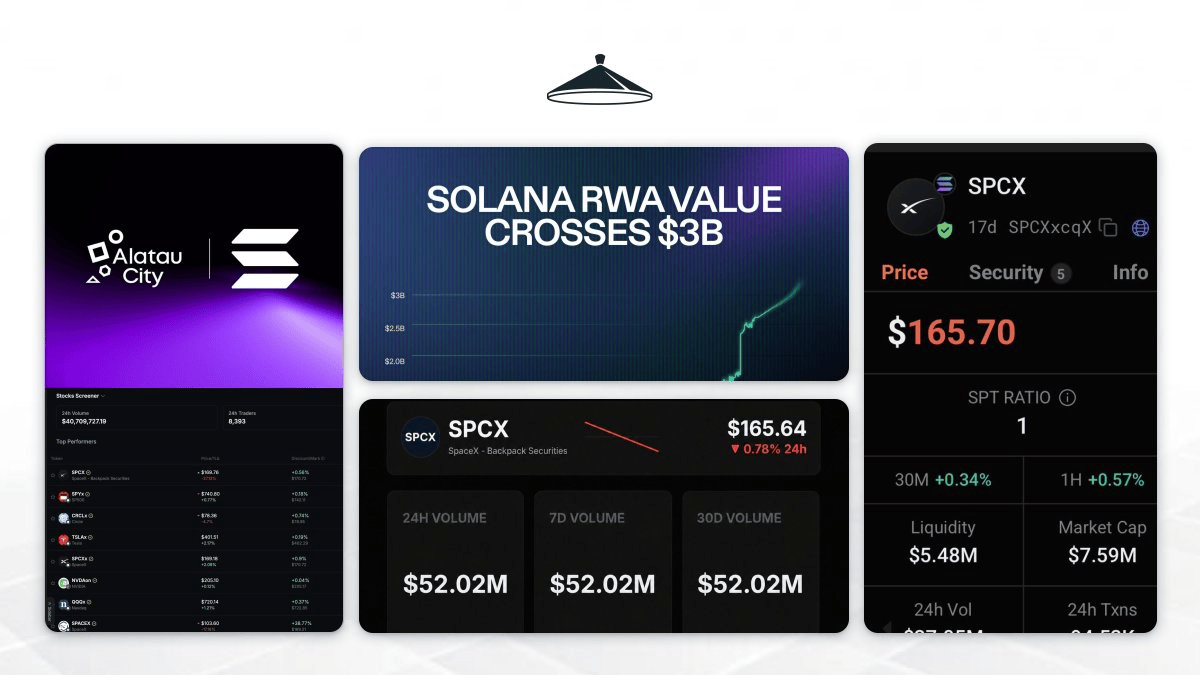
Alatau City, Kazakhstan, signed a memorandum of cooperation with the Solana Foundation.

At the same time, Solana’s RWA ecosystem crossed a new all-time high of more than $3 billion in total value. Activity around tokenized equities has also picked up, with SpaceX’s xStock (SPCX) becoming the most-traded tokenized stock on Solana after generating over $36.5 million in volume since launch. 

Notably, Backpack Securities launched SPCX on Solana on the same day SpaceX shares went live in traditional markets, with the token surpassing $50 million in on-chain trading volume within its first 24 hours.

Together, these developments suggest that Solana’s recent strength is being supported by growing network activity rather than price action alone.

SOLSOL
Source: X

That divergence puts Solana in a unique position this cycle.

While the ETH/BTC ratio continues to trend lower, signaling weak relative demand for Ethereum, SOL/BTC is moving in the opposite direction. In other words, capital isn’t just rotating back into altcoins.

Instead, it’s increasingly finding its way into Solana. If that trend continues, SOL could remain one of the key assets to watch as the market heads into Q3. 


Final Summary

  • SOL/BTC is trending higher, suggesting capital is flowing into Solana faster than Bitcoin.
  • Strong on-chain activity and growing RWA adoption indicate Solana’s rally is backed by real network demand.


Source link