Home Blog Page 357

Limelight Bank review (2026): Top rates on savings and CD accounts with few fees

0
Limelight Bank review (2026): Top rates on savings and CD accounts with few fees


Summary: Limelight Bank is the online-only division of Capital Community Bank (CC Bank), which was founded in 1993. Limelight is headquartered in Pleasant Grove, Utah. The bank offers several CDs and an HYSA, but no checking accounts are available at this time.

Limelight offers a high-yield savings account that currently earns 3.9% APY. That’s more than 10 times higher than the national average rate for savings accounts.

To open a Limelight HYSA, you’ll need to make a $100 minimum deposit. You can only open an account online, so you’ll need to transfer the funds from another bank, or send a check or wire to Limelight. 

Limelight does not offer a debit card, ATM access, or checks, so you shouldn’t open a Limelight HYSA unless you’re comfortable making all of your deposits and withdrawals online. It’s also worth noting that you can only make six transfers from your account each four-week period.

Limelight offers four different options for CDs, all with competitive interest rates. Terms range from six to 36 months and require a minimum deposit of $1,000. 

Limelight does not charge many fees, though customers may incur charges for specific services.

Pros: 

Cons: 

  • No checking accounts: Limelight doesn’t directly offer any checking accounts. If you go through the process to apply, you’ll be directed to apply for checking accounts from Limelight’s parent company, CC Bank. 

  • Limited access to accounts: HYSA account-holders do not get debit cards or checks, and customer reviews also mention difficulties logging into the bank’s apps. As a customer, this means you may end up frustrated with the limited options for making deposits, withdrawals, and monitoring your accounts. 

As a Limelight Bank customer, you may have trouble reaching customer support when you need it. Chat support is not available online. Additionally, Limelight does not post business hours for phone support. But if you call during regular business hours, your call is likely to go to voicemail. 

For other avenues of contacting the bank, you can try submitting a contact form on the website or sending an email to customercare@limelightbank.com.

Limelight does not have its own apps, so to access your account through your smartphone you’ll have to use the apps from Limelight’s parent company, CC Bank. Be sure not to confuse this for the CC Bank mobile app, which is an app for Central Cooperative Bank based in Bulgaria.

In the Apple App Store, the CC Bank Utah app has 3.7 out of 5 stars and the Google Play store lists 3.5 stars. Users of both apps report that, occasionally, the apps don’t work well and there are login issues.

The phone number for Limelight Bank is  800-639-6015. Limelight does not have any physical banking locations, but you can send mail correspondence to the following address:

Limelight Bank 
1909 W. State Street 
Pleasant Grove, UT 84062

Yes, Limelight Bank is FDIC-insured.

The routing number for Limelight Bank is 124302927.

Limelight Bank is a legitimate bank that offers several FDIC-insured deposit accounts, including a HYSA and several CDs.

Limelight Bank is the online-only division of Capital Community Bank, and it does not have any physical branches. Limelight’s headquarters are in Pleasant Grove, Utah.


Source link

Keeta: Why KTA couldn’t hold $0.24 despite a major UAE partnership

0
Keeta: Why KTA couldn't hold $0.24 despite a major UAE partnership


Keeta [KTA] has seen notable fundamental improvements that continue to shape its price action. Initially, its payment infrastructure launch drove the altcoin higher, sparking a 37% surge on strong trading activity.

Over the past 24 hours, KTA rallied another 15% at press time, after announcing a new partnership with the UAE’s ASK Group. Here’s what the deal involves:

Fundamentals and activity power KTA price action

According to a post by Keeta Network on X (formerly Twitter), the blockchain has formed a joint venture to tokenize Gulf commodities and modernize cross‑border payments across the Middle East, Africa, and Asia. These assets will be available worldwide.

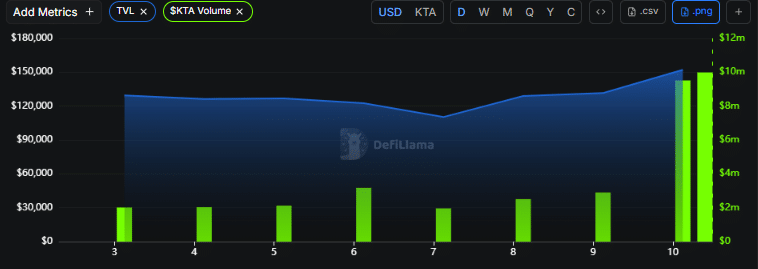
This initiative drove a shift in where on-chain volume surged by 500%, reaching $10 million. Not only was volume present, but also on-chain liquidity. Additionally, the Total Value Locked (TVL) rose by 15% in the past 24 hours, surpassing $152K. However, the figures were minimal compared to other popular blockchains.

KTA
Source: DefiLlama

Moreover, the number of KTA holders was rising, with the current reading at 22,371. As per Nansen AI, the Distribution Score was at 16, indicating healthy organic spread.

This increase in the number of holders resulted in exchange balances declining by 2.61% during this period.

Can KTA bulls sustain the rally long enough?

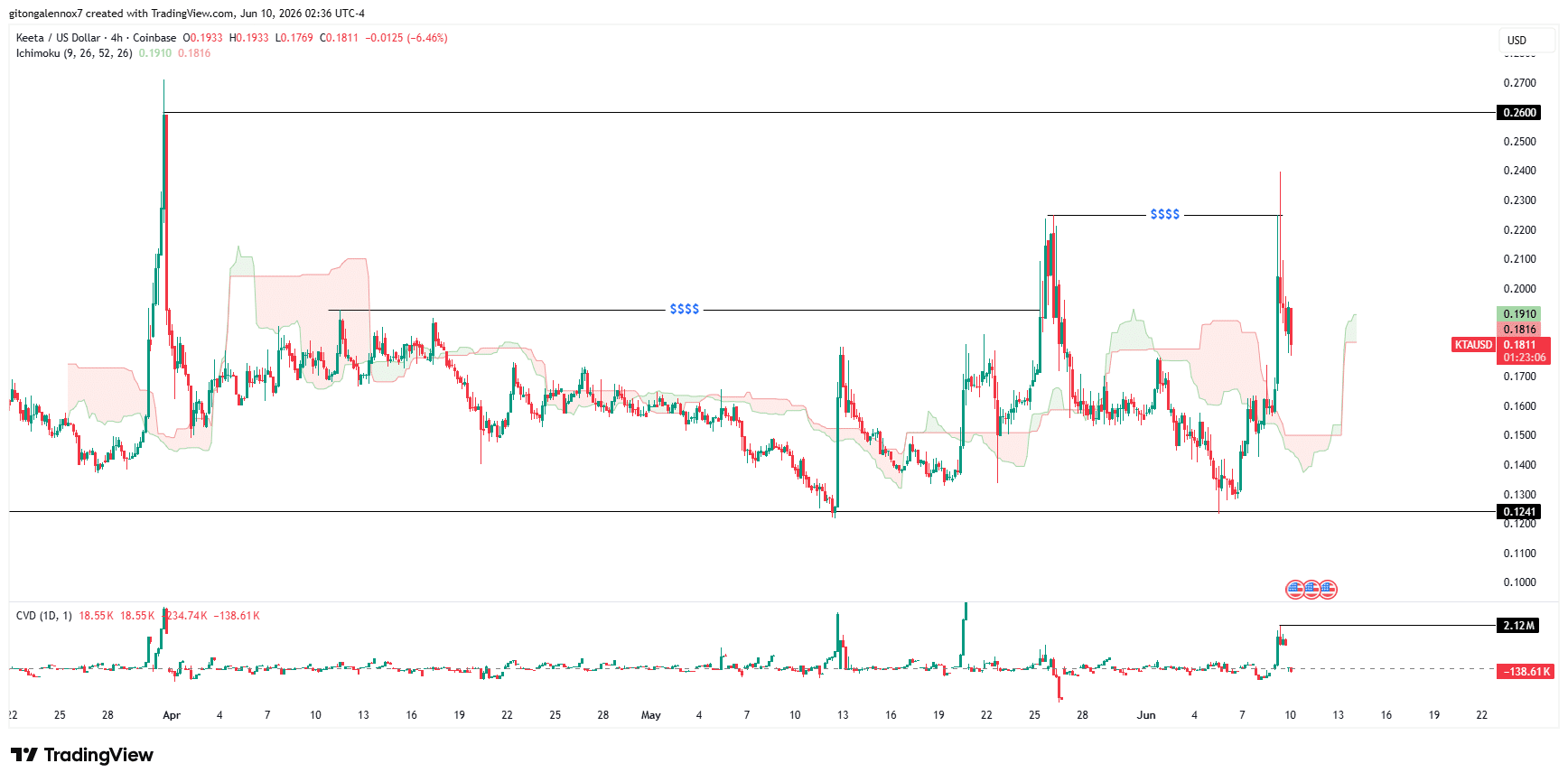
On the charts, KTA price was rising but failing to stay above previous resistance levels. It swept liquidity at $0.2252 and surged to a daily peak of $0.24 but instantly rejected this breakout.

Notably, KTA price was trading above the Ichimoku Cloud, showing bullish strength. However, its price was declining, potentially to test the flip of this indicator. Meanwhile, the significant decline in buying explains why KTA did not match the $0.26 price level.

The CVD showed a maximum of 2.12 million KTA tokens bought, but it has since declined to more than 138K tokens sold. This trend indicates that bulls are taking profits, which is why the rally cannot be maintained.

Keeta NetworkKTAKeeta NetworkKTA
Source: KTA/USD on TradingView

KTA’s price reaction to this news showed a classic ‘buy the rumor and sell the news’; hence, the token sold off after hitting $0.24. Therefore, it suggests the fundamentals alone cannot help bulls sustain this rally.


 Final Summary

  • Keeta Network rallies 15% upon partnership with the UAE’s ASK Group to tokenize commodities and modernize cross-border payments. 
  • KTA price swept liquidity at $0.24 and started declining but still stays above the Ichimoku Cloud, suggesting bulls are still present.  


Source link

Coinbase-backed Stand With Crypto calls on members to campaign against banks blocking digital asset transactions

0
Coinbase-backed Stand With Crypto calls on members to campaign against banks blocking digital asset transactions

The Coinbase-backed group Stand With Crypto UK called on its 286,000 members to file formal complaints against British retail banks over blanket restrictions on crypto transactions, it announced Wednesday.

The campaign is a demonstration against country-wide bank rules that block or cap customer transfers to exchanges, including those registered with the Financial Conduct Authority (FCA), the group said in a press release. Around 8% of UK adults hold cryptoassets, according to FCA research.

Stand With Crypto based its campaign on data from the U.K. Cryptoassets Business Council’s “Locked Out” report from January 2026. The report surveyed 10 exchanges: Coinbase, Kraken, Uphold, Xapo Bank, Zumo, Wirex, OKX, Luno, Bitpanda and Gemini.

A day after that report went out, a spokesperson for the HM Treasury, the country’s economic and finance ministry, told CoinDesk that government officials expected banks to treat all businesses fairly, including crypto services providers. “We would not expect such licensed firms to be subject to account or transaction restrictions by banking services providers,” a spokesperson said.

The FCA report found that British banks block or delay 40% of all domestic crypto transactions. Over the past 12 months, 80% of these exchanges reported a rise in the number of transfers blocked. One platform reported that banks rejected up to 1 million pounds (more than $1 million) in transactions in a single year.

The banking restrictions fall into two categories, Stand With Crypto UK said. Complete blocks are used by Chase UK, Starling, TSB, Virgin Money and Metro Bank, which stop all transfers and card payments to crypto exchanges. Hard transfer caps are set by Barclays, HSBC, Nationwide, NatWest, Santander and Monzo, which impose strict limits on the money users can transfer.

Last year, U.K.-based trading platform IG also released a damning survey saying millions of people were being locked out of crypto just because of they their banks anti-crypto stance. “Two in five (40%) UK crypto investors have had a payment blocked or delayed by their bank when trying to buy digital assets,” according to the IG report.

Advocates at SWC say these policies apply to everyone regardless of an individual’s actual risk profile. They also said that many of these same banks are hiring digital asset teams and exploring crypto products behind the scenes, making the retail customer blocks anti-competitive.

“People across the UK are being blocked from accessing a legal asset class because banks have chosen to impose blanket restrictions on an entire sector,” said Adriana Ennab, director at Stand With Crypto UK, in a statement. “From today, they are formally telling their banks that these restrictions are unacceptable.”

These blocks run counter to both local rules and the government’s stated plans to make the U.K. a global Web3 hub, SWC said. Under the Payment Services Regulations 2017, banks are obligated to execute payments that meet account conditions. In January 2026, HM Treasury explicitly stated it does not expect FCA-authorized firms to face transaction restrictions from banking providers, adding that firms must be treated fairly.

“The Government has set out a vision to make the UK a global hub for digital assets and Web3,” said Katie Harries, head of policy, Europe, at Coinbase, in a statement. “That vision requires retail participation — where every day people hold and engage with crypto assets. But the banks are choking off the crucial on-ramp from fiat (normal) money into crypto.”


Source link

MicroStrategy CFO sells company shares amid stock plunge

0
MicroStrategy CFO sells company shares amid stock plunge


The Strategy (Nasdaq: MSTR), née MicroStrategy, stock continued to decline on the price chart even days after the world’s leading Bitcoin (BTC) treasury company announced its first BTC sale in years on June 1.

The stock has lost 40% of its value over the past month and closed at $117.02 on June 9.

Related: Analysts reveal bold Bitcoin target despite AI frenzy

Bitcoin, the asset whose exposure Strategy aims to give to its investors, has lost around 25% of its value in the last month.

Following Strategy’s announcement, Bitcoin entered an even more volatile territory and was exchanging hands at $62,151 at press time.

More News:

Strategy CFO sells 1,949 shares

On June 9, Strategy CFO and EVP Andrew Kang sold 1,949 shares of Strategy for $241,362. These shares were sold in multiple transactions at prices ranging from $122.84 to $124.94.

Kang didn’t sell these shares to cash out but the proceeds from the sale went towards meeting tax obligations under the Rule 10b5-1 trading plan after he vested restricted stock units (RSUs) on June 5.

Prior to this sale, Kang acquired 4,260 MSTR shares through the settlement of RSUs on June 8.

As of June 9, he owns 71,044 shares after the reported sale.

Note that insider selling is a standard market practice in which a company executive or a major shareholder legally sells shares of their own company in the open market.

These transactions are required to be disclosed to the SEC, and executives may sell their shares for diversification, tax obligations, or other requirements. So, insider selling doesn’t necessarily indicate negative sentiment.

Related: Bank of America offers blunt advice to U.S. stock traders

This story was originally published by TheStreet on Jun 10, 2026, where it first appeared in the MARKETS section. Add TheStreet as a Preferred Source by clicking here.


Source link

Garrett Jin bets $11.9mln on Zcash – Can ZEC prove him right?

0
Garrett Jin bets $11.9mln on Zcash – Can ZEC prove him right?


Garrett Jin returned to the spotlight after opening a 2x leveraged long position on 27,723 ZEC worth approximately $11.9 million. 

The move followed the closure of a previous short position, signaling a notable shift in conviction toward the asset.

However, the market immediately challenged that decision. 

Shortly after entering the trade, the position recorded an unrealized loss of more than $812,000 as ZEC continued struggling beneath key resistance levels. 

Nevertheless, the timing of the entry attracted attention because Jin entered near a major support region rather than after a confirmed breakout. 

As a result, traders closely watched whether the whale anticipated an early recovery or simply stepped into the market before bearish pressure had fully subsided.

Top Binance traders still favor shorts

While Garrett Jin positioned for upside, Binance’s top traders largely maintained a bearish outlook. 

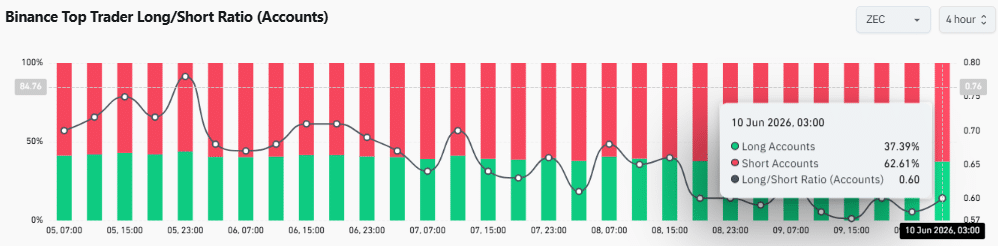
Data from the Top Trader Long/Short Ratio showed that short accounts continued to outnumber bullish positions across the exchange.

At the latest reading, only 37.39% of accounts remained long, while 62.61% held short exposure. 

The ratio stood near 0.60, highlighting persistent bearish conviction despite recent recovery attempts. 

Earlier sessions showed stronger bullish participation, yet sellers gradually regained control as sentiment weakened.

This divergence created an interesting market backdrop. A high-profile whale entered with a sizeable long position while experienced traders largely remained bearish. 

Therefore, any strong upside move could pressure short sellers. However, continued weakness would reinforce the prevailing sentiment among Binance’s top traders.

Source: CoinGlass

Can ZEC reclaim lost ground?

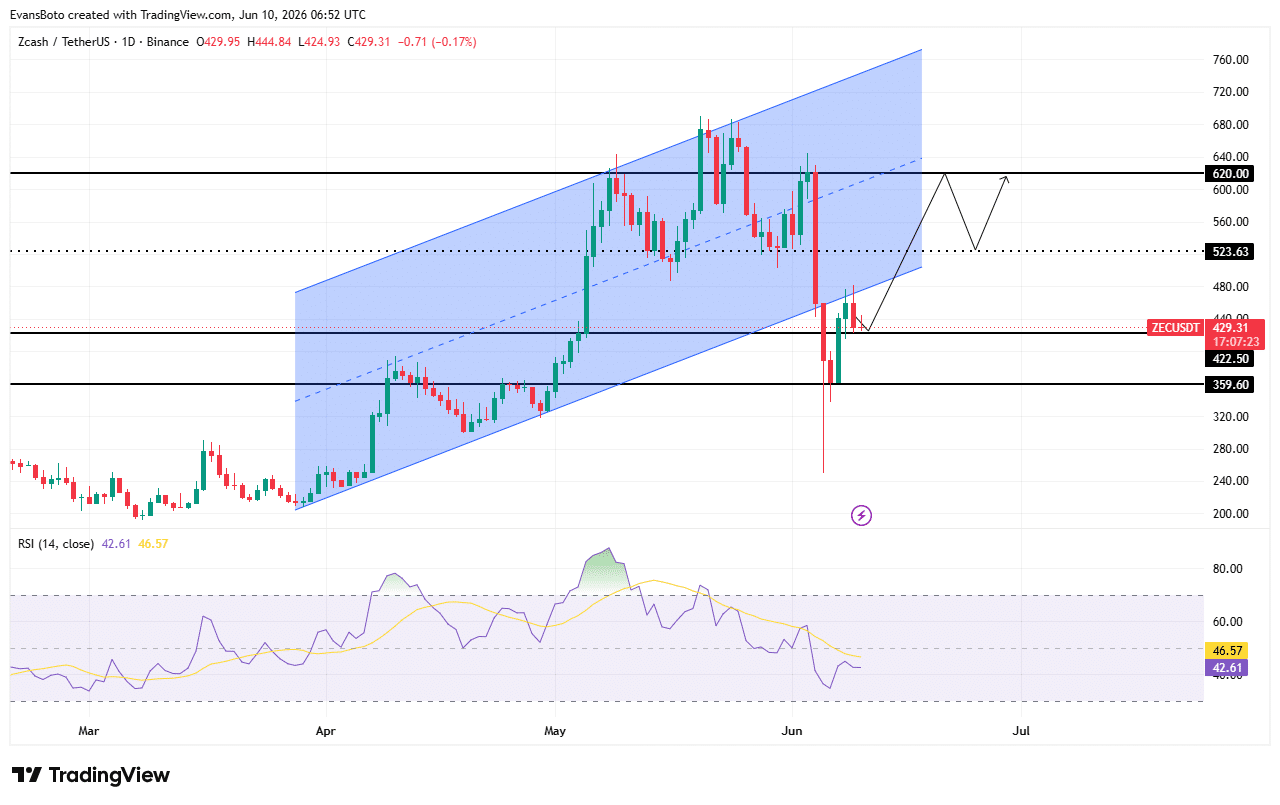
Zcash [ZEC] showed signs of stabilization after defending the $359.60 support level following a sharp decline. 

Buyers stepped in around that area and pushed the asset back above $422.50, allowing the rebound to remain intact.

Even so, the recovery faced a major obstacle at $523.63. 

That level previously acted as support inside the ascending channel before the recent breakdown shifted control toward sellers. 

Meanwhile, ZEC traded near $429, leaving buyers with significant work before confirming a broader recovery.

The RSI also reflected improving conditions. The indicator recovered to 42.61 after falling near oversold territory, suggesting that selling pressure eased considerably. 

Even so, RSI remained below the neutral 50 level, indicating that buyers had not fully regained control. If ZEC reclaimed $523.63, a move toward $620 would become increasingly likely.

ZEC price actionZEC price action
Source: TradingView

Liquidations highlight market uncertainty

Liquidation data revealed a market still searching for direction. 

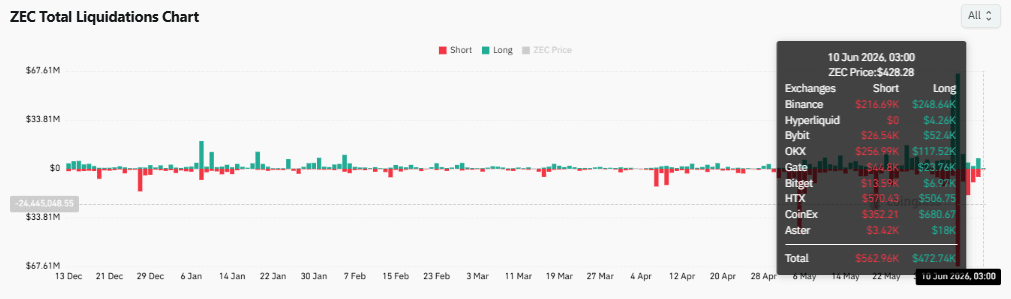
Recent figures showed approximately $562,960 in short liquidations compared to $472,740 in long liquidations.

Binance accounted for the largest share of activity, recording roughly $216,900 in short liquidations and $248,600 in long liquidations. 

Other exchanges, including Bybit, OKX, HTX, and CoinEx, also registered notable liquidations across both sides of the market.

The relatively balanced totals suggested that traders aggressively positioned for volatility rather than committing to a clear trend. 

Furthermore, the slightly higher short-liquidation figure indicated that recent rebounds caught some bearish traders off guard. 

Despite neither bulls nor bears establishing decisive control, the market is vulnerable to sharp swings around key levels.

Source: CoinGlass

Is a bigger recovery still possible?

ZEC has stabilized above the $359.60 support zone, but buyers still need to reclaim $523.63 before a stronger recovery can emerge. 

The improving RSI and recent rebound offered encouraging signs. 

However, Binance traders remained heavily short, showing that skepticism still dominated sentiment. 

If buyers overcame resistance, ZEC could target $620 next. Until then, the recovery would likely remain a work in progress.


Final Summary

  • ZEC defended major support, but resistance continues limiting recovery attempts.
  • Bearish trader positioning persists despite improving RSI and whale accumulation.


Source link

Strategy (MSTR) news: Michael Saylor gets into public back-and-forth with critics

0
Strategy (MSTR) news: Michael Saylor gets into public back-and-forth with critics

Tempers are flaring as the bitcoin bear market deepens.

Strategy’s (MSTR) latest bitcoin purchase has sparked a public debate on X between Executive Chairman Michael Saylor and bitcoin advocate Matthew Kratter over whether the company’s most recent capital raise was accretive or dilutive for shareholders.

The disagreement centers on Strategy’s own bitcoin performance metric, BTC Yield, which is designed to track changes in bitcoin holdings per assumed diluted share. According to Strategy’s latest figures, BTC Yield fell from 13.0% on June 1 to 12.8% on June 8, after the company acquired an additional 1,550 BTC.

Kratter argued that the decline shows the transaction was dilutive on a bitcoin-per-share basis. Over the same period, Strategy’s bitcoin holdings rose from 843,706 BTC to 845,256 BTC, while assumed diluted shares outstanding increased from 382.756 million to 384.180 million. BTC Gain YTD also fell from 87,754 BTC to 86,328 BTC.

Saylor pushed back, saying BTC Yield is a narrow KPI that measures only bitcoin per share, not total shareholder accretion. Saylor said the transaction also added approximately $100 million of U.S. dollar reserves, taking the total USD reserve to $1 billion, making the deal accretive when both bitcoin and cash are included.

If viewed strictly through BTC Yield, the latest raise appears dilutive. But if cash reserves and broader balance-sheet effects are included, Saylor argues that the transaction improved shareholder value.

Others jumped in. “Notice they keep changing the rules to fit the financial alchemy they’re doing,” sniped Wazz. “First $BTC yield was boasted everywhere and plastered accross every buy announcement as the standard accretive metric. Now it’s a ‘narrow KPI’ which is irrelevant.”

“As a short seller, I’ve watched innumerable companies ‘move the goalposts,’ and try and focus the market on new metrics when old ones aren’t showing the story they want them to anymore,” wrote Quoth the Raven. “Sometimes, companies outright delete key performance indicators (KPIs) and use new ones.”


Source link

Parabilis Medicines sets biotech record with $670m IPO

0
Parabilis Medicines sets biotech record with $670m IPO


Parabilis Medicines has secured the largest initial public offering (IPO) in biotech history, suggesting that an uptick of upsized public listings in the sector shows no signs of slowing.

Parabilis, a US biotech specialising in cancer therapies, has offered 33.5 million shares of its common stock at a price to the public of $20 apiece. This brings the company’s total proceeds to $670m – a record for a biotech IPO. The value could swell by a further $100m more if underwriters exercise their option to purchase an additional 5 million shares at $20 each.

The Massachusetts-based biotech, which listed on the Nasdaq under the ticker “PBLS” on 10 June, has outperformed market expectations. Originally, Parabilis expected a raise of $476m upon the initial unveiling of listing plans, but this was amended to $553m earlier this week amid high investor anticipation. The $670m raise means the IPO has exceeded forecasts.

Parabilis is pioneering a new type of peptides that it calls “Helicons”. These are stabilised helical peptides engineered to bind and precisely modulate proteins that the company says have historically been beyond the reach of conventional medicines.

The company’s lead product is zolucatetide, which targets the interaction between b-catenin and the T-cell factor family of transcription factors. This signalling pathway regulates cell proliferation and differentiation, but its hyperactivation drives cancer. Parabilis is confident in the drug’s early data, highlighting tumour reductions in 100% of patients with a 74% objective response rate in patients with desmoid tumours.

In May, the company entered into a $2.3bn collaboration and development agreement with Regeneron Pharmaceuticals to jointly explore novel oncology targets using the Helicon peptide platform.

Around $150m of the IPO raise will be used to continue the ongoing clinical development of zolucatetide in desmoid tumors, including continuation of dose expansion and the initiation of a Phase III trial. A further $120m will be used to investigate zolucatetide in other indications, such as rare tumours and a type of liver cancer.

The rest of the biotech’s early-stage pipeline, which includes ERG, ARON, and ß-catenin degraders, will benefit from a $190m tranche. Any remaining funds have been earmarked for advancement of the Helicon platform and general corporate expenses.

Biotechs crowd stock exchanges

Parabilis’ IPO comes just two months after Kailera Therapeutics – a biotech developing obesity therapies – secured $625m in a US listing. At the time, this was the largest IPO in biotech history, meaning the record has been broken twice in as many months.

Also in April, Seaport Therapeutics and Hemab Therapeutics outlined pricings for their respective IPOs. Neuropsychiatric specialist Seaport raised $255m, while Hemab – developing drugs for bleeding disorders – raised around $347m.

Eikon Therapeutics and Akis Oncology had already set a strong tone for the year, raising $381m and $318m, respectively, in January.

The value of IPOs so far this year suggests the sector is winning the battle against macroeconomic policy shifts in the US. However, it remains to be seen if a drought materialises in the middle of the year, akin to 2025.

“Parabilis Medicines sets biotech record with $670m IPO” was originally created and published by Pharmaceutical Technology, a GlobalData owned brand.


Source link