Home Blog Page 386

Ardelyx Eyes $500M+ Revenue as IBSRELA Growth Puts Profitability Within Reach

0
Ardelyx Eyes $500M+ Revenue as IBSRELA Growth Puts Profitability Within Reach


Ardelyx (NASDAQ:ARDX) executives said at the Jefferies Global Healthcare Conference that the company is focused on expanding demand for its commercial products, IBSRELA and XPHOZAH, while continuing to invest in its pipeline and positioning the business for sustainable profitability.

Chief Financial Officer Sue Hohenleitner said Ardelyx expects its two commercial products to generate more than $500 million in top-line revenue this year. IBSRELA, the company’s treatment for irritable bowel syndrome with constipation, or IBS-C, represents the largest portion of that outlook, with guidance of $410 million to $430 million. XPHOZAH, used for patients on dialysis with hyperphosphatemia, is expected to contribute $110 million to $120 million.

Palantir’s Drone Tailwind Puts Its Defense AI Story Back in Focus for Investors

Hohenleitner outlined four strategic priorities: increasing IBSRELA demand, sustaining XPHOZAH momentum, advancing the company’s pipeline and maintaining strong financial performance, including top-line growth and a healthy cash position.

IBSRELA Remains Ardelyx’s Main Growth Driver

Chief Commercial Officer Eric Foster said IBSRELA is positioned as an option for IBS-C patients who need something different after treatment with GC-C agonists such as LINZESS or Trulance. He said Ardelyx research indicates that about 77% of patients continue to have symptoms or are not satisfied on a GC-C agonist.

Best Buy’s AI Laptop Boost Sparks Hope for a BBY Turnaround

Foster said IBSRELA benefits from a unique mechanism of action as an NHE3 inhibitor, along with clinical efficacy and safety data. Ardelyx is targeting about 14,000 health care providers, including high-prescribing gastroenterologists, primary care physicians and advanced practice providers, who represent roughly half of the total prescription market the company is focused on.

Foster said IBSRELA grew 73% year over year in 2025 and 58% year over year in the first quarter compared with the prior-year period. He attributed the growth to several factors, including a larger sales force, more targeted physician engagement, improved prescription fulfillment through the IBSRELA Pharmacy Network and patient activation efforts.

3 Up-and-Coming Stocks That Could Be the Next NVIDIA

The company doubled the size of its IBSRELA sales force in late 2024 and is adding about 20 representatives, bringing the total to 144. Foster said the new representatives are expected to be in the field by July 1. Ardelyx is also adding field reimbursement managers to help physicians navigate payer requirements.

Specialty Pharmacy Network Seen as Key Lever

Foster said Ardelyx is steering more IBSRELA prescriptions through a limited specialty pharmacy network because retail pharmacies are often less suited to manage prior authorizations and other steps needed for branded products. He said prescriptions sent through the network have higher fulfillment rates and, on average, about one additional refill per year. He said average refills are around five or six annually.

“The worst thing that can happen is a physician write a prescription for a product and the patient not get it,” Foster said, describing the network as one of the company’s main growth levers.

On patient awareness, Foster said Ardelyx plans to continue investing in digital and social channels. Hohenleitner said the company is not planning a broad traditional direct-to-consumer television campaign, though Foster said targeted streaming media could be considered later this year. Hohenleitner said operating expenses are expected to rise about 25% year over year, to as much as $520 million, driven in part by high-return commercial programs and research and development spending.

Company Reiterates Longer-Term IBSRELA Ambition

Hohenleitner said Ardelyx’s goal of reaching $1 billion in IBSRELA revenue in 2029 implies about a 38% compound annual growth rate from the current guidance range, which she described as achievable based on recent growth trends. Foster said the IBS-C market remains sizable and is growing at double-digit rates, while the competitive landscape appears open over the next several years.

Ardelyx is also studying IBSRELA in chronic idiopathic constipation, or CIC. Hohenleitner said the company has dosed the first patients in a Phase 3 trial, with all pre-specified sites up and running. The trial is expected to enroll about 700 patients in a placebo-controlled, double-blind study with three active arms plus placebo. She said full enrollment is expected by the end of this year, with the trial taking about 26 weeks.

Foster said the CIC market is two to three times larger than IBS-C, though much of it is treated over the counter. He said a CIC indication could increase the overall value of IBSRELA and potentially strengthen physician confidence in the molecule. Hohenleitner also said Ardelyx recently received an Orange Book-listed formulation patent for tenapanor that extends to November 2042, complementing existing composition-of-matter and method-of-use patents.

XPHOZAH Growth Continues Despite Reimbursement Disruption

Hohenleitner said XPHOZAH guidance of $110 million to $120 million would represent growth of about 6% to 16% from the prior year. She said paid writers grew about 19% in the first quarter, while total prescriptions grew about 32%.

Foster said the hyperphosphatemia market has been disrupted during the TDAPA period, which ends at the close of 2026, but Ardelyx believes XPHOZAH will be well positioned in 2027. He said the product is indicated for use in addition to a phosphate binder and noted that many dialysis patients continue to have elevated phosphorus levels despite binder therapy.

Hohenleitner said Ardelyx continues to stand by its longer-term expectation for XPHOZAH to reach $750 million before loss of exclusivity. She said that outlook does not assume restoration of Medicare Part D coverage. The company is operating under a “business as usual” reimbursement assumption while awaiting further developments, she said.

Profitability Described as “Right Around the Corner”

On profitability, Hohenleitner said Ardelyx is not yet issuing formal profitability guidance because management wants confidence that profitability would be sustainable once achieved. She said that, depending on where revenue falls within the guided ranges, profitability could be possible this year, but the company is not ready to guide to a specific quarter.

“When we say we’re profitable, we’re profitable from here out,” Hohenleitner said. She added that the company has already laid out a capital allocation strategy focused on investing in IBSRELA, advancing its current pipeline, considering opportunistic deals and strengthening the balance sheet.

Hohenleitner also discussed Ardelyx’s preclinical compound 10531, describing it as highly soluble and potent. She said the company is evaluating it across several areas and has not yet determined whether it will become a next-generation tenapanor product or pursue another adjacent opportunity.

About Ardelyx (NASDAQ:ARDX)

Ardelyx, Inc (NASDAQ: ARDX) is a clinical‐stage biopharmaceutical company focused on discovering, developing and commercializing targeted small molecule drugs for cardio‐renal and gastrointestinal diseases. The company’s lead marketed product, tenapanor (sold under the brand name XPHOZAH in the United States), is approved for the treatment of hyperphosphatemia in patients with chronic kidney disease on dialysis. Ardelyx’s proprietary approach targets epithelial transporters in the gastrointestinal tract, offering localized activity with limited systemic exposure.

Beyond tenapanor, Ardelyx’s development pipeline includes treatments designed to address other complications in kidney disease and related metabolic disorders.

This instant news alert was generated by narrative science technology and financial data from MarketBeat in order to provide readers with the fastest reporting and unbiased coverage. Please send any questions or comments about this story to contact@marketbeat.com.

The article “Ardelyx Eyes $500M+ Revenue as IBSRELA Growth Puts Profitability Within Reach” was originally published by MarketBeat.

View MarketBeat’s top stocks for June 2026.


Source link

Bitcoin supply in loss overtakes profit, a hallmark of bear-market bottoms

0
Bitcoin supply in loss overtakes profit, a hallmark of bear-market bottoms


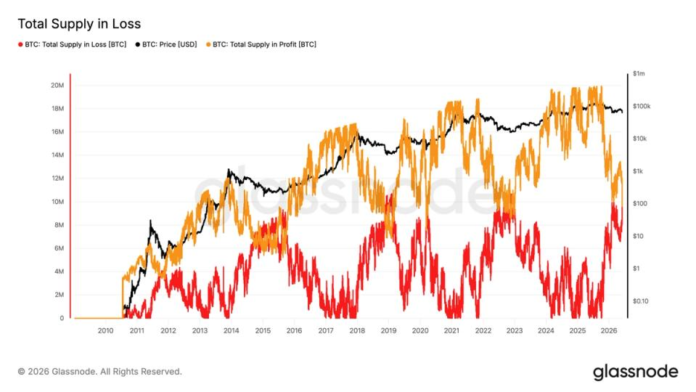
The amount of bitcoin supply in loss reached a key bear-market threshold, surpassing 10 million BTC, more than half of the total in circulation.

According to Glassnode data, at a one-hour resolution, the number peaked at about 10.5 million BTC as the price fell to as low as $61,300 on Thursday. Total circulating supply is roughly 20 million BTC, so more than half of all coins are currently held at an unrealized loss.

At the same time, supply in profit has declined to around 9.8 million BTC. This is the first time during the current market cycle that the amount of bitcoin held at a loss has exceeded the amount held in profit.

Historically, this transition has occurred only during deep bear-market conditions, and it has often coincided with major market bottoms.

Previous cycles provide some context.

During the 2015 bear market, supply in loss and supply in profit remained near equilibrium for almost a year before the market recovered. In 2019, the period lasted roughly six months. The Covid-driven capitulation in March 2020 was shorter, lasting around one month, and the 2022 bear market saw this condition persist for about six months.

The takeaway is that while this signal has historically aligned with bear-market lows, the duration of these periods has varied significantly, making it difficult to estimate how long bitcoin could remain at depressed levels.

Adding to the significance of the recent decline, bitcoin touched its 200-week moving average of around $61,300. The measure is a long-term trend indicator that calculates bitcoin’s average price over the previous 200 weeks. It has historically acted as a major support level during every bear market cycle.

Should bitcoin drop below the psychologically important $60,000 level, the next major support zone is around $54,000, which corresponds to the realized price. The realized price represents the average acquisition cost of all bitcoin in circulation based on the price at which each coin last moved onchain. Bitcoin has traded below its Realized Price during every major bear market.


Source link

Anthropic scales its most powerful AI a day after filing to IPO

0
Anthropic scales its most powerful AI a day after filing to IPO


Money is a story we agree to believe. A dollar buys a dollar’s worth because we all act as if it does, and a company is worth whatever the next buyer will pay, not a penny more.

For most of the past century, the biggest stores of that belief were countries and the giant public companies their citizens could actually own a slice of. You could buy Coca-Cola, your local bank, or the carmaker down the highway, and the value sat in plain sight on a stock exchange.

That arrangement is quietly breaking. Some of the most valuable enterprises on Earth are now private, held by venture funds and insiders rather than the public, and ordinary investors stay locked out until the company decides to let them in.

The hottest of them all just took two steps that bring it closer to your brokerage account.

Anthropic, the artificial intelligence (AI) lab behind the Claude chatbot, confidentially filed for an initial public offering (IPO) on June 1.

A day later, it scaled its most powerful model to critical infrastructure across more than 15 countries.

How AI startup Anthropic got bigger than most national economies

Anthropic, founded in 2021 by a group of researchers who left OpenAI, raised $65 billion in a Series H round on May 28.

The deal valued it at about $965 billion and pushed it past OpenAI as the most valuable AI startup in the world, according to CNBC.

More AI:

The filing drops Anthropic into a three-way sprint for the public markets. SpaceX is expected to list first, with Anthropic and OpenAI racing to be the second company ever to go public near or above a $1 trillion valuation, Axios reported.

When I ran Anthropic’s valuation against the IMF’s 2025 GDP table, the AI lab landed around the world’s 20th-largest economy, bigger than the yearly output of entire nations.

  • Anthropic’s roughly $965 billion valuation tops the 2025 gross domestic product (GDP) of Belgium, Sweden, or Argentina, based on IMF figures.

  • Only about 21 countries produced more than $1 trillion in goods and services in 2025, according to the IMF.

  • Anthropic’s revenue run rate reached about $47 billion in May, up from roughly $10 billion a year earlier, CNBC noted.

A valuation is not the same as GDP. One measures what investors will pay for a piece of a company, while the other measures a full year of a country’s output. Even so, the comparison captures something real about where wealth is pooling, and how few hands hold it.


Source link

‘Wall Street recognizes Hyperliquid’ – What makes Grayscale’s HYPG stand out?

0
'Wall Street recognizes Hyperliquid' - What makes Grayscale's HYPG stand out?


The Grayscale Hyperliquid [HYPE] Staking ETF, coded HYPG, was introduced on the 3rd of June, according to an announcement made by asset manager Grayscale.

That said, the ETF, which offers exposure to HYPE, the native token of the Hyperliquid protocol, has started trading on Nasdaq.

Furthermore, this HYPG was created to obtain staking rewards that are produced by actively participating in the network’s staking process.

How is Grayscale’s HYPG different from other HYPE ETFs? 

Surprisingly, HYPG is the most affordable way for investors to gain exposure to HYPE through an exchange-traded product because it launches with the lowest sponsor fee of 0.29% among U.S. Hyperliquid ETPs. 

For context, on the 12th of May, the Hyperliquid ETF from 21Shares, THYP, with an expense ratio of 0.30%, went live on the Nasdaq.

Three days later, Bitwise’s BHYP went live on the New York Stock Exchange (NYSE) with a promotional 0% fee for the first month, which will eventually increase to 0.34%. Hence, Grayscale’s fee of 0.29% is currently the lowest of the three options when normalized.

Remarking on the same, Eli Ndinga, the Global Head of Research at 21Shares, wrote in an email sent to AMBCrypto, 

The velocity we are seeing in US Hyperliquid ETFs, which have pulled in over $160 million in net inflows since launching, proves that Wall Street recognizes Hyperliquid as a decentralized financial powerhouse rather than just another speculative token.

HYPE ETF net flow analysis

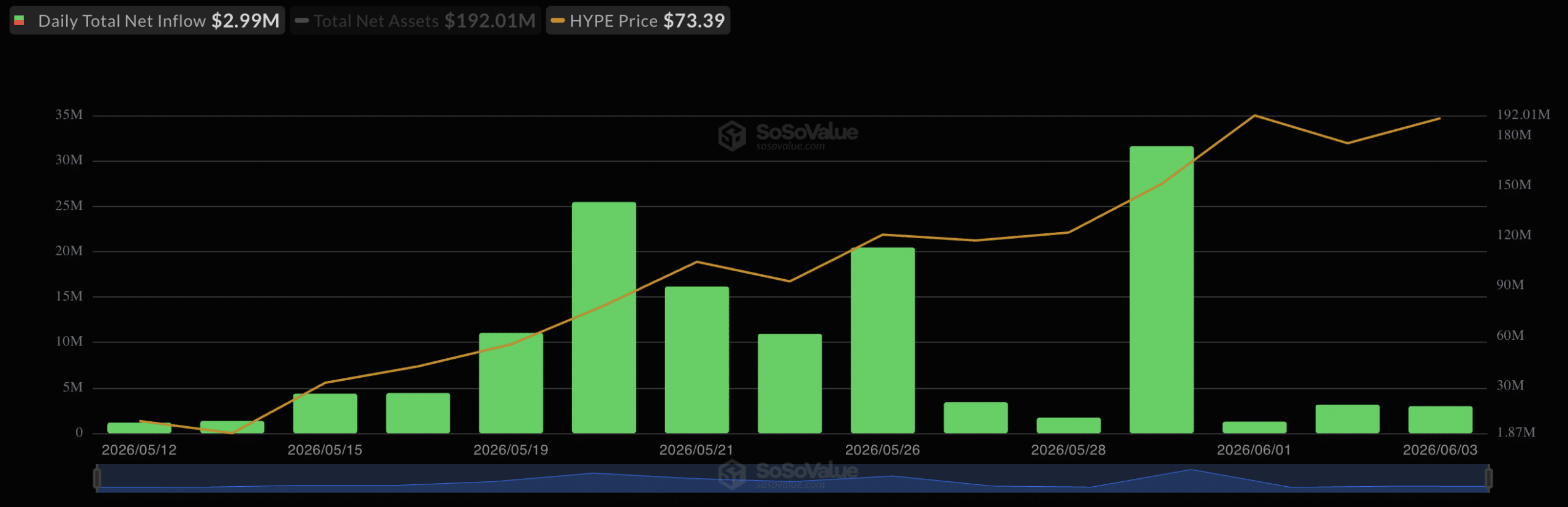
Meanwhile, according to data from SoSo values, the HYPE ETF has now reached $192.01 million. On the 3rd of June, the last recorded daily net inflow was $2.99 million. 

HYPE ETF flow
Source: SoSo Value

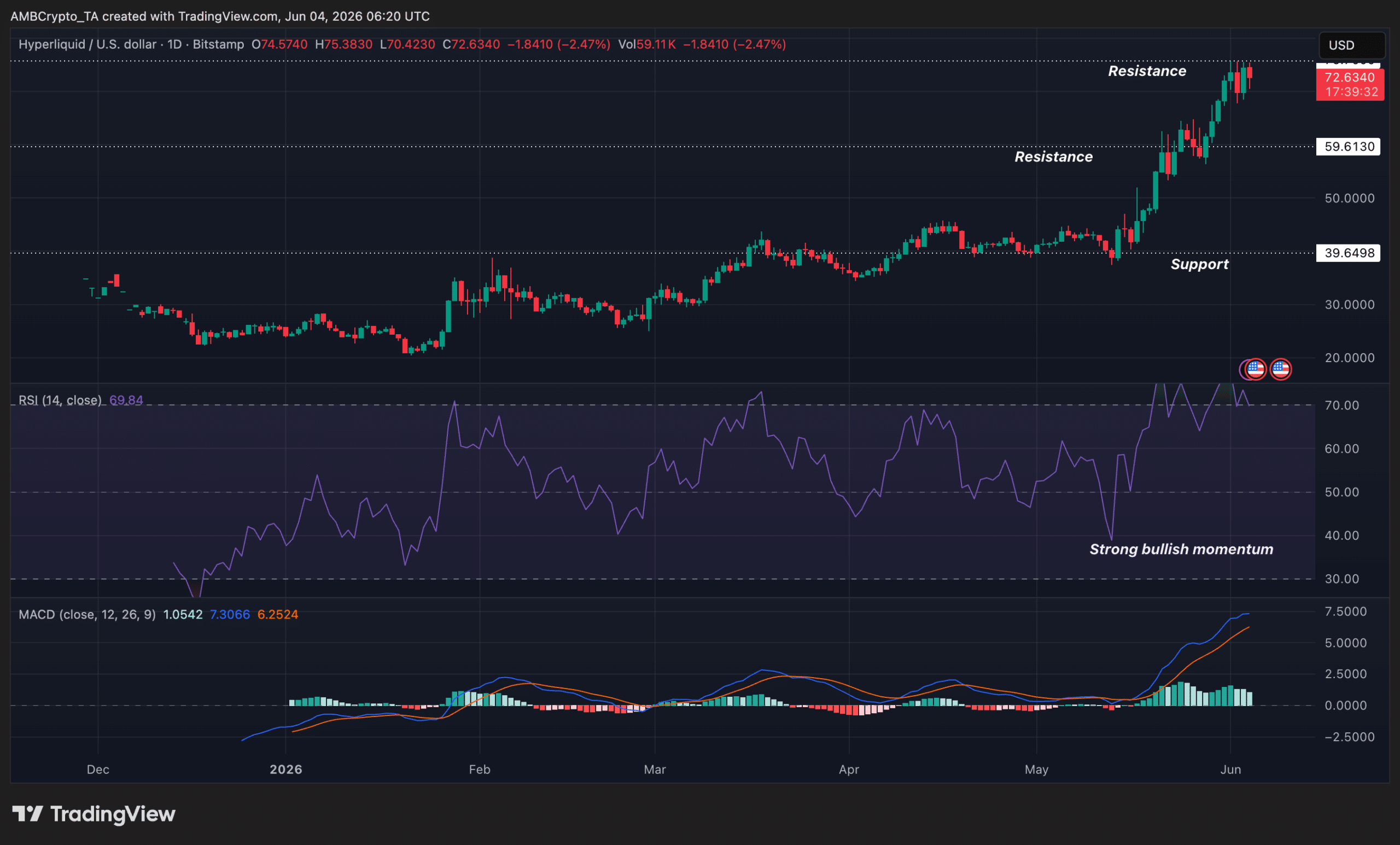
This occurred as HYPE’s price increased by 0.58% over the previous day to $72.79 at the time of publishing. The persistent bullish sentiment surrounding the altcoin was also validated by the RSI and the MACD indicator. 

HYPE price actionHYPE price action
Source: Trading View

Adding to this, Ndinga added, 

HYPE may surpass the $100 mark by the end of the year, potentially valuing it higher than TRON.

He continued by explaining that Hyperliquid has defied the trend of long redemptions of Bitcoin [BTC] and Ethereum [ETH] by routing over $170 billion in monthly volume across spot, perpetuals, and tokenized equities.

Actually, AMBCrypto also revealed that, out of all the multinational corporations, Hyperliquid had the highest revenue-to-employee ratio. It outperformed second-place Robinhood by 32 times, with $59.65 million in revenue per employee.


Final Summary

  • Grayscale’s HYPE ETF went live on the 3rd of June with a fee of 0.29%, the lowest in comparison to others.
  • The price action of the HYPE also echoed bullish sentiments, with the 21 Shares’ exec predicting that HYPE will surpass the $100 mark.


Source link

ADA under 20 cents as Hoskinson says he is ‘taking a break’ after warning of ecosystem failures

0
ADA under 20 cents as Hoskinson says he is 'taking a break' after warning of ecosystem failures

Cardano founder Charles Hoskinson said he is “taking a break” after warning that the blockchain’s ecosystem faces a coming “wave of failures,” as ADA fell below $0.20 for the first time in more than five years.

ADA is down nearly 10% on the news, according to CoinDesk market data. The token is down nearly 70% over the past year.

The comments came in response to the shutdown of TapTools, a Cardano analytics platform that said it would cease operations after four years building on the network.

“This is where we’re at as an ecosystem,” Hoskinson said in a video posted earlier this week.

The Cardano creator said he had warned earlier this year that deteriorating market conditions would force some projects to close.

“I said at the beginning of the year, we’re going to see a lot of people collapse because the markets are really bad,” he said. “There’s going to be a wave of failures in the ecosystem.”

Hoskinson also expressed frustration with what he characterized as limited community support for deploying treasury funds to support ecosystem growth.

“There doesn’t seem to be a lot of community desire to spend the treasury to take these ventures to the next level,” he said.

The remarks come days after Cardano’s community voted against funding the ecosystem’s flagship 2026 Summit conference in Singapore, forcing organizers to cancel the event.

“TTYL,” Hoskinson posted on X.


Source link

CEO says anyone who works from home is grabbing groceries or at the vet 30% of the time

0
CEO says anyone who works from home is grabbing groceries or at the vet 30% of the time

Just when you thought the dust had settled on the return-to-office wars, one startup founder has reignited the debate—accusing remote workers of sneaking off and doing life admin on company dime for a third of their working day.

Serial founder Bridger Pennington panned his camera around an office full of people still at their desks on a Friday evening to prove his point that in-office working is more productive.

“I get a lot of hate, but I’m a big believer for working in an office in person,” Pennington posted to his Threads account, where it’s racking up thousands of reactions. “You can look at the time, it is five exactly on the dock, and you can see everyone’s still working.”

The Utah-based co-founder of the startups Fund Launch and Ugly Unicorn explained that, despite offering workers incentives to work in the office—including free dinners for anyone who stays past 7 p.m.—he still faces backlash for not letting staff work remotely.

“You try that with your startup, go ahead. Good luck,” he bluntly responded to anyone pushing back on him. 

“I’ll bet your bottom dollar, Susan or Joe, whoever, on a Tuesday afternoon that’s working remote, 30% of the time they’re getting groceries, they’re running their dog to the vet, they got a kids dance recital—they’re not working, and you’re paying them full time.”

The internet fired back—and some of them do run their own companies

Pennington captioned his video, telling people to run their own company if they weren’t happy with his stance on in-office work. So naturally, founders came to his comment section to let him know they already do—and that their remote-first firms are thriving.

“Seeing this while my team helps me run a successful company from their beds or the beach, in different continents,” one user—who says she runs her own company with an entirely remote, women-only team—commented.

“No clocking in. No permission slips… I give them paid leave for periods because day two under fluorescent lighting is not it,” she said. “Daycares for their kids are covered too.”

“I do in fact run my own company. My employees are all remote and incredibly hardworking,” another user added.

Others pointed to Fund Launches’ 3.1-star Glassdoor rating as evidence that not everyone who works for the company is as happy as Pennington is with its in-office policy and company culture.

Meanwhile, remote workers took to the comments to argue how much more productive they are from home and that Pennington’s take has “micromanager written all over” it.

But Pennington pushed back, telling Fortune that in-office working is beneficial for both workers and company culture.

“Especially post-COVID, many young people want to work on something compelling, with people who work hard and build something fun together,” he said.

“That’s the culture we’ve built at Fund Launch, and it’s a cascading effect. It’s energizing, fun, and exciting to work with great people on really hard problems, especially when you know you have upside in the company you’re building.”

Workers and their bosses have very different definitions of productivity

As Pennington points out, he believes workers are less productive at home, not because of their output levels, but because he sees them having time to run errands. Whether or not his 30% figure holds up, he’s put his finger on a tension that isn’t going away: workers and employers genuinely cannot agree on what a productive day actually looks like.

Research has shown that only 25% of workers measure their productivity in any formal sense—meaning most people rely on something far more subjective, like ticking off a to-do list or simply feeling done for the day.

A key way many workers say they measure productivity is by being able to get their stuff done “without roadbacks”—something which the office is full of: The impromptu desk chats, the colleague who needs five minutes that turns into forty-five, the back-to-back meetings that could have been an email.

And yet Pennington describes being able to quickly tap a colleague on the shoulder as one of the biggest draws to working in an office.

“In person is such an advantage,” he said, while pointing to two young hires who are sitting in an open-plan office where you can overhear every conversation. “These guys all get to learn and be like around those people,” he added. “When you work in person, you can walk around and talk to people and get stuff done and just get things moving.”

Ironically, those same spontaneous interactions are precisely what remote workers cite as their biggest productivity drain when they’re in an office. 

Because while visibility may feel more productive for a manager—being able to see who’s at their desk, loop someone in on the spot, get a quick update in passing—for the individual contributor doing the actual work, those micro-interruptions compound, leaving them with less time to do their actual job.

It’s why workers and their employers may never see eye to eye on what constitutes a day well spent at work.  

Remote employees may argue they’re more productive because they can do their jobs two hours faster, sans distractions, than if they were in an office—leaving them extra time for life admin. To them, that’s proof of efficiency. But to their boss, it may look like two hours they weren’t working.


Source link

Bitcoin crash triggers billions in liquidations

0
Bitcoin crash triggers billions in liquidations


The digital assets market, which had already been struggling for months now, is now witnessing a bloodbath after Michael Saylor’s Bitcoin (BTC) treasury firm Strategy (Nasdaq: MSTR) announced the sale of 32 BTC.

The total cryptocurrency market cap has declined from $2.57 trillion on the announcement day on June 1 to $2.38 trillion at press time. So, the crypto market has lost $190 billion this month.

Bitcoin (BTC) has dropped from $73,800 to below $67,000 during the same period. It is the cryptocurrency’s worst price range since February this year.

Similarly, Ethereum (ETH) has fallen from $2,000 to $1,870, and XRP from $1.34 to $1.23 this month.

Related: Elon Musk brings back his McDonald’s Happy Meal offer

Massive liquidations hit crypto market

As the market began to bleed, traders rushed to liquidate their positions. In the past 24 hours, 266,158 traders got liquidated as per Coinglass.

$1.50 billion in long and $233 million in short crypto positions got liquidated during the same period.

Bitcoin ($773 million), Ether ($482 million), and Solana ($88 million) remained the most liquidated crypto assets during the last 24 hours.

Trending on TheStreet Roundtable:

Crypto stocks take a hit

The Strategy (Nasdaq: MSTR) stock fell only 0.50% today to trade at $135 at press time.

Bitmine Immersion Technologies (NYSE: BMNR), the leading Ether treasury firm, however, fell nearly 4% to trade at $17.30.

The Coinbase Global (Nasdaq: COIN) stock also fell 2.5% to trade at $169.75.

Robinhood Markets (Nasdaq: HOOD) fell nearly 5% to trade at $83.90 at press time. The Circle Internet Group (NYSE: CRCL) stock similarly fell nearly 5% to trade at $95.90.

Related: Analyst cuts MicroStrategy price target by 20%

This story was originally published by TheStreet on Jun 3, 2026, where it first appeared in the MARKETS section. Add TheStreet as a Preferred Source by clicking here.


Source link