Home Blog Page 403

How Stellar (XLM) became part of DTCC’s plan to bring securities onchain

0
How Stellar (XLM) became part of DTCC's plan to bring securities onchain

DTCC’s decision to connect its upcoming tokenized securities platform to the Stellar (XLM) network is the latest step in a relationship that stretches back nearly a decade, according to Stellar Development Foundation CEO Denelle Dixon.

Earlier this week, DTCC said tokenized assets held through its Depository Trust Company could become available on Stellar beginning in the first half of 2027.

The move carries weight because DTCC is one of Wall Street’s core market utilities, overseeing more than $114 trillion in assets. The Stellar integration is designed to support the issuance, settlement and lifecycle management of tokenized securities, while opening the door to future projects involving highly liquid assets such as major indexes and U.S. Treasuries

The roots of the partnership go back to Securrency, the institutional tokenization platform DTCC acquired in 2023 and became what is now DTCC Digital Assets.

Securrency, Dixon told CoinDesk in an interview, worked closely with Stellar developers on features regulated financial institutions needed to issue assets onchain, including clawback functionality, compliance controls and transfer restrictions. Those tools were later built directly into the network.

“Some of the team has been working with Stellar for a long time,” Dixon said.

The news landed as tokenization has become one of the dominant themes across both crypto and traditional finance, drawing interest from global banks and asset managers looking to move traditional financial instruments onto blockchain rails.

Tokenization refers to representing assets such as U.S. Treasury bonds, money market funds, stocks or private credit as digital tokens that can be issued, traded and settled on blockchains. Proponents argue the technology could shorten settlement times, free up collateral trapped in legacy processes and eventually allow markets to operate around the clock.

It’s potentially a huge market. Standard Chartered projected $2 trillion in tokenized assets by 2028, while BCG and Ripple forecasted a $18.9 trillion market size by 2033.

Franklin Templeton’s early bet on Stellar

Dixon argued that tokenized assets are only the visible layer of a broader infrastructure shift.

“Blockchain is excellent at books and records,” she said. “Tokenization is the product outcome, but it’s all these underlying components that are really important.”

That focus on record-keeping was one reason Franklin Templeton selected Stellar for its onchain money market fund, BENJI. Dixon said the asset manager began exploring Stellar in 2019 and later launched the fund in 2021, aiming to place fund records on a single shared ledger rather than relying on multiple databases.

BENJI became one of the earliest examples of a regulated tokenized fund and helped pave the way for today’s tokenized Treasury market, which has grown to roughly $15 billion with BlackRock, JPMorgan, Fidelity entering the ring.

Making public blockchains work for regulated finance

For institutions, however, moving assets onchain requires more than faster settlement.

Regulated firms must comply with securities laws, sanctions requirements and investor protections, creating demand for blockchain infrastructure that can support identity checks, transfer restrictions and other compliance controls.

That need for compliance-ready infrastructure is one reason Stellar’s long-standing relationship with Securrency proved valuable, Dixon said.

Stellar’s architecture allows issuers to add compliance, identity controls and privacy protections on top of an open network, she said. Asset issuers can decide whether transfers require know-your-customer (KYC) checks, whether assets can be frozen or clawed back and what transaction information remains visible.

“The base layer is always going to be open,” Dixon said. “Then the institution gets to decide how compliance and privacy come into play.”

Source link

Why Ethena traders are watching $0.079 before a $23.6M ENA unlock

0
Why Ethena traders are watching $0.079 before a $23.6M ENA unlock


Fresh concerns arose after wallets linked to the Ethena team deposited 7.524 million ENA, worth about $672,000, to Binance. The timing drew attention because the transfers occurred just before more than 267 million ENA, valued at $23.6 million, approached its scheduled unlock period between the 2nd and 5th of June. 

Traders often view exchange deposits as a sign that tokens could become available for sale, especially when they originate from project-related wallets. As a result, sentiment weakened across the market. 

The timing also intensified focus on Ethena’s supply dynamics because ENA has struggled to establish a sustained recovery recently. 

Exchange inflows point to rising sell-side risk

Recent exchange flow activity has reinforced concerns surrounding potential supply pressure. 

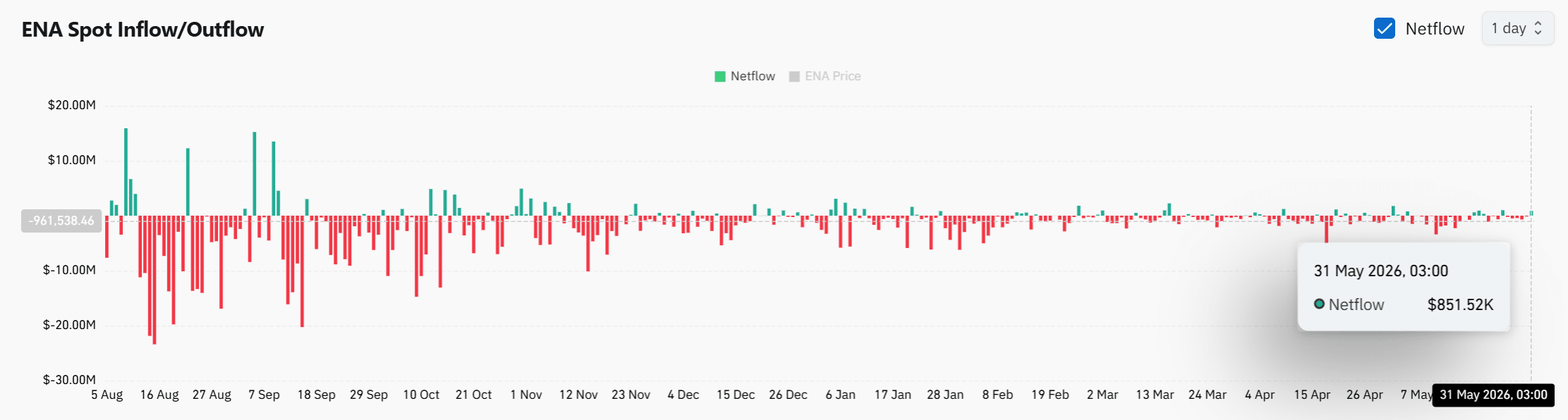
Spot Inflow/Outflow data showed a positive Netflow of approximately $851.52K, indicating that more ENA moved onto exchanges than left them. Positive netflows often suggest that traders are positioning tokens on trading venues rather than moving them into long-term storage. 

Although the latest inflow remained relatively small compared to historical spikes, it aligned with the recent Binance deposits from team-linked wallets. In addition, the shift stood out because ENA’s broader netflow trend had largely favored outflows over the past several months. 

Consequently, the latest reading suggested that market participants may have become more cautious as the token unlock period approached.

Source: CoinGlass

Can ENA turn support into a recovery?

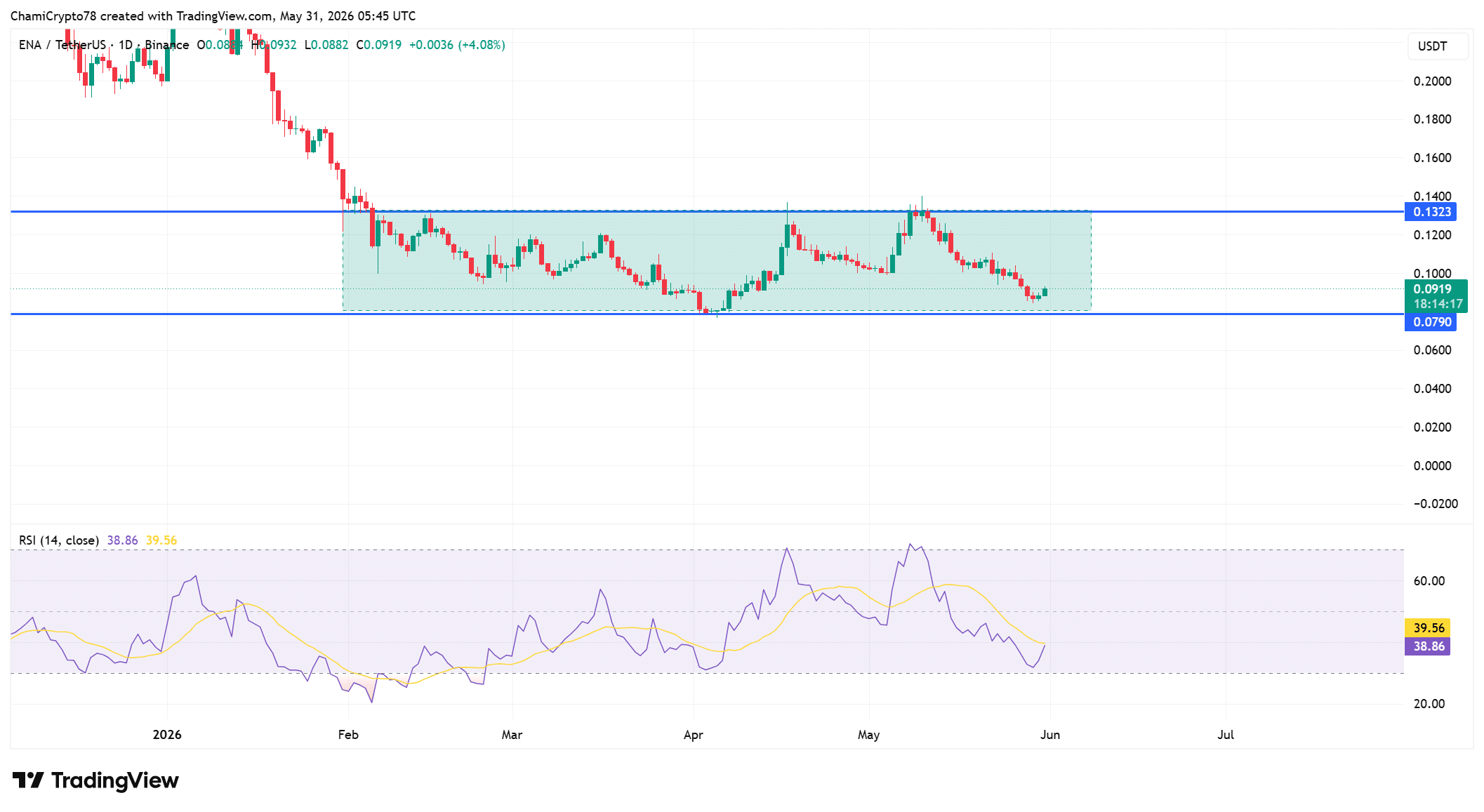
ENA continued trading inside its multi-month range between $0.0790 support and $0.1323 resistance, while recent price action showed buyers defending the lower boundary. 

After approaching support, the token rebounded to $0.0912, posting a 3.44% daily gain as demand returned near the range floor at press time. This reaction suggested buyers remained active despite concerns surrounding team-linked Binance deposits and the upcoming token unlock. 

The RSI also supported the recovery attempt. Although the indicator remained below the neutral 50 level at 38.86, it had rebounded from recent lows and started curving higher.

The shift highlighted that bearish pressure had eased compared to previous sessions. If buyers continue defending support, ENA could challenge the middle of the range. However, failure to sustain the rebound would place the $0.0790 support zone back under pressure.

ENA price actionENA price action
Source: TradingView

Short sellers regain the upper hand

Derivatives data revealed growing confidence among bearish traders despite the recent price bounce. 

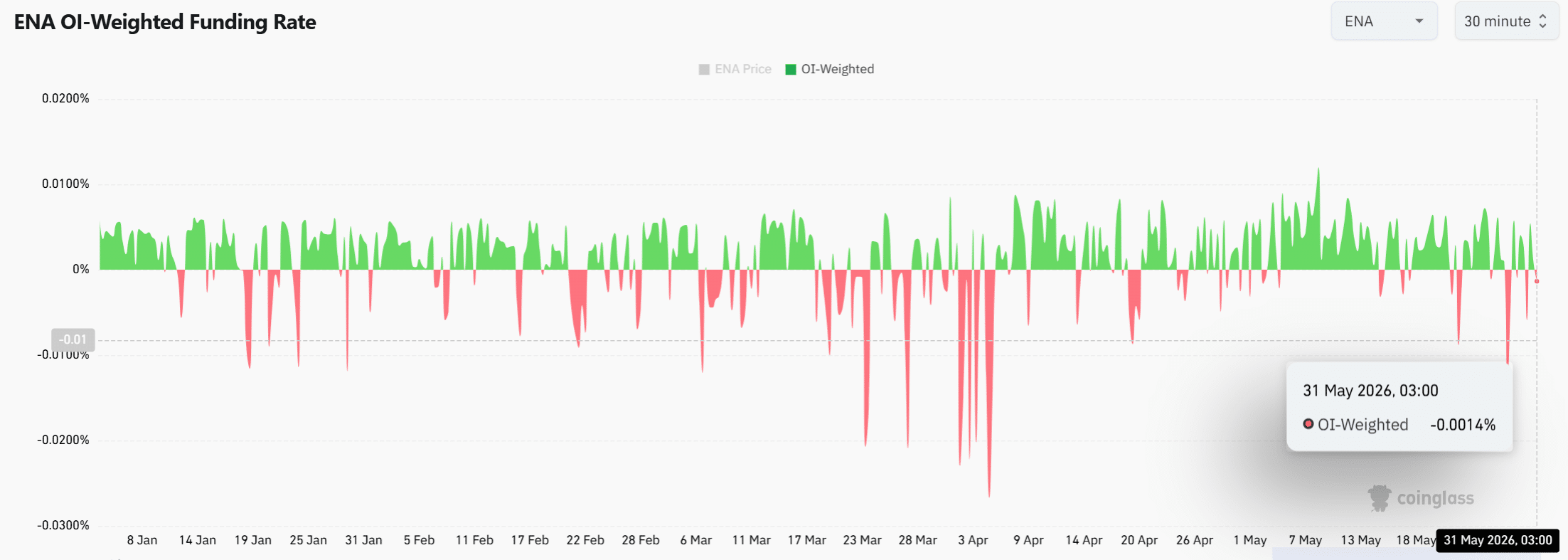
At the time of writing, the OI-Weighted Funding Rate declined to approximately -0.0014%, showing that traders increasingly paid to maintain short exposure. 

Negative funding rates generally indicate stronger demand for short positions than long positions. This development aligned with concerns surrounding exchange inflows and the upcoming unlock event. 

Furthermore, funding rates had fluctuated around neutral levels throughout recent months, making the latest move notable. While negative funding reflected cautious sentiment, it also highlighted the possibility of a future squeeze if ENA unexpectedly strengthened. 

For now, however, derivatives positioning suggested that traders remained hesitant to bet aggressively on a sustained recovery.

Source: CoinGlass

To sum up, ENA has entered a critical period as exchange deposits, positive netflows, and negative funding rates have increased focus on upcoming supply expansion. 

Even so, buyers have defended the $0.0790 support zone and pushed the price back to $0.0912, while the RSI has started recovering from recent lows. 

If demand continues absorbing incoming supply, ENA could extend its rebound toward higher levels within the range. However, a failure to absorb unlock-related selling would likely place support under renewed pressure.


Final Summary

  • Team-linked deposits and rising exchange inflows have increased ENA supply concerns.
  • ENA has rebounded from support, but unlock pressure remains a key risk.


Source link

Is Gibraltar Industries Stock a Buy After the CEO Purchased Nearly 20,000 Shares?

0
Is Gibraltar Industries Stock a Buy After the CEO Purchased Nearly 20,000 Shares?


On May 26, 2026, Gibraltar Industries, Inc. (NASDAQ:ROCK) President and CEO William T. Bosway reported an open-market purchase of 19,735 common shares at around $37.44 per share, according to the SEC Form 4 filing.

Transaction summary

Metric

Value

Shares traded

19,735

Transaction value

$739,000

Post-transaction shares (direct)

250,320

Post-transaction value (direct ownership)

$9.37 million

Transaction and post-transaction values based on SEC Form 4 reported price ($37.44).

Key questions

  • How does this purchase compare to Bosway’s historical trading activity?
    Bosway has not reported any open-market sales in the past two years, and this acquisition is the largest single-day buy in the available record, with all recent trades reflecting incremental increases in direct holdings.

  • What is the impact of this transaction on Bosway’s overall equity exposure?
    This purchase raised direct common stock holdings by 8.56%, and, when including restricted stock units, Bosway’s total beneficial interest remains diversified across both common and restricted equity classes.

  • Was the transaction timed relative to market performance or price dislocation?
    The buy occurred after a one-year share price decline of 38.3% (as of May 26, 2026), increasing Bosway’s exposure following a substantial share price drop over the prior year.

  • Does the purchase signal a shift in insider sentiment or strategy?
    Given the absence of recent sales and the ongoing accumulation of both common shares and restricted stock units, this transaction reinforces a commitment to equity ownership rather than a change in disposition strategy.

Company overview

Metric

Value

Revenue (TTM)

$1.2 billion

Net income (TTM)

($133.0 million)

Price (as of market close May 26, 2026)

$37.48

1-year price change

(38.3%)

* 1-year price change calculated using May 26, 2026 as the reference date.

Company snapshot

  • Gibraltar Industries manufactures and distributes building products for the renewables, residential, agtech, and infrastructure markets, including solar racking, mail and package solutions, greenhouse systems, and bridge protection products.

  • It operates through four business segments — Renewables, Residential, Agtech, and Infrastructure — generating revenue primarily from product sales, engineering, and installation services.

  • The company serves solar developers, commercial and institutional growers, home improvement retailers, wholesalers, distributors, and contractors across North America and Asia.

Gibraltar Industries, Inc. is a diversified manufacturer with a focus on engineered building products and solutions, operating at scale with over 2,000 employees and $1.2 billion in annual revenue. The company leverages its multi-segment structure to address growing demand in renewable energy, residential construction, and agricultural technology markets.


Source link

The institutional edge: moomoo targets Wall Street-grade crypto tools for retail investors

0
The institutional edge: moomoo targets Wall Street-grade crypto tools for retail investors

Retail investing platforms have spent a number of years racing to become “everything apps” for finance, piling on stocks, crypto, banking and payments in a bid to keep users inside a single ecosystem.

But for moomoo, the next battle isn’t about who offers the most assets.

It’s about who gives retail investors the same level of intelligence and execution long reserved for Wall Street institutions.

“We want to democratize access to the best tools that have historically only been available to institutional investors,” Albi Mema, director of crypto operations at moomoo U.S., told CoinDesk in an interview. “A decade ago the issue was access. Now it’s the quality of access.”

“Moomoo is built for the retail investor who has outgrown basic trading apps. Today’s retail investors are more informed, more engaged, and more demanding than ever,” according to Mema. “They do not just want access to markets, they want better data, better tools, better education, and more context around the decisions they make,” he added.

Global platform

Moomoo is a global trading platform that offers retail investors access to stocks, options, exchange-traded funds (ETFs) and cryptocurrencies through a single app. The company focuses on combining low-cost trading with institutional-grade market data, analytics and investing tools for self-directed traders.

The New York-based firm, which says it has more than 30 million global users, $156 billion in client assets and nearly $1.9 trillion in annual trading volume, is betting that retail traders increasingly want sophisticated analytics, AI-assisted trading and institutional-style execution tools rather than simply another crypto venue.

That positioning comes as brokerages across both crypto and traditional finance push toward the “one-stop shop” model. Robinhood (HOOD), Kraken and Coinbase (COIN) have all expanded beyond their original products in recent years, blending equities, derivatives, payments and digital assets into broader financial platforms.

Mema argues moomoo’s differentiator is not aggregation alone, but the depth of tooling layered on top of it.

“The next generation of retail investors won’t be defined by who offers the most assets,” he said. “It will be about who helps investors make the best decisions across those assets.”

Retail traders

Retail investors are increasingly seeking institutional-grade analytics, execution capabilities, and AI-powered trading tools which drive trading assistance into the platform.

“Retail investors are building positions, measuring volatility and thinking long term,” he said. “They’re trading alongside some of the best and brightest.”

The company’s no-code algorithm builder allows users to scan markets for technical patterns, backtest strategies and automate trading signals.

Traders can also share strategies with the broader community, creating what Mema described as a collaborative “trading floor” dynamic for over 30 million retail participants.

Mema says retail crypto traders often experience significantly worse execution speeds and slippage than institutions, with some retail orders taking hundreds of milliseconds to settle compared with institutional systems that operate in tens of milliseconds or faster.

“If you’re getting rinsed on slippage, that puts you at a disadvantage as a crypto user,” he said. “We are bringing institutional-level execution to retail.”

The firm is also pushing deeper into tokenization. Moomoo recently joined Figure Markets’ onchain public securities initiative and partnered with Figure (FIGR) and BitGo (BTGO) on tokenized secondary market offerings.

“We think the future is hybrid. Traditional markets are not disappearing. Blockchain-native markets are not replacing everything tomorrow,” Mema says. “But the two are starting to converge, and platforms that can bridge those worlds responsibly will be well positioned,” he added.

Read more: Gemini taps SpaceXAI to build a personalized prediction markets feed


Source link

Quantum Computing Just Hit Commercial Viability and These 3 ETFs Sit on Top of the Compute Transition

0
Quantum Computing Just Hit Commercial Viability and These 3 ETFs Sit on Top of the Compute Transition


Quick Read

  • Defiance Quantum ETF (QTUM) holds pure-play qubit makers and quantum-adjacent semiconductors with 45% year-to-date and 86% one-year returns via equal-weighted exposure to IonQ, Rigetti, D-Wave, and quantum research divisions at IBM and Alphabet. ARK Autonomous Technology & Robotics ETF (ARKQ) returned 25% year-to-date through active management of quantum-adjacent semiconductor and control electronics makers like Teradyne and AMD. Global X Robotics & Artificial Intelligence ETF (BOTZ) is up 11% year-to-date with $3.44B in assets, offering picks-and-shovels exposure through industrial automation names like FANUC and Keyence that fabricate qubit chips and cryogenic enclosures.

  • The Department of Commerce allocated $2 billion in CHIPS Act funding to nine quantum companies on May 21, 2026, validating the shift from speculation to concrete commercialization, while IBM’s error-correction breakthroughs and Google’s Willow chip benchmarks have moved the conversation to which quantum modality scales first.

  • Act now: the analyst who called NVIDIA in 2010 just named his top 10 AI stocks — and ARK Autonomous Technology & Robotics didn’t make the cut. Grab the names FREE today.

The quantum computing trade has shifted from a speculative bet to an identifiable, investable theme, and the three exchange-traded funds that best capture it each take a different angle on the same transition. Defiance Quantum ETF (NYSEARCA:QTUM) holds a pure-play roster of qubit makers and quantum-adjacent semiconductor companies. ARK Autonomous Technology & Robotics ETF (NYSEARCA:ARKQ) layers active management over an autonomous-tech mandate that touches the same compute build-out. Global X Robotics & Artificial Intelligence ETF (NASDAQ:BOTZ) provides picks-and-shovels exposure through industrial automation and AI hardware.

The catalysts are concrete, and on May 21, 2026, the Department of Commerce announced about $2 billion in CHIPS Act letters of intent to nine quantum companies, including $100 million each for D-Wave, Rigetti, Quantinuum, PsiQuantum, Atom Computing, and Infleqtion. That federal capital builds on IBM’s error-correction milestones and Google’s Willow chip benchmarks, which have shifted the conversation from “will quantum work” to “which modality scales first.” Performance has tracked the narrative: QTUM is up 45% year-to-date and 86% over the last 12 months.

QTUM: The Most Direct Bet on Qubit Commercialization

QTUM is the only ETF on this list designed around the quantum thesis itself. The fund tracks the BlueStar Quantum Computing and Machine Learning Index, holding the listed pure-plays (IonQ, Rigetti, D-Wave, Quantum Computing Inc.) alongside larger platform owners that house quantum research divisions, including IBM, Alphabet, and Honeywell. That basket is what gives the fund its claim to being the only quantum-specific ETF, because the index methodology explicitly screens for companies whose business activities tie back to quantum computing or machine learning, rather than letting a generic tech sleeve dominate the weighting.

Act now: the analyst who called NVIDIA in 2010 just named his top 10 AI stocks — and ARK Autonomous Technology & Robotics didn’t make the cut. Grab the names FREE today.

The expense ratio sits at 0.40%, competitive for a thematic fund this narrow. The portfolio is roughly equal-weighted, which matters more than it sounds: a market-cap weighted basket would be dominated by IBM, Alphabet, and a few semiconductor giants, diluting the pure-play exposure to IonQ and Rigetti that most investors want. Equal weighting keeps the small qubit companies meaningful contributors to returns.

The tradeoff for investors is volatility. When IonQ or Rigetti rise on a CHIPS funding headline, QTUM captures it directly. When those names are reduced by 30% due to a missed milestone, the fund feels it sharply. The recent move tells that story, with QTUM up roughly 23% over the past month.

ARKQ: The Active Overlay on Compute and Autonomy

ARKQ takes a different path to similar end markets. The fund is actively managed with a mandate to invest at least 80% of assets in autonomous technology and robotics companies, giving portfolio managers latitude to lean into quantum-adjacent names without being bound by an index. Net assets stand at $2.1 billion, and the expense ratio is 0.75%, the cost of active management in a thematic wrapper.

The top holdings show how that mandate translates into compute exposure. Tesla anchors the fund at about 10%, followed by Teradyne at around 7% and Kratos Defense at around 5%, with Advanced Micro Devices and Palantir each at around 8% and 3%, respectively. The semiconductor and testing names matter for the quantum thesis because qubit systems need classical control electronics, cryogenic test infrastructure, and AI orchestration software to operate. Teradyne builds the test equipment, AMD provides the classical compute layer, and Palantir handles the data workflows that quantum simulations will eventually plug into.

ARKQ has returned 25% year-to-date and 76% over the past year. It’s worth noting that 10 positions account for more than half of the fund, and a drawdown in Tesla moves the whole portfolio. Investors who want active conviction with quantum-adjacent positioning, rather than direct qubit exposure, find that here.

BOTZ: The Picks-and-Shovels Inclusion

BOTZ takes the broadest approach of the three. The fund manages roughly $3.44 billion in net assets, making it the largest of the three by a wide margin, and concentrates in industrial robotics, machine vision, and AI compute hardware. The case for including it in a quantum-themed portfolio rests on a single mechanism: every quantum system shipped requires a stack of classical infrastructure underneath it, and that stack is exactly what BOTZ owns.

Keyence sits at roughly 9% of net assets, ABB at about 9%, FANUC near 9%, and NVIDIA around 8%. NVIDIA is the obvious AI compute exposure, but the industrial automation names matter because the Japanese and European robotics leaders supply the precision manufacturing equipment that fabricates qubit chips, photonic packages, and cryogenic enclosures. The fund holds 51 positions across roughly a dozen automation verticals, with heavy weighting toward Japan.

Year to date, BOTZ is up 11%, with a one-year return of 30%. The lag versus QTUM reflects the trade-off: less direct quantum upside, but also less drawdown risk when a single-qubit company misses a milestone. The five-year return of 19% is a reminder that broad automation exposure does not always compound as much as pure thematic plays do during a hype cycle.

How to Choose Between Them

QTUM is the right vehicle for someone who wants direct exposure to the qubit commercialization trade and accepts that the equal-weight methodology will deliver both the upside and the volatility of the small pure-plays. CHIPS funding announcements and milestones from IBM and Google are the kinds of catalysts that move this fund the most.

ARKQ fits the investor who wants active management and is comfortable with a concentrated, conviction-driven portfolio that touches quantum themes through the semiconductor, defense, and AI software layers rather than directly through IonQ and Rigetti. The Tesla weighting means the fund’s performance will often have little to do with news about quantum.

BOTZ is the structural holding, as it offers exposure to the compute and automation infrastructure that benefits regardless of which qubit modality wins, positioning that may age well if the commercial timeline stretches past current expectations, though it will not match the return profile of QTUM during a quantum melt-up. Investors who want all three angles can blend the funds, weighting toward QTUM for thematic intensity and toward BOTZ for diversification across the broader compute transition.

Act now: the analyst who called NVIDIA in 2010 just named his top 10 AI stocks — and ARK Autonomous Technology & Robotics didn’t make the cut. Grab the names FREE today.


Source link

XRP did not break down despite a major inflow shock – Explained!

0
XRP did not break down despite a major inflow shock – Explained!


Ripple [XRP] spent much of late May under pressure as traders reacted to broader market weakness and declining risk appetite. As sentiment deteriorated, exchange activity surged, revealing how participants positioned around the recent selloff.

On the 28th of May, Exchange Inflows jumped by 22.8 million XRP, marking the largest transfer onto exchanges this year.

Such moves typically signal rising sell pressure as holders prepare to exit positions. Yet the market responded differently.

Source: Santiment

Rather than extending lower, XRP stabilized near a 15-week low, suggesting buyers absorbed much of the incoming supply.

That shift became more apparent afterward. Between the 29th and 30th of May, roughly 25.24 million XRP moved back off exchanges, exceeding the previous inflow and pointing to renewed accumulation beneath the surface.

Declining supply strengthens XRP’s bottoming case

XRP’s exchange flow reversal already suggested stronger hands were absorbing supply from weaker participants. Beyond those withdrawals, broader on-chain metrics now show that the shift is becoming more visible.

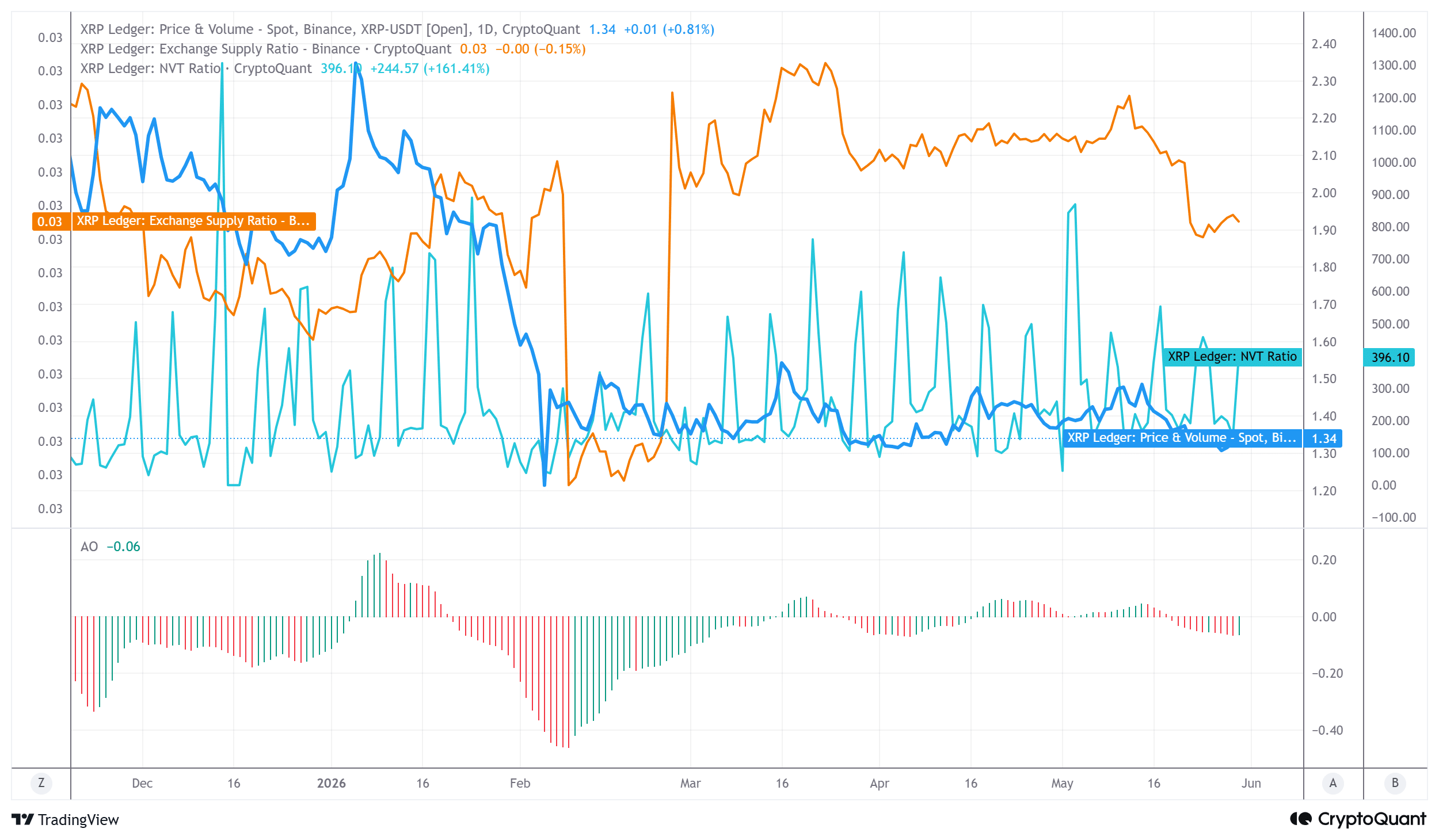
Exchange supply continues trending lower, with the Exchange Supply Ratio holding near 0.03. This decline reflects investors moving XRP into self-custody, reducing coins available for immediate selling.

Source: TradingView

The valuation picture also appears healthier.

In fact, the Network Value to Transactions (NVT) Ratio, which compares market value against transaction activity, has moderated toward 396 after earlier extremes. This suggests network usage increasingly supports valuation.

Meanwhile, XRP’s momentum remains neutral, with the Awesome Oscillator (OA) near -0.06. Yet declining supply and improving network efficiency are gradually reducing bearish pressure.

As selling liquidity tightens, buyers may need less capital to influence price direction, strengthening conditions for a durable market bottom.

XRP’s tight range reflects a market in transition

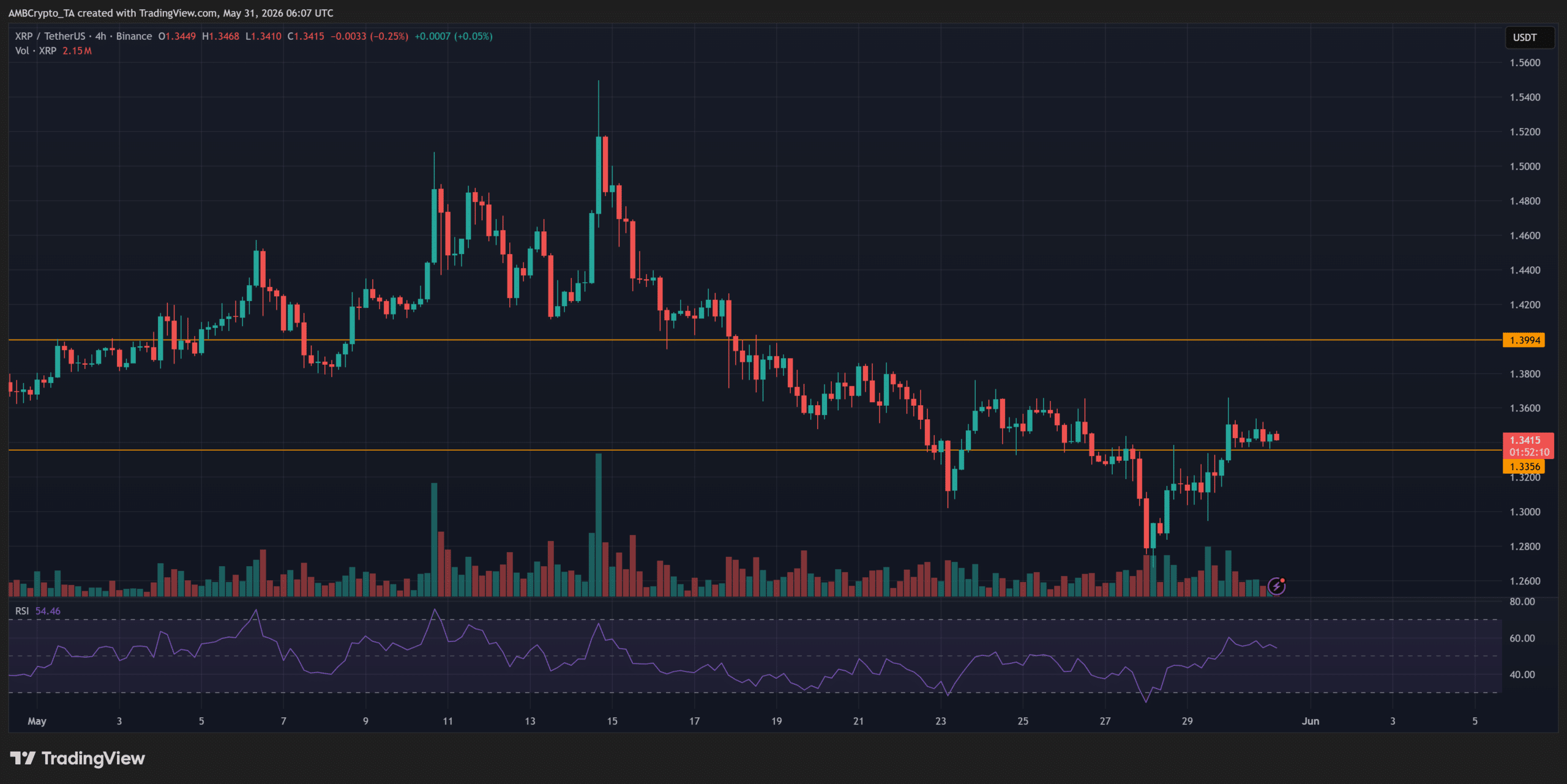
XRP’s improving on-chain structure is now beginning to influence market behavior. After weeks of heavy distribution, the price has settled into a tight $1.33-$1.35 range, signaling that selling pressure is gradually losing momentum.

That stabilization is occurring because buyers continue absorbing supply near the $1.30 support zone. Each retest has attracted demand, preventing a deeper breakdown despite broader market uncertainty.

Source: XRP/USDT on TradingView

Meanwhile, resistance near $1.40 continues limiting upside progress. This reflects a market still searching for conviction after months of volatility and shifting sentiment.

The RSI has recovered to 54.5, showing momentum is no longer firmly bearish. This behavior implies participants are transitioning from aggressive selling toward accumulation.

If support continues holding, compressed volatility could eventually fuel a stronger directional move as sidelined capital re-engages.


Final Summary

  • Ripple [XRP] is showing early bottoming signals as accumulation strengthens and exchange-held supply continues declining.
  • XRP remains in consolidation, though tightening supply and stable demand are improving recovery conditions.


Source link

I built a startup from scratch and still nearly died because of a broken healthcare system. That’s why I’m running for Congress

0
I built a startup from scratch and still nearly died because of a broken healthcare system. That's why I'm running for Congress

I did everything right.I started a company at 26 with nothing but a problem I needed solved: I wanted to print something in my neighborhood and couldn’t find anywhere to do it. That simple frustration became PrintWithMe — now a nationwide network of thousands of public printers, more than 100 employees, and a business I’m genuinely proud of. I moved from Chicago to Scottsdale during COVID, like millions of other millennials who finally did the math and realized our dollars could go further in the Sun Belt.We got more space, we enrolled our daughter into a good school. Things were really looking up.’

Then, two years ago, a growth started bleeding in my brain.My surgeon told me I had a narrow window — a few months — to get the procedure done or the consequences could be fatal. I had health insurance. Good health insurance, I thought. But my insurer refused to cover the specialist I’d been referred to. For weeks, I fought them — appealing, documenting, re-appealing — while a clock ticked in my skull. 

I eventually had to change my insurance. I got the surgery. I’m here to tell the story. But I spent a lot of time in that hospital bed thinking about how many people don’t survive that fight.

The math no longer adds up for the middle class

I’m a business nerd. I read the Wall Street Journal and Barron’s every week, not to mention Fortune. I understand how capital works, how markets function and how incentives shape behavior. And when I look at the economy we’ve built for the American middle class right now, the math simply doesn’t add up. My own story is evidence of that, but I know I’ve been lucky.

A friend of mine — a constituent in my district — pays $2,800 a month for daycare for her two young boys. That’s more than her mortgage. She and her husband both work. They’re doing everything right. And they’re still getting squeezed from every direction: housing costs that have risen 50% in five years, student loan payments that never seem to shrink, healthcare premiums that climb every January whether you used your plan or not.

This isn’t a failure of individual effort. This is a failure of policy.

Research shows that for every dollar the government invests in universal pre-K, society gets $7 back — in economic productivity, tax revenue and long-term child outcomes. These programs don’t cost us money. They make us money. And yet we can’t find the political will to pass them, because too many people in Washington are more focused on protecting the industries profiting from the status quo than on the families drowning in it.

Small businesses are the real economic engine — so why do we treat them that way?

Here’s something every member of Congress should know, but apparently needs reminding: the new jobs created in this country every month come overwhelmingly from small businesses, not large corporations. Large corporations are currently doing the opposite — slashing headcount and automating away jobs. 

Entrepreneurs and small business owners are the ones hiring, building, and taking risks with their own money. And yet the entire system — access to capital, trade facilitation, regulatory compliance — is tilted toward large incumbents.

Getting a small business off the ground in America still requires a network, luck, and a tolerance for chaos that not everyone has or should need. I was fortunate. I had enough of all three. But I think about the thousands of entrepreneurs who had the idea and the drive and never got the shot — because the system wasn’t built for them. When I get to Washington, I want a seat on the Small Business Committee. Not as a photo opportunity. As someone who has lived this.

The dream is still possible — but only if we fight for it

I’m a Democrat (the only lifelong Democrat in my primary race, actually). But the issues I’m running on — affordability, healthcare access, small business investment, universal childcare — aren’t partisan. When I knock doors in Scottsdale and North Phoenix, I hear from moderate Republicans and independents who are exhausted. They’re not ideologues. They’re parents trying to figure out how to cover daycare. They’re small business owners worried about their employees’ health plans. They’re millennials who missed the housing window and don’t know if they’ll ever own a home.They want their government to work for them. That’s not a radical ask.I started a company because I saw a problem and believed I could fix it. I’m running for Congress for the same reason. The American Dream isn’t dead — but it needs someone in Washington willing to actually defend it.

The opinions expressed in Fortune.com commentary pieces are solely the views of their authors and do not necessarily reflect the opinions and beliefs of Fortune.


Source link