Home Blog Page 413

Developer Withdraws New Hampshire Data Center Plan After Local Uproar

0
Developer Withdraws New Hampshire Data Center Plan After Local Uproar


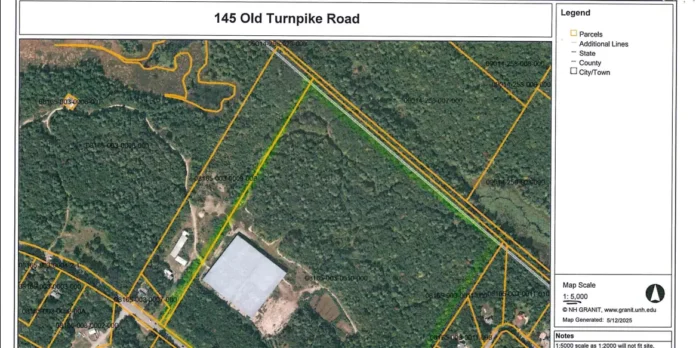
Hours before a scheduled meeting on a Nottingham, New Hampshire, data center proposal — which had to be moved to a larger venue because of growing backlash — the developer abruptly withdrew the plans.

“There was a lot of opposition, so I’m not surprised,” a coordinator for Nottingham’s Planning Department, Tracey Stickney, told Business Insider on Tuesday, adding that it was “nice” to see people come together and care about their local community.

She said she still expected residents of the town, with a population of about 5,300, would show up to the meeting to voice their concerns.

The proposed project, backed by local developer Thomas Moulton through Nottingham Business Park LLC, had sparked mounting backlash from residents worried about environmental impacts, noise, and the transformation of their rural town.

A Change.org petition opposing the project drew more than 25,000 signatures and support from residents who feared the development would fundamentally alter Nottingham’s character.

The fight in Nottingham is part of a growing wave of resistance to data center development across the US, as communities from Virginia to Georgia to Texas push back on projects they say strain water supplies, consume enormous amounts of electricity, generate constant noise, and transform rural landscapes into industrial corridors.

As Big Tech companies race to build the infrastructure needed to power AI and cloud computing, residents and local officials have increasingly demanded tighter regulations and environmental scrutiny — particularly in smaller towns unaccustomed to hosting massive digital infrastructure projects.

Brad Weit, a Nottingham-area resident who started the petition, said locals felt blindsided by the proposal and alarmed by the possibility of large-scale industrial infrastructure being built in a rural community known more for forests and lakes than server farms.

“I grew up hunting and fishing in these woods. I grew up on the lakes and the rivers. I value the beauty of New Hampshire, and I would like to keep it, especially in a small town like Nottingham, where it’s not very industrial at all,” Weit told Business Insider.

The uproar, he said, reflected broader anxiety about rapid data center expansion reaching small towns that lack the resources — and, in some cases, the water supply — to absorb projects of that scale.

“New Hampshire, and specifically this region near the seacoast, has already been in a severe drought for years,” Weit said. “It completely baffled me that of all places I’ve been reading about these, seeing them pop up, that Nottingham was the next one.”


Protesters against the Box Elder County data center backed by Kevin O'Leary.

Protesters against the Box Elder County data center in Utah, backed by investor Kevin O’Leary. 

Natalie Behring/Getty Images


In a statement, Moulton said the company was withdrawing its conceptual consultation request “without prejudice” to allow time for “additional research” and to determine “whether this is an appropriate use for the site.”

Moulton said in an interview that the project became consumed by “misconception and misinformation,” including online claims that the company planned to build a “40-acre building.” The proposed building, he said, would have been about 4 acres.

“I think the biggest thing is the environmental concerns,” Moulton said, adding that residents raised fears about noise and water pollution. “If we assemble truthful and accurate information, and present it fairly and transparently, then let everybody make their mind up — if they don’t want it, they don’t want it.”

Moulton argued the project could have brought a major tax windfall to Nottingham, which has a limited commercial tax base.

“It’s kind of like hitting a lottery ticket when it comes to tax revenue,” he said.

By Tuesday afternoon, he had decided it was better to temporarily retreat than fight the backlash, which he said included threats against his life.

Moulton emphasized that he lives in the community and would personally have to answer to neighbors affected by the project.

“I’m not some guy from New York trying to do a housing development and do it irresponsibly,” he said. “I live in the community, I want to do the right thing.”

The growth of data centers

For residents like Weit, those assurances weren’t enough. Weit said locals worried that once a project of that scale entered the town, Nottingham could lose control over future development.

Moulton said his goal was to think proactively about Nottingham’s future while balancing residents’ concerns.

“Someone’s going to do this regardless,” Moulton said of the growing demand for data infrastructure. “I’m just trying to plan and look at maybe this might be something for the future for the state and the community.”




Source link

Binance Plots Comeback In Philippines Market

0
Binance Plots Comeback In Philippines Market


Privately held cryptocurrency exchange Binance has partnered with BlockShoals Technologies as it plots a comeback in the Philippines.

Binance said on social media that the partnership will operate under the Philippine Securities and Exchange Commission’s Strategic Sandbox, also known as “StratBox.”

BlockShoals is a Philippine-registered company approved by regulators in the country. 

More From Cryptoprowl:

Going forward, BlockShoals will serve as the local intermediary while Binance will provide technology, security, operations, product support, and compliance in the Asian nation.

The sandbox phase of Binance’s return to the Philippines is expected to begin in the second half of this year and run for two years.

Binance said the process will allow the partners to meet regulatory milestones before any wider rollout of its crypto services in the country. 

The Philippines is one of Asia’s most active digital economies and a place where Binance has had success in the past. 

However, Binance lost its access to the Philippines market after the exchange was found to be offering unregistered securities and operating as an unlicensed broker.

Other crypto firms have also been blocked in the Phillippines, including OKX, Bybit, and KuCoin, among others. 

The Philippines’ government and markets regulator have cracked down on cryptocurrency companies, requiring that they register, maintain a local corporate presence, meet disclosure standards, and follow anti-money laundering regulations.

The regulator in the Philippines has warned that unregistered crypto platforms could face cease and desist orders, criminal complaints, website blocking, app removal, and financial penalties. 

Binance’s partnership with BlockShoals provides the crypto exchange with a path back to the Philippines market.

As a private company, Binance’s stock does not trade on a public exchange. 


Source link

Trump calls upon CFTC to protect prediction markets – ‘It’s a major industry!’

0
Trump calls upon CFTC to protect prediction markets - 'It’s a major industry!'


U.S. President Donald Trump has sided with the Commodity Futures Trading Commission (CFTC)  amid an ongoing legal fight with states over the multi-billion-dollar prediction markets. 

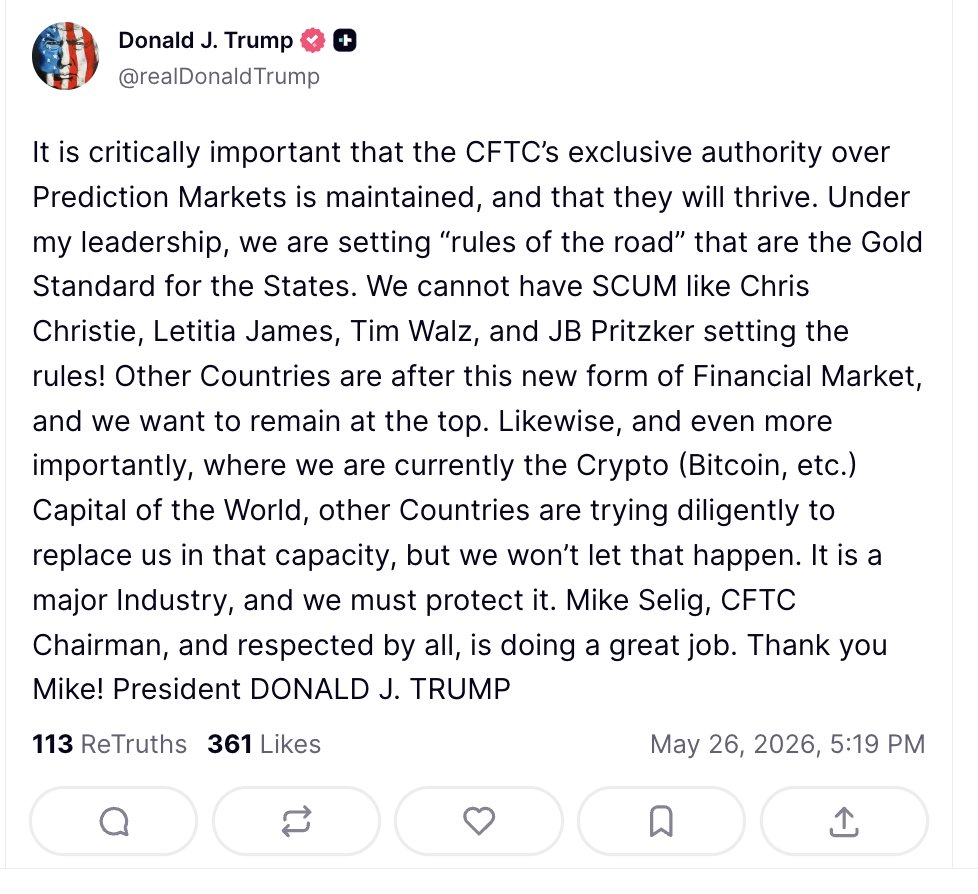
In a post on Truth Social on Tuesday, Trump said, 

It’s critically important that the CFTC’s exclusive authority over prediction markets is maintained and that they thrive. It’s a major industry, and we must protect it.

Prediction markets Trump
Source: Truth Social

It’s worth pointing out that Trump backed the sector as ‘financial markets’ and not ‘gambling’ platforms, as critics portray them. In fact, this is a similar framing that most supporters, like venture firm a16z and others, have been using. 

For them, prediction markets are crucial risk management tools for hedging against future events. As such, they should be allowed to “thrive” and improve through enough liquidity.

But ongoing states’ push for control over the sector can fragment liquidity and make prediction markets less accurate as forecasting tools. 

Prediction markets: Is Trump enough for states to back off?

In contrast, some states argue that these platforms are operating as betting sites and should be treated as such under gambling laws. 

In fact, the trading volumes on the two major platforms, Polymarket and Kalshi, are dominated by sports and elections markets. For critics, this makes them “100% gambling platforms.”

Against this backdrop, Minnesota recently passed a law that bans prediction markets with criminal charges for anyone found operating them. Arizona, Connecticut, Illinois, New York, and Wisconsin have also moved to ban or regulate these markets.

In rejoinder, the CFTC has moved to block these moves, claiming sole authority in the sector. 

So, Trump’s backing for the CFTC and its chair, Mike Selig, could boost the federal regulator’s push and authority claim over the sector. 

However, the different rulings on the jurisdictional fight by lower courts suggest that the final decision may rest with the Supreme Court, not Trump’s support.  

That said, Trump slammed Chris Christie, an advisor to the American gambling industry lobby, which opposes prediction markets. Similarly, the president took a swipe at governors and judges who are pushing back against prediction markets, calling them ‘scums.’

However, one must remember that the Trump family also has a conflict of interest in the sector.

Donald Trump Jr. is an investor and part of the advisory board at Polymarket. He’s also a strategic advisor to Kalshi, and Trump’s Truth Social has rolled out its prediction platform, TruthPredict, in partnership with Crypto.com. 


Final Summary

  • Trump has backed prediction markets as a ‘new form of financial markets,’ pressing for the CFTC to have exclusive authority in the sector. 
  • However, the Trump family’s conflict of interest in the segment continues to raise scrutiny. 


Source link

Google engineer insider-traded search results on Polymarket, Feds allege

0
Google engineer insider-traded search results on Polymarket, Feds allege

A Google security engineer, Michele Spagnuolo, was arrested and charged over alleged insider trading by placing bets on Polymarket about what Google users were searching, U.S. officials alleged on Wednesday.

According to a complaint unsealed by the U.S. Attorney’s Office for the Southern District of New York, Spagnuolo used “material nonpublic information” to place bets on who would appear on Google’s list of most-searched for individuals for 2025, after Polymarket began offering these markets last fall.

Spagnuolo allegedly used an internal Google tool to track who the most-searched-for individuals were and transferred some $3.8 million in USDC to a Polymarket address, said the complaint, which was signed by FBI Special Agent Brandon Racz.

The account, which used the username “AlphaRaccoon,” bet that D4vd (a rapper recently charged with murdering a 14-year-old girl) would be one of the most-searched for individuals in late November. Spagnuolo allegedly accessed Google’s internal tool, which showed D4vd trending, a few hours before the AlphaRaccoon account placed the bet.

The user AlphaRaccoon moved 5 million USDC.e from their Polymarket account to a wallet, before moving the funds through a swapping service and a privacy tool, the complaint said. Some of the funds were ultimately moved to an account at a payment processor in Italy, which had been opened by someone using Michele Spagnuolo’s government identification card.

“Unlike the counterparties to his trades, Spagnuolo knew the outcome of these wagers before the trading public did because he had accessed Google’s confidential, commercially valuable internal data,” the complaint said. “Spagnuolo personally profited more than approximately $1,200,000 from his trades based on nonpublic information. Once he won, Spagnuolo then took deliberate steps to conceal his unlawful use of nonpublic information by attempting to obscure the source and ownership of his unlawful proceeds.”

Spagnuolo is being charged with commodities fraud, wire fraud and money laundering, according to the complaint.

Wednesday’s charges mark the second major arrest of someone who allegedly traded on Polymarket using insider information, following an earlier arrest of a U.S. Army soldier who allegedly bet on the Nicolas Maduro raid he was part of.


Source link

‘Historically a solid sign’ – Why crypto’s bearish crowd may be wrong

0
‘Historically a solid sign’ – Why crypto’s bearish crowd may be wrong


Over the last ten days, the crypto crowd has been persistently leaning towards a bearish trend, but according to Santiment, it’s a good sign. 

In a recent X post, Santiment noted,

This is historically a solid sign that prices can rebound with little resistance, and while retail doesn’t expect it.

This is because in the past, there have been several occasions where prices have shifted in the opposite direction of the crowd’s lean. 

Given that the crowd was pessimistic, the chart also suggested that this is a good time to buy.

This coincided with a decline in the global crypto market cap, wherein BTC too was trading at $75,856.68 following a 1.93% decline over the previous week. 

The crowd leans towards bearish sentiment

Additionally, mentions associated with bearish terms like “lower” and “below” continue to be consistently high, according to Social Volume data.

On the other hand, spikes in bearish Social Dominance suggested that market conversations are still dominated by fear-driven narratives.

Bearish or expecting lower crypto prices
Source: Santiment

Despite the sporadic appearance of bullish discourse, traders have not been particularly convinced by bullish dominance.

All things considered, the data points to a cautious market climate in which investor confidence is still brittle but ongoing anxiety has not yet resulted in a significant price collapse. 

Bullish sentiment spirals

The Crypto Fear and Greed Index added to that cautious outlook. At press time, the index remained in the “Extreme Fear” zone at 25.

Fear sentimentsFear sentiments
Source: Alternative

On top of that, Ethereum’s total ERC-20 stablecoin supply continued declining over the past month. Supply dropped from roughly $159 billion to nearly $154.5 billion.

All Stablecoins(ERC20) Total SupplyAll Stablecoins(ERC20) Total Supply
Source: CryptoQuant

Stablecoins typically represent liquidity and available buying power across the crypto market. Falling supply often signals weaker capital inflows.

That decline may also suggest that traders and institutions remained cautious about deploying capital into Bitcoin and altcoins.

What’s ahead? 

The sentiment was also supported by the weighted sentiment of a few coins on the Santiment chart. According to the chart, Bitcoin’s weighted sentiment stayed comparatively higher than that of Ethereum [ETH] and Solana [SOL], suggesting that despite continuous market uncertainty, BTC continues to enjoy greater investor confidence.

Weighted sentimentsWeighted sentiments
Source: Santiment

SOL and ETH, on the other hand, experienced more abrupt fluctuations between bullish and bearish sentiment, indicating greater speculation and weakened conviction. 

Therefore, it is still unclear how the cryptocurrency market will behave in the coming days. But since AMBCrypto has already reported that sentiment rather than fundamentals may determine the bottom of the market, let’s see what happens next.


Final Summary

  • The market is leaning more towards the bearish zone, but past cycles suggest that extreme pessimism leads to price rebounds.
  • The Crypto Fear and Greed Index, weighted sentiments, and total ERC-20 stablecoin supply all confirm the cautious sentiment in the market. 


Source link

A new study finds escaping your income bracket no longer means building wealth

0
A new study finds escaping your income bracket no longer means building wealth

It’s easy to look at the child of a celebrity or power couple and see the leg up their family’s wealth, power, and connections got them in their own separate venture or company. And it’s even easier to label them a nepo baby when they benefit from their parent’s money and clout. But the nepo baby trend may extend beyond Hollywood, touching the lives of everyday Americans.

In other words, it’s increasingly obvious that who your parents are has become a more reliable predictor of your wealth than what you actually do for a living.

According to a new working paper from the National Bureau of Economic Research, there’s a growing rift between income and wealth generation. For decades, the American Dream was predicated on the fact that hard work and a decent income would lead to homeownership. But the research finds that high earnings no longer correlate directly with wealth generation. Rather, it matters more so today what assets your family owns.

“Those that come from wealthier families that are maybe able to achieve those other economic goals—wealth building, homeownership—I think also could play into a sentiment of a sort of unfairness in the economy,” Max Risch, one of the study’s co-authors and an assistant professor at Carnegie Mellon University, told Fortune

Even as Wall Street hits successive record highs, Americans are feeling worse and worse about the economy. An April Ipsos poll found that 61% of Americans today feel the economy is on the wrong track. Meanwhile, the May consumer sentiment index hit the lowest level since the University of Michigan started tracking the metric in 1952, lower than during the COVID pandemic and aftermath of the Great Recession. And that may be because even when workers secure steady if not high-paying jobs, they’re increasingly locked out of securing assets to generate wealth.

The resilient value of the ‘Bank of Mom and Dad’

The researchers leveraged a dataset of 3.4 million families and their wealth and income records across multiple generations to track how money moves geographically and cross-generationally. One of the most surprising findings, Risch said, was that earnings were only able to explain about half of the intergenerational inequality in housing. 

The data shows that even with identical incomes, a child of wealthier parents is substantially more likely to own a home than one without wealthy parents. Of course, there are other ways Americans amass wealth outside of homeownership. But Risch notes that for the bottom 95% of earners, nearly all wealth is tied to housing and pensions.

“It’s very consistent with the parents being able to help overcome these financial barriers,” Risch said, “maybe through direct asset transfers, co-signing a loan, putting a down payment.”

This tracks with the findings of a recent Northwestern Mutual report. More parents today are stepping in, or thinking about helping their kids secure keys to a home. The study also found that some parents are even prioritizing saving for a down payment than for a college degree.   

Homeownership becomes a fading dream

Higher incomes simply aren’t able to make the cut. A recent report from Harvard’s Joint Center for Housing Studies found that home prices have surged to five times the median income nationally, nearing historic highs. In some metros, including Los Angeles and San Francisco, home prices are more than 10 times the median income.

Risch looks west to illustrate why, even with a steady income today, it’s harder to climb up the wealth generation ladder. The study found California has some of the highest upward mobility in terms of income, meaning there’s ample opportunity for workers to move up a tax bracket or two thanks to the jobs offered in the state. But it turns out moving west to strike gold has its limitations. The state is one of the worst parts of the country for upward mobility of homeownership. Even with a high-paying job, most are locked out of homeownership in the Golden State, except those with wealthy parents. Americans in other metro hubs face the same barriers in turning a paycheck into property, from New York to Chicago to Houston.

Those stark geographical differences are something Risch said parents may consider when thinking about their kids’ future well-being.

“There are these sort of tradeoffs that families have to make either when they’re thinking about where to live, when they’re thinking about how to set up their children for economic success,” he said. 


Source link

Bitcoin and ethereum prices today, Wednesday, May 27, 2026: Lowest opening prices this week

0
Bitcoin and ethereum prices today, Wednesday, May 27, 2026: Lowest opening prices this week


Bitcoin (BTC-USD) opened at $75,829.41 on Wednesday, down 1.9% from Tuesday’s opening price. The price of bitcoin as of 9:21 a.m. ET fell further to $75,216.

Ethereum (ETH-USD) opened at $2,071.07 on Wednesday, also 1.9% lower than Tuesday’s opening price. Ethereum slid this morning, valued at $2,068 as of 9:21 a.m. ET.

Bitcoin and ethereum prices have opened lower this morning, and values continue to edge downward. Investors are processing the latest developments between the U.S. and Iran, with market observers hopeful that both sides are nearing a resolution and shipping can once again resume in the Strait of Hormuz. Even if the two sides reach an agreement, the consensus is that oil prices (BZ=F) will remain elevated for some time. Crypto investors have clearly been assessing risk levels and holding back for the time being.

Learn more: How the ‘Hormuz Hangover’ could impact oil prices

Current price of bitcoin and ethereum

Bitcoin

The price of bitcoin this morning was 1.9% lower than the day before. Here’s a look at how the opening bitcoin price has changed versus last week, month, and year:

  • One week ago: -1.2%

  • One month ago: -3.6%

  • One year ago: -30.7%

The all-time high for bitcoin was $126,198.07 on Oct. 6, 2025. The all-time low value for bitcoin was $0.04865 on July 14, 2010.

Ethereum

The price of ethereum this morning was 1.9% lower than it was early Tuesday. Here’s a look at how the opening ethereum price has changed versus last week, month, and year:

  • One week ago: -1.8%

  • One month ago: -12.6%

  • One year ago: -19.2%

The all-time high for ethereum was $4,953.73 on Aug. 24, 2025. The all-time low value for ethereum was $0.4209 on Oct. 21, 2015.

Bitcoin, ethereum, and other cryptocurrencies are rapidly evolving. Follow the latest developments from Yahoo Finance and others here.

Crypto and taxes

You generally owe taxes when you sell cryptocurrency for more than you paid for it. This also applies when you exchange one digital asset for another. Converting bitcoin into ethereum, for example, isn’t “just a trade” in the eyes of the IRS. It’s a taxable event if the value changes.

Crypto taxes aren’t paid at the time of the transaction, but instead, they’re reported on your tax return for the year in which the transaction took place. So, if you sold crypto for a profit at any point during 2025, that activity is reported when you file your 2025 return in early 2026.

How much tax you pay depends on two main factors:

  1. How long you held the asset before selling

  2. Your overall taxable income and filing status

Hold it for less than a year, and you’ll usually face higher rates. Hold it longer, and the rates tend to be lower.

This holding-period distinction matters more than most people realize. A few days can make a difference of as much as 17% or more — so timing matters.

Learn more: Yes, crypto is taxed. Here’s when you have to pay.

Bitcoin and ethereum price charts

Whether you’re brand new to tracking the value of bitcoin and ethereum or a more seasoned crypto investor, Yahoo Finance’s price-of-bitcoin and price-of-ethereum charts below show a visual history of how the currencies’ value continues to move and evolve.

More on crypto from the Yahoo Finance team: 


Source link