Home Blog Page 417

Canadian Regulator Approves Robinhood’s Purchase Of WonderFi

0
Canadian Regulator Approves Robinhood’s Purchase Of WonderFi


Robinhood Markets (NASDAQ: $HOOD) has received Canadian regulatory approval for its planned acquisition of WonderFi Technologies (TSX: $WNDR), allowing the $250 million deal to be completed by June 1.

According to a news release, the Canadian Investment Regulatory Organization has approved the acquisition of WonderFi, clearing the last remaining hurdle related to the deal.

Toronto-based WonderFi operates several crypto businesses in Canada, including Bitbuy, Coinsquare, and Bitcoin.ca. 

More From Cryptoprowl:

Once the transaction closes at the start of June, Robinhood will gain access to a regulated crypto trading network that’s established within the Canadian marketplace.

Robinhood announced plans to acquire WonderFi in May 2025 as part of its international crypto expansion. Analysts say the deal could add 10% to Robinhood’s annual revenue.

Shareholders of WonderFi Technologies voted in favor of the acquisition during a special meeting held in July 2025.

The Canadian approval arrives with Robinhood’s cryptocurrency business under pressure from weaker trading activity. 

The company reported $134 million U.S. in crypto revenue for this year’s first quarter, down 47% from $252 million U.S. a year earlier. 

Retail investor participation in crypto trading has weakened in recent months as the price of Bitcoin (CRYPTO: $BTC) languishes below $80,000 U.S.

Robinhood also just announced that its top crypto executive, Tanya Denisova, is leaving the company after five years.

During Denisova’s tenure, Robinhood introduced commission-free crypto trading, digital wallets, and staking products. 

The company also completed a series of acquisitions, with WonderFi being the latest deal that will help Robinhood grow outside the U.S. 

HOOD stock has declined 36% this year to trade at $73.64 U.S. per share. 


Source link

Bitcoin (BTC), ether (ETH) prices slide while stocks gain alongside AI tokens: Crypto Markets Today

0
Bitcoin (BTC), ether (ETH) prices slide while stocks gain alongside AI tokens: Crypto Markets Today

Bitcoin traded at $76,600 on Tuesday, down 0.8% since midnight UTC, as Monday’s brief bounce to $77,800 fades. The move leaves the largest cryptocurrency potentially forming another lower high in a bearish structure that has been in place since October, and down 7% over the past two weeks.

The weakness is not reflected in broader financial markets. S&P 500 index futures and Nasdaq 100 futures have gained more than 0.5%, pointing to crypto-specific headwinds rather than macroeconomic and geopolitical pressures.

Ether (ETH) is faring worse. Trading at $2,098, ETH has shed more than 10% over the past two weeks and sits firmly in the middle of the range it carved out between February and April, with no signs of reclaiming lost ground.

The altcoin market is mixed, with notable gains across AI tokens and steep losses for tokens that performed well earlier in the year like zcash (ZEC), which has lost around 7% since midnight.

Derivatives positioning

  • Crypto futures market volume has dropped 10% to $130 billion in 24 hours. Notional open interest (OI) is little changed around $126 billion, and 24-hour liquidations have declined 21% to $126 million. This points to a steady, rather boring market environment following the extended U.S. weekend holiday (though crypto is never closed).
  • SHIB, LINK, HBAR, NEAR and TRX are major OI gainers of the past 24 hours, while ZEC, XLM and HYPE are losers. The action indicates selective market positioning rather than broad-based capital deployment across the altcoin universe.
  • NEAR rose 58% in the week ended May 24 and has since gained an additional 14% to $2.82, a level last seen in November. The rally, likely fueled by a series of upgrades involving dynamic scaling, privacy and quantum defenses, is accompanied by an influx of new money into derivatives. Open interest jumped to a record 309 million tokens from 182 million a week ago.
  • NEAR also has the most positive 24-hour cumulative volume delta (CVD) among major tokens, a sign that buyers are setting the price action by trading at market orders rather than passive limit orders. Funding rates are only marginally positive, a sign the market is far from overheated. Together, these signal potential for continued price gains.
  • OI for futures in Chainlink’s LINK increased to 42.96 million tokens, the most since Feb. 7. Annualized funding rates of around 8% point to futures trading above the spot price in a bullish sign for the provider of oracle data.
  • Bitcoin futures have cooled. OI in BTC has pulled back to 711K BTC from 793k BTC early this month. ETH OI hovers just below record highs near 15 million ETH. BTC and ETH’s 30-day implied volatility indexes continue to slide in a sign of persistent volatility selling and no signs of panic demand for options.
  • Still, on Deribit, BTC puts at strikes from $70K to $76K are among the most traded of the past 24 hours. Puts represent a bearish bet, offering protection against price weakness in the underlying asset.

Token talk

  • CoinDesk’s Computing Select Index (CPUS) was the top-performing benchmark on Tuesday, rising by 1.9% since midnight UTC and 2.7% over the past 24 hours.
  • The CPUS is a basket of AI tokens and chainlink. FET added 4.8% on Tuesday, and RENDER climbed 7.2%.
  • The DeFi Select Index (DFX) also outperformed the crypto majors, rising by 1.3%. The gain suggests investors are opting for more speculative bets while waiting for bitcoin and ether to resolve their current trading ranges.
  • Privacy tokens weakened across the board as monero (XMR) and dash (DASH) followed zcash (ZEC) lower by around 1.5% apiece.
  • CoinMarketCap’s “Altcoin Season” indicator is currently at 35/100, up from last week’s low of 31/100 and below the monthly high of 50/100.


Source link

‘CLARITY Act promotes safety’ – Why Coinbase dismisses stablecoin risk concerns

0
‘CLARITY Act promotes safety’ - Why Coinbase dismisses stablecoin risk concerns


Coinbase is pushing back against claims that stablecoins pose a risk to the economy because they are ‘private’ money. 

For Paul Grewal, Coinbase’s legal chief, regulations can address these concerns. He noted, 

Money that’s ‘private’ isn’t any more inherently risky than healthcare or security or transportation that’s private. It’s how you manage that risk, as well as access and oversight, that matters. CLARITY promotes all this.

Grewal was responding to a Wall Street Journal report that framed stablecoins as risky bets that could destabilize traditional financial systems. Well, even Federal Reserve Governor Michael Barr had similar concerns in the past. 

So far, the most raised issue has been financial stability in case of bank-run-style events on major stablecoins like USDC, as many users opt for redemptions at the same time. 

Since they’re backed by short-term U.S. Treasury bonds, the instability may spill to the linked traditional institutions. However, the GENIUS Act, the stablecoin law, aims to address these issues by tight supervision of capital requirements, reserve assets, and liquidity buffers. 

Another risk has been the potential bank deposit flight that could undermine community banks’ capacity to lend to small and medium businesses. Again, this problem has been partly addressed by the stablecoin yield deal on the broader crypto market structure bill, the CLARITY Act. 

Still, White House support for stablecoins may not achieve its ultimate goal of U.S. dollar hegemony. 

Stablecoin isn’t enough for the U.S. dollar’s global dominance

Notably, the White House is actively promoting stablecoins, highlighting their potential to reduce national debt by creating new demand for Treasury bonds. 

Stablecoin issuers currently hold nearly $200 billion worth of Treasury bonds, with Tether leading the pack. Still, this is less than 1% of the total treasury market. A recent Bloomberg report noted that stablecoins may not be enough to assure U.S. dollar dominance as a global reserve currency. 

Josh Lipsky, chair of international economics at the Atlantic Council, told Bloomberg that, 

There’s nothing that stablecoins can do that gets to the foundations of the dollar, which are trust, fiscal processes, rule of law, and the independence of monetary authorities.

Furthermore, President Donald Trump’s attempts to influence the Fed have hit headlines since last year. This has dragged the value of the U.S. dollar, measured by the U.S. Dollar Index, to a five-year low. 

stablecoins
Source: CNBC

Final Summary

  • Coinbase’s Paul Grewal dismissed claims that stablecoins could threaten the stability of traditional financial markets. 
  • Still, the dollar could lose its global reserve currency status due to the lack of trust and political interference of its institutions, like the Fed


Source link

Thai Billionaire Charoen Sirivadhanabhakdi’s Frasers Property Sells European Properties To REIT For $343 Million

0
Thai Billionaire Charoen Sirivadhanabhakdi’s Frasers Property Sells European Properties To REIT For $343 Million


Singapore-listed Frasers Property—controlled by Thai billionaire Charoen Sirivadhanabhakdi—is selling four of its logistics properties in Europe to its unit Frasers Logistics & Commercial Trust (FLCT) for €294.9 million ($343 million).

“This proposed acquisition from our sponsor allows FLCT to deepen its presence in two of Europe’s most resilient and trade-oriented logistics markets,” Anthea Lee, CEO of the manager of the Singapore-listed REIT, said in a statement on Monday.

The two logistics properties in Germany and another two in the Netherlands with a combined gross leasable space of 179,645 square meters, is fully leased out to tenants including e-commerce players. The acquisition is earnings accretive and provides the REIT rental upside.

The properties will boost Frasers Logistics’ portfolio occupancy to 96.3% from 96.1% and the proportion of logistics assets in its portfolio to 76.6% from 75.1%. Upon completion of the transaction, Frasers Logistics would have 118 properties across Australia, Germany, Netherlands, Singapore and U.K.

Frasers Property said the divestment was in line with the strategy to recycle capital as part of active portfolio management by injecting stabilized and mature investment properties into its REITs.

“This active portfolio management approach enables the group to both optimize capital productivity and support the growth of its REITs,” Frasers Property said.

Charoen and his family are among the wealthiest in Thailand with an estimated fortune of $11.7 billion based on Forbes’ real-time data. Besides his controlling stake in Frasers Property, he also has interests in Chang Beer maker Thai Beverages, packaging company Berli Jucker, Thai property developer Asset World and Thailand’s Big C Supercenter hypermarket chain.


Source link

Are Wall Street Analysts Predicting Jacobs Solutions’ Stock Will Climb or Sink?

0
Are Wall Street Analysts Predicting Jacobs Solutions’ Stock Will Climb or Sink?


Jacobs Solutions Inc. (J) has grown into one of the world’s largest professional services firms, with a $13.5 billion market cap and operations spanning more than 50 countries. The company provides engineering, technical consulting, and project management services across infrastructure, water, environmental, energy, and defense markets globally.

While the business keeps busy on all fronts, shares of the Dallas, Texas-based company have been telling a very different story in the market. The stock slid 9.6% over the last 52 weeks and bled another 13.4% year-to-date (YTD) in 2026, putting the company on the wrong side of the broader market rally.

More News from Barchart

The S&P 500 Index ($SPX) posted a 27.9% gain over the same 52-week window and has already added 9.2% in 2026, making the gap between Jacobs and the index wider.

The State Street Industrial Select Sector SPDR ETF (XLI) painted an equally unflattering comparison, climbing 21.6% over the last 52 weeks while tacking on another 10.7% YTD, leaving Jacobs trailing its own sector by a wide margin.

www.barchart.com

The stock briefly found its footing on May 5 when Jacobs reported Q2 FY2026 results, jumping 4.4% as investors responded to what looked like a solid quarter on the surface. However, the optimism had a very short shelf life as shares dropped 7.3% in the very next trading session once the full picture came into focus.

Revenue grew 27% year over year to $3.7 billion during the quarter, clearing the analyst estimate of $3.3 billion. The trouble, though, ran deeper in the numbers, as Jacobs posted a GAAP net loss of $43 million that the company attributed to costs tied to its recent acquisition of PA Consulting.

Adjusted EPS came in at $1.75, up 22.4% year over year and comfortably beating the analyst estimate of $1.64 and showing that the underlying business held its ground, but that strength was not enough to hold investor confidence together.

Looking ahead, the picture appears encouraging. FY2026 wraps up in September, and analysts are penciling in an 18% year over year jump in diluted EPS to $7.22, reflecting growing confidence in where the business is heading. The confidence draws further backing from the fact that Jacobs has topped EPS estimates in each of the last four consecutive quarters.

Wall Street has settled on an overall “Moderate Buy” rating for J stock, though the breakdown among analysts reveals a clear lean toward the bullish side. Out of 16 analysts currently covering the company, eight hold a “Strong Buy” rating, two go with “Moderate Buy,” and six remain on the fence with a “Hold.”

www.barchart.com
www.barchart.com

The distribution has not shifted an inch over the last three months, when eight analysts also carried “Strong Buy” ratings on the stock.

The steady conviction only grew louder after the company’s strong second quarter showing. On May 9, RBC Capital analyst Sabahat Khan lifted his price target on J stock to $169 from $160 while maintaining an “Outperform” rating, citing impressive Q2 results and upbeat forward guidance.

J stock’s average price target of $159.14 suggests potential upside of 38.8%. However, the Street-High target of $181 set by Citigroup analyst Andrew Kaplowitz suggests a gain of 57.8% from current levels. Kaplowitz nudged his target price up to $181 from $180 and reiterated a “Buy” rating, making Citigroup the stock’s loudest cheerleader at the moment.

On the date of publication, Aanchal Sugandh did not have (either directly or indirectly) positions in any of the securities mentioned in this article. All information and data in this article is solely for informational purposes. This article was originally published on Barchart.com


Source link

Identifying the 60% Bitcoin dominance problem for Ethereum bulls

0
Identifying the 60% Bitcoin dominance problem for Ethereum bulls


Ethereum [ETH] has had a tough year compared to Bitcoin [BTC].

While Bitcoin continues to attract most of the market’s attention, Ethereum has struggled. The market still looks BTC-led, with investors preferring it over altcoins for now.

BTC has the upper hand in 2026

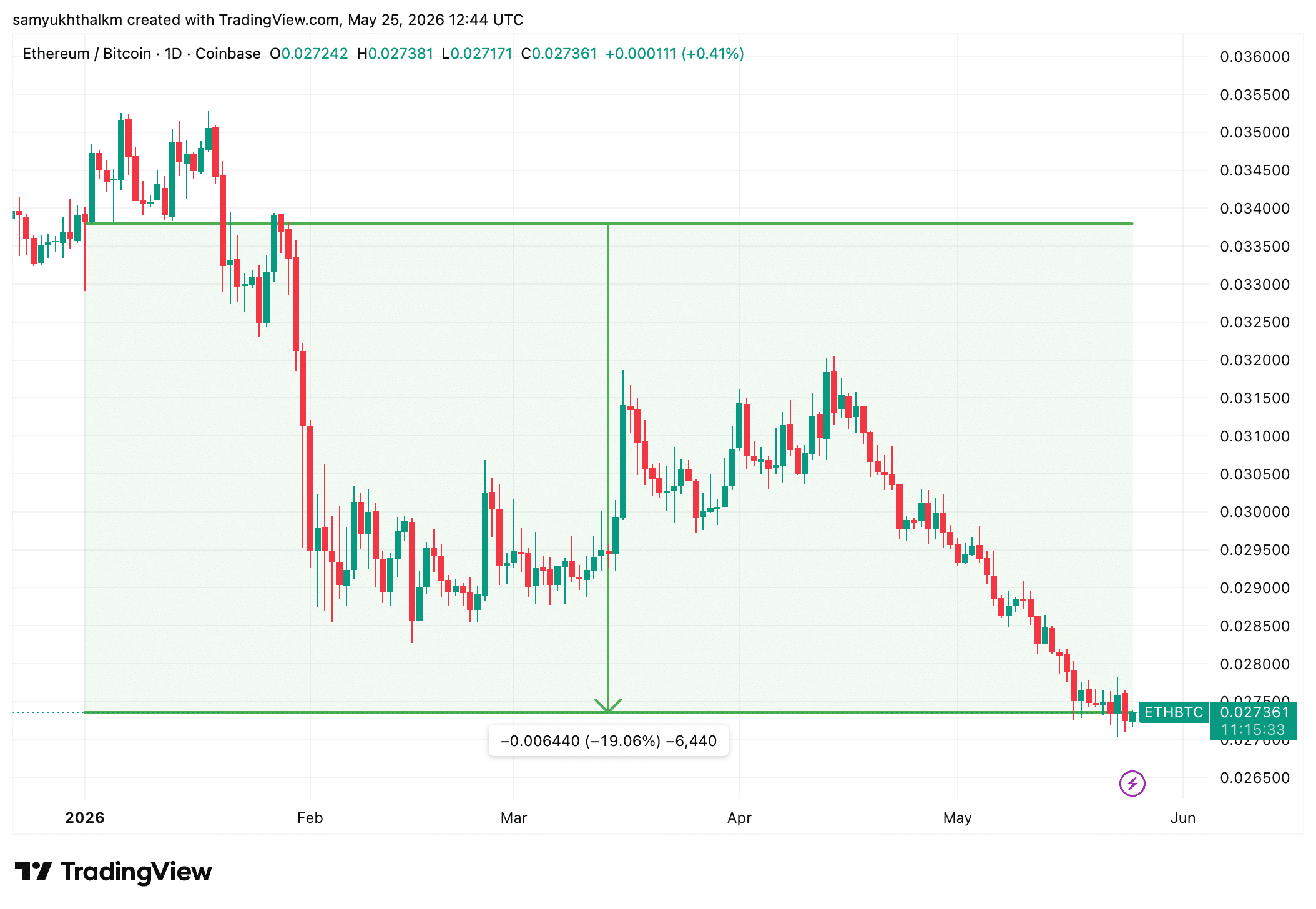
Ethereum has spent most of the year struggling against Bitcoin. The ETH/BTC pair is down close to 20% YTD, which simply means ETH has not kept pace with BTC’s strength.

ethereumethereum
Source: TradingView

This is important. ETH/BTC is often used as a quick way to judge whether the market is moving towards altcoins or staying focused on Bitcoin.

Right now, the indication is fairly clear. Capital is still favouring Bitcoin, and Ethereum has not shown enough momentum to challenge that trend.

Investors are pulling back too!

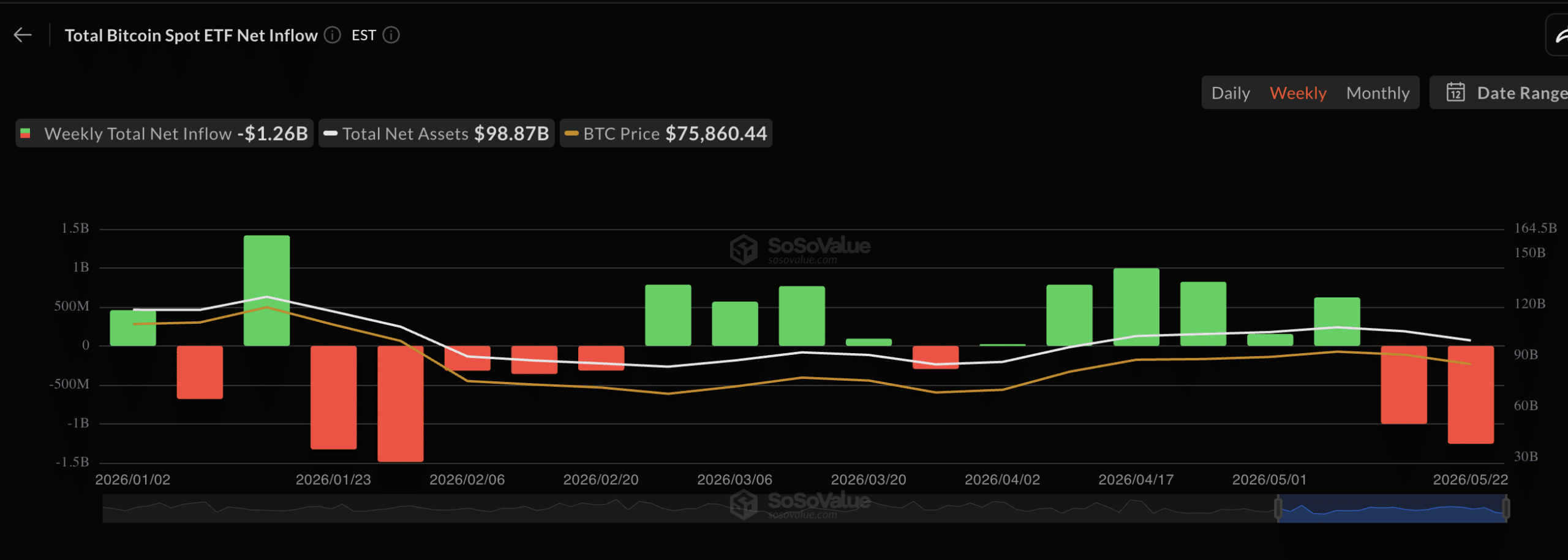
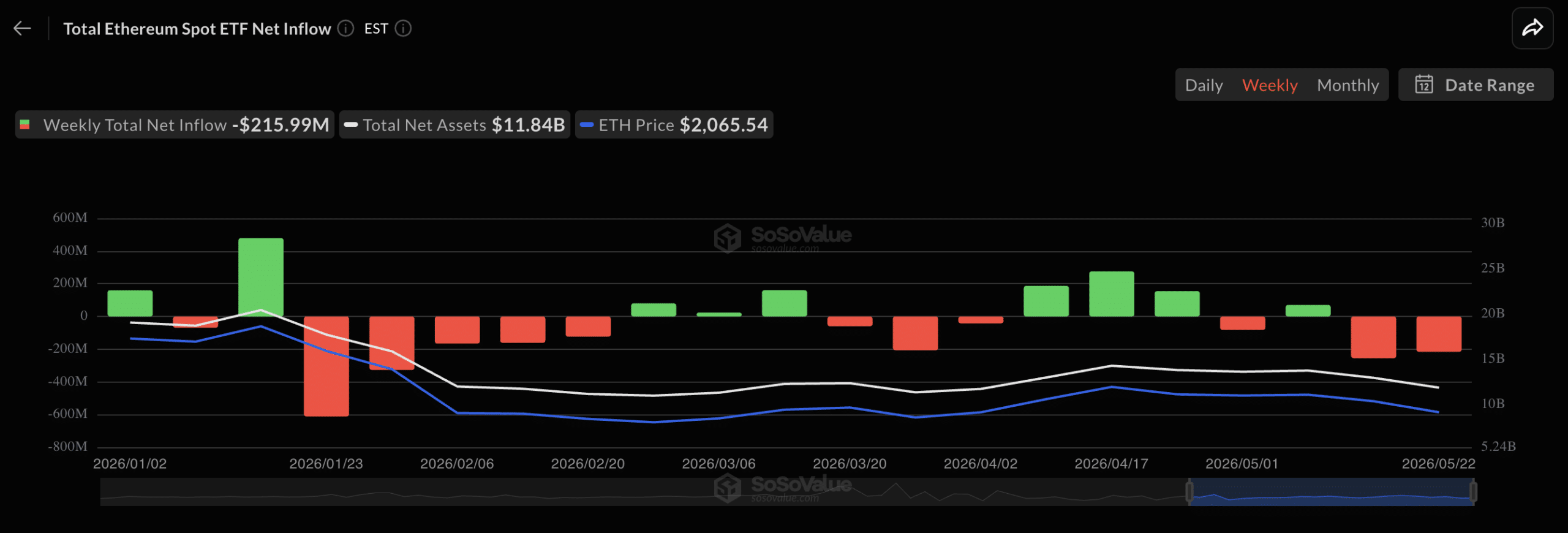
Bitcoin Spot ETFs saw weekly net outflows of about $1.26 billion, while Ethereum Spot ETFs also recorded outflows of around $216 million.

Source: SoSoValue

This tells us two things.

First, risk appetite has slowed down in general, even for Bitcoin. Second, the weakness is not leading investors towards Ethereum or other altcoins.

Source: SoSoValue

Bitcoin still has a much larger ETF asset base. So, even during outflow weeks, it remains the main institutional crypto trade.

Ethereum, on the other hand, has been seeing weaker price action and weaker flows together. That makes it harder to argue on the altcoin’s behalf.

BTC.D keeps altseason on hold


Source link

XRP slips below $1.35 after triangle breakdown puts focus on $1.30 support

0
XRP slips below $1.35 after triangle breakdown puts focus on $1.30 support

XRP spent weeks tightening into a narrow range, but the market finally started leaning lower after another failed push above resistance near $1.36. The move matters because repeated tests of support tend to weaken buyers over time, and XRP is now drifting back toward the same $1.30 area traders have treated as the line between consolidation and broader breakdown risk.

News Background

• Analysts remain split on XRP’s structure, with some calling the latest move a confirmed triangle breakdown while others still frame it as late-stage compression before a larger breakout.

• CME Group is preparing to launch 24/7 XRP-linked futures trading later this month, adding another layer of institutional exposure to the token.

• Whale activity also cooled sharply during the period, with large transaction counts falling more than 57% over nine days.

Price Action Summary

• XRP fell from $1.3457 to $1.3366 during the 24-hour session while trading inside a relatively tight 1.9% range.
• The largest move came after a failed breakout attempt near $1.3620, where elevated volume quickly reversed into selling pressure.
• XRP later broke below the $1.35 level and consolidated near session lows around $1.336 into the close.

Technical Analysis

• The breakdown below $1.35 reinforced short-term bearish momentum after weeks of tightening price action.
• XRP is now trading beneath several key moving averages, while resistance near $1.36 continues to reject upside attempts.
• Some analysts view the recent move as a confirmed symmetrical triangle breakdown with downside risk toward $1.14.
• Others still argue the broader structure resembles compression rather than outright collapse, especially while XRP remains above the critical $1.30 support area.

What traders should watch

• $1.30-$1.31 is now the key support zone. Losing it would likely accelerate downside momentum.
• $1.35 becomes the immediate resistance area XRP needs to reclaim to stabilize near-term structure.
• CME’s upcoming XRP futures launch could increase volatility and improve liquidity once trading begins later this month.


Source link