Home Blog Page 419

Polymarket scrutiny grows as CFTC suspensions raise oversight concerns

0
Polymarket scrutiny grows as CFTC suspensions raise oversight concerns


The Commodity Futures Trading Commission [CFTC] increasingly shifted toward market facilitation as crypto-adjacent trading activity expanded rapidly throughout 2025 and 2026. Regulatory approvals also accelerated once leadership prioritized innovation frameworks and streamlined access pathways across markets.

CFTC enforcement activity later fell below the 58 cases recorded during 2024. Roughly half of the agency’s open matters also closed by mid-2025.

Meanwhile, seventeen new Designated Contract Market applications emerged after early 2025 as approval timelines compressed further beneath acting leadership.


Source link

Pope Leo called AI an ‘instrument of domination, exclusion and death.’ Anthropic was in the room

0
Pope Leo called AI an 'instrument of domination, exclusion and death.' Anthropic was in the room

Pope Leo XIV called Monday for robust regulation of artificial intelligence and for its developers to work for the common good rather than profit, issuing a sweeping manifesto on safeguarding humankind as the technology impacts everything from work to war.

“Magnifica Humanitas” (Magnificent Humanity), Leo’s first encyclical, has been eagerly awaited ever since history’s first U.S.-born pope announced days after his election that he considered AI to be the biggest challenge facing humanity today.

In the text, Leo denounced the “culture of power” driving the AI race, especially in developing ever more sophisticated methods of remote warfare. He declared that it was “not permissible” to entrust irreversible, lethal decisions to AI systems, setting up another flash point between the American pope and the Trump administration, which has worked aggressively to deregulate AI development.

“Artificial Intelligence now demands to be disarmed, freed from logics that turn it into an instrument of domination, exclusion and death,″ the pope told a special Vatican presentation of the encyclical, one of the most authoritative types of teaching documents a pope can issue.

Experts in the tech industry, academia and Catholic morality said the document will likely become a benchmark in the debate over AI, a point of reference for policymakers, researchers and ordinary folk alike. It comes as the near-daily developments in the technology trigger concerns over AI replacing human jobs and even human intelligence.

Taylor Black, a Microsoft AI executive and director of Catholic University of America’s AI institute, said the document would prompt people “at the forefront of these tools” to ask questions such as “What does it mean to be human?”

Pope calls out AI companies even as he hosts Anthropic

The Vatican launch also included remarks by the co-founder of Anthropic, which is currently locked in a legal battle with the Trump administration over access to its AI technology. The Vatican decided to involve Anthropic as part of its decade-long effort to engage Silicon Valley in dialogue over the human cost of AI.

And yet in his text, Leo repeatedly blasted the concentration of power and data in the hands of so few people in the private sector as a danger, especially to children and the most vulnerable, and called for external regulation of their work.

“It is not enough to invoke ethics in the abstract; robust legal frameworks, independent oversight, informed users and a political system that does not abdicate its responsibility are required,” he wrote. “A more moral AI is not enough if that morality is determined by a few.”

Leo appealed to AI developers and political leaders responsible for regulating them to slow down and reflect on what they are doing. He urged them to use ethical and spiritual guidelines to make the choice to work not for their own profit or power, but the betterment of humanity.

AI competitors OpenAI and Anthropic are the second- and third-most valuable U.S. private companies, each valued at hundreds of billions of dollars, more than the GDP of many nations. Both companies are heading toward near-trillion dollar IPOs.

Anthropic co-founder Christopher Olah welcomed Leo’s criticism and concern. He said such external checks were fundamental to the technology “going well” for humankind since there is so much at stake — “a real possibility that AI will displace human labor at a very large scale.”

“We need more of the world — religious communities, civil society, scholars, governments — to do what His Holiness has done here: to take this seriously, to look closely, and to push events in a better direction,” Olah said. “We need moral voices that the incentives cannot bend.”

Experts say the text will become a benchmark

In a methodical text, the math major pope traced the history of the Catholic Church’s social teaching and applied its core concepts — justice, solidarity, the dignity of work and the universal destination of resources — to the digital revolution.

“I am convinced that this will prove to be a defining document for our era, a profound and prophetic document,” said Paolo Carozza, law professor at Notre Dame Law School and chair of the Meta Oversight Board.

“Pope Leo is offering a clear, comprehensive, and coherent voice urging us to take responsibility for constructing a world in which technology will serve humans rather than degrade them,” he said.

In its strongest chapters, Leo denounced how AI had helped accelerate the “normalization of war” by desensitizing people to its cost. He didn’t name specific conflicts, but cited “opposing imperialisms, between powers that wish to preserve their supremacy, and those that aspire to seize that supremacy.”

He demanded transparency and accountability by AI developers so that the chain of decision-making command in ordering strikes with AI weaponry is always known. He declared that the Catholic Church’s “just war” theory, which provides specific criteria for when force can be justified, was now “outdated” given the technological advances of warfare.

A text in the church’s social justice tradition

Leo signed the text May 15, the 135th anniversary of the publication of “Rerum Novarum” (Of New Things), the most important teaching document of Leo’s hero and namesake, Pope Leo XIII. That document addressed workers’ rights, the limits of capitalism, and the obligations that states and employers owed workers as the Industrial Revolution was underway.

It became the foundation of modern Catholic social thought, and the current pope cited it at the start of his pontificate in relation to the AI revolution, which he believes poses the same existential questions that the Industrial Revolution posed over a century ago. “Magnifica Humanitas” thus becomes the latest chapter in a century-long history of popes adapting “Rerum Novarum” to the social questions of their times, often dwelling on the dignity of work for human flourishing.

AI is evoking both existential fears and utopian vision amid an intensifying debate on whether it will become a catalyst that enriches humanity or a technological toxin that dulls human intelligence while wiping out millions of high-paying jobs.

“The pursuit of greater profits cannot justify choices that systematically sacrifice jobs, because the human person is an end, not a means, and the economic order must remain subordinate to human dignity and the common good,” Leo wrote.

Leo extended his concern for upholding human dignity in labor to issue the first-ever papal apology for the Holy See’s own role in legitimizing slavery by giving European sovereigns explicit authority to subjugate and enslave “infidels.”

A decade-long dialogue with Silicon Valley

Vatican officials declined to say who contributed to Leo’s encyclical. But Vatican and church officials have been engaged in a dialogue with Silicon Valley tech firms for a decade.

The decision to include Anthropic at the Vatican launch was criticized by some who considered it a papal stamp of approval of the AI firm, which is currently suing the Trump administration after it ordered all U.S. agencies to stop using Anthropic’s technology for its refusal to allow the U.S. military unrestricted use of it.

Brian Boyd, U.S. faith liaison for the nonprofit Future of Life Institute, read the inclusion of Anthropic’s co-founder Olah as a recognition of its prominence in the field and as similar to a papal audience with a head of state: not an endorsement.

Anthropic is an “enormous corporation that is taking onto itself an enormous risk and responsibility,” Boyd said, adding that the company has “demonstrated genuine goodwill and integrity and interest in dialogue.”

___

Winfield reported from Middletown, Connecticut, and Huamani reported from Los Angeles. Associated Press writers Kelvin Chan in London and Colleen Barry in Milan contributed to this report.

___

Associated Press religion coverage receives support through the AP’s collaboration with The Conversation US, with funding from Lilly Endowment Inc. The AP is solely responsible for this content.




Source link

Casey’s (CASY) General Appears To Be A Hidden Jim Cramer Gem

0
Casey’s (CASY) General Appears To Be A Hidden Jim Cramer Gem


We recently published . Casey’s General Stores, Inc. (NASDAQ:CASY) is one of the stocks discussed by Jim Cramer.

Convenience store firm Casey’s General Stores, Inc. (NASDAQ:CASY)’s shares are up by 85% over the past year and by 48% year-to-date. Keybanc discussed the firm on April 24th as it raised the share price target to $860 from $830 and kept an Overweight rating on the stock. Some of the factors that Keybanc discussed in its coverage include fuel margins and industry consolidation. As for Cramer, just as was the case in 2025, he is still a fan of Casey’s General Stores, Inc. (NASDAQ:CASY)’s breakfast pizza. The CNBC TV host recommended the stock in this appearance:

“I’m gonna recommend a stock. Casey General, unbelievable. It’s doing so well. This morning, we’ve got, you know the analysts one by one, today’s Blair. But they have a breakfast pizza, you know I’m a ham egg and cheese guy. I thought the breakfast pizza was a killer. They’re in small towns all over the place. There you go, Casey General.”

Casey’s (CASY) General Appears To Be A Hidden Jim Cramer Gem

marilyn barbone/Shutterstock.com

Carillon Eagle Mid Cap Growth Fund discussed Casey’s General Stores, Inc. (NASDAQ:CASY) in its Q1 2026 investor letter:

“Casey’s General Stores, Inc. (NASDAQ:CASY) operates a chain of convenience stores that sell fuel, groceries, and freshly prepared food, such as pizza, primarily in small-town and rural areas across the Midwest. The stock performed well, driven by strong quarterly results, with continued strength in fuel margins and robust in-store sales, particularly in prepared foods and pizza. It also benefitted from expectations that recent increases in oil prices could further expand fuel margins.”

While we acknowledge the potential of CASY as an investment, we believe certain AI stocks offer greater upside potential and carry less downside risk. If you’re looking for an extremely undervalued AI stock that also stands to benefit significantly from Trump-era tariffs and the onshoring trend, see our free report on the best short-term AI stock.

READ NEXT: 33 Stocks That Should Double in 3 Years and Cathie Wood 2026 Portfolio: 10 Best Stocks to Buy. 

Disclosure: None. Follow Insider Monkey on Google News.


Source link

$ESPORTS crashes 92% after on-chain analysts flag massive token movements

0
$ESPORTS crashes 92% after on-chain analysts flag massive token movements


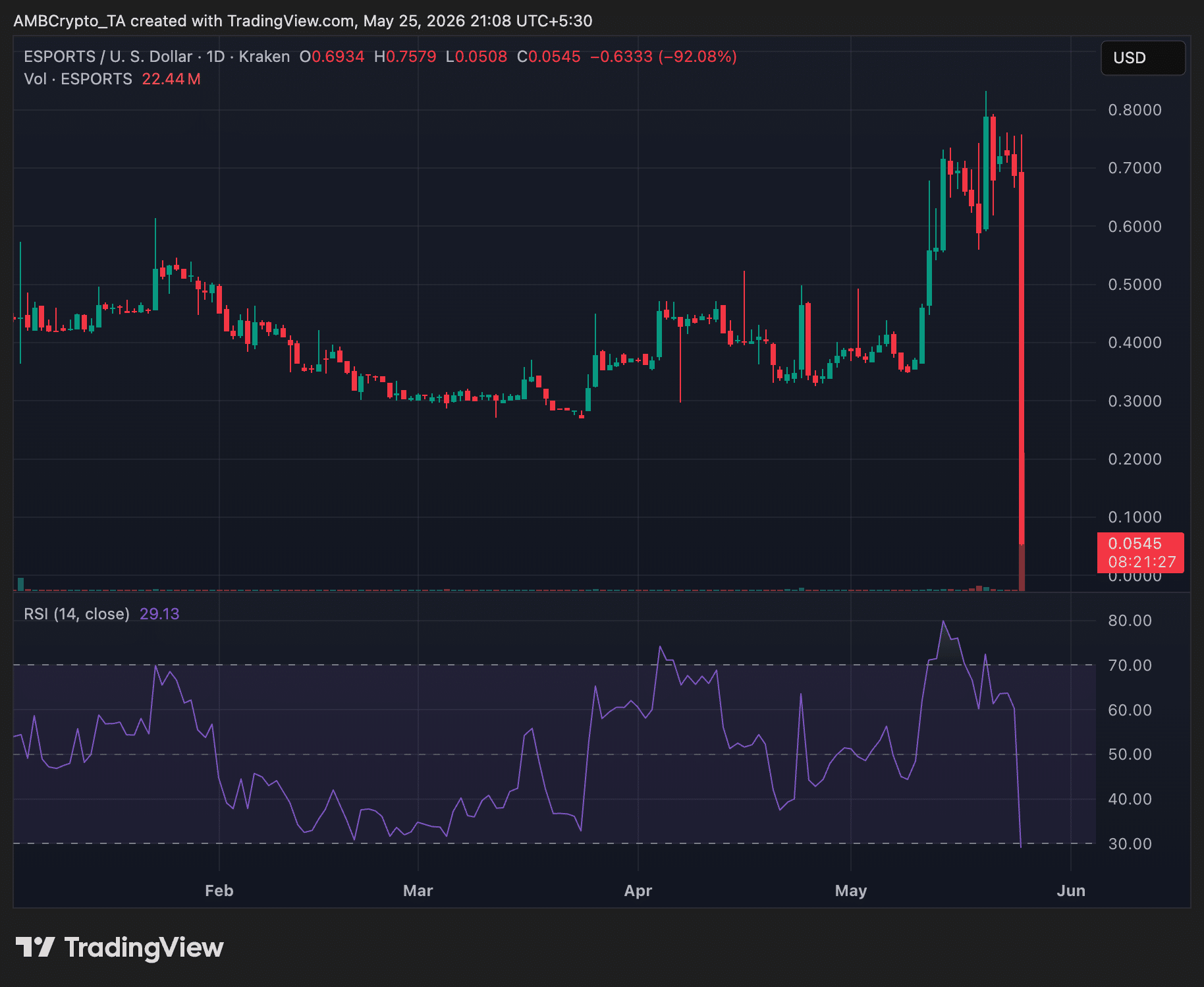
The $ESPORTS token collapsed more than 92% on 25 May, wiping out over $110m in market value after on-chain analysts flagged large token transfers, exchange deposits, and alleged team-linked wallet activity before the crash.

Data shared by multiple on-chain commentators suggested wallets connected to the project moved tens of millions of tokens through fresh addresses before depositing large amounts onto exchanges and selling through decentralized liquidity pools.

The token fell from around $0.69 to nearly $0.05 within a single daily candle, according to TradingView data. Total liquidation has now exceeded $6m, with long liquidations exceeding $5.2m.

Analysts flagged unusual wallet activity before collapse

On-chain analysts claimed roughly $23m worth of $ESPORTS tokens had moved to KuCoin over the past several days before the collapse.

They also alleged tokens moved from team wallets into clusters of fresh addresses before splitting into additional wallets and flowing toward exchanges.

Separately, onchainschool.pro claimed wallets tied to the project distributed large token balances across dozens of addresses before selling through decentralized exchanges.

Another widely shared post from Ash Crypto alleged that connected wallets dumped between 178m and 197m tokens, representing roughly 43% of the token’s circulating supply.

At the time of writing, the project team had not publicly responded to the allegations.

Chart structure showed weakening liquidity conditions

The collapse followed a sharp rally that pushed $ESPORTS from roughly $0.35 in early May to local highs near $0.75 before momentum abruptly reversed.

Despite the price surge, open interest reportedly remained relatively muted. 

TradingView data showed $ESPORTS plunging from an open near $0.69 to a close around $0.054, marking a daily decline of roughly 92%. Volume also spiked sharply during the selloff, signaling aggressive liquidation pressure and collapsing buy-side liquidity.

$ESPORTS 24-hr price trend chart
Source: TradingView

The token’s RSI fell to around 29, entering oversold territory as the breakdown destroyed the previous breakout structure.

Collapse renews scrutiny around token concentration

The incident has renewed attention on token concentration risks across smaller-cap crypto assets, particularly where large wallet holders control substantial portions of circulating supply.

Large unlocks, opaque treasury movements, and low-liquidity market structures have increasingly become major risk factors during volatile market conditions.

While the allegations surrounding insider-linked wallets remain unverified, the scale and speed of the collapse are likely to intensify scrutiny around token transparency and exchange inflow monitoring.


Final Summary

  • $ESPORTS plunged more than 92% after on-chain analysts flagged major wallet movements and alleged insider-linked token transfers.
  • The collapse erased over $110m in market value and renewed scrutiny around liquidity depth and token concentration risks.


Source link

PCE, jobless claims and housing data test Fed cut hopes: Crypto Week Ahead

0
PCE, jobless claims and housing data test Fed cut hopes: Crypto Week Ahead

The coming week appears to be macro-led, with U.S. economic data carrying the main calendar risk. Inflation, growth, jobless claims and housing numbers all land before the open, giving markets insight on whether the Fed has room to cut rates.

Prediction markets and the CME’s FedWatch tool currently point to rates remaining unchanged in June’s meeting.

The data comes amid the ongoing Middle East war, which keeps oil prices and inflation risk in focus. Any move higher in energy costs could make softer inflation harder to sustain and weigh on risk assets.

What to Watch

(All times ET)

  • Crypto
    • May 26–June 1: Kevin Warsh officially begins his first week as Federal Reserve Chair following his confirmation.
  • Macro
    • May 26, 08:00 a.m.: U.S. S&P/Case-Shiller Home Price YoY for March est. 1.1% (Prev. 0.9%)
    • May 26, 08:00 a.m.: U.S. House Price Index YoY for March est. 1.8% (Prev. 1.7%)
    • May 26, 09:00 a.m.: U.S. CB Consumer Confidence for May est. 92 (Prev. 92.8)
    • May 26, 08:30 p.m.: Australia Consumer Price Index YoY for April est. 4.4% (Prev. 4.6%)
    • May 27, 08:00 p.m.: Bank of Korea Interest Rate Decision (Prev. 2.5%)
    • May 28, 04:00 a.m.: Eurozone Economic Sentiment for May est. 92 (Prev. 93)
    • May 28, 07:30 a.m.: U.S. PCE Price Index YoY for April (Prev. 3.5%); Core PCE (Prev. 3.2%)
    • May 28, 07:30 a.m.: U.S. Initial Jobless Claims for period ending May 23 est. 212K (Prev. 209K)
    • May 28, 08:00 a.m.: South Africa Reserve Bank Interest Rate Decision est. 7.0% (Prev. 6.75%)
    • May 28, 09:00 a.m.: U.S. New Home Sales for April est. 0.67M (Prev. 0.682M)
    • May 28, 03:30 p.m.: U.S. Fed Balance Sheet for period ending May 27 (Prev. $6.713T)
    • May 28, 06:30 p.m.: Japan Tokyo Consumer Price Index YoY Prel for May (Prev. 1.5%)
    • May 29, 07:30 a.m.: Canada GDP Growth Rate Annualized for Q1 (Prev. -0.6%); QoQ (Prev. -0.2%)
    • May 29, 08:45 a.m.: U.S. Chicago PMI for May est. 49.5 (Prev. 49.2)
    • May 30, 08:30 p.m.: China NBS Manufacturing PMI for May est. 50.5 (Prev. 50.3)
  • Earnings
  • Governance Votes & Calls
    • Compound DAO is voting on a proposal to update Compound III supply caps for USDC, USDT, and WETH across Optimism, Polygon, and Unichain. Voting ends on May 25.
    • Aave DAO is voting on a proposal to establish a 3-of-4 rewards operations multisig to manage third-party incentive funding for growth campaigns. Voting ends on May 25.
    • Instadapp DAO is voting on a proposal to rebalance wstUSR vaults, withdraw 750,000 FLUID to fund rewards, configure PST launch limits, and consolidate InstaConnectorsV2 administrative controls to the Team Multisig. Voting ends on May 26.
    • Bancor DAO is voting on a proposal to increase the vortex MaxSaleAmount parameter from 100 to 100,000 for the TAC and IOTA EVM blockchains. Voting ends on May 27.
    • Arbitrum DAO is voting on an amended proposal to transfer 30,765.66 frozen ETH, tied to the rsETH incident, to an Aave LLC-controlled wallet. Voting ends on May 29.
    • Unlock DAO is voting on a proposal to process the May constant payment roll, compensating contributors David Moderator, Ceci Sakura, and Trigs for their roles. Voting ends on May 30.
    • Uniswap DAO is voting on proposals to expand protocol fee infrastructure to BNB Chain, Polygon, and Celo, and to recall 12.5M delegated UNI from the Franchiser system to the Governance Timelock. Voting ends on May 30.
  • Unlocks
    • May 26: Plasma (XPL) to unlock 3.38% of its circulating supply worth $7.39 million.
    • May 26: Huma Finance (HUMA) to unlock 20.04% of its circulating supply worth $11.76 million
    • May 29: Grass (GRASS) to unlock 3.55% of its circulating supply worth $11.29 million.
    • May 30: Falcon Finance (FF) to unlock 4.06% of its circulating supply worth $8.26 million.
    • June 1: EigenCloud (EIGEN) to unlock 4.99% of its circulating supply worth $8.48 million.
  • Token Launches


Source link

Ethereum whale dumps $72mln: Assessing if ETH support holds at $2k

0
Ethereum whale dumps $72mln: Assessing if ETH support holds at $2k


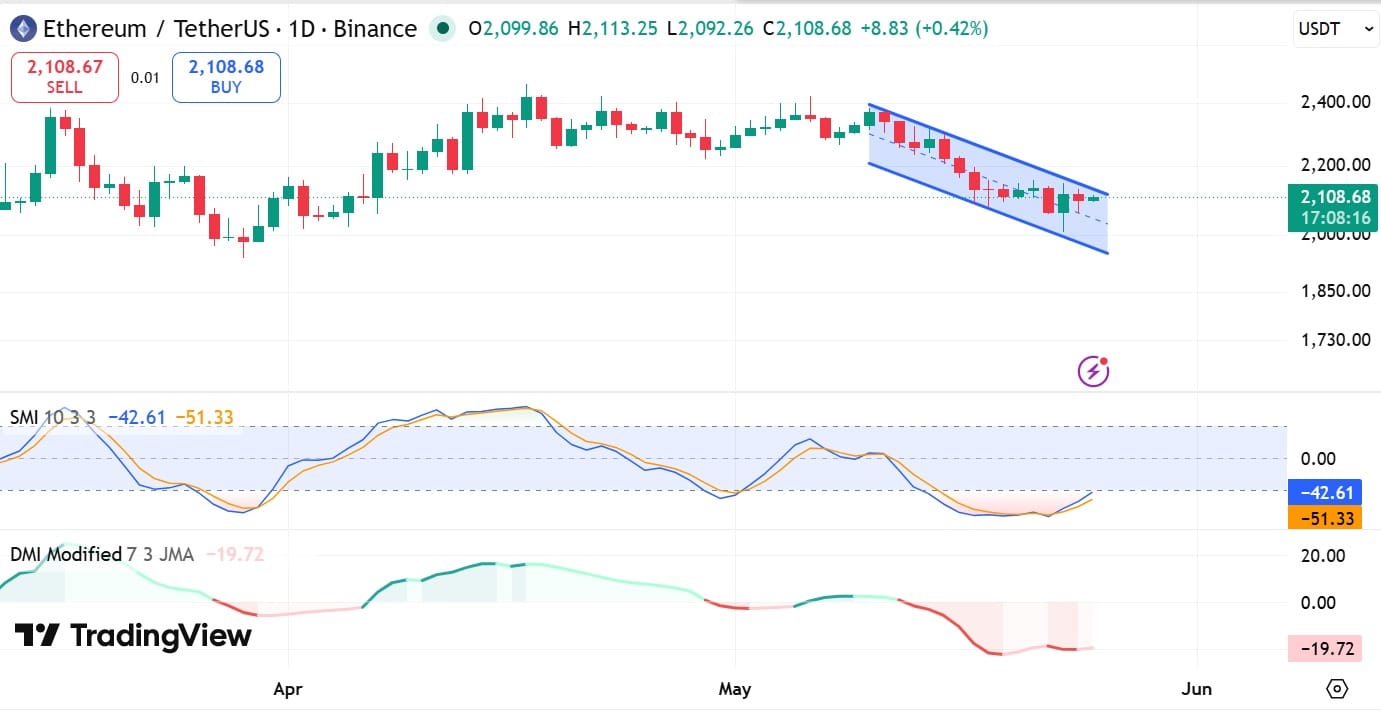
Ethereum traded within a descending channel after its uptrend stalled at $2.3k two weeks ago. During this decline, the altcoin dropped to $2,009 before rebounding slightly.

At press time, Ethereum [ETH] traded at $2,106 after falling 0.62% over the past day. With ETH hovering near $2k, whale activity reflected growing bearish sentiment.

Why are whales turning bearish?

Onchain Lens reported that a whale sold 15,000 ETH for $31.12 million. This whale has been aggressively selling over the past day. 

Over this period, the whale has offloaded 35,000 ETH for $72.3 million at an average price of $2,066 per ETH. 

When a whale sells during a period of weakness, it signals a lack of confidence in the market, as it anticipates further losses. Usually, when whale selling increases, as assets perform poorly, the downside risk strengthens further.

Interestingly, even those actively entering the market expect prices to drop. As such, whales are aggressively shorting the market.

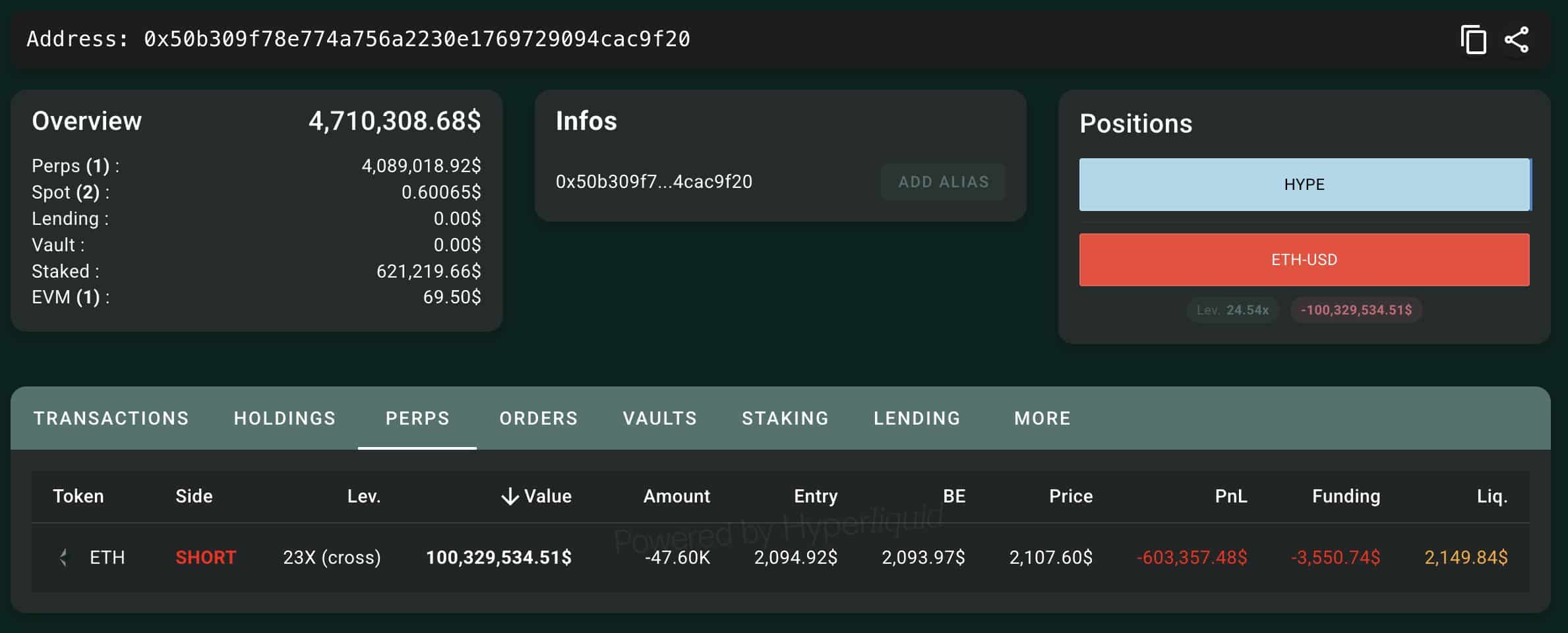
Ethereum whale short position
Source: Lookonchain

According to Lookonchain, a trader opened a 23x-leveraged short position on 47604 ETH worth $100.3 million, with a $2149 liquidation price. The whale’s taking such a huge bet shows elevated bearish sentiment in the market.

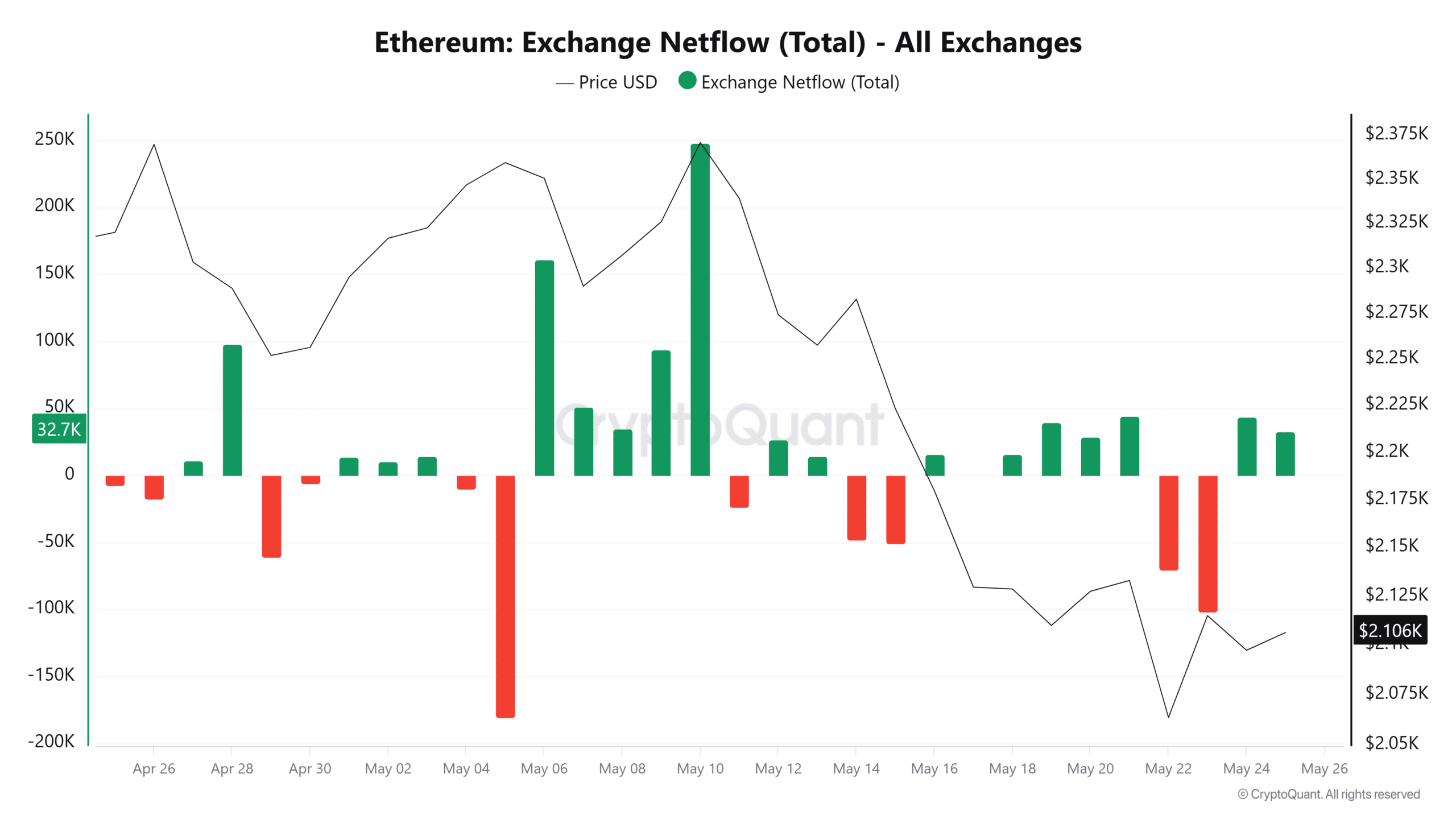
With whales turning bearish, Exchange Inflows also increased sharply over recent days. 

Ethereum exchange netflowEthereum exchange netflow
Source: CryptoQuant

According to CryptoQuant, Exchange Netflow remained positive for two straight days. At press time, Exchange Netflow stood at 33.4k ETH, down from 43k ETH previously.

Elevated inflows typically indicate growing selling activity as traders move assets onto exchanges. That shift aligned with weakening buyer demand across the market.

Can ETH defend the $2k support?

Ethereum’s weakness also reflected declining capital inflows across the ecosystem.

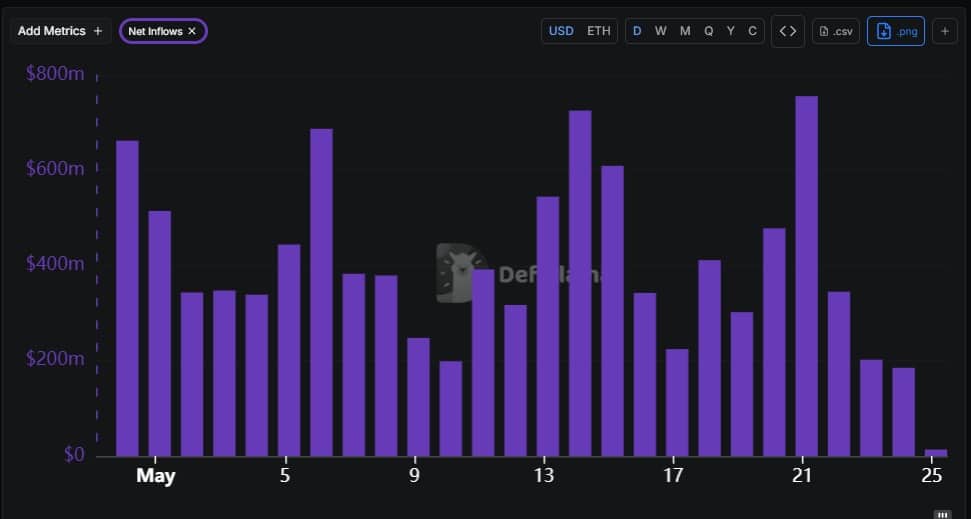
According to DeFiLlama, net inflows dropped sharply from $755 million to just $13 million.

Ethereum net inflowsEthereum net inflows
Source: DeFiLlama

Such a steep decline suggested investors largely stayed on the sidelines, reducing momentum further. In fact, momentum indicators also remained bearish.

The Stochastic Momentum Index (SMI) stayed in negative territory for nearly two weeks. Meanwhile, the DMI Modified remained negative for twelve consecutive days.

ETH DMI ModifiedETH DMI Modified
Source: TradingView

That prolonged weakness suggested sellers still controlled market momentum.

If bearish pressure continues, Ethereum could lose the $2k support level and fall toward $1,930. However, reclaiming $2.3k could invalidate the bearish outlook and weaken selling momentum.


Final Summary

  • Ethereum whales sold over 35,000 ETH worth $72.3 million as bearish sentiment intensified near the $2k level.
  • Weak capital inflows and negative momentum indicators suggested Ethereum’s downtrend could continue without stronger demand.


Source link

A Woman, 27, Who Thought She Had IBS, Was Diagnosed With Colon Cancer

0
A Woman, 27, Who Thought She Had IBS, Was Diagnosed With Colon Cancer


Despite living an active, busy life, Sydney Stoner was plagued by worsening digestive issues.

Around 2019, when she was in her mid-20s, she started cycling between constipation and diarrhea. “I just thought it was just regular stomach issues that people had,” the now 32-year-old told Business Insider.

For a while, Stoner was able to go on living her life in Little Rock, Arkansas, with her husband, two cats, and two dogs. Stoner worked as a professional theater actor, juggling roles with her part-time retail job. In her free time, she loved cycling and CrossFit.

In the meantime, she bounced around from different doctors, including a primary care physician and a holistic doctor, thinking they would diagnose her with IBS. She tried elimination diets, including cutting dairy, gluten, and sugar. Some doctors told her to “watch her weight.”

Nothing worked.

She said she had blood in her stool to get screened sooner


Sydney Stoner after her surgery, which also involved removing lymph nodes.

Stoner after her surgery, which also involved removing lymph nodes. 

Sydney Stoner


Within a year, the discomfort became more severe. Stoner only felt relief when she used the restroom, which resulted in intense cramping throughout. “I felt like my insides were twisting,” she said.

One day, the pain became too great for Stoner. It hurt to eat, and the cramps wouldn’t stop. “I was like, ‘Someone needs to see inside my body,'” Stoner said.

She called a gastroenterology care center and started listing her symptoms to the woman on the phone. When she was asked for her age and was told she’d need a referral to get screened, Stoner improvised.

From Googling her symptoms, she read that having blood in her stool, one of the most common signs of colon cancer, was typically considered more dire than stomach pain or changes in bowel movements. After she lied and said she had the symptom, she was scheduled for a colonoscopy right away.

Stoner knew something was wrong once she started waking up from the sedation used in a colonoscopy. “I’m pretty sure I heard them say ‘cancer,'” she recalled, adding that the doctors brought her husband into the room with her. “I knew that that wasn’t a good sign.”

She learned that the colonoscope, the long thin medical device used to navigate through the rectum and colon, couldn’t even get a foot inside her colon due to a mass.

Stoner was diagnosed with stage 4 colon cancer at 27. Because she was still coming down from the anesthesia, she didn’t really respond.

“I was just in shock. I didn’t really say anything,” Stoner said. “When I finally ate some foodShe was scheduled for PET and CT scans as well as a tumor removal surgery one month later. after the colonoscopy, the tears just started flowing.”

Almost two years into married life, Stoner struggled to make sense of the diagnosis. “We went on trips often, hung out with a lot of friends, loved going to live shows,” she said. “I just really never thought that cancer would be a part of that.”

Grieving her life before cancer


Sydney Stoner in cancer treatment

Stoner has undergone surgery, radiation, and multiple chemotherapy treatments since her diagnosis. 

Sydney Stoner


Stoner was scheduled for PET and CT scans as well as a tumor removal surgery one month later. She woke up from her surgery with an ileostomy, a bag attached to her abdomen to collect waste that allows the colon to heal. A year later it’d be reversed.

Initially, she was told by doctors that she had stage 3B cancer, and that it had only spread to a few lymph nodes. But once she moved to St. Louis and started care there, her scans found that the cancer had spread to her liver and lungs, making it stage 4.

Stoner did 12 rounds of chemotherapy, which caused her cold sensitivity. “I had to wear gloves to even get into the refrigerator,” she said. “I had to microwave all of my drinks.” After that, she did three rounds of radiation per lung, which led to no evidence of disease.

Two months later, her blood work showed signs of cancer, so she underwent 12 additional rounds of a different chemo medication, which led to dizziness and nausea, common symptoms. “It’s kind of like being drunk on a cruise ship, but not the fun drunk,” she said.

Since 2023, for over two years, she has been on a lower-dose maintenance chemo pill. But when her recent scans in October showed more progression of disease than her oncologist was comfortable with, she was put on more rounds of the second chemotherapy drug again.


Sydney Stoner with tattoo

Stoner now works part-time at a cat café, which she said is therapeutic. 

Sydney Stoner


The near-never-ending treatments caused both financial and emotional strain. Because Stoner and her husband had just been kicked off their parents’ insurance, Stoner struggled to get scans or treatments approved until she could apply for disability in 2021. Now, she’s on Medicare.

Stoner, who legally can’t work over a certain number of hours ,also works part-time at a cat café. Her husband is a self-employed barber, and they pay for some of Stoner’s treatment through a GoFundMe.

“You just wake up and just grieve your old life every day, which sounds really depressing,” Stoner said. “But you’re just not the same person after you get news like that.”

She’s advocating for more research funding


Sydney Stoner advocating for colon cancer research funding

Stoner is advocating for increased funding for colon cancer research. 

Fight Colorectal Cancer


Stoner said her friends and family have been a great support throughout treatment. So has the colon cancer community she found.

In 2023, Stoner discovered the nonprofit Fight Colorectal Cancer (Fight CRC), which connected her to others diagnosed with colon cancer. She learned about opportunities to present her story to Congress and to advocate for more funding for colon cancer research. It’s timely as colon cancer is now the leading cause of cancer death in people under 50.

For young people with potential colon cancer symptoms, Stoner urged listening to your body.

“Especially young women, we are dismissed a lot, and you have to find a doctor that will do the test that you need, or even try Cologuard,” a stool test that can detect existing cancer and requires a colonoscopy after a positive result, she said. “It’s better to find out early because colon cancer is so preventable.”


Source link