The takeaway is that even as oil prices retreat from their second-quarter highs, oil products are getting more expensive. The broader market, including BTC, may not have fully priced that in yet.
A second detail is that oil itself may be due for a bounce. Crude has emerged from a four-month-long bearish trend (check the Daily Signal), and there’s still disruption of tanker traffic through the Strait of Hormuz.
Those two effects, combined with concerns about government debt levels, continue to push yields on U.S. Treasuries and other advanced-economy bonds higher. That raises the opportunity cost of holding other assets and may cap bitcoin’s gains, a dynamic CoinDesk recently flagged.
One factor is still working in bitcoin’s favor, at least for now: the U.S. currency. The Dollar Index fell to a two-and-a-half-month low of 99.29 on Monday and broke down out of a bullish trendline, a technical signal pointing to further losses ahead. A weaker dollar has historically been a supportive backdrop for bitcoin.
Taken together, it’s a genuinely mixed tape that leaves bitcoin trading in the middle of several narratives pulling in opposite directions. Stay alert!
Read more: For analysis of today’s activity in altcoins and derivatives, see Crypto Markets Today . For a comprehensive list of events this week, see CoinDesk’s “Crypto Week Ahead.”
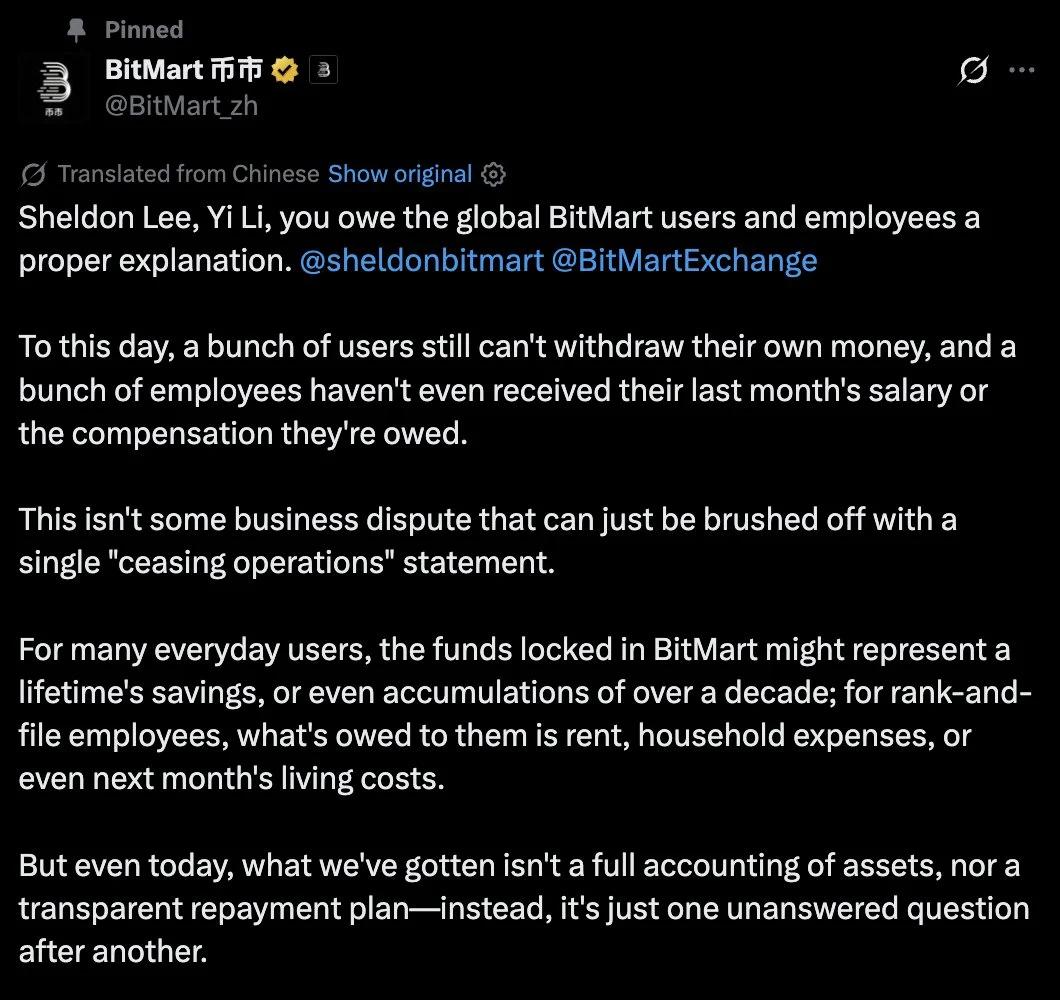
The wind-down process for BitMart is under increasing pressure. This is after customers have claimed that their ability to withdraw money is being limited while former employees are claiming that they have yet to be paid the salary owed.
As a result, its Chinese X account has called for an independent third party to verify all users’ wallets, assets, liabilities, and reserves held at BitMart. The dispute follows last week’s withdrawal concerns, when founder Sheldon Xia denied claims that he misused customer funds.
Source: X
Xia now reports that hackers accessed the Chinese account and sent out false information about him, prompting him to pursue legal action.
Withdrawals may explain part of that decline, but unresolved liabilities increase the importance of knowing what remains. Independent verification would clarify whether BitMart still holds enough assets to meet customer and employee claims as the wind-down progresses.
BitMart’s reserves draw scrutiny
That uncertainty now makes BitMart’s remaining asset coverage more important than the movement of individual withdrawals.
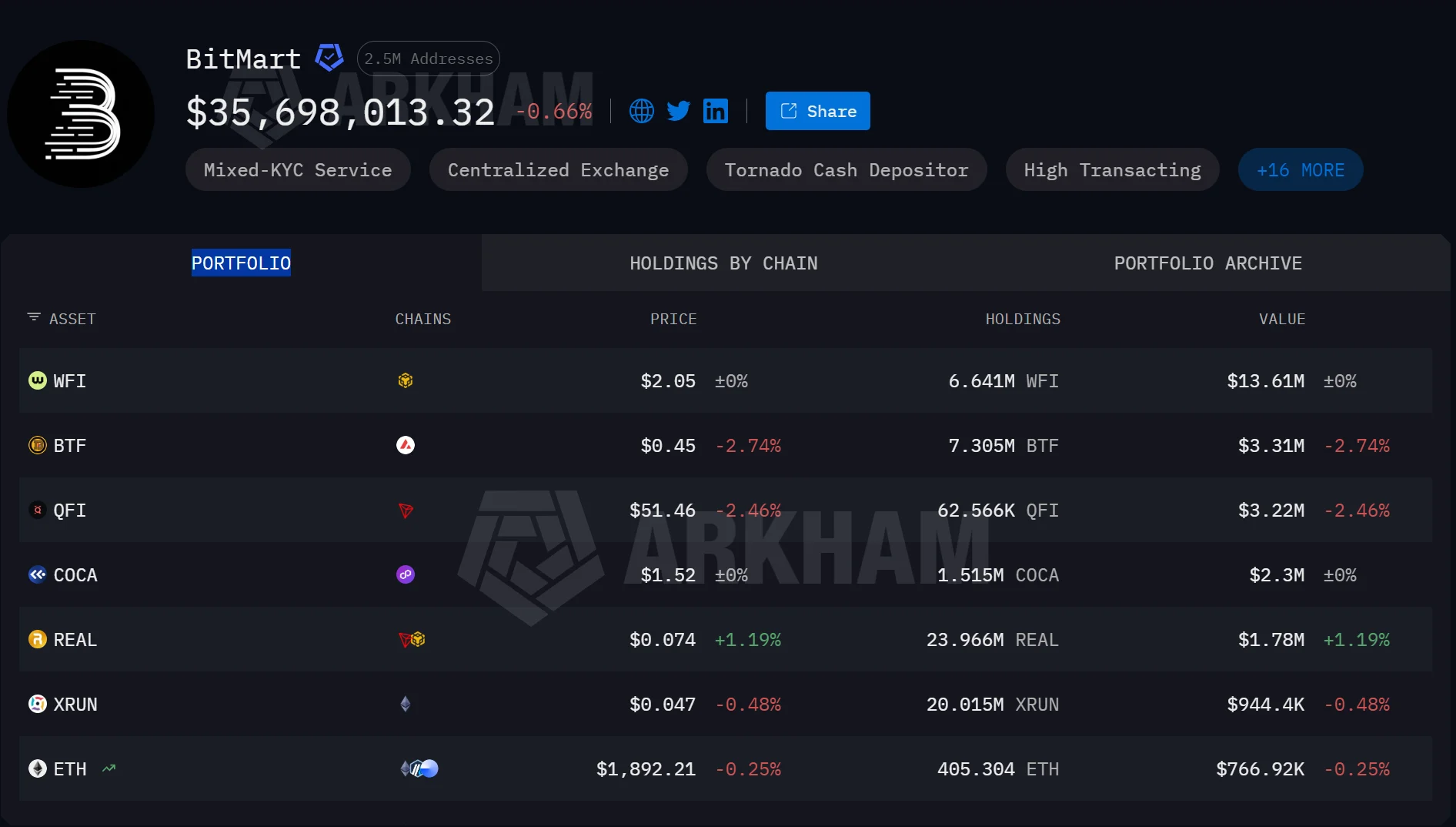
Prior to the operational announcement by Arkham, approximately $71 million was attributed to the exchanges’ exchange-linked wallets. As of writing, approximately $35.6 million is being attributed to these same wallets. Even though some of the decline may be from customers withdrawing their funds.
Source: Arkham
However, merely showing a decrease in wallet balance does not provide any information as to whether or not BitMart is able to pay its customer claims.
In order to determine if BitMart still has sufficient assets to meet its customer liabilities, the exchange will have to provide proof of reserves, which links identifiable assets that remain with the current customer liabilities.
Currently, there is no way for the public to know what percentage of each customer liability that BitMart can currently fund. Therefore, the ability of the exchange to properly close down will depend upon information that is unavailable through on-chain wallet balances alone.
A complete disclosure of all wallet activity by BitMart and a corresponding matching to each obligation. This would show whether falling reserves reflect orderly repayments or reveal a funding shortfall.
Opinions expressed by Entrepreneur contributors are their own.
Key Takeaways
If your business can’t exist without you, you don’t have a business — you have a personality with a payroll.
Real businesses build in repeatability. They develop a culture that holds regardless of any one person’s mood or bandwidth on a particular day. They build a genuinely recognizable brand.
Sit through enough award stages at real estate conferences, and the script starts to repeat itself. Three hundred deals closed last year. Twenty-five agents on the roster. Two hundred million in volume. Everyone claps, a few people scribble the number down, somebody asks for a business card on the way out.
It’s a real accomplishment. It’s also not the question worth asking. Try this one instead: What happens if the founder disappears for six months?
For a lot of teams, the answer isn’t pretty. Referrals dry up because they were tied to a person, not a brand. Recruiting slows because agents joined to be near someone specific, not to be part of an institution. The momentum everyone mistook for business growth turns out to have been one person’s output running under a company name. That’s not really a business. It’s a personality with a payroll.
A recent study tracking over 184,000 productive agents across major MLS regions found that the top 10% of agents who switched brokerages controlled roughly 45% of the total transaction volume tracked in that period. That kind of concentration isn’t an outlier in this business. It’s closer to the default setting. Most teams have an outsized share of production riding on a small handful of people, frequently just one. When that person walks away, retires or even just slows down, the business doesn’t ease into a smaller version of itself. It can come apart fast, and the founder is often the most surprised person in the room.
Growth hides a lot of weak foundations
When the market is good and the founder is producing at full speed, almost everything looks healthy. They’re recruiting, closing, marketing, fielding every referral and putting out every fire personally. From the outside, that reads as a well-oiled operation. From the inside, it’s frequently one person doing the job of an org chart and calling it a system. Growth papers over that completely. As long as the numbers keep going up, hardly anyone stops to ask whether there’s actual infrastructure underneath them or just a very fast person running very hard.
The truth tends to surface later, once growth slows down or the founder simply runs out of capacity to keep absorbing everything. The National Association of Realtors’ most recent member profile put the median realtor age at 57, and the organization is projecting membership could fall by roughly 150,000 agents by the end of this year. A large piece of that decline will be experienced producers retiring, and 21% of agents with more than 25 years in the business are already actively planning their exit, according to the same research. A lot of teams built around one of those careers are about to learn exactly how dependent they really were on it.
Top producers often become the bottleneck
Here’s the part nobody likes saying at the team meeting. The person who built the business is often the same person now holding it back. Clients want that person specifically. Major decisions route through them because that’s simply how it’s always worked. Recruiting pitches lean on access to them because that access was the actual sales pitch. None of this is a character flaw. It’s just what happens when a business gets built around one exceptional performer instead of around systems anyone could run.
Many teams don’t really scale. They stretch. Those two things look the same on a chart showing year-over-year growth, but they’re not the same thing at all. Scaling means a team can take on more volume without putting proportionally more pressure on one individual. Stretching means leaning on that same individual to absorb more, with less room to breathe, until eventually something gives out. Usually it’s the founder.
Institutions compound, personalities burn out
Real businesses build in repeatability. They develop a culture that holds regardless of any one person’s mood or bandwidth on a particular day. They build a genuinely recognizable brand. None of that means stripping out the personality that built the thing in the first place. It means building something larger than that personality, so growth doesn’t stall the second the person at the center steps back.
Law firms that last figured this out generations ago. Family offices that survive across decades figured it out, too. The strongest brokerage brands work the same way. Nobody is immune to losing key people. What separates the ones that endure is that losing one person, even a critical one, doesn’t threaten to take the whole structure down with them. Businesses built entirely around a single individual don’t compound the way people assume they will. They just get older, and eventually the bill comes due.
The next great brokerages will feel like institutions
The teams and brokerages that matter a decade out probably won’t be the loudest or even the largest. They’ll be the ones that made it through something. A leadership transition. A rough cycle. A founder’s retirement that didn’t drag the whole business down with it. Durability like that doesn’t happen by accident, and it doesn’t get built during the good years when everyone’s too busy producing to think about it. It gets built deliberately, usually well before anyone believes it’s necessary.
If your business stops growing the moment you stop showing up, you may have built a career instead of a company. Those aren’t the same accomplishment, even though they can look identical from a conference stage. One of them is worth real money to someone other than you. The other one was always just you, with a bigger title attached.
Key Takeaways
If your business can’t exist without you, you don’t have a business — you have a personality with a payroll.
Real businesses build in repeatability. They develop a culture that holds regardless of any one person’s mood or bandwidth on a particular day. They build a genuinely recognizable brand.
Sit through enough award stages at real estate conferences, and the script starts to repeat itself. Three hundred deals closed last year. Twenty-five agents on the roster. Two hundred million in volume. Everyone claps, a few people scribble the number down, somebody asks for a business card on the way out.
It’s a real accomplishment. It’s also not the question worth asking. Try this one instead: What happens if the founder disappears for six months?
For a lot of teams, the answer isn’t pretty. Referrals dry up because they were tied to a person, not a brand. Recruiting slows because agents joined to be near someone specific, not to be part of an institution. The momentum everyone mistook for business growth turns out to have been one person’s output running under a company name. That’s not really a business. It’s a personality with a payroll.
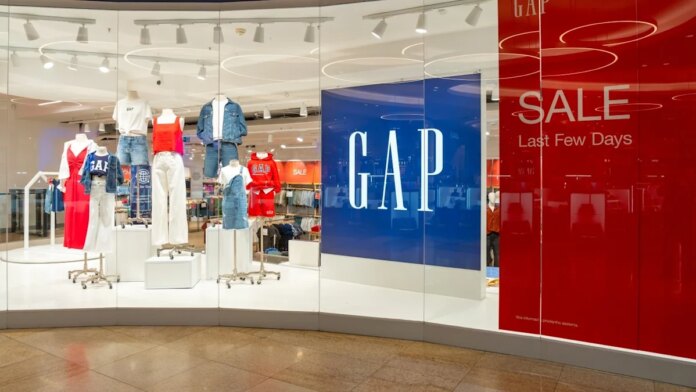
US apparel retailer Gap has agreed a partnership with Iconic Brands Nordic to grow its presence across the Nordic and Baltic markets.
The rollout is set to take place in three stages.
It will start with Gap launching on Boozt in Sweden, Denmark, Norway and Finland this month.
This will be followed by the opening of Gap sections within Stockmann department stores in Finland, Estonia and Latvia.
The third stage will see Gap open its first standalone store and e-commerce site in Estonia in September.
Gap franchise and wholesale senior vice-president Facundo Ginobili said: “Our partnership with Iconic Brands Nordic reflects our long-term commitment to growing Gap in markets where we see meaningful opportunity.
“Together, we are bringing the Gap brand to life through storytelling, experiences, partnerships and omnichannel retail, creating modern, relevant ways for customers across the Nordic and Baltic regions to discover and engage with the brand.”
Founded in 2025 as a joint venture between Brandgate Group and Tristafan, Iconic Brands Nordic has the exclusive regional licence for Gap in the Nordic and Baltic markets.
Iconic Brands Nordic CEO Kristjan Rajando added: “We are excited to introduce Gap to even more customers across the Nordic and Baltic markets. We believe Gap’s iconic style and timeless essentials will resonate strongly across the region.”
Earlier this month, Gap also confirmed a partnership with Chalhoub Group to bring the Gap, Banana Republic and Athleta brands to the Gulf Cooperation Council (GCC) region.
Under the agreement, Gap’s brand strategy will be paired with Chalhoub Group’s regional retail expertise, with the aim of offering customers an integrated shopping experience across channels and introducing the three brands to the market through a range of retail formats and activities.
In June, the clothing retailer partnered with Google Cloud, Zeta Global and Publicis Sapient to build an AI-driven marketing platform across its brand portfolio.
“Gap partners Iconic Brands Nordic for regional push” was originally created and published by Retail Insight Network, a GlobalData owned brand.
Bitcoin traded near $64,100 on Tuesday, up 1% on the day and holding above $64,000 even as rising bond yields and climbing oil drained appetite for risk assets, per CoinDesk data.
Ether held near $1,893 and the rest of the majors sat flat, with Hyperliquid the week’s outlier, up 8.3%.
The pressure is coming from bonds and crude. The 30-year Treasury yield rose to 5.33%, its highest since 2007, as investors demand more to finance heavily indebted governments and guard against sticky inflation. Long-dated yields climbed worldwide, and S&P 500 futures fell 0.5%, heading for a third straight day of losses.
Brent crude topped $91 a barrel as the US-Iran conflict escalated, with Trump threatening to bomb Oman if it interferes with US operations in the region.
That combination is the macro headwind that has capped crypto all summer, now sharpening. Higher oil feeds inflation, higher inflation lifts yields, and rising borrowing costs pull money out of risk assets and reinforce expectations that central banks stay tight. Bitcoin sits in the same risk complex, so the read-through is negative at the margin.
What stands out is that bitcoin is holding anyway. It’s up on the day and green on the week while stocks fall for a third session and yields hit generational highs, the kind of relative firmness that fits the returning-ETF-demand thread rather than fighting it. Watch whether it can keep diverging.
A break above $64,500 would strengthen the case that fresh buyers are absorbing the macro pressure, while oil pushing toward $100 and yields climbing further would test that resilience fast.
SpaceX(SPCX) stock is back trading near $140, up nearly 5% over the past week, as investors find new reasons to bet on Tesla (TSLA) CEO Elon Musk‘s newest public-market heavyweight.
Also, the latest 13F filings are only adding to the fuel.
AI behemoth Nvidia(NVDA) disclosed 122.76 million SpaceX shares worth nearly $21 billion on June 30, according to 13f.info.
At the same time, Alphabet (GOOG) reported 551.2 million shares valued at nearly $94.2 billion, according to 13f.info. That’s some insane institutional firepower behind a stock that hasn’t left the spotlight since its earth-shattering June debut.
As we look ahead, nearly 320 million restricted shares will become eligible for transfer on August 20.
For context, the last lock-up release on August 6 was much bigger, at 911.5 million shares, yet the feared selling wave never came, as reported by CNN. Instead, SpaceX jumped back above its $135 IPO price.
Nevertheless, Wall Street remains bullish, slapping an average price target of around $227, implying 62% upside according to Seeking Alpha.
Phillip Securities analyst Glenn Thum just took Wall Street’s most bearish stance on SpaceX stock.
Thum kept a Sell rating and a $75 price target, implying 46% downside from the stock’s current price near $140. That’s also near the lower end of Wall Street’s consensus range.
Thum’s call carries a ton of extra weight, as he’s rated a five-star TipRanks analyst, with a tremendous 89% success rate across his ratings.
That’s higher than veteran analysts such as Dan Ives, who has a 58% success rate.
Moreover, of his 106 tracked calls, 94 were profitable, generating an impressive average return of 20.8% per rating.
More SpaceX:
Interestingly, his concerns start with AI.
Musk had suggested AI could potentially become SpaceX’s biggest revenue engine, not merely a side business. I covered that shift in my Aug. 12 story, “Elon Musk just redefined what SpaceX could become.”
Musk told employees: “Probably our AI revenue — not probably, definitely — our AI revenue will exceed all other SpaceX revenue probably in September, like next month.”
SpaceX’s AI revenue skyrocketed 247% year over year in Q2, with nearly $1.6 billion stemming from the initial ramp of cloud-service agreements.
On the surface, that’s the sort of growth investors typically reward with a premium multiple.
However, Thum makes the case that those contracts aren’t strong enough to justify one.
The cloud agreements charge monthly fees and can be exited with just a 90-day notice following the initial ramp.
What’s more important is that a single AI customer generated 19.5% of SpaceX’s Q2 sales, up from less than 10% a year earlier. That has SpaceX carrying an unusually high concentration risk if one major customer slows down spending or walks away.
On top of that, there’s also the cost of chasing that growth.
Reuters reported that SpaceX spent a whopping $18.4 billion on CapEx in Q2, nearly 2.4 times its quarterly sales, and Thum expects that elevated spending to remain near that level over the next two quarters.
Additionally, compute capacity is expected to exceed 2 gigawatts by December, up from 1.4 gigawatts in June.
Put simply, his argument is that SpaceX is spending as if AI demand is permanent before its contracts prove it is.
For the stock to re-rate higher, he argues that those compute deals must be converted into multi-year commitments.
SpaceX stock faces a $75 target despite its recent market rebound.Anna Moneymaker/Getty Images
AI is already reshaping SpaceX’s sales mix
SpaceX’s relatively complex valuation becomes easier to understand when its business segments are pulled apart.
For perspective in Q2, SpaceX generated $7.81 billion in revenue. Connectivity products, spearheaded by Starlink, contributed $4.29 billion, or roughly 55% of sales. On top of that, AI generated $2.56 billion, about 33%, while space products contributed another $962 million.
So clearly, on paper, AI is far more than just an experimental side project for SpaceX.
It is currently the company’s second-largest sales engine, and that gap with connectivity is likely to close out pretty quickly.
Thum feels that even though demand is strong, he feels investors are assigning too much value to sales backed by contracts that can be exited with hardly much notice.
Nevertheless, the scale matters.
SpaceX is targeting over 2 gigawatts of compute capacity by December, up from 1.4 gigawatts in June, while dropping billions to build it.
SpaceX investors are paying years ahead
For SpaceX investors, the debate is pretty much about how much future growth is embedded into the stock.
At $140 per share, SpaceX trades at 373 times forward non-GAAP earnings, compared to just 13.4 times for the sector, according to Seeking Alpha. On a forward GAAP basis, the multiple balloons to roughly 1,891 times.
Those numbers look pretty extreme, as Wall Street is expecting earnings to rise from a remarkably low base.
GuruFocus estimates put GAAP EPS at just $0.008 in 2026, before jumping to $1.66 in 2027, $4.95 in 2028, $7.29 in 2029, and $11.19 by 2030.
If we take today’s $140 share price, it means investors are paying roughly 84 times 2027 earnings, 28 times 2028 earnings, 19 times 2029 earnings, and only around 12.5 times projected 2030 EPS.
That’s a pretty telling piece of information.
SpaceX looks remarkably pricey when compared to near-term profits, but a lot less so if Wall Street’s long-term earnings ramp materializes.
Revenue expectations point to the same story.
According to GuruFocus data, sales are expected to rise from nearly $44.7 billion in 2026 to $103.8 billion in 2027 before surging to about $451.6 billion by 2030.
Essentially, it then becomes more of a duration trade.
Investors are loading on SpaceX today, betting that AI, Starlink, and its space businesses could convert sales growth into bottom-line strength quickly enough to compress that multiple. On the flip side, if AI contracts weaken and CapEx is elevated with meager margins, Thum’s bearish arguments become tougher to miss.
“$57,000 is a key region to watch. If Bitcoin trades down into that area, we could see a massive wave of long liquidations,” Joao Wedson, CEO of crypto analytics platform Alphractal, said.
The risk is amplified by thin trading volumes. As CoinDesk reported Monday, the number of active contracts is unusually large relative to trading volume. That combination matters a scenario, where a large batch of leveraged longs get liquidated and thin order books make it harder to absorb those liquidations at stable prices. The result could a sharper, faster drop rather than a orderly pullback.
The question is whether BTC will fall to $57,000.
Past crypto bear cycles have seen severe crashes of 76% to 84%. The latest one, which began at highs above $126,000 last October, has so far only cut prices in half. If history is any guide, there may be another leg lower still to come.
Analysts at crypto exchange Bitfinex noted that bitcoin is showing mid-to-late bear market characteristics, with price trading between the long-term holder realized price of $52,699 and the short-term holder realized price of $67,176. The realized price median, near $63,200, has provided support over the past two weeks; a break below that level could put the June low of $57,803 back in focus.