Home Blog Page 708

ZCash sheds 20% in 3 days – Should swing traders still remain bullish?

0
ZCash sheds 20% in 3 days - Should swing traders still remain bullish?


Another day, another crypto market price drop, and another $900+ million in liquidations in the derivatives market. Unlike the previous weekend’s mass liquidations, ZCash [ZEC] bulls were unable to shrug this hit off.

Since the 25th of May, the privacy altcoin has lost just over 20%. AMBCrypto had reported earlier this week that ZEC had accomplished a bullish breakout from a local range.

Since then, the market-wide selling pressure has forced ZEC back into the range.

Bitcoin [BTC] was also down nearly 5% since Monday, helping explain the ZEC pullback. Despite the pace of ZEC’s losses, there’s reason to believe that the recent ZCash drop was just that—a pullback.

The ZCash buying opportunity

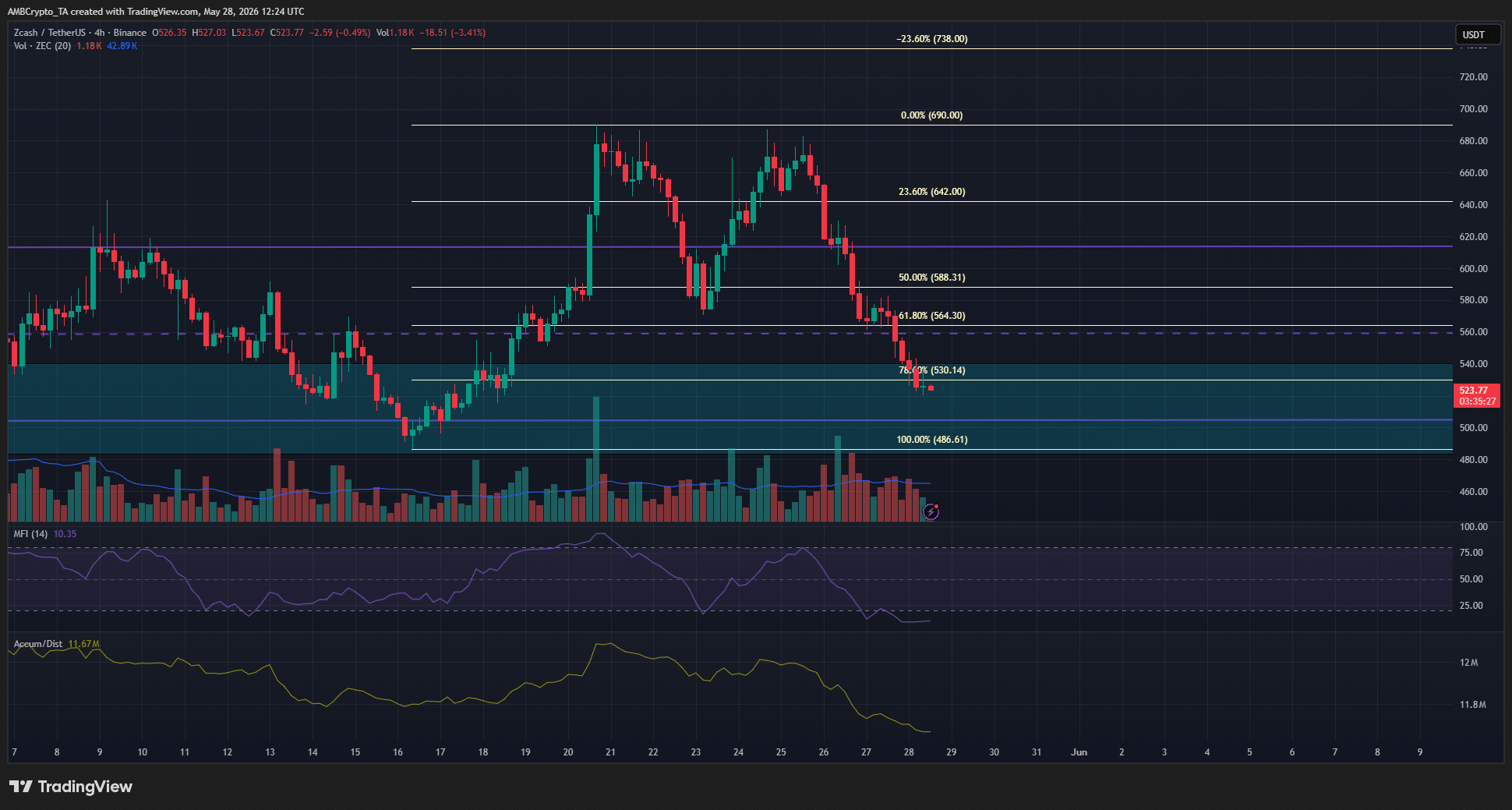
The recent AMBCrypto report had taken a bullish stance on the privacy token and noted that $486 was the invalidation level for this bias. This idea still held. The recent losses have pulled ZEC to a key Fibonacci retracement level at $530.

ZCash 4-hour Chart
Source: ZEC/USDT on TradingView

The closer ZCash retreated to the $486 swing low, the more bulls were at risk from the bears. The A/D indicator signaled that sellers have been in control over the past week.

Meanwhile, the MFI on this timeframe was at 10.35, a sign that the asset was heavily oversold.

It presented a good risk-to-reward buying opportunity but also came with a clear sign of where to exit the trade.

Given the wider market sentiment and Bitcoin’s bearish shift, it is possible that ZEC is forced to shed more in the coming weeks, even as it retains its higher timeframe bullish structure.

ZCash Liquidation HeatmapZCash Liquidation Heatmap
Source: CoinGlass

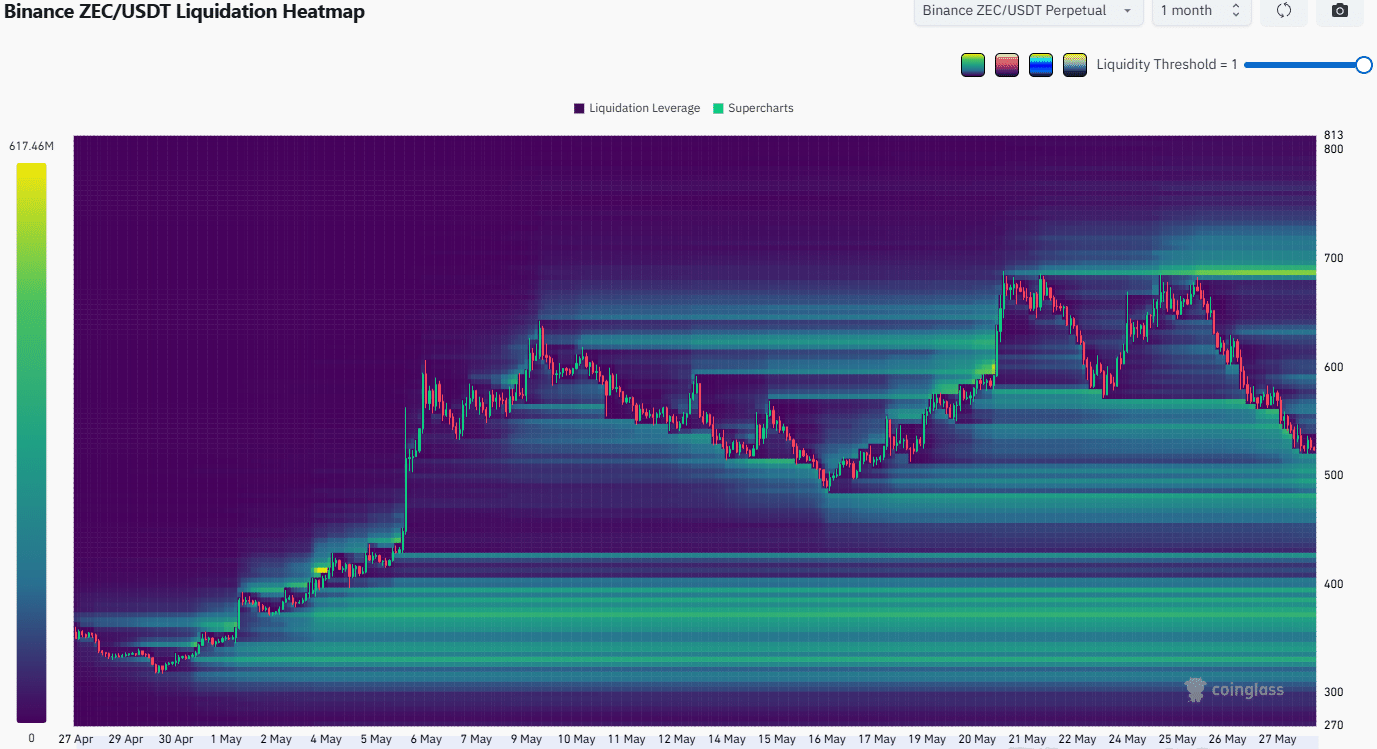
The 1-month liquidation heatmap revealed clusters of liquidations from $520 to $470. These magnetic zones would likely be revisited soon.

However, swing traders and investors need to remain patient. The market is about to make its decision and reveal its hand. Until a breakdown below $486 comes about, traders can await a lower timeframe bullish shift to buy ZEC.


Final Summary

  • The recent days saw ZCash shed just over 20% since the 25th of May.
  • Despite the swift losses, the ZEC short-term outlook remains bullish unless $486 is breached.


Source link

The EEOC chair knows gutting diversity reporting will blind the agency to discrimination. She’s doing it anyway.

0
The EEOC chair knows gutting diversity reporting will blind the agency to discrimination. She's doing it anyway.

On April 22, Andrea Lucas, chair of the Equal Employment Opportunity Commission (EEOC), addressed a group of academics, legal experts, and community advocates at a conference at Harvard University. 

The conversation immediately turned to the elephant in the room: the EEOC’s investigation into anti-Semitism at the University of Pennsylvania. As part of the investigation, the EEOC subpoenaed the university for the names and contacts of employees affiliated with Jewish groups at the university, a move that stirred controversy and raised safety concerns from students and faculty. 

As she was not at liberty to speak about ongoing litigation, Lucas spoke in general terms and offered a simple explanation about why the EEOC collects data. Across the commission’s 60-year history, the agency has collected information, she said. 

“Why?” she asked. “Because there is no other way to protect victims of harassment or discrimination unless you collect information about them.” 

Less than a month later, the EEOC submitted a proposal to rescind the regulation requiring employers, unions, and state and local governments with more than 100 employees to report their racial and gender demographics, ending six decades of precedent. These rules also apply to federal contractors with more than 50 employees.

The move comes as the commission under Lucas has begun a crusade against diversity efforts and is searching for cases of discrimination against white men. In December, Lucas posted a video on social media calling on white men to report discrimination they have faced at work based on their race or sex. In the months since, the EEOC has launched investigations into Coca-Cola for hosting a two-day trip and networking event for female employees and Nike for race-restricted mentorship and leadership opportunities. 

The proposal to end demographic reporting is consistent with Lucas’s broader effort to reframe civil rights enforcement away from systemic or unintentional discrimination and toward individual claims. If employers stop tracking workforce demographics, it becomes far harder to identify patterns—disproportionate layoffs of Black workers, pay gaps for women—that serve as the evidentiary foundation for class-action and systemic discrimination cases. Those are precisely the kinds of cases that have historically benefited minority workers. 

By contrast, the discrimination claims Lucas has been actively soliciting—from white men alleging reverse discrimination—tend to be individual in nature and don’t require aggregate demographic data to prosecute. Eliminating the reporting requirement, then, doesn’t just reduce the EEOC’s investigative capacity equally across the board; it selectively weakens the tools used to pursue the cases Lucas appears least interested in bringing.

The EEOC did not respond to Fortune’s requests for comment. 

Last week at Fortune’s Workplace Innovation Summit, Lucas repeated a refrain she used to frame the EEOC’s work since she began leading the commission in 2025. 

“We are the Equal Employment Opportunity Commission. We’re not the Equitable Outcomes Commission,” she said, arguing that Title VII protects any race or sex against discrimination, not specific groups. 

The data the EEOC collects from employers is an important starting point when a claim is filed, Chai Feldblum, who served as an EEOC commissioner from 2009 to 2019, explained. She is president of EEO Leaders, a watchdog organization of former high-level EEOC and Department of Labor officials. 

“In some of the very important, large-scale employment concerns, employment claims, it will reduce the efficacy of the investigation to not have that information already on file,” Feldblum said. 

She added that when the commission begins an investigation, they can request data, such as in the University of Pennsylvania case, because Jewish identity data is not collected as part of traditional EEO-1 forms. But more problems could arise for investigators if the rescission is passed and employers stop collecting data for a period of time, she explained. 

“This EEOC is not walking away from collecting data to investigate the claims they think are problematic right now,” Feldman said. “What they are doing with this proposed rescission is removing a mechanism by which employers can self-regulate by seeing what their issues are.”

When speaking at Harvard, Lucas appeared to agree on the importance of data collection. 

“There is no other way for me to be able to get money to victims who have been harmed. And I believe in many cases have been grievously harmed unless I know something about someone’s affiliation with a religious organization,” Lucas said. “The same principle, of course, is true for any protected characteristic. I can’t protect Black workers if I don’t collect information about the Black workers who applied to a job or are employees right now who might be within class.” 

“That’s the nature of civil rights enforcement.”


Source link

Crypto trading firm FalconX confidentially files with SEC for IPO, hires bankers

0
Crypto trading firm FalconX confidentially files with SEC for IPO, hires bankers

Crypto trading firm FalconX has confidentially filed a draft S-1 registration statement with the Securities and Exchange Commission (SEC), the initial step toward a potential public listing, according to a person with knowledge of the matter.

FalconX has hired Wall Street heavyweight Cantor and other bankers to advise on its initial public offering (IPO), the person said, who spoke on condition of anonymity as the matter is private.

The California-based company’s IPO is not expected to happen until the end of the year, given market conditions, the person added. CoinDesk previously reported that Cantor was among the firms pitching FalconX for its potential listing.

Both FalconX and Cantor declined to comment.

FalconX is a brokerage and trading firm that primarily serves institutional clients, including hedge funds, asset managers, and market makers. Founded in 2018, it operates as a digital asset prime broker, providing services such as trade execution, liquidity access, credit, and clearing. In June 2022, the company raised $150 million in a Series D funding round that valued the firm at $8 billion.

Crypto firms entered 2026 expecting a strong year for IPOs after successful listings by companies such as Circle (CRCL) and Bullish (BLSH), CoinDesk’s parent company, helped rekindle investor appetite for digital-asset businesses in 2025.

Since then, however, deteriorating market conditions, weaker trading volumes and lackluster post-listing performances from newly public firms such as BitGo (BTGO) have cooled enthusiasm for additional crypto IPOs.

Several major crypto companies, including Payward, Kraken’s parent company; Ethereum software developer Consensys; hardware wallet maker Ledger, and asset manager Grayscale, have since postponed their IPO plans while waiting for market conditions to improve.

Some firms are still pushing ahead with their plans to go public. Blockchain.com said last week that it had confidentially filed for a U.S. IPO with the SEC.

Meanwhile, Securitize has agreed to merge with Cantor Equity Partners II, a Nasdaq-listed special purpose acquisition company, in a deal that would make it one of the few publicly traded firms primarily focused on tokenized securities and real-world assets.

Read more: Crypto IPOs could create massive $1 trillion market amid tokenization wave, Jefferies says


Source link

Do Wall Street Analysts Like Ameriprise Financial Stock?

0
Do Wall Street Analysts Like Ameriprise Financial Stock?


With a market cap of $40.9 billion, Ameriprise Financial, Inc. (AMP) is a diversified financial services firm that provides financial planning, investment management, and insurance solutions to individual and institutional clients across the United States and globally. It operates through segments including Advice & Wealth Management, Asset Management, and Retirement & Protection Solutions.

The Minneapolis, Minnesota-based company’s shares have underperformed the broader market over the past 52 weeks. AMP stock has decreased 9.7% over this time frame, while the broader S&P 500 Index ($SPX) has rallied 27.1%. Moreover, shares of the company are down 7.1% on a YTD basis, compared to SPX’s 9.9% gain.

More News from Barchart

Looking closer, the financial services company stock has lagged behind the State Street Financial Select Sector SPDR ETF’s (XLF) 1.8% return over the past 52 weeks.

www.barchart.com

Shares of Ameriprise Financial recovered marginally following its Q1 2026 results on Apr. 23 after the company reported record adjusted EPS of $11.26, up 19%, alongside 11% growth in adjusted operating revenue to $4.8 billion and ROE exceeding 54%. Investor sentiment was also supported by strong business momentum, including 12% growth in assets under management, administration, and advisement to $1.7 trillion, a 20% increase in Advice & Wealth Management pretax earnings to $951 million, and the announcement of a multiyear Huntington Bank partnership expected to add approximately 260 advisers and $28 billion in assets beginning in Q4.

For the fiscal year ending in December 2026, analysts expect Ameriprise Financial’s adjusted EPS to grow 8.4% year-over-year to $42.63. The company’s earnings surprise history is promising. It beat the consensus estimates in the last four quarters.

Among the 15 analysts covering the stock, the consensus rating is a “Moderate Buy.” That’s based on four “Strong Buy” ratings, two “Moderate Buys,” eight “Holds,” and one “Strong Sell.”

On Apr. 24, BofA raised its price target on Ameriprise Financial to $594 and maintained a “Buy” rating.

The mean price target of $540.25 represents a 21.2% premium to AMP’s current price levels. The Street-high price target of $636 suggests a 42.7% potential upside.

On the date of publication, Sohini Mondal did not have (either directly or indirectly) positions in any of the securities mentioned in this article. All information and data in this article is solely for informational purposes. This article was originally published on Barchart.com


Source link

Calamos bets protected Bitcoin ETFs can outlast crypto market swings

0
Calamos bets protected Bitcoin ETFs can outlast crypto market swings

Latest developments: Calamos says its protected Bitcoin ETFs are attracting inflows even as spot Bitcoin ETFs see redemptions.

  • Matt Kaufman, head of ETFs at Calamos, said the firm saw roughly $10 million to $15 million in inflows over the past several weeks.
  • Kaufman said advisors are increasingly looking for Bitcoin exposure that reduces volatility and downside risk.
  • The firm offers three versions of its protected Bitcoin ETFs, including products with full downside protection and others with 10% or 20% downside risk.
  • “You can get upside of Bitcoin with no downside risk,” Kaufman said.
  • Kaufman joined CoinDesk’s Jennifer Sanasie on Public Keys.

How it works: Calamos structures the products using Treasuries and options tied to Bitcoin-linked indexes.

  • Kaufman said the firm allocates roughly 90% of assets into Treasuries to build downside protection.
  • The remaining budget is used to buy Bitcoin-linked call spreads through FLEX options.
  • Calamos created its own Bitcoin-linked index and listed FLEX options tied to that index after the launch of spot Bitcoin ETF options.
  • The products are offered in quarterly structures as well as laddered versions designed for model portfolios.

What advisors are asking: Wealth managers are becoming more sophisticated in how they evaluate crypto exposure.

  • Kaufman said advisors previously focused on whether Bitcoin belonged in portfolios at all.
  • Now, advisors are asking how to improve risk-adjusted returns and portfolio construction using crypto exposure.
  • Calamos positions its products as alternatives to traditional portfolio allocations, including broad equities, bonds and cash.
  • Kaufman said some investors are moving from cash-like products into fully protected Bitcoin ETFs tied to Bitcoin performance but without downside exposure.

Reading between the lines: The crypto ETF market is evolving beyond simple spot exposure.

  • Kaufman said the industry is increasingly dividing crypto ETF strategies into three categories: protection, income and growth.
  • Calamos previously launched auto-callable income ETFs and is exploring additional crypto-related strategies.
  • Other ETF issuers have focused on generating yield from Bitcoin volatility through options-based products.
  • “You don’t just have to sit in the spot vehicle anymore and ride out those waves,” Kaufman said.

What comes next: Calamos expects Bitcoin volatility to remain a defining feature of the asset.

  • Kaufman said he expects Bitcoin to revisit previous highs despite recent market turbulence.
  • He argued Bitcoin’s volatility profile creates opportunities for structured products and options-based strategies.
  • “I think we’re going higher,” Kaufman said.


Source link

Mastercard wins New York’s BitLicense to expand crypto payments -Details 

0
Mastercard wins New York’s BitLicense to expand crypto payments -Details 


Global payment giant Mastercard is now ready to expand its crypto payments after getting a key New York (NY) State approval. 

On Wednesday, the firm announced it had been granted a BitLicense by the NY State Department of Financial Services (NYDFS).

The license allows Mastercard to conduct crypto payment activities in the state. In other words, it will now clear and settle crypto and tokenized assets without the need for third parties. 

Jorn Lambert, chief product officer at Mastercard, billed the approval as a crucial way to build trust and confidence in the sector.  

Clear regulatory frameworks play an important role in building trust and confidence as new forms of digital value move from experimentation toward practical application.

The firm echoed that the move is part of its “long-term strategy” to responsibly engage with new payment and settlement infrastructure involving stablecoins and tokenized deposits. 

In March, Mastercard partnered with SoFi Technologies to support its stablecoin, SoFiUSD. It was included in the firm’s Mastercard Multi-Token Network (MTN), which integrates fiat currencies with digital assets. 

As such, the latest approval scales its integrated crypto payments and tokenized asset transfers. 

Mastercard and rivals race to add stablecoin payments

Mastercard’s move is part of a broader trend of integration of on-chain rails, especially stablecoins. 

Earlier in May, another global player, Visa, announced expanded stablecoin settlement rails to five new chains, including Circle-backed Arc and Stripe-backed Tempo. 

According to Visa, the demand for stablecoin payment on its platform surged 50% in Q1 2026, prompting the expansion of on-chain rails. 

MoneyGram, Western Union, and other cross-border players are also racing to integrate stablecoins and crypto payments. In fact, the adoption trend goes against the previous claim that stablecoins would replace and disrupt these traditional payments. 

With clear rules through the GENIUS Act, stablecoin momentum has picked up pace, and institutions are now increasingly engaging with these new payment rails.

In fact, a recent Artemis report showed that business-to-business (B2B) transfers dominated as of August 2025. 

Mastercard
Source: Artemis

Additionally, crypto cards, which allow holders to directly spend their balances in traditional stores, have surpassed P2P stablecoin transfers. 


Final Summary

  • Mastercard was granted a BitLicense by New York State amid the firm’s aggressive push to integrate crypto into its traditional payment platform. 
  • This is part of a broader trend as Visa and other rivals expand their support for crypto payments. 


Source link