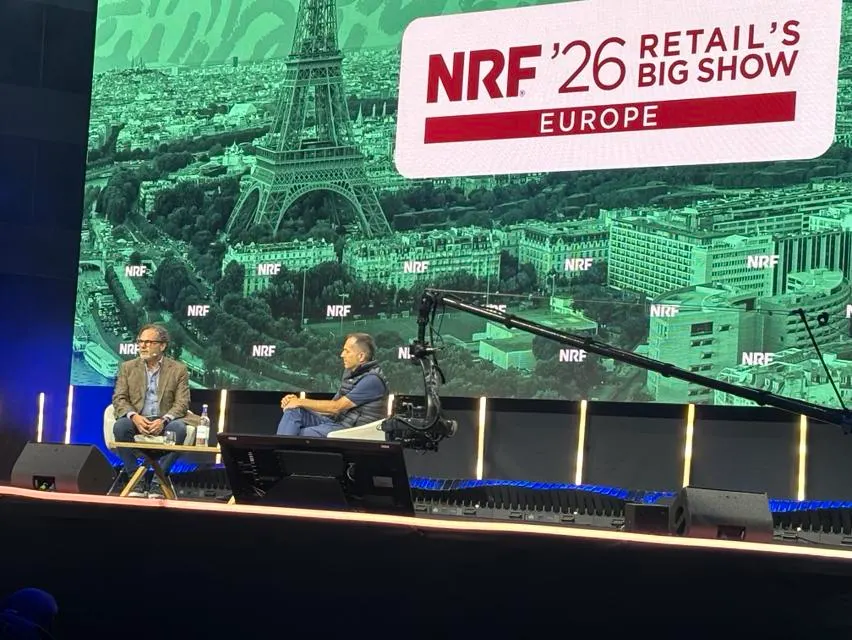
Zabka Group’s CEO designate outlined his company’s formula for success in Paris this week.
Mark Faithfull
When Alimentation Couche-Tard abandoned its attempt to buy the owner of 7-Eleven last year, it missed the chance to acquire arguably the world’s most recognizable convenience-store network.
But now it is set to spend about $8.8 billion on Żabka Group, Poland’s largest convenience retailer and one of the best operators you may well never have heard of, which has been described as Europe’s very own answer to 7-Eleven.
The group already has around 13,300 stores in Poland and Romania, a sophisticated franchise model, a well developed digital ecosystem, a huge and high quality prepared-food business and a format designed around consumers who want to buy food and everyday essentials as close to home as possible, and immediately.
Zabka Group CEO designate Tomasz Blicharski was at the National Retail Federation’s European event in Paris this week and on stage he insisted that the company is building the “ultimate convenience ecosystem” rather than simply a chain of small shops.
It’s a proposition that has drawn in Canada’s Couche-Tard, owner of Circle K, which agreed in July to acquire control of Żabka for approximately PLN32.6 billion, or $8.8 billion, and shareholders representing roughly 57% of Żabka’s shares have backed the transaction.
While Żabka may not be 7-Eleven, the acquisition gets Couche-Tard much closer to what it was seeking, a dense, scalable convenience platform capable of becoming a major European retail network.
Zabka Group Focus on Food To Go
“The model works everywhere,” Blicharski insisted. “Our typical store is only about 700-750-sq.-ft. and we position them close to where consumers live, work or travel. Our network handles approximately 4.3 million transactions a day, while our stores provide access to a broad range of immediate-consumption products. We are the leading seller of hot food including our iconic hot dogs, pizza, ready meals and coffee.”
Indeed, the company sells roughly 85 million hot dogs a year and has redeveloped its stores around high quality food-to-go and immediate consumption after historically operating as a lower-price convenience business, opening at a more pedestrian 200 stores a year. But after being acquired by CVC Capital Partners in 2017 when the network was at about 4,500 stores, it hasalmost tripled that store count, while transforming what those stores actually look like and do.
“We needed to change the business and get closer to customers,” Blicharski said. “The first revolution was towards modern convenience and targeting people who don’t have time to cook at home. That meant changing the proposition for a younger consumer and we couldn’t serve with conviction in the old platform, so we changed the look and format of the stores.”
Żabka subsequently remodelled about 4,000 stores and now around 60% of its customers are under 35, according to Blicharski. That transformation is undoubtedly one of the reasons the business is so appealing to Couche-Tard.
Zabka Builds Digital Platform
Żabka also began its digital transformation around a decade ago, initially using data to improve its assortment, pricing and site selection. It subsequently built a consumer app and moved into ultra rapid delivery, meal subscriptions, autonomous stores and AI.
“Digital started with the use of data, differentiated assortments, pricing and location finding for new stores,” Blicharski said. “Through this, we were able to accelerate expansion and we increased margins.”
A Zabka convenience store in central Warsaw, Poland. Photographer: Damian Lemanski/Bloomberg
© 2024 Bloomberg Finance LP
It has also acquired and integrated adjacent businesses including meal-delivery company Maczfit and meal marketplace Dietly, while its digital ecosystem also includes rapid grocery delivery and autonomous Żabka Nano stores.
“Delivery within 10 minutes, with the key not to lose money, was the aim,” Blicharski said of the strategy and the solution was not simply to turn every convenience store into a mini fulfillment centre.
“We built it by leveraging the synergies between the mothership and young start-up,” he recalled. “We have dark stores because execution is fundamental and at the top level, we couldn’t do that from stores alone.”
The company has also developed a sophisticated franchise model, centralized procurement and logistics, data capabilities, consumer technology and a store format that can be rolled out rapidly, allowing the company to expand its footprint without funding every shop itself while retaining central control over brand, technology, supply chain and assortment.
“We’re still opening stores in Romania with the Froo format, on our way to 20,000 stores in Poland,” Blicharski said. “We have developed a high street concept that works in a market with the share of discounters higher than in Germany, at 50%. So we’re very used to competing in a highly discounted market.”
Couche-Tard says the acquisition would give it an immediate scaled platform in Central and Eastern Europe but the real possibility is clearly taking the Żabka playbook well beyond Poland.