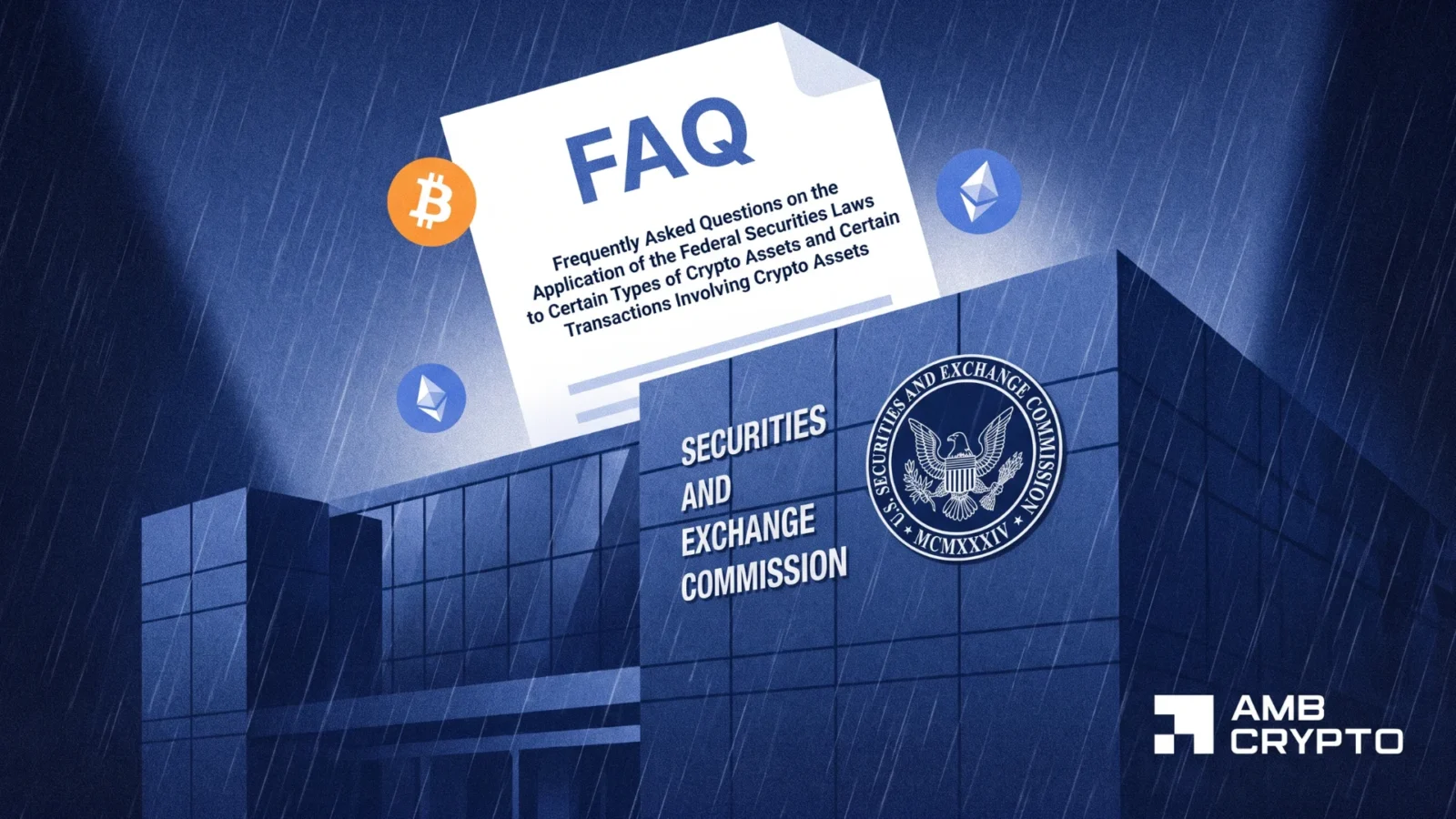
The United States Securities and Exchange Commission (SEC) has come up with a set of Frequently Asked Questions (FAQs) on the 25th of September.
Here, the aim of the FAQs is to provide additional clarity on how the agency’s March 2026 Interpretive Release should be applied to different types of crypto assets and transactions.
Notably, these FAQs are not SEC rules or regulations. Instead, these are just staff guidance. And it goes without saying that this guidance does not have legal force, and as of now, the SEC itself has neither approved nor rejected this content.
In fact, it explains how the ‘Division of Corporation Finance’ interprets existing securities laws and the earlier interpretive release.
Table of Contents
SEC’s staff take on staking tokens
Speaking of the FAQs, the SEC staff clarified its definitions of “functional” and “decentralized”. They said these definitions are used to classify crypto assets but do not determine whether an issuer has fulfilled its specific promises to investors.
Then they cleared the air around staking receipt tokens, which they believe can be classified as a digital tool. This is because they simply represent ownership of an underlying digital commodity and are not subject to an investment contract.
However, when issued by a protocol-based liquid staking provider, they may qualify as digital commodities. This is because their value is linked to the automated operation of a functional crypto system and supply-demand dynamics.
Clarity around buybacks and investment contracts
Furthermore, the SEC said crypto marketing creates an investment contract only depending on the facts, specific promises, and profit expectations involved.
Herein, broad statements about current or potential features generally do not qualify, while detailed promises of managerial efforts tied to profits may.
In this, an investment contract may also remain intact if another party assumes the issuer’s promises. Once a system is functional, routine maintenance, upgrades, security, and development generally are not “essential managerial efforts.” Meanwhile, a fully decentralized system with no central party is less likely to create a new investment contract.
Buybacks, similarly, do not qualify for functional systems unless, for a non-functional system, they are promoted as generating returns. Lastly, exchanges also do not automatically become promoters unless they meet Rule 405.
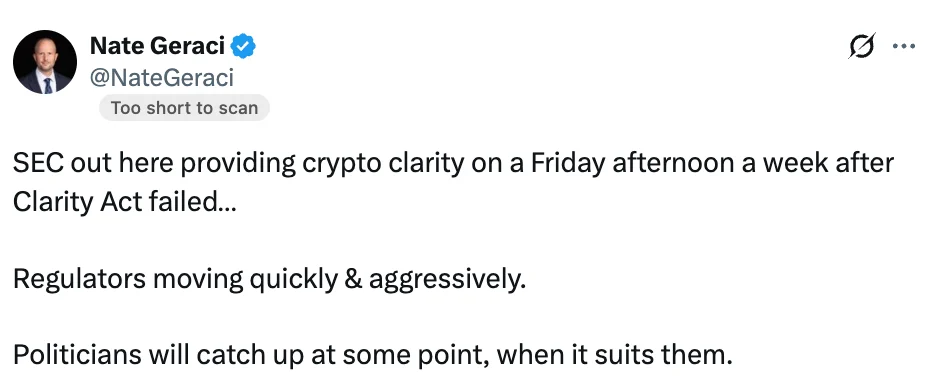
All this happened on the heels of the CLARITY Act failing to advance in the Senate.
The CFTC also updated its FAQs
Interestingly, the SEC FAQs came just a day after the CFTC updated its FAQs to clarify that certain assets already permitted under its rules can be held in tokenized form.
In that, they also confirmed whether regulated firms can use blockchain or distributed ledger technology for recordkeeping.
However, the CFTC FAQs were unable to expand on permitted customer-fund investments in cryptocurrencies such as Bitcoin or Ether.
Final Summary
- With the help of the FAQ, the SEC staff clarified how the Division of Corporation Finance interprets existing securities laws.
- Overall, the guidance focuses on the issuer’s promises, system functionality and decentralization, and more.