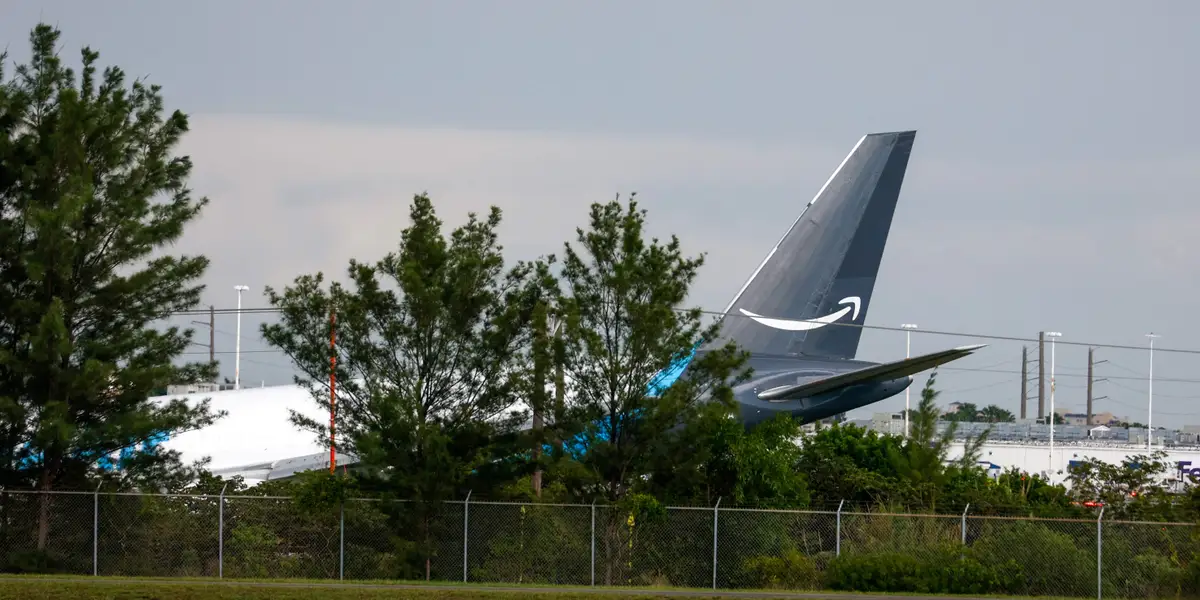
At least five people were killed, and five more injured, authorities said, after an Amazon Prime Air Boeing 767 cargo plane overshot the runway at Miami International Airport on Sunday, striking multiple vehicles and erupting into a blaze.
Videos from the scene showed a fire and thick black smoke rising from the plane. Miami-Dade Fire Rescue said in a Sunday evening statement that more than 60 of its units and about 200 personnel responded to the incident, arriving to find an airplane with “heavy flames and smoke showing.”
At a news conference Sunday afternoon, Miami-Dade Sheriff Rosie Cordero-Stutz said the engine was shut down, the fire had been contained, and there was no ongoing threat to the public. The National Transportation Safety Board and the Federal Aviation Administration are investigating.
“This is a fast-moving situation, and we’re still gathering details,” Amazon spokesperson Kelly Nantel said in an X post on Sunday. “We’re working closely with local authorities and officials to understand exactly what happened.”
NTSB chair Jennifer Homendy said during a Monday press conference said the plane struck two vehicles: a Ford Econoline van owned by an airline contract cleaning company with seven people inside, and a Toyota Corolla Cross driving down a nearby road off the airport.
The five people who died were inside the cleaning van, Cordero-Stutz said on Tuesday.
Of the five people who were injured, three were taken to a trauma center, Miami-Dade Fire Rescue said. The other two were taken to area hospitals.
Homendy also said there was a team of 32 investigators on-site, and that the NTSB has recovered the flight data and cockpit voice recorders, also known as black boxes, which are actually colored orange.
“There’s fuel everywhere that will have to be remediated, but then they are also removing fuel from the aircraft, so we have to allow that to occur,” Homendy said. “And as we speak, recovery operations continue. The recovery of victims is most important.”
In a subsequent Tuesday evening presser, Homendy shared details of the aircraft’s pilots. The 55-year-old captain had over 7,000 hours of flying experience and received his type rating for the Boeing 767 in May, she said. The first officer, 37, had about 2,600 hours of flying experience and received his type rating in April 2025.
At the presser, NTSB’s lead investigator for the crash, Chihoon Shin, talked about the last 30 seconds of the plane’s recording, leading up to the plane overshooting the runway.
Shin said the brakes were applied once the plane’s right landing gear touched down; its left touched down seconds after. The brakes were then released about 15 seconds before the recording ended, and Shin said the throttles were increased to levels “consistent with go-around thrust.”
Then, 11 seconds before the recording ended, the brakes were applied again. At the end of the recording, the plane was still traveling at 65 knots, or about 74 miles per hour.
Homendy added that NTSB would release a readout of the cockpit voice recorder on Wednesday.
What we know about the plane and the crash so far
The plane took off from Puerto Rico at noon and reached Miami around 2 p.m., according to data from the aviation tracking website Flightradar24. The website also showed the plane was traveling at 112 knots as it exited the usable part of the runway and the perimeter fence, ultimately going about 1,300 feet past the pavement into an area where Tesla robotaxis were stationed. Weather data shows there were thunderstorms and gusting winds at the time of the crash.
The plane involved was a Boeing 767-300 freighter, registered as N1997A, and first delivered as a passenger jet in 1994 to the now-defunct Belgian airline Sobelair. It passed through several more airlines before being converted into a freighter by a third party — not Boeing — and re-entering service in 2016. That means it had been operated and maintained by multiple companies over three decades before Sunday’s crash.
“Boeing extends our deepest condolences to the families and loved ones of those who lost their lives in the accident in Miami,” Boeing said in a statement. “Our hearts go out to those injured and affected by this tragedy. Boeing is supporting the investigation led by the U.S National Transportation Safety Board.”
Homendy said a key piece of the investigation will be whether an Engineered Materials Arresting System (EMAS), a crushable material placed at the ends of runways to help stop overrun planes, would have helped in this crash.
Miami does not have EMAS because its runways have FAA-standard runway safety areas extending 1,000 feet beyond the runway ends. Airports that cannot meet the standard, often because of nearby roads, waterways, or other obstacles, can install EMAS as an alternative.
FAA data show that about 120 runway ends at roughly 70 airports in the US have EMAS installed, and that EMAS has stopped 26 planes carrying nearly 500 people to date.
The plane was left disabled at the northwest end of the airport. The airport has since partially reopened, but as of Tuesday, two of its four runways remain closed. Passengers should expect delays of at least 5 hours, according to the FAA.
Describing the scene, Homendy said the crash left behind fuel, skid marks, and debris, calling it “devastating.” Miami-Dade First Rescue said on Sunday that firefighters had “encountered a complex engine compartment fire and used foam from specialized airport firefighting units to extinguish the flames.”
“The Crews also conducted search and rescue operations for the pilots and co-pilots inside the cockpit while locating and assessing patients throughout the scene,” the agency added.
According to Miami-Dade Fire Rescue radio transmissions recorded on Broadcastify, first responders scrambled to attain a reliable water supply as they sought to control the fire on the plane. A command dispatcher repeatedly asked first responders to enter the plane, according to the recordings.
“I need you to start making entry with your crew so we can shut down the engine,” the command dispatcher said, according to the recordings. “I believe the pilots are out of the aircraft.”
A first responder said in the recordings that one pilot was with him in a parking lot. Another first responder said that the pilot was talking with firefighters at the scene to show them how to shut down the engine. The fire was largely extinguished by 2:08 p.m.
This is the second 767 cargo plane to crash in Amazon’s Prime Air network. In 2019, an Atlas Air freighter flying on behalf of Amazon crashed into Trinity Bay near Houston, killing the three people on board. The NTSB said the cause of that accident was in-flight loss of control due to pilot error.