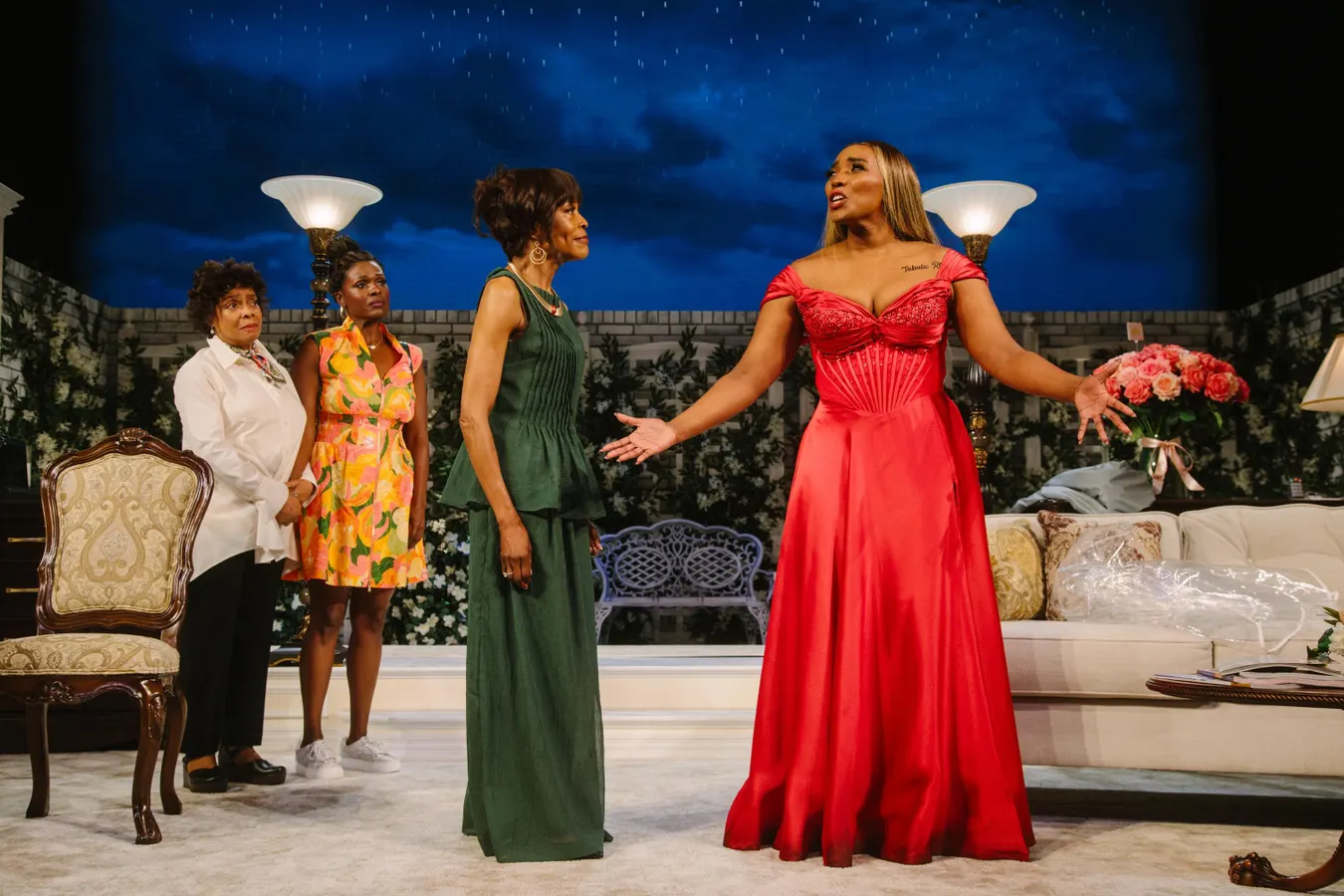
L-R: Denise Burse, Deborah Joy Winans, Charlayne Woodard and Olivia Washington in Angry, Raucous, and Shamelessly Gorgeous at Geffen Playhouse. Directed by LaTanya Richardson Jackson.
Jeff Lorch
Lauded and award-winning playwright Pearl Cleage created sharp-witted Angry, Raucous, and Shamelessly Gorgeous in 2018 to explore an intergenerational conversation among Black women of all ages and to offer a feminist critique of how Black women were portrayed in August Wilson’s early plays, providing a soulful and comedic take on art, activism, and aging on your own terms.
Now, the play makes its way to Los Angeles at the Geffen Playhouse, with opening night on June 18th and running through July 12th. “I’m very interested in how we forge a conversation between younger generations and ours; how do we begin to talk about the work that we do. I wanted very much to talk about the fact that women in my generation, whom I can say without any fear of contradiction have done and continue to do such amazing work, really need to celebrate themselves,” she said to me during our Zoom interview. “We went through a lot to get all of these changes to happen, and we went through a lot to help our brothers, and understand that they had to fight against, sexism and racism, and and it really started there trying to figure out what, what would be a spark that could, that could have a young woman and an older woman who were engaged in the same kind of work to talk about, and how do we understand each other.”
Pearl Cleage (she/her), playwright, Angry, Raucous, and Shamelessly Gorgeous.
Quintin Jackson
Cleage likens her desire to hear more of Black women’s voices and perspectives to her experiences in the civil rights, Black arts, freedom struggle, anti-war, and women’s movements decades earlier, during which she took a critical look at misogyny and feminism. “We stayed as long as it was helpful to us, and then we left and started talking among ourselves, because then race ceases to be a factor. It’s like in a group of men and women trying to talk about something serious; it’s very different if you take the men out, and it’s only the women talking.”
She continued, “I remember going to see for colored girls who have considered suicide/when the rainbow is enuf for the very first time, and I, I wept loudly throughout that, and I was trying to be, you know, quiet because I’m in a theater, I don’t want to disturb people, but it was so absolutely true to what I knew it felt like to be a young black woman, it was like, oh my god, she put all of it on the stage. She’s telling everything, and at first there’s like, oh my god, oh my god, now they’ll know all our secrets. And then by the time that play is over, you feel like, thank goodness, now they know. That’s what we want: when we go to the theater, that realization that somebody’s telling the truth.”
L-R: Denise Burse, Charlayne Woodard and Deborah Joy Winans in rehearsal for Angry, Raucous, and Shamelessly Gorgeous at Geffen Playhouse.
Isaak Berliner
That feeling Cleage references in watching for colored girls who have considered suicide/when the rainbow is enuf, was my experience with viewing her play. The play was a meditation on ownership: of one’s work, one’s story, and one’s right to begin again. At its core, the play sits in Black sisterhood, grief, and redemption, while insisting on the audacity it takes to reclaim the trajectory of your own life.
The performances by icons Denise Burse, Deborah Joy Winans, Charlayne Woodard, and Olivia Washington were intentional, sharp, and all-consuming—commanding attention in a way that made the entire room lean in and stay there.
What lingers most is how the play quietly confronts you: your purpose, your participation in community, and the ways patriarchal expectations still shape how we move through the world—and what it might look like to break free.
This work demands that you think critically about your life’s work—and how to expand both it and yourself. It invites an unapologetic reckoning. Angry, Raucous, and Shamelessly Gorgeous challenges the audience to reflect on the different stages of their lives and whether they will be able to transition gracefully into them when the time comes, or be resistant and stubborn. It also encourages the audience to question the art we’ve grown to love and consume.
The premise of the play centers on Anna Campbell (Woodard), a trailblazing actress decorated with accolades but in a financially precarious situation. Upon returning to her hometown, Atlanta, Georgia, with hopes of executing a career-defining comeback, she collides with a younger performer (Olivia Washington) who challenges her past, her politics, and her place in the movement.
Charlayne Woodard in Angry, Raucous, and Shamelessly Gorgeous at Geffen Playhouse. Directed by LaTanya Richardson Jackson.
Jeff Lorch
In the play, while you hear of male characters, there’s no physical representation of them, which Cleage says is intentional. “Part of that is because men have a lot of platforms and a lot of space, because they still control so much of how we move through the world. They have a lot of space to tell their stories, and sometimes, you know, writing a play, it’s like, no, I don’t want to hear that voice anymore; I want to hear all the different voices that we have, just as women, and they’re so interesting to me,” she said.
Additionally, Cleage shared that she sees a lot of herself in the character she writes. “I always see parts of myself in the characters in my place, because they all start in my brain, you know, they start in my own imagination, so they’re always representations of different things that I’m thinking about, or things that are driving me crazy, like aging,” she shared. “I also want us to continue to confront our own judgmental ideas about who is considered an artist. No matter what our initial judgment of Pete (Washington) might be, is such a likable, strong, brave, interesting, charismatic character that after a while, you don’t care what she does to earn a living, you want her to be able to do it at the highest level that she can do it, which is what I want for all the young women who are are stepping onto these stages and into these spaces – to be their bad ass selves. There’s space big enough for them to show us what they got,” Cleage stated.
L-R: Olivia Washington, Denise Burse and Deborah Joy Winans in Angry, Raucous, and Shamelessly Gorgeous at Geffen Playhouse. Directed by LaTanya Richardson Jackson.
Jeff Lorch
The women-led and directed play, guided by seasoned actress LaTanya Richardson Jackson, takes an introspective look at Black women’s representation in theater and addresses male playwrights, something Cleage was tempted to do for a while. “We still get to say to them, our stories are as important as your stories. It seems like such an obvious thing to say, but that’s a big part of what is still the conversation between men and women: at times men don’t understand that our stories are equally important, interesting, vibrant, sexy, contradictory, and all those things are there in the work and the stories of women, because we’re fully formed human beings,” she said. “Even the idea of which was very fun for me to say, ‘Okay, I’m gonna say something about August Wilson,’ because I’m a Black theater girl. I understand that August begin to critique August Wilson without understanding the role that he played and the role that he continues to play in the lives of us who consider ourselves to be American theater artists and world theater artists, but that doesn’t mean that we can’t also bring a sisterly feminist womanhood critique not only to the plays but also to the beautiful, wonderful charismatic brothers who put those plays on.”
As far as the name of the play, which is striking, Cleage found inspiration through wordplay. “Five years ago, there was an exhibition in New York, and the headline was an exhibition of work by a black woman artist, visual artist, and the headline talking about the exhibition was Angry, Raucous, and Shamelessly Gorgeous, and I thought, ‘Wow, what a great phrase for something,” I loved it, because it’s angry, of course, you have to have rage, because there’s so much injustice that you want to fix, raucous, because it’s always more effective and more fun to be loud and rowdy when you’re protesting something, and shamelessly gorgeous, because we still want to be fabulous while we do it. We still want to be able to sweep into a room and, you know, have stars behind us,” she enthusiastically said.
Cleage and the play’s director, Jackson, had known each other for years and both attended Spelman College, so it was a no-brainer for them to collaborate on the play. “Our job is to tell the story. We got to tell the story. The playwright has given us the words, but our emotional resonance and our emotional investment tell the story,” Jackson told me. “That’s our job as actors. That’s what we’re called to do: to find what’s inside that allows us to dig in and let it out. It’s like when people are grappling with how a scene should go, who they’re going to be in the scene.”
Director LaTanya Richardson Jackson in rehearsal for Angry, Raucous, and Shamelessly Gorgeous at Geffen Playhouse.
Jeff Lorch
Her advice to the younger generation of actors? Confidence. “In 2026 I encourage all of you, be about it, be shameless in that regard, we can, you know, everyone has lived without shame, you know, in a different context, denotatively, contextually, but right now we have to not – I want to use shameless in the context of not being, not being ashamed, not worrying about how you’re showing up, as long as you’re showing up in a positive, and you know, a positive way that is moving the culture forward. You need to show up and take it,” Jackson said.
Cleage hopes audiences of all ages take away from this play and experience the power of open communication and understanding. “It’s worth it to try to have risky conversations with people that you’re curious about, but don’t necessarily know. It’s worth it across lines of race, across lines of age, across lines of different kinds of work you do, but those conversations are ultimately what bind us if, at the heart of those conversations, is a mutual determination to tell the truth. I hope people are intrigued by the fact that these women are coming to a common truth they can agree on, and that they also realize what we were talking about earlier: we can talk about the most serious topics in the world and still laugh together,” she stated.