The tokenized stock market is experiencing a rapid shift as fresh capital continues to enter the space. Avalanche [AVAX] generated $131.2 million over the past week, with all other networks lagging well behind.
Securitize, which provided a $132 million boost in market capitalization and was responsible for nearly the entire increase, helped Avalanche take the lead.
As such, this concentration suggests that the inflows reflect demand for a specific tokenized-stock product rather than a broad move into Avalanche-based equities.
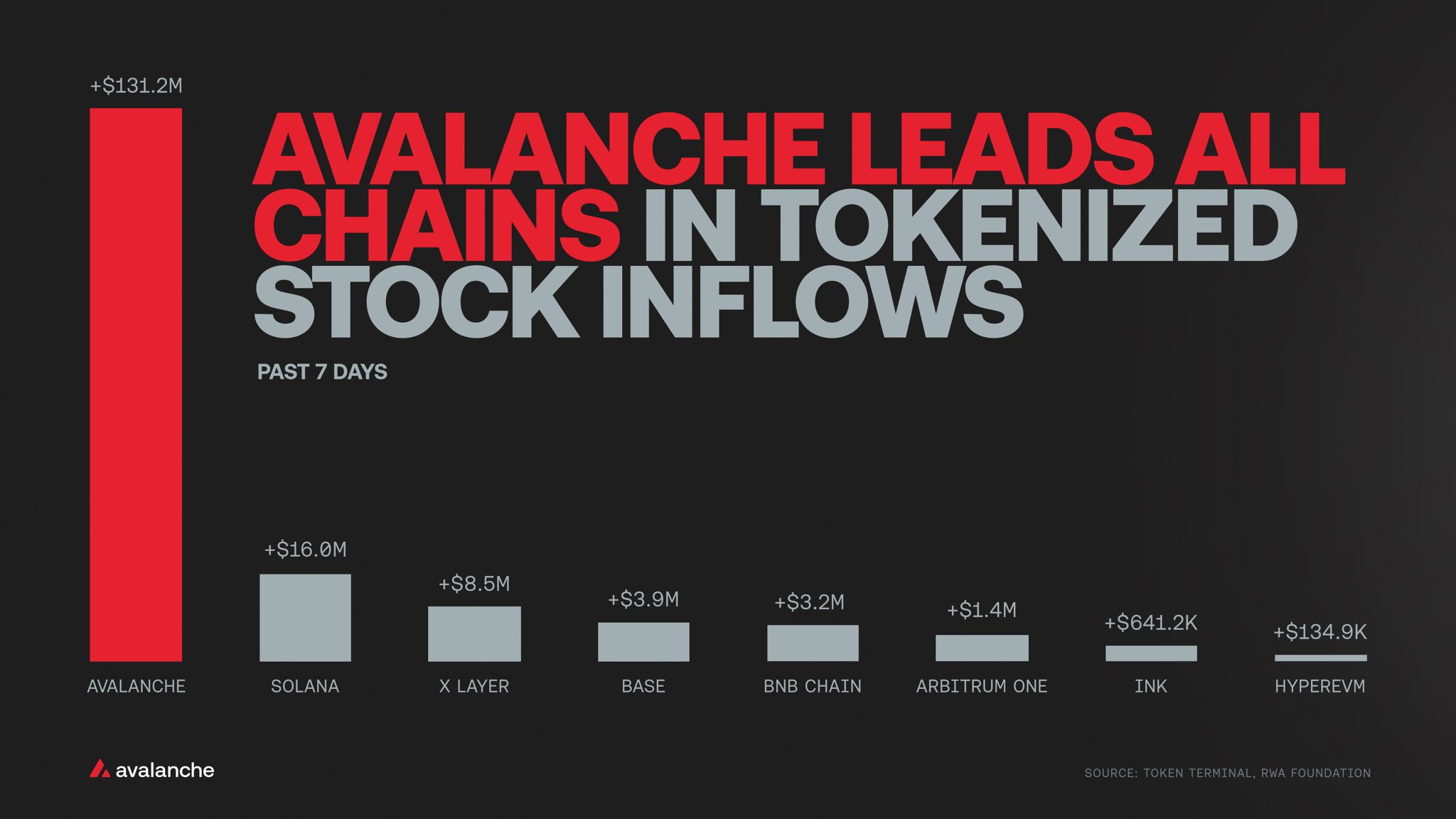
Meanwhile, Solana [SOL] captured $16 million, while X Layer saw $8.5 million, indicating some additional activity existed outside of Avalanche. On the other hand, the Ethereum [ETH] network lost approximately $5.6 million.
With the current total market size being roughly $3.6 billion, the recent surge in the AVAX price may solidify its position within institutional tokenization. However, if most of the remaining investment comes from a single product line, it will lead to limited future growth.
Goldman Sachs expands Avalanche ties
Beyond simply tokenizing equities, Avalanche is also beginning to serve as an institutionally accessible settlement platform for institutional cash management. Goldman Sachs has announced it will be migrating its $105 billion FTIXX Treasury Fund to Lynq.
This allows firms to utilize their capital between trades using this vehicle, earning Treasury yields and redeeming them once liquidity levels are back to normal. Eligible firms may do so by holding traditional money market share via Lynq and tZero Securities.

Notably, Lynq connects more than 30 institutional participants through a permissioned Avalanche Layer 1 network, creating a distribution channel for tokenized financial products.
Moreover, instead of creating a new tokenized stock, the FTIXX treasury fund provides yet another way to allow balances to flow through the Lynq platform.
If enough balances continue to flow through the Lynq platform, Avalanche could begin capturing some portion of institutional settlement activities. This would be done without requiring institutional investors to become interested in tokenized stocks.
Can Avalanche sustain institutional activity?
Avalanche is experiencing a conversion issue with its growing institutional base. Higher asset valuations have not yet resulted in stronger RWA activity.
Distributed RWA values increased by 8.4% from $1.67 billion to $1.80 billion over a thirty-day period, indicating an influx of capital into the ecosystem.
Conversely, RWA transfer volumes decreased by 75% to $81 million. Simply, this suggests that a significant portion of this value may be dormant after being issued. The contrast becomes clearer against stablecoins, where $934 million of supply supported $17.5 billion in transfers.
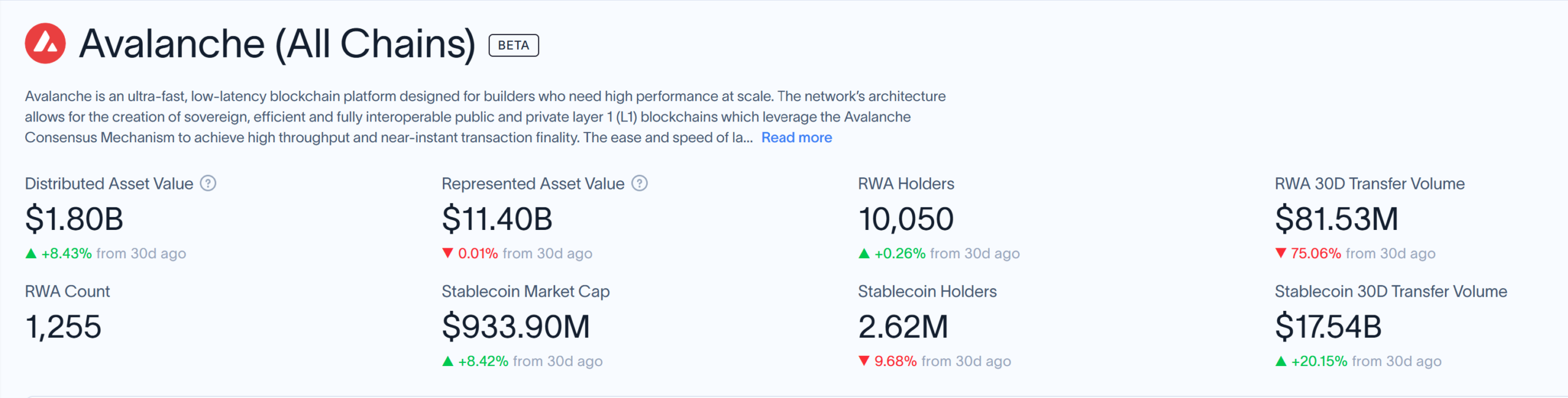
This shows Avalanche already has deeper transactional use in payments than tokenized assets. For institutional adoption to broaden, new treasury and equity products must generate recurring transfers rather than simply increase assets under management.
Until then, Avalanche’s growth remains characterized as asset-heavy but activity-light, thereby limiting its overall network effect.