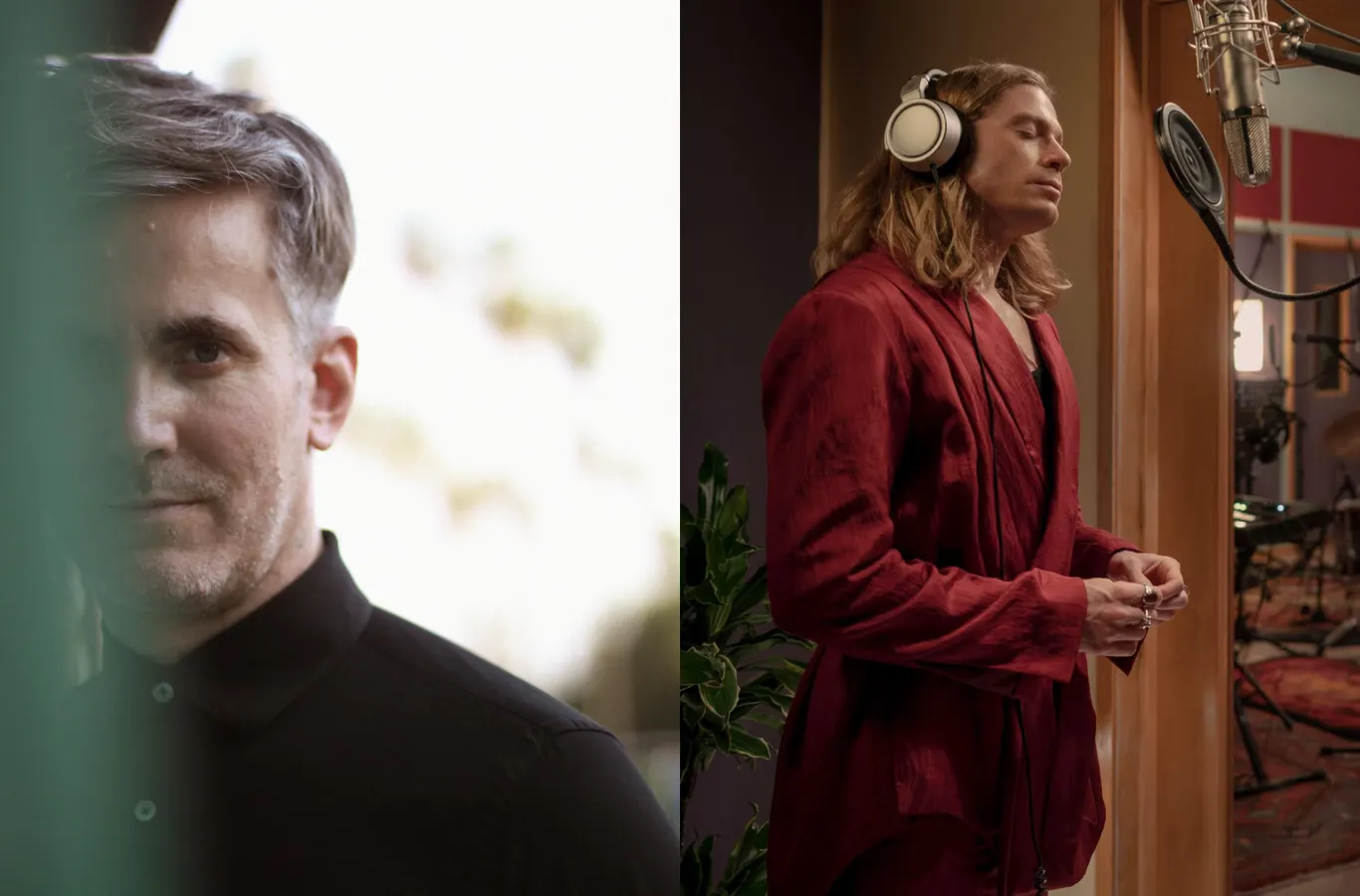
Interview with the Vampire’s composer Daniel Hart has taken the audience on a wonderfully chaotic journey through different styles of music in The Vampire Lestat. Episode 5, “New York,” is when the season slows down long enough to delve into the process of making an album. It’s for this reason that he shares the episode’s writing credit with executive producer Hannah Moscovitch.
Ahead of episode 5’s premiere, Hart and I discussed Lestat’s (Sam Reid) evolution through his musical arc, beginning with the studio time that makes up a third of “New York.” While it may have been unexpected to viewers, myself included, it’s a decision that was baked into the narrative from the start.
Table of Contents
The Path ‘The Vampire Lestat’ Charts Through Music
As the musician at the writer’s room table with the most recording studio experience, Hart knew how to shape this side of the band’s world or as he put it, “I knew all the right words to put in the right places.” It’s an important element considering Lestat describes the studio as his favorite sarcophagus and it’s there that he begins to come into his own as an artist.
In terms of threading the needle between the experimentation and playing Lestat does before landing on a style that’s uniquely his, Lestat’s preference for musical exploration is akin to Hart’s own. He works the same way when he’s writing music for himself.
“So, it wasn’t a great leap for me to do that for Lestat,” Hart said. “But it was something that we actually needed for him as a character. He’s going on a journey of self-discovery throughout season 3, and he’s doing that via music, part of the time. You’re going on a journey of self-discovery, and you are changing as you go. You need that music to change, too. Otherwise, where’s the proof that you actually learned something?”
This evolution didn’t have a specific sound to it. Not at first. Not when it comes to the muses and characters that inspire the songs Lestat writes. When Hart was first exploring ideas, he tried not to box himself into a certain direction. He let the story guide him, especially in regards to the deceased that haunt Lestat’s waking hours and his sleep.
“These characters sort of showed me what they wanted musically,” Hart explained. “I think different characters did end up getting different things. But it wasn’t like I set out in the beginning to do that. I just tried to stay open and listen to what would make sense within those characters and within the larger story that we were telling.”
Holding Out Hope For A Beyoncé-esque Song From Lestat
However, this doesn’t mean that there aren’t influences Hart was interested in exploring that didn’t make it into the show. He still wishes there was more Beyoncé in Lestat’s music, which is a point he brought up in his Billboard interview as well.
Queen Bey does get a mention in the premiere, “Detroit,” when Louis (Jacob Anderson) calls the song Lestat is struggling to compose nice but that he doesn’t see Beyoncé singing it. Though that may not be a nod to the conversation Hart and showrunner Rolin Jones had early on in the writer’s room about Lestat being aware of and liking her music but probably not being influenced by her in his own, it does somewhat dim the possibility of it happening.
In Hart’s words, from Jones’ perspective, “He’s a 265 year old vampire. He has a vastly different life and world experience from Beyoncé.”
Be that as it may, and true really of any artist that has influenced Lestat pre and post-vampiric transformation, Hart wanted a bit more R&B and hip-hop influence in his music because “that’s all surrounding us in music at the moment. In popular music in 2026.”
So we, of course, discussed what era of the icon’s body of work Lestat would gravitate toward. Whether it’s the bolder and more genre-defying music of her current style or the definitively R&B sound of the late ‘90s and 2000s. Hart said it would be the latter and his opinion is rooted in Lestat’s characterization.
He shared, “…Lestat seems to take forever to digest what is going on in the world and with himself, specifically. It just takes him a long time to work through. He’s so old, you know, it’s like, time moves differently, I guess. But whether that’s true or not for other vampires, for him, it just takes him a long time to figure sh-t out.”
“So I thought,” Hart continued. “He would hear a song in the ‘90s and then he would only be able to work it out for himself like 30, 35 years later.”
Which Beyoncé song would Hart have liked to work into Lestat’s music as an influence? 2003’s “Naughty Girl.”
“I feel like Lestat’s a bit of a naughty girl,” he said. “I see him in a giant champagne glass.”
Given the vampire’s penchant for enticement, particularly toward the subject of his desire (re: Louis, “Toledo” being a prime example) it’s an apt choice. A visionary one perhaps that, with a little luck and Jones coming to see the magic of it, could hopefully come to fruition if Interview with the Vampire is renewed for a fourth season.
The Vampire Lestat, Sam Barclay, and Nicolas de Lenfent
Sophie Giraud/AMC
Developing A Vampiric Sound for ‘The Vampire Lestat’
Lestat’s focus in “New York” is squarely on developing a sound that captures the three centuries of his life, which he describes as a train wreck. The band is forced into doing take after take in his quest to fully convey his own emotions. He wants to be killed savagely, and he needs his band mates to play their instruments like they’re metaphors.
The scene between him and TC (Sarah Swire) presents viewers with a peculiar question—what should music written and produced by a vampire sound like? When considering the concept of instruments as metaphors, Hart was on TC’s side of the argument.
“A drum is a drum,” he said. “It can make you feel things. Something about music is intangible. Like a painting is in front of you, you can point at it. A ballet, you see someone moving. Where is music? Is it in here? Is it in here? Is it out here? It’s a little ethereal, to me anyways. It feels like it’s got a kind of magic that transcends any physicality but you get that with tangible things.”
“A drum is a drum,” Hart continued. “I tried not to think too metaphorically about it. I was just trying to stay out of my own way when I was writing these songs. If I start to think about things too much, and get overly analytical, or I set out with too specific of a goal, I feel like I don’t leave enough room for improvisation and creativity, and for fresh ideas to sort of sneak in.”
For the composer, it was important to keep something authentic and fun about the process including the magic Lestat is looking for in his music. Hart’s of the mind that what Lestat isn’t finding in it at first, what he’s asking for and not receiving, is happening because Lestat is maybe asking in the wrong way.
“I think you record the drum, and then you can find the magic,” he said. “You stay open to it. That’s my thought.”
Though that’s not to say that Hart didn’t have his own battle with pinning down the sound he was searching for himself for this episode.
How “Stained Glass Eyes” Was Created For Claudia
“New York” features “Stained Glass Eyes,” the most compelling song of the season. It’s a tribute to Claudia (Delainey Hayles), and it’s the song Hart spent the most time on for The Vampire Lestat. He wrote it from the ground up three times, each with different styles, music, lyrics, and instrumentation.
He called it a writing assignment from Jones. Unlike several of the songs he’d written for the season that were created before the team knew what scene they’d fit into, the song that would become “Stained Glass Eyes” had a specific place in the narrative.
Jones knew there would be a scene where Lestat would explore his grief over Claudia and that there needed to be a song for it. What he wanted was a montage of the song being built in the studio and that it would play over the moment. Hart went into writing the ballad with that information, but the rest was up to him.
The first version he thought was cool, but Jones didn’t want it. It was very synth-y and faster than the song in the scene.
“I would describe it as halfway between Chapell Roan and A-ha’s “Take on Me.”
Version two, he wasn’t happy with the way it turned out.
“It was piano-based,” Hart said. “But when I finished it and I listened back to it, I thought, this feels too much like—this song would be great if we were making a Broadway musical version of Lestat. I think it was too dramatic, too over the top.”
The third time is where Hart found the magic.
“I did some crying in the studio as I was writing it. I found this whole idea very sad. And this father-daughter relationship, that he deeply regrets and really tried hard to avoid confronting throughout all of season 3 up to this point, is devastating in lots of ways. So I tried to embrace the devastation.”
Hart had taken the kernels of the ideas that were working in the first two versions and created the third and final song. One that he really loves. His happiness over the way it turned out has an added element of satisfaction because Claudia is his favorite character.
He shared, “When I think about all the characters in this vampire world that Anne Rice created, I find myself most drawn to Claudia. I think I feel an affinity towards her or a sympathy for her that is greater than I feel for other characters, a connection to her that is greater than I feel for other characters.”
It’s why he expected it to be a little easier to find the song he needed to write for her. Hart said, “When I’ve written music for her in previous seasons, they came to me very easily. I’m not sure why this one was harder.”
Given the beauty of “Stained Glass Eyes,” and its placement in the narrative as the catalyst for Lestat finding the sound he’s been searching for, the extra time Hart needed to take with it strikes at the very core of The Vampire Lestat. Failure leads to reflection which opens the door to the possibility of discovering what you need even if it’s not what you thought you wanted.
New episodes of The Vampire Lestat air Sundays at 9 p.m. ET on AMC and are available to stream on AMC+. Follow Sabrina Reed on Forbes for weekly coverage of the season and news about the business of TV.