
Is Ethereum’s outperformance in Q3 because of Bitcoin’s weakness? Judging from the rotation standpoint, yes.
According to Bitcoin’s quarterly framework, the dominant asset’s dominance grew by 1.5% on a quarterly basis so far, while Ethereum’s dominance is up by over 25% on a quarter-over-quarter basis.
This implies that there has been a significant rotation into ETH and higher beta assets in general as BTC approached the $80k resistance.
Further supporting this trend, the ETH/BTC ratio is also up by over 25% in Q3, which is its highest quarterly increase since Q3 2025. However, the ratio remains in the 0.03 resistance area, which suggests that the next move higher is needed to indicate a stronger bullish rotation into Ethereum.
And it seems highly plausible, considering Bitcoin’s on-chain dynamics.
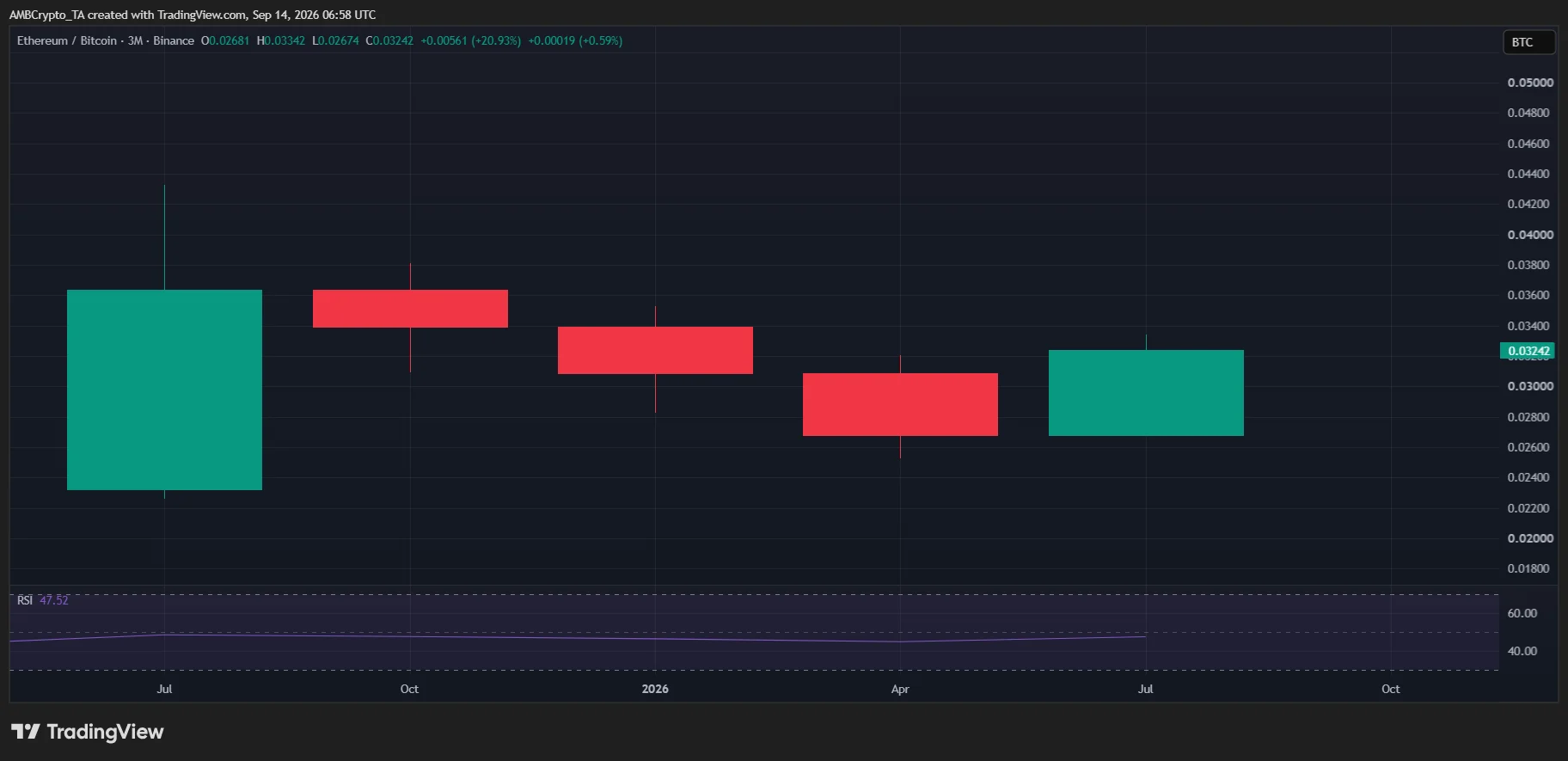
According to Bitcoin’s True Market Mean Price, BTC is gradually approaching $76,921.27. And if it reaches this level, another wave of selling pressure is to be expected, which will unlock fresh deposits on exchanges and provide the required space for capital rotation into Ethereum [ETH].
In the given context, the analyst’s prediction makes perfect sense.
Especially, one analyst expects no less than Ethereum to outperform Bitcoin once the market flips risk-on driven by on-chain and technical factors.
This raises an important question: With ETH already leading Q3 with 58%+ ROI, is this growing FOMO setting the stage for Ethereum’s most bullish Q3 in crypto history?
Ethereum’s rising dominance points to a strong Q3 close
Ethereum’s growing dominance could be a sign that it is gaining more market share.
On the technical side, ETH.D is up over 25% on the quarter, on par with the increase of the ETH/BTC ratio. That being said, Ethereum’s Q3 ROI is at nearly 60%, just a few points shy of its Q3 2025 record of over 66%. If ETH breaks that level this quarter, it would mark its strongest Q3 on record.
This is where the chart below comes in. ETH.D is up over 25%, while ETH’s Q3 ROI is nearing 60%. This implies that ETH’s rise is being driven not only by the weakness of Bitcoin but also by an increased appetite for the altcoin itself, with the chart below being a powerful indicator of the trend.
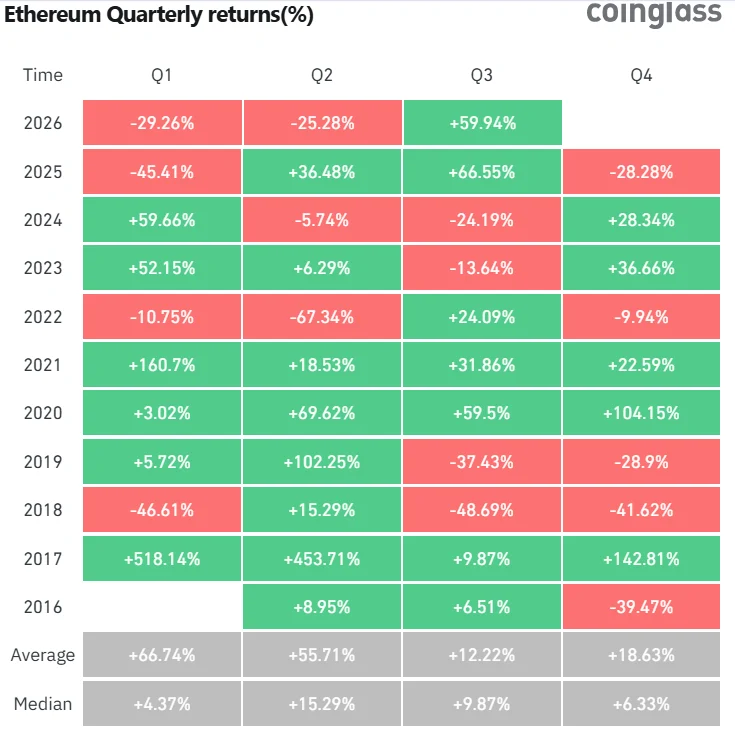
In this scenario, the analyst’s forecast appears to be justified.
As rotational flows account for only a part of Ethereum’s Q3 proceeds, the underlying demand for ETH remains strong. Recent ETF inflows also support this setup, while Bitcoin’s weakness could give Ethereum more room to attract fresh capital as investors look for higher returns.