Home Blog Page 139

Hayward Holdings, Inc. Q2 2026 Earnings Call Summary

0
Hayward Holdings, Inc. Q2 2026 Earnings Call Summary


Hayward Holdings, Inc. Q2 2026 Earnings Call Summary – Moby

Strategic Performance Drivers

Our analysts just identified a stock with the potential to be the next Nvidia. Tell us how you invest and we’ll show you why it’s our #1 pick. Tap here.

  • Net sales growth of 6% in Q2 was driven by positive price realization and stable volumes, reflecting the resilience of the installed base aftermarket model.

  • North American performance (up 9%) benefited from demand in discretionary categories like salt chlorine generators and automation, offsetting an 8% decline in Europe and Rest of World due to geopolitical conflicts.

  • Management attributes market share gains to a multi-year ‘offense’ playbook, including increased RD&E investment which has raised new product vitality to 23%.

  • Operational excellence initiatives, such as nearshoring and dual sourcing, are being utilized to mitigate tariff risks and improve supply chain reliability.

  • The company is leveraging AI in customer service to resolve 80% of North American calls without human intervention, enhancing both customer experience and operational efficiency.

  • Gross margins remain near record levels (48.7%) despite inflationary pressures in specialty metals, freight, and resin, supported by proactive surcharges and cost-out actions.

Outlook and Strategic Assumptions

  • Full year 2026 guidance is maintained, assuming approximately 5% net sales growth and 9% to 13% adjusted diluted EPS growth.

  • Management expects gross margins for the full year to remain approximately in line with the prior year’s record levels as mitigation actions fully take hold.

  • Channel inventory is expected to follow seasonal patterns, with further net reductions in Q3 followed by a build in Q4 for the ‘early buy’ season.

  • The company plans to open its sixth Hayward Hub training center in Atlanta during Q4 to support dealer conversions and technical capabilities.

  • Capital allocation priorities remain focused on organic investment and strategic M&A, supported by a reduced net leverage of 1.5x.

Financial and Operational Risk Factors

  • A comprehensive debt refinancing completed in the quarter extended maturities to 2033 and is expected to reduce annual interest expense by approximately $6 million.

  • Geopolitical disruption in the Middle East and Ukraine continues to act as a headwind for the Europe and Rest of World segment, particularly impacting volume.

  • Incremental inflation in commodities and transportation required the implementation of mid-quarter surcharges to protect dollar-for-dollar margins.

  • Management is currently evaluating the process for returning approximately $8 million to $10 million in IEEPA refunds to customers, net of associated costs.


Source link

Meme Con Brings Internet Culture and Crypto Communities Under One Roof

0
Meme Con Brings Internet Culture and Crypto Communities Under One Roof


Memes have evolved from random content to community, narrative, and market drivers. What once started as internet humor has evolved into one of the most influential forces that shape online behavior, digital economies, and Web3 culture. From meme coins that have led to billion-dollar ecosystems to viral trends impacting investor sentiment overnight, internet culture heavily influences blockchain’s future.

Recognizing this shift, Meme Con is a unique gathering dedicated entirely to the intersection of memes, crypto, and community-driven economies. Powered by Namecoin News, the event aims to bring together creators, traders, founders, marketers, and online communities under one roof to explore how memes redefine the Web3 landscape.

Unlike traditional infrastructure and technical-focused blockchain conferences, culture takes the centre stage in Meme Con. The idea that memes often push communities to move markets is the true driving force of this event.

Over the past few years, the rise of meme coins has proven that internet attention carries massive economic value. Communities built around humor, identity, relatability, and shared online experiences attract millions of users and generate unprecedented engagement levels. Meme Con intends to unpack this phenomenon through open conversations, creator-led discussions, and real-world insights from people actively shaping the meme economy.

The event will cover a wide range of topics tied to the growing influence of internet culture in crypto. Attendees can expect discussions around meme coin ecosystems, the psychology behind viral trends, community-led growth strategies in Web3, and the impact of online narratives on blockchain markets. More importantly, the event filters the hype to examine why certain communities sustain long-term value while others fade as quickly as they rise.

At its core, Meme Con is not just about speculation or internet jokes. It is about understanding the cultural mechanics driving modern digital economies. In Web3, attention is currency, and memes have become one of the most powerful tools for capturing and directing that attention. Whether it is a viral image, a trending catchphrase, or a community movement born on social media, internet culture now plays a direct role in influencing adoption, visibility, and even investment decisions across the crypto space.

The experience itself is being designed to encourage participation and genuine interaction rather than passive attendance. The event will feature panel discussions with industry voices, creators, meme influencers, and Web3 builders who understand the evolving relationship between culture and technology. Networking sessions will allow attendees to connect directly with founders, traders, community managers, and digital creators operating at the center of the meme economy.

Additionally, open-format conversations will focus on topics the industry often avoids, including the fine line between hype and utility, the sustainability of meme-driven projects, and the role of communities in determining value. By bringing creators and investors into the same space, Meme Con hopes to create a more transparent and grounded dialogue around the realities of meme culture in crypto.

The event is expected to attract a diverse audience from across the Web3 ecosystem. Crypto traders and enthusiasts will gain insight into the cultural trends influencing market behavior, while meme creators and influencers will have the opportunity to connect with communities and industry leaders shaping the next phase of digital engagement. Web3 founders, marketers, community managers, and even observers of internet culture will find value in understanding how memes have evolved from entertainment into economic infrastructure.

What truly sets Meme Con apart is its culture-first narrative. While many events in the blockchain industry focus on technical roadmaps and speculative conversations, Meme Con acknowledges that culture is often the foundation for building successful Web3 ecosystems. 

As the media platform powering the event, Namecoin News continues to expand its coverage of emerging crypto trends, internet-native communities, and the rapidly growing meme economy. Through Meme Con, the platform aims to amplify conversations that reflect the changing dynamics of Web3 and the increasing influence of online culture on decentralized ecosystems.

As memes continue to shape conversations, communities, and financial markets, Meme Con arrives at a time when understanding internet culture is essential. The event represents a new kind of gathering for a new era of the internet, one where culture and capital move together in real time.

Meme Con captures the energy, influence, and evolution of internet culture in the world of Web3. Join the culture shaping Web3. Register now.

 Disclaimer: This is an Event Partner post and should not be treated as news/advice.


Source link

Bitcoin (BTC) is as hard to trade right now as it was in January

0
Bitcoin (BTC) is as hard to trade right now as it was in January

Trading bitcoin these days feels much as it did seven months ago, at the start of the year.

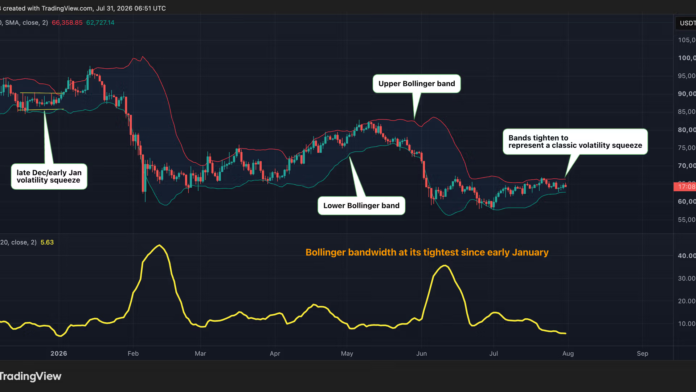
The price of the largest cryptocurrency is stuck in a tight range, with volatility at six-month lows, and traders are struggling to identify a break to bet on. Not surprisingly, transaction volume has slumped and is on track for the lowest since November 2023.

Back in January, the bitcoin price had been stuck in a narrow band, $86,000-$90,000, since the second half of December. Trading volume had dropped to an average of $5.1 billion a day, and has fallen to $2.2 billion this month, according to research from K33.

What happened next is interesting. Volatility picked up in the following weeks, the price rose to nearly $98,000 by mid-January and then slid down to around $60,000 by early February. Trading volume rose.

And that’s precisely the point. Volatility is cyclical: long stretches of quiet price action often precede a sharp move in one direction or the other. Like a coiled spring, the tighter the market compresses, the more forcefully it can unwind.


Source link

First look: C.H. Robinson hits target, still cutting jobs

0
First look: C.H. Robinson hits target, still cutting jobs


The first bullet point in the earnings report of C.H. Robinson (NASDAQ: CHRW) was that the 3PL hit its mid-cycle operating margin targets “while the freight market is still in the trough of the demand cycle.”

The adjusted operating margin rose 360 bps from the corresponding quarter a year ago to 34.7%. Adjusted gross profit was up 6.5% for the company as a whole to $738 million.

At North American Surface Transport, which houses the company’s core brokerage operations, the adjusted operating margin was 40.9%. Adjusted gross profits were up 8.6% from a year earlier.

Total revenue at C.H. Robinson was up 19.3% to $4.9 billion, “primarily driven by higher pricing in our truckload, less than truckload (“LTL”), air and ocean services,” the company said in its earnings statement released Wednesday afternoon.

The significant jump in revenues did not result in anything close to a corresponding increase in profitability.

Rising freight rates that contribute to higher revenue, especially when they come rapidly, can be a significant burden for 3PLs. Contract business booked at a lower number often will be supplied by spot capacity that has risen in price.

That trend is likely to have resulted in gross profits being up just 2.7% to $1.4 billion. Adjusted gross profits, a non-GAAP measurement, rose 2.4%, “primarily driven by higher adjusted gross profit per transaction in our LTL and air services.”

The difference in truckload and LTL profitability was stark, a complete reversal of the performance of TFI International, which had a banner second quarter in truckload but not LTL. Admittedly one is a carrier and the other is a broker but the difference was notable.

Truckload adjusted gross profits at C.H. Robinson were down 1.4% from a year earlier. Meanwhile, LTL was up 21.8%.

Air also had a strong performance with adjusted gross profits up 22.9%.

Ocean was down 2.7% and Customs was down 9.4%.

Job reductions at C.H. Robinson continued in the quarter. In his few remarks in the company’s earnings statement, CEO Dave Bozeman referred as he consistently does to the company’s “Lean AI strategy, which has enabled us to identify and remove waste and to automate manual processes in the quote-to-case lifecycle of an order.”

‘The result has been evergreen productivity improvements of over 60% since the end of 2022 in both NAST and Global Forwarding,” Bozeman said. “The execution of our strategy has also enabled us to build a scalable model with significant operating leverage, which contributed to the 20% year-over-year increase in our adjusted operating income.”


Source link

BTC, ETH price news: Bitcoin at $64,000 as Kospi’s record 17% surge leaves crypto untouched

0
BTC, ETH price news: Bitcoin at $64,000 as Kospi's record 17% surge leaves crypto untouched

Crypto markets barely registered one of the sharpest equity rallies of the year on Friday, with bitcoin holding near $64,300 while South Korean stocks staged a record rebound from the selloff that dominated the past two weeks.

The majors were close to unchanged. Ether traded at $1,907, XRP at $1.08, solana at $74 and dogecoin at $0.07, with roughly $27 billion changing hands in bitcoin and $7 billion in ether. BNB was the exception, up 3% on the day to $590 and the only major holding a meaningful weekly gain. Bitcoin spiked to $65,300 in early Asian hours before giving it back within an hour.

The weekly picture stays soft. Hyperliquid’s HYPE is down 5% over seven sessions, solana and XRP are each off 3%, and bitcoin has lost 2%. Ether and dogecoin are up 1%.

Equities went the other way, hard. The Kospi surged as much as 17%, rebounding from a three-day rout that had taken the index more than 40% below its June peak. Samsung and SK Hynix both jumped more than 23%, and Taiwan Semiconductor rose 10%, making chipmakers the biggest contributors to a broad Asian advance.


Source link

Biogen Inc. Q2 2026 Earnings Call Summary

0
Biogen Inc. Q2 2026 Earnings Call Summary


Biogen Inc. Q2 2026 Earnings Call Summary – Moby

Strategic Performance and Portfolio Evolution

Our analysts just identified a stock with the potential to be the next Nvidia. Tell us how you invest and we’ll show you why it’s our #1 pick. Tap here.

  • Management attributes the return to growth to a portfolio transition where new products now exceed legacy Multiple Sclerosis (MS) revenue, driven by faster-than-expected conversion to high-dose SPINRAZA.

  • The Apellis acquisition is framed as a successful integration milestone, with management citing continuity of revenue during organizational turbulence as the primary metric of success.

  • Strategic positioning has shifted from a neurology-only focus to a multi-specialty model targeting rheumatologists, dermatologists, and nephrologists to maximize the addressable market of the late-stage pipeline.

  • Operational overhauls in the research organization ended a three-year IND drought, with three filings already in 2026 aimed at securing growth into the mid-2030s.

  • The LEQEMBI IQLIK (subcutaneous) approval is viewed as a critical tool to reduce patient drop-off by removing the logistical barriers associated with biweekly infusions.

  • Management is pivoting from intentional M&A toward opportunistic deals, prioritizing early-stage assets between development candidate and IND stages to rebuild the long-term pipeline.

Registrational Cycle and Market Expansion Outlook

  • Biogen is entering a multiyear registrational cycle with five Phase 3 readouts expected across four indications (SLE, CLE, AMR, and Dravet syndrome) within the next four quarters.

  • Guidance assumes SYFOVRE and Empaveli will maintain mid-to-high-teens growth through at least 2028, serving as a stable base for upcoming pipeline launches.

  • Management expects to achieve at least $250 million in run-rate synergies by the end of 2027, primarily through the optimization of G&A and R&D expenses following the Apellis deal.

  • The company has accelerated Phase 3 timelines for felzartamab in AMR and litifilimab in CLE, with data now anticipated in the first half of 2027 due to strong enrollment momentum.

  • Future Alzheimer’s strategy involves exploring combination therapies (anti-amyloid and anti-tau) and next-generation brain shuttle delivery systems to maintain market leadership into the next decade.

Financial Adjustments and Risk Factors

  • The 2026 EPS guidance includes a $0.85 dilutive impact from the Apellis transaction, primarily driven by financing costs and foregone interest income.

  • Management flagged a $164 million charge for acquired IPR&D and milestones in Q2, including a $100 million payment for worldwide rights to felzartamab.

  • A strategic pause was placed on the BIIB091 (BTK inhibitor) program despite proof-of-concept, as management evaluates its viability in an increasingly crowded and competitive MS market.

  • The company recorded higher amortization costs linked to inventory fair value step-ups from the Reata and Apellis acquisitions, impacting GAAP cost of sales.


Source link

Can XRP buyers trigger a price breakout despite fall in whale activity?

0
Can XRP buyers trigger a price breakout despite fall in whale activity?


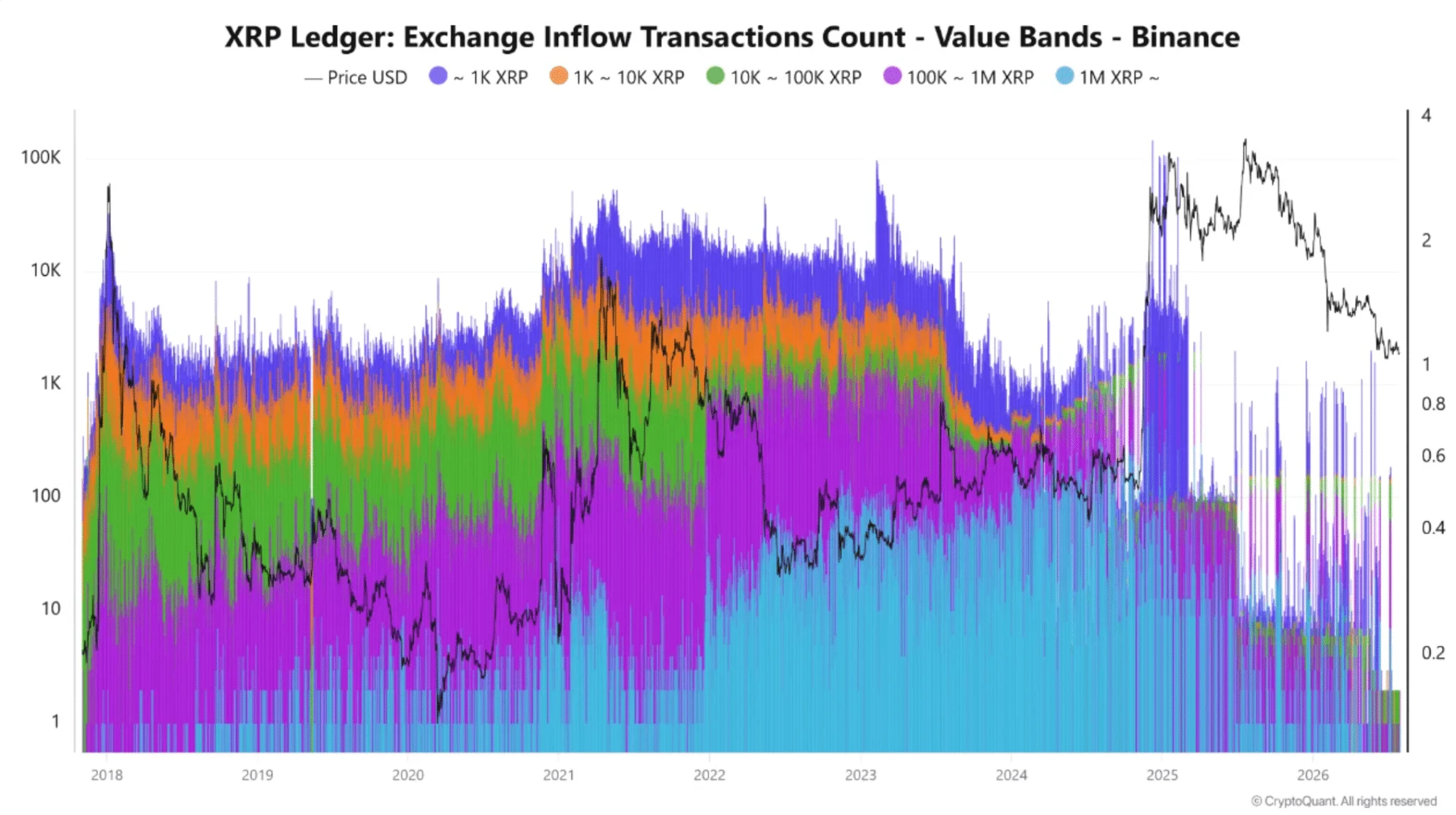
Large Binance transfers often provide an early indication of whether whales are preparing to accumulate or distribute XRP. Recent activity, however, might be suggestive that neither flow is dominating the market.

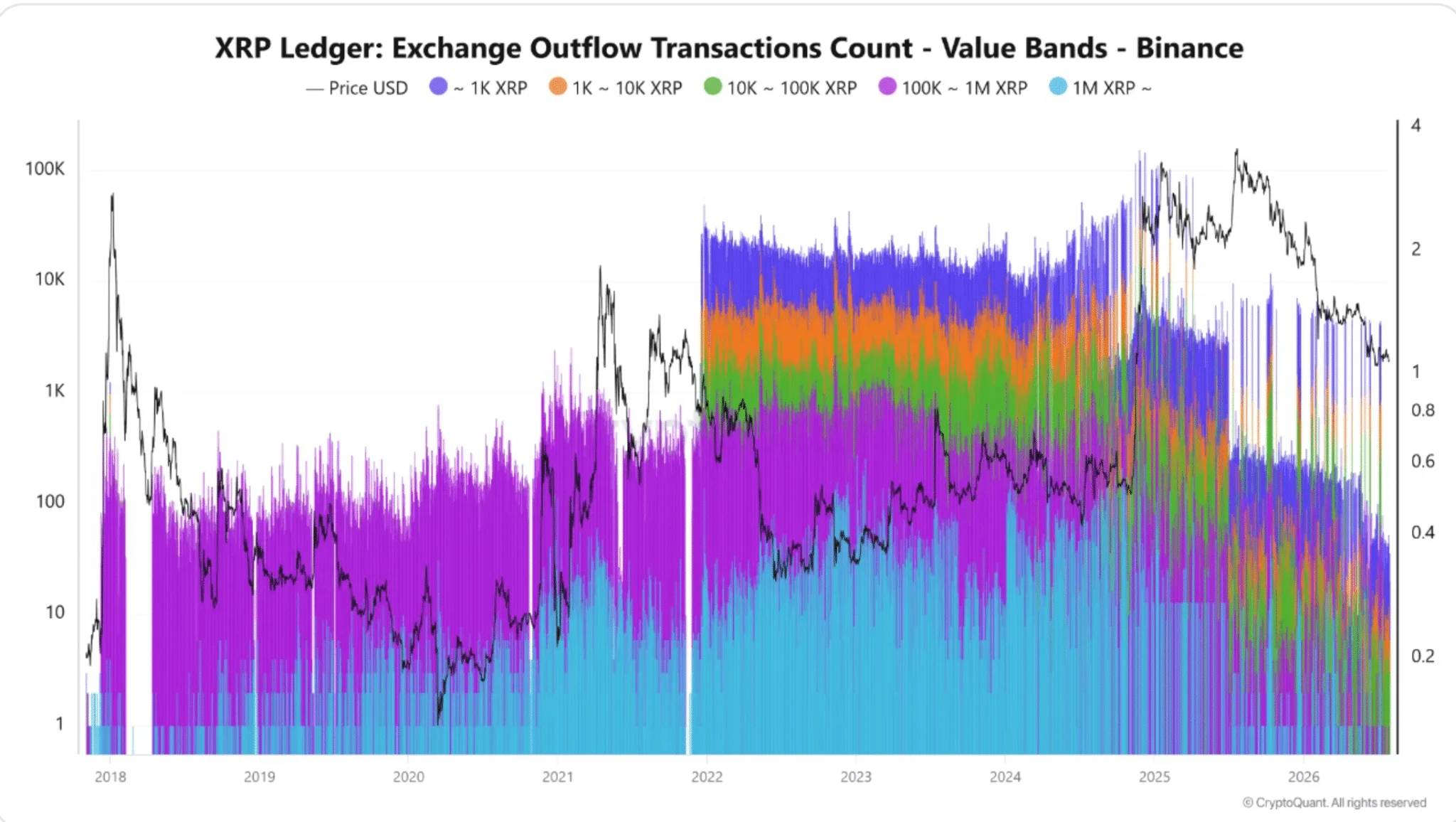
Transaction counts have fallen sharply across every major value band. The 100K to 1 million XRP and over 1 million XRP cohorts stood out in both inflows and outflows.

As large inflows weakened, immediate pressure on prices reduced since fewer whales were moving XRP onto Binance.

Source: CryptoQuant

However, declining outflows also showed those same investors may not be withdrawing tokens into private wallets, weakening the case for renewed accumulation.

Together, these trends pointed to a market where major holders may be preserving liquidity, rather than taking directional positions.

Source: CryptoQuant

That hesitation limits the number of large volume transactions that generally drive sustained breakouts or deeper corrections. Now, retail transfer activity between 1K and 10K XRP has continued to dominate activity. However, it has rarely provided enough capital to replace whale participation.

Until institutional and whale flows recover, the altcoin is likely to remain range-bound, with weaker liquidity limiting both upside momentum and downside conviction.

Seller exhaustion strengthens XRP’s consolidation

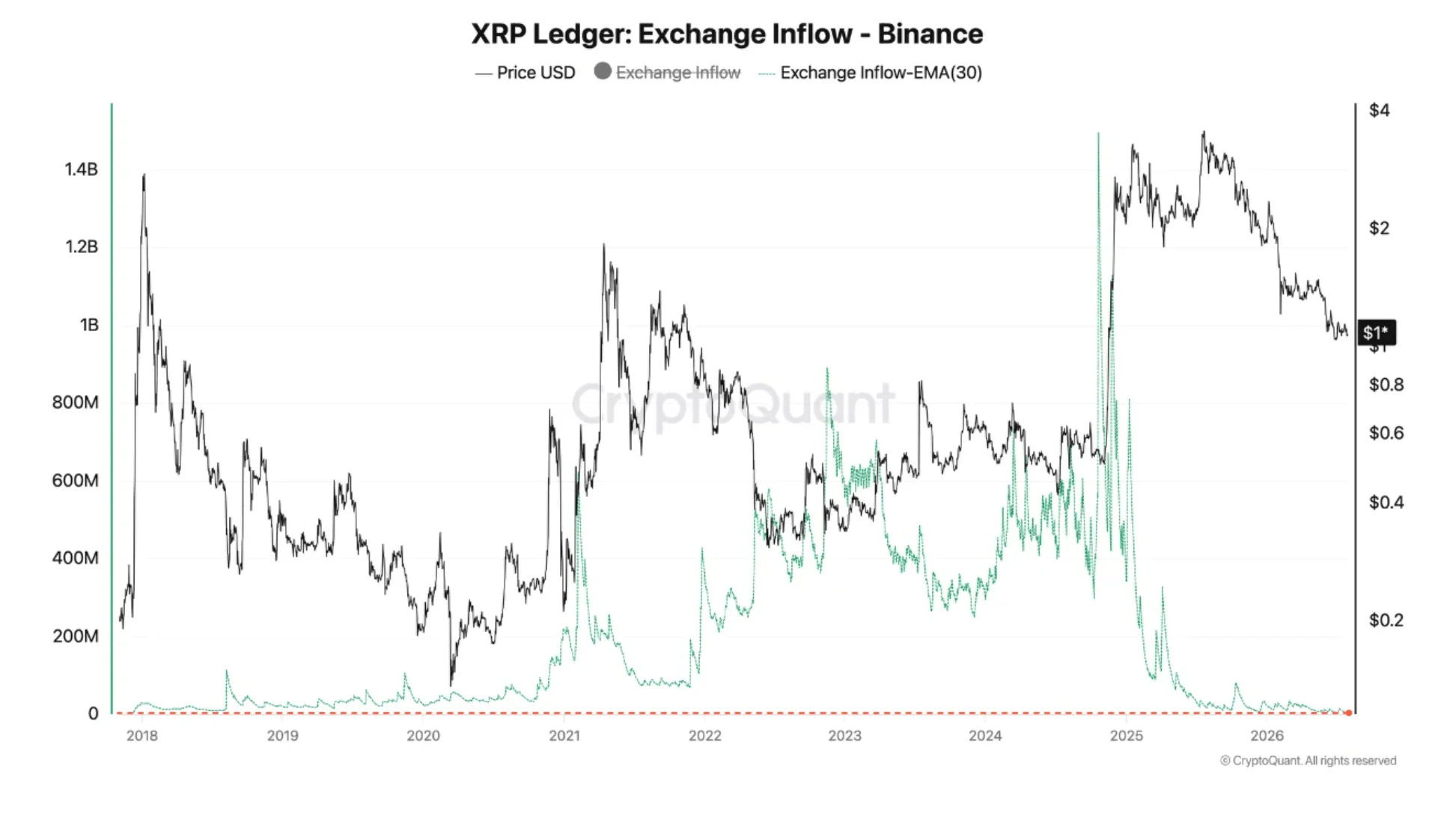
The slowdown in whale transfers also semed to align with a broader decline in Binance exchange inflows, reinforcing the view that large holders might no longer be rushing to sell XRP.

Following months of heavy distribution, average monthly inflows dropped to roughly 3.6 million XRP, the lowest level on record. This shift may be evidence that there was less intense pressure to sell, as opposed to a hike in selling pressure.

It could also support XRP’s ability to begin consolidating above $1 after declining by over 72% since reaching the $3.66-peak.

Source: CryptoQuant

Nevertheless, lower inflow rates alone cannot sustainably result in a price hike for XRP. This, due to the fact that less aggressive selling does not always translate into greater demand.

Instead, the market might just be transitioning from distribution into balance, where buyers absorb available supply. A stronger bullish trend will ultimately require fresh whale and institutional participation to replace exhausted sellers with new demand.

Can XRP convert weaker selling into a breakout?

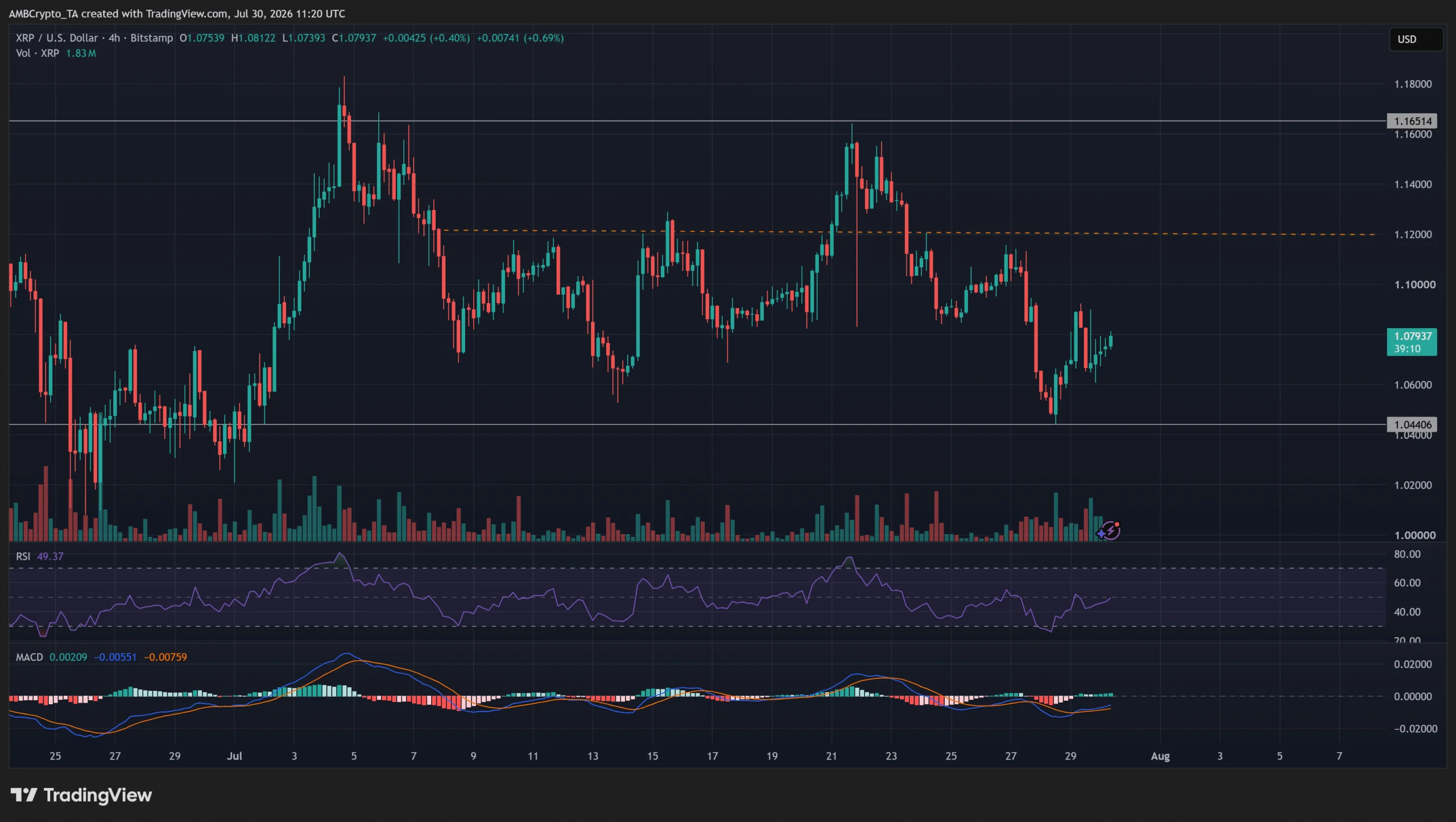
Notably, that seller exhaustion is now reflected in XRP’s recent price action. After sweeping liquidity near $1.16, the altcoin fell sharply before finding strong support around $1.04.

Buyers then defended the zone, allowing price to form a higher low above $1.05 before recovering towards $1.07. This rebound seemed to support the previous decline in Binance inflows.

Source: XRP/USD on TradingView

However, $1.12 remains the key challenge. Reclaiming that level would strengthen the recovery towards $1.16, while another rejection could signal renewed distribution and increase the likelihood of revisiting the $1.0440-support zone.


Final Summary

  • XRP remains range-bound as whale activity and Binance inflows weakened across the board. 
  • XRP must reclaim $1.12 with stronger whale demand to sustain a recovery towards $1.16.


Source link