Home Blog Page 140

Andy Jassy said Amazon will spend $220 billion this year—and still won’t have enough capacity

0
Andy Jassy said Amazon will spend $220 billion this year—and still won't have enough capacity

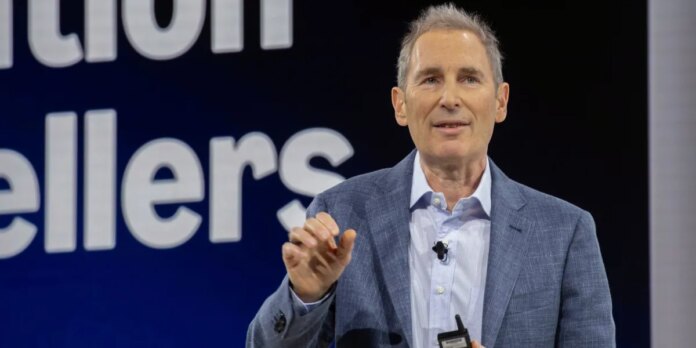
Amazon’s stock price jumped more than 9% in after-hours trading on Thursday after the retail-and-AI giant reported second-quarter results buoyed by its Amazon Web Services cloud business, which is racing faster ahead than it has in more than four years.

The cloud unit posted $42.2 billion in revenue in Q2, up 37% from $30.9 billion a year ago, marking AWS’ fastest growth in 18 quarters, and what Amazon CEO Andy Jassy called its fifth consecutive quarter of accelerating growth. AWS added more than $4.6 billion in revenue quarter over quarter, and AWS operating income hit $16.6 billion, up 64% from $10.2 billion a year ago, on a 39.4% margin, up from 32.9% in the same period a year ago. AWS’s backlog—customer agreements representing future revenue—grew to $496 billion. 

“AWS is now a $169 billion dollar annualized revenue run rate business, which, for perspective, would place it 24th on the Fortune 500 list if it was a standalone company,” Jassy said during Thursday’s earnings call.

Across all of Amazon businesses including stores, advertising, Prime, devices, and cloud, net sales rose 20% to $200.6 billion, compared with $167.7 billion a year earlier. Operating income surged to $27.5 billion, from $19.2 billion. Net income hit $62.6 billion, or $5.75 per diluted share, compared with $18.2 billion, or $1.68 per share, a year ago—with a caveat that the net-income figure includes $53.4 billion in non-operating income primarily from Amazon’s investments in Anthropic. Advertising, one of the unsung heroes of Amazon’s business, grew 26% year-over-year, up from 22% growth a year ago when the segment hit $15.7 billion.  

Meanwhile, free cash flow, a metric that has caused some angst among investors as hyperscalers and cloud providers have committed to plowing more than $800 billion into building out data centers and AI infrastructure, flipped to negative $7.6 billion, compared with an inflow of $18.2 billion a year ago. The flip is driven by Amazon’s $66.1 billion year-over-year increase in equipment purchases, which Amazon said reflects AI investments. 

During the call, Jassy told investors that Amazon now expects to spend $220 billion in capital expenditures in 2026, up from its prior estimate of $200 billion, due to higher memory costs. Even at the elevated level, however, Jassy said Amazon still won’t “have enough capacity to meet all the demand we have in 2026. And I believe this dynamic will also be true in 2027 too.”

Undergirding much of the growth is AWS, which “is booming,” said Jassy in his remarks. 

The acceleration of AWS has been a steady build that began its most recent ascent in the third quarter of 2025 when growth hit 20% and accelerated each quarter until 37% in Q2. During the same span, AWS’ operating margins expanded from 32.9% a year ago to 39.4% while the company has been spending heavily on data center infrastructure. AWS property and equipment grew to $223 billion in Q1 up from $190 billion the quarter before. (Comparable Q2 figures haven’t been published yet.)

On Thursday’s call, Jassy said the growth acceleration is being driven by capacity additions plus other factors. Customers are gravitating toward AWS because it has “the broadest functionality across both cloud core and AI” and “the strongest operational performance and security.”

“As more and more companies are bringing their inference workloads to production, they want it to live near the rest of their workloads and data, and so much more of it lives in AWS than anywhere else,” said Jassy.

And as for Amazon’s core cloud business, which has seen its own boost from post-training reinforcement learning and agent tool use, Jassy noted that 85% of global IT spending is still on-premises. Meaning, plenty of companies are still running their own hardware in their own facilities. 

“That equation is going to flip in the next 10 to 20 years,” he said, adding that AWS is “winning the lion’s share” of enterprise cloud migration plans. 

Customer adoption of Bedrock—Amazon’s platform for accessing AI models from Anthropic, Meta, and OpenAI—has seen solid performance and customers spent more on the service in Q2 than in all prior quarters combined, an analyst noted on Thursday. Jassy’s view is that AWS and Amazon can “have a wildly successful business” without its own frontier model because there won’t be one model “to rule the world.”

“It’s not just Anthropic; it’s not just OpenAI,” Jassy said. “You see increasingly more and more companies being interested in the open models as well, and we have all of them in Bedrock.”

Meanwhile, AWS remains on pace to double its power capacity by the end of 2027, compared with 2025, Jassy said. 



Source link

Crypto for Advisors: Is the Clarity Act dead?

0
Bitcoin analysts agree the Fed's hold was hawkish. They don't agree on what happens next.

Ask an Expert

Q. The Clarity Act, yea or nay?

Yea, with one important caveat. The objective cannot simply be to make life easier for crypto companies. It should make legitimate projects easier to identify, while making fraud and regulatory arbitrage harder. The biggest problem in the U.S. has been that companies often cannot determine whether they are dealing with the SEC, the CFTC or both until an enforcement action happens.

That is not a serious regulatory system. It pushes responsible teams offshore while doing surprisingly little to stop bad actors. The Clarity Act is directionally right because it recognizes that a capital-raising transaction can involve securities laws without automatically making the underlying token a security. ​

That distinction is much closer to how decentralized networks actually develop. My main concern is implementation. If the definitions remain subjective, or the SEC and CFTC apply conflicting standards, the uncertainty simply moves from the courts into the rulemaking process. The bill should pass, but success will depend on clear rules, coordinated regulators and real enforcement against fraud.

Q. What aspect will benefit investors the most?

The greatest benefit is the combination of clearer asset classification and mandatory disclosure. Investors need to know what they are buying, which regulator has jurisdiction, what information the project must disclose and what legal protections exist if something goes wrong. The current system often gives investors the worst of both worlds. Many projects do not provide disclosures comparable to public companies, yet they also lack a practical regulatory framework tailored to decentralized networks.


Source link

Best CD rates today, Thursday, July 30, 2026: Lock in up to 4.15% APY with a 14-month CD

0
Best CD rates today, Thursday, June 25, 2026: Lock in up to 4% APY


Find out which banks are offering the best CD rates right now. If you’re looking for a secure place to store your savings, a certificate of deposit (CD) may be a great choice. These accounts often provide higher interest rates than traditional checking and savings accounts. However, CD rates can vary widely.

Learn more about where CD rates stand today and how to find the best rates available.

CD rates are relatively high compared to historical averages. That said, CD rates have been on the decline since last year when the Federal Reserve began cutting its target rate. The good news is that several financial institutions offer competitive rates of 4% APY and up, particularly online banks.

Today, Thursday, July 30, 2026, the highest CD rate is 4.15%. This rate is offered by Synchrony Bank on its 14-month CD.

Here is a look at some of the best CD rates available today from our verified partners:

The Federal Reserve began decreasing the federal funds rate in light of slowing inflation and an overall improved economic outlook. It cut its target rate three times in late 2024 by a total of one percentage point.

Back in December, the Fed announced its third rate cut of 2025. However, it’s now unlikely the Fed will cut rates again in 2026. So far this year, the Fed has left rates unchanged, and a rate increase is growing more likely before the year’s end.

The federal funds rate doesn’t directly impact deposit interest rates, though they are correlated. When the Fed lowers rates, financial institutions typically follow suit (and vice versa). So now that the Fed has lowered rates and kept them low, CD rates are trending lower again. That’s why now may be a good time to put your money in a CD and lock in today’s best rates.

The process for opening a CD account varies by financial institution. However, there are a few general steps you can expect to follow:

  • Research CD rates: One of the most important factors to consider when opening a CD is whether the account provides a competitive rate. You can easily compare CD rates online to find the best offers.

  • Choose an account that meets your needs: While a CD’s interest rate is a key consideration, it shouldn’t be the only one. You should also evaluate the CD’s term length, minimum opening deposit requirements, and fees to ensure a particular account fits your financial needs and goals. For example, you want to avoid choosing a CD term that’s too long, otherwise you’ll be subject to an early withdrawal penalty if you need to pull out your funds before the CD matures.

  • Get your documents ready: When opening a bank account, you will need to provide a few pieces of information, including your Social Security number, address, and driver’s license or passport number. Having these documents on hand will help streamline the application process.

  • Complete the application: These days, many financial institutions allow you to apply for an account online, though you might have to visit the branch in some cases. Either way, the application for a new CD should only take a few minutes to complete. And in many cases, you’ll get your approval decision instantly.

  • Fund the account: Once your CD application is approved, it’s time to fund the account. This can usually be done by transferring money from another account or mailing a check.

Read more: Step-by-step instructions for opening a CD


Source link

Ethena whale stakes 60M tokens: Can shrinking supply revive ENA?

0
Ethena whale stakes 60M tokens: Can shrinking supply revive ENA?


A whale reinforced institutional confidence after staking 60 million Ethena [ENA], worth approximately $4.73 million, only a day after acquiring the tokens through Coinbase Prime. 

The transaction represented nearly 0.63% of ENA’s circulating supply, immediately removing a sizeable allocation from liquid circulation. Such behavior reflected a long-term investment approach rather than short-term speculation. 

Large staking activity often reduces the amount of readily tradable supply, especially when it follows direct purchases from institutional venues. 

However, the move arrived while ENA continued trading near an important support area, preventing the market from responding with an immediate breakout. Investors instead weighed the impact of shrinking liquid supply against broader market caution. 

As a result, the staking event strengthened the accumulation narrative, although buyers still needed stronger participation before sentiment could shift decisively.

ENA’s exchange outflows keep supply constrained

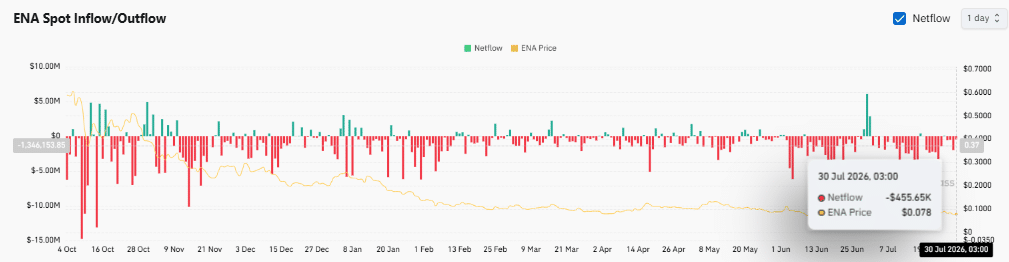
Spot flows continued to favor outflows despite recent price weakness. 

The latest daily reading reached -$455.65K, extending a broader sequence of negative netflows that indicated more ENA left exchanges than entered them. The trend reduced the amount of immediately available supply for potential sellers and helped offset bearish pressure created by the recent pullback. 

Exchange outflows often reflected investors moving tokens into self-custody or staking rather than preparing them for liquidation. However, price action failed to respond positively despite the continued reduction in exchange balances. The divergence suggested demand remained cautious even as available sell-side liquidity tightened. 

Buyers therefore retained an underlying structural advantage, although stronger spot demand would still need to emerge before reduced exchange supply could translate into sustained upside.

Source: CoinGlass

Funding flip raises fresh caution

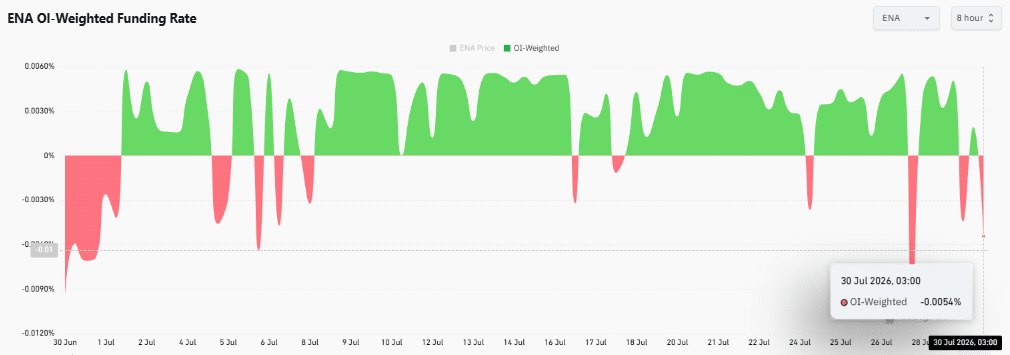
Bullish conviction across the derivatives market weakened after the OI-Weighted Funding Rate slipped to -0.0054% as of writing. This shift marked a notable change from the predominantly positive readings seen throughout much of July. 

Negative funding indicated short traders had started paying longs, reflecting growing bearish positioning in perpetual futures. However, the decline remained relatively modest instead of signaling aggressive panic selling. 

Derivatives traders appeared to reduce bullish exposure rather than build heavily leveraged short positions. This behavior aligned with ENA’s recent price weakness and suggested market participants had adopted a more defensive stance while awaiting stronger confirmation. 

Unless funding recovered into positive territory, leveraged traders would likely remain cautious, limiting the probability of an immediate bullish expansion.

Source: CoinGlass

ENA loses channel support as sellers test key floor

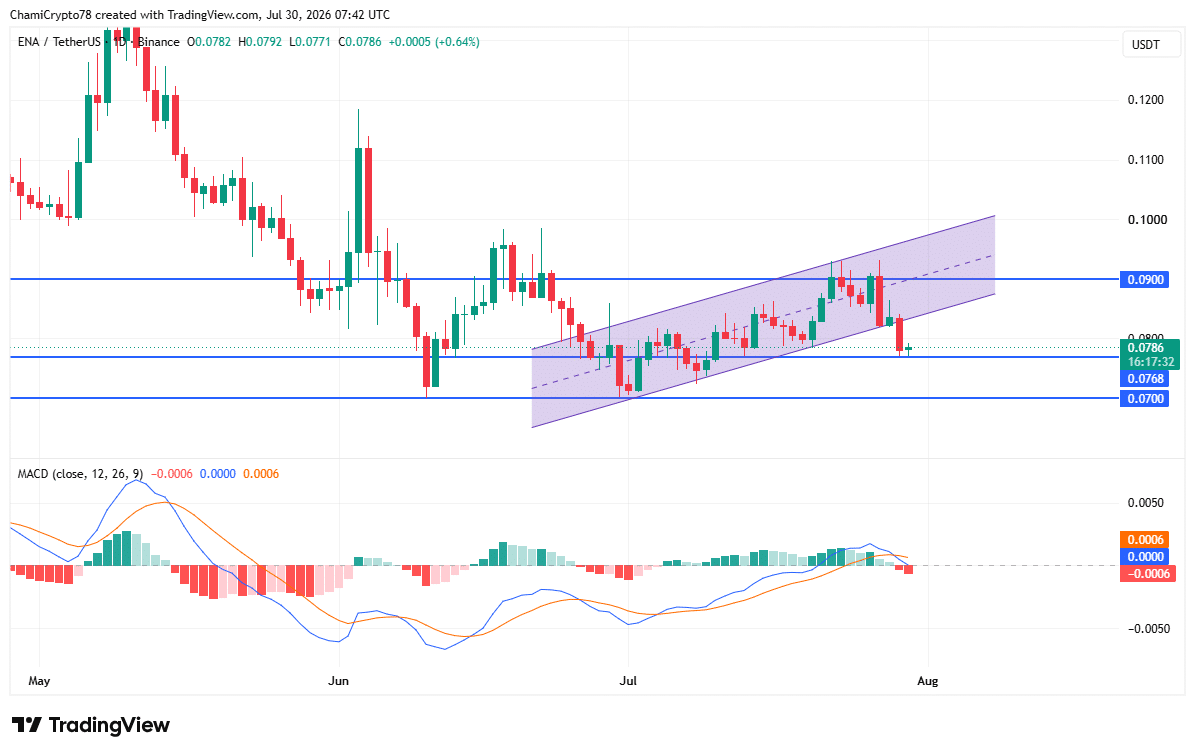
ENA broke below its ascending channel and shifted attention toward the $0.0768 support level after failing to sustain its recent recovery structure. 

Price briefly slipped beneath that level before attempting to stabilize, while the next major support rested near $0.0700. Overhead resistance remained positioned around $0.0900, creating a wide recovery range if buyers regained control. 

Meanwhile, at press time, the MACD completed a bearish crossover, and the histogram turned negative at approximately -0.0006, reflecting fading buying strength. Those signals reinforced the loss of short-term trend control instead of confirming a broader reversal. 

If buyers defend $0.0768, ENA could attempt another move toward $0.0900. However, a decisive break below support would increase the probability of a deeper decline toward $0.0700.

ENA price actionENA price action
Source: TradingView

Final Summary

  • Whale staking and continued exchange outflows reduce available ENA supply despite weaker market sentiment.
  • ENA now defends critical support after losing its bullish structure as bearish signals increase.


Source link

Ondo Finance explores deal valued at up to $500 million

0
Ondo Finance explores deal valued at up to $500 million

Tokenized asset specialist Ondo Finance is evaluating a potential acquisition of between $250 million and $500 million, according to a person with knowledge of the matter.

The New York-based company is considering wealthtech targets, among other subsectors, said the person, who spoke on condition of anonymity because the matter is private.

Ondo has not yet appointed any formal advisers, the person said.

Founded in 2021 by former Goldman Sachs executives, Ondo Finance is a tokenization platform that brings traditional financial assets onchain. The company issues tokenized U.S. Treasuries and stocks and has become one of the largest providers of tokenized real-world assets, with more than $3.5 billion across its products.

“As a fast-growing company, Ondo regularly evaluates the market as part of normal business operations. We are not in conversations with any party at this time,” an Ondo representative said in emailed comments to CoinDesk.

Crypto dealmaking has remained strong in 2026 as traditional financial firms and larger digital-asset companies use acquisitions to add licenses, technology and distribution.


Source link

How many Americans have no savings?

0
How many Americans have no savings?


Americans have a savings crisis. Or more accurately, we have a crisis of under-saving. 

In 2026, about a third of U.S. adults have $0 saved for emergencies. People in this group often feel like they’re just bad with money. However, you should keep in mind that we’re all facing factors beyond our control. Between inflation, high medical costs, and challenges in the job market, many Americans are finding it difficult or even impossible to save money.

It’s difficult to say exactly how many Americans have $0 in savings, since different sources cite different figures. 

One survey from Empower found that 32% of respondents reported they had no emergency savings. And 39% said rising prices are the biggest roadblock to saving for a rainy day

Meanwhile, a Yahoo Finance and Marist poll put the number of Americans without savings higher; 35% of respondents said their savings would not last them a full month if they lost income.

Who is saving the least in America? According to the Federal Reserve, the groups with the least money saved include people who didn’t complete high school and adults under the age of 30 (Gen Z).

A savings shortage is not always about lack of discipline. According to Yahoo Finance’s survey, only 8% said their savings shortage was due to overspending. These were the more prevalent causes people cited:

  • 47%: Cost of living

  • 11%: Unexpected bills or expenses

  • 10%: Change of income or employment status

  • 10%: Too many financial obligations 

  • 8%: Choosing to spend extra income on things you enjoy

  • 6%: High-interest debt repayment

Read more: What to do when your pay raises aren’t keeping up with the cost of living

Unfortunately, people who don’t have savings often make harmful financial decisions to cover their expenses. Here are some of the common “solutions” people turn to when their savings accounts are empty:

  • Overborrowing: A FINRA study found that 27% of people use credit cards to cover unexpected expenses, and 12% turn to loans. Considering that the average personal loan rate is now 11.40% and credit card rates are at 21%, these fixes might turn a temporary financial problem into a long-term debt issue.

  • Overworking: A common solution for people who need emergency funds is to pick up extra work. But as a result of overworking, you might become fatigued and make bad financial decisions for the sake of convenience. For example, after a long shift, you’re more likely to buy fast food than to cook at home.

  • Tapping into retirement: Many people see their retirement savings as a solution for unexpected expenses. But taking an early withdrawal or a loan from a retirement account can be costly. For example, if you make an early 401(k) withdrawal, you usually have to pay a 10% penalty, plus income taxes on the withdrawal amount. You’ll also have less money available when you retire.

Read more: How much do you really need to save for retirement?

When money is tight, saving can feel impossible. But don’t worry about saving a lot at first — instead, focus on building the habit. Setting aside a few dollars consistently adds up and can create momentum to build a bigger cushion over time.

Here are a few ways to get started saving:

  • Start small: Even if you can only save $10 from each paycheck, it’s important to build a habit of spending less than you make. Once your finances improve, you can increase your contribution. 

  • Take advantage of pay increases: If your income increases, don’t ramp up your spending. Instead, increase your automatic contributions to your savings. You can also increase your savings contributions when you pay off debt. For example, if you pay off a $250 a month car loan in July, start contributing $250 a month to your savings in August. 

  • Earn interest: Almost a quarter (23%) of Americans keep their savings in checking accounts, and 19% store their cash at home. But both of those options mean losing out on interest earnings. A far better option is to keep your savings in a high-yield savings account, where it can potentially earn as much as 4% APY.   

  • Pause retirement contributions: If you’re contributing money to retirement, put your contributions on pause. Use the money to build up your emergency savings fund first, and then go back to saving for retirement. That way, you won’t be tempted to make expensive early retirement withdrawals to cover emergencies.

  • Sign-up bonus: Find a bank that will reward you with a sign-up bonus for opening an account. If you choose the right bank, you can earn as much as $300 for opening an account and following specific deposit guidelines.

  • Implement a spending freeze: For many people, the thought of cutting all your non-necessities can feel suffocating. But what if you only cut them out for a set period, like a month or two? If you put a pause on expenses such as streaming, travel, and dining out, you might find yourself with hundreds of dollars to deposit to your savings.

Read more: I went on a one-week spending freeze and saved $200. Here’s how you can too.


Source link

Coinbase (COIN) sinks 5% after missing Q2 revenue estimates

0
Coinbase (COIN) sinks 5% after missing Q2 revenue estimates

In a post on X, CEO Brian Armstrong pointed to the company’s expanding businesses beyond spot trading, including stablecoins, Base and prediction markets, noting that Coinbase reached a record 10.3% share of global crypto trading volume during the quarter.

CFO Alesia Haas struck a more measured tone, saying crypto market conditions were challenging as industry spot trading volumes fell more than 20% and the total crypto market capitalization declined by double digits. She said those conditions contributed to a 14% quarter-over-quarter decline in Coinbase’s total revenue.

Several Wall Street firms lowered estimates ahead of earnings and trimmed EBITDA forecasts as lower crypto prices weighed on institutional trading, blockchain rewards and retail activity.

Investors remained focused on Coinbase’s efforts to reduce its dependence on transaction fees.

Subscription and services revenue, which includes USDC interest income, staking, custody, Coinbase One memberships and institutional services, has become a key measure of whether the company can generate more stable revenue through crypto market cycles.

Analysts also watched for updates on newer businesses, including derivatives, prediction markets and Base, Coinbase’s Ethereum layer-2 network.

The company will host a call with investors at 5pm E.T.


Source link