Tokenized asset specialist Ondo Finance is evaluating a potential acquisition of between $250 million and $500 million, according to a person with knowledge of the matter.
The New York-based company is considering wealthtech targets, among other subsectors, said the person, who spoke on condition of anonymity because the matter is private.
Ondo has not yet appointed any formal advisers, the person said.
Founded in 2021 by former Goldman Sachs executives, Ondo Finance is a tokenization platform that brings traditional financial assets onchain. The company issues tokenized U.S. Treasuries and stocks and has become one of the largest providers of tokenized real-world assets, with more than $3.5 billion across its products.
“As a fast-growing company, Ondo regularly evaluates the market as part of normal business operations. We are not in conversations with any party at this time,” an Ondo representative said in emailed comments to CoinDesk.
Crypto dealmaking has remained strong in 2026 as traditional financial firms and larger digital-asset companies use acquisitions to add licenses, technology and distribution.
Americans have a savings crisis. Or more accurately, we have a crisis of under-saving.
In 2026, about a third of U.S. adults have $0 saved for emergencies. People in this group often feel like they’re just bad with money. However, you should keep in mind that we’re all facing factors beyond our control. Between inflation, high medical costs, and challenges in the job market, many Americans are finding it difficult or even impossible to save money.
How many Americans have no savings?
It’s difficult to say exactly how many Americans have $0 in savings, since different sources cite different figures.
One survey from Empower found that 32% of respondents reported they had no emergency savings. And 39% said rising prices are the biggest roadblock to saving for a rainy day.
Meanwhile, a Yahoo Finance and Marist poll put the number of Americans without savings higher; 35% of respondents said their savings would not last them a full month if they lost income.
Who is saving the least in America? According to the Federal Reserve, the groups with the least money saved include people who didn’t complete high school and adults under the age of 30 (Gen Z).
Biggest challenges to saving in today’s economy
A savings shortage is not always about lack of discipline. According to Yahoo Finance’s survey, only 8% said their savings shortage was due to overspending. These were the more prevalent causes people cited:
Unfortunately, people who don’t have savings often make harmful financial decisions to cover their expenses. Here are some of the common “solutions” people turn to when their savings accounts are empty:
Overborrowing: A FINRA study found that 27% of people use credit cards to cover unexpected expenses, and 12% turn to loans. Considering that the average personal loan rate is now 11.40% and credit card rates are at 21%, these fixes might turn a temporary financial problem into a long-term debt issue.
Overworking: A common solution for people who need emergency funds is to pick up extra work. But as a result of overworking, you might become fatigued and make bad financial decisions for the sake of convenience. For example, after a long shift, you’re more likely to buy fast food than to cook at home.
Tapping into retirement: Many people see their retirement savings as a solution for unexpected expenses. But taking an early withdrawal or a loan from a retirement account can be costly. For example, if you make an early 401(k) withdrawal, you usually have to pay a 10% penalty, plus income taxes on the withdrawal amount. You’ll also have less money available when you retire.
How to start saving money even when money is tight
When money is tight, saving can feel impossible. But don’t worry about saving a lot at first — instead, focus on building the habit. Setting aside a few dollars consistently adds up and can create momentum to build a bigger cushion over time.
Here are a few ways to get started saving:
Start small: Even if you can only save $10 from each paycheck, it’s important to build a habit of spending less than you make. Once your finances improve, you can increase your contribution.
Take advantage of pay increases: If your income increases, don’t ramp up your spending. Instead, increase your automatic contributions to your savings. You can also increase your savings contributions when you pay off debt. For example, if you pay off a $250 a month car loan in July, start contributing $250 a month to your savings in August.
Earn interest: Almost a quarter (23%) of Americans keep their savings in checking accounts, and 19% store their cash at home. But both of those options mean losing out on interest earnings. A far better option is to keep your savings in a high-yield savings account, where it can potentially earn as much as 4% APY.
Pause retirement contributions: If you’re contributing money to retirement, put your contributions on pause. Use the money to build up your emergency savings fund first, and then go back to saving for retirement. That way, you won’t be tempted to make expensive early retirement withdrawals to cover emergencies.
Sign-up bonus: Find a bank that will reward you with a sign-up bonus for opening an account. If you choose the right bank, you can earn as much as $300 for opening an account and following specific deposit guidelines.
Implement a spending freeze: For many people, the thought of cutting all your non-necessities can feel suffocating. But what if you only cut them out for a set period, like a month or two? If you put a pause on expenses such as streaming, travel, and dining out, you might find yourself with hundreds of dollars to deposit to your savings.
In a post on X, CEO Brian Armstrong pointed to the company’s expanding businesses beyond spot trading, including stablecoins, Base and prediction markets, noting that Coinbase reached a record 10.3% share of global crypto trading volume during the quarter.
CFO Alesia Haas struck a more measured tone, saying crypto market conditions were challenging as industry spot trading volumes fell more than 20% and the total crypto market capitalization declined by double digits. She said those conditions contributed to a 14% quarter-over-quarter decline in Coinbase’s total revenue.
Several Wall Street firms lowered estimates ahead of earnings and trimmed EBITDA forecasts as lower crypto prices weighed on institutional trading, blockchain rewards and retail activity.
Investors remained focused on Coinbase’s efforts to reduce its dependence on transaction fees.
Subscription and services revenue, which includes USDC interest income, staking, custody, Coinbase One memberships and institutional services, has become a key measure of whether the company can generate more stable revenue through crypto market cycles.
Analysts also watched for updates on newer businesses, including derivatives, prediction markets and Base, Coinbase’s Ethereum layer-2 network.
The company will host a call with investors at 5pm E.T.
Michael Dempsey, managing partner at the New York-based investment firm Compound, said in a long post on X that Situational Awareness’s “prescience was incredibly impressive and likely should still be funded and respected.”
“That said, anyone who has experience in public markets could somewhat easily see this was One Big Trade and so probably there should have been way better views on risk besides buying index-level puts,” he added, outlining several ways he thought the hedge fund may have mismanaged its risk.
“We shouldn’t grave dance but should instead internalize some of the learnings here and appreciate someone who basically called their shot and executed on it but (thus far) didn’t land the plane.”
Though the Fed’s newly appointed chair, Kevin Warsh, has emphasized the goal of lowering inflation to 2%, he hasn’t outlined a detailed plan.
Earlier, President Donald Trump called Warsh “fantastic” and reiterated that the Fed should lower the rates, “He wants to do the right thing. I know what he wants to do.”
But he sharply criticized other Fed officials as “very political” who “perhaps have bad intentions.” The president said,
“We should have the lowest interest rate in the world, like it used to be 30 years ago.”
However, the Warsh-led FOMC committee has decided to keep rates steady this time.
Trending on TheStreet Roundtable:
Bitcoin, XRP react to FOMC decision
Following the Federal Open Market Committee’s (FOMC) latest interest rate decision, Bitcoin (BTC) and XRP were trading at $64,268.33 and $1.08 at the time of writing.
Ethereum (ETH) and Solana (SOL) were trading at $1,917.43 and $73.97.
The Crypto Fear & Greed Index by CoinGlass stood at 28 at the time of writing, reflecting “Fear” among crypto traders. However, the sentiment has gotten better after weeks of “Extreme Fear” among traders.
In 2025, public disclosures showed that U.S. President Donald Trump’s crypto-related business had $1.4 billion in crypto-related income. Political scrutiny over this fact has led Senators to expand the CLARITY Act by adding an ethics provision.
This provision prohibits senior government officials from issuing or sponsoring digital assets for compensation.
The proposal has drawn attention because of the Trump family’s crypto-related businesses, including World Liberty Financial and the Official Trump memecoin.
Official Trump [TRUMP], alongside the WLFI venture, has contributed to the $1.4 billion income. How will the memecoin respond to the developments in the ethics debate?
TRUMP coin unable to keep its bullish structure going
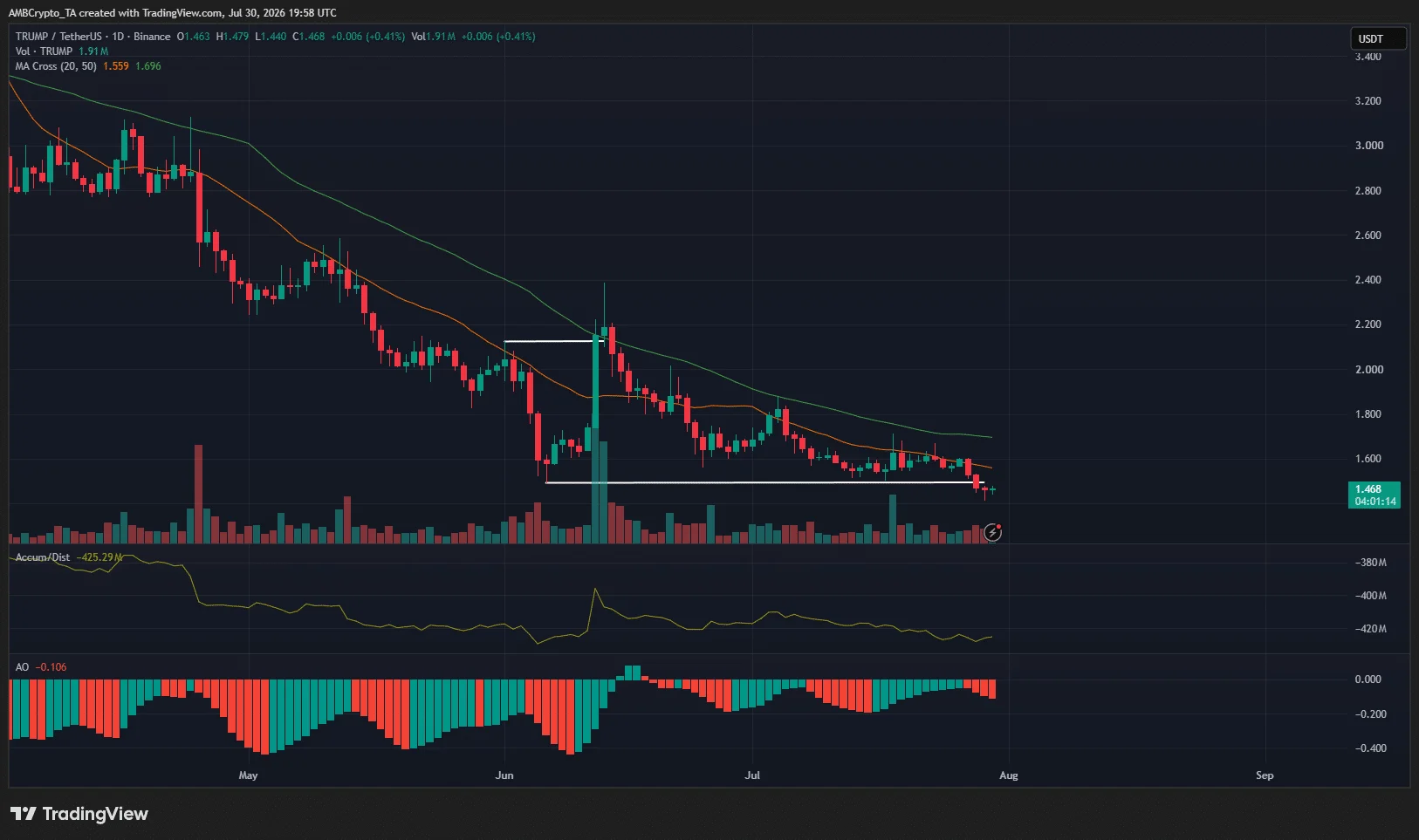
Source: TRUMP/USDT on TradingView
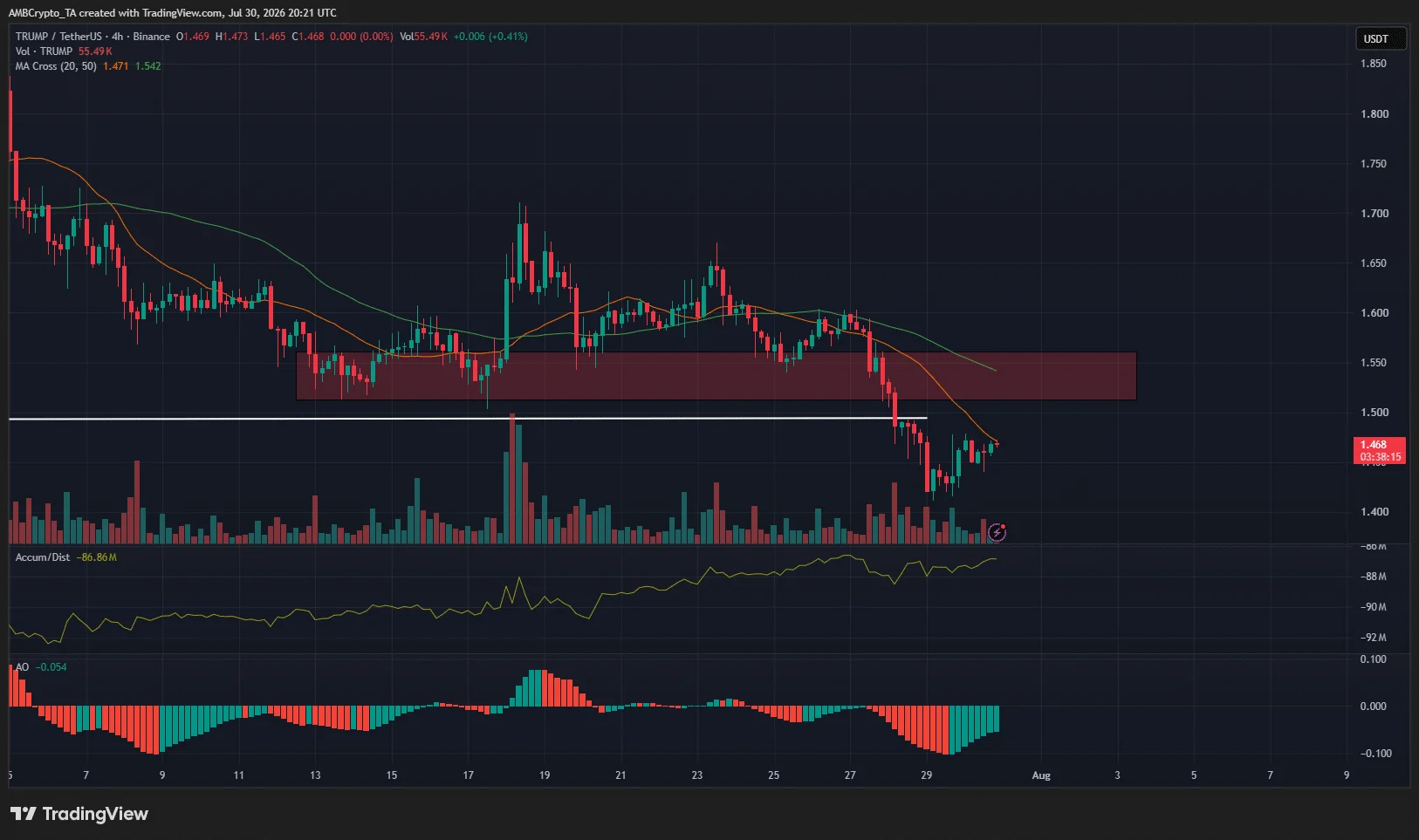
In mid-June, a bullish structure break [white] occurred, when TRUMP coin breached the previous swing high at $2.12 to reach $2.39. Over the past six weeks, the memecoin retraced these gains, and fell to the $1.49 swing low by mid-July.
A couple of days ago, TRUMP crypto fell below this low once more. In so doing, the bears flipped the structure in their favor once again. The A/D indicator has steadily fallen lower, and the Awesome Oscillator has been below the zero line for months.
Overall, the price structure and selling pressure favor the bears. More downside can be expected. At the same time, an outsized rally like the mid-June one to grab liquidity overhead is a possibility swing traders must beware of.
Traders’ call to action- Sell
Source: TRUMP/USDT on TradingView
The 4-hour chart was clearly bearish, following the drop below the $1.50 swing point on this timeframe. Interestingly, the A/D indicator was rising while the prices fell, a divergence that could see a price bounce.
In case of such a bounce, the $1.55 and $1.60 levels would be the immediate targets.
Source: CoinGlass
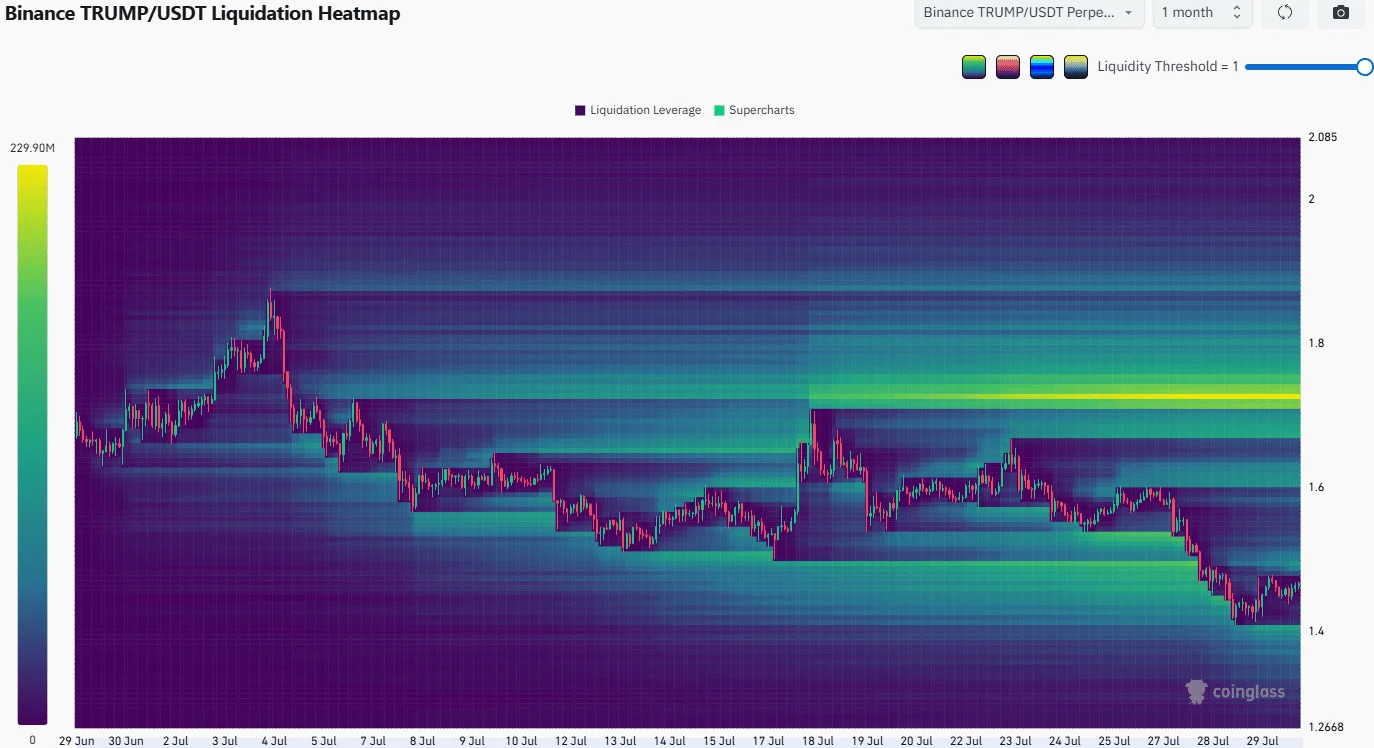
The 1-month liquidation heatmap showed a dense cluster of short liquidations around $1.73. A sweep of these local highs from mid-July is also a possibility, though less likely than a bearish reversal at $1.60.
Final Summary
The CLARITY Act and the ethics provision debate can have political and regulatory implications for TRUMP coin.
The long-term trend was bearish once again, and a brief bounce toward $1.60 before further drawdown appeared a likely price course for the memecoin.
Strategy (MSTR), the world’s largest corporate bitcoin BTC$64,860.27 holder, reported Thursday an $8.2 billion second-quarter net loss after the cryptocurrency’s price decline erased billions of dollars from the value of its digital asset holdings.
The quarterly loss was driven almost entirely by an $8.32 billion unrealized markdown on its bitcoin holdings under fair-value accounting.
The company held 843,775 bitcoin as of July 26, up 25% from the start of the year. At current prices, the stash is worth roughly $54.8 billion, compared with an acquisition cost of $63.7 billion.
The report came after a period of growing investor scrutiny on the firm over whether it can sustain an increasingly complex capital structure built around multiple classes of preferred stock, common equity and convertible debt.
The company raised $17.06 billion through at-the-market stock offerings this year, repurchased $1.5 billion of convertible notes at an 8% discount and expanded its U.S. dollar reserve to $3.75 billion, enough to cover more than two years of preferred dividend payments and interest expenses.