The Federal Reserve‘s July policymaking meeting ended with no interest-rate hikes nor forward guidance but with a boatload of Fed speak and word salad.
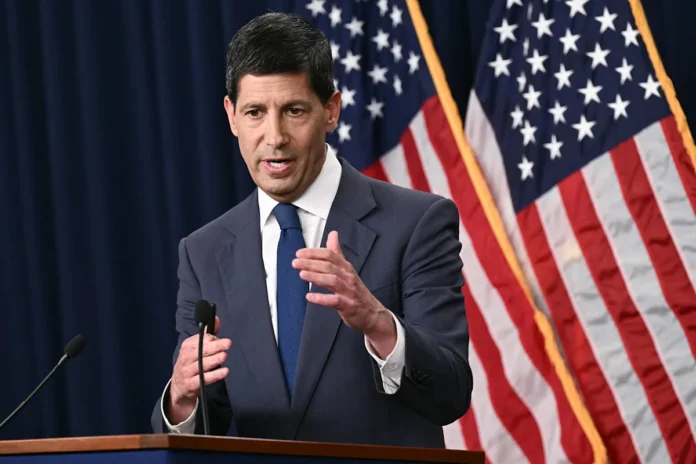
Kevin Warsh insisted the Fed will still be able to lower inflation to its 2% target — a measure it has missed for five years — but didn’t say how.
He also wants U.S. households, businesses and investors to continue to be patient with the central bank.
Meanwhile, markets stumbled after the Federal Open Market Committee voted 9-3 to hold benchmark short-term interest rates steady on July 29.
The 30-year Treasury yield hit 5.2% and the Dow closed down 1,153.18 points (or -2.19%) signaling Wall Street‘s concern that the new Fed chair’s approach won’t be able to beat back inflation much longer thus leading to even higher rate hikes.
Cetera Financial Group Chief Investment Officer Gene Goldman said that the market was not “shrugging off” the hold.
“It’s a market betting a hike is coming sooner. September, right after Jackson Hole and with a new dot plot in hand, is shaping up to be the meeting that matters,” Goldman told TheStreet in an email.
Warsh is choosing flexibility over clear guidance offered by past Fed chairs on purpose, Goldman said.
“He wants the debate out in the open instead of settled behind closed doors. That means more ups and downs around every Fed decision this year, since the market doesn’t get a clear heads-up anymore on what’s next,” Goldman said.
TradeStation Global Head of Market Strategy David Russell said the Iran War and the recent resumption of military escalation is key to what the Fed’s next move will be.
“Hikes are coming into focus as inflation runs ahead of the Fed’s target. Policymakers are getting more hawkish and putting September into play for a tightening move,” Russell said.
“It all comes down to energy. Given the situation in the Middle East, oil prices are in the driver’s seat and the Fed is going along for the ride,” he told TheStreet in an email.
Warsh doubles down on reducing inflation risk
Warsh repeated his pledge that the Fed is committed to bring inflation down to the 2% target. He was also repeatedly mum on how that would be achieved.
“For some households, businesses and market professionals, five years of high inflation have left a mistaken impression-that’s hard to shake — that the Fed’s implicit inflation target was somehow above 2%,” Warsh told reporters.
“Let me reiterate: There is no soft inflation target,” he added. “There is no soft implicit target, not on this committee’s watch.”
He emphasized that the two-day meeting was ripe with active and robust efforts from all 12 participants to create a valuable outlook for monetary policy and referred frequently to the five task forces he commissioned to study and recommend reforms.
“There was nothing inertial about our discussions, our policy or our strategy,” he said.
Warsh’s mission: To kill inflation
TheStreet Pro veteran portfolio trader James “Rev Shark” DePorre said that while Warsh has gained “the respect of many folks on Wall Street, he has a tough job.”
“He has changed the entire dialogue of the Fed and it isn’t just a matter of being hawkish or dovish,” DePorre said. “His mission is to kill inflation and he is moving in that direction in a methodical and sober way, but he can’t do that without some pain.’‘
The post-meeting statement was a terse five paragraphs that described the economic activity as “expanding at a solid pace despite elevated uncertainty that owes, in part, to the conflict in the Middle East.” It cited the energy shocks that have driven up prices in some sectors.
Fed’s mandate balances jobs and prices
The Fed’s congressional dual mandate requires full employment and price stability.
Here’s the tricky part:
Lower interest rates support hiring but can fuel inflation. This risks fueling further inflation, potentially leading to an inflationary spiral.
Higher rates cool prices but can weaken the job market. This increases the cost of borrowing and further stifles economic activity.
Fed holds interest rates steady thus far this year
The rate-setting FOMC voted unanimously in June to hold its benchmark Federal Funds Rate target in a range of 3.5% to 3.75%.
But, as I reported, the minutes of the June FOMC meeting showed policymakers splitting their views on inflation risk and the impact on interest rates with a rising hawkish tinge to the quarterly dot plot.
The three Fed presidents who voted for a 25 basis-point hike in July — Cleveland’s Beth Hammack, Minneapolis’ Neel Kashkari and Lorie Logan of Dallas — expressed concerns about the impact of underlying inflation after the June meeting based in part on comments and observations from consumers and businesses in their regions.
“A hawkish hold does not close the door on potential rate hikes as soon as September, but it offered some near-term relief to both equities and fixed income amid elevated uncertainty about the Fed’s path forward,” Edward Jones’ Angelo Kourkafas told The New York Times. “The three dissents were not surprising, though they may signal the direction of travel if geopolitical tensions persist.”
Traders reset Fed interest-rate bets
Policymakers had cut rates by 25 basis points at its last three meetings of 2025 to shore up the softening labor market.
These “insurance” cuts stopped after the majority of policymakers decided the risk from higher prices was outweighing signs that the jobs market was stabilizing.
September Shift: Traders now price in a 67.9% chance of at least one 25 basis-point rate hike from the current 3.50%-3.75% level during the Sept. 15-16 FOMC meeting, according to the CME Group FedWatch Tool. “There will be a lot of data in the interim, but with oil prices spiking back up and the Iran situation still a mess, inflationary pressures are not coming down,” DePorre said.
December Tightening: By the end of the year, the CME Group FedWatch Tool leans heavily toward a 45.8% probability of at least a 50-basis-point hike with a 36.5% probability specifically for a 4.00%–4.25% target range.
Can the Fed afford to wait out inflation?
The economic shocks of the past two years aren’t discrete events the Fed can wait out, Daleep Singh, a former New York Fed executive told The Wall Street Journal.
Singh, who is now chief global economist at PGIM, said the Fed should stop counting on inflation to drift lower on its own, and that hiring strong enough to keep unemployment from rising gives it an unusual opening to tighten without the job losses that usually follow.
The longer it waits, Singh said, the higher rates would eventually have to rise.
President Donald Trump repeated his call for interest-rate cuts after the FOMC meeting, stating that the United States “should have the lowest rates in the world.”
Trump, who called Warsh a “brilliant guy,” blamed other members of the FOMC for failing to drastically reduce interest rates.
The president said Warsh would prefer to lower rates but described the FOMC as a “political board” with some members who “want to keep rates up.”
How the Fed impacts your wallet, mortgage
The Federal Funds Rate is the interest rate at which banks lend balances at the Federal Reserve to other banks overnight.
A change in the funds rate triggers moves in short-term borrowing costs ranging from credit cards, auto loans, student loans and home-equity loans. The funds rate also impacts interest on savings accounts and CDs.
Mortgage rates are a different animal.
Chip Hughey, Managing Director of Fixed Income at Truist Advisory Services, told TheStreet in an email that Fed rate decisions can have knock-on effects for longer-term rates, too.
“The Fed’s decision to forego a rate hike today is recalibrating inflation outlooks higher, which also fuels higher long-term interest rates,” Hughey said. “As a result, 30-year fixed mortgage rates are likely to rise further this week and remain elevated until global inflation concerns ease on a persistent and sustainable basis.”
But he added that the sluggish housing market is being hampered more by home prices than mortgage rates and that a “housing supply/demand imbalance has driven home prices up approximately 40-50% since 2020, which has had a far greater impact on affordability.”
The Artificial Superintelligence Alliance [FET] token rallied by 4.54% in the past 24 hours, but was still down 6.52% over the past week. FET’s rebound coincided with Bitcoin’s recovery following the Federal Reserve’s interest-rate decision.
FET’s rebound coincided with Bitcoin’s recovery following the Federal Reserve’s interest-rate decision.
The sentiment in the altcoin market remained largely pessimistic. The total altcoin market cap, excluding Ethereum [ETH], was up 1.48% over 20 hours but has trended lower since the first week of July.
Against this backdrop, any large-cap altcoin outperforming the broader market is likely to attract increased speculative interest.
Can such a surge help set the altcoin up for an uptrend?
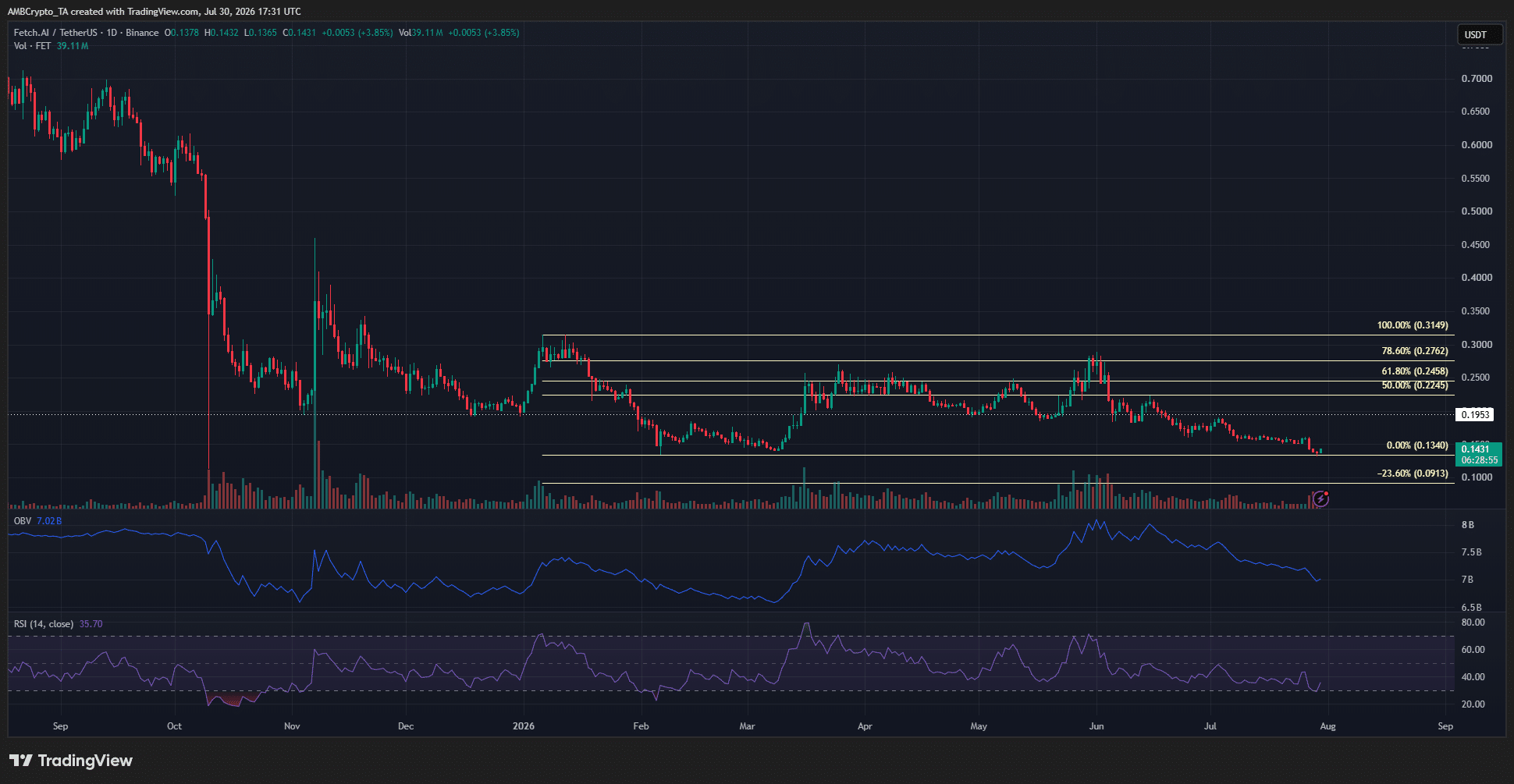
FET crypto tests February crash demand zone once more
Source: FET/USDT on TradingView
The $0.195 support level had been respected towards the end of 2025, but was eventually breached. The strong selling pressure on FET crypto and across the market in late January-early February saw the altcoin post a local low at $0.134.
After months of perseverance, the bulls managed to drive a rally up to $0.276. While it was just over 115% above the February low, it was still within the bearish swing structure.
This structure is captured by the Fibonacci retracement levels [yellow]. A rejection from the 78.6% level resulted in strong selling in June.
The OBV has been steadily falling over the past two months, and the RSI was also consistently below neutral 50. Together, they showed more losses are likely for the altcoin.
Traders’ call to action- Sell the bounce
Source: FET/USDT on TradingView
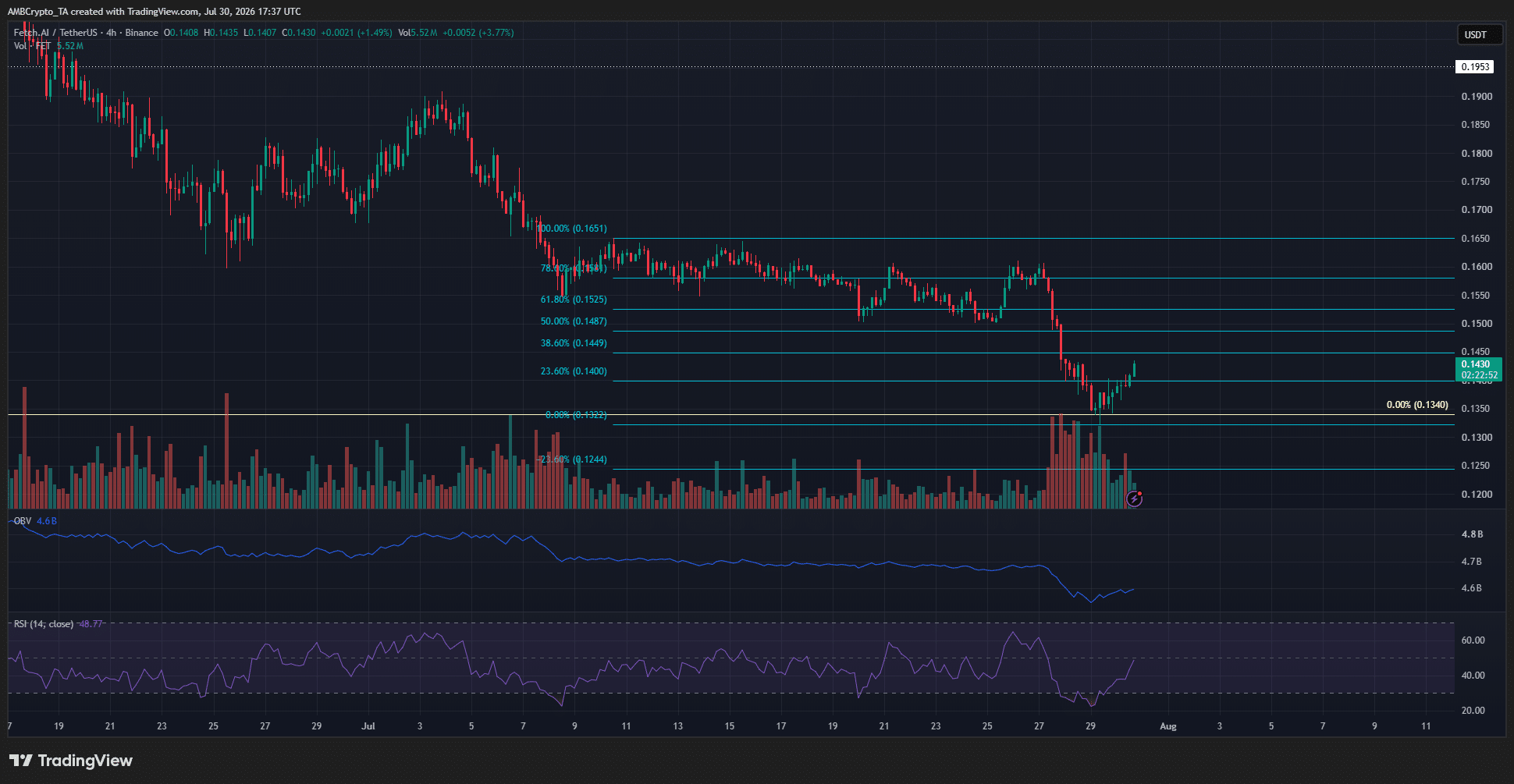
The 4-hour structure was bearish, but the recent gains come as part of the dead cat bounce from the $0.134 low. The H4 RSI was at 48.7 and could climb higher, but the OBV has been steadily falling.
A bounce up to $0.149-$0.158 would likely offer a selling opportunity. This short-term bearish bias would be broken by a rally beyond $0.165, but even if buyers reclaim higher levels, the broader trend remains bearish until key resistance is broken.
Final Summary
The FET crypto rally of 4.54% in the past 24 hours was a sign of relative strength against the rest of the market.
Despite the short-term gains, a FET bounce toward $0.149-$0.158 would likely be a selling opportunity for swing traders.
Strategy (MSTR), the world’s largest corporate bitcoin BTC$64,779.11 holder, reported Thursday an $8.2 billion second-quarter net loss after the cryptocurrency’s price decline erased billions of dollars from the value of its digital asset holdings.
The quarterly loss was driven almost entirely by an $8.32 billion unrealized markdown on its bitcoin holdings under fair-value accounting.
The company held 843,775 bitcoin as of July 26, up 25% from the start of the year. At current prices, the stash is worth roughly $54.8 billion, compared with an acquisition cost of $63.7 billion.
The report came after a period of growing investor scrutiny on the firm over whether it can sustain an increasingly complex capital structure built around multiple classes of preferred stock, common equity and convertible debt.
The company raised $17.06 billion through at-the-market stock offerings this year, repurchased $1.5 billion of convertible notes at an 8% discount and expanded its U.S. dollar reserve to $3.75 billion, enough to cover more than two years of preferred dividend payments and interest expenses.
Gold (GC=F) August futures opened at $4,060.70 per troy ounce on Thursday, July 30, 2026, up 0.6% from Wednesday’s closing price. The price of gold moved up significantly this morning, trading at $4,130.90 as of 8:33 a.m. ET.
The Fed held rates steady following its two-day rate-setting meeting yesterday, and gold prices have responded positively so far. It has been about two weeks since gold prices have consistently held in the $4,100 range, with ever-changing market conditions providing little consistency to firming gold-price trends.
While the Fed didn’t raise rates, comments by Fed Chair Warsh following the meeting did certainly reiterate the committee’s commitment to lower prices.
The Fed’s decision comes amid continued fighting between the U.S., Iran, and their respective allies. The push and pull between safe-haven appeal and headwinds from concerns over higher interest rates later this year keep gold prices bound within a narrow range, which should only continue as these conditions persist.
The opening price of gold futures on Thursday, July 30, 2026, was up 0.6% from Wednesday’s close. Here’s a look at how the opening gold price has changed versus last week, month, and year:
One week ago: -1.7%
One month ago: +1.5%
One year ago: +22.1%
For context, gold’s year-over-year growth was 95.6% on Jan. 29.
Want to learn more about the current top-performing companies in the gold industry? Explore a list of the top-performing companies in the gold industry using the Yahoo Finance Screener. You can create your own screeners with over 150 different screening criteria.
Gold IRA: What it is, how it works
If you are socking gold bars away for a rainy day, there may be an opportunity to earn some tax perks in the process. You could establish a gold IRA to hold those assets and diversify your retirement wealth.
A gold IRA is a specialty form of self-directed IRA that’s designed for gold and other precious metals.
Gold IRA vs. traditional IRA
The table below compares the main features of standard IRAs and gold IRAs.
IRS restrictions
You must work with a specialty provider that can ensure your account complies with these IRS restrictions:
Storage: Your gold must be held in an IRS-approved facility.
Asset types: A gold IRA can hold physical gold, silver, platinum, or palladium — but not all forms of these metals are eligible. For example, gold bullion, silver coins, and bars must meet purity requirements. Additionally, gold bars must come from approved refiners.
Whether you’re tracking the price of gold since last month or last year, the price of gold chart below shows the precious metal’s value journey so far this year.
How is human knowledge of reality possible, and what are its limits?
getty
Near the turn of the 19th century, Immanuel Kant became obsessed with discovering the synthesis of human knowledge, resulting in his three masterpieces of the human psyche: Critique of Pure Reason (1781, 1787), Critique of Practical Reason (1788), and the Critique of the Power of Judgement (1790).
His question: How is human knowledge of reality possible, and what are its limits?
As Kant dove deeper into the subject, it became increasingly more complex. He argued that we never experience the world exactly as it is in itself. Instead, our minds act like a built-in filter, processing raw reality through human frameworks like space and time, cause and effect. This revelation led to some of philosophy’s most enduring questions: Is reality isolated from our human knowledge? If so, can we live a happy life knowing this?
Philosophers across millennia offered different answers. Socrates argued that an unexamined life is not worth living. Marcus Aurelius taught that happiness comes from mastering our own judgments. Kant ultimately decided that the role of reason was to shape our understanding of reality to guide our actions.
Today, more than two centuries later, understanding reason may come down to three questions: What is reality? What do we know about it? And how do we interpret and value it?
Reality
Reality is what surrounds us, independent of us or our own thoughts. We’re subject to the weather, to large-scale global events, even traffic. Despite how much we may despise or love it, there’s not much we can do about the Earth’s rotational speed.
In the same way, we cannot control the thoughts and actions of the person on the subway next to us, our colleagues’, or our children’s. In turn, their reasoning impacts other people’s experiences. They all become part of the fabric of reality, actively defining their own life and the lives of others.
Understanding nature is identifying those patterns and regularities, all created independently of our experiences. We can trust that the sun will rise tomorrow. We can estimate how much breakfast we can make from the four eggs left in the refrigerator. We can expect when the train will arrive for our morning commute. Our world is, if not entirely definable, at least somewhat predictable.
Over time, that predictability becomes the basis by which we construct a framework for understanding life. What works and what doesn’t? How can we alter reality with our experiences, and what remains independent of our influence?
Understanding Truth
Knowledge grows because of questions like those. Our basis for understanding revolves around answering questions.
Consider the last time your car made a thumping sound when you started it in the summer. You might analyze the situation by asking questions like, “Where is the noise coming from?” or “When did the noise start?” From there, you’d narrow down possible explanations for the noise. When you take it to the shop, or you look under the hood, your answered question gets logged into your understanding of reality.
But there is a limited number of answers we can get for every question. From a limited perspective, we can always find truth. Truth can correlate perfectly with reality, but only within a limited scope. If that scope expands—if we hear that same noise from a car during winter instead—our understanding of reality may change. We can’t always apply the same logic in summer as in winter, because the underlying cause may be different.
Observation alone has limitations. Every time we ask questions, we get closer to the truth, but we can never arrive at complete truth when the scope is limitless. Experience becomes the key to understanding not only what we can control, but what an appropriate reaction to it should be. As a consequence, we see things through a filtered lens. We attempt to understand truth through a flawed perspective, since no perspective is completely unbiased.
It’s impossible to fully detach ourselves from personal experiences when seeking the truth. But, within a limited scope, we can approach truth. Every time we ask “why,” we’re pushing the boundaries of our observations. We find truth when our observations strongly correlate with reality under a given scope.
Defining Axioms
Given enough experience, we begin to associate questions with familiar answers.
Every answer to a question can be followed by another question, “why”; however, we cannot live forever seeking answers endlessly. At some point, every chain of explanations arrives at assumptions we already understand, accept, or regard as self-evidently true. These become our axioms, the foundational principles upon which further reasoning is built.
Many common life lessons emerge from this process. Murphy’s Law—whatever can go wrong will go wrong—is a familiar axiom for some people because they may have repeatedly observed situations that appear to confirm it. The axiom becomes a good enough interpretation of their experiences that most people stop asking why after a series of unhappy events.
Over time, these axioms become the basis for judgment. The patterns we repeatedly observe and accept form the foundation from which we evaluate new situations and make decisions.
Mapping the Territory
How do you put all that together? That’s the secret, isn’t it?
My years exploring physics have led me to see structure in life. Whether we are studying nature or navigating daily life, understanding often depends on identifying the relationships that remain invariant beneath changing appearances.
Consider a map. A subway map looks very different from a road map. A road map highlights one-way streets, speed limits, and routes. A subway map includes stations, connections, and transfer points. While you may find your desired destination from either, neither reproduces the territory exactly.
Yet both remain useful because they preserve the relevant structure of the territory for a specific purpose.
The same principle applies to life.
First, we identify what exists independently of us, the patterns, regularities, and constraints that form the foundation of reality.
Second, we seek to understand those structures as accurately as possible. We refine our understanding through observations, experiences, and questioning.
Finally, we map the structures for the purpose of achieving our goals, according to our values and aspirations.
The purpose of life is not merely to collect facts. It is more about experiencing what we desire to experience, or simply, becoming who we want to be. To achieve this, we need to discover the structures that govern reality, build a framework that helps us navigate it successfully, and incorporate what matters most to us along the way.
Life is truly what you make it!
Discovering Your Foundations
Of course, this is only the beginning.
Any framework for understanding life contains an enormous number of possibilities. The challenge is finding the path that leads to your fulfillment.
Some of the world’s biggest banks have completed real cross-border payments using tokenized money in a test led by the Bank for International Settlements (BIS), another sign that tokenization is moving into the plumbing of global finance.
Project Agorá, which brings together five central banks and 28 commercial lenders including JPMorgan, Citi, UBS, Deutsche Bank and Standard Chartered, processed roughly $1 million (CHF 800,000) in real-value transactions across six currencies — the U.S. dollar, euro, British pound, Japanese yen, Swiss franc and South Korean won.
The pilot used tokenized central bank reserves and commercial bank deposits to settle corporate, interbank payments perand foreign exchange settlements. The payments settled in an average of about 80 seconds, even though the prototype was not directly integrated with banks’ existing payment infrastructure, the BIS report said.
The project fits into a broader shift as stablecoins and tokenized assets gain traction across global finance. Asset managers have begun issuing tokenized money market and private credit funds, while stablecoins are increasingly being used for cross-border payments and corporate treasury operations.
A new model for cross-border payments
Project Agorá explores whether the same technology can modernize the infrastructure banks use to move money internationally.
Silver (SI=F) September futures opened at $57.97 per ounce on Thursday, July 30, 2026, down 0.2% from Wednesday’s closing price. Silver prices moved higher this morning, reaching $58.24 as of 8:56 a.m. ET.
Silver prices struggle to reclaim the $60 per ounce benchmark, even after the Fed decided to leave rates unchanged yesterday. Silver prices haven’t opened above $60 since July 8.
With military actions only escalating in the Middle East, the prospect of higher interest rates later this year still in place, and waning industrial demand, the chances silver prices will break out above the $60 mark and stay there seem increasingly unlikely, at least in the short term.
The opening price of silver futures on Thursday, July 30, 2026, was 0.2% lower compared to Wednesday’s closing price. Here’s how today’s opening silver price has changed versus last week, month, and year:
One week ago: -1.2%
One month ago: -0.6%
One year ago: +51.9%
For context, silver’s year-over-year growth was 173.3% on May 14.
Want to learn more about the current top-performing companies in the silver industry? Explore a list of the top-performing companies in the silver industry using the Yahoo Finance Screener. You can create your own screeners with over 150 different screening criteria.
Looking for a gold alternative? How to invest in silver, platinum, and palladium.
Precious metals are in high demand. Although gold has historically been the headlining investment metal, silver, platinum, and palladium are quickly becoming popular portfolio diversifiers. Here are three easy, action-oriented steps to help you start investing in these precious metals:
Whether you’re tracking the price of silver since last month or last year, the price-of-silver chart below shows the precious metal’s value journey so far this year.