Home Blog Page 143

Silver prices today, Thursday, July 30, 2026: Silver prices remain below $60, even without a rate increase

0
Silver prices today, Thursday, July 2: Prices crest $62 following soft June employment report


Silver (SI=F) September futures opened at $57.97 per ounce on Thursday, July 30, 2026, down 0.2% from Wednesday’s closing price. Silver prices moved higher this morning, reaching $58.24 as of 8:56 a.m. ET.

Silver prices struggle to reclaim the $60 per ounce benchmark, even after the Fed decided to leave rates unchanged yesterday. Silver prices haven’t opened above $60 since July 8.

With military actions only escalating in the Middle East, the prospect of higher interest rates later this year still in place, and waning industrial demand, the chances silver prices will break out above the $60 mark and stay there seem increasingly unlikely, at least in the short term.

Watch for more: Fed’s Warsh: ‘Path to central bank heaven requires delivering’ on inflation

The opening price of silver futures on Thursday, July 30, 2026, was 0.2% lower compared to Wednesday’s closing price. Here’s how today’s opening silver price has changed versus last week, month, and year:

  • One week ago: -1.2%

  • One month ago: -0.6%

  • One year ago: +51.9%

For context, silver’s year-over-year growth was 173.3% on May 14.

24/7 silver price tracking: Don’t forget you can monitor the current price of silver on Yahoo Finance 24 hours a day, seven days a week.

Want to learn more about the current top-performing companies in the silver industry? Explore a list of the top-performing companies in the silver industry using the Yahoo Finance Screener. You can create your own screeners with over 150 different screening criteria.

Precious metals are in high demand. Although gold has historically been the headlining investment metal, silver, platinum, and palladium are quickly becoming popular portfolio diversifiers. Here are three easy, action-oriented steps to help you start investing in these precious metals:

1. Learn the risks, growth drivers, and purposes

2. Understand the ownership options

3. Define your goal and allocation

Keep reading to learn more: How to invest in silver, platinum, and palladium

Whether you’re tracking the price of silver since last month or last year, the price-of-silver chart below shows the precious metal’s value journey so far this year. 

More silver coverage from the Yahoo Finance team: 


Source link

Fidelity Bitcoin ETF posts $43.1 million in outflows as Bitcoin indicator signals increased local stress

0
Fidelity Bitcoin ETF posts $43.1 million in outflows as Bitcoin indicator signals increased local stress


Bitcoin [BTC] was trading around the $64.6k mark on Thursday, July 30. The US Federal Reserve announced its decision to keep interest rates unchanged at 3.50%-3.75% on Wednesday, July 29.

Energy-related supply disruptions have kept inflation rates elevated above the target 2%, but economic activity was expanding at a solid pace, and operational interest rates were left unchanged.

Bitcoin did not see a big short-term reaction to the Fed’s hawkish stance. The short-term price structure remained bearish. The ETF flows gave their own signals, too.

Fidelity Bitcoin ETF posts $43 million outflow

Farside Bitcoin spot ETF Flows
Source: Farside Investors

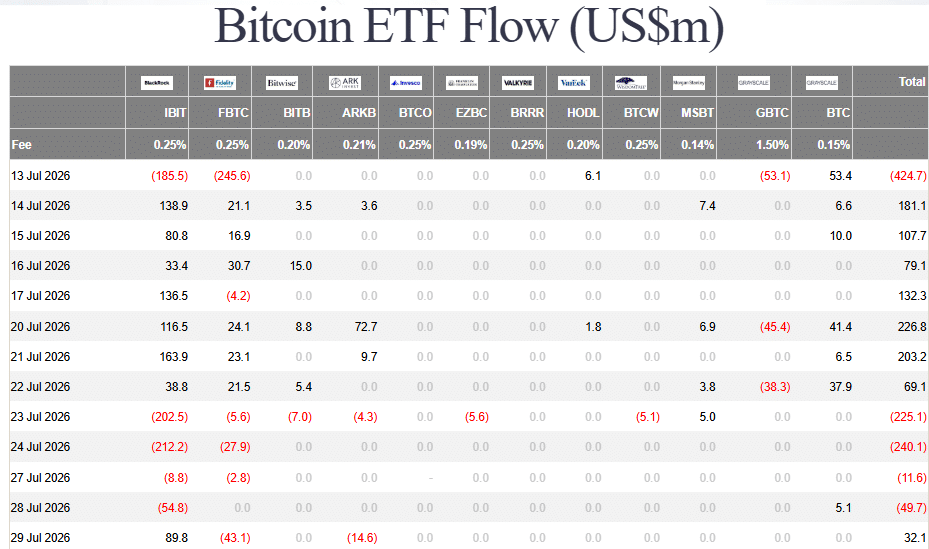
A 7-day streak of Bitcoin spot ETF inflows was broken on July 23. Thereafter, four days of net outflows saw $526.5 million shed.

On July 29, the day of the rate decision from the Federal Reserve, BlackRock’s IBIT attracted $89.8 million, compared to Fidelity Bitcoin ETF’s $43.1 million outflows.

The recent ETF outflows have been interpreted by some analysts as temporary de-risking ahead of the Fed decision. Looking forward, the rate decision in September has a higher chance of a rate hike, according to the FedWatch Tool.

Indicators pick up Bitcoin local stress driven solely by price movement

Bitcoin Local Market Stress IndexBitcoin Local Market Stress Index
Source: Axel Adler Jr.

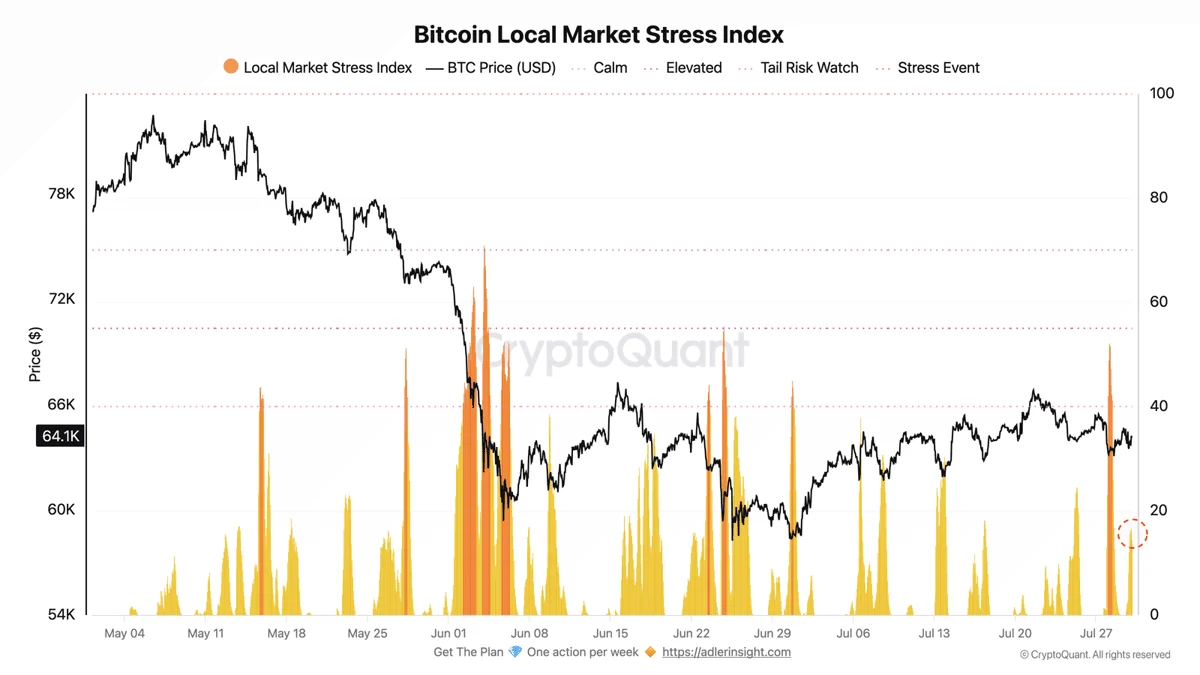
The stress indicator captures local stress. Components include derivatives, exchange flows, and the price movement itself. Crypto analyst Axel Adler Jr. observed that there were two spikes in the past three days.

The one on the 28th reached a score of 52, or elevated risk.

Bitcoin Stress DriversBitcoin Stress Drivers
Source: Axel Adler Jr.

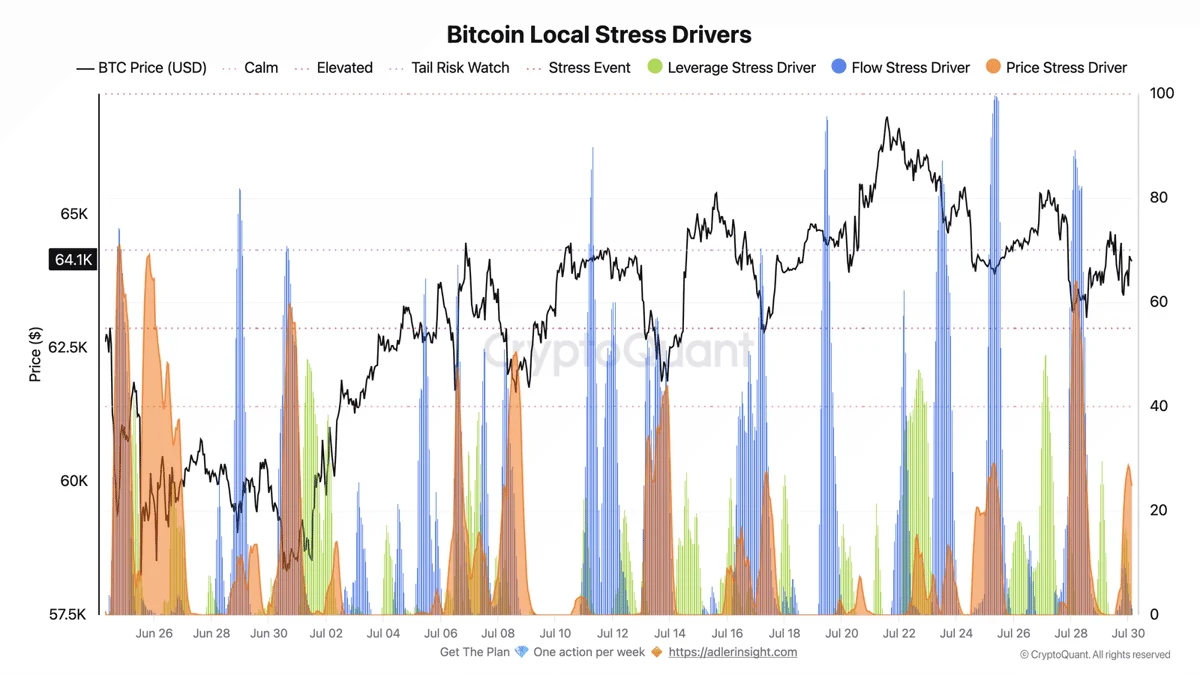
It was a combination of exchange flows and price movement that led to elevated market stress before the rate decision. Generally, the uptick in stress in late July has not been accompanied by high price, flow, and derivatives stress drivers.

The recent behavior from these components was much different to the early June sell-off. If we see increased local stress, combined with high exchange flows and a large derivatives swing, it could be worrisome for traders and investors.


Final Summary

  • The Fidelity Bitcoin ETF saw a $43.1 million outflow on Wednesday, July 29, while BlackRock’s IBIT posted $89.8 million in inflows.
  • The Bitcoin local stress indicator saw elevated price stress, but none from flow and derivatives components, explaining why the stress levels were still in “Calm” territory.


Source link

Ondo Finance explores deal valued at up to $500 million

0
Ondo Finance explores deal valued at up to $500 million

Tokenized asset specialist Ondo Finance is evaluating a potential acquisition of between $250 million and $500 million, according to a person with knowledge of the matter.

The New York-based company is considering wealthtech targets, among other subsectors, said the person, who spoke on condition of anonymity because the matter is private.

Ondo has not yet appointed any formal advisers, the person said.

Founded in 2021 by former Goldman Sachs executives, Ondo Finance is a tokenization platform that brings traditional financial assets onchain. The company issues tokenized U.S. Treasuries and stocks and has become one of the largest providers of tokenized real-world assets, with more than $2.5 billion across its products.

“As a fast-growing company, Ondo regularly evaluates the market as part of normal business operations. We are not in conversations with any party at this time,” an Ondo representative said in emailed comments to CoinDesk.

Crypto dealmaking has remained strong in 2026 as traditional financial firms and larger digital-asset companies use acquisitions to add licenses, technology and distribution.


Source link

Worldline cuts revenue growth forecast as bank contract delays slow recovery

0
Worldline cuts revenue growth forecast as bank contract delays slow recovery


By Gianluca Lo Nostro

July 30 (Reuters) – French digital payments group Worldline lowered its 2026 revenue growth expectations on Thursday, saying a recovery in ‌new business had taken longer than expected as banks delayed awarding contracts ‌following the company’s recent setbacks.

Worldline now expects flat to marginally positive revenue growth in 2026, compared with ​its previous forecast for low single-digit growth.

Second-quarter revenue was flat year-on-year after seven consecutive quarters of contraction.

Chief Executive Pierre-Antoine Vacheron said the recovery in commercial activity and revenue recognition had been slower than anticipated because some banking clients took longer to commit ‌to new business with the ⁠company.

“For one very simple reason, which is that there have been delays in the decision of the banks to allocate new ⁠contracts to Worldline because of what we’ve been going through in 2025, which led the banks to question,” Vacheron told reporters.

He said Worldline was now emerging from that phase ​and expected ​the second half to be “a bit better” ​than the first, helped by ‌continued momentum in its merchant services business.

The company has not delivered organic revenue growth since late 2024 after setbacks including allegations of money laundering and a series of profit warnings triggered significant customer losses and a slump in its share price.

Backed by major shareholders Credit Agricole, BNP Paribas and French state investment bank Bpifrance, Worldline ‌has been trying to rebuild investor confidence following ​a 500 million euro ($576 million) capital injection and ​asset disposals.

Revenue in the six ​months to June fell 0.2% to 1.74 billion euros, broadly in ‌line with analysts’ expectations of 1.72 ​billion euros in a ​company-compiled poll.

Adjusted EBITDA reached 294 million euros, ahead of analysts’ average estimate of 273 million euros.

Worldline confirmed its full-year EBITDA outlook and improved its ​free cash flow target to ‌a negative range of 60 million euros to 40 million euros, from ​a previous negative range of 80 million euros to 70 million ​euros.

($1 = 0.8681 euros)

(Reporting by Gianluca Lo Nostro)


Source link

Australia targets Telegram one day after Russia charges Durov

0
Australia targets Telegram one day after Russia charges Durov


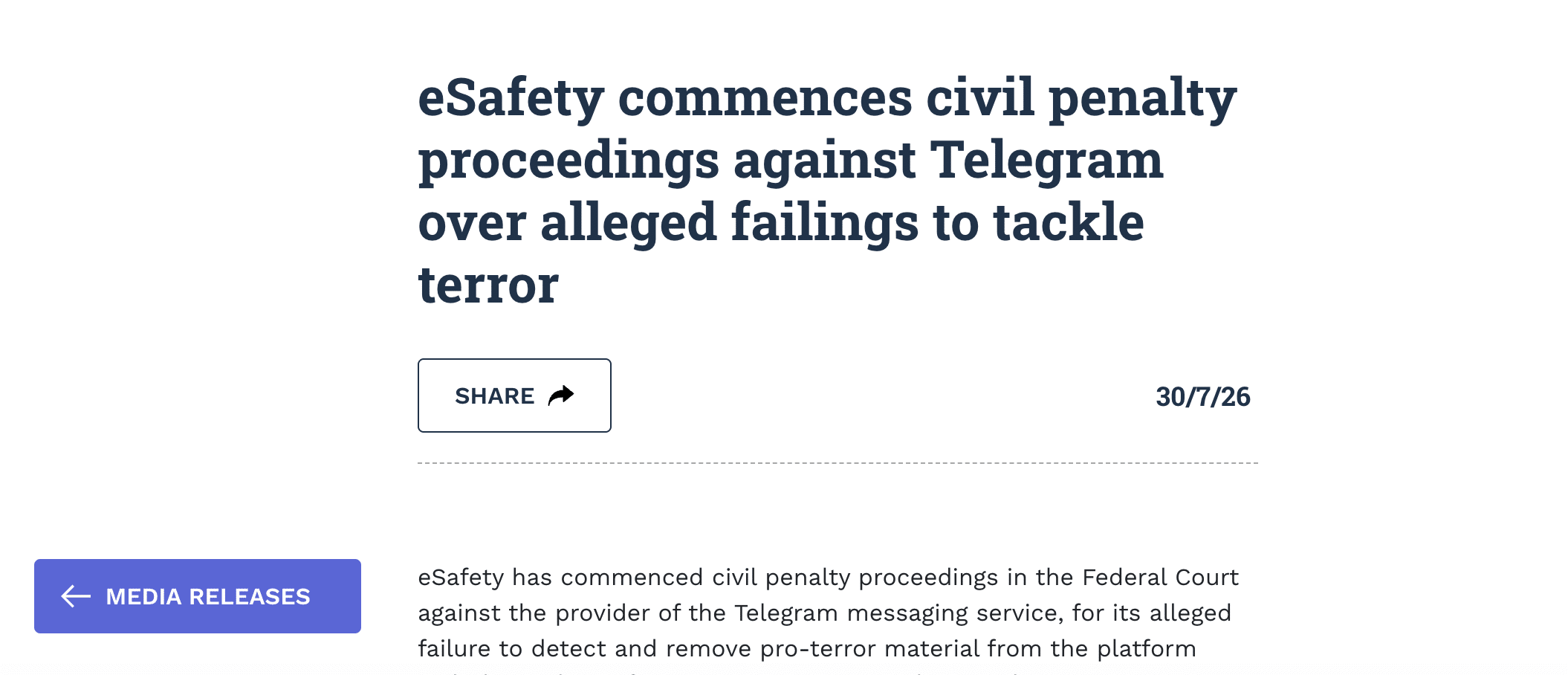
Telegram is facing the heat! Australia’s eSafety Commissioner has launched civil penalty proceedings against Telegram in the Federal Court, over claims that it failed to remove terrorism-linked content.

Interestingly, this comes just a day after Russia accused founder Pavel Durov with aiding terrorism as well.

Australia takes Telegram to court over alleged pro-terror content

Australia’s eSafety Commissioner launched civil penalty proceedings against Telegram in Federal Court on Thursday. The platform is accused of failing to act on reports of pro-terror content.

Source: esafety.gov

The regulator said its year-long investigation found that some flagged material remained online, for up to three weeks. It stated that Telegram failed to remove accounts, groups and channels that share such content or detect known extremist footage.

If found to have breached the Online Safety Act, Telegram could face penalties of up to AUD 54.6 million [$35.8 million].

The company has not formally responded. However, a cheeky X post is making the rounds.

telegramtelegram
Source: Telegram Messenger/X

Russia charged Durov over Telegram’s alleged terrorist activity

AMBCrypto previously reported that Russia’s Federal Security Service had accused Telegram founder Pavel Durov of helping facilitate terrorist activity. The FSB says it has formally charged him, and says an international arrest warrant has been issued.

Russian officials claim Telegram failed to remove channels, group chats, and bots allegedly used by Ukrainian intelligence, terrorist groups, and extremist organizations. They say these tools supported attack planning, recruitment, and cyber fraud.

Durov is also being investigated in France over claims that Telegram enabled illegal activity.

GRAM not greatly affected?

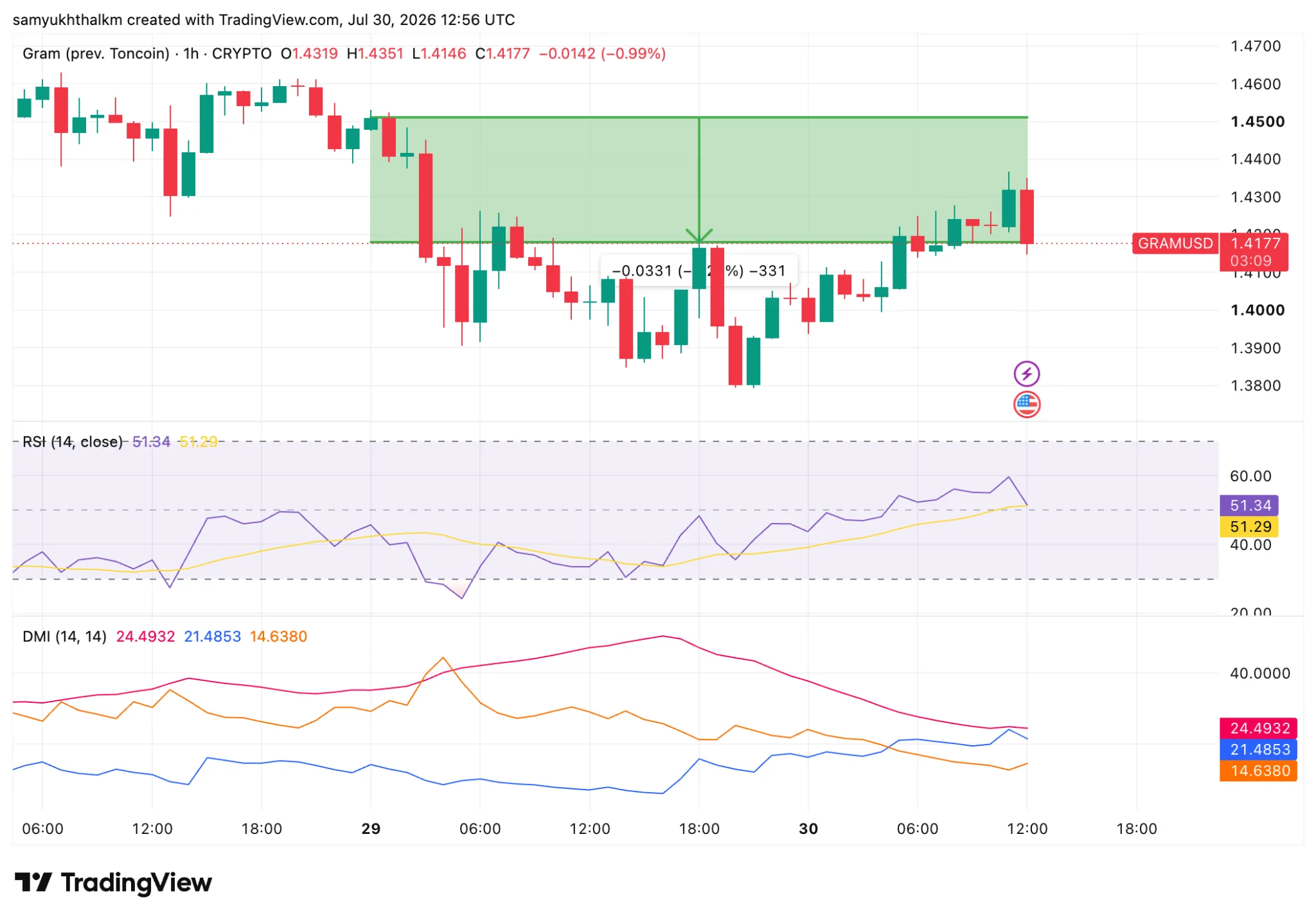
With legal pressure building around Telegram and Durov, native token GRAM’s response has been relatively controlled. However, traders still seem to be taking a few steps back.

telegramtelegram
Source: TradingView

On the 1h chart, GRAM traded near $1.42 after falling about 2.3% at press time. Its RSI was at 51.34, so pace is neutral.

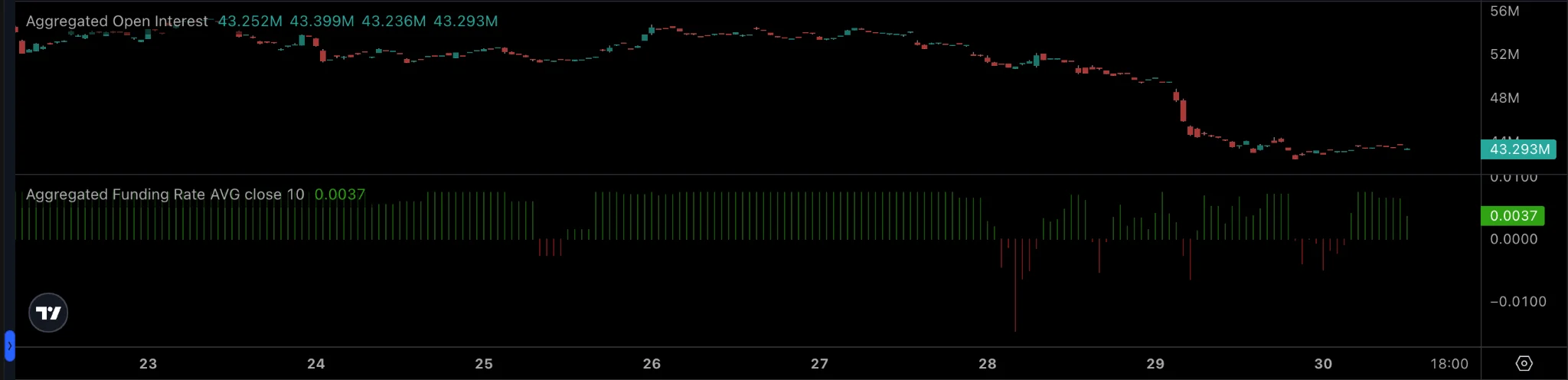
The bigger change, however, was in the derivatives market. Aggregated Open Interest fell greatly to about $43.3 million; traders may be closing positions during the uncertainty.

GRAM open interestGRAM open interest
Source: Coinalyze

Funding was positive at 0.0037%, so there’s a mild preference for long positions. If legal developments continue to escalate, GRAM could face additional selling pressure.


Final Summary

  • Australia has launched civil penalty proceedings against Telegram a day after Russia escalated its criminal case against founder Pavel Durov.
  • GRAM remained relatively stable near $1.42, although declining Open Interest suggests traders are reducing exposure while legal uncertainty persists.


Source link

There is a hidden tax risk of crypto perps that no one is talking about, says CME’s CEO

0
There is a hidden tax risk of crypto perps that no one is talking about, says CME's CEO

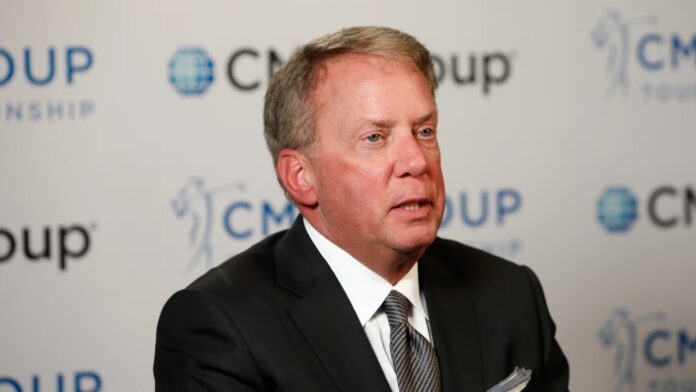
U.S. approval of perpetual futures contracts could expose traders to unexpected tax and regulatory uncertainty if the products are ultimately determined to be swaps rather than futures, an issue that has received little public attention, according to CME Group Chairman and CEO Terry Duffy.

“There’s a consequence that nobody’s talking about,” Duffy said in an interview with CoinDesk. “There’s ambiguity right there, from a tax perspective, for all U.S. participants now.”

The comments come as CME continues its legal challenge against the Commodity Futures Trading Commission (CFTC) over the regulator’s approval of perpetual futures contracts in the U.S. Both sides await a federal court decision, and the outcome could significantly influence how the U.S. approaches the rapidly growing arena of perpetual futures. One consequence, according to Duffy, is how the Internal Revenue Service (IRS) ultimately taxes these contracts.

The dispute stems from whether perpetual futures should legally be treated as futures or swaps.

Duffy said that perps should fall under the legal definition of swaps, instead of how the CFTC categorizes them as futures, because of the periodic funding payments exchanged between long and short positions.

Unlike traditional futures, perpetual contracts never expire. Instead, traders periodically exchange funding payments intended to keep the derivative’s price close to that of the underlying asset. Duffy argued that those recurring payment exchanges satisfy the statutory definition of a swap under U.S. law.

“When two parties exchange payments to each other, that is deemed a swap,” he said, referring to the funding-rate mechanism used by perpetual contracts.

What Duffy sees as the main problem with this mismatched designation is that if perpetual contracts qualify as futures, many institutional traders could receive the blended tax treatment available under Section 1256 of the U.S. tax code. Under this, gains and losses are generally treated as 60% long-term and 40% short-term capital gains. If those contracts fall under swaps, they will be taxed under “ordinary” taxation. Given that the perps are newer innovations, the IRS has not issued guidance specifically addressing the tax treatment of perpetual futures.

So if the regulators or courts ultimately conclude that perpetual contracts are swaps rather than futures, market participants who have been treating them as futures for tax purposes could face uncertainty about how to report those positions to the IRS.

“So if you file your tax return and this ruling comes back, where these products that you’ve been trading and filing government tax returns as 1256 contracts [futures], when it should be ordinary, I will be curious what the IRS has to say to you about how much they think you owe them because you didn’t file your tax returns properly,” Duffy said.

‘Substance over form’

Legal experts, however, said that the issue is much more complex than that.

“The challenge here is that textually, by the structure, perpetual futures look a lot like a swap, but economically they perform a lot like futures,” said Rustin Diehl, a tax attorney and counselor at Allegis Law and an Emeritus Fellow at Georgetown Law’s Institute for International Economic Law and professor of business law at Weber State University. “It’s really a substance-over-form question … function versus text.”

Adding to the uncertainty, legal experts say that the definition of swaps is extremely broad.

“Basically, the statutory definition of swaps is so broad as to encompass … anything,” Jason Gottlieb, partner and chair of Morrison Cohen’s digital assets practice, told CoinDesk. He added that the breadth of the statutory language leaves considerable room for interpretation regarding its application to new financial products such as perpetual futures.

What it will come down to is how the court interprets it.

That’s because the Supreme Court’s 2024 Loper Bright decision eliminated the longstanding Chevron doctrine; federal courts now give less deference to agencies’ interpretations of ambiguous statutes, meaning judges could play a larger role in deciding how existing derivatives laws apply to novel crypto products.

Tax evasion?

And it’s likely to be a long, drawn-out process.

“My view is that there’s going to be a lot of litigation about it, and the Supreme Court has told courts that if there is ambiguity in the statute, they can ignore the CFTC and read the statute for themselves,” Gottlieb said.

Also, rather than immediately deciding whether the products should be classified as swaps or futures, a federal judge is likely to first examine whether the regulator reasonably considered public comments and sufficiently explained its decision before approving these contracts, Diehl said.

“I think the judge is going to focus on the Administrative Procedure Act, and kind of look at the question of did the CFTC really exercise independent judgment? Were they thorough? Were they reasoned? Did they express their reasoning?” he said.

Even if the litigation ultimately clarifies whether perpetual contracts are swaps or futures, tax treatment may still require separate guidance from the IRS, which is not obligated to adopt the CFTC’s interpretation of financial instruments, Diehl said.

“I think people are going to want to maybe check with the IRS and see how they should report these,” said Diehl. “They [IRS] generally do agree with the CFTC’s definitions of commodities historically, but there’s been many times when the IRS doesn’t just agree with a taxpayer submitting their tax position based on CFTC rules.”

Until regulators, tax authorities, or the courts provide greater clarity, Duffy said, large institutions could face uncertainty over how to report trades involving perpetual futures.

“How would you like to be running a very large public company that trades a lot and hedges a lot, and all of a sudden you’re in the news for not paying proper taxes,” said Duffy.

Read more: Inside the CME and CFTC’s battle over onchain perpetual futures


Source link

For Two Years, I Was Using AI Wrong. Fixing It Is Why My Clients Are Winning While Other Brands Fall Behind.

0
For Two Years, I Was Using AI Wrong. Fixing It Is Why My Clients Are Winning While Other Brands Fall Behind.


Opinions expressed by Entrepreneur contributors are their own.

Key Takeaways

  • AI does not build a premium personal brand by producing more content — it builds one by sharpening your thinking, deepening your positioning and turning years of expertise into scalable intellectual property.
  • Stop starting from zero every time you open Claude or ChatGPT — build a persistent brand ecosystem the system already knows, then feed it real audience data like transcripts, DMs and reviews so the output reflects what your audience is actually saying.

If you are building a personal brand and are not actively learning how to use AI tools like Claude and ChatGPT, you are leaving real results — and real revenue — on the table.

That might sound blunt, but the market is blunt right now. Increased visibility does not cut it anymore. You have to produce more content, articulate resonant ideas, build stronger positioning and stand out in ways that actually mean something. And it is less about volume than it is about precision.

At my company, D2 Branding, we work with speakers, founders, authors and podcast hosts whose ideas are their business. Their brands encompass a lot: social media, yes, but more broadly, reputation, intellectual property and market influence. Getting AI right has completely changed how we help them scale — but we did not get it right the first time.

How we got it wrong at first

Here is the honest part. Like many businesses, we first approached AI as if it were a productivity shortcut, using it to quickly spit out captions, blogs and emails. Efficient on the surface, sure. But we hit a wall pretty fast when we realized that premium personal brands need sharper thinking, not more content.

Established founders, speakers and industry leaders are not valuable because they post constantly and show up at the top of your Instagram feed. They are valuable because they can communicate clearly what others cannot, with more conviction and more precision.

Once that clicked, our approach changed. Instead of prompting AI with vague tasks like “write a post about leadership,” we started using it to challenge and deepen perspectives. We asked harder questions: Where is this founder’s philosophy being misunderstood? Which parts of their expertise are flying under the radar? What would make this message land harder?

That shift turned AI from a content-producing machine into a genuine thought partner. Now, we use it to hone keynote messaging, test frameworks and shape content that actually resonates.

Stop starting from zero

The second thing we got wrong was not building any real intelligence around the brands themselves. Every time we opened Claude or ChatGPT, we started from scratch — re-explaining the founder’s backstory, positioning, target audience, offers and tone of voice every single time. That approach was inefficient, and worse, it held us back from reaching real strategic depth. When a brand is built on ideas and voice, you cannot operate that way.

So we changed how we work. For every premium personal brand client we take on, we now build a structured ecosystem inside platforms like Claude Projects. Before a single prompt is typed, the system already knows the brand’s foundation — origin story, core philosophies, audience and positioning.

That adjustment turned AI into infrastructure. When a brand has a centralized intelligence system behind it, it can actually scale. Speakers sound aligned whether they are on stage, on a podcast or in copy on their website. Authors expand across channels without becoming scattered. The brand grows without losing what made it take off in the first place.

Take advantage of real data

Our third mistake, and possibly the biggest, was underestimating the power of real-world data. Most businesses are still guessing what their audience wants. They open an AI platform, type in a prompt and hope the response lands with their target audience. Premium brands should take the guesswork out of the equation altogether.

The move that changed our work the most was starting to feed AI actual data. We uploaded podcast transcripts, sales conversations, event recordings, customer questions, comments, DMs and Google reviews. Then we asked AI to show us patterns we might be missing. What emotional triggers keep surfacing? Where are people stuck but struggling to articulate why? Which ideas are resonating but need to be more fully developed?

The answers to those questions build stronger brands. When you use AI to identify the exact language, pain points and desires your audience has already been expressing, your messaging becomes far more effective. You are building an evidence-based strategy that makes people feel genuinely understood.

The AI advantage

This is where AI becomes one of the most valuable tools a personal brand can use. It can take human insight and sharpen it, help create messaging that converts into high-ticket offers, uncover themes that become books or keynote addresses and translate years of lived experience into scalable intellectual property.

We have shifted away from using AI to mindlessly pump out more content. Instead, we use these platforms to clarify thinking and strengthen positioning in crowded markets. AI helps us turn expertise into premium assets.

Do not make the mistake of thinking you just need more content to succeed. You do not. You need more precision, more data and more depth. AI alone will not build your personal brand — but used strategically, it can help you package years of expertise faster, communicate it more clearly and scale it further than you could on your own. In today’s market, that is a real advantage.

Key Takeaways

  • AI does not build a premium personal brand by producing more content — it builds one by sharpening your thinking, deepening your positioning and turning years of expertise into scalable intellectual property.
  • Stop starting from zero every time you open Claude or ChatGPT — build a persistent brand ecosystem the system already knows, then feed it real audience data like transcripts, DMs and reviews so the output reflects what your audience is actually saying.

If you are building a personal brand and are not actively learning how to use AI tools like Claude and ChatGPT, you are leaving real results — and real revenue — on the table.

That might sound blunt, but the market is blunt right now. Increased visibility does not cut it anymore. You have to produce more content, articulate resonant ideas, build stronger positioning and stand out in ways that actually mean something. And it is less about volume than it is about precision.

At my company, D2 Branding, we work with speakers, founders, authors and podcast hosts whose ideas are their business. Their brands encompass a lot: social media, yes, but more broadly, reputation, intellectual property and market influence. Getting AI right has completely changed how we help them scale — but we did not get it right the first time.


Source link