Home Blog Page 144

Alphabet is $330 a Share: Could It Go To $420 This Year?

0
Alphabet is $330 a Share: Could It Go To $420 This Year?


Quick Read

  • Alphabet trades at 16x earnings while growing revenue 24%, a rare discount for a business posting double-digit growth for 12 straight quarters.

  • On earnings day, GOOGL dropped 7% while SPY rose, as $45B in quarterly capex and negative free cash flow alarmed investors.

  • Risk/reward skews favorably at $320, with roughly 6% downside to $300 and 34% upside to the $428 analyst consensus target.

  • Act now: the analyst who called NVIDIA in 2010 just named his top 10 AI stocks — and Google didn’t make the cut. Grab the names FREE today.

At $330, Alphabet (NASDAQ:GOOGL) looks compelling. A macro and capex-driven pullback from peaks above $400 has compressed the valuation to a rare level for this business.

247 wall street

Alphabet owns Google Search, YouTube, Google Cloud, Waymo, and the Gemini AI stack. The Q2 FY2026 report on July 22, 2026 delivered $119.80B in revenue, up 24.2% year over year, with Cloud growing 82% to $24.77B.

Despite the beat, shares slid 7.13% on earnings day as investors digested a $195 billion to $205 billion full year 2026 capex range and negative $5.86B free cash flow.

Why the Pullback Looks Like a Gift

At $330, GOOGL trades at a P/E of 16, a rare discount for a franchise compounding revenue in the double digits for 12 straight quarters. Cloud operating income more than tripled year over year, and Cloud operating margin expanded to 35.6% from 20.7%.

Demand signals are strong. Cloud backlog reached $514 billion. The Gemini App has 950 million monthly active users, and nearly 90% of the Fortune 100 use Gemini Enterprise. Analyst price targets sit at $428.12, implying room for the multiple to rerate as capex ROI proves out.

Why the Capex Wall Scares the Market

Q2 capex hit $44.92B, doubling year over year, and long-term debt jumped from $46.5B to $98.2B. Buybacks were suspended, and Alphabet raised roughly $70B in combined equity and debt.

Act now: the analyst who called NVIDIA in 2010 just named his top 10 AI stocks — and Google didn’t make the cut. Grab the names FREE today.

Reported EPS of $9.11 was inflated by a $99.03B gain on equity securities. Insiders have logged 175 recent transactions with net selling, and one r/wallstreetbets thread captured skepticism on AI capex ROI.

Why Some Investors Would Rather Wait

Free cash flow turned negative for the first time, and CFO Anat Ashkenazi warned that “free cash flow will remain under pressure” as depreciation and data center costs ramp. Third party cloud capacity will pressure Cloud margins in Q3.

Composite sentiment sits at a neutral 55.21, and the 7 day change is down 6.26 points. Patient investors may prefer to see one quarter of stable Cloud margins and clarity on 2027 capex before committing.

What the Targets Say

GOOGL currently trades at $330, down 7.79% over the past week and 7.4% over the past month, yet up 66.86% over one year and 2.29% year to date. The S&P 500 proxy SPDR S&P 500 ETF Trust (NYSEARCA:SPY) rose on the same earnings day GOOGL fell 7%.

The consensus analyst target of $428.12 implies meaningful upside. Polymarket traders assign a 47% probability GOOGL closes July above $320 and an 88.9% chance it holds $300. Options positioning skews bullish near term with a 0.43 full chain put/call ratio, though 2027 tenors carry ratios above 1, showing hedging demand further out.

The Verdict at $330: The Base Case

At $330, Alphabet screens as an attractive risk/reward setup.

The path to appreciation runs through Cloud. With a $514 billion backlog and 35.6% segment margins, every quarter of sustained 60%-plus growth compresses the bear case on capex ROI. Sundar Pichai framed the setup plainly: “If anything, over the past year, we’ve gotten more bullish on the opportunities ahead.”

Risk/reward at 16x trailing earnings for a business growing revenue 24% is skewed. Downside to $300 is roughly 6%. Upside to the analyst target near $428 is closer to 34%. The $300 to $330 zone frames the base case entry, with a price objective of $420 to $440.

The thesis breaks if Cloud growth decelerates below 40%, if 2027 capex balloons without matching revenue signals, or if the equity securities gain reverses and drags reported earnings. Watch Cloud margin, backlog conversion, and any update to the $195 billion to $205 billion capex band next quarter.

Rarely does the market hand you the world’s second largest AI franchise at 16x earnings with Cloud accelerating.

Act now: the analyst who called NVIDIA in 2010 just named his top 10 AI stocks — and Google didn’t make the cut. Grab the names FREE today.

Contact editorial@247wallst.com for any questions or corrections.


Source link

Pavel Durov’s Telegram messaging app faces new terror charges. Now in Australia.

0
Pavel Durov's Telegram messaging app faces new terror charges. Now in Australia.

Australian authorities are taking Telegram to court over an alleged failure to remove terror-related content, including video of the March 2019 shooting at a Christchurch, New Zealand mosque in which 51 people were murdered, several news outlets reported Thursday.

Julie Inman-Grant, Australia’s Safety Commissioner, said the messaging app founded by Pavel Durov faced a fine of up to $38 million for failing to comply with its obligations under the Online Safety Act, the BBC said.

“This case concerns content linked to some of the most notorious ​acts of known extremist violence in recent history, including material associated ​with the Christchurch and Buffalo terror attacks,” Inman-⁠Grant said in a statement, according to Reuters.

“We reject these allegations and will contest them in court,” a spokesperson for Telegram said in response to Reuters a ​request for comment. Telegram’s anti-terrorism efforts are well-documented, with thousands of ​extremist communities blocked by the platform in 2026 alone, the spokesperson told the news agency.

Telegram, home of many crypto-related discussion groups, hosting project communities, trading groups, bots and blockchain-based mini apps, did not immediately respond to a CoinDesk request for further comment.


Source link

Samsung Q2 2026 earnings: Record profit, mobile unit swings to loss

0
Samsung Q2 2026 earnings: Record profit, mobile unit swings to loss


Samsung Electronics reported a record quarterly operating profit and revenue for the second quarter of 2026, driven by surging demand for AI server chips — even as its mobile and networks business swung to an operating loss.

The company posted operating profit of 89.5 trillion won for the quarter ended June 30, a 1,814% increase year on year, with the sequential gain from the prior quarter coming in at 56%. Revenue reached 171.5 trillion won, up 130% year on year and 28% quarter on quarter, also a record. Earnings per share rose 52% to 10,849 won.

The result beat analyst expectations for operating profit of 88.13 trillion won, while revenue came in just below the expected 172.65 trillion won, according to CNBC.

Samsung’s Device Solutions division, which houses its memory chip operations, was the engine of the quarter. The division posted 127.5 trillion won in revenue and 89.2 trillion won in operating profit, the company said. It cited AI server demand as the primary driver, with server products commanding a record share of the sales mix. Samsung said it ramped HBM4 volumes and delivered the industry’s initial HBM4E samples to leading customers; HBM4 is its sixth-generation high-bandwidth memory product built to support advanced AI processors.

The mobile and networks business told a different story. The MX and Networks unit posted 33.2 trillion won in revenue but recorded an operating loss of 700 billion won for the quarter, the company said. Revenue climbed compared with a year earlier, lifted by the Galaxy S26 series and a strong showing from the Galaxy A lineup, but surging component costs across the industry wiped out any margin. The same semiconductor boom fueling Samsung’s chip division is squeezing its handset operations, as component prices rise.

Samsung’s consumer electronics unit also recorded a slight operating loss, while Samsung Display Corporation posted 7.5 trillion won in revenue and 700 billion won in operating profit.

Looking to the back half of 2026, Samsung said server memory demand should remain strong, underpinned by continued AI infrastructure spending and the expanding reach of agentic AI. Samsung warned that supply tightness will carry into 2027 and said a growing number of customers are pursuing longer-term procurement contracts to guarantee access to capacity as AI demand accelerates.

Samsung said it has locked in contracts with its five largest global data center clients and is close to completing deals with another five sizable accounts. The results come as Samsung and SK Hynix announced major memory chip supply agreements with leading U.S. technology companies during South Korean President Lee Jae Myung’s visit to San Francisco last week.

Samsung stock closed 0.72% lower on Thursday.


Source link

Uniswap enters a critical zone: Can institutional demand drive UNI’s next move?

0
Uniswap enters a critical zone: Can institutional demand drive UNI's next move?


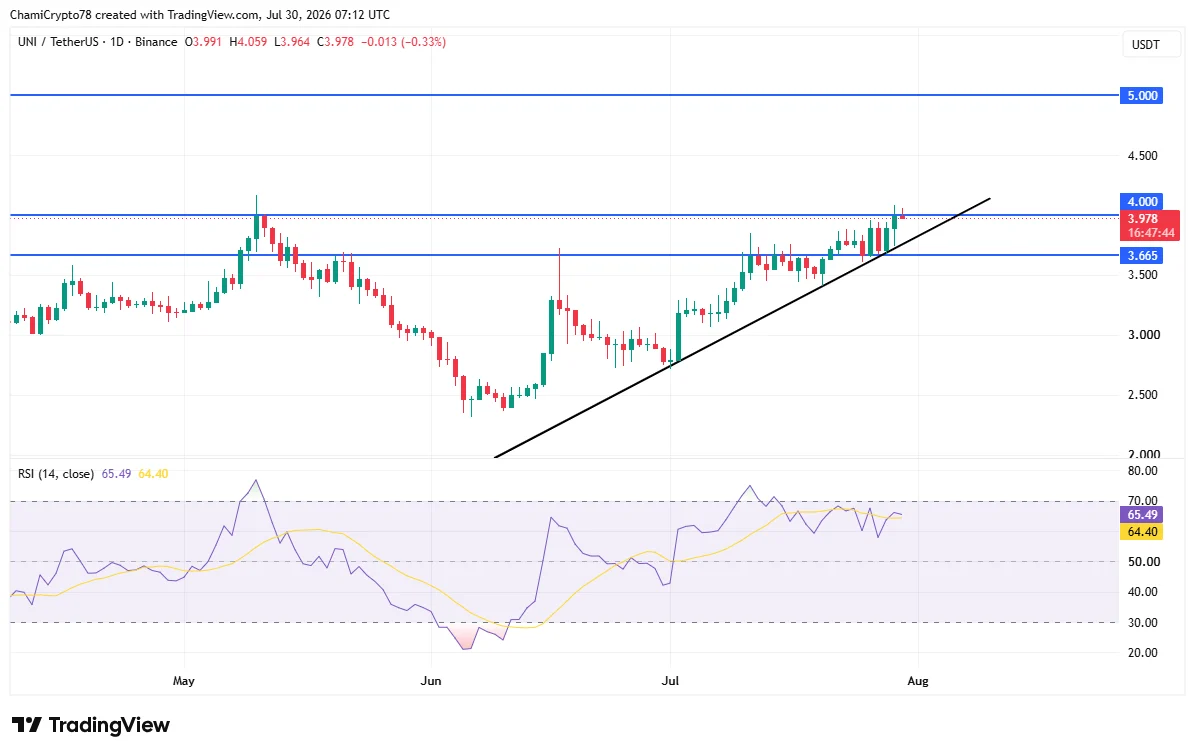
Uniswap [UNI] reclaimed the $4.00 mark for the first time since early May after institutional participants intensified accumulation across consecutive sessions. 

Wintermute had previously transferred more than $1 million worth of UNI through major exchanges, yet the latest activity shifted toward outright buying. 

A wallet linked to Cumberland accumulated $6.12 million worth of UNI before transferring the full amount to a wallet associated with Monetalis. 

Consecutive transactions from prominent market participants reflected growing confidence near a multi-month breakout instead of profit-taking. 

As a result, the breakout above a multi-month barrier reflected more than short-term speculation. 

Buyers absorbed every wave of UNI available supply

Exchange activity never translated into dominant selling pressure because spot participants continued lifting offers throughout the session. 

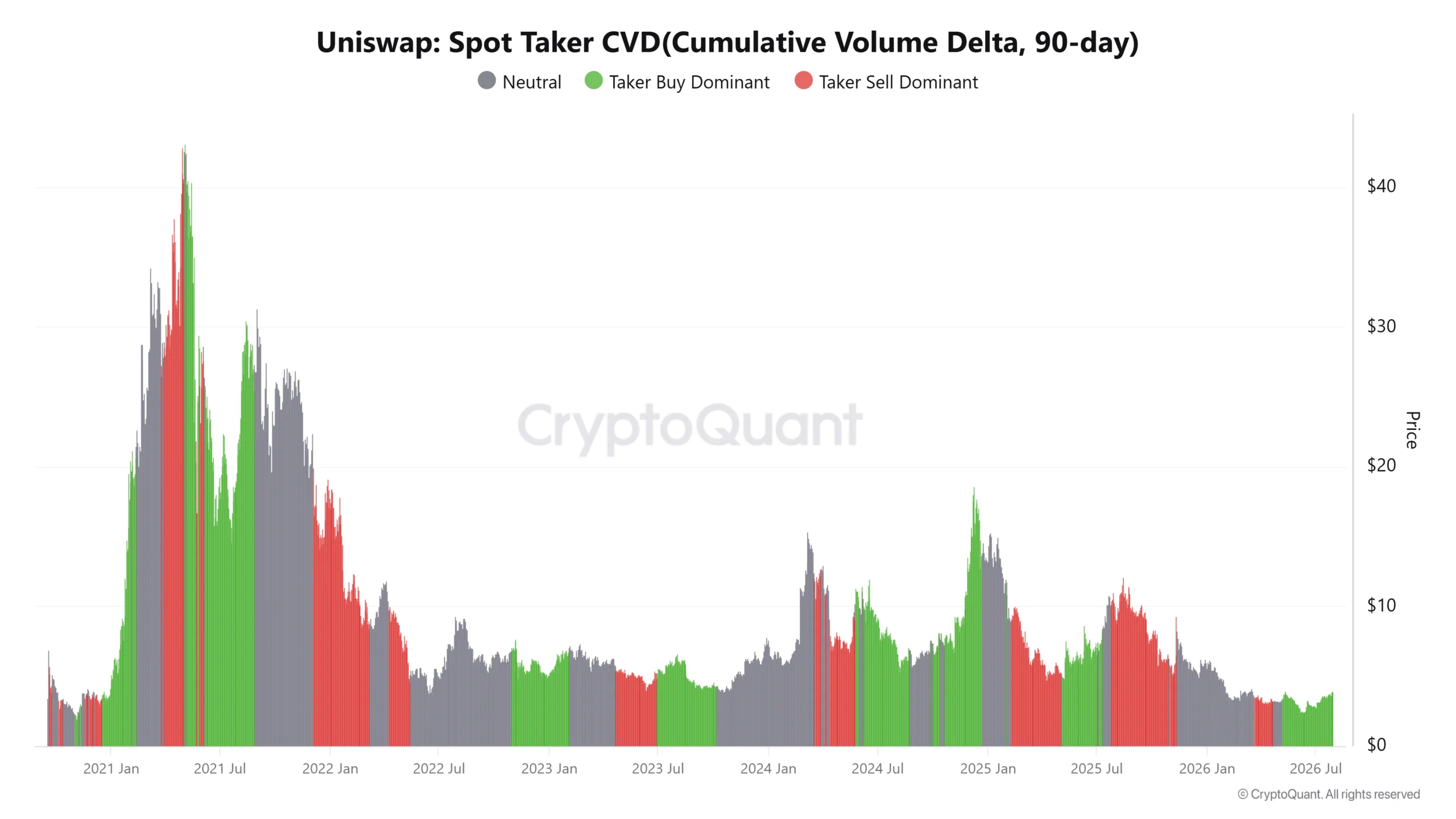
The 90-day Spot Taker CVD remained buyer dominant, confirming market orders favored accumulation instead of distribution. 

Rather than retreating after reclaiming $4.00, buyers repeatedly absorbed liquidity entering the order books and preserved bullish control. 

Source: CryptoQuant

The breakout entered its decisive proving ground

Breaking above resistance represented only the first challenge. Holding it would determine whether UNI transformed a breakout into a broader trend continuation. 

Price respected the rising trendline that had supported every meaningful July retracement, preserving the sequence of higher lows without interruption. 

Meanwhile, the RSI printed 65.49, reflecting healthy buying strength while leaving room before entering overbought conditions. 

Interestingly, the indicator stabilized instead of accelerating as price approached resistance, implying the advance relied on steady participation rather than euphoric buying. 

A successful defense of $4.00 would likely convert the former ceiling into fresh support.  

However, losing that level could invite another visit toward $3.66, where buyers previously regained control and aligned with the ascending trendline.

UNI price actionUNI price action
Source: TradingView

Why $4.05 could trigger another surge

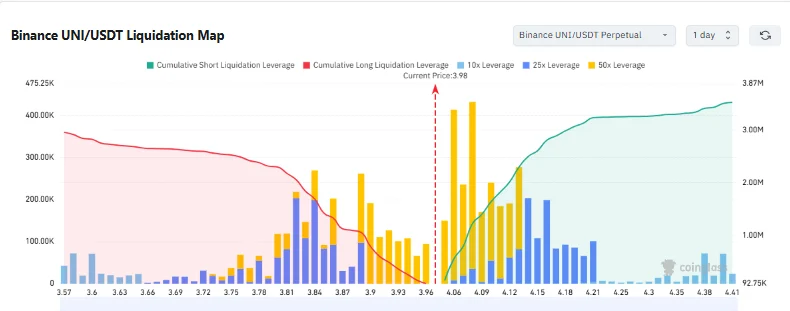
The liquidation map revealed where volatility could expand next instead of identifying ordinary resistance levels. 

Above the current market sat a dense concentration of short liquidations stretching from roughly $4.05 to $4.15, with cumulative exposure continuing to build toward $4.40. 

Every move through those zones would increase the probability of forced buybacks as bearish positions closed automatically. 

Should UNI establish acceptance beyond $4.05, cascading short liquidations would likely provide the additional fuel needed to extend the breakout.

Source: CoinGlass

Final Summary

  • Institutional wallets continued accumulating even after UNI reclaimed the long-lost $4 level.
  • Short positions above resistance may add buying pressure if UNI extends its breakout.


Source link

Founder of Russia’s largest crypto mining operation transferred to a detention center

0
Founder of Russia's largest crypto mining operation transferred to a detention center

A Russian court transferred Igor Runets, the founder of the country’s largest crypto mining company BitRiver, to a pretrial detention facility to face trial for fraud, Pravo.ru reported on Thursday.

Runets is charged with “large-scale” fraud, according to the news service. Investigators allege he caused damages exceeding 1 billion rubles ($12.5 million) by failing to deliver equipment to Infrastructure of Siberia, a subsidiary of En+, a multibillion-dollar corporation that produces 5% of the world’s aluminum and also manages digital, technology and crypto mining infrastructure projects.

Russian law enforcement officials say that in 2023, Runets entered into an equipment supply contract worth $8 million that it never fulfilled, according to Pravo.ru.

Runets, a crypto mining pioneer in Russia, was reportedly detained and placed on house arrest in February on three charges of tax evasion. The Stanford University MBA graduate began building a crypto mining data center in Siberia in 2017, the same year he founded BitRiver. He later expanded the operation to 15 data centers with more than 175,000 servers.

Following the closure of several of his crypto mining centers due to a six-year government ban across 10 regions, BitRiver began facing financial issues. A regional arbitration court opened insolvency proceedings against its controlling shareholder, Group of Companies Fox, which owns 98% of BitRiver’s authorized capital, in February.


Source link

Mortgage and refinance interest rates today, Thursday, July 30, 2026: Rates mostly lower

0
Mortgage and refinance interest rates today, Thursday, July 30, 2026: Rates mostly lower


According to the Zillow lender marketplace, mortgage rates are mostly lower today. The average 30-year fixed rate today, Thursday, July 30, 2026, is 6.65%, down 4 basis points since yesterday. The 15-year fixed loan is currently at 6.07%, the same rate as yesterday. The 5/1 ARM is 6.58%, 41 basis points lower than on Wednesday.

Read more: Weekly survey of mortgage lenders with the lowest rates: Pushing higher

Here are the current purchase mortgage rates, according to our latest Zillow data, for Thursday, July 30, 2026:

  • 30-year fixed: 6.65%

  • 20-year fixed: 6.30%

  • 15-year fixed: 6.07%

  • 5/1 ARM: 6.58%

  • 7/1 ARM: 6.21%

  • 30-year VA: 5.98%

  • 15-year VA: 5.52%

  • 5/1 VA: 5.81%

Remember, these are the national averages and rounded to the nearest hundredth.

Here are the current refinance mortgage rates, according to our latest Zillow data, for Thursday, July 30, 2026:

  • 30-year fixed: 6.65%

  • 20-year fixed: 6.42%

  • 15-year fixed: 6.05%

  • 5/1 ARM: 6.62%

  • 7/1 ARM: 6.52%

  • 30-year VA: 6.10%

  • 15-year VA: 5.70%

  • 5/1 VA: 5.53%

As with mortgage rates for purchase, these are national averages that we’ve rounded to the nearest hundredth. Refinance rates can be higher than purchase mortgage rates, but that isn’t always the case.

Use the mortgage calculator below to see how various mortgage rates will impact your monthly payments.

Mortgage payment calculator

Mortgage payment breakdown

81% Principal & interest

$2,179


You can bookmark the Yahoo Finance mortgage payment calculator and keep it handy for future use, as you shop for homes and lenders. Be sure to use the dropdown to include private mortgage insurance costs and HOA dues if they apply to you. These monthly expenses, along with your mortgage principal and interest rate, will give you a realistic idea of what your monthly payment could be.

A mortgage interest rate is the fee charged by a lender for borrowing money, expressed as a percentage. There are two basic types of mortgage rates: fixed and adjustable rates.

A fixed-rate mortgage locks in your rate for the entire life of your loan. For example, if you get a 30-year mortgage with a 6% interest rate, your rate will remain at 6% for the entire 30 years. (Unless you refinance or sell the home.)

An adjustable-rate mortgage keeps your rate the same for the first few years, then changes it periodically. Let’s say you get a 5/1 ARM with an introductory rate of 6%. Your rate would be 6% for the first five years, and then the rate would increase or decrease once per year for the last 25 years of your term. Whether your rate goes up or down depends on several factors, such as the economy and the U.S. housing market.

At the beginning of your mortgage term, most of your monthly payment goes toward interest. As time passes, less of your payment goes toward interest, and more goes toward the mortgage principal or the amount you originally borrowed.

Read more: Learn how to choose between an adjustable-rate vs. fixed-rate mortgage

Two categories determine mortgage rates: those you can control and those you cannot.

What factors can you control? First, you can compare the best mortgage lenders to find the one that gives you the lowest rate and fees.

Second, lenders typically extend lower rates to people with higher credit scores, lower debt-to-income (DTI) ratios, and considerable down payments. If you can save more or pay down debt before securing a mortgage, a lender will probably give you a better interest rate.

What factors can you not control? In short, the economy.

The list of ways the economy impacts mortgage rates is long, but here are the basic details. If the economy — for example, employment rates — is struggling, mortgage rates decrease to encourage borrowing, which helps boost the economy. If the economy is strong, mortgage rates go up to temper spending.

With all other factors being equal, mortgage refinance rates are typically slightly higher than purchase rates. So don’t be surprised if your refinance rate is higher than you may have expected.

Two of the most common mortgage terms are 30-year and 15-year fixed-rate mortgages. Both lock in your rate for the entire loan term.

A 30-year mortgage is popular because it has relatively low monthly payments. But it comes with a higher interest rate than shorter terms, and because you’re accumulating interest for three decades, you’ll pay a lot of interest in the long run.

A 15-year mortgage can be a good choice because it has a lower rate than you’ll get with longer terms, so you’ll pay less in interest over the years. You’ll also pay off your mortgage much faster. But your monthly payments will be higher because you’re paying off the same loan amount in half the time.

Basically, 30-year mortgages are more affordable from month to month, while 15-year mortgages are cheaper in the long run.

According to Yahoo Finance’s weekly survey of lenders with the lowest rates, some of the banks with the lowest median mortgage rates are Chase and Citibank. However, it’s a good idea to shop around for the best rate, not just with banks, but also with credit unions and companies specializing in mortgage lending.

Yes, 2.75% is an amazing mortgage rate. You’re unlikely to get a 2.75% rate in today’s market unless you take on an assumable mortgage from a seller who locked in this rate in 2020 or 2021, when rates were at all-time lows.

According to Freddie Mac, the lowest-ever 30-year fixed mortgage rate was 2.65%. This was the national average in January 2021. It is extremely unlikely that rates will dip below 3% again anytime soon.

Some experts say it’s worth refinancing when you can lock in a rate that’s 2% less than your current mortgage rate. Others say 1% is the magic number. It all depends on your financial goals when refinancing, how long you plan to stay in the same house, and on your break-even point after paying the refinance closing costs.


Source link

Forget robots on assembly lines. Foundational Industries wants AI to run the entire factory

0
Forget robots on assembly lines. Foundational Industries wants AI to run the entire factory

His startup, Foundational Industries, just raised a $25 million seed round, Fortune learned exclusively, to build factories where AI runs the whole operation rather than bolting automation onto an old assembly line. The round was led by BoxGroup and Zigg Ventures, with Abstract Ventures, Adverb Ventures, Buckley Ventures, and Offline Ventures participating. 

Rather than retrofitting a factory with a robot arm here and a vision sensor there, Foundational makes physical products, starting with data-center hardware, using factories designed from scratch to be run by software. 

Winer, who spent 25 years at Alphabet’s Sidewalk Infrastructure Partners deploying over $1 billion in capital, told me the seed money isn’t meant to fund a giant factory yet. “What this is allowing us to do is to sort of build a minimum viable product,” he said. “We’ve actually built the entire factory in software already using software emulators.”

Foundational’s first customers are data-center developers, neoclouds, and chipmakers who need custom rack enclosures now that new AI silicon runs at different voltages and cooling requirements. They declined to disclose customer names.

But Winer’s real argument is about China. The common wisdom in Washington is that China’s manufacturing dominance is built on cheap labor and lower-quality copying. Winer says that’s outdated. “Many of their factories are some of the most advanced automated factories in the world, and they are increasingly using not just international industrial automation, but also homegrown and home produced solutions,” he told me. China has poured over $1 trillion into advanced manufacturing over the past decade, backed by state subsidies and what Winer calls “a really dense industrial ecosystem” that lets new products get designed and launched fast.

That density is precisely why he thinks a head-on copy of China’s approach won’t work. “We just don’t have the people or the skill sets to do it,” he said. “And even if we did, it’s probably not economically competitive to China.”

So Winer’s thesis is to skip that fight entirely and build a different kind of factory. His argument rests on two American advantages: sophisticated AI models and researchers (which is now a shrinking talent gap) and far more AI compute. That combination, he says, lets Foundational’s system take a customer’s “product intent” and almost instantly generate a bill of materials and manufacturing process (a step that traditionally took months of manual design work). 

There’s also a structural weakness in China’s model that Winer is betting against. He argues China’s factories, however advanced, are still built around older-style automation that needs constant utilization to justify state subsidies. “They kind of need to feed the beast now,” he said. His wager is that AI-native factories—cheaper and faster with each one built—can give the U.S. a much-needed edge. 

See you tomorrow,

Lily Mae Lazarus
X:
@LilyMaeLazarus
Email: lily.lazarus@fortune.com
Submit a deal for the Term Sheet newsletter here.

Joey Abrams curated the deals section of today’s newsletter. Subscribe here.

VENTURE DEALS

CAIS, a New York City-based alternative investment platform for independent financial advisors, raised $170 million in Series D funding. Vista Equity Partners led the round and was joined by AllianceBernstein and others.

Eliyan, a Santa Clara, Calif.-based developer of connectivity technologies designed for AI compute, memory, and networking systems, raised $145 million in Series C funding. Seligman Ventures led the round and was joined by Cisco Investments and Lumentum

Onyx Security, a Tel Aviv, Israel and New York City-based AI control company, raised $113 million in Series B funding. Bessemer Venture Partners led the round and was joined by Cyberstarts, TCV, Conviction, FirstMark, Vintage, QuantumLight, and G Squared.

groundcover, a Tel Aviv, Israel-based observability platform, raised $100 million in Series C funding. One Peak led the round and was joined by Morgan Stanley Expansion Capital and existing investors Zeev Ventures, Angular Ventures, Heavybit, and Jibe.

ChipAgents, a Santa Clara, Calif.-based agentic AI platform for semiconductor design, raised $60 million in Series A2 funding from B Capital, Bessemer Venture Partners, Micron, and others.

P-1 AI, a San Mateo, Calif.-based developer of an AI mechanical and electrical engineer designed for industrial teams, raised $50 million in Series A funding. New Enterprise Associates led the round. 

Terminal, a Toronto, Canada-based provider of a unified telematics-integration platform for insurance, fleet-management, and logistics companies, raised $20 million in Series A funding. Battery Ventures led the round.

Centralize, a San Francisco-based relationship intelligence platform for enterprise revenue teams, raised $19 million in funding. NEA led the round and was joined by Salesforce Ventures, Y Combinator, 20SALES, Ritual Capital, and others.

Henry AI, a New York City-based AI platform automating back-office knowledge work for commercial real estate teams, raised $16.5 million in Series A funding. FirstMark Capital led the round and was joined by Thomson Reuters Ventures and existing investors.

UnitAI, a Boston, Mass.-based physical AI company developing warehouse-automation technology, raised $12 million in seed funding. Prologis Ventures, Dynamo Ventures, and Ground Up Ventures led the round and were joined by eGateway Capital, Recursive Ventures, Think + Ventures, ZEP Fund, and Crosscourt.

Pangram Labs, a Brooklyn, N.Y.-based AI detection platform, raised $9 million in funding. Menlo Ventures led the round and was joined by Haystack, ScOp Venture Capital, Script Capital, and Cadenza.

Mirae, a New York City-based AI-driven continuous care platform for autoimmune disease and other complex chronic conditions, raised $5.4 million in funding. Oxford Science Enterprises led the round.

FAST Metals, a Stamford, Conn.-based mining technology company, raised $4.3 million in pre-seed funding. New Climate Ventures led the round.

CopySight, a Los Angeles, Calif.-based AI IP governance company, raised $3 million in seed funding. Mucker Capital led the round and was joined by Taisu VC, Flint Capital, and Yellow Rocks!

MASAJ, a London, U.K.-based bodywork brand, raised £1.5 million in funding. FIGR Ventures and Sorven Capital led the round.

Dimension, a Los Angeles, Calif.-based social commerce tech company, raised $1.7 million in seed funding from Science Inc., UpscaleX, OpenSky, and others.

PRIVATE EQUITY

CHAOS Industries, backed by Valor Equity Partners, acquired Atropos Group, a New York City-based defense technology company specializing in autonomous aircraft systems. Financial terms were not disclosed.

Lafayette Instrument, backed by Branford Castle, acquired Avisoft Bioacoustics, a Glienicke/Nordbahn-based bioacoustics company. Financial terms were not disclosed.

Vista Equity Partners agreed to acquire Quantios, a London, U.K.-based provider of SaaS solutions to the trust and corporate services industry. Financial terms were not disclosed. 

FUNDS + FUNDS OF FUNDS

Jump Capital, a Chicago, Ill.-based venture capital firm, raised $350 million for its eighth fund focused on tech companies.



Source link