Natural gas storage facility by roibu via Adobe Stock
August Nymex natural gas (NGQ26) on Monday closed down -0.104 (-3.62%).
Nat-gas prices sank to a 2.5-month nearest-futures low on Monday and settled sharply lower. The outlook for cooler US weather, which diminishes the need for air conditioning, is weighing on nat-gas prices. The Commodity Weather Group said on Monday that forecasts call for normal to below-normal temperatures across the central and eastern US for August 1-5.
More News from Barchart
A bearish factor for nat-gas prices in the medium term is speculation that a powerful El Niño weather system will bring warmer-than-normal temperatures to the Northern Hemisphere this fall and winter, reducing nat-gas heating demand.
US (lower-48) dry gas production on Monday was 113.1 bcf/day (+3.7% y/y), according to BNEF. Lower-48 state gas demand on Monday was 81.4 bcf/day (+2.7% y/y), according to BNEF. Estimated LNG net flows to US LNG export terminals on Monday were 18.1 bcf/day (+2.4% w/w), according to BNEF.
Projections for higher US nat-gas production are negative for prices. On July 7, the EIA raised its forecast for 2026 US dry nat-gas production to 111.2 bcf/day from a June estimate of 111.0 bcf/day.
As a positive factor for gas prices, the Edison Electric Institute reported last Wednesday that US (lower-48) electricity output in the week ended July 18 rose +2.0% y/y to 101,391 GWh (gigawatt hours). Also, US electricity output in the 52 weeks ending July 18 rose +2.3% y/y to 4,350,346 GWh.
Last Thursday’s weekly EIA report was mixed for nat-gas prices, as nat-gas inventories for the week ended July 17 rose by +32 bcf, less than expectations of +34 bcf but above the 5-year weekly average increase of +30 bcf. As of July 17, nat-gas inventories were down -0.6% y/y, and +6.4% above their 5-year seasonal average, signaling adequate nat-gas supplies. As of July 25, gas storage in Europe was 55% full, compared to the 5-year seasonal average of 71% full for this time of year.
Baker Hughes reported last Friday that the number of active US nat-gas drilling rigs in the week ending July 24 rose by +1 rig to 127 rigs, below the 3-year high of 134 rigs set in February 2026.
On the date of publication, Rich Asplund did not have (either directly or indirectly) positions in any of the securities mentioned in this article. All information and data in this article is solely for informational purposes. This article was originally published on Barchart.com
Liquidity providers (LPs) are now concerned over Uniswap’s fee switch across the Robinhood Chain and the DEX’s other V4 versions across other networks.
The latest fee switch was activated on Monday, the 27th of July. Experts now claim that those who provide liquidity in V2 and V3 will see up to a 25% haircut. For those in V4, the shared profits can be cut by up to 33%, mainly for Uniswap [UNI] buyback and burn.
According to some LPs like Guil Lambert, the new fees ‘structurally can’t work,’ pressing his colleagues to explore better yield opportunities.
The fee switch is live on all UniV4 pools. LPs now pay 10- 25% of fee revenues to the protocol. I’ll keep being an LP, but providing liquidity as usual structurally can’t work, to be honest.
Aerodrome Finance’s Alexander Cutler jumped on the opportunity to woo disgruntled Uniswap LPs back to their DEX, which is on Base.
Source: X
Are Uniswap fees ‘horrible’ or good for UNI?
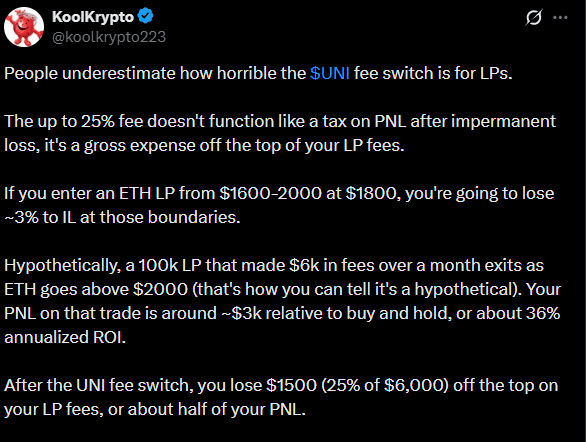
For his part, analyst KoolKrypto called the entire Uniswap protocol fee switch ‘horrible’ for LPs. In fact, he projected that the LPs will likely move to Aerodrome and other competitors.
According to him, Uniswap LPs were not profitable even before the fee switch went live. As a result, the new fee cuts will worsen the situation.
It will not be optimal or even viable to provide liquidity on most pairs for Uniswap going forward. The relative success of the Robinhood chain launch might have provided a small bump, but Uniswap’s business model is unsustainable, and I expect it to start melting away from here.
Source: X
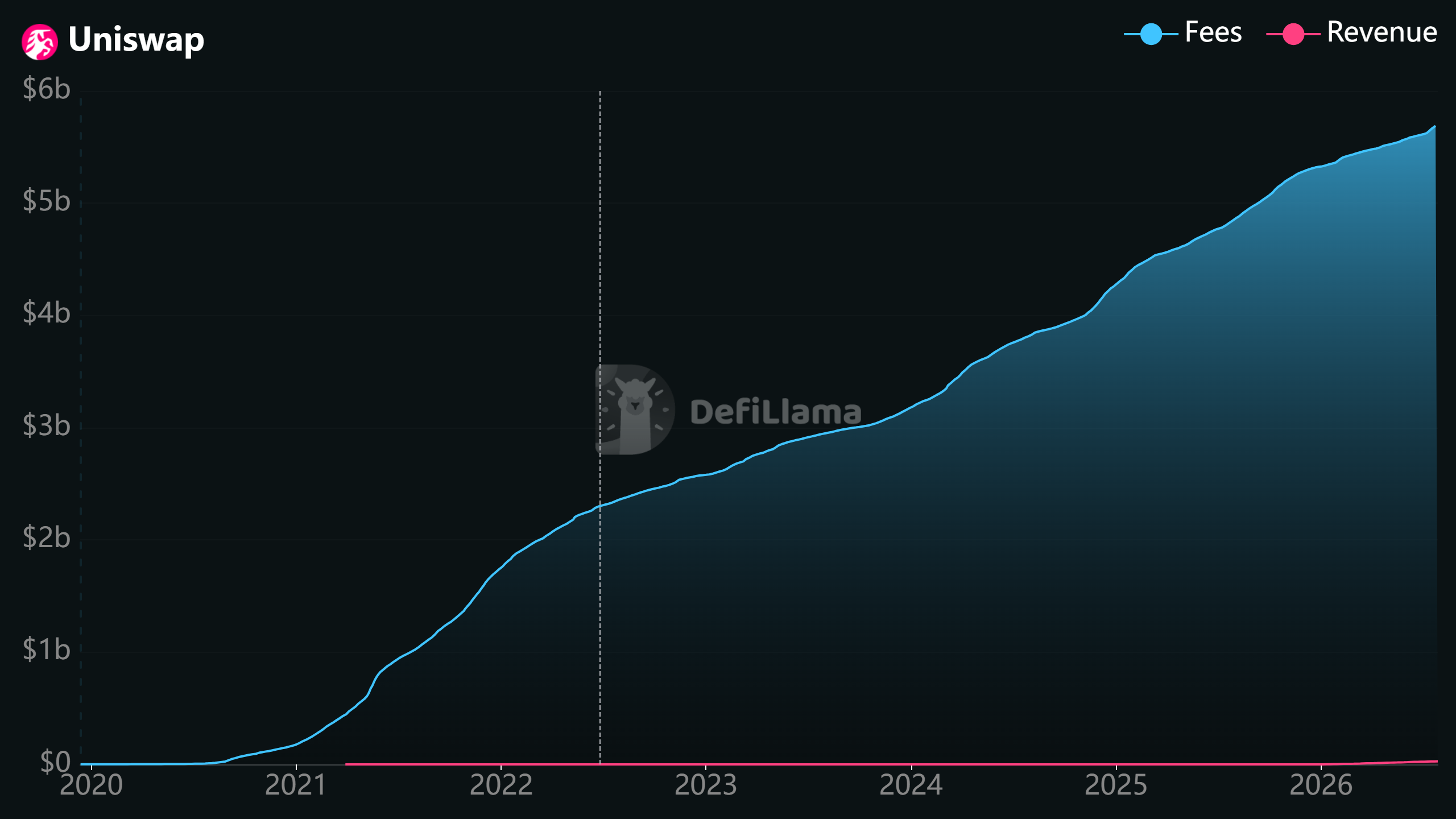
Worth noting that since Uniswap’s debut, LPs have been the ones collecting the generated trading fees, with zero going to protocol revenue.
Last year, the fee switch was activated. A percentage of the generated fees is set aside for UNI buybacks and burn while LPs pocket the rest. So far, Uniswap has generated nearly $6B in fees but only collected $27 million in revenue since 2020.
Source: DeFiLlama
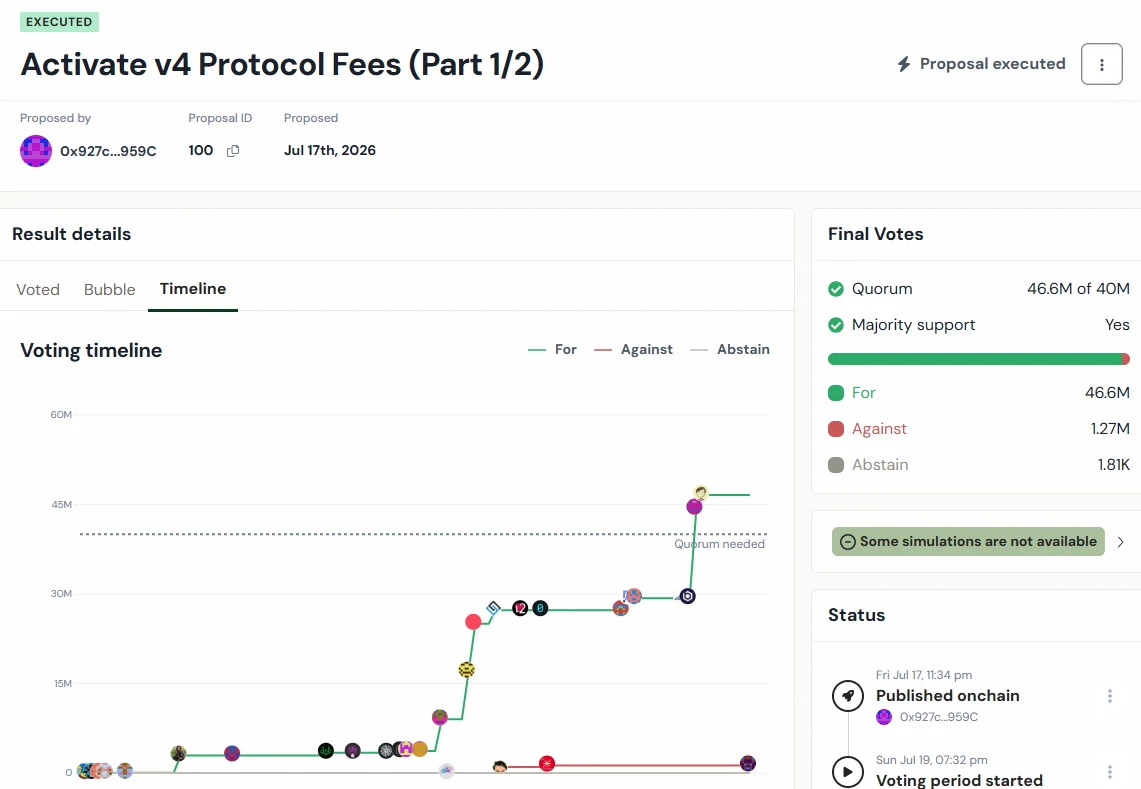
In fact, the latest fee switch plan was announced about three weeks ago. Apart from Guil Lambert and a few others, who complained that the fee switch would make Uniswap V4 uncompetitive, most LPs didn’t voice major concern. In fact, the proposal got an overwhelming 97% support with only 2.7% voting against it. However, whether the critics’ concerns, like uncompetitiveness or LPs’ migration to rivals, will emerge remains to be seen.
Source: Uniswap Governance
Final Summary
Uniswap LPs warned that the recent fee switch on Robinhood Chain and other networks will force them to migrate to rivals.
Liquidity providers have collected $6B of generated Uniswap fees since 2020, but some claim they have been mostly unprofitable.
The Bank of Russia published its first draft rules as part of the introduction of cryptocurrency regulations in the country, including capital requirements for companies that hold and record digital assets.
The proposals would extend systems already used in Russia’s securities markets, including exchange trading, custody, record-keeping and disclosure rules, to digital assets.
The framework would create “digital depositories,” regulated companies that would record holdings of cryptocurrencies and other digital assets. They would need between 50 million ($570,000) and 250 million rubles ($2.8 million) in capital, depending on the services they provide.
Settlement depositories would require 250 million rubles ($2.8 million) in capital The requirement falls to 100 million rubles ($1.1 million) for firms that control crypto addresses or hold assets with foreign custodians, and 50 million rubles ($570,000) for other digital depositories.
Assets counted toward those capital requirements must be liquid, while eligible financial assets must meet the central bank’s credit-quality standards. The requirements would also apply to operators of electronic platforms that settle transactions involving digital financial assets.
The central bank will maintain registers of digital depositories, crypto exchange operators and companies that issue digital financial assets.
Uber Technologies Inc logo outside offices-by Sundry Photography via iStock
Unusually high put options volume today in Uber Technologies (UBER) could augur well for UBER stock. The strike price is over 18% below today’s price, or “out-of-the-money.” It could be initiated by UBER short-put sellers looking for yield and a potentially lower buy-in point.
UBER is up about 3% in midday trading at $67.85, after closing at a 6-month low of $65.92 on Friday. However, it’s well off a recent closing peak of $79.17 on May 6.
More News from Barchart
UBER stock – last 6 months – Barchart – July 27 midday
Uber’s Q2 earnings are due out on Aug. 5 (before the market open). Analysts expect at least 12.72% revenue growth to $14.26 billion for Q2.
That compares to $12.65 billion last year, according to Yahoo! Finance. In Q1, revenue growth was 14.48%, slightly lower than analysts’ expectations, according to Seeking Alpha.
Moreover, earnings per share (EPS) forecasts are for 80 cents on a normalized basis (83 cents on a GAAP basis), vs. 63 cents EPS last year (Q2).
Last quarter EPS was significantly below analysts’ projections, which could account for the weakness in UBER stock
Unusual Options Volume Today
The strike price for today’s huge put option volume is $55.00 for expiration in a little over one month (Aug. 28). This can be seen in today’s Barchart Unusual Stock Options Activity Report.
That strike price is 18.7% lower than today’s price. Buyers may be hedging long UBER investments with a bet that earnings could disappoint (i.e., buyers of the puts). In other words, it could be a cheap form of insurance for long UBER stockholders.
UBER puts expiring Aug. 28 – Barchart Unusual Stock Options Activity Report – July 27, 2026
However, sellers of these puts earn 45 cents per put contract shorted. That works out to an average yield of 82 basis points (0.82%), or a little less than 1% for the next month.
Moreover, if UBER stock moves up from its trough closer to earnings, the put premium is likely to fall quite dramatically. That is because the strike price is so far away from today’s trading price.
Moreover, there is every indication that UBER stock looks too cheap here. Here’s why.
UBER’s Strong Cash Flow
In Q1, Uber generated $2.286 billion in free cash flow (FCF) on $11.28 billion, representing a 20.27% FCF margin. That can be seen on page 32 of its supplemental info deck and page 12 of its earnings release.
Moreover, for the trailing 12 months (TTM), it generated almost $10 billion in FCF ($9.799 billion), as seen in the supplemental deck. That represented 18.25% of TTM revenue, according to Stock Analysis. In other words, its FCF margin is rising as revenue grows.
This could lead to higher FCF going forward. For example, analysts now project $58.02 billion in 2026 revenue (up 11.5% from $52.02 billion in 2025), as well as $67.08 billion in 2027 (+15.6% over 2026 estimates).
As a result, for the next 12 months (NTM), revenue could average $62.55 billion. So, assuming the company generates at least 20% in FCF, the FCF could rise to $12.51 billion (0.20 x $62.55b).
That is 27.65% higher than the $9.8 billion in TTM FCF and could lead to a higher stock price.
UBER Price Targets
Today, UBER’s market cap is $138.14 billion, according to Yahoo! Finance. So, its TTM FCF yield is 7.09% (i.e., $9.8b / $138.14b). That’s the same as multiplying FCF by 14.1x (1/0.0709)
So, applying this to my $12.51 FCF forecast over the next 12 months:
$12.51b x 14.1 = $176.4 billion fair market value (FMV)
That is 27.7% higher than today’s market cap, and implies that UBER’s price target (PT) is over $86 per share:
$67.85 x 1.277 = $86.64 PT
Analysts surveyed by Yahoo! Finance have a much higher average PT: $104.10, or +53% upside. Similarly, Barchart’s mean survey PT is $105.69, +56%, and AnaChart’s survey of 27 analysts is $105.71.
The bottom line is that UBER stock looks way too cheap, as long as it keeps generating strong FCF margins.
That could be why investors are willing to short out-of-the-money puts today.
Better OTM Put Plays
In fact, it might make sense for less risk-averse investors to short closer-in puts. For example, the $63.00 put option strike price, about 6.5% below today’s price, has a midpoint premium of $1.75.
That means a short-seller of this put option can make a one-month yield of 2.778% (i.e., $1.75/$63.00).
UBER puts expiring Aug. 28 – Barchart – As of July 27
In other words, an investor who posts $6,300 with their brokerage firm can earn $175.00 in their account immediately, after entering an order to “Sell to Open” 1 put at $65.00. The $6,300 acts as collateral in case UBER drops to $63.00 on or before Aug. 28 and the account is assigned to buy 100 shares.
But, even if that occurs, the investor has a lower breakeven point:
$63.00 – $1.75 = $61.25
That is 10% below today’s price. Moreover, the likelihood of this occurring is low, as the delta ratio is only -.27, implying just a 27% chance, based on past volatility, of UBER dropping 6.5% to $63.00
The bottom line is that shorting UBER puts today looks like an attractive strategy for value investors.
On the date of publication, Mark R. Hake, CFA did not have (either directly or indirectly) positions in any of the securities mentioned in this article. All information and data in this article is solely for informational purposes. This article was originally published on Barchart.com
As the reliance on technology increases, healthcare leaders need to invest heavily in cyber-protection measures.
getty
Last week, U.K. based healthcare billing software provider Craneware announced that it had been impacted by a serious cybersecurity event, indicating that a significant amount of customer and employee data has been compromised. As healthcare billing often entails sensitive patient and medical data, this is a critical event that indicates a broader and ongoing trend across the industry.
In fact, healthcare is undergoing one of the most severe cybersecurity crisis periods in the history of the industry. Medical billing software companies and developers seem to be especially targeted in recent years, as hackers are realizing that these companies are often the gateways to numerous hospitals across the globe. Additionally, these targets often contain the most amount of high yield, concentrated datasets, making the threats even more serious and therefore, worthy of higher ransom collection threats.
By no means is Craneware alone in this tragedy; other billing companies, such as TriZetto, CareCloud and Episource, have undergone similar breaches over the last year, indicative of a broader industry calamity.
According to Becker’s and per the Identify Theft Resource Center, healthcare data breaches climbed to 281 in just the first half of 2026; the number is second only to the financial services industry, which had 387 encounters in the same time period. Per the report, “the healthcare figures come inside a record-setting national picture. The U.S. recorded 1,803 total data compromises across all sectors in the first half of 2026, affecting an estimated 471.2 million individuals — a total that already exceeds all of 2025’s 297.5 million victim notices in just six months.”
Per the HIPAA Journal, there has been a significant uptick in the number of data breaches in healthcare since 2009. The report also highlights the largest confirmed healthcare data breaches of all time, with some events impacting more than 190 million individuals.
Why is all of this important?
For one, health data and medical records are among the most sensitive aspects of an individual’s identity. They often contain more than just diagnoses and illnesses, but frequently entail detailed social histories, family information and other sensitive identifying information that could make individuals incredibly vulnerable. A loss of privacy over this information is monumental.
Additionally, healthcare breaches are incredibly disruptive to care systems. A JMIR article found that “hospitals’ breach responses increase the financial burden on hospitals. The efforts to repair the damages from a data breach increase direct and indirect costs and may divert resources from improving patient quality of care.”
Organizations are equally concerned with these impacts, and are especially worried as the reliance on more integrated data systems and artificial intelligence is growing. More technology also means increased vulnerability to potential breaches, and healthcare leaders are aware that they need to invest heavily in cyber protection measures. Hackers are also becoming more sophisticated in their approach; beyond just targeting large systems or back-office service providers, they are also targeting vulnerable patient populations for identify theft or other cyber incursions.
Indeed, as the rate of these cyber events in healthcare is rapidly increasing, technology and healthcare leaders alike must come together to find sustainable and long-term solutions.
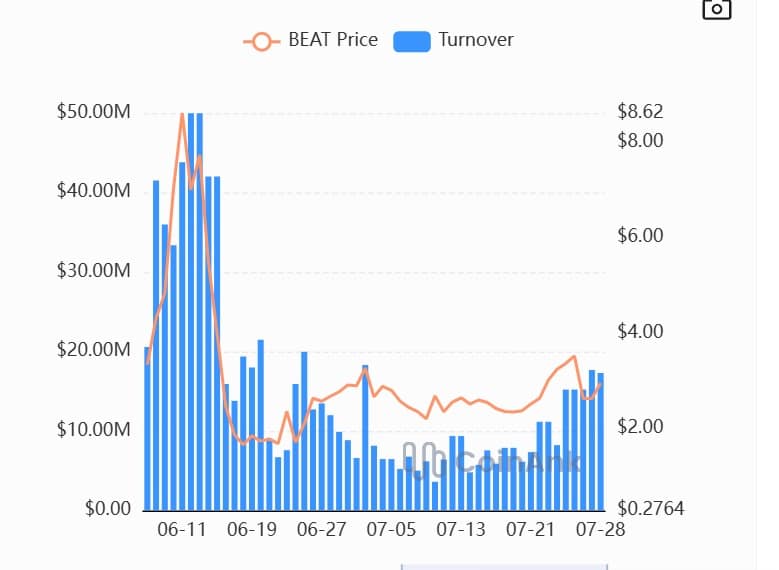
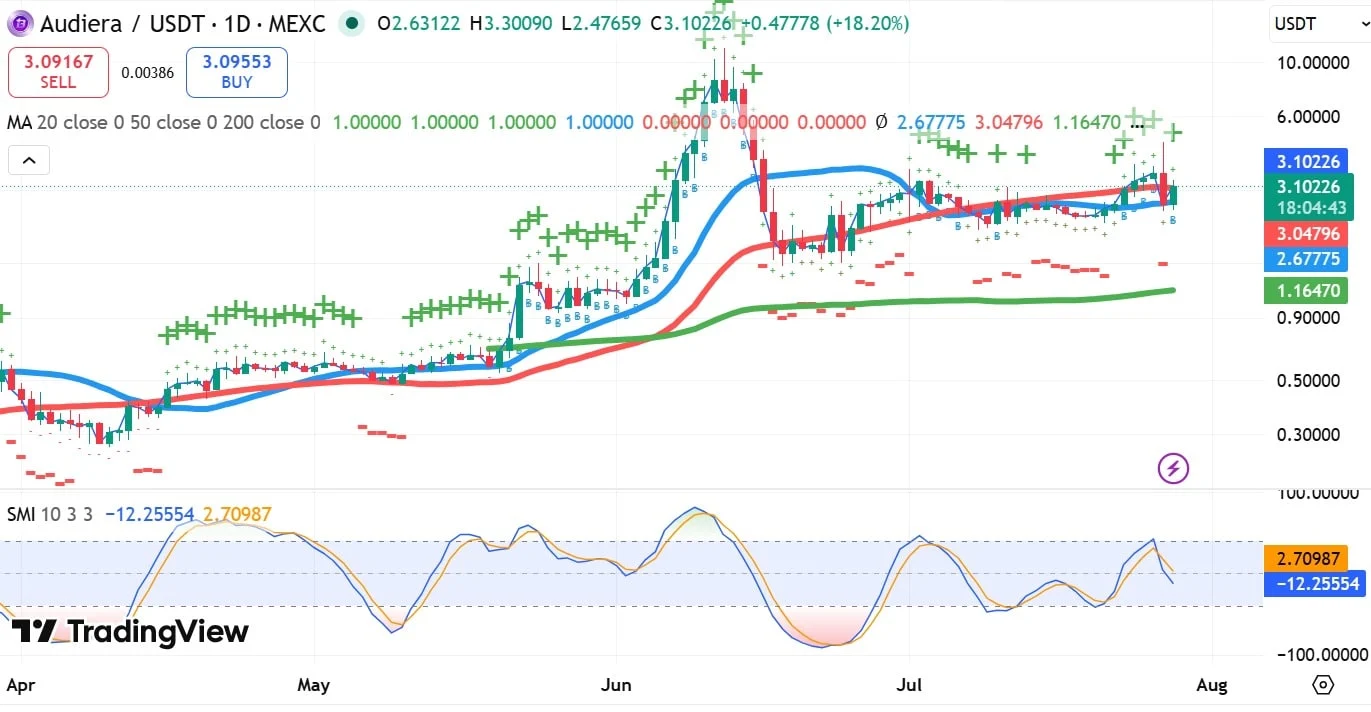
Audiera [BEAT] breached the $3 support level and fell to a low of $2.4. This price drop came after days of strong upward pressure, marking a significant reversal. At press time, BEAT was trading around $2.76, after dropping 24.29% on the daily charts.
Source: Coinank
Notably, Audiera’s Turnover climbed to $17.6 million, marking a significant jump from $15 million the previous day, reflecting bear market dominance.
Audiera traders panic-exit the market
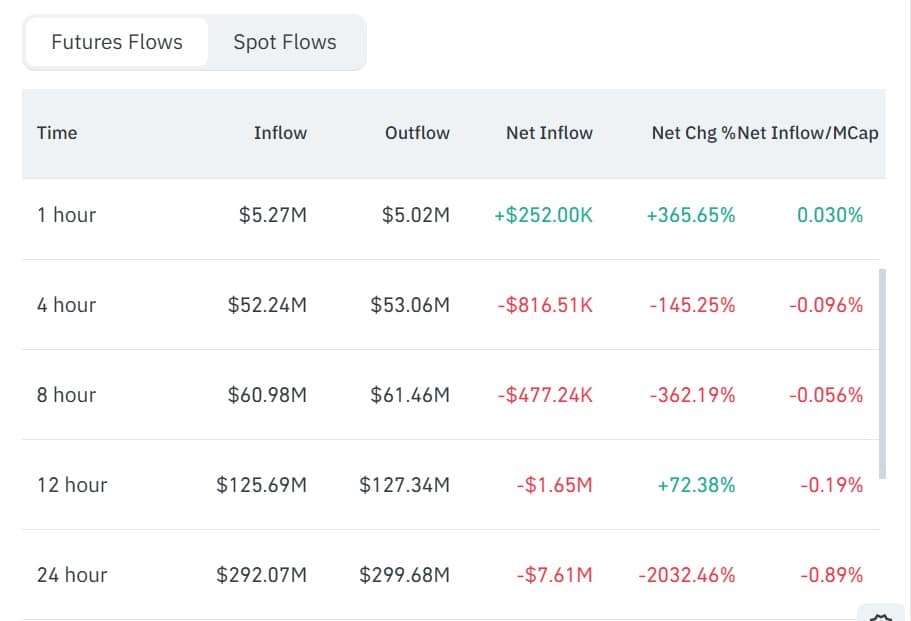
BEAT saw increased selling pressure as traders closed their positions. On the Futures side, the altcoin recorded $299.68 million in Outflows compared to $292 million in inflows.
As a result, the Futures Netflow declined 2032% to -$7.61 million, implying a significant number of traders closed their positions.
Source: CoinGlass
Reduced speculative activity has historically resulted in short-term market weakness, often preceding price decline.
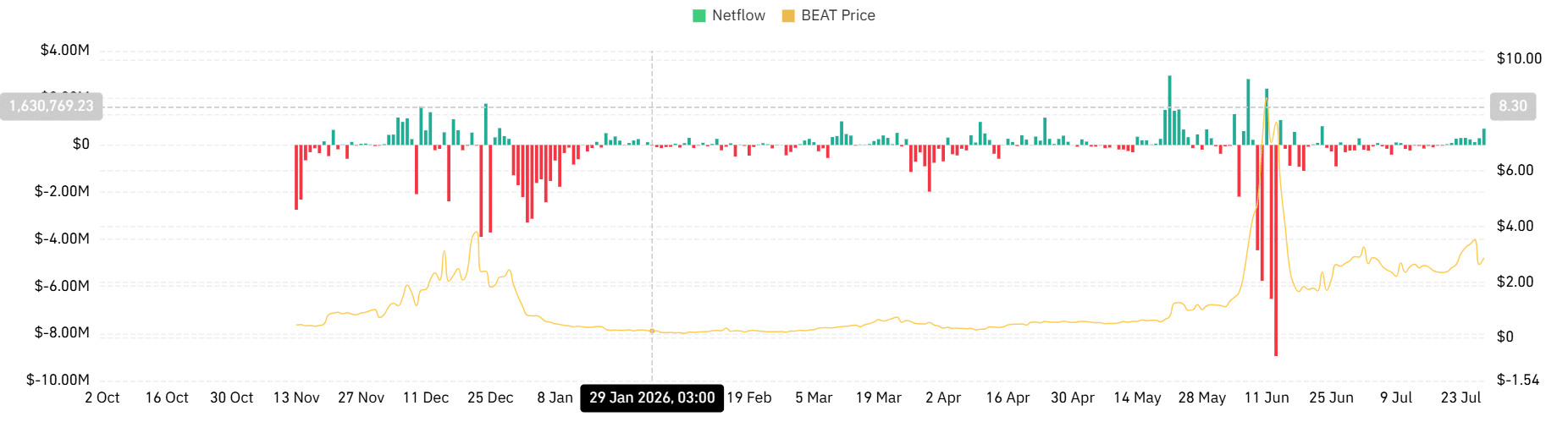
On the spot side, holders increased spending significantly. While investors on the spot have been cashing out, the pressure increased substantially.
As of writing, Audiera’s Spot Netflow was around $688k, marking a monthly high. Such a jump in exchange inflows reflected elevated bearish pressure.
Source: CoinGlass
Strong market pressure on both the spot and futures markets has often weakened the market significantly, leading to a sharp price drop.
More losses ahead for BEAT?
Audiera’s downward momentum was elevated by increased selling pressure. As a result, the altcoin’s earlier momentum faded, with BEAT falling below EMA50 at $3.04 as of writing, signaling a short-term bearish takeover.
Source: TradingView
At the same time, Audiera’s Stochastic Momentum Index (SMI) formed a bearish crossover and dropped into the negative zone. At -14, the SMI indicator further validated this trend reversal.
For now, the 50-day Moving Average is acting as the dynamic resistance. As such, bulls need to reclaim the price level to ease the market pressure.
In doing so, the altcoin will be strengthened enough to target a move above $3.8. On the other hand, if the recent market pressure continues, the altcoin will drop below the 200-day EMA at $2.6.
Final Summary
Audiera plummeted 24%, breaching the $3 support to a low of $2.4, before slightly rebounding to $2.8.
BEAT faced intense selling pressure across the market.
EthSystems, a startup spun out of the Ethereum Foundation earlier this month, is betting that privacy, not scalability, is the biggest obstacle preventing institutions from moving financial activity onto public blockchains.
The company, which emerged from the Ethereum Foundation’s Institutional Privacy Task Force, is building confidentiality infrastructure for banks, asset managers and governments looking to use Ethereum for tokenized assets, stablecoins and other financial applications.
Rather than creating an entirely new blockchain, EthSystems helps institutions deploy privacy technologies that allow sensitive transaction data to remain confidential while still settling on Ethereum.
“Almost every single financial institution requires some level of confidentiality,” co-founder Mo Jalil told CoinDesk in an interview. “Confidentiality doesn’t necessarily mean something has to be anonymous or hidden. There just needs to be controls over who sees what, when and how.”
EthSystems is far from the only company focused on institutional privacy. Projects such as Canton Network, which is backed by major financial institutions including Goldman Sachs, BNP Paribas and DTCC, as well as Ethereum-native privacy protocols like Aztec and Miden, are also developing infrastructure aimed at enabling confidential transactions for enterprises.