Home Blog Page 157

Bitmine now holds 5.78M Ethereum worth $11.8B – ‘Bodes well for ETH’s future’

0
Bitmine now holds 5.78M Ethereum worth $11.8B - 'Bodes well for ETH's future'


Since introducing its Ethereum [ETH] treasury strategy in June 2025, Bitmine Immersion Technologies has been buying ETH every week, and in the past week it bought 9,946 ETH.

With this acquisition, the company’s total balance sheet value – which includes cash, marketable securities, strategic equity investments, and cryptocurrency assets – was $11.8 billion.

That said, these purchases happened at an average ETH price of $1,948, bringing the company’s total holdings to 5,787,414 ETH.

Bitmine’s ETH strategy 

With this, Bitmine’s Ethereum holdings currently make up about 4.8% of the 120.7 million ETH in total supply that is in circulation.

Of that sum, 4,917,189 ETH (or about 85% of its holdings) is already staked through its institutional staking platform, MAVAN (the Made in American VAlidator Network).

With an estimated yearly staking revenue of $254 million and an annualized staking reward of roughly $299 million based on its current staking yield of 2.65%, the company clearly sees staking as a substantial source of recurring income in addition to ETH price appreciation. 

Bitmine’s chairman has high hopes

Beyond staking and accumulating, Bitmine Chairman Thomas “Tom” Lee noted

Bitmine repurchased 6.1 million shares of common stock in the past week, an increase from the 5.5 million purchased the week prior.

He added, 

We increased our equity buyback as we view the rising ETH/BTC ratio, despite the falling odds of passage of the Clarity Act in 2026, as a sign crypto prices are strengthening. In fact, this ratio is now at a 3-month high at 0.3000, which we believe bodes well for future strengthening of ETH prices.

According to Lee, the increased buybacks are a result of better crypto market signals. In particular, the ETH/BTC ratio increased to a three-month high of 0.30, indicating Ethereum is outperforming Bitcoin.

ETHBTC ratio
Source: Trading View

Lee also noted that the next significant price targets for ETH are technical resistance levels of $2,000 and $2,500. 


Final Summary

  • Bitmine’s Ethereum holdings have surged to $11.8 billion, with the company adding 9,946 ETH in the past week.
  • Beyond accumulation, Bitmine emphasizes staking as a recurring income source, projecting that this approach could help drive Ethereum’s price momentum.


Source link

SK Hynix perps suffer flash crash to $900 on Hyperliquid

0
SK Hynix perps suffer flash crash to $900 on Hyperliquid

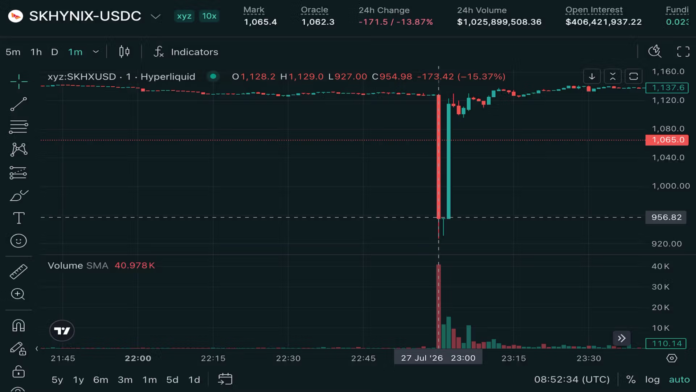
Perpetual futures tied to SK Hynix, a South Korean chipmaker whose American depositary receipts debuted on Nasdaq earlier this month, suffered a flash crash on Hyperliquid shortly before the underlying share price came under pressure in its home market.

Between 23:00 UTC and 23:01 UTC, the price of perpetuals tracking the Seoul-traded stock crashed 20% to $900, according to data from Hyperliquid. The price rebounded to over $1,000 the very next minute and was recently priced at $1,092. The contract is traded and denominated in dollar-pegged stablecoin USDC.

An hour later, the Korean stock market opened on a negative note, led by chipmakers. By the end of the day, SK Hynix shares had dropped by 15% to 1,550,000 won ($1,762). Other losers included Samsung Electronics and carmaker Hyundai Motor. The benchmark Kospi index fell 11%.

SK Hynix ADRs, 10 of which equal one share, fell 4.5% in pre-market trading to $136.51.

Hyperliquid, the leading perpetuals-focused decentralized exchange, has emerged as a hot favorite of traders looking to express their view on traditional assets, especially since the onset of the Iran war in late February. The exchange had not responded to a request for comment by publication time.


Source link

argenx signs agreement to buy Forte Biosciences for $2.2bn

0
argenx signs agreement to buy Forte Biosciences for $2.2bn


argenx has entered a definitive agreement to acquire Forte Biosciences for approximately $2.2bn in total equity value.

Approved by both companies’ boards of directors, the transaction is expected to close in the third quarter of 2026, contingent upon standard closing conditions.

The main asset involved is FB102, Forte Biosciences’ first-in-class anti-CD122 antibody, which will be added to argenx’s immunology portfolio. FB102 was evaluated in Phase Ib studies for vitiligo and celiac disease.

These studies were a key factor in deciding to proceed from a strategic investment to acquisition by argenx.

Forte Biosciences expects to release Phase II data for FB102 in the second half of this year.

argenx CEO Karen Massey said: “The acquisition of Forte Biosciences builds on the strength of that foundation and advances our ambition to be the leading immunology innovator of the future.

“The addition of FB102 to our portfolio aligns perfectly with the argenx playbook: compelling biology, strong clinical validation and broad potential to address patient need.

“I am grateful to the Forte Biosciences team for their outstanding work. Together, we look forward to unlocking the full potential of FB102 and accelerating its impact for patients.”

Under the agreement, argenx will begin a cash tender offer, via a wholly owned subsidiary, for acquiring all of the outstanding Forte Biosciences’ common stock shares at $77 per share price.

This represents a premium of around 86% to Forte Biosciences’ volume-weighted average price since announcing positive Phase Ib trial data for vitiligo on 9 July.

The offer will be funded entirely from argenx’s cash on hand and is not subject to financing conditions.

Completion requires the tender of a majority of outstanding Forte Biosciences shares and the expiration of applicable regulatory waiting periods.

The transaction will see FB102 added to argenx’s existing antibody-based programmes, including adimanebart, ARGX-121, efgartigimod, empasiprubart, and several early-stage molecules.

Goldman Sachs International is acting as exclusive financial adviser and Freshfields as legal adviser to argenx. Guggenheim Securities is the exclusive financial adviser to Forte Biosciences, and Wilson Sonsini Goodrich & Rosati is serving as legal counsel.

In July 2024, China’s National Medical Products Administration (NMPA) approved Zai Lab and argenx’s efgartigimod alfa subcutaneous injection (efgartigimod SC), 1,000mg (5.6ml)/vial for the treatment of generalised myasthenia gravis (gMG).

“argenx signs agreement to buy Forte Biosciences for $2.2bn” was originally created and published by Pharmaceutical Technology, a GlobalData owned brand.


Source link

Ondo extends RWA dominance with new network – But will institutions use it?

0
Ondo extends RWA dominance with new network - But will institutions use it?


Institutional investors have long faced a tradeoff between execution speed and blockchain transparency.

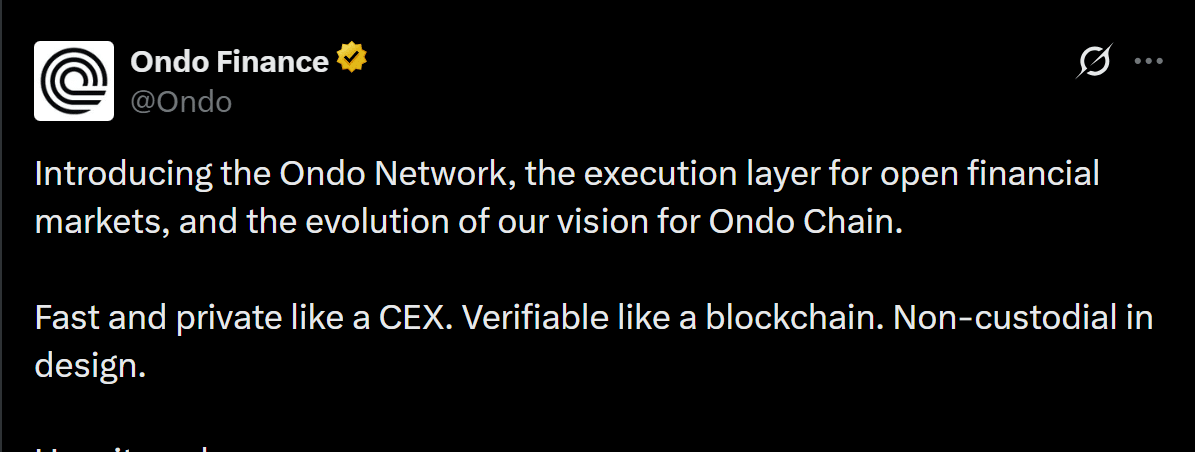
Ondo Finance [ONDO] launched the Ondo Network to address that challenge through private execution, decentralized verification, and on-chain settlement.

Through this, institutions will gain centralized exchange-like performance without sacrificing non-custodial control.

Source: X

Rather than simply increasing speed, the infrastructure improves settlement efficiency while preserving verifiable ownership.

As such, if adoption accelerates, Ondo may potentially create deeper levels of liquidity, attract new developers into its ecosystem, and increase the amount of assets being tokenized within its network. This would create further potential for overall ecosystem development.

Furthermore, it would encourage institutional participation across decentralized finance while giving institutions greater confidence in scalable, transparent, high-performance market infrastructure over time.

How Ondo Network works

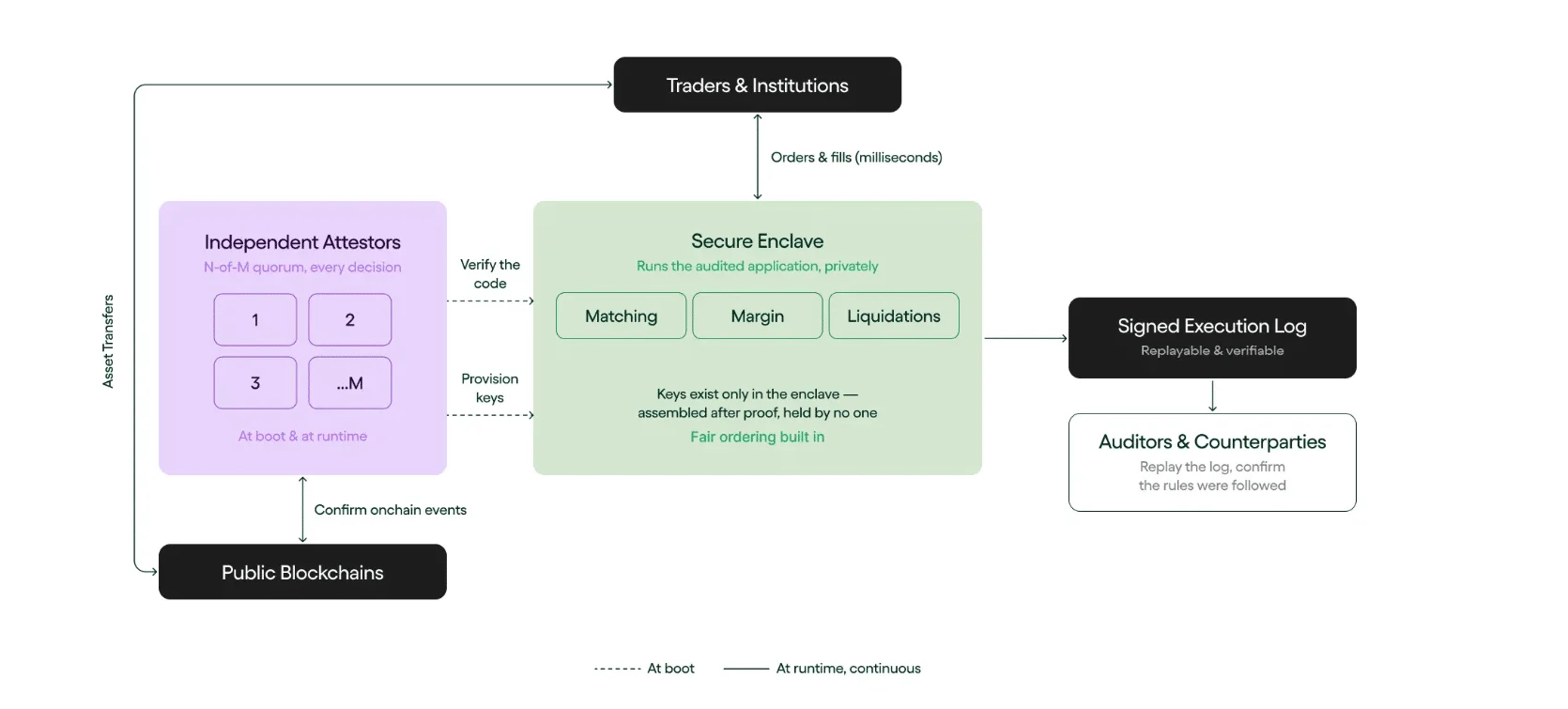
Instead of asking every network participant to process each transaction, the Ondo Network divides responsibilities across specialized components.

Secure enclaves (trusted execution environments) first execute application code inside protected hardware, where operators cannot view or alter it. Even changing a single byte prevents the code from running.

Source: Ondo Finance

Meanwhile, independent attestors verify that only the approved code operates before they reconstruct the security keys used to confirm transactions via public blockchain.

This approach keeps verification separate from execution, allowing applications to process trades with centralized exchange-like speed without sacrificing security.

Will Ondo’s infrastructure lead to adoption?

Although the architecture provides solutions to long-standing problems related to infrastructure, the ultimate value will depend upon how many users adopt this architecture.

Ondo Finance currently manages almost $3.5 billion in Total Value Locked (TVL). Therefore, there exists a solid institutional basis to provide a high level of credibility in terms of managing large amounts of capital

If capital continues flowing through the network, wallet growth, transaction values, and liquidity should expand together. That momentum would indicate execution quality drives broader adoption.

Over time, stronger developer activity, new protocol launches, higher network TVL, and rising transaction counts would determine whether Ondo evolves into a broader institutional financial ecosystem.


Final Summary

  • Ondo is extending its RWA leadership with infrastructure that combines centralized exchange speed and non-custodial blockchain settlement.
  • The network needs sustained institutional adoption and ecosystem growth to turn its $3.5 billion TVL into long-term network expansion.


Source link

Inside the CME and CFTC’s battle over onchain perpetual futures

0
Inside the CME and CFTC’s battle over onchain perpetual futures

It’s highly unusual for the largest derivatives exchange operator in the U.S., the CME Group, to be at war with its regulator, the Commodity Futures Trading Commission (CFTC) — but that’s now happening in a situation brought about by the agency’s decision to allow blockchain-based perpetual future products.

Last month, the CME sued the ​CFTC and its chairman, Mike Selig, challenging his decision to let ‌the prediction markets platform Kalshi and cryptocurrency exchange Coinbase (COIN) list crypto perps, decentralized derivative contracts that allow users to speculate on the price of an asset with leverage and no expiration date.

Now, both sides await federal court action that could have significant influence on how the U.S. approaches the rapidly growing arena, with non-U.S. perps volume reportedly growing to $60 trillion in volume last year.

CME claims the agency is mislabeling the products, and therefore misapplying the law. Futures need an end date, and the products known as perps are designed for traders to be able to take a financial position on an asset’s future without any deadlines. The lawsuit argues these perps are harmful to its long-dated futures products and alleges that the CFTC’s sudden embrace of them did not consider the ramifications.

Mounting tension between the two entities ramped up around the start of Iran conflict, which saw interest spike in perpetual contracts on oil prices traded 24/7 on off-shore decentralized finance (DeFi) exchanges like Hyperliquid, as well as blockchain prediction markets hosting trades tied to the oil markets.

Those on the side of the CFTC’s reforming agenda in this highly politicized schism are voicing frustration, if not outrage.

“It is unbelievably unusual to see the largest exchange in America attacking its own regulator, where the regulator is basically saying everybody who’s registered, including the CME, can offer these types of products, and the CME says no one should be allowed to offer them,” said Jake Chervinsky, CEO of Hyperliquid Policy Center (HPC) in an interview.

HPC is a Washington, D.C.-based non-profit focused on creating compliant DeFi in the U.S, heavily focused on perps and on-chain financial infrastructure, and backed by a $28 million initiative from the Hyper Foundation.

Not long after CME filed suit, this disagreement took another turn, when the exchange made a bid to fast-track 24/7 trading for crude oil futures but was blocked by the CFTC. CME Group’s attempted 24/7 West Texas Intermediate (WTI) crude oil contract is a traditional expiring futures product rather than a crypto-style perpetual swap. The CME had cited investors’ desire to manage their positions “whenever news breaks.”

Representatives of the CFTC declined to comment. At the time, CFTC Chair Mike Selig said on X that “CME’s decision to disregard the Commission’s effort to undertake a reasoned analysis of the critical issues at stake is wholly inappropriate.”

CME, which played a significant role in getting bitcoin futures listed and was helpful in getting crypto accepted and adopted in the U.S., has a deep influence over commodities that the exchange has successfully wielded in Washington D.C. over the years, thanks in large part to its outspoken chairman, Terry Duffy.

“The definition of a swap is pretty clear,” he said in an interview with CoinDesk. “When two parties exchange payments to each other, that is deemed a swap,” he said. “When you’re dealing in swaps contracts, that comes with obligations to maintain five-day margin and register with the CFTC as a participant in the swaps market.”

As such, the CFTC did not follow the protocol which is effectively the law of the land, Duffy claimed, adding a complaint that the CFTC may not be prepared to enforce its emerging perps policy properly, such as blocking non-U.S. traders from trading on Kalshi or other CFTC-regulated platforms. “What are you doing to police U.S. participants from not participating in something that it’s illegal for them to do?” Duffy asked.

“I’ve not seen an answer to that yet, but yet they’re holding up my 24/7 contract of self certification,” he said.

Duffy had tangled with opponents in the digital-assets space before, once debating then-FTX CEO Sam Bankman-Fried on the industry’s efforts to cut out intermediaries months before Bankman-Fried’s company collapsed and he was imprisoned on a conviction tied to fraud.

During the CME’s recent Q2 earnings call, Duffy addressed the growing market presence of perpetual futures, stating that institutional clients do not use perpetuals for hedging. He said that CME has “the full technical and operational capabilities to launch perpetual futures” but “have not heard demand from our customers for these products.” Duffy went on to describe competitors’ perp markets as “an incubator system that I’m not paying for.”

When it comes to the way futures contracts work on traditional commodities, the structure differs from crypto, according to Liz Davis, partner and co-chair of the financial services practice at the law firm Davis Wright Tremaine.

“These perpetual contracts that started out in the crypto space are a different type of product than, say, pork bellies or crude oil,” Davis said in an interview. “There’s an underlying tension with these new types of products being offered on traditional commodities. Here you have delivery issues, and it really isn’t traded 24/7, because you have monthly contracts that you roll from month to month.”

Davis said there’s a lot to consider in a market in which the commodities the perps are tied to can be limited to trading only five days a week and set to only change hands within certain hours, as opposed to being always on.

“You just need to think through the various issues in terms of marginal liquidity and custody over the weekend; staffing and resources; your surveillance now needs to go over to the weekends and holidays, etc.,” she said.

Duffy’s crypto perps stance is viewed by crypto natives and DeFi enthusiasts as typical of the way large incumbents handle innovation that might threaten their dominance.

“It’s really going to come down to this sort of policy fight between this massive incumbent and the regulator who is trying to allow challengers to that incumbent, allowing competition that the incumbent doesn’t want to see happen,” HPC’s Chervinsky said, adding:

“The issue with the CME isn’t whether they’re pro or anti-crypto. It’s an incumbent using regulation to hold off competition, and they’re willing to take opposite positions depending on the moment to try to beat back the competition.”

So the future of CFTC-driven perps remains on a bubble as the CME readies its case, which includes claims that the agency rubber-stamped the Kalshi application, which had been submitted a day before approval.

“The CFTC approved perps despite a history of arguing they are swaps and without issuing a regulation despite seeking public comment in April 2025,” noted Jaret Seiberg, a financial policy analyst with TD Cowen, arguing the CME may have the “upper hand” in this legal dispute. “This distinction matters as the regulatory and tax regimes for swaps and futures are different.”

Though the CFTC is meant to be a five-member commission, Chairman Selig currently occupies the leadership as its lone member, so his is the lone voice of the agency. And he wanted the regulator to clear a path for U.S. perps in the crypto space, signing off on a Kalshi product and approving customer activity at Coinbase.

“It’s interesting that this is being done with a single-person commission,” Davis said. “When you have a five-person commission, the rulemaking doesn’t go as quickly, because of the counter view. So you’re sort of getting deprived of that counter view, other than the CME bringing suit and their commentary.”

Representatives of Kalshi and Coinbase declined to comment about the perps regulatory situation.

So far, Selig’s agency is opening up this U.S. market through a policy statement — not a new rulemaking that gives interested parties a chance to comment and try to steer the outcome. It’s much the same crypto approach as its sister agency, the Securities and Exchange Commission, which has issued a wide array of new policy statements without yet pursuing formal and durable rules.

The CFTC determined that a case-by-case review process was suitable for perps. As a result, Kalshi’s debut offering emerged last month, and the company said it reached more than $1 billion in trading volume in less than a week.


Source link

Shein Long-Awaited IPO Just Got Harder To Sell As Tariffs Bite

0
Shein Long-Awaited IPO Just Got Harder To Sell As Tariffs Bite


Shein has spent the better part of three years chasing a stock market listing, first in New York, then in London and now, finally, in Hong Kong. But the numbers it revealed to prospective investors this week suggest that the pitch has gotten considerably tougher.

The fast-fashion giant swung to a $99 million loss in the first quarter of 2026, a stark reversal from the same period a year earlier. The figures, disclosed in a draft prospectus filed with the Hong Kong Stock Exchange as part of its long-awaited initial public offering, mark the clearest signal yet that tariffs and regulations are landing squarely on Shein’s bottom line.

Part of the loss was a one-off, a $328 million non-cash accounting charge tied to the fair-value treatment of convertible preferred shares, a technical adjustment that converts investor stock into ordinary shares once a company lists.

What might concern investors more is that Shein’s U.S. revenue fell 14.3% year-on-year to roughly $2 billion, as the Trump administration’s removal of the de minimis import exemption in May 2025 stripped away the loophole that had let low-value parcels enter America duty-free.

The exemption’s removal didn’t just raise Shein’s costs, it hit the company at the core of its business model, which depends on shipping enormous volumes of very cheap items directly to individual consumers. The U.S., which accounted for 29.4% of Shein’s annual revenue as recently as 2023, has shrunk to 22.5% of quarterly sales. Its operating margin slid to 2.9% from 3.9% a year prior, as marketing and fulfillment costs rose while sales stagnated.

Shein is now weighing U.S. price increases to offset the added duties but that’s a move that risks eroding its price advantage.

European Regulations Bite Too

And if the U.S. pressure wasn’t enough, Shein flagged that Europe, roughly a third of its annual revenue, could deliver a similar or even larger blow after the European Union introduced a charge equivalent to around $3.50 on low-value e-commerce parcels this month, part of a broader push by Brussels to close what it views as an unfair advantage enjoyed by overseas marketplaces shipping directly to consumers.

Shein’s own filing warned that disruption in Europe could “match or exceed” what it experienced in the U.S.

Zoom out, and the full-year picture is sobering. Shein’s net profit for 2025 fell 38.7%, to roughly $2.06 billion, even as revenue climbed 8% to $37.1 billion, a sharp deceleration from the 20.7% sales growth it posted in 2024.

Meantime, Shein cleared its biggest remaining hurdle on July 10 when it received approval from China’s securities regulator for the Hong Kong listing, targeting for September or October this year and aiming to raise around $3 billion at a valuation of $40 billion to $50 billion.

That’s well below the roughly $98.2 billion it commanded during its 2022 funding round, and even the $64 billion valuation it was assigned in a subsequent 2024 round. And some investors have reportedly pushed for the valuation to be cut further still, to around $30 billion.

That repricing tells its own story. Shein’s IPO has now been rerouted three times, abandoned in New York amid U.S. political scrutiny over its supply chain and labor practices, shelved in London after regulatory and reputational headwinds, and finally redirected to Hong Kong, where Beijing’s backing offers a smoother, if smaller, path to market.

Backers including Sequoia China, Tiger Global, General Atlantic and IDG Capital stand to get their first real liquidity event, whatever the final price.

Analysts Warn Of Further Slip

But some analysts are openly skeptical that Shein can command a premium, or even hold its ground once it goes public. Shen Meng, director at Beijing-based investment bank Chanson & Co, said he doubts Shein will achieve any meaningful uplift in valuation at its Hong Kong IPO or in the secondary market compared with its last private fundraising round, arguing the retailer would have fared far better had it completed its London or New York listing years earlier.

Tony Huang of Deloitte China’s Capital Market Services Group struck a more optimistic tone in a June note, suggesting that an easing of Middle East tensions and a reopening of the Strait of Hormuz could potentially give Hong Kong listings, including Shein’s, a tailwind. But even that came with an acknowledgment that Shein’s own operational and geopolitical challenges remain the more decisive factor in how investors ultimately price the deal.

According to the filing, proceeds from the listing will fund technology investment, including AI for demand forecasting, alongside international expansion, brand-building and Shein’s corporate responsibility initiatives.

Shein is also pressing ahead with plans to plough roughly $1.5 billion into logistics hub development in Guangdong province to improve operational efficiency at a time when the cost of moving goods across borders has become its single biggest headache.


Source link