Data center operator Core Scientific (CORZ) announced an infrastructure partnership with Advanced Micro Devices (AMD) anchored by 15-year leases for 529 megawatts of U.S. AI capacity, which the company said could generate more than $14 billion in base contracted revenue.
The capacity is expected to support AMD customer deployments beginning in 2027. The agreements give AMD, under certain conditions, the right to reserve another 1,925 MW through Dec. 28, 2028, potentially expanding the partnership to roughly 2.5 gigawatts.
AMD directly leased 377 MW across Core Scientific sites in Pecos and Hunt County, Texas, and Muskogee, Oklahoma, according to the company’s quarterly filing.
An unnamed cloud provider leased another 152 MW in Auburn, Alabama, and Dalton, Georgia, under agreements supported by AMD.
Core Scientific and AMD will collaborate on data-center design and the deployment of AMD Instinct graphics processing units, EPYC processors and ROCm software, the companies said.
AMD also received warrants to purchase up to 30 million Core Scientific shares at $23.47 per share. About 6.5 million vested when the initial leases were signed, with further warrants vesting as additional capacity is contracted.
Apple (AAPL) on Tuesday briefly became the second publicly traded company in history to hit a market capitalization of $5 trillion.
The tech giant hit the milestone less than a year after topping $4 trillion in October 2025.
Apple stock is up roughly 24% year to date and nearly 60% over the past 12 months, driven by strong iPhone sales.
Investors have criticized Cupertino, Calif.-based Apple over the past few years, concerned that the company was too far behind in the AI race. While Apple initially debuted its Apple Intelligence platform in 2024, it delayed key parts of the software, including an upgraded version of Siri.
That led to executive shakeups at the company. Apple eventually signed a deal to use Google’s (GOOG, GOOGL) Gemini AI models to power the voice assistant.
Apple is now expected to launch the overhauled Siri as a beta alongside its highly anticipated first foldable iPhone and the iPhone 18 lineup later this fall.
The company’s lack of heavy AI exposure has meant it hasn’t seen the same kind of explosive growth as some of its Big Tech peers since OpenAI (OPAI.PVT) released ChatGPT in November 2022.
Of the group, Nvidia (NVDA) stock has benefited the most, climbing about 1,125%, while Meta (META) stock rose around 386% and Google jumped 226%. Shares of Apple, meanwhile, increased 130% during that time.
But Apple was also insulated from some of the steep selloffs that its AI-focused rivals have faced. Microsoft (MSFT) stock, for instance, has struggled since hitting an all-time closing high of $542.07 in October 2025, falling roughly 28% on questions about AI spending and growth.
AI, however, has hit Apple in another way. The company, like much of the consumer tech industry, is currently contending with the AI-induced global memory and storage shortage.
That has forced Apple to raise prices on its Mac and iPad products, among others. And while the company hasn’t increased iPhone prices yet, that could change with its upcoming smartphones.
All of this comes as Apple CEO Tim Cook prepares to hand over the reins to incoming CEO John Ternus on Sept. 1, marking one of the biggest leadership transitions in the company’s history.
Jared Blikre contributed to this story.
Sign up for Yahoo Finance’s Week in Tech newsletter. ·Yahoo Finance
Email Daniel Howley at dhowley@yahoofinance.com. Follow him on X at @DanielHowley.
In the current suit, James Ramirez, claims he downloaded the app on July 25, 2025 and had 7.4 BTC “transferred to a scammer.” He reported the app and theft to Apple that day, according to the filing. Christopher Ellis allegedly lost about $840,000 after installing the app on Aug. 3.
Jalen Delgado, who had downloaded the app around May 1, 2025, lost 1.05 BTC, then worth roughly $120,000 after relying on “Apple’s representations that its App Store was safe and the apps hosted in the Apple App Store had been vetted by experts,” according to the filing.
Ramirez and Ellis said Apple never responded to their reports.
The official Sparrow Wallet is a desktop-only application available for Windows, macOS and Linux. It does not offer an iOS version.
The lawsuit alleges Apple ranked the fraudulent application and included it in curated cryptocurrency app collections alongside legitimate products. It also points to Sparrow developer Craig Raw warning in January 2024 that an impersonator remained available despite being reported to Apple weeks earlier.
The case seeks reimbursement of the alleged stolen assets, compensatory and punitive damages and potentially multiplied damages. The plaintiffs also want Apple to disclose the limitations of its review process, strengthen its controls and warn users that an App Store listing does not establish that a cryptocurrency application is authentic.
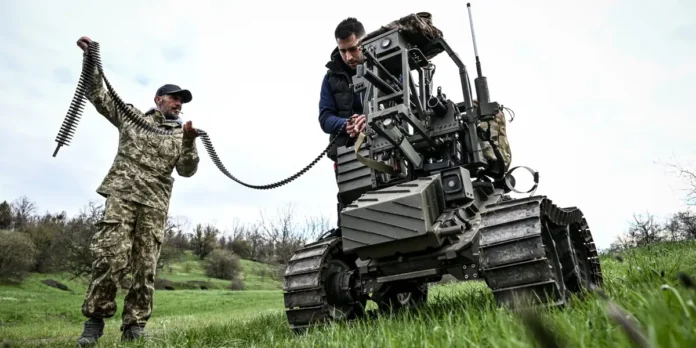
Ukraine is sending ground robots into combat in record numbers to replace its soldiers in deadly roles wherever possible, from logistics missions to front-line assaults.
And while the ground robots are helping save lives, they’re also changing how the Ukrainian military sustains the war as it nears the four-and-a-half-year mark and continues facing manpower challenges.
Ukrainian commanders told Business Insider that one of the benefits of uncrewed ground robots, or UGVs, is their ability to increase Kyiv’s “operational endurance.”
War robots don’t “fatigue in the same way humans do, allowing persistent tasks such as monitoring, transport, or reconnaissance support,” said Grek, a UGV company commander with the 21st Unmanned Systems “Kraken” Regiment. He used his call sign for security reasons.
The commander of a UGV unit in the 2nd “Khartia” Corps, who goes by his call sign Mathematician, said that the main purpose of the ground robots is to decrease the number of soldiers involved in missions.
However, he said the robots have a durability advantage: they can go on more missions than a small infantry unit can, and at any time of day, too. “Without that, the Ukrainian Army cannot exist now, really. So this is definitely about durability.”
Ukraine is pushing more robots into combat to replace soldiers on dangerous missions.
Polina Kulish/Gwara Media/Global Images Ukraine via Getty Images
Ukraine has made UGVs a priority defense investment this year. The country contracted 25,000 robots in the first half of 2026 — twice as many as in all of 2025. And Ukrainian President Volodymyr Zelenskyy wants 50,000 produced by the end of the year.
The investments in this technology underscore Ukraine’s push to replace soldiers with robots in various combat roles, especially deadly logistics missions. Officials have praised the UGVs for their ability to save lives on the battlefield.
The robots are playing a growing role in the war. Zelenskyy said in April that UGVs had logged more than 22,000 missions since the start of the year. The figure had climbed to more than 50,000 by June.
Ukrainian UGV commanders said the aim in using the robots is to reduce the number of soldiers doing dangerous missions, but not actually remove them entirely from the war.
“Keeping humans involved in decision-making remains essential,” Grek said. “UGVs are tools that support people — they can handle the most hazardous parts of a mission while humans provide judgment, control, and responsibility.”
He added that the robots increase efficiency, allowing a smaller number of soldiers to control or coordinate systems that previously required more people and resources.
UGVs have short lifetimes because they travel slowly and lack protection against drones.
Nina Liashonok/Ukrinform/NurPhoto via Getty Images
Ground robots are particularly valuable at the front lines, which have evolved into a miles-wide “kill zone” where any movement can draw a fatal drone strike. Ukrainian officials and soldiers have said this area is growing.
Equipped with advanced sensors and cameras, war robots provide troops farther back with greater situational awareness, allowing them to see closer to the front lines and “extending human capability,” Grek said.
He said operators can “observe, deliver, recover, inspect, or support operations from a safer distance.”
However, as the battlefield becomes deadlier for soldiers, it has also become riskier for robots, which move slowly and lack the same protection against drones that an armored vehicle may have.
Near the line of contact, robots may only survive five or 10 missions before they’re destroyed, said Andrii Kushnierov, a platoon leader with Ukraine’s 59th Assault Brigade.
Mathematician said that in some areas of the battlefield, the life of a robot may be as long as 20 missions. In his, though, it’s maybe three or four. For the Ukrainians, these machine losses are worth it to keep soldiers alive.
Banco Sabadell will introduce a revised organisational set-up to streamline operations, advance its transformation programme and reinforce its relationship banking approach.
The new structure takes effect on 1 September.
The lender said the membership of its management committee will stay the same, leaving its governance arrangements unchanged during the reorganisation.
A central element of the overhaul is a new corporate transformation & artificial intelligence unit within the strategy division overseen by Marc Prat.
Robert Duran will lead the new team, which is intended to support the wider use of AI across the bank.
The operations & technology division under Elena Carrera will also gain additional AI-related capabilities.
In the Spain Business area run by Carlos Ventura, the bank is setting up a business transformation unit.
It is focused on product development for high-value customers, digitalisation and customer-facing projects.
Jorge Rodríguez Maroto, currently head of retail banking, will lead that area.
His responsibilities will also extend to small businesses and the self-employed, adding to his existing remit across financing, payment methods, consumer lending, insurance, asset management and Sabadell Consumer Finance.
Ventura’s area will also include a newly formed commercial banking unit led by Albert Figueras.
Alongside his current work coordinating regional management teams, he will also take charge of remote sales and remote customer service.
A new personal banking unit will be headed by Xavi Blanquet and will report to Ventura.
Separately, the bank recently announced the forthcoming appointment of Adela Martín to lead its private banking business.
Following the changes, Sabadell’s operations in Spain will be divided into five areas: retail banking & business transformation, corporate banking, private banking, personal banking, and commercial banking.
The marketing division will also report to Ventura.
Further adjustments affect the finance division, where Sergio Palavecino will take on responsibility for cost management.
The people & sustainability division under Sonia Quibus will add procurement, while the communications division led by Virginia Zafra will assume full control of internal communications.
The bank also said it will centralise a range of functions now spread across different business areas.
These include people, legal, financial planning, organisation, technology and operations, in an effort to make decision-making more agile.
Sabadell CEO Marc Armengol said: “This new structure will enable us to concentrate more resources and capabilities in the areas that are key to our strategy, accelerate the bank’s transformation and fully harness the potential of artificial intelligence to improve our processes. We want a simpler, more agile and more collaborative organisation, equipped to deliver the best service to our customers and successfully meet the challenges of the years ahead.”
“Sabadell to expand AI focus, centralise key functions in restructure” was originally created and published by Retail Banker International, a GlobalData owned brand.
Since introducing its Ethereum [ETH] treasury strategy in June 2025, Bitmine Immersion Technologies has been buying ETH every week, and in the past week it bought 9,946 ETH.
With this acquisition, the company’s total balance sheet value – which includes cash, marketable securities, strategic equity investments, and cryptocurrency assets – was $11.8 billion.
That said, these purchases happened at an average ETH price of $1,948, bringing the company’s total holdings to 5,787,414 ETH.
Bitmine’s ETH strategy
With this, Bitmine’s Ethereum holdings currently make up about 4.8% of the 120.7 million ETH in total supply that is in circulation.
Of that sum, 4,917,189 ETH (or about 85% of its holdings) is already staked through its institutional staking platform, MAVAN (the Made in American VAlidator Network).
With an estimated yearly staking revenue of $254 million and an annualized staking reward of roughly $299 million based on its current staking yield of 2.65%, the company clearly sees staking as a substantial source of recurring income in addition to ETH price appreciation.
Bitmine’s chairman has high hopes
Beyond staking and accumulating, Bitmine Chairman Thomas “Tom” Lee noted,
Bitmine repurchased 6.1 million shares of common stock in the past week, an increase from the 5.5 million purchased the week prior.
He added,
We increased our equity buyback as we view the rising ETH/BTC ratio, despite the falling odds of passage of the Clarity Act in 2026, as a sign crypto prices are strengthening. In fact, this ratio is now at a 3-month high at 0.3000, which we believe bodes well for future strengthening of ETH prices.
According to Lee, the increased buybacks are a result of better crypto market signals. In particular, the ETH/BTC ratio increased to a three-month high of 0.30, indicating Ethereum is outperforming Bitcoin.
Source: Trading View
Lee also noted that the next significant price targets for ETH are technical resistance levels of $2,000 and $2,500.
Final Summary
Bitmine’s Ethereum holdings have surged to $11.8 billion, with the company adding 9,946 ETH in the past week.
Beyond accumulation, Bitmine emphasizes staking as a recurring income source, projecting that this approach could help drive Ethereum’s price momentum.
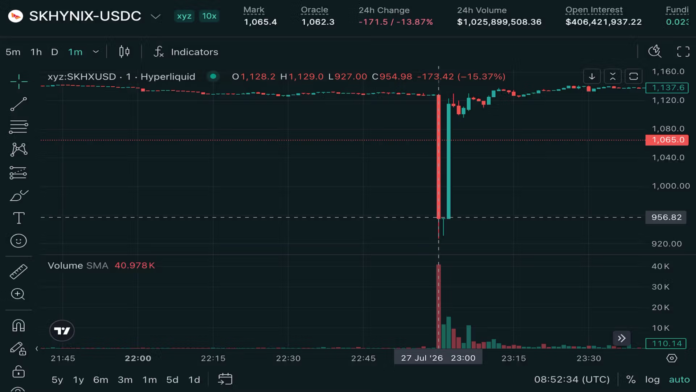
Perpetual futures tied to SK Hynix, a South Korean chipmaker whose American depositary receipts debuted on Nasdaq earlier this month, suffered a flash crash on Hyperliquid shortly before the underlying share price came under pressure in its home market.
Between 23:00 UTC and 23:01 UTC, the price of perpetuals tracking the Seoul-traded stock crashed 20% to $900, according to data from Hyperliquid. The price rebounded to over $1,000 the very next minute and was recently priced at $1,092. The contract is traded and denominated in dollar-pegged stablecoin USDC.
An hour later, the Korean stock market opened on a negative note, led by chipmakers. By the end of the day, SK Hynix shares had dropped by 15% to 1,550,000 won ($1,762). Other losers included Samsung Electronics and carmaker Hyundai Motor. The benchmark Kospi index fell 11%.
SK Hynix ADRs, 10 of which equal one share, fell 4.5% in pre-market trading to $136.51.
Hyperliquid, the leading perpetuals-focused decentralized exchange, has emerged as a hot favorite of traders looking to express their view on traditional assets, especially since the onset of the Iran war in late February. The exchange had not responded to a request for comment by publication time.