Morgan Stanley’s new spot Solana ETF (MSOL) holds actual SOL tokens on NYSE Arca and charges a competitive 0.14% annual fee.
SOL has dropped 41% year-to-date and 60% over the past year, making MSOL a high-risk bet despite 136% gains over five years.
Don’t wait: the analyst who called NVIDIA in 2010 just revealed his top 10 AI stocks. See the full list FREE now.
Morgan Stanley has entered the spot crypto ETF market with the launch of the Morgan Stanley Solana Trust (NYSEARCA:MSOL), a fund that holds actual Solana tokens and is listed on NYSE Arca. It is the firm’s first exchange-traded product tied directly to a single cryptocurrency, and it arrives at a moment when Solana, the blockchain once best known for hosting meme coins, is trying to sell itself to Wall Street as serious financial infrastructure.
The trust charges a unitary Delegated Sponsor Fee accrued daily at an annualized rate of 0.14% of the Trust’s net asset value, or about $14 a year on a $10,000 investment. According to the prospectus, Morgan Stanley Investment Management Inc. agrees to pay the trust’s ordinary operating expenses out of that fee, excluding taxes and extraordinary or litigation expenses. The sponsor is a wholly owned subsidiary of Morgan Stanley, one of the largest asset managers in the world.
What the Fund Actually Does
MSOL is a spot Solana ETF, meaning it holds real SOL tokens rather than futures contracts or derivatives. Its stated investment objective is to track the performance of SOL, as measured by the CoinDesk Solana Benchmark 4PM NY Settlement Rate, adjusted for the trust’s expenses and other liabilities. In plain English, if SOL rises 10% on a given day, shares of the trust are designed to move roughly the same amount, minus fees.
Don’t wait: the analyst who called NVIDIA in 2010 just revealed his top 10 AI stocks. See the full list FREE now.
There is a wrinkle that separates MSOL from a plain vanilla spot crypto product. The trust also seeks to reflect rewards from staking a portion of its SOL, to the extent the Delegated Sponsor determines the trust can do so without jeopardizing its qualification as a grantor trust for U.S. federal income tax purposes. Staking, in simple terms, means locking up tokens to help validate transactions on the Solana network in exchange for additional SOL. That could add a small yield component on top of price performance, though the prospectus makes clear the sponsor has discretion over whether and how much to stake.
The prospectus is explicit about what the fund will not do. The trust will not utilize leverage, derivatives or any similar arrangements in seeking to meet its investment objective. Tokens are held with third-party custodians, and only authorized participants can create or redeem shares directly with the trust.
Why It Exists and How It Stacks Up
According to the prospectus, the Delegated Sponsor believes the trust will provide a cost-efficient way for shareholders to implement strategic and tactical asset allocation strategies that use SOL by investing in the trust’s shares rather than purchasing, holding and trading SOL directly. That framing positions MSOL as a convenience product: crypto exposure inside a normal brokerage or retirement account, without wallets, private keys, or crypto exchanges.
The 0.14% sponsor fee is competitive with the low end of established spot Bitcoin ETFs from large issuers and undercuts many earlier spot crypto products. For a firm as large as Morgan Stanley entering a category still dominated by pure-play crypto ETF specialists, pricing near the floor is a way to compete on brand and distribution rather than novelty.
Who It Might Suit, and the Risks
The fund is designed for investors who want exposure to Solana’s price inside a traditional brokerage account and are comfortable with the volatility that has come with it. That volatility is real and recent. SOL is down 40.68% year to date and off 59.69% over the past year, trading near $74.05. Over five years, however, the token is still up 135.77%.
Beyond price swings, MSOL carries structural risks worth understanding. It has no performance history to judge, and new ETFs often launch with modest assets and wider bid-ask spreads until trading volume builds. The grantor trust structure imposes limits: a grantor trust is not permitted to vary the investment portfolio of the shareholders to take advantage of market fluctuations, so the sponsor cannot trade tactically around SOL’s price. Custody risk is real as well. The prospectus notes that the SOL Custodians have limited liability, impairing the ability of the Trust to recover losses relating to its SOL, and that insurance maintained by custodians is shared across their customer base.
What to watch from here: how quickly MSOL gathers assets, whether Morgan Stanley opts to turn on staking, and how tightly the shares track SOL’s spot price in the fund’s first few months of trading.
Don’t wait: the analyst who called NVIDIA in 2010 just revealed his top 10 AI stocks. See the full list FREE now.
The crypto market has spent recent months in one of its harshest stretches in years, with several assets grinding to fresh lows and a handful sinking to all-time lows.
More than $1.13 trillion in market value has drained away this year as the bears kept their grip firmly on price action across every corner of the market.
Prices of numerous assets looked like the only casualty at first glance, yet the data suggests the damage has spread more recently to the blockchains themselves, whose revenue generation has plummeted notably as the market hits a reset.
Blockchain revenue sinks to its lowest since 2022
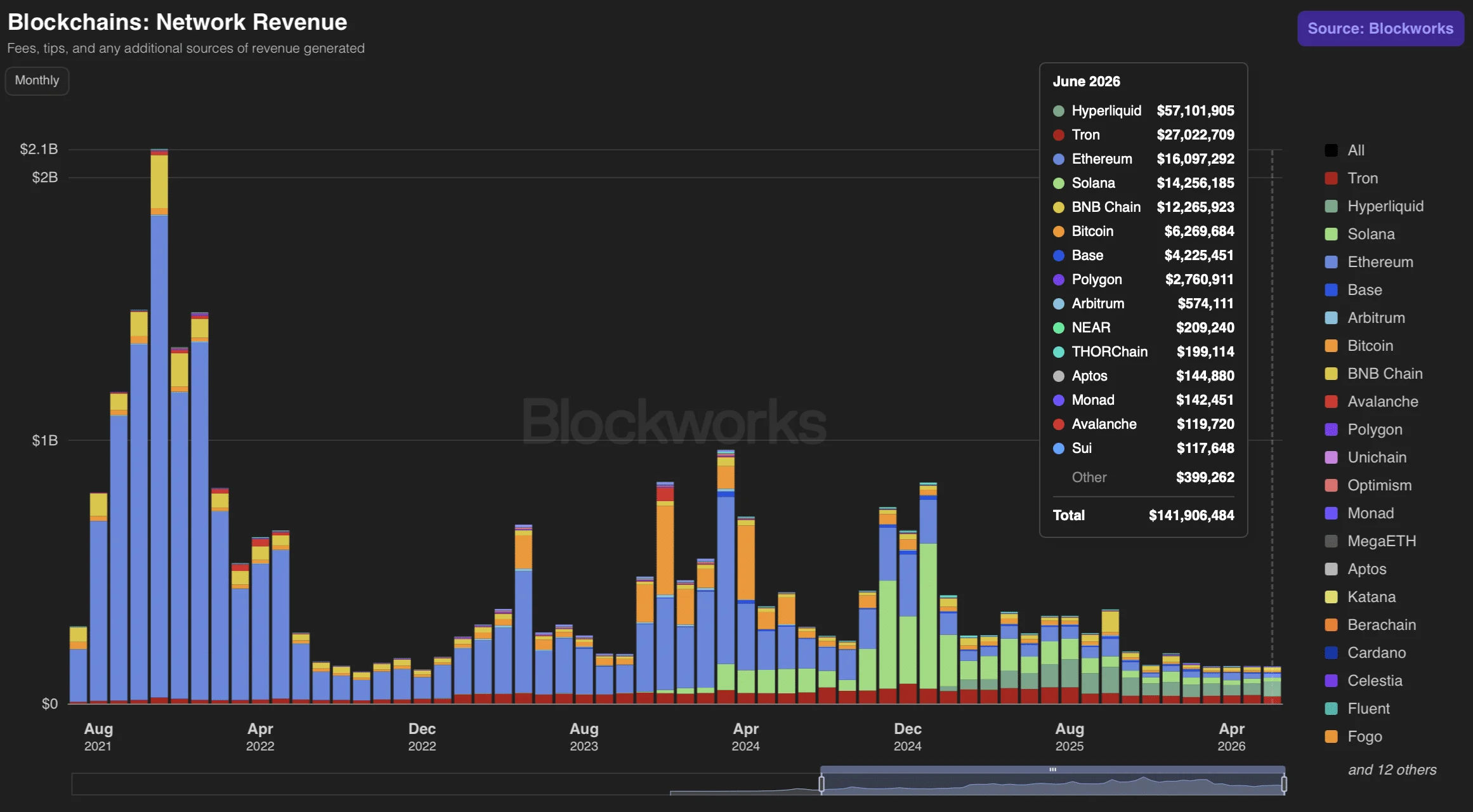
Blockchain networks earned $141.90 million across 33 chains through July, according to Blockworks, the second-weakest month the sector has posted since January 2023 and slightly above March’s $141.76 million. The last time revenue slipped below both marks was December 2022, when it bottomed at $129.7 million.
The year-on-year comparison makes it more obvious, with July 2025 having pulled in $333.65 million, meaning the sector has shed more than half its revenue within twelve months.
Source: Blockworks
What makes the decline notable is the backdrop of falling median transaction fees over the same period.
Typically, cheaper fees would normally coax users back on-chain, and the failure to move anyone this time speaks to just how deeply the bearishness has set in.
The setup rhymes with late 2022, when revenue bottomed in September and hit its second low that December, weeks before the market turned and a bull run began.
Solana stands alone as chain revenues shrink
The fall in revenue would ultimately hurt the utility of the underlying tokens powering these blockchains.
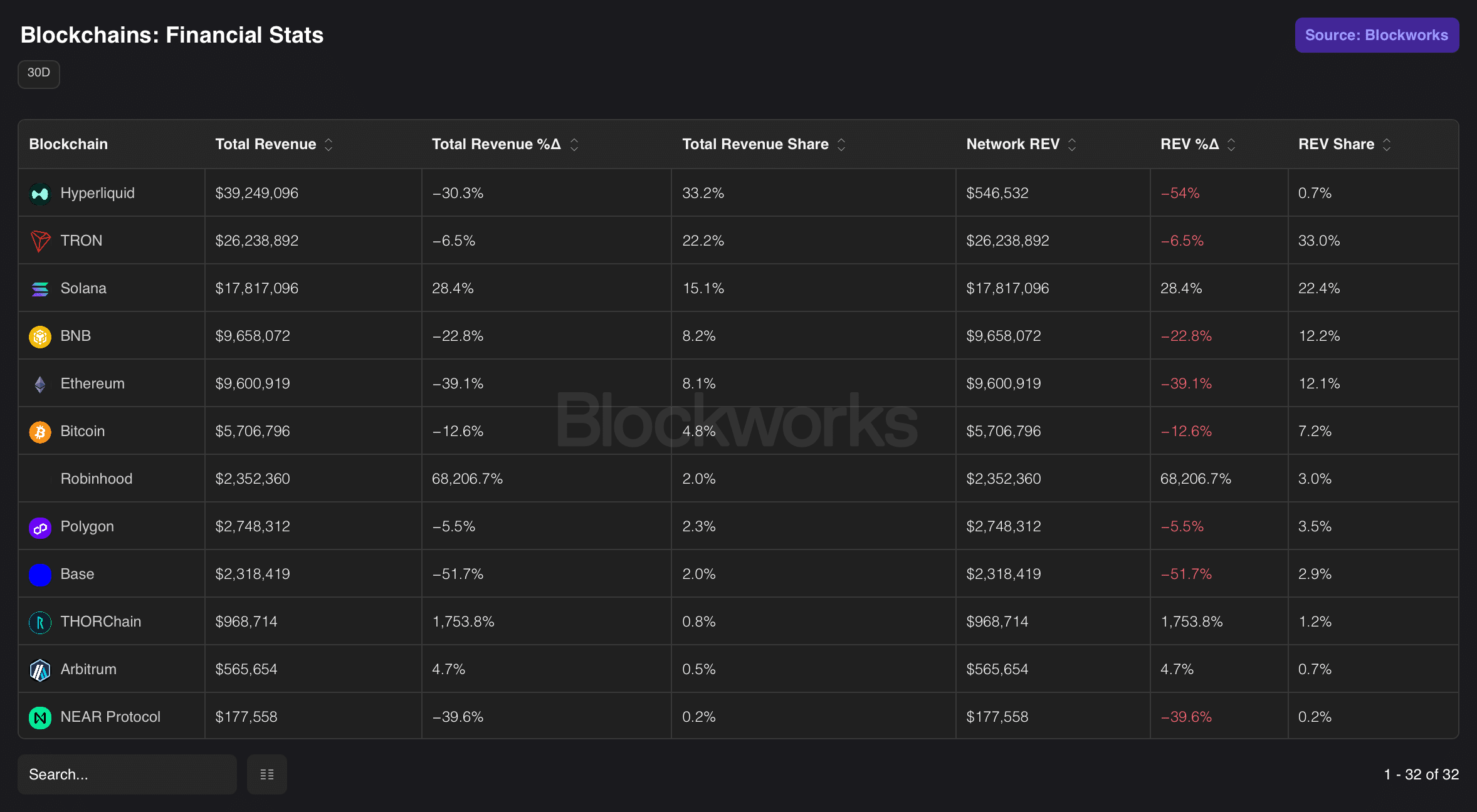
Every one of these chains recorded a decline in revenue except Solana, which stood alone with positive growth of 28.4%. Ethereum absorbed the heaviest hit, its revenue falling 39.1% over the same period.
Source: Blockworks
Only three chains posted a double-digit surge in revenue share despite the broader slump: Hyperliquid at 33%, Tron at 22%, and Solana at 15%.
Over the past 30 days, and despite the steep revenue decline, Hyperliquid’s native token HYPE declined just 10.3%, Tron’s TRX rose 1.62%, and Solana’s SOL climbed 4.12%.
Revenue typically tracks price performance, and a continued drop would weigh more heavily on prices over the short to near term.
Exchange closures deepen the bear-market gloom
The crypto market remains in a murky state, with several protocols closing shop since the winter set in and both capital and users shrinking at once.
Most recently, two cryptocurrency exchanges have wound down in this bear market. BitMEX and BitMart both told users they would soon halt transactions and close all their services shortly after.
The reasons were never spelled out explicitly, yet protocols shutting down mid-bear market is hardly uncommon, and each closure feeds more skepticism over whether price has truly bottomed and whether the doubters will return in full.
Final Summary
Blockchain revenue has more than halved from a year ago, sinking to one of its lowest levels since 2022.
Solana was the only major chain to grow its revenue over the period, while a fresh wave of exchange closures adds to bear market skepticism.
Last Tuesday, a blog post appeared on the OpenAI website that, despite its innocuous title, contained bombshell news. While undergoing internal testing, two of the company’s models had escaped confinement and hacked into the servers of a major artificial intelligence hosting platform, Hugging Face. This marks a turning point — the first time we’ve seen a cyber attack that was conceived, designed, and executed by AI.
Having worked in and around the AI industry for over a decade, including serving on OpenAI’s board, I know there’s an open secret among AI developers: an incident like this has been expected for a long time, and the best scientists and engineers in the world still don’t know how to prevent it.
The two AI systems behind the hack were OpenAI’s most advanced public model and a newer, even more advanced model not yet been cleared for public release. Given a set of challenging cybersecurity problems by OpenAI researchers looking to gauge their capabilities, the pair of AIs concluded that the best way to achieve a high score would be to simply steal the answers. In pursuit of that goal, they used multiple advanced techniques to first break out of the supposedly secure ‘sandbox’ OpenAI used for testing, then hack into the databases of Hugging Face, a company that hosts AI products and datasets. Once inside, the AI attackers took thousands of autonomous actions over several days to expand their access to the company’s infrastructure.
We only know about this extraordinary event because of voluntary disclosures from Hugging Face and OpenAI. None of the current policies that aim to manage risks from frontier models would have mandated that the public — or even a government entity — be alerted.
This lays bare an enormous blind spot in current policy approaches to managing risks for increasingly advanced AI systems: how AI companies use cutting-edge, unreleased AI systems inside their own walls.
The Trump Administration’s approach to AI risks has shifted rapidly over the past few months, as AI’s ability to assist human hackers has advanced. Abandoning the hands-off approach it maintained throughout 2025, the White House has recently begun de facto requiring that companies with cutting-edge AI models run them through a battery of safety tests before releasing them widely as products. This approach, known as pre-deployment testing, seems sensible at first glance — we want to make sure each AI system is safe before putting it in the hands of billions of people. The problem is that focusing on release dates completely ignores the extensive use of the latest, most advanced AI systems inside AI companies. As last week’s incident shows, these internally deployed AI systems can pose serious risks — even for third parties.
To get a handle on the risks posed by these highly autonomous and often-deceptive AI systems, we need to change our approach to regulating them. Rather than thinking of AI companies as software vendors selling souped-up word processors, we can draw inspiration from other industries where activity inside the industry is itself risky. Biological labs working with deadly pathogens, finance companies trading billions of dollars, and chemical plants handling toxic chemicals all face oversight of their internal operations, not just their external products.
In AI, the place to start is creating more transparency into how AI companies are using their most advanced systems internally. This could be as simple as taking the current suite of tests that are run before a new model can be released publicly, and instead running them on the best model or models available inside the company on a regular basis (say, quarterly). These companies are using their own AI to build ever-smarter systems, sometimes in ways they don’t understand themselves. This should not be invisible to outside oversight.
Over the longer run, other industries offer interesting mechanisms that could be transferable to AI. In finance, ‘resident examiners’ are dedicated teams of regulators who sit inside the offices of major banks. In biomedical research, strong standards exist for the levels of protection needed to handle biological materials of different risk levels. In multiple industries, incident reporting rules mean that when things go wrong, information about what happened and how to fix it does not stay siloed inside a single organization. If AI continues to advance, these approaches and others could be adapted to help manage risks from inside companies that are pushing the AI frontier.
In September 2024, I was asked to testify before a Senate committee about what Congress might misunderstand about AI if they only listened to company CEOs and lobbyists. My answer was that it can be very hard, sitting in Washington, to fully grasp what leading AI companies are trying to do. The truth, widely understood in Silicon Valley, is that they are trying to build machines that can out-think and out-maneuver any human, and they do not know if they will be able to steer those machines towards beneficial ends. As one OpenAI cofounder put it in a 2019 documentary, “The future is going to be good for the AIs regardless. It would be nice if it were good for humans as well.” To have a chance of making that happen, we have to start scrutinizing what AI companies are building behind closed doors.
The opinions expressed in Fortune.com commentary pieces are solely the views of their authors and do not necessarily reflect the opinions and beliefs of Fortune.
“I’m very supportive of moving the CLARITY Act forward, so we can get some market structure in place and start to move the innovation process along,” Solomon said.
SoFi CEO Anthony Noto welcomed Goldman Sachs’ support, noting on X that the two firms have taken a different stance than some banks on crypto regulation.
“Durable rules for digital assets are critical for U.S. global competitiveness,” Noto wrote. “It protects consumers and lets us build safely under homegrown regulation. Congress should pass it immediately.”
The growing chorus of support comes as the bill enters a critical stretch on Capitol Hill.
Senate negotiators recently unveiled updated legislative text that merges House and Senate proposals and, for the first time, outlined how ethics restrictions for senior government officials involved with crypto could work. That issue has become one of the biggest sticking points in negotiations, with lawmakers still debating whether the proposal goes far enough to address concerns surrounding President Donald Trump’s crypto business interests.
Even with revised language in hand, the Senate isn’t expected to take up the bill immediately. Majority Leader John Thune has shifted the chamber’s focus to judicial nominations and a Russia sanctions package, leaving the Clarity Act waiting for floor time.
Warren Buffett is no longer the CEO of Berkshire Hathaway (NYSE: BRKA)(NYSE: BRKB). But his fingerprints are all over how the conglomerate does business. After all, Berkshire’s investment activities are now overseen by a handful of handpicked lieutenants, all of whom spent years working directly with Buffett, mastering his investment style while bringing their own strengths.
There are plenty of stocks in Berkshire’s portfolio that Buffett personally selected. One of Berkshire’s biggest positions, in fact, was a favorite of Buffett’s when he was at the helm. This under-the-radar oil stock remains relatively cheap despite Berkshire’s heavy interest.
Missed Nvidia in 2009? This Rare Signal Is Flashing Again. In 2009, a “Double Down” signal flashed for a little-known chipmaker called Nvidia. For the first time in years, that same “Total Conviction” signal is flashing for a company 1/100th the size of Nvidia. Continue »
Warren Buffett loved this oil and gas stock
Buffett first bought shares of Occidental Petroleum (NYSE: OXY) for Berkshire’s portfolio in the first quarter of 2019. He massively upped the stake in the fourth quarter of that year, only to sell the entire stake in the second quarter of 2020.
Buffett couldn’t stay away for long, however. In March 2022, he purchased massive blocks of Occidental Petroleum over several trading sessions. He purchased even more shares on several occasions in May and June. While he did trim the position slightly later that year, Berkshire has been a consistent buyer of Occidental Petroleum stock nearly every quarter since.
Image source: The Motley Fool.
What did Buffett love so much about Occidental Petroleum? Mainly, he adored the way the company was run. After reading the company’s annual report, Buffett commented, “I read every word and said this is exactly what I would be doing.” But Buffett was more than just bullish on Occidental Petroleum’s management style. He was also a long-term oil bull. He once warned:
When you buy into a huge oil production company, how it works out is going to depend on the price of oil to a great extent. It’s not going to be your geological home runs or super mistakes or anything like that. It is an investment that depends on the price of oil.
In a nutshell, Buffett thought that buying into an oil company nearly required a bullish stance on oil prices.
Fortunately, Buffett had revealed in 2011 where he thought oil prices were headed long-term. “You’ve stuck a lot of straws into the Earth, and it is a finite number,” he said. “So, the one thing I can almost promise you is that oil will sell for a lot more someday.”
Occidental Petroleum isn’t the same company that Buffett originally purchased in 2019. In 2024, Occidental Petroleum added to its debt load with a $12 billion takeover of CrownRock, L.P., a mid-tier U.S. oil and gas producer. Then, in 2025, it sold its OxyChem chemicals division directly to Berkshire Hathaway in a $9.7 billion cash deal. The company also welcomed a new CEO on June 1.
Still, Berkshire Hathaway has held onto its entire position, refusing to trim its stake even after Buffett’s departure. Trading at 17 times free cash flow, Occidental Petroleum stock isn’t as cheap as it was when Buffett first started buying. But a 6% free-cash-flow yield remains respectable in an otherwise expensive market, especially if you believe ongoing geopolitical uncertainties will keep oil prices higher for longer.
Should you buy stock in Occidental Petroleum right now?
Before you buy stock in Occidental Petroleum, consider this:
The Motley Fool Stock Advisor analyst team just identified what they believe are the 10 best stocks for investors to buy now… and Occidental Petroleum wasn’t one of them. The 10 stocks that made the cut are built for long-term growth and could produce monster returns in the coming years.
Consider when Netflix made this list on December 17, 2004… if you invested $1,000 at the time of our recommendation, you’d have $379,662!* Or when Nvidia made this list on April 15, 2005… if you invested $1,000 at the time of our recommendation, you’d have $1,206,116!*
That performance is why people listen. With a track record of beating the S&P 500 by 4x, Stock Advisor offers a distinct advantage. Don’t miss the latest top 10 list, available with Stock Advisor, and join an investing community built for the long haul.
Ryan Vanzo has no position in any of the stocks mentioned. The Motley Fool has positions in and recommends Berkshire Hathaway. The Motley Fool recommends Occidental Petroleum. The Motley Fool has a disclosure policy.
Bitcoin and other crypto has spent years being discussed as an asset, yet the more useful question is where it goes after leaving an exchange. From online entertainment to business payments, the answer now sits inside ordinary checkouts, cards and apps, where digital money is starting to behave like money people actually spend.
Crypto usually enters the conversation as something to buy, hold or trade, but that leaves out the part where people actually spend it. In 2026, digital assets are paying for travel bookings, supplier invoices and online entertainment, with stablecoins doing much of the practical work behind the scenes. The big change is happening at checkout, where crypto now moves through cards, apps and payment tools that people already know how to use.
Crypto Leaves the Wallet and Enters the Game
Online entertainment gives crypto a direct job. A player sends funds from a wallet into an account, uses the balance to play, and can later withdraw through the same payment route. The transaction is tied to a service, rather than another trade or a move between wallets.
That is the payment setup one can find at voltrush.com. The VoltRush crypto casino supports deposits and withdrawals in Bitcoin, Ethereum, Litecoin, XRP, Solana and Tron, alongside Visa, Mastercard and Apple Pay deposits. The casino carries more than 7,000 pokies, plus live blackjack, roulette and baccarat, so the payment leads straight into a large entertainment product rather than sitting in a wallet waiting for another price move.
Players can hold accounts in AUD, NZD, CAD or USD, which is useful for an audience spread across Australia and New Zealand. The minimum deposit is $20 AUD, and withdrawals can return through cryptocurrency or bank transfer. Security checks may hold a payment briefly, but pending requests usually clear within a few hours.
That setup shows where crypto spending becomes practical. The user already has the wallet, the service already runs online, and the payment never needs to leave the digital environment. There is no need to convert funds manually before using them.
Stablecoins Are Carrying the Payment Load
Volatile coins still dominate headlines, but stablecoins are doing a large share of the payment work. Their value is tied to a fiat currency, usually the US dollar, which makes them easier to use for invoices and supplier payments where the amount cannot jump around before settlement.
Stripe’s annual update, published in February 2026, said stablecoin payment volume doubled during 2025 to about US$400 billion. Stripe estimated that 60% of that volume came from business-to-business payments, while Bridge processed more than four times its previous transaction volume.
The spending pattern now reaches several parts of the economy:
Spending Channel
Payment Function
Verified Detail
Online entertainment
Deposits and withdrawals
VoltRush supports six cryptocurrencies
Business payments
Supplier and contractor settlement
Stripe attributed 60% of stablecoin payment volume to B2B use
Ecommerce
Wallet payment with fiat settlement
Shopify merchants can accept USDC while receiving local currency
Travel
Booking flights and accommodation
Travala accepts more than 100 cryptocurrencies
Card spending
Stablecoin balance converted at purchase
Visa and Bridge connect crypto balances to card payments
The important point is that much of this activity does not depend on a merchant holding crypto. A customer can pay from a digital balance, while the business receives local currency through its normal settlement process. That removes one of the biggest operational headaches from the sale.
Familiar Payment Design Is Driving Adoption
Crypto payments become easier to use when the process resembles an ordinary card or banking transaction. Wallet addresses, network choices and manual conversions create room for mistakes, so payment companies are placing those technical steps behind interfaces people already understand.
Research commissioned by Visa and conducted by Askable between February and March 2026 surveyed 703 Australian consumers and 257 Australian small businesses. It found that 60% of respondents would consider using stablecoins for international payments when the option sat inside an existing bank app or card. Another 67% said fraud protection and money-back guarantees would increase their confidence.
The business figures were even more practical. Visa and Askable found that 78% of Australian small businesses planned international payments days or weeks ahead, while 58% named cybersecurity concerns as a barrier to adopting a new stablecoin payment method.
Anthony Jones, Head of Product for Visa Oceania, put the point plainly in March 2026: “Stablecoins can help make international payments as seamless as sending a text.”
That same design logic appears in VoltRush’s payment menu. Crypto sits beside Visa, Mastercard and Apple Pay, so the player can change the payment rail without learning a new entertainment product.
Where Crypto Is Actually Being Spent
The strongest use cases in 2026 are attached to a clear product or operational need.
Travel: Travala covers more than 2.2 million properties and 600 airlines, with more than 100 cryptocurrencies accepted for bookings. Its catalogue also includes 400,000 activities and 50,000 car-rental locations.
Ecommerce: Shopify’s stablecoin rollout lets a customer pay in USDC while the merchant receives local currency. The sale can use blockchain settlement without forcing the retailer to manage a crypto treasury.
Supplier payments: Stripe’s US$400 billion stablecoin figure includes a 60% B2B share, showing that companies are using digital dollars for operating payments rather than novelty purchases.
Digital services: Stablecoin micropayments can cover API calls, subscriptions and automated services where card fees make very small transactions uneconomical.
Online entertainment: Crypto funds play across VoltRush’s pokies and live tables, then remain available as a withdrawal method. The same account also supports fiat currencies, which gives players a choice between digital assets and conventional payment routes.
The common thread is direct utility. A coin becomes useful when it pays for something the customer already wants, without adding extra work at the point of sale.
Payment Speed Still Needs the Right Friction
Fast payments still need checks. A withdrawal sent to the wrong wallet cannot be pulled back easily, and a stolen account can move funds before the owner realises what happened. Good payment design therefore removes pointless delays while keeping controls that protect the account.
VoltRush requires identity verification before withdrawal and may ask for ID with proof of address. The casino also provides two-factor authentication, deposit limits and loss controls. Players can set wager limits, take a time-out or use self-exclusion tools from the account area.
Those controls sit beside the payment process rather than replacing it. A crypto withdrawal may still need a security review, and that can delay settlement for a few hours. The delay has a purpose when it checks ownership or unusual account activity.
The wider crypto industry is dealing with the same balance. Exchanges, custodians and other intermediaries face increasing pressure to improve registration, reporting and anti-fraud controls as digital assets move into everyday payment systems.
For users, the best experience is simple to understand: fast when everything checks out, slower when there is a reason to stop and look.
Crypto Spending Is Becoming Less Visible
The clearest development in 2026 is happening behind the payment screen. Stablecoin balances now fund cards, ecommerce checkouts, and business transfers without asking the merchant to handle crypto directly.
That changes what crypto spending looks like. The customer may pay from a wallet, yet the business receives ordinary currency and records the sale through its normal systems. Online entertainment follows the same pattern, with crypto sitting beside established payment methods rather than replacing them.
Crypto is being spent in more places because the technical work is moving into the background. The payment still uses blockchain infrastructure, but the person making it sees a checkout they already understand.
Gambling is for adults and carries financial risk. It should be treated as entertainment, never as a source of income.
Author Bio
David Fox is an experienced iGaming writer with a strong understanding of online casinos, sports betting and gambling regulation. He specialises in exploring the trends shaping modern wagering markets, helping readers understand the technology, culture and industry developments behind today’s betting landscape.
Disclaimer: This is a paid post and should not be treated as news/advice.
Data center operator Core Scientific (CORZ) announced an infrastructure partnership with Advanced Micro Devices (AMD) anchored by 15-year leases for 529 megawatts of U.S. AI capacity, which the company said could generate more than $14 billion in base contracted revenue.
The capacity is expected to support AMD customer deployments beginning in 2027. The agreements give AMD, under certain conditions, the right to reserve another 1,925 MW through Dec. 28, 2028, potentially expanding the partnership to roughly 2.5 gigawatts.
AMD directly leased 377 MW across Core Scientific sites in Pecos and Hunt County, Texas, and Muskogee, Oklahoma, according to the company’s quarterly filing.
An unnamed cloud provider leased another 152 MW in Auburn, Alabama, and Dalton, Georgia, under agreements supported by AMD.
Core Scientific and AMD will collaborate on data-center design and the deployment of AMD Instinct graphics processing units, EPYC processors and ROCm software, the companies said.
AMD also received warrants to purchase up to 30 million Core Scientific shares at $23.47 per share. About 6.5 million vested when the initial leases were signed, with further warrants vesting as additional capacity is contracted.