Home Blog Page 163

Uphold reduces global headcount by 17% amid enterprise pivot

0
Uphold reduces global headcount by 17% amid enterprise pivot

The cuts come as the crypto industry grapples with a prolonged downturn. After three consecutive quarters of declines, the total cryptocurrency market capitalization fell to around $2.1 trillion at the end of the second quarter, while trading volumes weakened and retail participation slowed amid higher interest rates, geopolitical uncertainty and persistent outflows from crypto exchange-traded fund (ETF).

U.S. spot bitcoin ETFs recorded a combined $6.9 billion of net outflows in May and June. While flows have recovered in July, including a six-day streak of inflows, the rebound remains modest relative to the withdrawals seen during the broader market downturn.

Uphold stressed that it is not closing its U.K. operations or any of its international offices, adding that all locations remain fully staffed and operational.

The firm’s enterprise platform enables banks, fintechs and broker-dealers to integrate digital asset services for their own customers, an area the company said is seeing rapid growth.

The momentum in that business, combined with weaker retail demand, made the restructuring necessary as it shifts personnel and investment toward enterprise products. Further growth announcements are expected in the coming months, the company said.

The firm remains bullish on the long-term outlook for the retail market. “In 2026, we’re expanding our popular consumer app into a multi-asset, blockchain-enabled financial companion,” McLoughlin said. “By year end, the app will offer US stocks, tokenized securities, asset-backed lending, credit cards, prediction markets and enhanced DeFi yield opportunities on assets including XRP,” he added.


Source link

Can Bitcoin outperform gold? THESE macro events may hold the answer

0
Can Bitcoin outperform gold? THESE macro events may hold the answer


The recent halt in military exchanges between the United States and Iran shifted investors’ attention away from traditional safe-haven assets and back toward risk-driven markets. 

Gold had rallied during the conflict as traders sought protection from geopolitical uncertainty. However, analysts later argued that easing tensions reduced the urgency for defensive positioning. 

Several market commentators expected gold to struggle near the $4,100 region after the conflict cooled, while Bitcoin [BTC] stood to benefit if investors rotated capital toward higher-risk assets. That shift arrived just as broader market sentiment improved across equities and digital assets. 

Moreover, traders remained cautious because macroeconomic events still carried the power to reshape market direction. As a result, both gold and cryptocurrencies entered the week with competing narratives rather than a clear trend.

Will macro events decide the next winner?

Investors closely monitored a packed economic calendar that placed both crypto and gold at another decisive crossroads. 

The U.S. stock market reopened after the U.S.-Iran ceasefire, while lawmakers prepared for another possible discussion around the Clarity Act on the 28th of July. 

Markets also awaited the Federal Reserve’s interest rate decision on the 29th of July alongside earnings from Microsoft, Meta, and Kevin Warsh’s scheduled remarks. 

The following day brought PCE inflation data, Bank of Japan and Bank of England rate decisions, plus earnings from Strategy and Apple. Each event carries the potential to reshape expectations around liquidity, interest rates, and risk appetite. 

China fueled fresh debate over gold markets

According to reports, China intended to impose restrictions on the trading of paper gold, adding even more uncertainty to the commodity markets. 

The discussion centered on China’s reported holding of roughly 30,000 tonnes of physical gold while concerns grew over leveraged paper contracts determining market prices. 

Analysts argued that one ounce of physical gold often supported multiple paper claims, leaving price discovery heavily influenced by derivatives instead of physical demand. 

That narrative encouraged speculation that confidence could gradually shift toward physical metal ownership. However, the development also carried broader implications for cryptocurrencies. 

Bitcoin supporters have long promoted the asset as a transparent alternative to traditional financial markets because its supply remains verifiable on-chain. Therefore, any decline in confidence surrounding paper gold markets could strengthen Bitcoin’s appeal among investors seeking assets with greater transparency and fixed issuance.

Source: X

Bitcoin’s historical signals revived long-term conviction

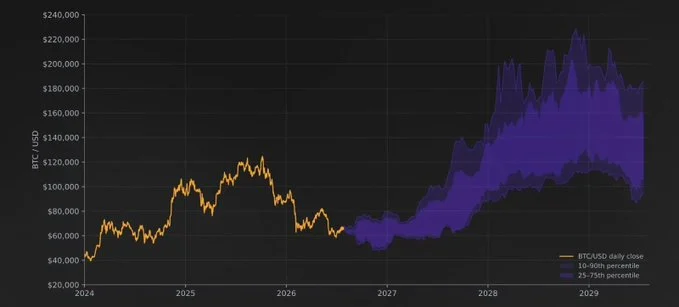
Bitcoin also attracted renewed attention after Blockworks Research highlighted several historical valuation signals. BTC traded at its most oversold level relative to the Nasdaq in recent history. 

The report also showed Bitcoin reaching an extreme oversold condition against gold while changing hands only 18% above its realized price of approximately $53,000. 

Previous bear market cycles had formed bottoms roughly 60 weeks after each all-time high, while the current cycle approached 40 weeks since its peak. Those comparisons suggested Bitcoin had entered a valuation zone that historically rewarded patient investors. 

Although history would not guarantee another identical outcome, the data indicated that downside pressure had already eased significantly compared with earlier stages of previous market cycles.

Source: X

Final Summary

  • Bitcoin’s historical valuation signals strengthened while gold’s geopolitical support started fading.
  • Macro events this week could determine whether investors favor crypto or traditional safe havens.


Source link

Kalshi, Polymarket win pause against Minnesota’s prediction market ban

0
Kalshi, Polymarket win pause against Minnesota's prediction market ban

A federal judge ruled that Minnesota’s law banning prediction markets likely runs afoul of the Commodity Exchange Act, granting a preliminary injunction against the law to Kalshi, Polymarket and the Commodity Futures Trading Commission.

Judge Katherine Menendez, of the U.S. District Court for the District of Minnesota, ruled Monday that Minnesota’s recently passed law that would ban prediction market operators from offering their products in the state seems to be preempted by the federal CEA, and that the companies and federal regulator “are likely to succeed” in showing so after a full trial.

Kalshi, Polymarket and the CFTC sued Minnesota earlier this year after the state passed the law criminalizing the operation of prediction markets, arguing that the statute violated the CFTC’s jurisdiction to oversee “swaps,” which prediction market contracts are structured as.

In her ruling, Judge Menendez said that the three parties had shown they were likely to succeed in their arguments that the law underpinning U.S. commodities exchanges preempts the state law, that the CFTC has jurisdiction over these products and that the plaintiffs would likely succeed on the merits of the case.


Source link

Stop Asking for Links. Publish One Number Nobody Else Has.

0
Stop Asking for Links. Publish One Number Nobody Else Has.


Opinions expressed by Entrepreneur contributors are their own.

Key Takeaways

  • Instead of sending cold outreach that asks for links, businesses are more likely to earn citations and media coverage by publishing unique, credible data from their own records
  • As AI-powered search reduces clicks to traditional websites, publishing original research increases the chances of being cited in articles and AI-generated answers, helping build long-term visibility and authority even when users don’t visit the site directly.

Most outreach asks for value and offers none in return. The businesses that earn links and citations publish proof first.

Every Monday morning, I open my inbox and find the same email waiting 30 or 40 times. The subject line says “quick question” or “collaboration opportunity.” The body asks me to add a link to an article I wrote three years ago, points to a homepage and offers nothing in return.

I run a digital PR agency called ESBO and publish a handful of industry sites, so I sit on both sides of this trade. I send outreach for a living, and I delete it for a living. The deleting takes less time every year, because the emails all share one flaw: they ask, and they bring nothing an editor can use.

None of this is personal. Muck Rack’s State of Journalism 2026 survey found that 88% of journalists delete pitches that miss their beat, and about half say they seldom or never respond to pitches at all. What interests me is the small group of requests that get a yes, because the reason is usually unglamorous and repeatable: they arrive carrying proof.

When I cite a source in an article, one question decides it. Does this page back the claim I am making? A homepage backs nothing, and neither does a services page with a paragraph about passion for excellence.

What backs a claim is a number attached to a method. In the same Muck Rack survey, 40% of journalists named original data or research among the elements they value most in a pitch. That matches what I see in my own inbox so closely it barely counts as a finding.

Imagine two emails from the same moving company. One says it is a trusted leader in relocation services. The other says it compared 2,400 quotes against final invoices this year and found that the typical move cost 23% more than the estimate. The first email is marketing. The second is a source, and I would cite it by Friday.

The data you already have is the asset

You do not need a research department for this. Any business that has operated for a few years is sitting on records nobody else can see: quotes, invoices, support tickets, return reasons, delivery times and refund rates. That pile of admin is the raw material.

An accounting firm could publish how many of its clients file in the final week and what the panic costs them. An online store could break down its return reasons by product category. A recruiter could report how long candidates in one niche stay in their first job. The work is not complicated. It comes down to pulling six to 12 months of records, removing anything that identifies a client and writing up what you found.

Honesty about scale matters here. If your dataset is 300 projects, say it is based on 300 projects. Small and real beats big and vague, and editors can tell the difference in seconds.

One good number outworks a hundred cold emails

There is a bigger reason to do this in 2026, and it is the way answers now get assembled. A Pew Research Center analysis of real browsing behavior found that when an AI summary appears on a search page, people click a traditional result in 8% of visits, down from 15% without one. Clicks on the sources cited inside those summaries happen about 1% of the time.

You could read that as a reason to give up on visibility. I read it the opposite way. If answers are assembled from a handful of sources and almost nobody clicks through, the only durable position is being one of those sources, because your name travels with the number even when the visit never happens.

I have watched this on my own sites. Articles built around one original figure keep getting picked up in roundups, newsletters and AI answers years after publication, while pure opinion pieces fade within months. Something else happens too, and it still amuses me: once you become the source, the emails reverse direction. People start writing to you, asking to be included in the next update.

The easiest number to copy wins the citation

Packaging decides whether any of this gets used. Put the main finding in the title, then repeat it in the first hundred words as one plain sentence someone can lift. Explain the method at the bottom. Refresh the numbers once a year so the citation stays current and earns a second round of pickups.

And do not gate it. I have lost count of the promising reports I abandoned because the figure I needed sat behind a lead capture form (abandoned is generous; I closed the tab in five seconds). An editor on deadline will not fill in a form, and neither will a language model.

The hit rate is nothing to brag about. Most of these assets get ignored, and in my experience roughly one in three earns real pickup. The one that lands pays for the other two many times over, which is still a better return than any cold sequence I have ever run.

I still send outreach every week, so this is not a sermon against asking. Asking just stopped working on its own. If you want links, mentions and a place inside AI answers, give people something that survives the delete key. Publish one number this quarter that nobody else has, then watch what starts showing up in your own inbox.


Key Takeaways

  • Instead of sending cold outreach that asks for links, businesses are more likely to earn citations and media coverage by publishing unique, credible data from their own records
  • As AI-powered search reduces clicks to traditional websites, publishing original research increases the chances of being cited in articles and AI-generated answers, helping build long-term visibility and authority even when users don’t visit the site directly.

Most outreach asks for value and offers none in return. The businesses that earn links and citations publish proof first.

Every Monday morning, I open my inbox and find the same email waiting 30 or 40 times. The subject line says “quick question” or “collaboration opportunity.” The body asks me to add a link to an article I wrote three years ago, points to a homepage and offers nothing in return.

I run a digital PR agency called ESBO and publish a handful of industry sites, so I sit on both sides of this trade. I send outreach for a living, and I delete it for a living. The deleting takes less time every year, because the emails all share one flaw: they ask, and they bring nothing an editor can use.


Source link

Gold prices today, Monday, July 27, 2026: Gold prices see positive traction as fighting with Iran has paused

0
Gold prices today, Monday, June 29: Holding at last week's levels ahead of June jobs report


Gold (GC=F) August futures opened at $4,097.50 per troy ounce on Monday, July 27, 2026, up 0.7% from Friday’s closing price. As of 8:13 a.m. ET, the price of gold was holding steady at $4,098.30.

Gold prices this morning are showing positive traction compared to a day, week, month, and year ago, something that hasn’t happened in months. After two straight weeks of airstrikes, the U.S. and Iran have paused their mutual attacks in order to reestablish diplomacy. As a result, precious metal prices have firmed, and oil prices (BZ=F) have eased about 6% in the last day.

The economic calendar is booked solid this week with important earnings reports and a two-day Fed meeting that concludes on Wednesday. As of now, the CME Group’s FedWatch tool is predicting a 66.3% chance the Fed will leave rates alone, and a 33.7% chance rates rise by 25 basis points.

Easing oil prices and a softer dollar (^NYICDX) will give gold prices some room to breathe, unless the Fed decides to raise rates. Higher rates can put a lid on gold prices since the precious metal does not pay interest.

Read more: The Fed’s rate move this week is the hardest to call in years

The opening price of gold futures on Monday, July 27, 2026, was up 0.7% from Friday’s closing price. Here’s a look at how the opening gold price has changed versus last week, month, and year:  

  • One week ago: +2.4%

  • One month ago: +0.5%

  • One year ago: +22.5%

The last time we observed positive price movements compared to the last day, week, month, and year was back in May. For context, the one-year gain for gold was 95.6% on Jan. 29.

24/7 gold price tracking: Don’t forget you can monitor the current price of gold on Yahoo Finance 24 hours a day, seven days a week. 

Want to learn more about the current top-performing companies in the gold industry? Explore a list of the top-performing companies in the gold industry using the Yahoo Finance Screener. You can create your own screeners with over 150 different screening criteria.

The price of gold can be quoted in multiple forms because the precious metal is traded in different ways. The two main gold prices investors should know about are spot prices and gold futures prices.

Learn more: How to invest in gold in 4 steps

The spot price of gold is the current market price per ounce for physical gold as a raw material, sometimes called spot gold. Gold ETFs that are backed by physical gold assets generally track the gold spot price. 

The spot price is lower than what you’d pay to buy gold coins, bullion, or jewelry, since your total price will include a markup called the gold premium that covers refining, marketing, dealer overhead, and profits. The spot price is more like a wholesale price, and the spot price plus the gold premium is the retail price.   

Learn more: Thinking of buying gold? Here’s what investors should watch for.

Gold futures are contracts that mandate a gold transaction at a specific price on a future date. These contracts are exchange-traded and more liquid than physical gold. They settle on the contract expiration date or earlier, either financially or via delivery. A financial cash settlement involves paying the contract’s profit or loss in cash. Delivery means the seller sends physical gold to the buyer for the contracted price.

Supply and demand determine gold spot prices and gold futures prices. Factors that influence gold supply and demand include:

  1. Geopolitical events

  2. Central bank buying trends

  3. Inflation 

  4. Interest rates

  5. Mining production

Learn more: Who decides what gold is worth? How prices are determined.

Whether you’re tracking the price since last month or last year, the price of gold chart below shows the precious metal’s change in value. 


Source link

U.S. Senate puts off crypto Clarity Act for now as it focuses limited bandwidth elsewhere

0
U.S. Senate puts off crypto Clarity Act for now as it focuses limited bandwidth elsewhere

Bottom line: Clarity isn’t likely to come up for voting before next week — the final days before the chamber’s summer break is set to start on August 8. The hotly debated market structure bill isn’t yet ready for a vote, anyway, as the parties continue to try to seek a compromise on a contentious provision that’s stood in the way of a deal: the ban against senior government officials, including President Donald Trump, backing crypto projects.

Thune’s office had told CoinDesk last week that his next floor-time priority would go to the Russia legislation. While the majority leader also said he hopes to get to Clarity before the break, he said the leadership would have to “see where the votes are.”

At this point in the Senate calendar, every hour of floor time is a precious commodity, and the debate over the Clarity Act still hasn’t settled some of the major outstanding points — especially the section on government ethics, which was the topic of a Monday event hosted by Democrats opposing the Clarity Act and the president’s crypto activities.

Having significant disagreements at this stage could narrow the chances that Clarity can become law in 2026, potentially throwing the industry into some uncertainty over the timeline for U.S. regulations. If this legislation tanks, the next best avenues for regulatory legitimacy is the ongoing implementation of the Guiding and Establishing National Innovation for U.S. Stablecoins (GENIUS) Act and the policy efforts at the U.S. Securities and Exchange Commission and the Commodity Futures Trading Commission.


Source link