Home Blog Page 164

Silver prices today, Monday, July 27, 2026: Silver prices trend higher as Iran airatrikes on pause

0
Silver prices today, Monday, June 15, 2026: Silver prices moving up following U.S., Iran ceasefire deal


Silver (SI=F) September futures opened at $59.81 per ounce on Monday, July 27, 2026, up 1.5% from Friday’s closing price. The silver price stayed pretty consistent this morning, reaching $59.10 as of 8:41 a.m. ET.

After two weeks of back-and-forth airstrikes, the U.S. paused its attacks over the weekend in an effort to restart peace talks. As a result, silver prices this morning trended higher over the past day, week, month, and year for the first time since May.

While renewed peace talks tend to trigger blips of improvement in things like oil and silver prices, it’s going to take long-term peace and pre-war oil exports through the Strait of Hormuz for positive price trends to persist

The CME Group’s FedWatch tool currently projects a 66.3% chance the Fed keeps rates unchanged after its two-day meeting concludes on Wednesday. Higher interest rates tend to lower the price of silver since the precious metal does not pay interest.

The opening price of silver futures on Monday, July 27, 2026, was 1.5% higher compared to Friday’s closing price. Here’s how today’s opening silver price has changed versus last week, month, and year:

  • One week ago: +7.5%

  • One month ago: +1.0%

  • One year ago: +53.6%

The last time we observed positive silver price trends compared to the last day, week, month, and year was May 2026. For context, silver’s year-over-year growth was 173.3% on May 14.

24/7 silver price tracking: Don’t forget you can monitor the current price of silver on Yahoo Finance 24 hours a day, seven days a week.

Want to learn more about the current top-performing companies in the silver industry? Explore a list of the top-performing companies in the silver industry using the Yahoo Finance Screener. You can create your own screeners with over 150 different screening criteria.

There are several ways to invest in silver, from buying the metal itself to choosing financial products tied to its price. Here’s how each option works.

The most direct way to invest in silver is to buy it in physical form, either as bullion bars or government-minted coins. This gives you direct ownership of the metal, with no counterparty risk from an exchange or financial institution.

The trade-off is logistics. You’ll need to think about storage, security, and potentially insurance. Dealers also charge a markup above the spot price, which means prices need to rise enough to cover that premium before you’re in profit. Still, for investors who want tangible ownership of their assets, physical silver is a straightforward option.

Silver exchange-traded funds (ETFs) trade on stock exchanges the same way individual stocks do. Some ETFs hold physical silver directly, giving shareholders fractional ownership of real metal. Others invest in silver mining companies rather than the commodity itself.

ETFs are generally the most accessible and liquid way to get silver exposure. You can buy and sell them through any standard brokerage account, and there’s no storage or insurance to worry about.

Keep in mind, though, that some silver funds are taxed as collectibles rather than investments, which can mean a higher tax rate. It’s worth confirming the tax treatment with a professional before investing. You’ll also have to keep an eye on expense ratios.

Read more: 5 ways to invest in silver for beginners

Whether you’re tracking the price of silver since last month or last year, the price-of-silver chart below shows the precious metal’s value journey so far this year.

More silver coverage from the Yahoo Finance team: 



Source link

August token unlock tests SUI holders as long-term downtrend persists

0
August token unlock tests SUI holders as long-term downtrend persists


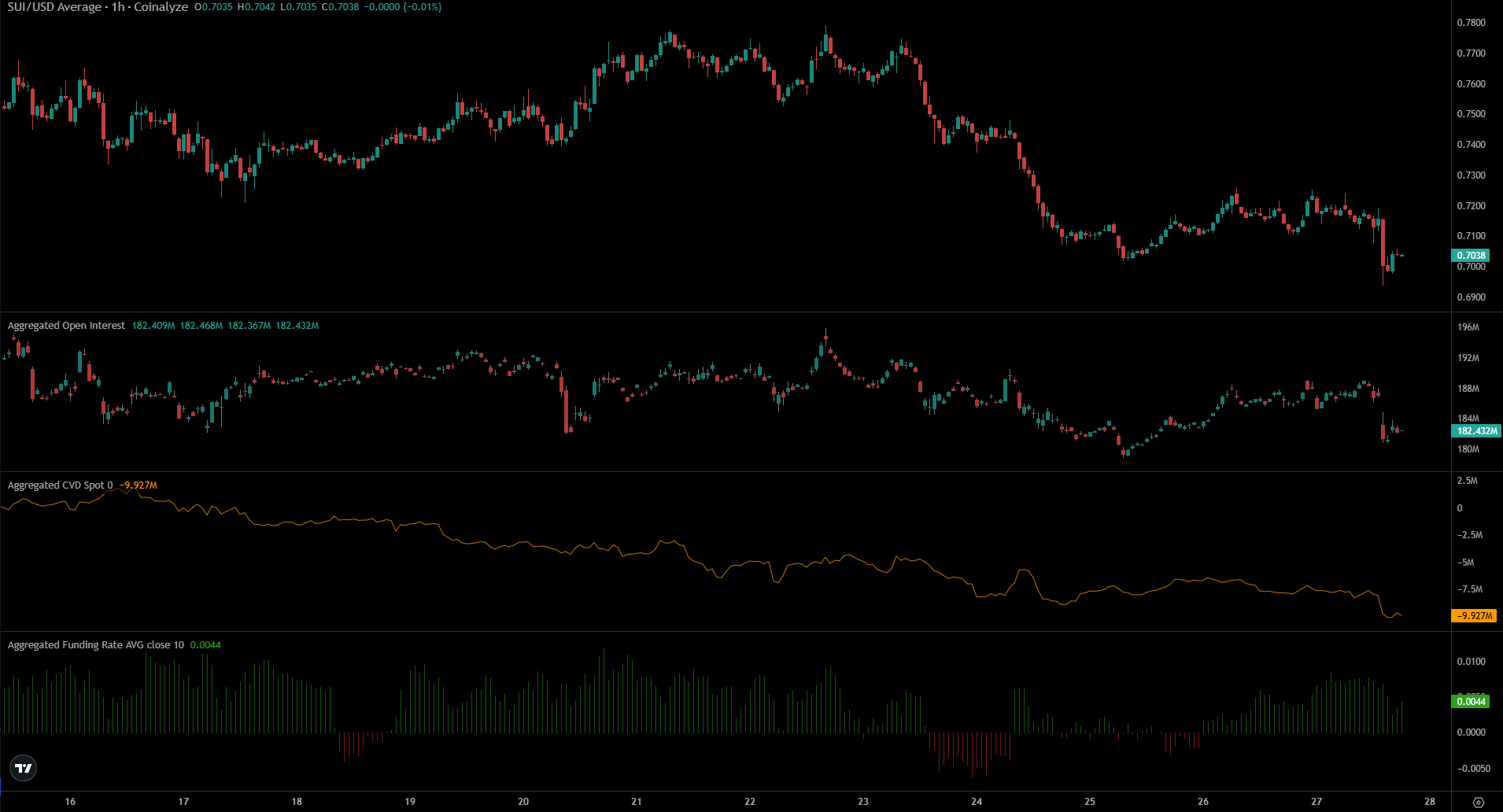
Sui [SUI] crypto was down 8.76% over the past week and has slid 1.43% in the past 24 hours. By comparison, Bitcoin [BTC] was up 0.5% in 24 hours.

Sui Coinalyze
Source: Coinalyze

Coinalyze data showed that the spot CVD for the altcoin has been in decline over the past two days. The Open Interest also slid lower as prices fell from $0.72, but the funding rate remained positive.

It showed that market sentiment in the short-term was bearish, but aggressive short selling has not yet commenced. Negative funding rates and rising Open Interest could lead to a price bounce and a short squeeze.

As things stand, there were other threats to traders and investors.

Token unlocks and long-term Sui crypto downtrend loom upon the bulls

The Sui recovery was under pressure. A SUI token unlock of 13.72 million tokens, worth $9.76 million, will be unlocked on August 1. Over the past 30 days, 22.76 million tokens have already been released in four events.

Unlocks signal supply pressure and potential short-term selling as the tokens become available to early contributors. Moreover, only 40.6% of the vesting schedule is complete, which means there will be more unlocks in the future.

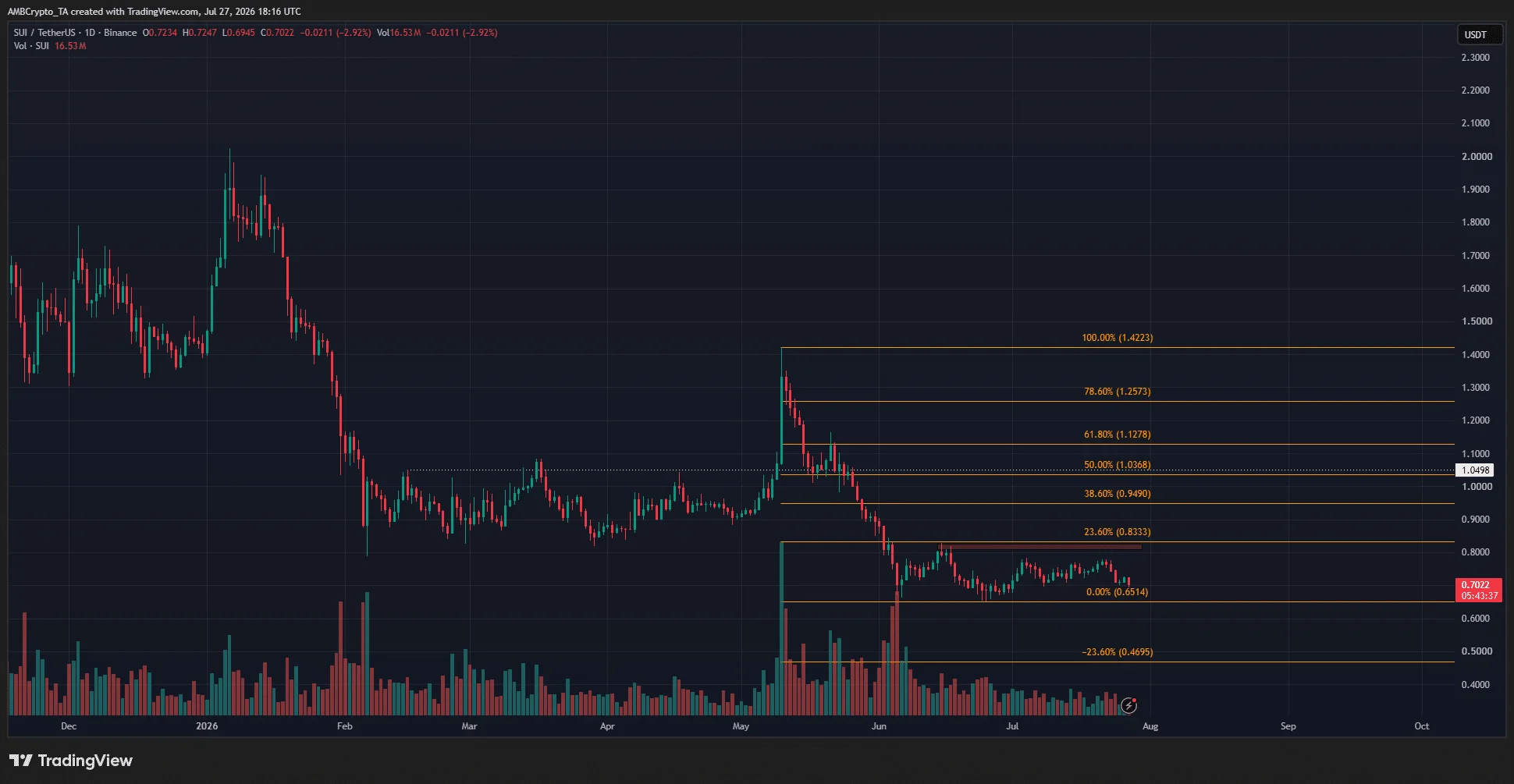
SUI Crypto 1-day ChartSUI Crypto 1-day Chart
Source: SUI/USDT on TradingView

The 1-day swing structure of SUI crypto was firmly bearish. The latest impulse move downward from $1.42 to $0.65 in May, and early June has set the stage for a potential bounce into the Fibonacci golden pocket between $1.12-$1.25, the 61.8%-78.6% retracement levels.

Over the past two months, the altcoin has been in a consolidation phase.

Traders’ call to action- Watch the range

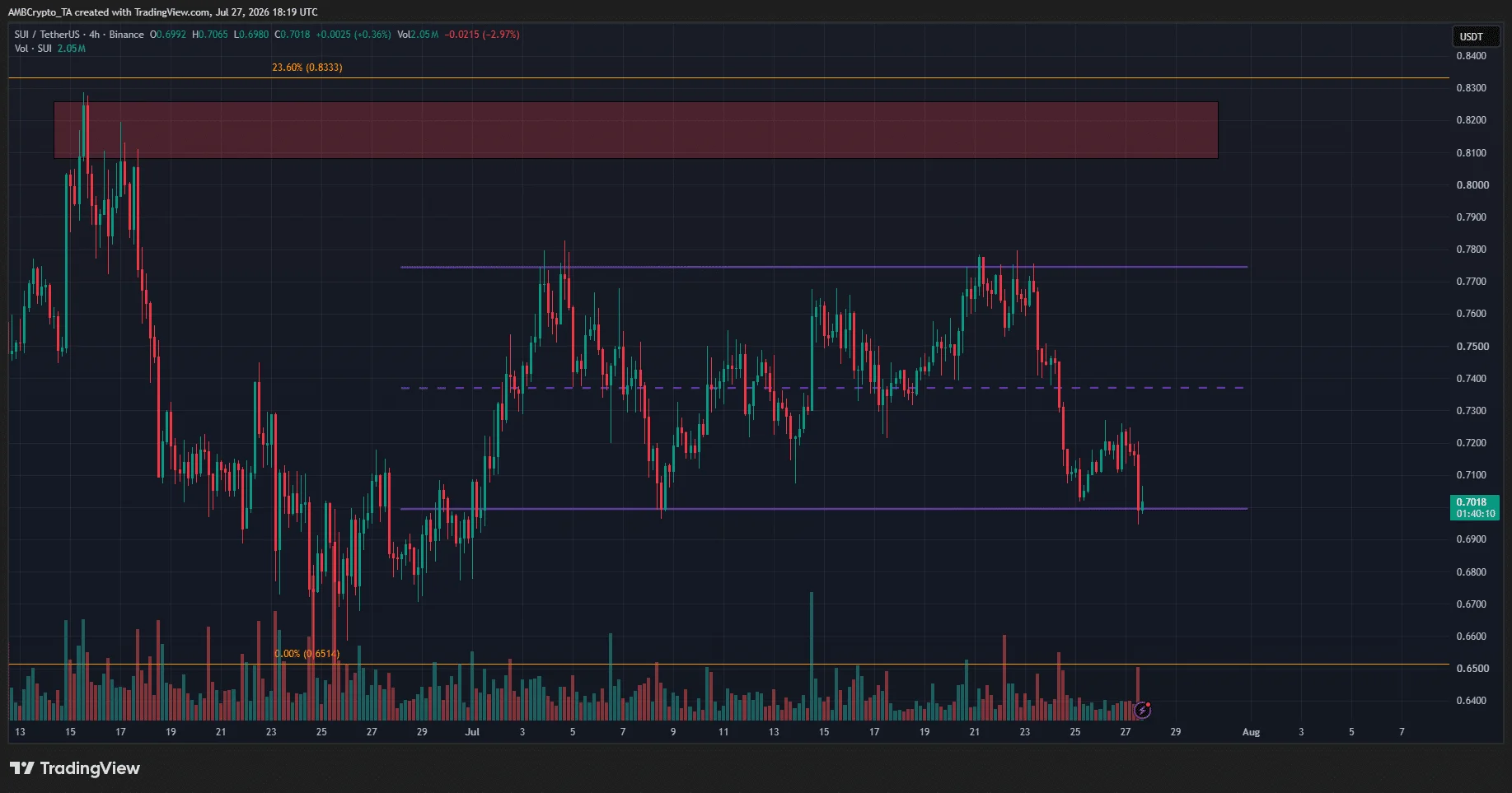
Sui Crypto 4-hour ChartSui Crypto 4-hour Chart
Source: SUI/USDT on TradingView

The past two months’ consolidation had resulted in a SUI range formation [purple] between $0.70-$0.77. At the time of writing, the altcoin was trading almost exactly at the range lows.

A liquidity sweep toward $0.69 has occurred in recent hours. Another such sweep is possible in the coming days, if SUI crypto does not react bullishly soon.

As things stand, swing traders can look to buy, targeting the range highs around $0.775. Invalidation of the range formation would occur upon an H4 session close below $0.692.


Final Summary

  • The Sui token unlocks and long-term bearish trend is testing investors’ conviction.
  • As things stand, swing traders have a chance to buy, anticipating a 10% rally, but a breakout past $1.42 is needed to flip the long-term trend bullishly. 


Source link

Crypto’s favorite $90 trillion trading product is coming to Wall Street, but big banks are taking it slow

0
Crypto’s favorite $90 trillion trading product is coming to Wall Street, but big banks are taking it slow

Perpetual futures have spent years as one of crypto’s most popular trading products, especially for investors outside the United States. Now that the contracts are entering regulated American markets, Wall Street is trying to decide whether they are a passing retail craze or a lasting threat to traditional futures.

The early numbers have been hard to ignore.

Kalshi’s perpetual futures topped $1 billion in trading volume within a week of launch in June, making them the company’s biggest product debut since prediction markets. The exchange has since sought regulatory approval to offer perpetual futures tied to gold and silver, a sign that the product may not stay confined to bitcoin (BTC) and other digital assets.

Perpetual futures, often called perps, resemble standard futures contracts but do not expire. Traders do not need to close or roll a position into a new contract each month or quarter. Instead, periodic funding payments help keep the contract’s price close to the underlying asset.

The product has become a core part of global crypto trading. Bank of America has estimated annual perpetual futures volume at about $90 trillion.

On May 29, the Commodity Futures Trading Commission (CFTC) cleared Kalshi to offer the contracts. Coinbase (COIN) also received approval to list regulated perpetual futures in the U.S.

Inside Wall Street, however, interest does not mean immediate adoption.

People familiar with discussions said perps are coming up more often, in part because U.S. regulators are allowing markets that once operated offshore to move onshore. Yet most large financial institutions are still studying the products rather than preparing major launches. The first movers are more likely to be proprietary trading firms, market makers and newer clearing firms.

Unlike large banks, prop shops trade their own capital. That gives them more freedom to test new venues, accept operational risk and withdraw if the economics stop working. Big banks face stricter capital rules, client obligations and reputational risk. For them, the profit available in a young market may not yet justify the cost of building compliance, clearing and risk systems around it.

That difference matters because the phrase “Wall Street” covers several groups moving at different speeds. Individual traders and smaller firms often arrive first. Market makers tend to follow once volume grows. Banks usually want years of data, clear regulatory treatment and stable infrastructure before committing large sums.

Still, the potential use cases extend beyond speculation. Perps could help traders manage weekend risk. Traditional futures markets close for part of the weekend, even though wars, elections and policy decisions do not. A trader holding options exposure on Friday may have to wait until Sunday night to hedge a sharp move.

A liquid 24-hour perpetual market could change that. Firms could adjust positions as events unfold, then use weekend prices to estimate where CME futures may reopen. Insiders said that could make perps useful as both a hedge and a source of price discovery.

“The demand has to be there, or the capital won’t be,” one industry insider said, arguing that firms won’t commit balance sheet until customer activity justifies it.

The problem is depth. A contract may trade around the clock, but that does not mean institutions can move large positions without shifting the market. Weekend liquidity remains thin, and collateral systems do not always move as quickly as the markets they support.

There is also a regulatory fight taking shape. One key question is whether some perpetual contracts should be treated as futures or swaps. That distinction affects margin rules, registration duties and who can provide liquidity. Industry insiders said those legal questions may become more important as exchanges push perps into commodities, equities and other traditional markets.

The debate is also becoming a competitive one. CME has challenged the CFTC’s treatment of Kalshi’s bitcoin perpetuals, arguing the contracts should be regulated differently. Similar disputes could emerge if exchanges seek to expand perpetuals into equities and other asset classes.

“A lot of this stuff… is more commercial than people are going to admit to out loud,” another industry insider said, suggesting some opposition reflects incumbent exchanges protecting existing businesses as much as concerns about market structure.

For now, Wall Street’s view is cautious rather than hostile. Trading firms see a product they understand, regulators see a market moving onshore and exchanges see a chance to capture new volume.

But the largest banks are unlikely to lead. They will wait for the rules, liquidity and infrastructure to catch up.


Source link

Bitcoin and ethereum prices today, Monday, July 27, 2026: Can positive price trends hold this week?

0
Bitcoin and ethereum prices today, Monday, June 8, 2026: Moving up after bitcoin prices fell below $60,000


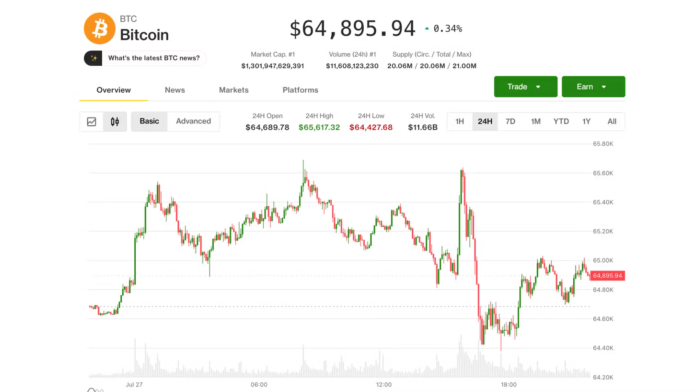
Bitcoin (BTC-USD) opened at $65,333.12 on Monday, July 27, 2026, 1.6% higher than Sunday’s opening price. As of 9:11 a.m. ET this morning, the price of bitcoin moved down to $64,974.08.

Ethereum (ETH-USD) opened at $1,953.02 on Monday, July 27, 2026, up 4.3% from Sunday’s opening price. The price of ethereum moved slightly higher this morning to $1,955.04 as of 9:11 a.m. ET.

Compared to a week and month ago, the prices for bitcoin and ethereum are up this morning after the U.S. decided to pause airstrikes against Iranian military targets in an effort to restore peace.

With the Fed set to conclude a rate-setting meeting this week and a full slate of earnings reports due, we’ll be monitoring how investors treat risk-based investments like crypto.

Learn more: Why bear markets may actually be more favorable for crypto builders

The price of bitcoin this morning was 1.6% higher than Sunday’s opening price. Here’s a look at how the opening bitcoin price has changed versus last week, month, and year:

  • One week ago: +1.0%

  • One month ago: +8.9%

  • One year ago: -44.6%

The all-time high for bitcoin was $126,198.07 on Oct. 6, 2025. The all-time low value for bitcoin was $0.04865 on July 14, 2010. 

The price of ethereum this morning was 4.3% higher than Sunday’s open. Here’s a look at how the opening ethereum price has changed versus last week, month, and year:

  • One week ago: +4.4%

  • One month ago: +23.9%

  • One year ago: -47.8%

The all-time high for ethereum was $4,953.73 on Aug. 24, 2025. The all-time low value for ethereum was $0.4209 on Oct. 21, 2015. 

Bitcoin, ethereum, and other cryptocurrencies are rapidly evolving. Follow the latest developments from Yahoo Finance and others here.

Bitcoin is a type of cryptocurrency, which is a currency that exists only in digital form and operates without government or banking oversight. By comparison, the U.S. dollar, the EU euro, the Canadian dollar, and other national currencies have paper versions and are issued by their respective governments.

Bitcoin relies on a public digital ledger that validates and records transactions and verifies bitcoin ownership. This ledger is called the blockchain, and it is globally distributed — that is, decentralized — across a broad, worldwide network of servers.

Decentralization is a fundamental aspect of cryptocurrencies. Decentralization facilitates peer-to-peer payments with no banking intermediary, enhanced security, and defense against manipulation attempts.

Learn more: What is Bitcoin, and how does it work?

There are several ways to buy Bitcoin. You can go through a crypto exchange, a fintech app, or a traditional brokerage that will allow you to buy into a bitcoin ETF.

Before placing a trade, though, decide what you actually want: full ownership of your bitcoin and private keys — or easy price exposure inside a familiar, regulated system.

Whichever avenue you take, it’s important to remember that bitcoin remains a high-risk, highly volatile asset compared to many other investments. Prices can surge or drop quickly, sometimes without warning. If you’re considering buying bitcoin, assume volatility is part of the deal.

Learn more: Is bitcoin’s price volatility an investing opportunity? Here’s how to buy bitcoin.

Whether you’re brand new to tracking the value of bitcoin and ethereum or a more seasoned crypto investor, Yahoo Finance’s price-of-bitcoin chart and price-of-ethereum chart below show a visual history of how the currencies’ value continues to move and evolve.

More on crypto from the Yahoo Finance team: 


Source link

A Nobel economist challenged Elon Musk to donate his entire $1T fortune by 2036

0
A Nobel economist challenged Elon Musk to donate his entire $1T fortune by 2036

The public has long questioned the world’s richest man, Elon Musk, about what he’s doing sitting on a trillion-dollar fortune. After all, other billionaires give away vast amounts of their wealth (take MacKenzie Scott, who’s donated more than $26 billion and is still worth nearly $35 billion). 

On social media, some have begged and pleaded for him to give at least some of his wealth away, or even all of it, but Musk has been pretty direct about his relationship with philanthropy

“I agree with love of humanity, and I think we should try to do things that help our fellow human beings,” Musk told Nikhil Kamath for the WTF podcast in an episode published in December 2025. “But it’s very hard.”

That’s an interesting conception from a person who also believes money won’t matter anymore because of AI, so Nobel prize-winning economist Daron Acemoglu called Musk out for it on Monday.

“A proposed pledge for Elon Musk,” wrote Acemoglu in an X post on Monday. “An opportunity to put your money where your mouth is. If money won’t matter in 2036, why don’t you pledge to donate your current wealth of approximately $1 trillion to charity no later than 2036. This would establish with great credibility your belief in the powers of AI and technology.”

Acemoglu also argued it would assuage people around the world who are concerned about the political and social power of billionaires and trillionaires. 

“The charities chosen for this should be approved as effective and non-ideological by an impartial body,” he added. 

And in somewhat of a shocking response, Musk replied to Acemoglu and said: “I am actually going to do something along these lines!”

While Musk didn’t elaborate on what this means, it’s a complete 180 of how the Tesla and SpaceX CEO has historically approached philanthropy. He’s also been openly critical of other major philanthropists like Scott, having recently said her efforts make the world worse off.

Musk’s history with philanthropy

On June 27, Pubity, a major viral media and social news brand, posted on X about Scott’s giving, saying her $26 billion in donations has made her one of the “biggest individual donors in history,” and the ex-wife of Amazon founder Jeff Bezos indeed confirmed as the biggest megadonor in 2025.

Then, an account with 22,500 followers with the name @FrenlyOfficer, whose bio describes them as a “Heterosexual Alpha Male,” replied to Pubity’s post about Scott, saying, “Unfortunately, she’s spending it making the world a worse place.” Musk responded to @FrenlyOfficer agreeing with the sentiment, saying: “Sadly, yes.”

While Musk’s foundation stood at about $14 billion as of the end of 2025, according to files obtained by The New York Times, he’s only largely given to organizations that “narrowly track” with the interests of his own businesses. For example, three-quarters of Musk’s total giving in 2024, $370 million, went to a nonprofit in Texas led by his top aide.

“That nonprofit appears to provide a benefit to Mr. Musk’s business empire,” according to the NYT. “It operates an elementary school in a rural area where many of his employees live, near a cluster of Mr. Musk’s companies.”

So with Musk saying in the past that philanthropy is hard and that his track record shows he’s only given to things within his own interest, it will be interesting to see whether the world’s richest man will live up to what he wrote on his own platform, X, this week.


Source link

ETHGas down 92%, hits all-time low – Can GWEI’s price recover?

0
ETHGas down 92%, hits all-time low - Can GWEI's price recover?


ETHGas [GWEI], which tracks the gas fees on the Ethereum [ETH] network, is down by more than 10% in the past 24 hours. It is a measure of the Ethereum ecosystem’s usage.

Notably, the daily trading volume was a reflection of this price decline, as it decreased by 49% to around $20 million. This decline confirmed the loss of trader interest in GWEI.

Hence, what were the specifics behind the decline in the price of ETHGas?

Why is the price of ETHGas falling?

Interest in GWEI declined because the token’s intrinsic value is linked to Ethereum gas fees, which were falling. This decline was occurring despite the ongoing Ethereum ecosystem upgrades.

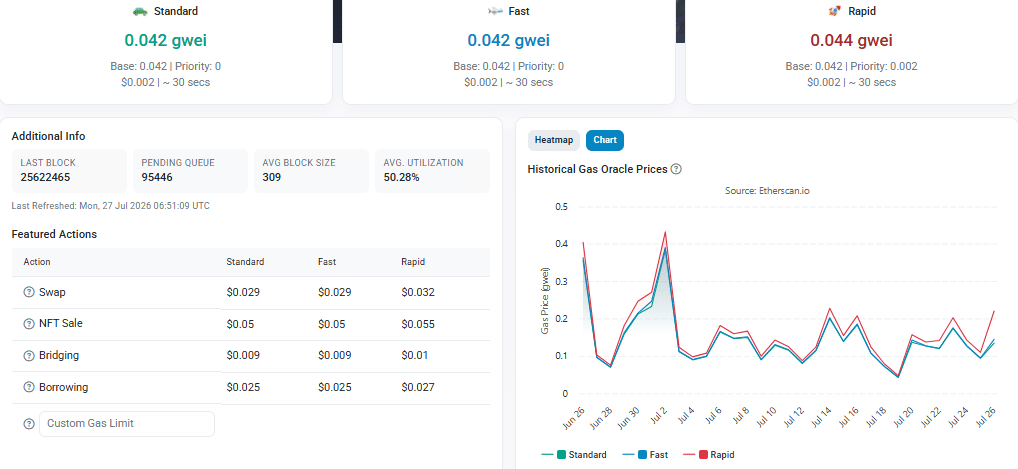
At press time, ETHGas was at its all-time low (ATL) of 0.042 GWEI, indicating minimal network congestion and user demand. When fees are this low, the token’s core utility and speculative demand evaporate.

Worth noting, high fees were on NFT sales, indicating demand on the Ethereum network leaned toward the sector.

GWEI
Source: Etherscan

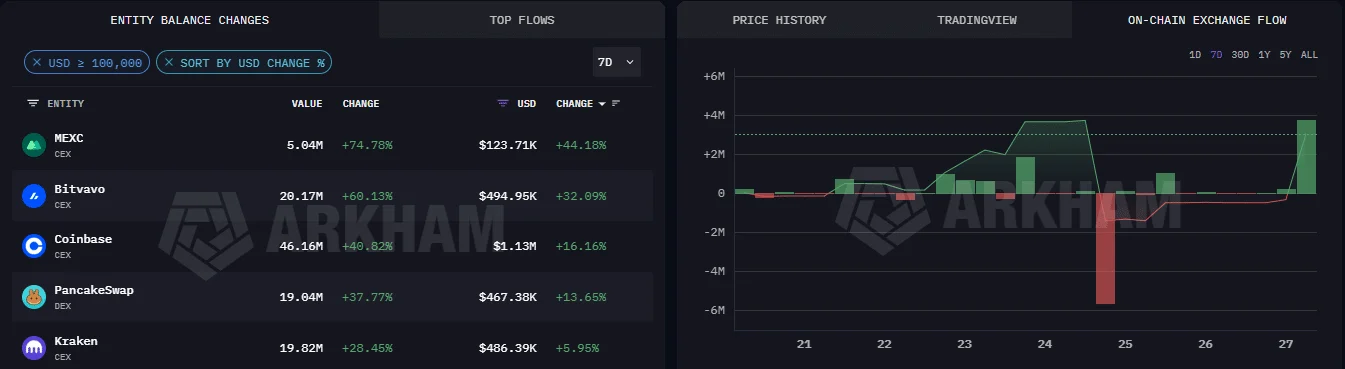
As fees traded at an ATL, both institutions and retailers were selling the token on CEXes and DEXes due to its low demand. For instance, retailers were mainly using PancakeSwap DEX, OKX, and Bitget to offload their holdings.

Moreover, KuCoin and Gate were moving their holdings from cold wallets to hot wallets. Gate moved 20 million GWEI worth $591K in two transactions, while KuCoin moved 30 million GWEI worth $800K in three transfers.

In total, well over 50 million GWEI valued at around $1.40 million were sold in 24 hours, excluding the retailers’ distribution.

Overall, exchange balances were going up, about 3.7 million tokens in 24 hours, affirming the intention to sell GWEI across the crypto divide.

ETHGasETHGas
Source: Arkham

Can GWEI bounce from its all-time low levels?

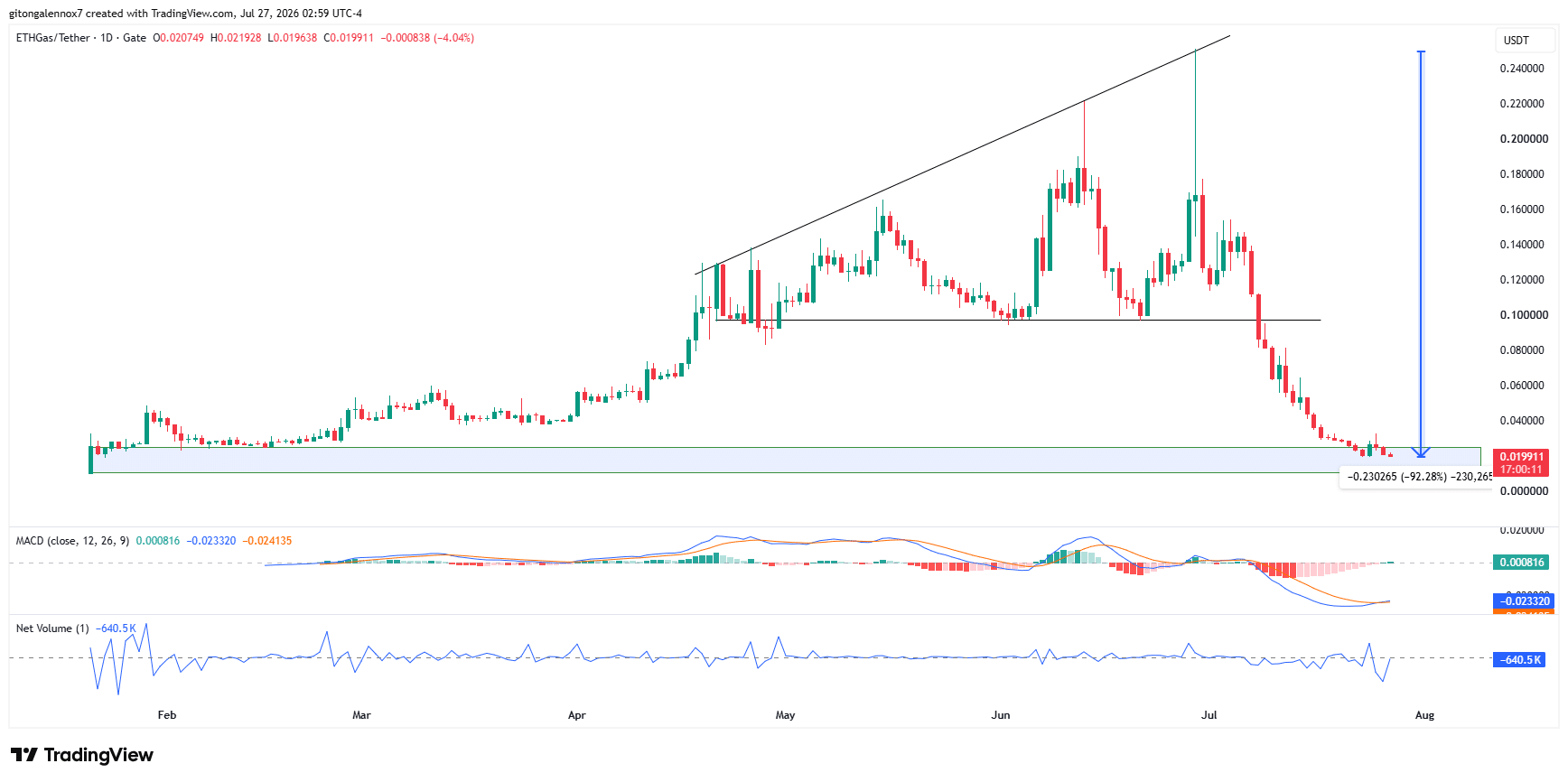
GWEI price action aligned with the low network demand. The token has dropped around 92% from its peak value of $0.2519 in late June.

The net volume showed a fall from 5.37 million to negative 9.15 million. This indicated a massive distribution event, though it was starting to stabilize.

GWEIETHGasGWEIETHGas
Source: GWEI/USDT on TradingView

While bears had forced a breakdown below a broadening wedge pattern, bulls were giving hints of potential price recovery.

In fact, the MACD was having a crossover with bars blinking green for the first time since the 7th of July. As such, this development could indicate that ETHGas was on track for a recovery.

Therefore, GWEI remains in a bearish market structure unless Ethereum’s high network usage and user demand return.


Final Summary

  • ETHGas declined by more than 10% in 24 hours due to Ethereum’s minimal network congestion and user demand. 
  • GWEI broke below a massive broadening wedge pattern and hit an ATL of $0.01892, but bulls were showing signs of a return. 


Source link

Bitcoin (BTC) price may fall to $52,000 as demand remains elusive, Nansen analyst says

0
Bitcoin (BTC) price may fall to $52,000 as demand remains elusive, Nansen analyst says

Kruger said bitcoin needs to clear $67,300 to break out of the multi-week consolidation that has capped prices since June. A move above that level could signal the next leg of higher, while ether (ETH) faces a similar test at $2,000.

Tom Lee, chairman of Bitmine and co-founder of Fundstrat, also noted ether’s recent outperformance relative to BTC as a bullish signal for crypto markets. The ETH-BTC ratio, which measures the price of ether in bitcoin, climbed to a three-month high on Monday.

Rally lacks demand amid macro risks

Still, not everyone is convinced about bitcoin’s strength.

Nansen senior research analyst Nicolai Sondergaard said the recent rebound lacks the buying conviction typically seen before sustained rallies.

“The market is holding range without strong buyers, not building toward a breakout,” Sondergaard said.

His base case remains a pullback toward $52,000-$58,000 unless market conditions improve.

While nearly 9,000 BTC left exchanges over the past week, open interest in bitcoin futures has fallen even as prices edged higher, suggesting traders are reducing exposure rather than adding fresh bullish bets. Order-book data also continues to point to net selling pressure, he said.

Sondergaard said the Fed’s rate decision and communication about it will likely set the tone for risk assets on Wednesday. Investors will also be watching Thursday’s core PCE inflation report, second-quarter GDP data and earnings from Microsoft, Meta, Apple and Amazon before Friday’s roughly $13-14 billion bitcoin and ether options expiry.


Source link