Home Blog Page 17

Bitcoin (BTC) price slips as U.S. PPI fails to spark gains, ETFs see August’s first two-day drawdown

0
Bitcoin (BTC) price slips as U.S. PPI fails to spark gains, ETFs see August's first two-day drawdown

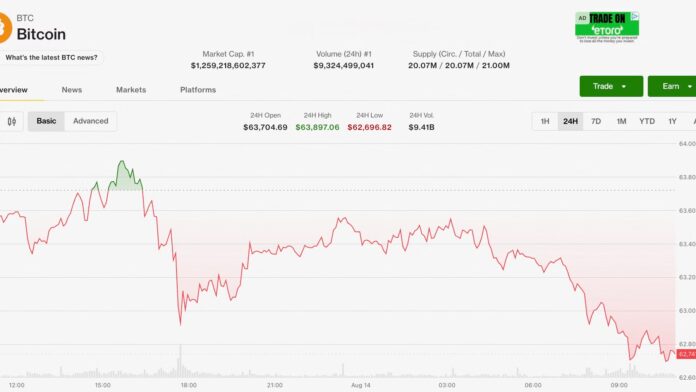
Bitcoin dropped below $63,000, losing 1.14% since midnight UTC as a second day of outflows from spot exchange-traded funds and a lack of bullish catalysts weighed on the crypto market.

Spot bitcoin ETFs experienced the first back-to-back days of outflows since late July with $192 million exiting the products, according to SoSoValue.

The largest cryptocurrency is now trading at its lowest point since Aug. 3 having wiped out all of last week’s rally. Ether is down by 0.73% since midnight, while a portion of the altcoin market continues to show resilience, outperforming crypto majors.

U.S. equities were boosted on Thursday by producer price inflation data, which cooled to 4.7%, below forecasts. The S&P 500 and Nasdaq 100 both rallied following the report, and futures on the indexes remain marginally in the black.

Derivatives positioning

  • Futures churn continues: While the crypto market is under pressure, the long-short taker ratio in futures remains balanced, with longs accounting for half of the flow. 24-hour volume growth is again outpacing open interest (OI) growth by a wide margin. That’s a sign of churn rather than fresh positioning.
  • BCH sees heaviest fresh shorting: Futures tied to Bitcoin Cash are the biggest OI gainer of the past 24 hours, adding 10% to 1.64 million tokens as the spot price drops 3%. That combination points to short positions being built up. Deeply negative annualized funding rates support that interpretation. The 24-hour OI-adjusted cumulative volume delta (CVD) is negative too, signaling that shorts are trading more aggressively via market orders rather than passive limit orders. Together, these signals point to positioning for a deeper selloff in the token.
  • BTC OI rises alongside falling price: Bitcoin is another OI gainer, with the tally rising over 3% to 765,000 BTC alongside a negative CVD. Annualized funding rates, however, still hold mildly positive.
  • HBAR shows the clearest bearish tilt: The token’s 24-hour CVD is the most negative among the top 25 coins, with funding rates around -20%, pointing to a market clearly dominated by bears. More broadly, all the top 25 are showing negative CVD.
  • Bitcoin volatility cools: BTC’s 30-day implied volatility index, BVIV, fell back below 36%, erasing a spike to nearly 39% earlier this week. That points to continued investor interest in overwriting strategies — approaches aimed at generating extra yield on top of spot holdings. Ether’s equivalent index, EVIV, is showing the same pattern.
  • Options positioning stays mixed: On Deribit, BTC calls at the $70,000, $69,000 and $67,000 strikes rank among the five most-traded bets. For ETH, puts at the $1,700 and $1,780 strikes ranked higher instead.

Token talk

  • Ether.fi (ETHFI) is the standout performer over the past 24 hours, rallying by 11.5% after adding tokenized stocks and DeFi loans to its neobank platform. The token gave back some of the gains on Friday, dropping 3.3%.
  • Cosmos also experienced upside. The token surged by more than 10% in 24 hours and trading volume jumped by 232% to $51 million despite the absence of a clear news catalyst.
  • Fetch.ai and monero (XMR) extended their positive weeks, rising 0.55% and 0.81%, respectively, since midnight UTC.
  • NEAR, MORPHO, TAO and JUP all lost around 2% since midnight as cautious sentiment remains the dominant theme across the crypto market.



Source link

Psychological Safety Does More For Your Team Than You Think

0
Psychological Safety Does More For Your Team Than You Think


Opinions expressed by Entrepreneur contributors are their own.

Key Takeaways

  • One of the most effective communication methods is the mirror method, focused on reverse communication. When you apply the reverse communication method, your immediate goal is to get staff in a psychologically safe state, where they’re the most receptive to take instructions and to execute.
  • When your staff feels heard and seen, the environment shifts. Structure appears as safety, and safety boosts motivation. The performance follows.

The right message and the wrong method lead nowhere: The problem isn’t what you said. The problem begins before you even open your mouth.

When you discuss things with your staff or with your customers, do you listen to what they say? Do you pay attention, or do you just wait for your turn to present your ideas?

Are you a leader who just waits for your turn to speak and puts all your effort into getting your employees to like you? But the most important question to ask yourself is: Do you want your employees to like what you say or what you execute?

Why mirror method works

One of the most effective communication methods to try is the mirror method, focused on reverse communication. Let’s say a person comes to you with a problem. They explain the problem in detail while you carefully listen without interruption.

Once they’re fully done with expressing the problem, it’s your turn. Tell them their exact problem in detail, but use technical vocabulary relevant to your industry.

According to psychologist Carl Rogers, people are more likely to accept change and direction when they feel understood and not evaluated. In his person-centered theory, Rogers argues that psychological safety is built on reflective listening.

To increase the feeling of psychological safety in the business environment you lead, the first step is to master the skill of reflective listening.

Reflecting back on their problem ensures you several things:

  • They comprehend that you’ve listened carefully and deduce that you care enough for them, which makes them feel heard and safer in your environment.
  • They comprehend that you understand their problem, and they start building trust in you as an expert in the field.
  • They are ready to act with less defense and more trust towards a person who knows about their problems as much as they do.

In the context of a doctor’s office, for example, this translates to: If this doctor knows my problem better than I do, they must be the person capable of fixing it!

How to make reverse communication part of your leading system

In businesses, staff often refuse to execute proposed tasks not because the tasks feel too difficult, but because they don’t feel heard. They don’t feel psychological safety in that environment. They don’t feel their reality is acknowledged before a new task is proposed.

When you apply the reverse communication method — listen first, and reflect back at them — they will generally respond with less pushback. This method may look like people-pleasing, but the two have completely different goals.

The reverse communication method is different from people-pleasing. If you’re a people-pleaser, your ultimate goal is to fit in and reduce your own anxiety from potential pushback. When you apply the reverse communication method, your immediate goal is to get staff in a psychologically safe state, where they’re the most receptive to taking instructions and executing.

While Rogers proves why the mirror method works psychologically, former FBI negotiator Chris Voss, author of Never Split the Difference, explores why the method works strategically. According to him, mirroring is one of the most powerful communication tools, and it has nothing to do with people-pleasing. It disarms people and makes them ready to move forward.

Do you want your business to move forward? It can’t be done without effective leader-team communication. Use the mirror method as your leadership strategy to build an environment focused on safety. It is what your staff and even your customers need.

Leaders don’t need likes

The purpose of the mirror method isn’t to make your staff like you. You don’t need staff to be your friends, and neither do they need you. You’re not there to be liked. You’re there to lead and to be respected.

Sometimes, likability can be a byproduct of respect built through an environment that makes people feel heard. But it should never be the goal.  

When the building is on fire, nobody looks for the leader they like. They look for the leader who will make the right call. The mirror method helps you gain respect from your staff. People-pleasing doesn’t. One signals that you see and understand the staff clearly. The other signals that you constantly agree with them despite logic.

Create a performance culture

When applied consistently and on all business levels, the mirror method has a strong impact on your business culture. Your staff stops performing for approval and starts performing for purpose. Top performers want to know where they’re going and that their leader sees them clearly enough to get them there.

Comfort was never a motivation for people at the top. Highest achieving professionals wake up every day asking themselves where their career is going, what is the next challenge, and if their current leader is the one to take them to the top. A performance culture built on reverse communication answers all three questions even before they are asked.

When your staff feels heard and seen, the environment shifts. Structure appears as safety, and safety boosts motivation. The performance follows.

Conclusion

The mirror method isn’t a soft leadership tactic. It is the ultimate respect that you can give staff (and even customers), and as a by-product, improve performance from staff (and even customer conversions).

See your people clearly. Reflect them accurately. Then lead them somewhere worth going.

The best businesses are never the ones with the best individuals. The best businesses are the ones with leaders who can see the individuals clearly to make the systems work for them.

Key Takeaways

  • One of the most effective communication methods is the mirror method, focused on reverse communication. When you apply the reverse communication method, your immediate goal is to get staff in a psychologically safe state, where they’re the most receptive to take instructions and to execute.
  • When your staff feels heard and seen, the environment shifts. Structure appears as safety, and safety boosts motivation. The performance follows.

The right message and the wrong method lead nowhere: The problem isn’t what you said. The problem begins before you even open your mouth.

When you discuss things with your staff or with your customers, do you listen to what they say? Do you pay attention, or do you just wait for your turn to present your ideas?

Are you a leader who just waits for your turn to speak and puts all your effort into getting your employees to like you? But the most important question to ask yourself is: Do you want your employees to like what you say or what you execute?


Source link

Privia Health’s (PRVA) Guidance Keeps Rising, So Is The Stock Keeping Pace?

0
Privia Health’s (PRVA) Guidance Keeps Rising, So Is The Stock Keeping Pace?


Privia Health (NASDAQ:PRVA) just turned in a quarter that checked every box management set for itself, and then raised the bar again for the rest of the year. On the company’s August 6 earnings call, CEO Parth Mehrotra and CFO David Mountcastle laid out a business adding doctors, patients, and cash at a pace that has held for nine straight years. The question is whether the market is pricing in the streak continuing.

HPE Price Target Raised to $28 as Corporate AI Spending Accelerates

Bull Case: A Growth Engine Still Humming

Privia’s numbers move together. Implemented providers grew 10.1% year-over-year to 5,644, adding 109 physicians in the quarter alone, while value-based attributed lives climbed 19.2%. That combination pushed practice collections up 12.4% to $970 million in the second quarter and 13.4% to $1.88 billion for the first half. Adjusted EBITDA rose 29% to $37.4 million, with margin as a share of care margin expanding 310 basis points to 28.3%, a sign the business is getting more profitable as it scales, not just bigger.

In late May, Privia entered New Jersey, its 25th state, through a partnership with the Urology Group of Bergen County covering 25 clinicians. Commercial attributed lives rose 11.7% to 942,000, while CMS Medicare lives jumped 55%. The company now oversees an estimated $15.7 billion in total medical spend across more than 130 value-based programs, and gross provider retention has averaged 98% over the past three years. Management raised 2026 guidance across practice collections, care margin, GAAP revenue, platform contribution, and EBITDA, with attributed lives already tracking above the prior high end.

Bear Case: Cash Timing And Policy Are Wildcards

The growth story comes with a few strings attached. Privia became a full cash taxpayer this year, and management expects only 70% to 80% of full-year adjusted EBITDA to convert to free cash flow, a figure that assumes the company collects a significant chunk of its 2025 shared savings payments by year-end. That assumption now has a complication: CMS proposed changes to the Medicare Shared Savings Program for performance year 2025 that could delay final reconciliation results until November, which management says could create an atypical year-end cash flow pattern even though the accrual impact looks minimal.

The company also holds $412 million in cash with no debt, which is a comfortable cushion, but its raised guidance still assumes no additional business development activity, meaning any acquisitions would be upside not yet baked in.

Wall Street Watches The Growth Story

Hedge fund ownership ticked up from 29 funds to 30 in the most recent quarter, a modest gain rather than a rush. Short interest sits at 4.45% of float, which points to limited organized skepticism around the stock. As of August 13, Privia trades at a forward P/E of 24.63, a multiple that assumes the earnings growth investors just saw continues rather than fades.

Where The Story Goes From Here

Privia’s second quarter gave bulls plenty to point to: double-digit growth in providers, patients, and profitability, plus guidance that keeps climbing. The bear case is thinner and more about timing than fundamentals, centered on how CMS’s proposed MSSP changes play out and whether cash flow lands where management expects by year-end. For the growth trajectory to keep justifying its valuation, the provider and attribution gains need to keep compounding at this pace.

While we acknowledge the potential of PRVA as an investment, we believe certain AI stocks offer greater upside potential and carry less downside risk. If you’re looking for an extremely undervalued AI stock that also stands to benefit significantly from Trump-era tariffs and the onshoring trend, see our free report on the best short-term AI stock.

READ NEXT: 10 Best Future Stocks to Buy Under $10 and 12 Best Performing Semiconductor Stocks to Invest In.

Disclosure: None. Follow Insider Monkey on Google News.


Source link

Trump expected to attend White House meeting with crypto CEOs, sources say

0
Trump expected to attend White House meeting with crypto CEOs, sources say

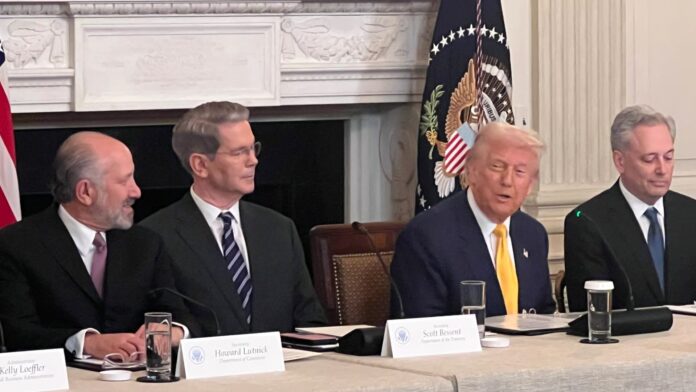
President Donald Trump is expected to be in attendance when the administration’s new innovation committee — a crowd of crypto CEOs and leaders of prediction market and AI companies — sits for a White House meeting on Wednesday, said people briefed on the planning.

The chief executives of companies such as Coinbase, Ripple, Gemini, Robinhood, Polymarket and Kalshi are members of the new Innovation Advisory Committee at the Commodity Futures Trading Commission, but before they attend their first committee meeting on Thursday, the crypto CEOs will gather for the White House meeting, said the people, who asked not to be named, and participants have been told Trump is planning to attend.

The meeting, expected to be held at the Eisenhower Executive Office Building next door to the White House, is meant to get a policy dialogue started in some of the leading arenas for U.S. innovation. The roster at that meeting was also expected to include CFTC Chairman Mike Selig and other advisers, the people said. One of them added that Treasury Secretary Scott Bessent and Secretary of Commerce Howard Lutnick may attend.

White House spokespeople didn’t immediately respond to requests for comment on the plans.


Source link

Ondo crypto slides 24% as weak demand puts $0.30 support at risk

0
Ondo crypto slides 24% as weak demand puts $0.30 support at risk


Ondo Finance [ONDO] token prices were down 5.44% over the past week. It was reported that a team-linked wallet sent 4.019 million tokens worth around $1.4 million to the centralized exchange Coinbase.

While the transfer does not confirm a sale, it does signal increased ONDO supply in the near-term, especially given the momentum of the past week.

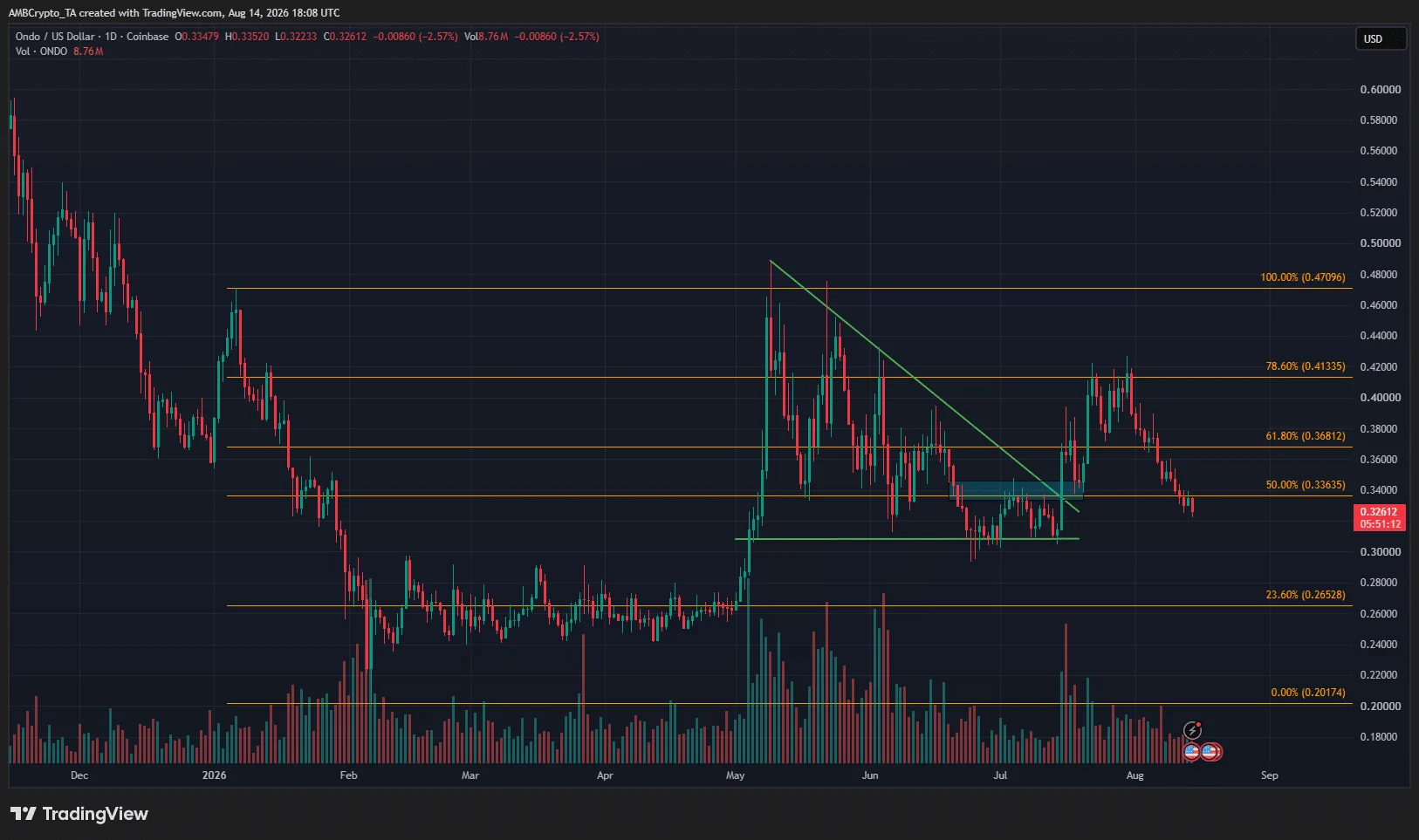
Ondo crypto token prices were back at a key support zone after breaking out of a bullish triangle pattern and climbing to the $0.42 supply zone.

In other news, Ondo Finance announced in a blog post that they submitted a no-action request to the SEC. In a limited set of circumstances, the relevant securities entitlements would also be represented in tokenized form on the Ethereum Mainnet, and held by onchain custodian BitGo to facilitate recordkeeping.

The SEC has not publicly responded to the request.

Assessing the ONDO downturn from the triangle pattern breakout

In a report towards the end of July, AMBCrypto warned of a potential bearish turn in the Ondo crypto token price action. The cited reason was a lack of steady buying pressure.

Since then, ONDO has slid by close to 24% in value, from $0.427 to $0.325 at the time of writing.

Ondo 1-day Chart
Source: ONDO/USDT on TradingView

Since May, the trading volume has declined. The breakout from the triangle pattern was not accompanied by a surge in buying volume, resulting in the price drawdown.

Moreover, the 1-day timeframe’s swing structure remained bearish. Therefore, traders can maintain their long-term bearish expectations until Ondo crypto closes a daily trading session above the $0.47 swing high.

Short-term Ondo crypto price expectations

Ondo Liquidation MapOndo Liquidation Map
Source: CoinGlass

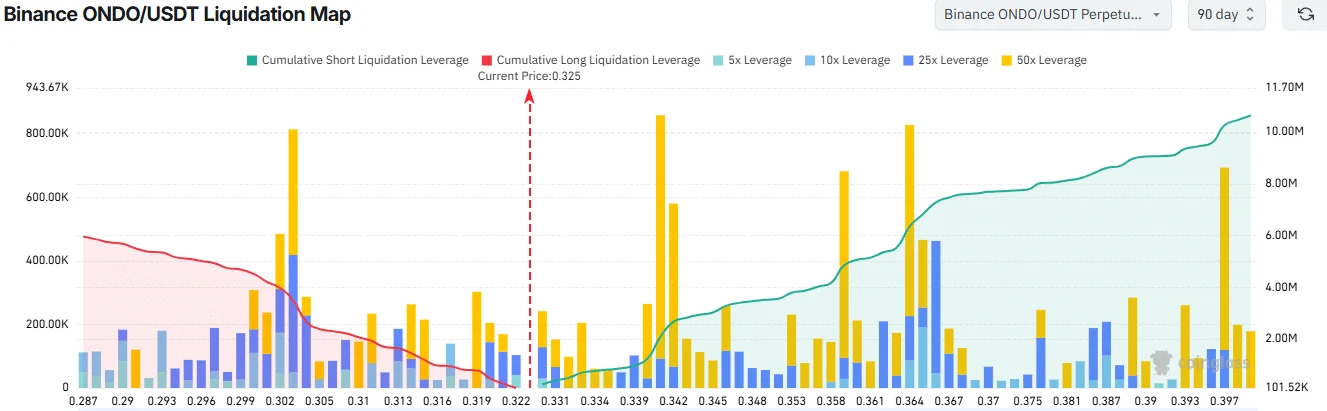
The cumulative long leverage below $0.322, down to $0.302, significantly outweighed the cumulative short leverage overhead. There was a cluster of high-leverage short liquidations around $0.342.

However, because of the higher long leverage, it appeared likely that ONDO would fall toward $0.30 before seeing any bounce.

This is what short-term traders can expect over the next few days. A price bounce thereafter would depend on incoming capital flows and an uptick in buying pressure.


Final Summary

  • Ondo tokens worth $1.4 million were sent to Coinbase recently, and the bullish breakout from the triangle pattern has lost its momentum.
  • The long-term swing structure was bearish, and the short-term price expectations involved a slide to the $0.30 area.


Source link

AMD looks to raise $4 billion to $5 billion in debt offering, source says

0
AMD looks to raise $4 billion to $5 billion in debt offering, source says


By Saeed Azhar and Rashika Singh

Aug 13 (Reuters) – Advanced Micro Devices on Thursday launched a four-part debt offering that could raise between $4 billion ‌and $5 billion, according to a source and terms reviewed by Reuters, ‌as the chipmaker seeks funding flexibility amid a broader wave of tech-sector fundraising driven by investments ​in AI.

The offering includes senior unsecured notes due in 2029, 2031, 2033 and 2036.

Initial price discussions were set at about 70 basis points over U.S. Treasuries for the 3-year notes, 90 basis points for the 5-year tranche, 100 basis points for ‌the 7-year notes and 115 ⁠basis points for the 10-year debt.

The company said it intends to use the proceeds for general corporate purposes, which may ⁠include the repayment of debt.

“AMD is committed to maintaining its strong financial balance sheet and we have strong investment grade ratings. We intend to leverage net proceeds from ​the offering ​for general corporate purposes,” an AMD spokesperson ​said.

The offering underscores how semiconductor ‌companies are increasingly turning to capital markets as they race to fund AI-related investments, data-center expansion and manufacturing projects.

Earlier this week, Intel raised $20 billion in an upsized stock offering to help finance its contract chipmaking ambitions.

AMD also filed with the U.S. Securities and Exchange Commission earlier on Thursday in connection with the offering, though ‌the filing did not disclose specific terms ​of the deal.

The debt sale comes as AMD ​continues to expand its AI and ​data-center businesses, where it competes with larger rival Nvidia and challenges ‌Intel across multiple processor markets.

Bank of ​America, JPMorgan, Barclays and ​Wells Fargo are leading the debt sale, according to the term sheet. The bonds are expected to settle on August 17.

Earlier this month, AMD ​forecast third-quarter revenue above ‌Wall Street estimates and said data-center sales would more than double ​by 2027, underscoring strong demand for its AI-focused chips.

(Reporting by Rashika ​Singh in Bengaluru; Editing by Shreya Biswas)


Source link

Trump-backed World Liberty wins conditional bank charter from federal regulator

0
Trump bitcoin news: Trump Media (DJT) BTC holdings shrink as crypto losses hit $361 million

A federal bank regulator has granted World Liberty Trust Co. a conditional bank charter, it announced Friday.

The Office of the Comptroller of the Currency, the U.S. banking agency that grants federal charters, said in a letter posted to its website that World Liberty could operate fiduciary and other trust company-related activities as a national trust bank.

“This preliminary conditional approval is granted based on a thorough evaluation of all information available to the OCC, including the representations and commitments made in the application and by the Bank’s representatives,” the letter said.

Final approval won’t be granted until the company meets additional “preopening requirements,” the letter said.

According to the letter, World Liberty Trust Company will focus on services tied to World Liberty Financial’s USD1 stablecoin.

“The bank plans to issue USD1, a fiat currency-backed stablecoin, to institutional clients on a nationwide basis, assuming this role from BitGo Bank & Trust, National Association (BitGo), the current exclusive issuer and custodian for USD1,” the letter said. “The bank plans to provide its digital asset custody services as a fiduciary, primarily to USD1 customers and other institutional clients.”


Source link