Home Blog Page 181

Unlocking the Future: The Most Trusted Online Casinos of 2026

0


As the online gambling industry continues to evolve, new technologies and standards are shaping the way players experience their favorite games.

Introduction

The online casino landscape has undergone significant changes in recent years. With advancements in technology and increased regulation, players can now enjoy a safer and more immersive gaming experience. As we step into 2026, it’s crucial to identify which platforms have earned the trust of players worldwide.

Criteria for Trust

Several factors contribute to the credibility and reliability of an online casino:

  • Licensing and Regulation: A reliable casino is licensed by reputable gaming authorities.
  • Security Measures: Use of encryption technologies to protect player data and payments.
  • Fair Play: Commitment to random number generation and transparency in game results.
  • Customer Support: Accessibility and responsiveness of customer service teams.
  • Player Reviews: Positive feedback and testimonials from existing players.

Top Trusted Online Casinos of 2026

Based on rigorous evaluations, here are some of the most trusted online casinos for 2026:

  • Casino Royale: Known for its vast game selection and top-notch customer service.
  • Lucky Star: Offers strong bonuses and a user-friendly interface, appealing to new players.
  • BetElite: Stands out with its commitment to player safety and fair gaming practices.
  • GambleHub: Features cutting-edge technology for live dealer games and VR experiences.
  • Spin Palace: Popular for its mobile-friendly platform and extensive payment options.

The Role of Technology in Enhancing Trust

Modern online casinos are leveraging technology to strengthen player trust:

  • Blockchain Technology: Enhances transparency and traceability of transactions.
  • Artificial Intelligence: Helps manage customer accounts and detect fraudulent activity.
  • Virtual Reality: Provides immersive gaming experiences that make players feel as though they are in a physical casino.

Conclusion

As we approach 2026, the landscape of online gambling continues to change, offering exciting possibilities for players. The trusted online casinos identified in this article embody the necessary standards of security, transparency, and user experience. Prioritizing safety and reliability, these platforms are paving the way for a safer and more enjoyable future in online gaming.

© 2026 Online Casino Insights. All rights reserved.

2026’s Best Online Casinos: Where Trust Meets Top-Tier Gaming

0


The world of online casinos continues to evolve rapidly, and 2026 is set to be an exceptional year for gamers seeking both thrilling experiences and reliable platforms. With advancements in technology and increasing regulations, players can now enjoy peace of mind while indulging in their favorite games. In this article, we’ll explore some of the best online casinos of 2026 that combine trust with top-tier gaming.

What Defines the Best Online Casinos?

When it comes to assessing the best online casinos, several key factors come into play:

  • Licensing and Regulation: Ensure that an online casino holds valid licenses from reputable regulatory bodies.
  • Game Variety: The best casinos offer a wide range of games, from slots and table games to live dealer options.
  • Payment Options: Multiple payment methods, including cryptocurrency, can enhance user experience.
  • Customer Support: Reliable customer service is crucial for resolving any issues that may arise.
  • User Experience: A user-friendly interface and seamless mobile compatibility make for an enjoyable gaming experience.

Top Online Casinos of 2026

Here are some of the best online casinos to consider in 2026:

  • Casino Royale

    Known for its stunning graphics and a wide selection of games, Casino Royale holds licenses from multiple regulatory bodies, ensuring a secure environment for players.

    Visit Casino Royale

  • Jackpot City

    With a massive library of over 500 games and 24/7 customer support, Jackpot City offers an outstanding online gaming experience.

    Visit Jackpot City

  • Spin Palace

    Spin Palace is famous for its lucrative bonuses and fast payout options, making it a favorite among players.

    Visit Spin Palace

  • Betway Casino

    Betway offers a rich selection of sports betting alongside its casino games, catering to a diverse range of gaming preferences.

    Visit Betway Casino

  • 888 Casino

    With a strong reputation and a wide variety of live dealer games, 888 Casino is a must-try for any serious gambler.

    Visit 888 Casino

© 2026 Best Online Casinos. All rights reserved.

Why Wall Street Trusts Some CEOs and Doubts Others With the Same Balance Sheet

0
Why Wall Street Trusts Some CEOs and Doubts Others With the Same Balance Sheet


Opinions expressed by Entrepreneur contributors are their own.

Key Takeaways

  • Two companies with identical numbers can get opposite reactions from the market because investors, employees and customers no longer wait for results — they judge leadership in real time based on tone, consistency and how well decisions are explained.
  • Credibility is a compounding business asset: leaders who pair visibility with clarity earn the benefit of the doubt in a crisis, while those who execute without explaining leave a vacuum that stakeholders fill with assumptions, rumors and worse.

Listen to enough earnings calls, and you’ll start to hear something curious.

Two companies can be doing the same thing, numbers-wise. Similar revenue trajectories, solid margins, stable guidance. Yet one management team inspires investor trust while the other fills them with apprehension.

The reason usually has little to do with the numbers. It has to do with confidence — confidence in leadership, in direction and in the leaders’ understanding of the business and what needs to be done. And that has become one of the most critical factors in business over the past decade.

Companies have always known uncertainty is part of the job. What has changed is the pace at which that uncertainty is now traveling.

Every strategic move now happens in public

Any strategic change — a shift in the labor force, an acquisition, an AI initiative, a regulatory challenge, an earnings release — happens in full public view. Decision-makers no longer wait for the annual report to form their opinions. Investors, employees, customers and partners are forming them in real time. That has created an environment where perception and performance are essentially inseparable.

Management teams have long been told that numbers would talk, that good execution would get rewarded and that communication, while important, was secondary. That is no longer the case. Good execution remains essential. But execution without explanation fills a void, and vacuums are rarely empty. People fill them with assumptions, rumors, even propaganda.

The organizations that have mastered change are the ones that anticipate this dynamic early. They understand that communication is not an add-on to strategy but part of the strategy itself.

Context has become a competitive advantage

You see it most clearly in moments of transition. During a downturn, a technological shift or a reorganization, stakeholders search for cues. They want to know not only what is changing, but why. And it is often the “why” that determines how the “what” is received.

Consider the proliferation of artificial intelligence across industries. Reactions to the same announcement can differ dramatically depending on how the story is framed. Investors focus on productivity and future prospects. Employees focus on job security. Customers focus on how their experience will change. The facts are the same. The interpretations are not.

That means the job of a leader has grown larger than most executives appreciate. Making decisions is no longer sufficient. Leaders also have to help others understand why those decisions are being made. Without that context, even smart, effective moves can create alarm.

Credibility is the compounding asset

Credibility takes time to build. It develops through consistency, through demonstrated alignment between words and actions and through a stable narrative in good times and bad. Markets recognize it. Employees see it. Customers notice.

Once credibility is established, stakeholders are far more willing to give leaders room when uncertainty hits. They may not love every decision or agree with every strategy, but they are more likely to believe leadership has earned the benefit of the doubt.

That benefit is hard to quantify. It does not show up on the balance sheet or in quarterly reports. But it is real, and the best organizations in the world rely on it. Their leaders communicate clearly, reinforce context and direction and avoid disappearing — or overreacting — in a crisis. They have a consistent message about where the organization is headed.

Visibility is not the same as clarity

Modern business places enormous value on visibility. Leaders are expected to speak up, sit for interviews and make their case across platforms. Visibility has its role, but on its own it offers little. Visibility without clarity breeds noise. Clarity without visibility falls on deaf ears.

Effective leaders understand the connection between the two and use visibility to achieve clarity. That link matters more than ever now that decision cycles have compressed. Choices that once took weeks now take hours. Responses that once took days are expected almost immediately.

Leadership signals are market signals. Stakeholders are not only watching what an organization does — they are watching how its leaders manage uncertainty. Tone. Consistency. Confidence. Transparency. Those are the qualities that build trust and shape stakeholder behavior: patience from investors, engagement from employees, loyalty from customers and a willingness from partners to commit their own resources. All of it happens inside a confidence-rich environment.

Reputation is a leadership function, not a marketing one

Most leaders remain focused on outcomes — efficiency targets, revenue growth, cost control, market opportunity. Those metrics deserve careful attention. But far fewer organizations give the same attention to leadership’s reputation. That is a serious and expensive oversight.

Reputation may not be built on performance alone, but it heavily influences how performance is perceived. And leadership reputation becomes even more valuable in uncertain times. Reputation cannot be a marketing afterthought. It is a continuous leadership function.

The organizations building lasting confidence today understand that trust is not a byproduct of communication. It is a business asset that requires consistent investment — and it pays a real dividend when things get hard.

The best leadership question to ask right now may also be the simplest: Are stakeholders seeing our decisions the way we intend them to be seen?

Most leaders assume the answer is yes. The effective ones go out of their way to make sure.

Because the real mark of success is not only what an organization achieves. It is how many of the people around it believe in the leader guiding them toward it.


Key Takeaways

  • Two companies with identical numbers can get opposite reactions from the market because investors, employees and customers no longer wait for results — they judge leadership in real time based on tone, consistency and how well decisions are explained.
  • Credibility is a compounding business asset: leaders who pair visibility with clarity earn the benefit of the doubt in a crisis, while those who execute without explaining leave a vacuum that stakeholders fill with assumptions, rumors and worse.

Listen to enough earnings calls, and you’ll start to hear something curious.

Two companies can be doing the same thing, numbers-wise. Similar revenue trajectories, solid margins, stable guidance. Yet one management team inspires investor trust while the other fills them with apprehension.

The reason usually has little to do with the numbers. It has to do with confidence — confidence in leadership, in direction and in the leaders’ understanding of the business and what needs to be done. And that has become one of the most critical factors in business over the past decade.


Source link

Will Ripple’s institutional push, XRP Ledger’s new milestone spur new price rally?

0
Will Ripple's institutional push, XRP Ledger's new milestone spur new price rally?


XRP’s price has been holding above a key trendline support level lately, despite the broader trend being under strong bearish pressure. In fact, the altcoin has continued to trade below its key daily moving averages too.

However, recent developments around the Ripple ecosystem might give investors something new to watch.

Over the past few days, Ripple has expanded its institutional footprint while the XRP Ledger hit another milestone in network adoption. The question now is whether improving fundamentals can translate into stronger price action.

Ripple strengthens its enterprise ecosystem

Ripple is in the news today after announcing a strategic investment in Notabene, a compliance platform that connects more than 2,300 financial institutions across over 100 jurisdictions.

The move is designed to strengthen RLUSD’s institutional infrastructure by helping businesses meet global compliance requirements before transactions are processed. It follows Ripple’s broader effort to position RLUSD for cross-border payments and regulated financial services.

At nearly the same time, the XRP Ledger crossed 1 million agentic transactions.

Unlike traditional transfers, agentic transactions are executed by AI agents and automated systems without requiring direct human input. Ripple believes the figure could eventually climb beyond 10 million as more automated financial applications are built on the network.

Both developments are proofs that Ripple is expanding beyond payments and building infrastructure. 

What about the market activity?

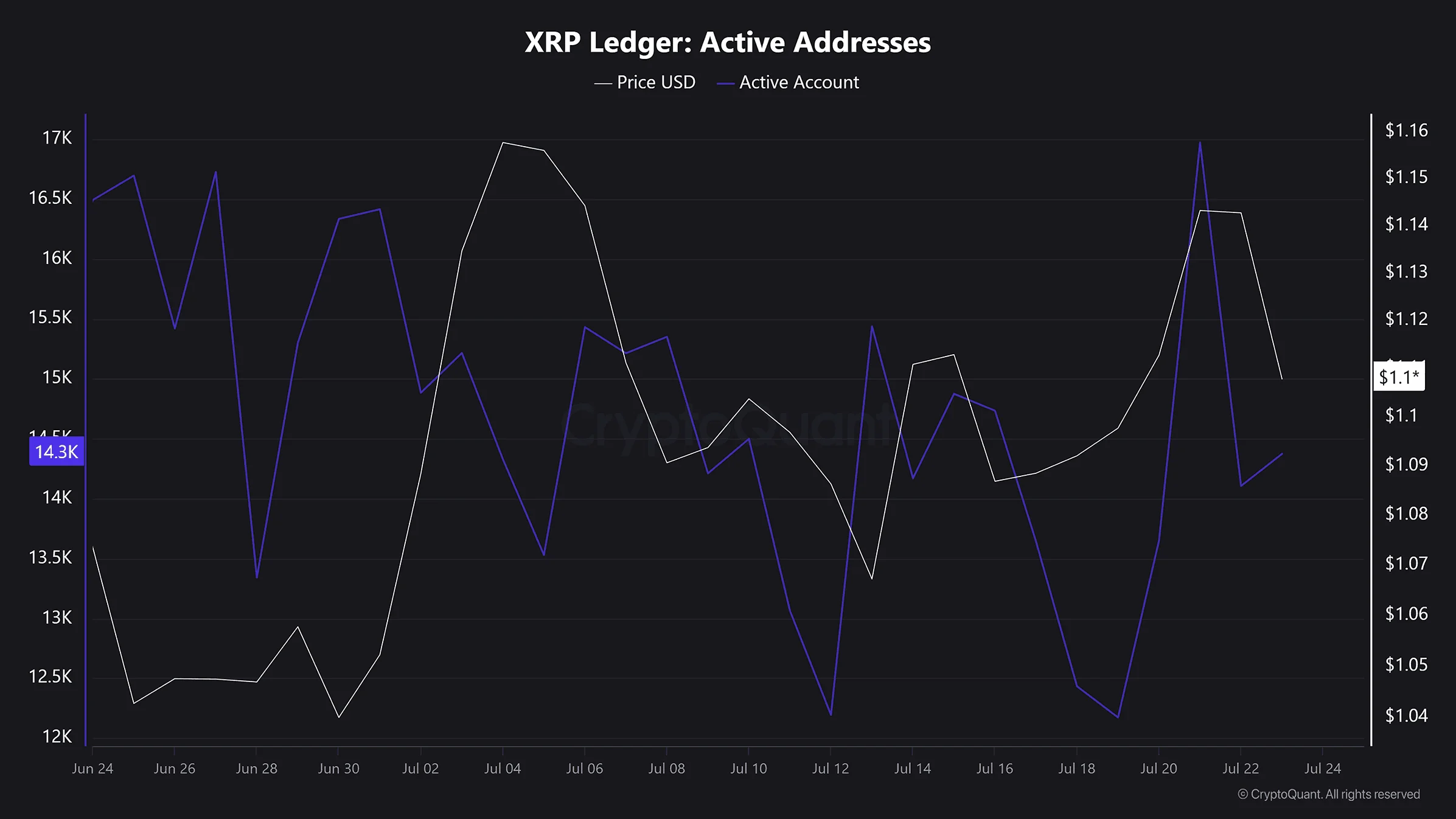
Ripple’s market activity has shown no significant changes over the last 24 hours. At the time of writing, the number of active addresses had flattened at around 14.5K, following gains of just 0.3K.

The lack of activity highlighted investors’ behavior as they seemed to be averse to observing the next price moves. 

XRP's active addresses
Source: CryptoQuant

Trendline support will be key for the next price move

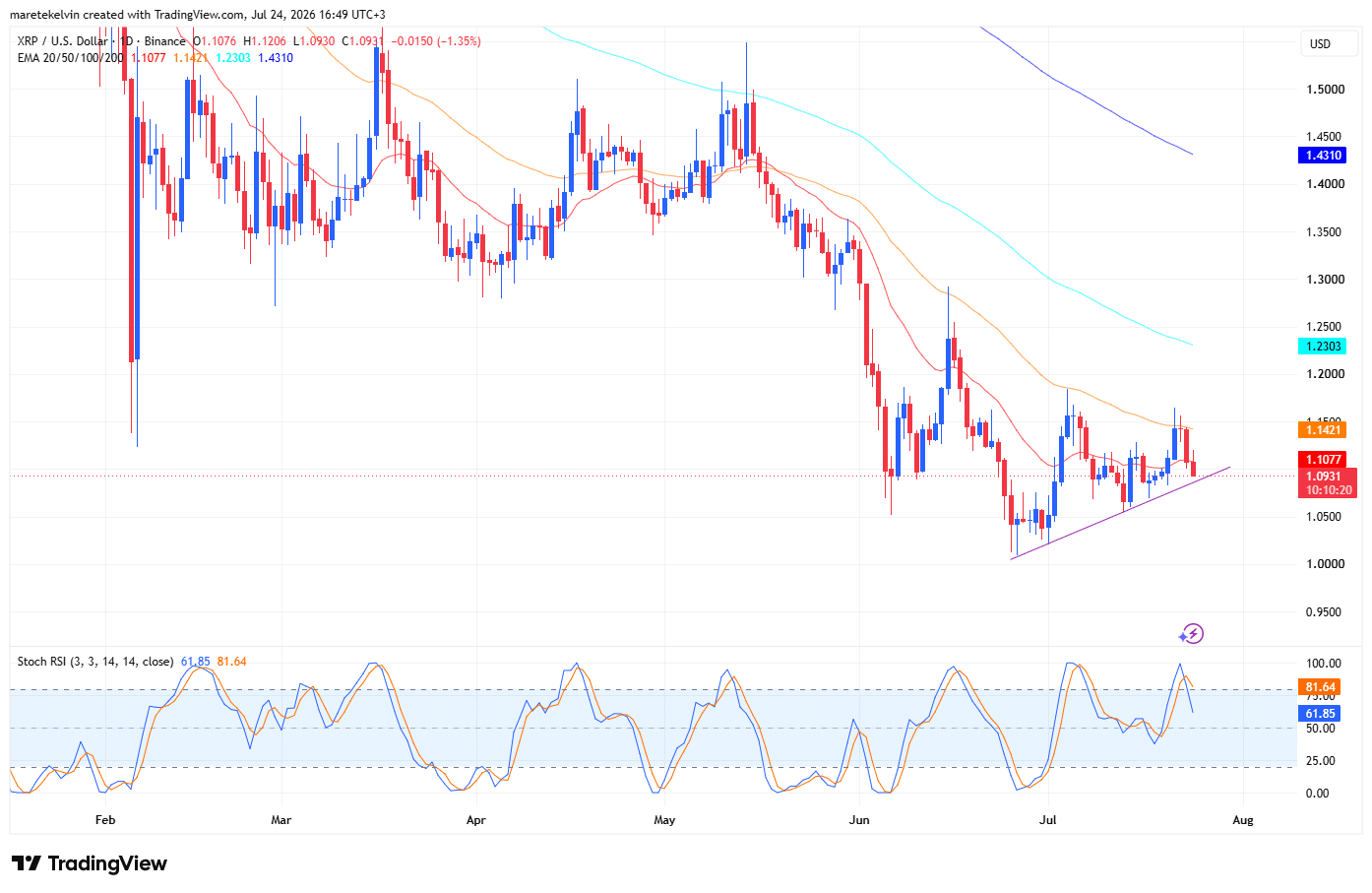
And yet, despite the positive news, XRP’s price is yet to break out. At press time, the token was still trading below every Exponential Moving Averages on the daily chart.  

The three-day bearish run pushed the token’s price to $1.09, with the same approaching a key trendline support too.

Price reaction at this point will determine XRP’s price trajectory. A break below the support level will extend the current bearish run to $1. A more significant correction cannot be overruled either.

This hypothesis was also based on the token’s momentum indicators leaning bearish. For instance, the XRP Stochastic RSI had a reading of 81.64 — Evidence that the token was in an overbought zone despite aggressive selling pressure.

XRP price analysisXRP price analysis
Source: TradingView

Final Summary

  • Ripple strengthened its institutional ecosystem through a strategic investment in Notabene after XRP Ledger’s major update. 
  • XRP continues to hold above the $1.05 support level, despite trading below key daily moving averages.


Source link

Poolin files for bankruptcy after collapse from bitcoin’s biggest mining pool

0
Poolin files for bankruptcy after collapse from bitcoin's biggest mining pool

Bitcoin mining company Poolin has filed for bankruptcy alongside its two U.S. affiliates Lonestar Dream and Lonestar Taproot with estimated liabilities between $100 million-$500 million, TheEnergyMag reported on Friday.

The Singapore-based firm, which once dominated the industry, filed for Chapter 11 protection in New Jersey on July 22 with debts of around $173 million,

A $52 million bid for two mining sites in West Texas is currently on the table from Thor CALAP LLC. The sites represent the better part of the company’s assets.

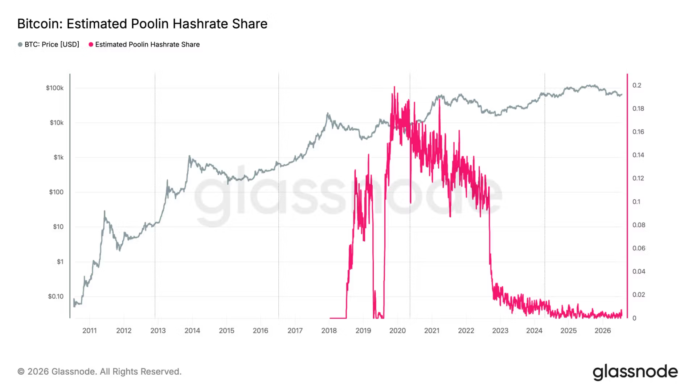
Poolin was one of the biggest mining pools in bitcoin at its peak meaning more bitcoin was being mined through Poolin than through any other single pool on earth. Glassnode data shows its share of global hashrate reached roughly 18-20% in 2019.

Users were already complaining about withdrawal delays on Poolin’s Telegram channels in late 2022, a period plagued by crypto companies facing liquidity squeezes as that year’s market downturn came to a head. Co-founder Kevin Pan acknowledged in a WeChat post that the company was “facing liquidity problems” while insisting user funds were safe.


Source link

Gold prices today, Friday, July 24, 2026: Gold price remains below $4,100 ahead of next week’s rate decision

0
Gold prices today, Friday, July 10, 2026: Gold finally opens higher this morning


Gold (GC=F) August futures opened at $4,053.40 per troy ounce on Friday, July 24, 2026, up 0.1% from Thursday’s closing price. The gold price moved higher this morning to $4,057 at 8:07 a.m. ET.

After stretching above $4,100 Thursday, the gold price has pulled back slightly. Investors are watching economic data and Iran war developments to weigh interest-rate risks in the U.S. against further global trade disruptions related to the Middle East conflict.

The European Central Bank held interest rates steady on Thursday. The consensus expects the Fed to do the same when the policy-making committee meets next week. The latest jobless claims report came in lower than expected, at 187,000 new claims vs. a median forecast of 212,000. A stronger labor market would likely encourage higher interest rates later in the year if inflation remains above the Fed’s 2% long-term target.

Higher interest rates limit the gold price by raising the opportunity cost of holding the precious metal.

The opening price of August gold futures on Friday, July 24, 2026, was 0.1% higher compared to Thursday’s opening price. Here’s a look at how the gold price has changed versus last week, month, and year:  

  • One week ago: +2%

  • One month ago: -1.2%

  • One year ago: +21.2%

On Jan. 29, gold’s one-year gain was 95.6%.

24/7 gold price tracking: Don’t forget you can monitor the current price of gold on Yahoo Finance 24 hours a day, seven days a week. 

Want to learn more about the current top-performing companies in the gold industry? Explore a list of the top-performing companies in the gold industry using the Yahoo Finance Screener. You can create your own screeners with over 150 different screening criteria.

A gold investment can add stability and inflation protection to your portfolio. But it can also dilute your gains when stock prices are rising quickly. Finding the right balance between gold’s diversification benefits and profiting from growth potential in other assets can be challenging. 

Even the experts are divided on how to achieve the correct balance. Below, five experts explain their recommended gold allocations, which range from 0% to 20%. 

Learn more: How to invest in gold in 4 steps

Robert R. Johnson, professor at Creighton University’s Heider College of Business, does not advocate gold investing. In his words, “while having a small position in precious metals may dampen portfolio volatility in the short-run, the tradeoff between slightly dampened volatility and the lost long-term return is certainly not a prudent one, particularly for Gen Z/millennials with long investing time horizons.”

Brett Elliott, director of content and SEO at American Precious Metals Exchange (APMEX), recommends setting an allocation that aligns with your investing goals. 

Growth-oriented investors may be comfortable with an allocation of 10% or 15%, according to Elliott. But income investors will prefer a smaller position, because gold provides no yield. A 2% to 5% gold allocation can provide some resiliency without an excessive drag on income potential. 

Learn more: Who decides what gold is worth? How gold prices are determined.

Blake McLaughlin, executive vice president at Axcap Ventures, said historical data support a gold allocation of 5% to 8%. “Gold may not offer the outsized return potential of private investments, but the metal holds a set of attributes that are increasingly hard to ignore,” according to McLaughlin. Those attributes include the metal’s resilience amid economic uncertainty and geopolitical unrest. 

Thomas Winmill, portfolio manager at Midas Funds, believes most investors will benefit from a long-term gold allocation of 5% to 15%. Winmill specifically advocates investing in gold mining companies through a mutual fund. 

Your risk tolerance and current mix of financial versus hard assets can guide you to an appropriate allocation, according to Winmill. 

  1. Risk tolerance: Keep your allocation percentage low if you tend to panic in volatile cycles.  

  2. Financial vs. hard assets: Financial assets are stocks and bonds. Hard assets include tangible items like real estate, gold, collectibles, classic cars, and equipment. If you have no home equity and your wealth is primarily in financial assets, you can set your gold allocation higher. Or, if your home is paid for and more valuable than your stock portfolio, gold investing may not be necessary.  

Learn more: Thinking of buying gold? Here’s what investors should watch for.

Vince Stanzione, CEO and founder at First Information, recommends a 20% gold allocation, specifically in physical gold or a gold ETF. Stanzione argues for a higher exposure to gold as a wealth protection strategy. As he says, “gold keeps with inflation and gold retains its purchasing power,” while paper currencies are devaluing around the world.   

Learn more: Gold IRA: Benefits, risks, and how it differs from a traditional IRA

Whether you’re tracking the price of gold since last month or last year, the price-of-gold chart below shows the precious metal’s change in value so far this year. 


Source link

Bitcoin (BTC) news: This $5 billion cluster points to bullish positioning

0
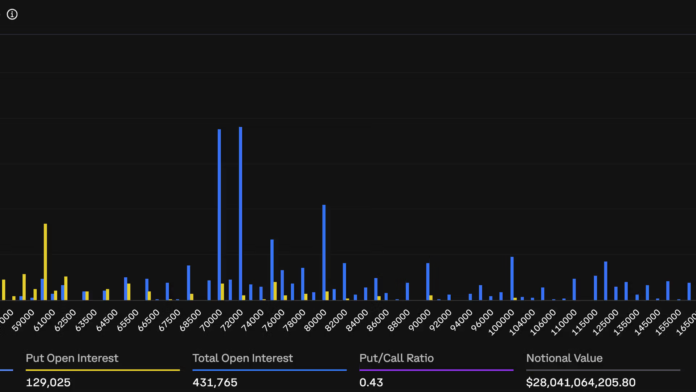
Bitcoin (BTC) news: This $5 billion cluster points to bullish positioning

Several large, deliberate trades hit the tape recently, building up this concentration of open interest at $70,000 and $72,000 levels. Laevitas identified a large bull call spread structure, involving buying the $70,000 call and simultaneously selling the $72,000 call.

The bull call spread, as the name suggests, bets on a moderate upswing in prices of the underlying asset, in this case, up to $72,000.

“The structure accounts for approximately 49% and 50% of total call open interest at the $70K and $72K strikes, respectively,” Laevitas noted.

Other notable trades included calendar spreads, a strategy used to profit from volatility changes in short- and near-term expiries.

Another trader or a group of traders bought a large number of calls at $70,000, paying $3.4 million in premium to gain upside exposure.

Jimmy Yang, co-founder of Orbit Markets, an institutional digital asset liquidity provider, pointed out similar trades, saying these have been driven by Clarity Act optimism.

“Earlier this month, we saw decent demand for BTC topside calls, with the 31 July $70,000 and $72,000 strikes being particularly popular. A lot of this positioning was driven by expectations that the CLARITY Act could be passed before the end of the month,” Yang said.


Source link