Once one of the biggest Bitcoin [BTC] mining pools globally, Poolin has declared Chapter 11 bankruptcy in the United States. The filing includes the parent company Poolin, which is based in Singapore, as well as its U.S subsidiaries Lonestar Dream Inc. and Lonestar Taproot LLC.
With this declaration, the companies are seeking a court-supervised liquidation of their remaining assets. This will center around their mining infrastructure in Texas, rather than reorganizing and continuing to operate under Chapter 11.
This, in turn, would mark the end of a financial meltdown that started during the bear market for cryptocurrencies in 2022.
Poolin underwater
According to the filings, the total assets and liabilities range from $1 million to $10 million and $100 million to $500 million, respectively.
A more accurate picture was shared by Chief Restructuring Officer Michael DuFrayne’s declaration as it placed the total pre-bankruptcy obligations at about $173.1 million.
Of that sum, almost $163.7 million is made up of unsecured debts. This amount is owed to Poolin Wallet users whose assets were rendered inaccessible following the company’s 2022 withdrawal freeze.
What’s the actual cause behind this?
Here, instead of its mining operations, Poolin’s wallet business was the main source of its financial burdens. This, because the company allowed users to deposit cryptocurrency, borrow USDT against collateral, and earn yield during the cryptocurrency boom.
Following the 2022 market crash, it suspended withdrawals and gave approximately 11,700 customers IOU tokens worth $163.7 million, rendering them unsecured creditors.
However, after borrowing $213 million against cryptocurrency collateral from Antalpha Technologies, its problems got worse. In the months ahead, Poolin suffered enormous losses when Antalpha liquidated the collateral in late 2022 as prices fell. At the same time, its mining expansion in the United States also failed.
Additionally, mining operations were also found to be unsustainable. At last, after approximately $45.9 million in operating losses incurred by Lonestar Dream and Lonestar Taproot, Poolin closed its Texas sites for mining and hosting on 10th July.
And yet, despite the failure of its Bitcoin mining business, it marketed the assets to over 335 prospective buyers before declaring bankruptcy. This resulted in 28 non-disclosure agreements and seven letters of intent.
In the past, the business also attempted to sell its Texas operations to China Green Agriculture for $49 million. However, the deal never went through.
Poolin is now trying to sell its remaining assets and give the money to its creditors through Chapter 11. Nevertheless, the amount recovered for Poolin Wallet users is anticipated to be contingent upon the outcome of the auction and is probably going to be far less than the $163.7 million that is owed to them.
Bitcoin miner status sparks concerns
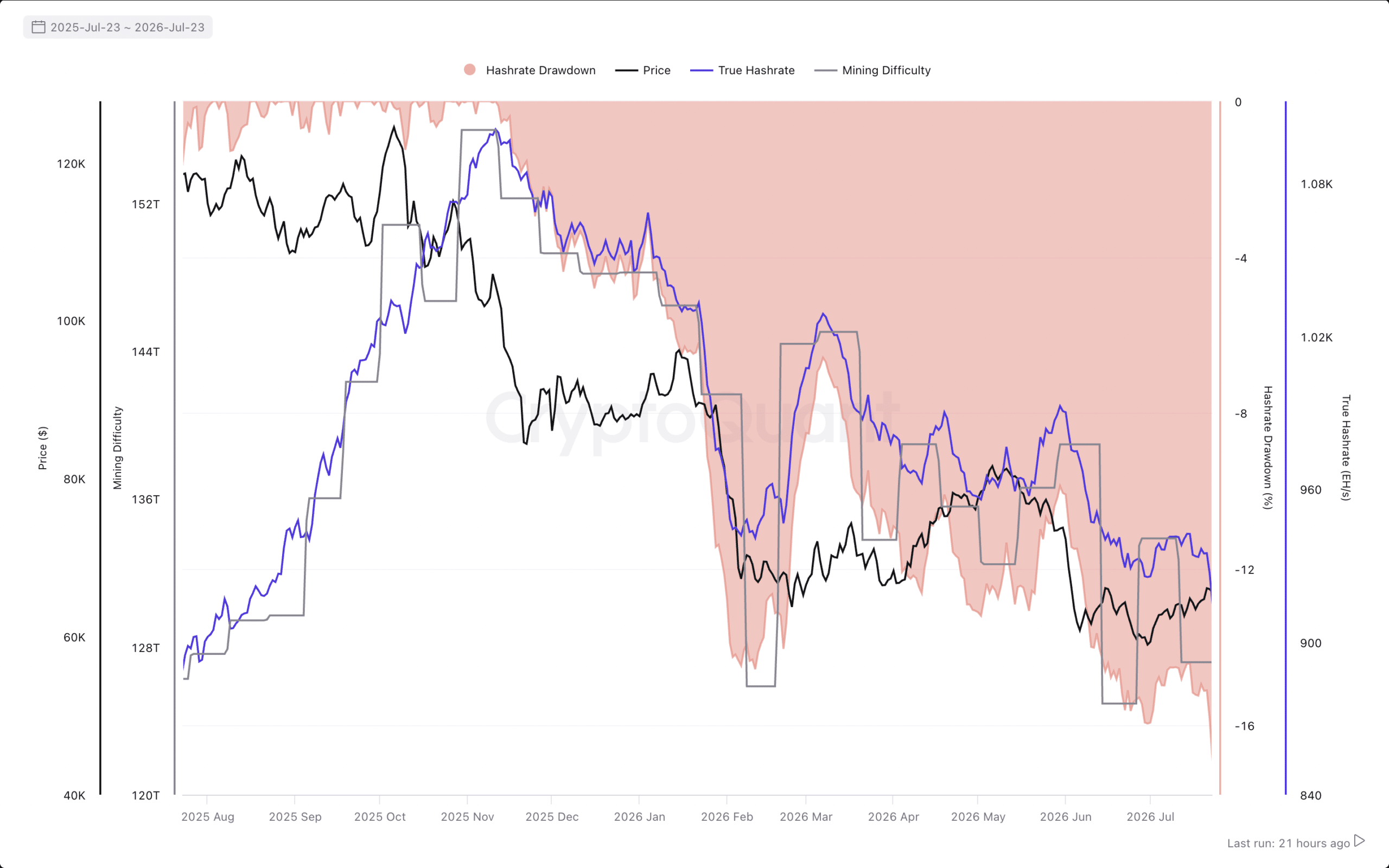
This news comes on the heels of AMBCrypto’s recent report on the Miners’ Financial Health Index, which indicated that miners were under a lot of pressure. In fact, the CryptoQuant graph below further confirmed a protracted period of miner surrender.
Source: CryptoQuant
According to the same, the hashrate drawdown remained consistently negative, worsening to about -16% by July. Additionally, Bitcoin’s true hashrate also fell to -12 precipitously starting in late January and never fully recovered.
All in all, in the broader market too, miners have been taking machines offline in greater numbers. Especially as profitability declined.
Final Summary
Firm has total assets and liabilities ranging from $1 million to $10 million and $100 million to $500 million, respectively.
Despite the challenges, Poolin marketed the assets to over 335 prospective buyers before going bankrupt.
Silver (SI=F) September futures opened at $57.92 per ounce on Friday, July 24, 2026, down 0.2% from Thursday’s closing price. The silver price moved higher this morning, reaching $58.87 as of 8:28 a.m. ET.
After pulling back Thursday, silver rebounded slightly Friday morning. Strength in the U.S. dollar (DX-Y.NB) contributed to Thursday’s decline and inflation risk continues to limit any recovery for silver prices. According to CME FedWatch, the consensus for next week’s rate decision is a hold — but the probability has declined to 64.2% from 87.2% last week. A better-than-expected initial jobless claims report on Thursday contributed to the sentiment change.
Since silver does not pay interest, investors tend to shift into yield-bearing assets when interest rates rise. That limits demand and silver’s appreciation potential.
Current price of silver
The opening price of silver futures on Friday, July 24, 2026, was 0.2% lower compared to Thursday’s closing price. Here’s how today’s opening silver price has changed versus last week, month, and year:
One week ago: +4.3%
One month ago: -2.5%
One year ago: +48.3%
For context, silver’s year-over-year growth was 173.3% on May 14.
Want to learn more about the current top-performing companies in the silver industry? Explore a list of the top-performing companies using the Yahoo Finance Screener. You can create your own screeners with over 150 different screening criteria.
Investing in silver? Here’s how to avoid taxes.
Do you have to pay taxes on silver? Yes. Silver is a capital asset, so when you sell it for more than you paid, the gain is taxable and reported on Schedule D of your federal return.
Many investors assume holding silver for more than a year qualifies them for the same long-term capital gains rates as stocks (0%, 15% or 20%).
Spoiler: It doesn’t.
The 28% collectible tax trap
The IRS classifies physical precious metals — including bars, rounds, and coins — as collectibles. That classification changes the tax math in a big way.
Short-term gains
If you hold silver for one year or less, your profit is taxed as ordinary income. Depending on your tax bracket, that could go as high as 37%.
Long-term gains
If you hold silver for more than one year, your gain is taxed at your ordinary income rate — but no more than 28%.
Here’s what that looks like in real life:
If you’re in the 10%, 12%, 22% or 24% bracket, your silver gain is taxed at that same rate.
If you’re in the 32%, 35% or 37% bracket, you’re capped at 28%.
So if you’re a middle-income earner accustomed to paying 15% on stock gains, silver can cost you more, maybe 22% or 24%, depending on your adjusted gross income.
If you’re in the top brackets, the 28% cap is technically a discount versus 35% or 37% — but it’s still higher than the 20% max long-term capital gains rate on stocks.
That difference adds up quickly when you’re talking five- or six-figure gains.
Whether you’re tracking the price of silver since last month or last year, the price-of-silver chart below shows the precious metal’s value journey so far this year.
Nearly 150,000 California voters had their mail-in ballots rejected for the state’s June primary, a spike from recent elections even as the state attempts to make voting easier with the goal of boosting participation and counting every ballot.
California has become notorious for its ponderously slow vote counts that can drag on for weeks and sometimes longer, largely the result of multiple changes over the years that were intended to increase turnout but have done little to achieve that. Among the changes: Every voter receives a mail-in ballot that can arrive at an election office seven days late and still be counted, provided the envelope is postmarked by Election Day.
Yet even with that generous weeklong window, the primary driver of the higher rejection numbers is late-arriving ballots, according to data compiled by the secretary of state’s office. Voting experts suspect the main problem is postmarks on ballots that came after Election Day, making them ineligible to be counted. The culprit could be U.S. Postal Service changes that might affect the timing of when postmarks are applied.
In raw numbers, that’s up from the 2024 primary, when 108,982 mail ballots were rejected, or a 1.56% rate. In 2022, 105,818 mail ballots were voided during the primary, or a rate similar to 2024.
Lateness accounted for 93,479 rejected ballots in June, by far the largest category for disqualifying a ballot. That was up from about 70,000 in the 2022 primary and about 76,000 in the 2024 primary, though turnout in those elections was smaller compared to last June.
Kim Alexander, president of the nonpartisan California Voter Foundation, said the jump in rejected ballots because of lateness is a major concern that — along with postal procedures — might also be connected to a late surge in ballots in June. Many voters waited until the final days to make a decision in a wide-open and chaotic race for governor.
“Ballots rejected due to lateness are caused primarily to being postmarked too late to count, not because they arrived too late to count,” Alexander wrote in an email.
Rejection rates have fluctuated over time, but the growing number of those set aside for lateness compared to recent elections “does really demand the question why this is happening,” said Mindy Romero, director of the Center for Inclusive Democracy, a nonpartisan research group.
Updated agency policy says postmarks might not indicate the first day the Postal Service received the mail, but rather the day it was handled in one of its processing centers. Those centers are increasingly likely to be further away from certain communities because of recent consolidations within the Postal Service, which could further delay postmarks.
On Thursday, two Wisconsin Democrats, U.S. Sen. Tammy Baldwin and Gov. Tony Evers, called on the Postal Service to address delays that caused hundreds of ballots to arrive after Election Day in the state in April. In June, a federal judge halted President Donald Trump’s executive order that sought to create a federal voter list and limit who can receive a mail ballot.
Earlier this year, California election officials urged voters to send their mail ballots early, warning that Postal Service changes could lead to slower mail service.
In California, the highest mail ballot rejection rate in June — 3.52% — was in Tulare County, in the agriculture-heavy Central Valley. It was followed by Alpine County, south of Lake Tahoe, and Merced County, also in the Central Valley, which both notched a 3.36% rejection rate.
Mismatched signatures and multiple ballots in an envelope
Nearly 44,000 ballots were set aside because the voter’s signature didn’t match the one on record with county officials. Over 8,300 ballots were rejected because there was no signature on the returned ballot envelope.
In 743 cases, the voter had already cast a ballot, so the mail ballot was voided. Other reasons for rejection included a ballot being missing from the return envelope, or multiple ballots were sent back in a single envelope.
The data didn’t break down the uncounted ballots by party registration.
Florida, Texas and other large population states quickly wrap up vote counting, while California is a national laggard.
After the June primary, President Donald Trump seized on California’s reputation as the national slowpoke in vote counting to renew his long-standing criticism of the state’s elections, while the Republican’s Department of Justice launched an investigation into Los Angeles County’s elections.
There is no indication of any widespread problems with mail voting, which has gained in popularity among Democrats and Republicans alike. A report by the Brookings Institution published in 2025 found that the number of cases of mail voting fraud was minuscule — about four cases per 10 million mail ballots.
The crypto market continues to mature with growing institutional participation, and memecoins are paying the price.
The combined market capitalization of DOGE$0.06963 and shiba inu (SHIB), the two largest memecoins by value, has fallen to $13.27 billion, the lowest in three years and down about 2% this month alone, even though market leader bitcoin BTC$64,061.41 has risen by 10%.
A more revealing picture emerges when you measure the top two memecoins against bitcoin’s market cap of $1.30 trillion.
That ratio now stands at just 1.02%, the lowest on record. That’s a dramatic reset if considering where things stood at the peak of memecoin mania in 2021, when DOGE and SHIB together accounted for 7% of bitcoin’s market cap. In other words, for every dollar invested in bitcoin, seven cents were chasing internet joke tokens. Today that figure is just over one cent.
Bitcoin has grown substantially since 2021, meaning memecoins haven’t just lost value in dollar terms, they have ceded ground against the very asset that defines the crypto market cycle.
If you’re looking for a relatively safe and steady way to grow your cash, consider a CD or bond ladder. These two strategies are designed to manage interest rate risk and provide periodic access to your cash.
But which option is better for your goals? Learn what CD ladders and bond ladders are, the key differences between them, and how to decide which one you should choose.
What is a CD ladder?
A CD ladder is a strategy in which you spread your money across multiple certificates of deposit (CDs) with staggered maturity dates. As each CD matures, you get access to a portion of your cash over time instead of waiting for a singular maturity date to access all of your funds at once.
This strategy can help mitigate risk by giving you the recurring opportunity to either renew individual CDs or withdraw your cash. It also lets you take advantage of whichever CD term is offering the best interest rate.
CD ladder example
Imagine you have $40,000 you want to deposit into CDs. The bank’s 1-year CD rates are the highest, but you don’t want to lock up all your money for that long to get the best rate. So, you set up a CD ladder, putting $10,000 into four different accounts with terms ranging from three months to one year.
When each CD matures, you can either renew it, choose a different term, or withdraw the cash and put it elsewhere.
Before setting up a CD ladder, consider these pros and cons:
Pros
Regular access to cash: With CDs maturing at regular intervals, you have frequent opportunities to withdraw cash penalty-free, if needed.
Regular renewal opportunities: When CDs in your ladder mature, you have the chance to renew them. If rates have gone up, you can lock in those higher earnings.
Predictable returns: CDs offer fixed interest rates for the entire term, so you know precisely how much you’ll earn by the time each CD matures.
Deposit insurance: CDs are a deposit product and therefore come with insurance on up to $250,000 per depositor, per institution. Depending on whether you open CDs at a bank or credit union, the FDIC or NCUA insures those deposits.
Cons
Regular maintenance: A CD ladder isn’t a “set-it-and-forget-it” strategy. You’ll have multiple maturity dates to track, at which point you’ll have to decide whether you want to renew the CD, put the money into a different CD, or withdraw the cash.
Less liquidity: CD ladders give you scheduled access to cash, but you can’t withdraw the money whenever you want. If you make withdrawals before a CD matures, you generally have to pay early withdrawal penalties.
Interest rate risk: Because CDs pay fixed interest, you lock in your rate until maturity. If interest rates rise after opening a CD, you’ll be stuck with the lower rate throughout the CD’s term (with the exception of bump-up CDs).
Inflation risk: If inflation outpaces your CD’s interest rate, your money will lose buying power over time.
What is a bond ladder?
Bonds are low-risk investments that pay you a fixed rate of return. For this reason, the “laddering” approach common with CDs also works with bonds. A bond ladder is similar to a CD ladder: It’s a group of bonds with evenly staggered maturity dates. Splitting your cash between multiple bonds gives you regularly scheduled access to maturing bonds and can help you adapt to a changing financial climate.
Bond ladders can include government bonds, municipal bonds, corporate bonds, and even bond ETFs. Compared to CDs, bonds often come with longer investment timelines — long-term bonds can have terms of up to 30 years.
Example of a bond ladder
Say you have $10,000 to invest in bonds. Instead of putting it all in bond that matures in 5 years, you spread it out over five different bonds with a range of interest rates and staggered maturities:
In this example, a bond will mature every year. At that point, you can reinvest the money by purchasing another bond or use the money elsewhere.
Note: Actual bond returns depend on the coupon rate, purchase price (premium or discount), reinvestment, and whether the bond is held to maturity. Some types of bonds, like savings bonds, require you to hold them for a minimum number of years before cashing in, otherwise you must forfeit a portion of the interest earned.
When building a bond ladder, keep these pros and cons in mind:
Pros
Regular access to cash: Like a CD ladder, a bond ladder gives you regular, scheduled access to your cash. When bonds mature, you can choose to reinvest the cash or not, based on your current financial situation.
Diversification: A bond ladder lets you diversify in multiple ways. By building a ladder with varying interest rates, maturities, and bond types, you can potentially reduce default, tax, and inflation risk.
Regular payouts: Some bonds issue payouts at regular intervals throughout their terms, providing a predictable stream of income.
Potential tax advantages: U.S. Treasury bonds, bills, and notes are taxed at the federal level, but not the state or local level. Municipal bonds may be exempt from taxes, too.
Potential inflation protection: Treasury Inflation-Protected Securities (TIPS) provide a hedge against inflation. The principal increases or decreases with inflation, and at maturity, you either receive the original principal or the inflation-adjusted principal — whichever is greater.
Cons
Ongoing maintenance: Bond ladders, like CD ladders, require ongoing maintenance and decision-making every time a bond matures. Again, you’ll have to track individual bonds’ maturity dates.
Interest rate risk: When interest rates rise, the price of existing bonds decreases. So if you need to sell a bond before maturity, you might not get what you paid for it.
Inflation risk: Aside from inflation-protected bonds, bonds in your ladder may lose purchasing power if inflation outpaces interest rates.
Potential default: While bonds are considered low-risk, many carry a risk of default. Default is when the bond issuer fails to make required payments.
Lower returns compared to other investments: While bonds carry little risk, that also means they don’t offer the same growth potential as other securities, such as stocks.
CD ladder vs. bond ladder: Key differences
How interest rates affect each laddering strategy
With fixed-rate CDs, you earn predictable interest throughout your CD’s term. Here’s how rising or falling interest rates can affect your CD ladder strategy:
CDs and rising interest rates: When rates rise over time, you’re able to reinvest CD earnings as they mature at regular intervals, taking advantage of the new, higher rates. However, some of your money will be locked into longer-term CDs with the older, lower rates.
CDs and falling interest rates: CDs generally continue earning interest at whatever rate you locked in when the account was opened. So, when rates fall, long-term CDs are advantageous. When a CD matures, you can decide whether or not to deposit it in a CD, likely with a lower interest rate, or use the money elsewhere.
When it comes to bond ladders, a similar principle applies. Regular maturities allow you to reinvest or not, depending on the current interest rate environment. However, because bonds can be bought and sold before maturity, there’s another layer to how interest rates affect bond ladder strategy.
Bonds and rising interest rates: When interest rates rise, existing bond prices tend to fall. That can make it harder to sell bonds before maturity, and you may not get what you paid for them. However, when a bond matures, you can reinvest the money into a bond with a higher rate.
Bonds and falling interest rates: When rates fall, your existing bonds become more valuable. But when they mature, you’ll likely need to invest them at lower rates.
Tax considerations
Interest you earn from a CD is taxed as ordinary income, just like your salary or wages. You generally have to pay taxes on these earnings for the year you receive them (or are entitled to receive them), even if you deposit it right back into another CD. If a CD has a maturity longer than one year, you still have to include part of the total interest due as part of your annual income.
On the other hand, bond ladder taxes are dependent on the type(s) of bonds they include:
U.S. Treasury bills, bonds, and notes are taxed at the federal level but not at the state or local level.
Municipal bonds are generally (but not always) exempt from federal taxes and may be exempt from state and local taxes.
Corporate bonds are generally taxed as ordinary income.
In short, taxes on CD ladders are relatively straightforward, but taxes on bond ladders depend on the type of bonds that make up your portfolio.
Which should you choose: CD ladder or bond ladder?
Whether you choose a CD ladder or a bond ladder depends on your financial situation, risk tolerance, and goals. Your circumstances may be unique, but the following are some general rules to help you decide where to put your money.
CD ladders may be better for:
Bond ladders may be better for:
Income-focused investors
Retirees seeking higher yields
Investors with larger portfolios
Those willing to accept some risk for potentially greater returns
Can you combine CD and bond ladders?
Yes, you can combine CD and bond ladders — there’s no rule against it. But ensure each strategy has a unique purpose in your portfolio. For instance, a CD ladder might make sense for growing a portion of your savings over the next several years. Meanwhile, a bond ladder might be a longer-term tool to mitigate risk in your investment portfolio.
Keep in mind, however, that both CD ladders and bond ladders offer modest growth. If you’re trying to save for retirement, you’ll likely need stocks or other growth-oriented assets in your portfolio to reach your financial goals.
Since the October 2025 peak, Bitcoin has failed to sustain an uptrend, falling 48% from its ATH. Amid this extended market weakness, long-term holders, especially institutions, have seen their losses skyrocket.
The rising losses have pushed many of these firms to a breaking point, and they are not only capitulating but also walking away.
KULRTech dumps $9 million in Bitcoin
Treasuries that rushed to accumulate Bitcoin [BTC] from late 2024 and 2025, fearing they would miss out, have found themselves operating at a loss.
Others were pushed to capitulate to avoid more losses, and one such Bitcoin treasury company is KULRTech.
KULRTech has been aggressively dumping its BTC over the past months. According to Arkham data, KULRTech transferred 145.8 BTC worth $9.45 million to Coinbase Prime.
Source: Arkham
After multiple transfers, its holdings of 1,021 BTC worth $101 million now have only 100 BTC worth $6.47 million left.
In its selling spree, the company has mostly exited at a loss. AMBCrypto earlier reported that KULR Bitcoin holdings saw over $18 million in losses.
Now with only 100 BTC left, it seems the company is on the verge of completely exiting its position. Thus, if weakness continues, the company is likely to sell and exit the market entirely.
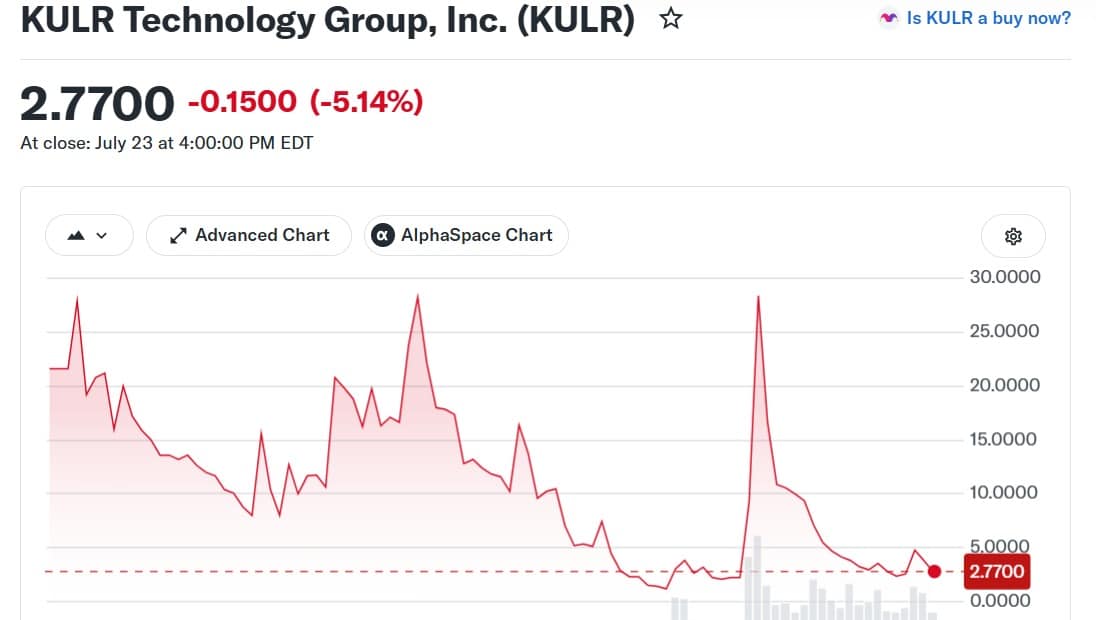
Source: Yahoo Finance
Even more impactful for KULRTech, the company’s stock value was hit the hardest by extended Bitcoin poor performance.
Yahoo Finance data showed that the company’s stock declined 78% from its ATH of $43 recorded after it announced its BTC investment. As of this writing, the firm’s stock value was around $2.7.
Treasuries holdings value plunges $47 billion from 2025 peak
KULR Technology Group, Inc is one of the many Bitcoin treasury companies operating at a loss. Also, it joins a long list of these firms aggressively selling.
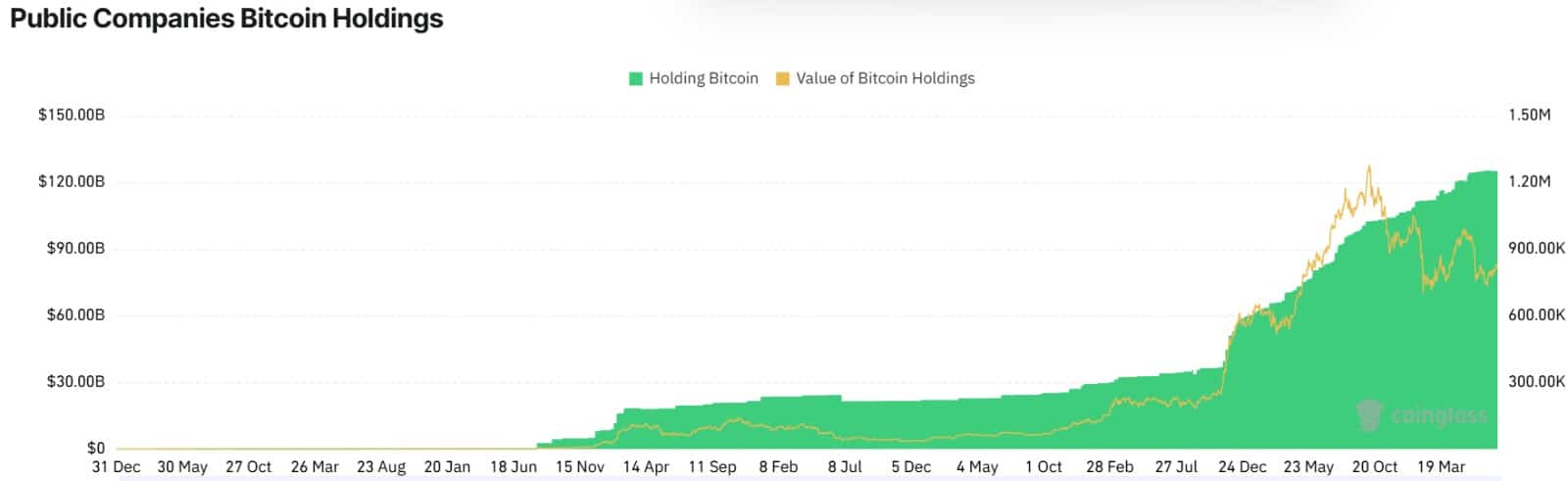
Interestingly, while Treasury companies have increased their holdings in 2026, they have yet to reclaim peak value.
Source: CoinGlass
In 2025, Bitcoin treasury companies held 1.02 million BTC worth approximately $128.5 billion at the peak. Now, these firms hold 1.25 million BTC worth $81.5 billion, marking a $47 billion drop from the 2025 peak.
Thus, although holdings have increased by 230k BTC, the value remains extremely low, signaling rising losses. For example, Strategy is currently operating on $9 billion in losses.
With these major investors holding at a loss and continually selling, the Bitcoin market still remains at extreme risk. Thus, fear from treasuries could drive continued market weakness, further reducing the capital that BTC relied on significantly for the 2024-2025 rally.
Final Summary
KULR Technology Group transferred 145.8 BTC worth $9.45 million to Coinbase Prime, reducing total holdings to 100 Bitcoin.
Bitcoin treasuries have increased holdings by 230k BTC since October 2025, but value dropped from $128 billion to $81 billion.
Crypto markets have struggled for much of the year as weaker trading volumes, concerns over the economy and fading risk appetite weighed on digital assets. The tougher backdrop has hurt market makers, whose revenues depend largely on trading flows and providing liquidity. With spot trading volumes subdued, firms across the sector have faced pressure on profitability.
Mergers and acquisitions are expected to remain a defining theme in 2026 as digital asset firms consolidate to achieve scale, expand product offerings and meet growing institutional demand, according to industry analysts.
Exchanges, market makers, custodians and financial technology providers are looking to acquire complementary businesses to build integrated digital asset platforms, reflecting the maturation of the crypto ecosystem into a more institutional and regulated market.
SBI Financial Services, a subsidiary of SBI Holdings, acquired a 90% stake in B2C2 in December 2020, months after investing $30 million in the firm.
B2C2’s financial results are not disclosed separately. They are reported as part of SBI’s broader crypto-asset business segment. For the fiscal year ended March 31, that segment generated 89.6 billion yen ($550 million) in revenue, up 10.9% from a year earlier, while profit before tax was unchanged at 21.2 billion yen.