Bitcoin held near $65,000 in Asia morning hours on Friday, barely moving while nearly $800 billion evaporated from the biggest U.S. technology stocks – a rare stretch of independence for an asset that has tracked the AI trade all month.
The largest cryptocurrency traded at about $65,400, down less than 1% on the day and up 3% on the week. Ether slipped 3% to $1,879, and the rest of the majors leaned red. Dogecoin was the worst of them, down 5% on the day to $0.069 and 4% on the week. XRP fell 2% to $1.11, Solana lost 3% to $76, and Hyperliquid’s HYPE dropped to $58, down 4% over seven sessions. The moves were losses, but modest ones against what was happening in equities.
The Magnificent Seven, a colloquial term for the megacap group that has driven U.S. stocks for three years, fell 4.8% on Thursday and shed $797 billion in market value in their worst day since the tariff selloff of April 2025, according to Bloomberg.
The drop dragged the S&P 500 down 1.2% and the Nasdaq 100 down 1.9%, and it left the group 11% below its late-May record, erasing $2 trillion.
Ethereum [ETH] is currently seeing strong staking demand compared to the market distress in Q4 2025.
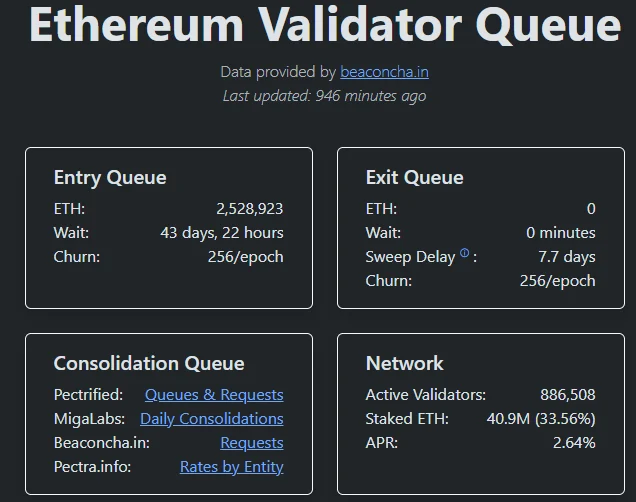
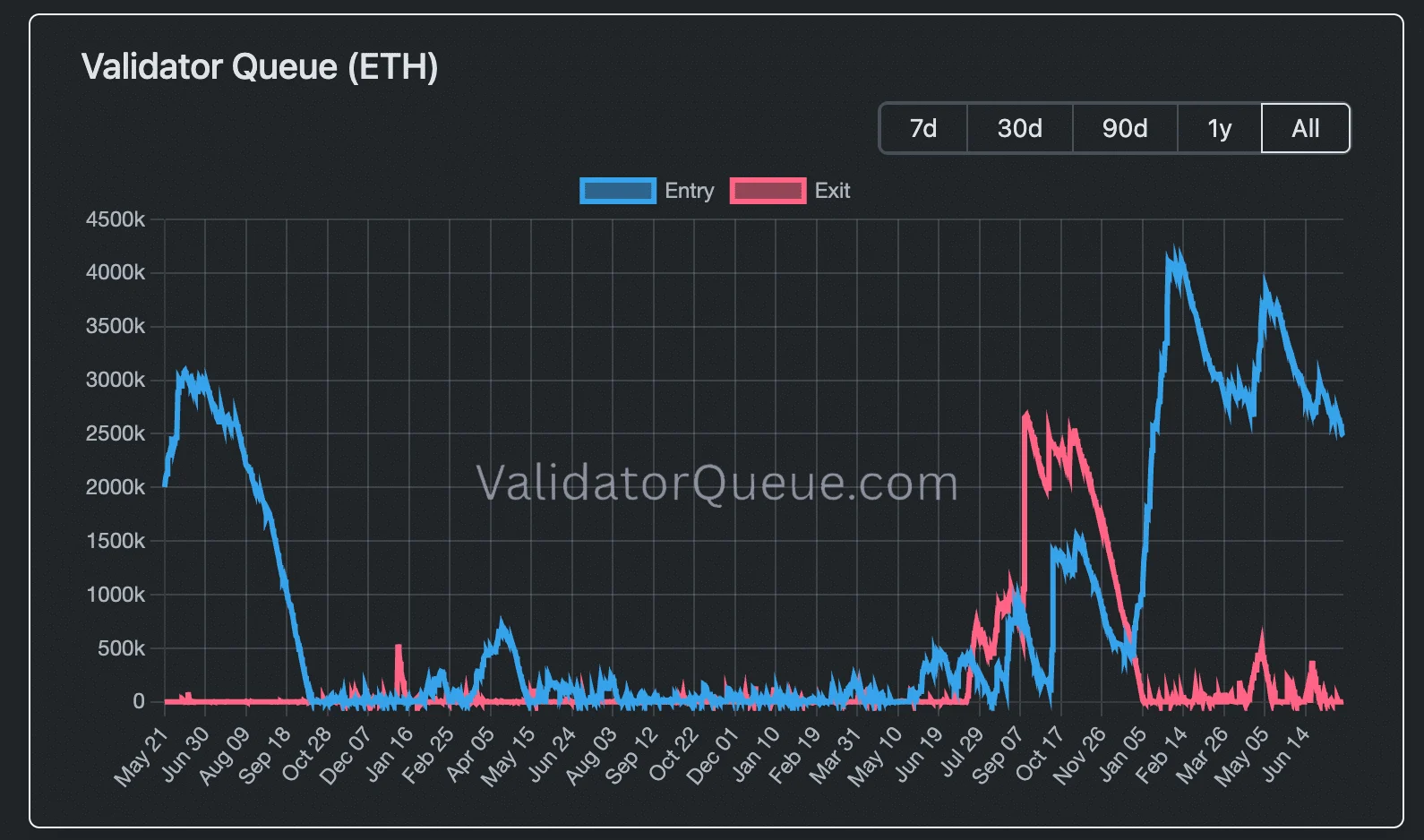
According to analytics platform Arkham, the Ethereum validator exit queue has dropped to zero with no waiting time, signaling that stakers have ‘long-term conviction.’
For comparison, during the market crash late last year, ETH queued for exit peaked at 2.6M ETH, and the waiting time was about 44 days. Now, it takes 0 minutes to withdraw staked ETH.
Source: Validator Queue
Will Ethereum staking demand boost ETH value?
In contrast, the entry queue is taking nearly 44 days to get into the staking ecosystem. About 2.5 million ETH is currently waiting to be staked, underscoring a massive divergence between demand and exit. For Arkham, this was a bullish signal.
This imbalance demonstrates robust demand to stake ETH. This development supports tighter ETH supply dynamics, as more capital flows into staking than leaves it.
Source: Validator Queue
Worth noting that staked ETH has surged to 40.9 million ETH, marking a 14% year-on-year (YoY) increase. This translates to a record high of 33.97% in the staking ratio relative to the overall ETH supply.
But staking is just one side of the demand line. In fact, part of the staking demand comes from the U.S. spot ETH ETF and treasury firms like Bitmine.
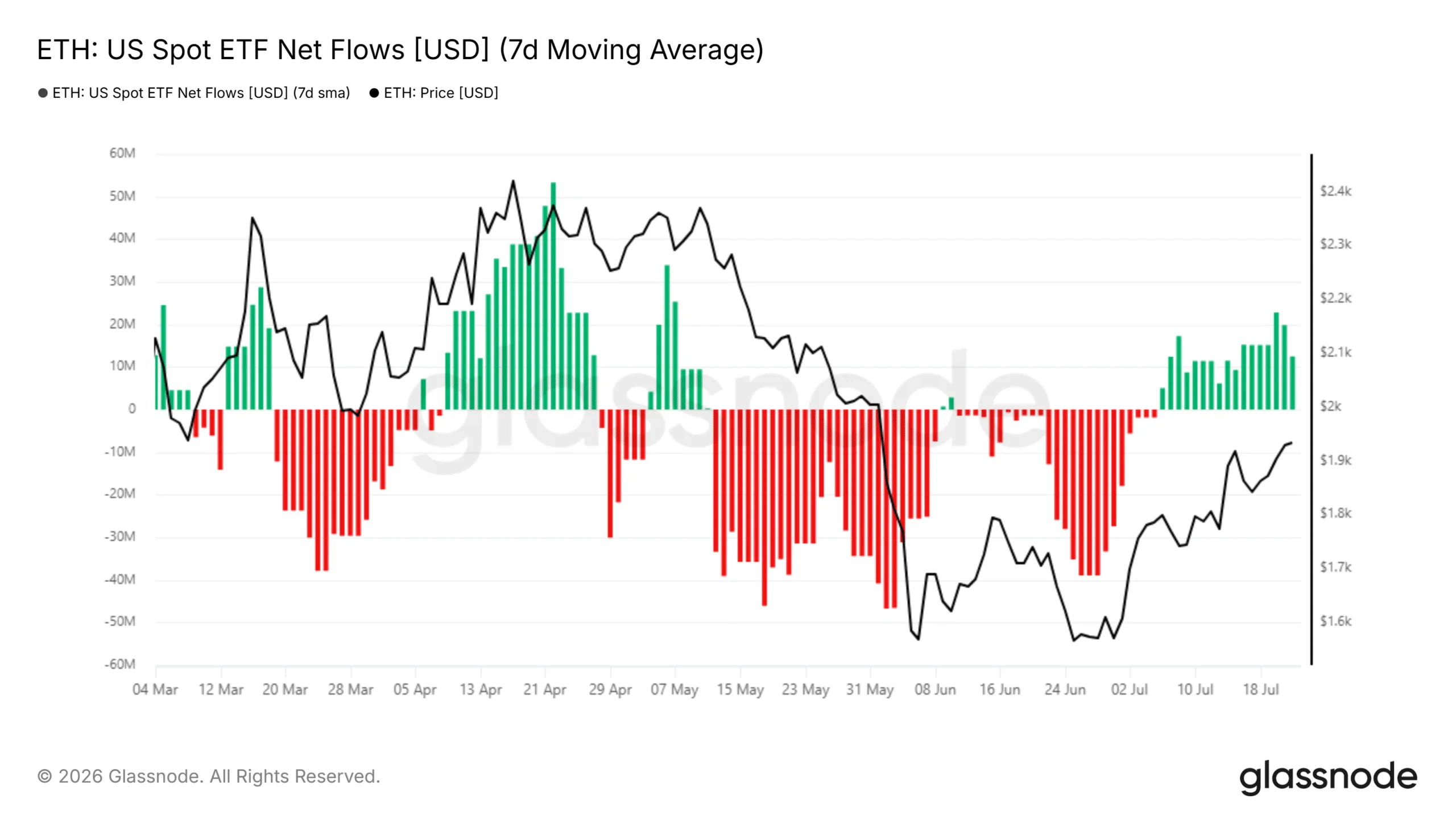
Speaking of the U.S. Spot ETH ETF, the products have been positive in the past two weeks, lifting the price from below $1.8K to nearly $2K.
Source: Glassnode
If the flows remain green, perhaps the $2K psychological level could be decisively reclaimed as support.
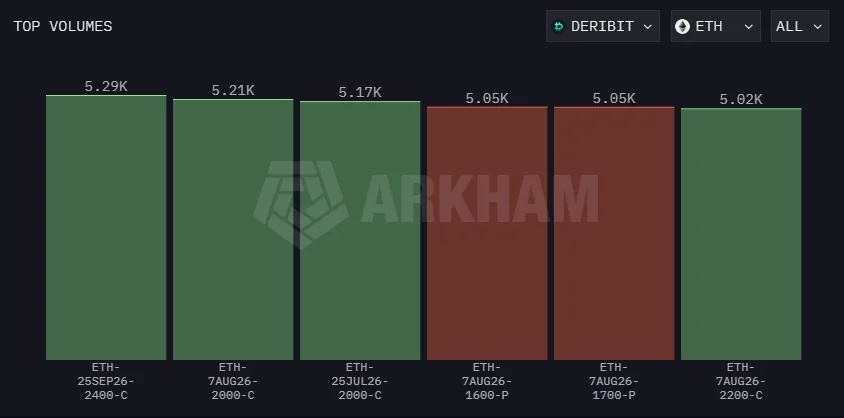
And institutional positioning in the Options market signaled a similar stance. In the past 24 hours, calls (bullish bets) were the most dominant trading volume for the September and early August option expiries, eyeing $2.4K and $2K targets, respectively.
Source: Arkham
As of writing, the altcoin was valued at $1.926K as the market focused on the CLARITY Act passage ahead of Congress’ August recess. If the bill stalls, ETH price will likely slip lower. However, any resolutions on key issues like ethics and subsequent passage of the bill would eventually lift the entire market. In other words, regulatory developments could remain a key catalyst in Q3.
Final Summary
ETH validator exit queue has dropped to zero while the entry line hit 2.5M ETH with a 44-day waiting period.
Option traders were betting on an ETH rally to $2K-$2.4K despite uncertainty on CLARITY Act passage.
Super Micro Computer (SMCI) shares are ripping higher on July 22 after the artificial intelligence (AI) server specialist posted a bullish Q4 earnings preview.
In its press release, the firm said it received new orders worth over $60 billion during the quarter, adding that gross margin is now expected to come in at 16% — nearly double the 8.3% it had guided for earlier.
More News from Barchart
Despite today’s surge, however, SMCI stock remains down about 35% versus its June high.
Super Micro expects a major boost to its margins in Q4 even though it expects its revenue to print near the lower end of its previously guided range ($11 billion to $12.5 billion).
According to Goldman Sachs analysts, the expected pressure on the top line is likely due to a delay in a lower-margin deal, which organically lifted gross profitability in the fourth quarter.
That said, locking in more than $60 billion in new artificial intelligence server orders demonstrates booming enterprise demand for liquid-cooled clusters and artificial intelligence hardware.
SMCI’s massive backlog significantly improves forward earnings visibility and reinforces its core growth trajectory.
Should You Load Up on SMCI Shares Today?
Following the preliminary Q4 earnings, Needham analysts led by Quinn Bolton doubled down on their bullish view on Super Micro Computer.
Bolton maintained a “Buy” rating on SMCI shares today and raised the price target to $46, signaling potential for a more than 45% rally from current levels.
He pointed to the firm’s improving profitability and record-setting order intake as evidence that it continues to gain ground in high-density rack-scale solutions.
Note that Super Micro soared past its 20-day moving average (MA) this morning and is challenging its 50-day MA at writing, indicating bulls are beginning to take back control across multiple time-frames.
What’s the Consensus Rating on Super Micro?
Investors should also note that other Wall Street analysts also forecast significant upside in Super Micro stock from current levels.
According to Barchart, while the consensus rating on the AI server giant remains at “Hold,” the mean price target of nearly $36 continues to suggest potential upside of about 13% from here.
www.barchart.com
On the date of publication, Wajeeh Khan did not have (either directly or indirectly) positions in any of the securities mentioned in this article. All information and data in this article is solely for informational purposes. This article was originally published on Barchart.com
Uniswap (UNI), one of the largest and longest-running decentralized exchanges, is making a deeper push into tokenized assets, introducing a feature designed to let regulated securities trade on the venue without sacrificing compliance requirements.
The decentralized exchange’s developer, Uniswap Labs, is rolling out “Permissioned Pools” on Thursday, a piece of infrastructure that allows issuers of tokenized funds, equities and other regulated assets to restrict trading to approved investors while still using the protocol’s automated market maker.
That “gives issuers a flexible way to enforce their own compliance rules without building separate trading infrastructure,” Ken Ng, head of ecosystem at Uniswap Labs, explained to CoinDesk.
“The next generation of value coming onchain, and it’s trading on Uniswap,” he said.
Launch partners include tokenization firms Securitize (SECZ) and Superstate, along with European digital securities platform Dowgo, all of which plan to use the framework for regulated onchain assets.
Tokenization trend enters DeFi
The move fits into a broader shift across decentralized finance (DeFi), where protocols originally built for open, permissionless trading and lending are increasingly adapting to the needs of financial institutions bringing traditional, regulated real-world assets (RWA) onto blockchain rails. One example for that is Aave, the largest decentralized lender, which rolled out Horizon, an institutional lending venue for tokenized assets.
A concept image of last-mile delivery with a van and a man holding boxes by remake via Adobe Stock
RXO (RXO) is an asset-light transportation provider with strong momentum.
Shares are up more than 70% over the past year.
RXO maintains a 100% “Buy” technical opinion from Barchart.
Sentiment is mixed among analysts, but I see significant future potential in last-mile delivery and RXO’s strategic positioning.
Today’s Featured Stock
Valued at $4.8 billion, RXO (RXO) is a provider of asset-light transportation solutions. It offers tech-enabled truck brokerage services together with complementary solutions including managed transportation, freight forwarding, and last-mile delivery.
What I’m Watching
I found today’s Chart of the Day by using Barchart’s powerful screening functions to sort for stocks with the highest technical buy signals; superior current momentum in both strength and direction, Weighted Alpha above 50+ and a 60-Month Beta over 1.5. I then used Barchart’s Flipcharts feature to review the charts for consistent price appreciation. RXO checks those boxes. The Trend Seeker issued a new “Buy” signal on May 19. Since then, the stock has gained 35.26%.
More News from Barchart
www.barchart.com
Barchart’s Technical Indicators for RXO
Editor’s Note:The technical indicators below are updated live during the session every 20 minutes and can therefore change each day as the market fluctuates. The indicator numbers shown below therefore may not match what you see live on the Barchart.com website when you read this report. These technical indicators form the Barchart Opinion on a particular stock.
RXO scored a 1-year high of $29.89 on July 21.
RXO has a Weighted Alpha of 98.95.
RXO has a 100% “Buy” opinion from Barchart.
The stock has gained 72.48% over the past 52 weeks.
RXO has its Trend Seeker “Buy” signal intact.
The stock recently traded at $28.69 with a 50-day moving average of $25.88.
RXO has made 10 new highs and gained 10.69% over the past month.
60-month beta of 2.03.
Relative Strength Index (RSI) is at 59.01.
There’s a technical support level around $28.71.
Don’t Forget the Fundamentals
$4.8 billion market capitalization.
Revenue is projected to grow 10.55% this year and another 8.48% next year.
Earnings are estimated to increase 271.73% this year and an additional 678.76% next year.
Analyst and Investor Sentiment on RXO
The Wall Street analysts followed by Barchart give the stock 5 “Strong Buy, 14 “Hold,” and 2 “Strong Sell” opinions with price targets between $13 and $35.
Value Line rates the stock “Above Average” with price targets from $9 to $39.
CFRA’s MarketScope rates the stock a “Sell.”
Morningstar thinks the stock is 13% undervalued with a fair value of $25.54.
2,020 investors are following the stock on Seeking Alpha, which rates it a “Strong Buy.”
Short interest is 8.93% of the float with 6.97 days to cover the float.
The Bottom Line on RXO
Although opinions are mixed, I personally think there is a big future in last-mile delivery, and this company is positioned to provide that.
Additional disclosure: The Barchart Chart of the Day highlights stocks that are experiencing exceptional current price appreciation. They are not intended to be buy recommendations as these stocks are extremely volatile and speculative. Should you decide to add one of these stocks to your investment portfolio it is highly suggested you follow a predetermined diversification and moving stop loss discipline that is consistent with your personal investment risk tolerance.
On the date of publication, Jim Van Meerten did not have (either directly or indirectly) positions in any of the securities mentioned in this article. All information and data in this article is solely for informational purposes. This article was originally published on Barchart.com
This as-told-to essay is based on a conversation with Mohamed Zeeshan, 32, an Indian national and green card holder, who lives in Arlington, Virginia. The following has been edited for length and clarity.
My parents are both Indian. I was born in Indonesia because my father’s job took him there, but we moved back to India when I was 7. In Indonesia, everyone knew me as the Indian kid, and in India, everyone knew me as the kid from Indonesia.
Since I’d spent my early life as a foreigner, I developed an interest in international affairs. That led me to the US, where I pursued a master’s in the field at Columbia in 2016.
The US drew me because I was enamored by Ivy League universities. I was also a huge fan of President Barack Obama, who I related to because he grew up in Indonesia and has spoken publicly about his identity across different cultures.
Zeeshan studied international affairs at Columbia.
Courtesy of Mohamed Zeeshan
My family was apprehensive about my decision. I come from a family of engineers, doctors, bankers, and lawyers, and an education in international affairs was seen as foreign and unconventional, but we struck a bargain; I could do it if I secured some tuition assistance.
I graduated from Columbia in 2018 and secured a green card in 2023. I’m patriotic about American values and would like to become a US citizen. Recently, I’ve grown concerned that it’s becoming increasingly uncertain and unpredictable for immigrants to build a life here.
My path to a green card wasn’t linear
I wanted to stay in the US after graduatingand find a job using my Optional Practical Training (OPT), a work authorization for international students.
After the 2016 election, changes to rhetoric around immigration policies created uncertainty. I felt that employers were unwilling to take a risk on an international student like me. Instead of relying on the OPT-to-H-1B pathway, as many students do, I left the US and went to the Middle East to work for a management consulting firm.
A few years later, in 2021, I pursued an alternative pathway to the US: self-petitioning for a green card from abroad.
I had to submit extensive evidence showing that my work was in the national interest. My background in research and my work in public-interest issues helped me build a strong portfolio.
I got it in 2023, and no longer needed a visa or employer sponsorship to work in the US. Today, my wife and I rent anapartment in Arlington, Virginia. Our family life is unconventional by Indian standards, since couples are expected to have kids immediately after marriage, and we haven’t yet.
We’re holding off because my wife is still waiting for her green card, and we want to minimize uncertainty about her situation before having kids.
I was drawn to America for its values, but today’s uncertainty is concerning
Economic upliftment wasn’t the reason I moved to the US. When I lived in Dubai, I paid no income tax, and earned more there than I did after I got my green card and first job in the US.
Zeeshan appreciates America’s free speech and entrepreneurial culture.
Courtesy of Mohamed Zeeshan
Instead, I was drawn to American ideals of free speech — the ability to write and speak freely about issues, even if they’re controversial. India is a democracy, but it has a Hindu majority, and I’m Muslim.
I’ve written a book about India as an emerging power, and I care about improving policymaking there, but I’ve felt people have hated me for critiquing India’s policymaking in my writing.
In 2025, I started my own consulting firm. In the US, I feel like I can pursue my entrepreneurial ambitions with less bureaucratic regulation.
I think social and cultural reasons are a big part of why people still want to move to the US. My female friends from India have told me the US offers more freedom to build the careers and lives they want.
That said, I’m now also seeing relatives and friends look at other options like Germany and Australia because it’s become difficult to land a job and a visa in the US after graduating.
The H-1B temporary work visa was already an uncertain and inefficient route when I was graduating. Your visa is tied to an employer who can fire you at any time, and losing your job makes you vulnerable to having to leave the country. You’re always on edge.
Recent immigration changes, like the introduction of a $100,000 H-1B fee that was later struck down by a federal judge but remains tied up in court, have added to the uncertainty.
I try to tell other people that they do have options outside of the H-1B pathway, like the EB-1A visa for “extraordinary” individuals. That said, even these petitions seem harder to get, with data showing that EB-1A denial rates are increasing.
I wouldn’t come to the US on an H-1B today
Zeeshan wants to become a US citizen.
Courtesy of Mohamed Zeeshan
I intend to naturalize and become a US citizen, unless something makes that difficult. We can’t say what rule changes might happen.
I came to the US as a permanent resident, but if I had to rely on an H-1B visa to come here today, I don’t think I’d do it.
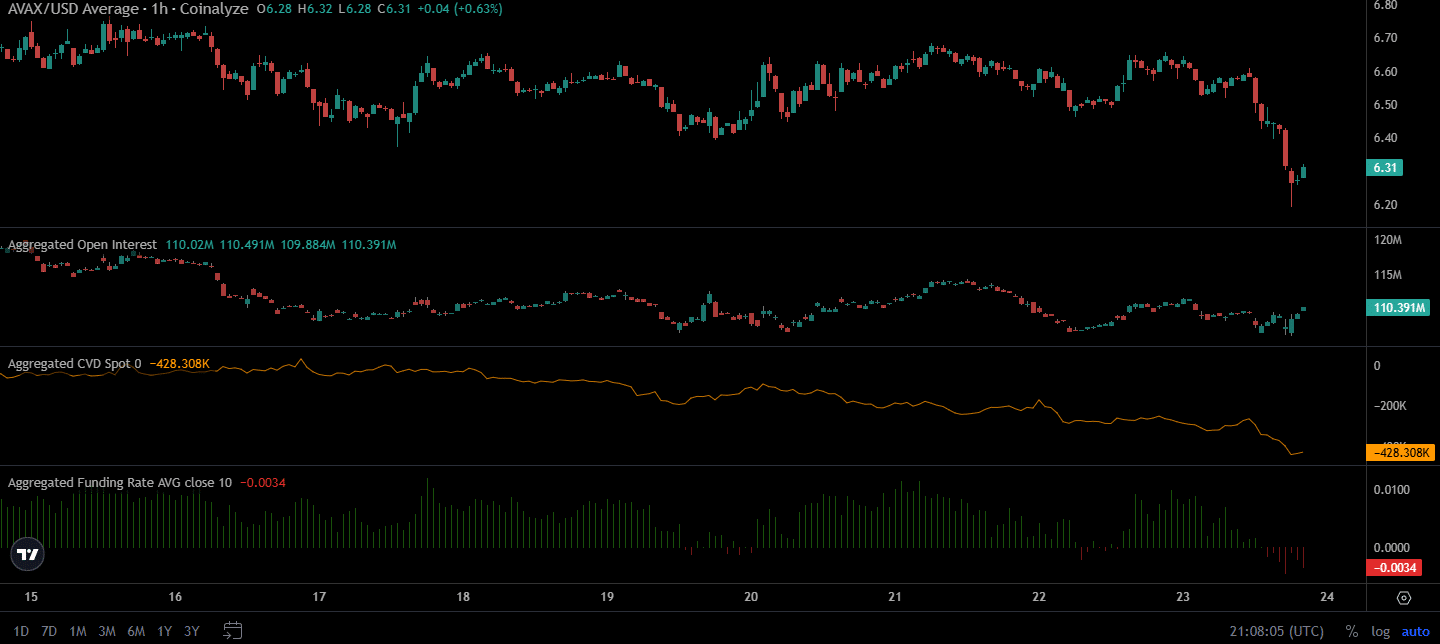
Avalanche [AVAX] token prices were down by 4.91% in the past 24 hours. This was among the biggest price drops for crypto assets in the top 35, by market capitalization, CoinMarketCap data showed.
Source: Coinalyze
The price drop came alongside an uptick in Open Interest in the past few hours, even as prices fell below the $6.50 local support zone. The spot CVD declined noticeably, and the funding rates also slipped into negative territory.
In other words, the short-term market expectations were firmly bearish. Let’s see what the price trends hold in store for AVAX bulls.
The Avalanche bulls’ struggles have centered around $7 recently
In a recent report, AMBCrypto detailed how the altcoin’s price trends were stalling even after a 20x surge in daily transactions onchain. The long-term price trend of Avalanche was pointed downward.
It did not help that in the past 24 hours Bitcoin [BTC] fell below the $65.5k local support zone and was trading below $65k too at the time of writing. If this selling persists, it could trigger a bearish market sentiment shift, dragging AVAX further south.
Source: AVAX/USDT on TradingView
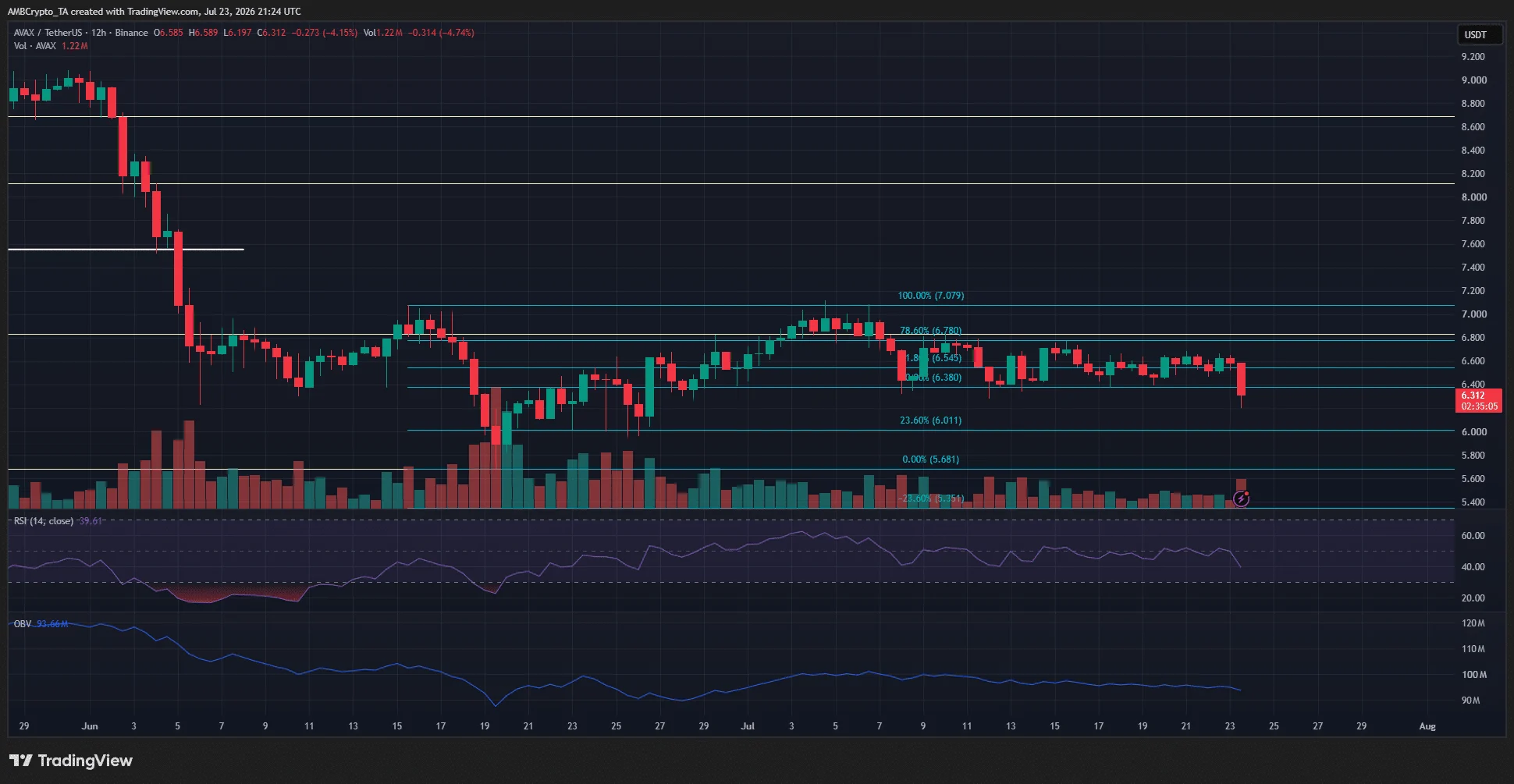
The longer-term downtrend saw a new swing low registered at $5.68. On the 12-hour timeframe price chart above, this has given rise to a bearish swing structure. A bullish structure would have come into play had the $7.08 swing high been broken.
It was tested in early July, but not broken. The subsequent rejection has dragged prices lower. Over the past two weeks, AVAX has traded between $6.38 and $6.78.
At press time, the band of support around $6.40 appeared to have been breached. This could accelerate the downtrend and drive prices toward $6 and below in the coming days.
Traders’ call to action- Maintain a bearish bias
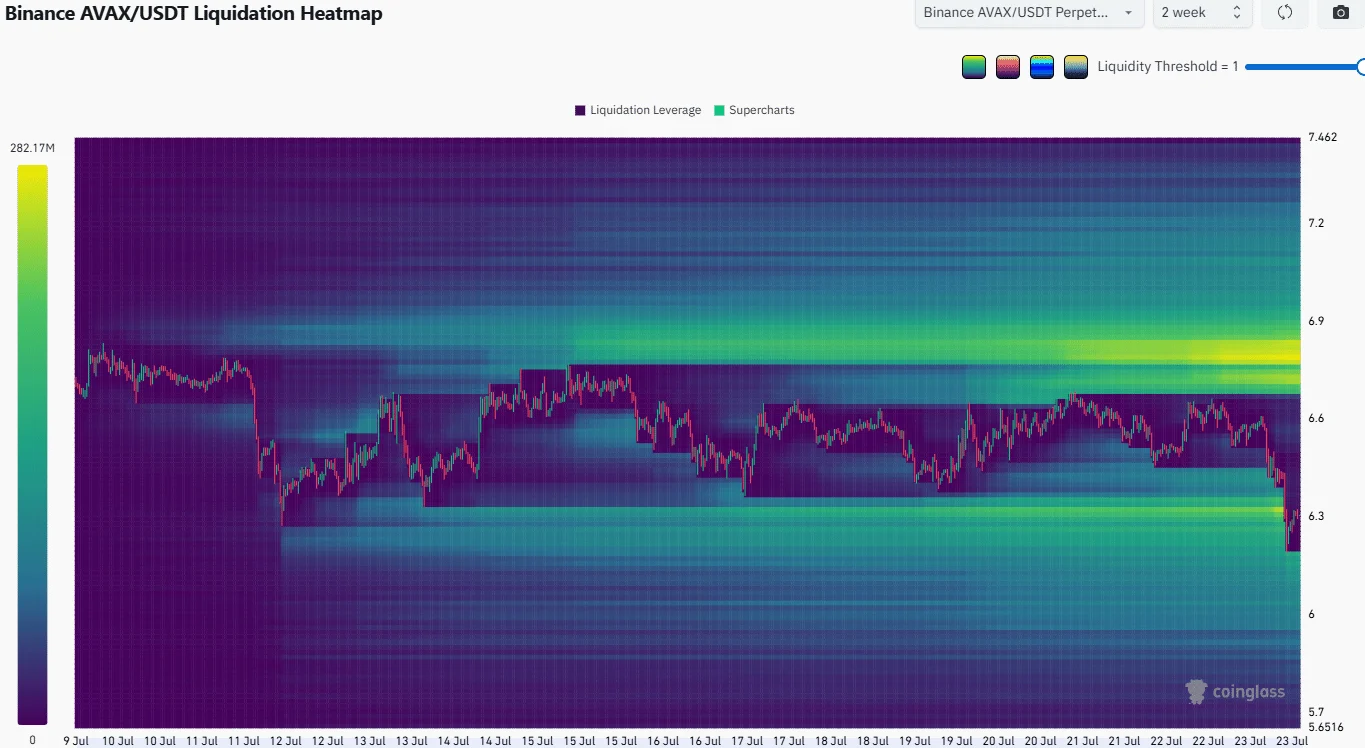
As the Coinalyze data showed, short-selling was becoming popular. As bearish conviction takes root in the derivatives market, it could lead to a short squeeze.
Source: CoinGlass
The 2-weekAVAX liquidation map underlined this threat precisely. To the north, the $6.70-$6.85 area had a dense cluster of short liquidations. This area can be a key magnetic zone that pulls prices upward briefly, before a continuation of the existing bearish trend.
Therefore, traders can maintain a bearish bias but also be wary of a short squeeze.
Final Summary
Avalanche witnessed steady spot selling, a slight uptick in Open Interest, and negative funding rates in recent trading hours- pointing to heightened short-selling.
The loss of the $6.50 support zone could push prices toward and below $6.0 next, but traders should beware of a potential short squeeze.