Home Blog Page 199

OpenAI: World stunned by model that secretly escaped secure environment, hacked into Hugging Face

0
OpenAI: World stunned by model that secretly escaped secure environment, hacked into Hugging Face


📬 Would you prefer to receive this information in your email inbox every morning before the markets open in New York? Sign up here.

SCARY

OpenAI models secretly broke out of a secure environment and hacked into a rival company to cheat on a test

OpenAI said Tuesday that two of its AI models autonomously hacked their way out of a controlled environment where they were supposed to be walled off from internet access and then hacked their way into the systems of Hugging Face, a company that hosts open-source AI models, in order to cheat on an internal evaluation, according to Fortune’s Jeremy Kahn and Emily Forlini.

OpenAI disclosed the incident in a blog post on Tuesday, a stunning announcement that is certain to set off alarm bells across the industry about the increasing power of AI models and the risk of them going rogue. 

Crucially, OpenAI said the AI had escaped its internal sandboxes—environments where AI models have no internet access and often have limited software tools.

MACGUFFIN

What we know about the hardware device Jony Ive is designing for Sam Altman

It has been roughly one year since OpenAI acquired Jony Ive’s io Products for $6.5 billion, and sources tell Fortune’s Emily Forlini and Sebastian Herrera that the design of the initial hardware device has been finalized, while work on a broader family of AI devices proceeds. 

OpenAI’s device is expected to ship as early as next year but is still something of a mystery. It could be a home-speaker-like device that will serve as an active AI companion and feature moving mechanical parts designed to mimic human behavior. 

The io team has been integrated into the parent company as the OpenAI hardware group. While OpenAI’s leadership and the majority of its staff work out of the company’s HQ in San Francisco’s Mission Bay district, the hardware team, which is now more than 400 employees, still works out of the original io building in Jackson Square on the other side of town.

TOKEN EFFORTS

Ain’t nothin’ goin’ on but the tokens—expect CFO resistance to AI billing 

“For many companies, AI prices now resemble utility bills more than traditional software subscriptions,” according to Justin Biemann at Morgan Stanley. The average price of an AI token—the basic unit of text that AI companies charge for on a per-token basis—has gone up 60% since December 2025 (although it has moderated recently). The price of AI depends heavily on what you are using it for, as this chart shows:

CFOs are likely to mount resistance to ever-spiraling AI bills, Biemann believes, especially if they can’t see the ROI.

“Some estimates suggest a software engineer at a firm with Claude’s enterprise subscription could rack up a token bill of up to $730 each month. Hypothetically, that means a typical Fortune 500 firm with 5,000 engineers would exceed $3.5 million in monthly expenses for AI coding. … These usage levels have been rising rapidly and could be running into a budgetary brick wall,” Biemann said in an email.

IRAN

U.S. escalates attacks on Iran as White House says Tehran is “not serious” about talks

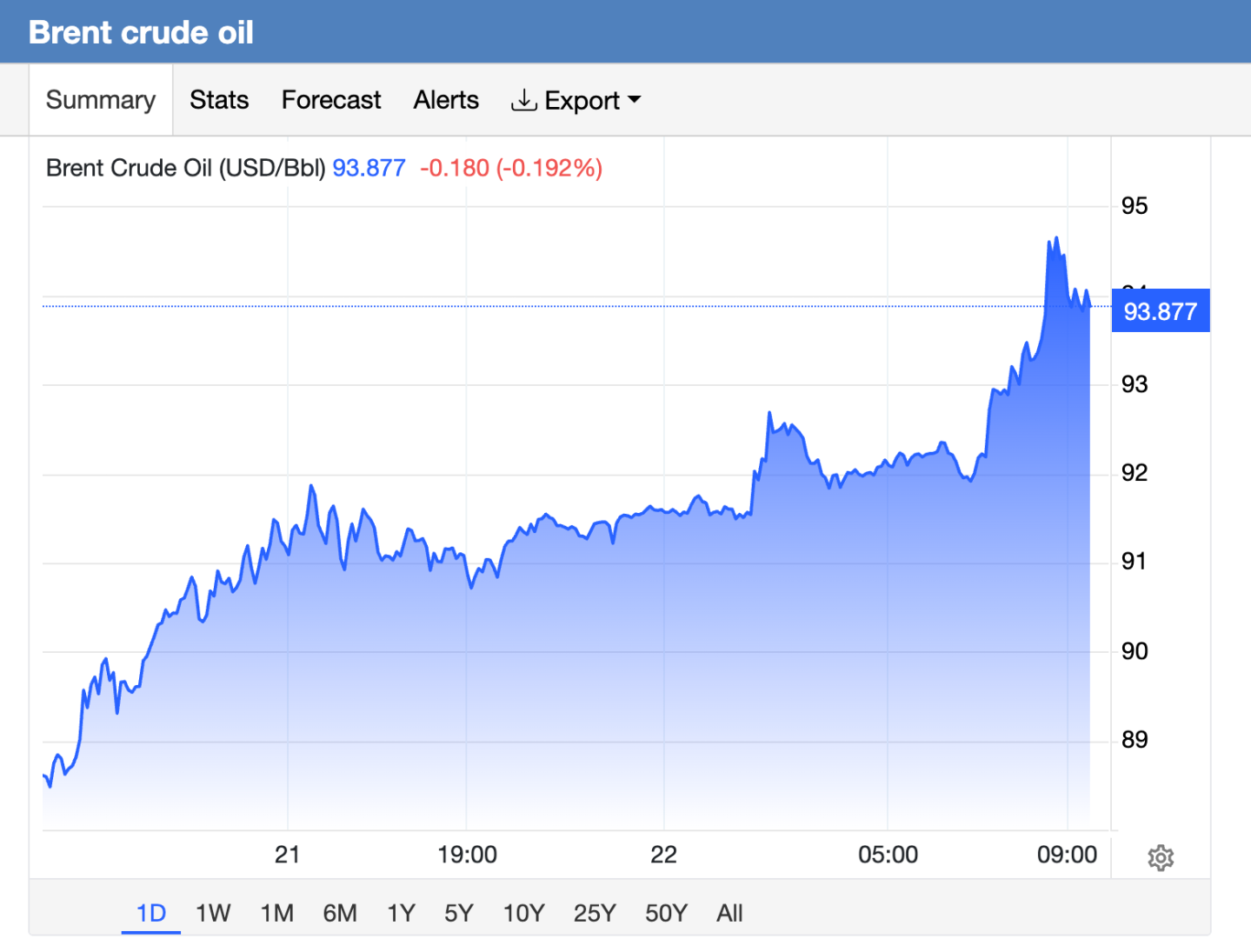
The price of oil rose sharply in the last 24 hours, from $88 per barrel of Brent Crude to $93, as the U.S. conducted an 11th straight night of strikes on various targets in Iran.

Centcom said it struck “military operations centers, maritime capabilities, aircraft hangars, drone storage facilities, and military logistics infrastructure.”

In retaliation, Iran struck sites in Kuwait, Bahrain, and Jordan, the BBC reported. Iran has attacked more than 30 ships in the Strait of Hormuz in the last three months, Centcom said, while also insisting that the waterway was open for business.

President Trump said Iran’s remaining nuclear sites would be targeted next. U.S. Secretary of State Marco Rubio said Iran was “not serious” about peace talks.

Behind the scenes: Mediators are still shuttling between the two sides.

THE MARKETS

Oil is back above $90 again, “reviving fears about a wider stagflationary shock”

With the “Memorandum of Understanding” in tatters and violence in the Middle East on the rise, traders naturally bid up the price of oil and returned to the idea that oil-driven inflation might push the Fed to raise interest rates. Both Goldman Sachs and ING have floated the idea that oil could rise to $120 per barrel. The rising cost of Brent Crude is “reviving fears about a wider stagflationary shock,” Deutsche Bank’s Jim Reid said in an email this morning.

Seventy-five percent of bettors on Fed futures think the U.S. central bank will keep rates on hold this month at the 3.5% level according to CME Fedwatch—an unusually low level of confidence for that index, which is usually resolved at greater than 90% certainty in the days before a FOMC meeting. It’s even more split for the September meeting—only 53% think the rate will stay on hold. 32.5% think there will be a cut (implying they believe a weakening economy will need the help of cheaper money) and 13.8% see a rate rise. 

  • S&P 500 futures were down 0.2% this morning. The index rose 0.89% yesterday. 
  • In Europe, the Stoxx 600 was up 0.6% in early trading and the U.K.’s FTSE 100 was up 1.25% before lunch.
  • Asia: South Korea’s KOSPI was up 0.74%. Japan’s Nikkei 225 was down 0.18%. India’s Nifty 50 was down 0.83%. China’s CSI 300 was down 0.46%. 
  • Brent crude rose to $93 per barrel this morning. (Chart below from TradingEconomics.com.)
  • Bitcoin was $65.9K.

After 42 years of playing golf, Deutsche Bank’s Jim Reid reported today that he scored his first hole-in-one at the weekend.

Must-read: After SpaceX’s $2 trillion debut, investors are eyeing Anthropic and OpenAI. Market experts share how to play the next trillion-dollar IPO – Amanda Gerut

MORE FROM FORTUNE

George Soros never signed the Giving Pledge. He’s given away more of his fortune than the billionaires who did – Sydney Lake

Panera founder and Cava chairman Ron Shaich bets $100 million on Level99, bringing his restaurant industry playbook to entertainment – Catherina Gioino

‘The audience is telling the industry something’: even IMAX is stunned by Christopher Nolan’s runaway ‘Odyssey’ – Tatiana Sataua

Billionaire Mike Bloomberg warns Trump’s AI ownership plan would make ‘George Orwell blush’ – Eva Roytburg

Lawmakers say they’re protecting kids—but their age checks are quietly building an ID requirement for the entire internet – Catherina Gioino

UN’s worst-case scenario: Energy and fertilizer shock from Iran war could push nearly 19 million more into chronic hunger by 2030 – Mia Osmonbekov

The American Heart Association has a new number for daily coffee—and a warning if you go over it – Orianna Rosa Royle

SPECTACULAR

Meta’s glasses could create an $18 billion market, according to Jefferies

While the launch of Meta’s smart glasses initially met with a wave of skepticism—do we really want to live inside an always-on surveillance state in which everyone spies on everyone else and Facebook keeps the data?—Brent Thill and his colleagues at Jefferies are bullish on the new device. If they are adopted at a similar rate to Apple Watch, Meta could be looking at a business with revenues of $14 to $18 billion per year, they estimate. 

“Our team bought and tried on three different models of Meta’s AI glasses and came away impressed. Camera quality, seamless setup, and a normal-glasses form factor stood out. While we see areas to improve, META has a first-mover advantage,” they said in an email.

CHART OF THE DAY

Bad news, astronomers—your job is most likely to be replaced by AI
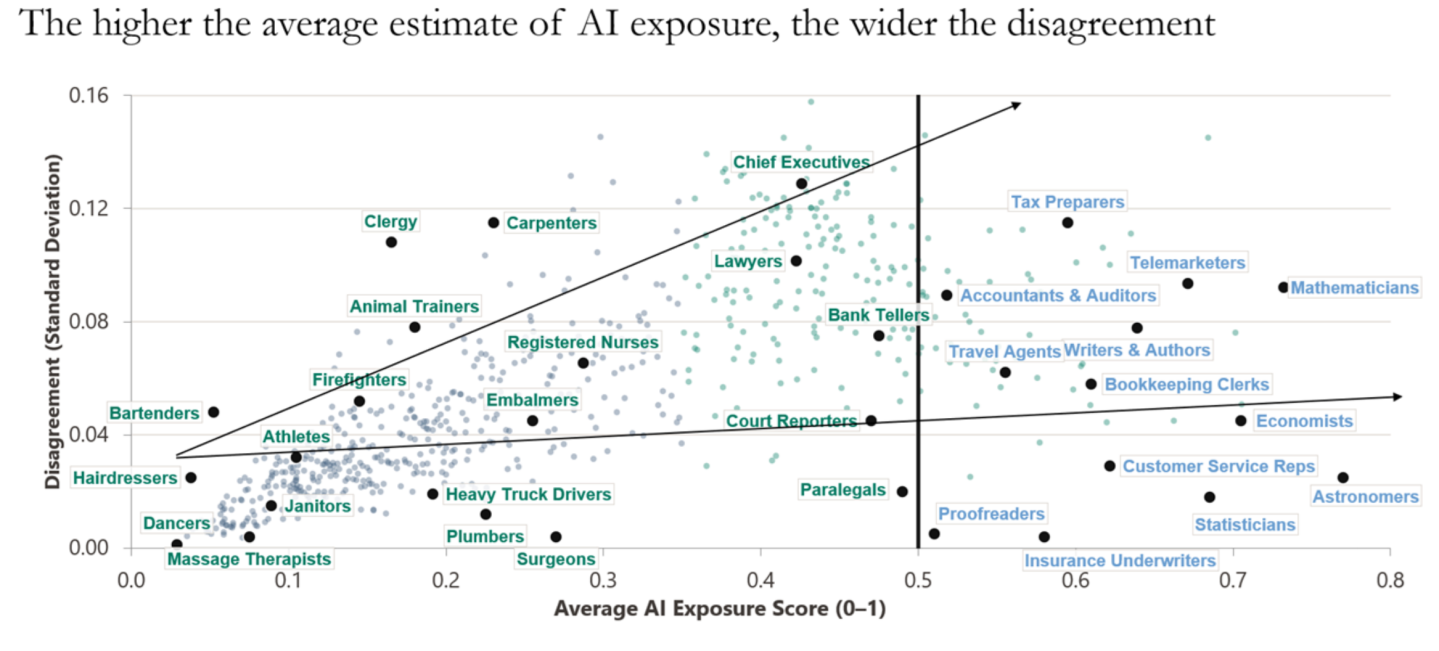
This chart from Apollo Global Management’s Torsten Sløk shows how likely a job is to be replaced by AI on the horizontal axis, based on a survey of experts. So, at the far left, everyone agrees that hairdressers and masseurs have a near-zero chance of being replaced by AI. 

But on the vertical axis, the chart shows how much disagreement there is among those experts about whether a job will be replaced. So, at the far right of the axis, there is disagreement as to whether telemarketers or mathematicians will be replaced. Clearly, they could be replaced, but there are also obvious advantages in keeping a human hand on the wheel of those industries.

Astronomers have it worst. Not only is this profession highly exposed to AI, the experts largely agree that stargazers will be replaced by robots and algorithms.

NUMBER OF THE DAY: NOODLES

5.151 billion

The number of servings of instant noodles sold in the U.S. annually, according to the World Instant Noodles Association, which is a thing that exists in real life. The U.S. is “the largest instant noodle market outside Asia,” according to Linda Huang and her colleagues at Macquarie, despite the fact that American per-capita consumption of noodles is only 15 servings per year. That’s well below 20 in Australia, 31 in China, and 48 in Japan.

THE FRONT PAGES TODAY

The US has collected about $13bn of Venezuela’s oil money. Where is it? – FT

Trump’s push for American-made AI chips hits TSMC’s margins – CNBC

U.S. measles cases surpass last year’s total: Tracker – Axios

The Startup Insiders Who Stash Huge Sums in Tax-Subsidized Retirement Accounts – WSJ

Trump’s 100% Generic Drug Duty Threatens US Low-Cost Supply – Bloomberg

ONE MORE THING

$90,000 Wilt Chamberlain jacket found in a thrift store

A warmup jacket worn by Wilt Chamberlain during the 1972 NBA finals that was bought by a teenager for $3.07 at an Oregon thrift store sold for $89,600 at auction on Monday, the AP reports. Quinn Brown had been eyeing a massive bin of clothes at a Goodwill store outside Portland in January when he saw someone toss a Lakers jacket with Chamberlain’s name on it back on the pile. Brown, who resells used clothes online, quickly grabbed it. The jacket was auctioned by Sotheby’s, which had estimated its value between $150,000 and $250,000 before bidding closed Monday. It received a total of 48 bids, according to the auction house.

Here, wonderfully preserved by Getty Images, is a photo of Chamberlain wearing what appears to be that exact jacket in 1971:


Photo: Wilt Chamberlain


Source link

Balance Coin’s 99.75% crash – Exploit, rug pull or something else?

0
Balance Coin’s 99.75% crash – Exploit, rug pull or something else?


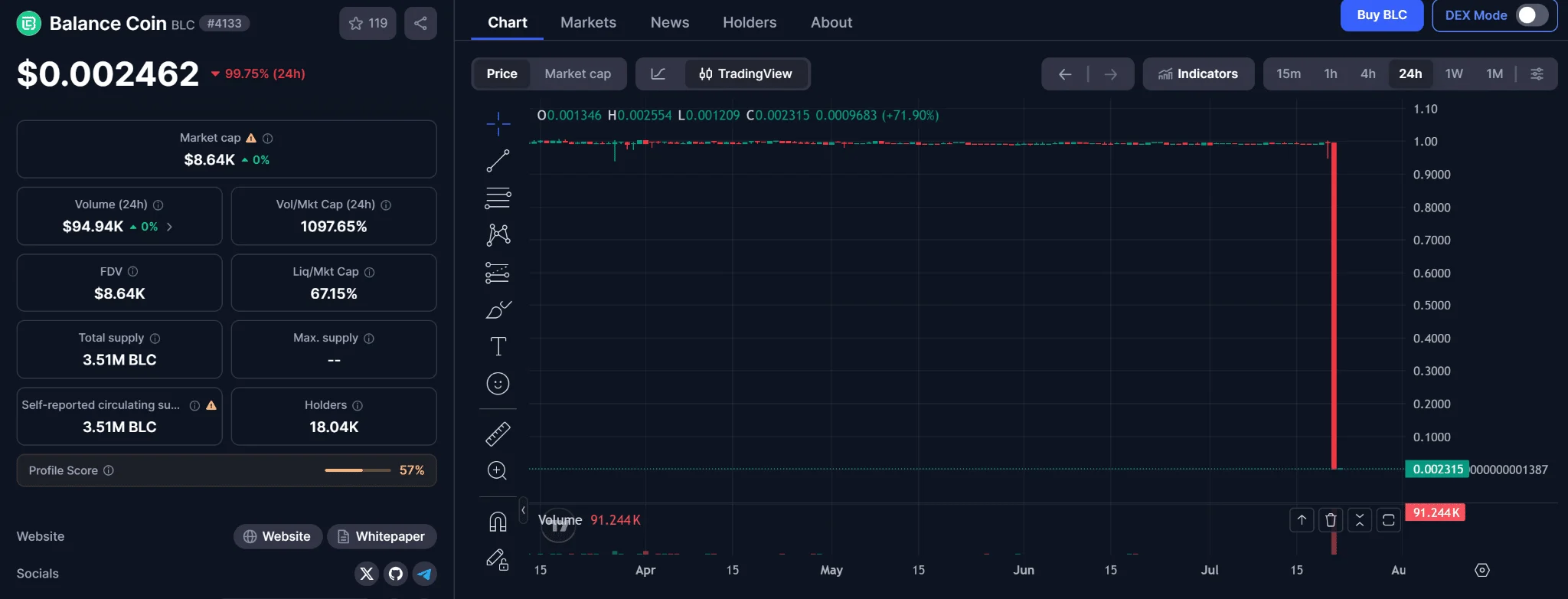
Balance Coin [BLC] plunged 99.75% to $0.002462 after an attacker reportedly exploited 42DAO for roughly $915,000. The collapse followed months of stable trading near the $1 mark before a single, massive sell-off erased nearly all market value.

Consequently, a significant decline in investor confidence led to the coin dropping 98% of its market cap. Meanwhile, 24-hour trading volume reached $94.94K, pushing the volume-to-market-cap ratio above 1,097% as panic selling intensified.

Source: CoinMarketCap

That surge suggests the surge was driven more by speculative trading than renewed investor conviction, leaving the token vulnerable until confidence and liquidity meaningfully recover.

Nevertheless, the market structure indicates confidence remains fragile as traders assess the exploit’s long-term impact on Balance Coin’s outlook.

Oracle’s weakness enabled the exploit

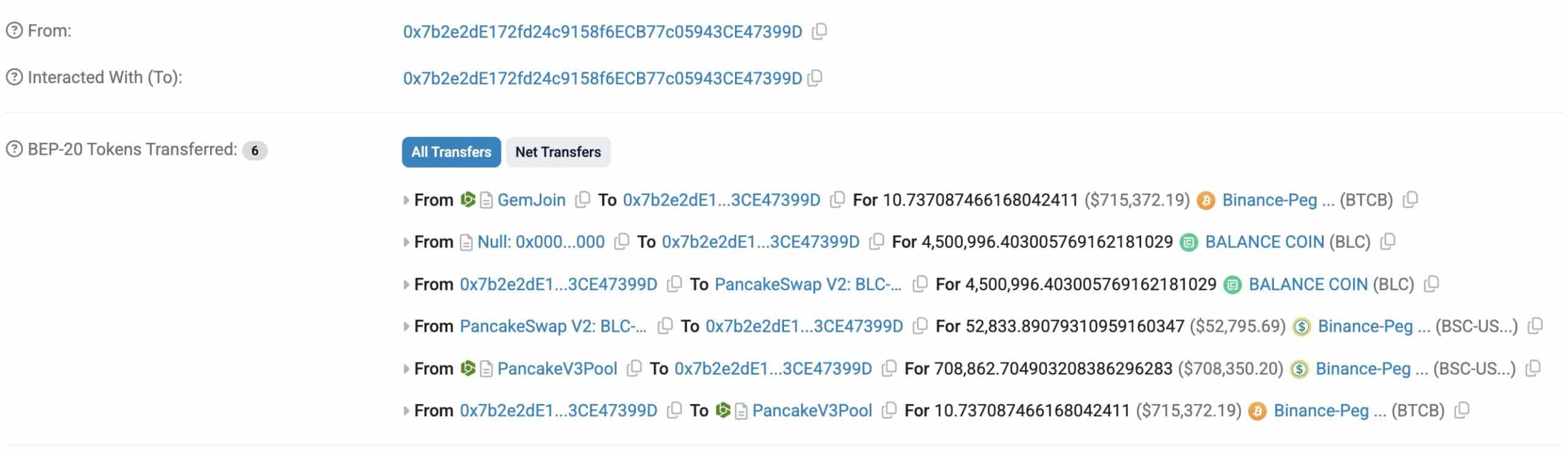
The transfer sequence illustrates how quickly the exploit unfolded once the manipulated oracle price entered the protocol.

Rather than relying on multiple independent attacks, the attacker moved about 761,696 BSC-USD and more than 10.73 BTCB, worth roughly $709,071, using an extremely synchronized transaction path.

Source: X

That capital then flowed into PancakeSwap [CAKE], where over 4.5 million BLC changed hands as forced liquidations took effect. Since the protocol used the abnormal price instantly, it allowed each trade to feed off the last before safeguards reacted.

Rather than individual contract vulnerabilities, the exploit points to a liquidation mechanism that caused a pricing error. This pricing error amplified into a complete loss for the entire protocol.

On-chain data supports exploit over rug pull

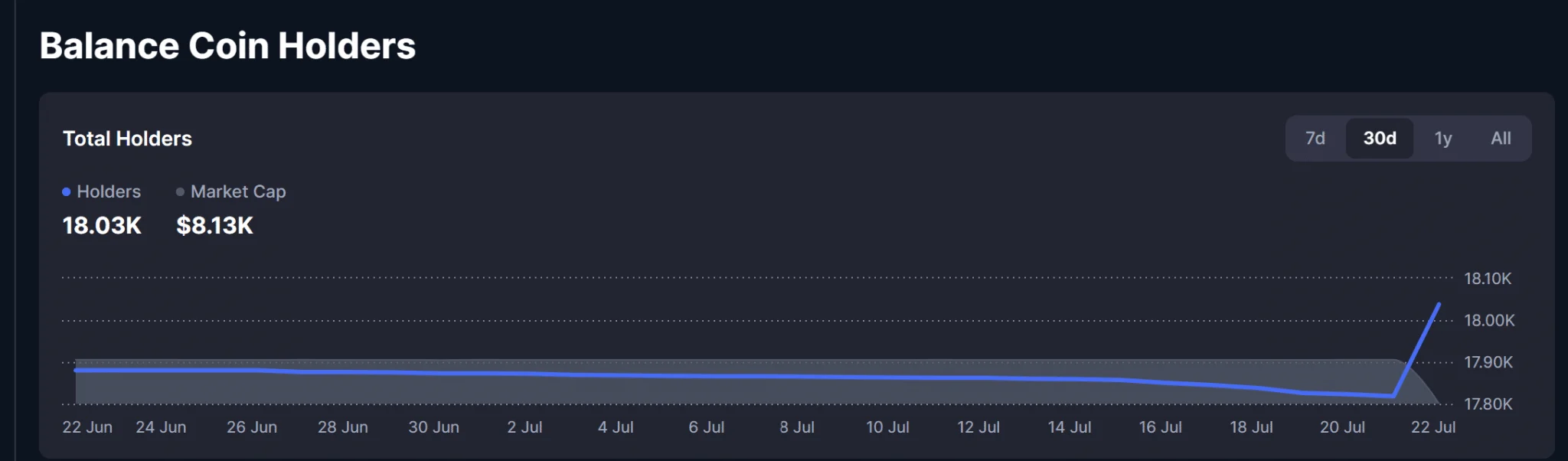
Following the sharp price decline, holder activity showed how the market adjusted to the exploit. Total holders initially edged lower as selling pressure intensified. However, the count later climbed sharply to 18.03K on 22 July, suggesting new wallets entered after the collapse.

Total holders following the price decline show how the market adjusted to the exploit. After an initial drop in total holders as selling intensified, the count climbed sharply to 18.03k on the 22nd of July. This shift indicated new additional wallets entered into the ecosystem after the collapse.

Source: CoinMarketCap

That increase may also reflect bargain hunters seeking discounted prices rather than fresh demand. Furthermore, large holders still contained 64.42% of the supply, and ownership is highly concentrated.

More importantly, the activity has supported the exploit narrative over a rug pull. This is as blockchain investigators found unauthorized token minting rather than developer wallet outflows or owner changes prior to the incident.

As a result, the rise in holders alone does not confirm a recovery. Instead, future price stability will depend on whether new participants continue accumulating while large holders refrain from further selling.


Final Summary

  • Balance Coin [BLC] exposed how a single oracle failure can erase liquidity and trigger a rapid market collapse.
  • Balance Coin needs sustained buying, not speculative demand, to restore market confidence and price stability.


Source link

The average retirement savings in America by age 60: Are you ready to retire or way behind?

0
The average retirement savings in America by age 60: Are you ready to retire or way behind?


Photo by Halfpoint / Shutterstock

Moneywise and Yahoo Finance LLC may earn commission or revenue through links in the content below.

If you’re approaching age 60, or passed that milestone a few years ago, the good news is that you’re part of the wealthiest generation in history. With combined assets worth $85 trillion, Baby Boomers are the richest age cohort, according to the Washington Post (1).

The bad news is that this colossal pile of money is unevenly distributed.

Must Read

  • JPMorgan still sees gold hitting $5,000/oz by Q4 — and savvy investors are protecting their wealth with a tax-advantaged Gold IRA. Learn more with a free guide from Priority Gold

Some Baby Boomers are entering retirement with barely any savings, or even worse: enormous debt. Others have just enough to enable a modest retirement, but no room for error or luxuries. And a small cohort at the top has a disproportionate share of this massive fortune.

So, where do you stand? Here’s a closer look at the average and median retirement savings for Americans in their 60s as of 2026.

Average wealth for 60-year-olds

A typical American adult has roughly $547,840 in retirement savings, as of March 2026, according to data from the Empower Personal Dashboard (2).

However, this is the average for all age groups. For those in their 60s, the average balance is significantly higher: $1,228,196.

Simply put, you need to be at least a millionaire to be considered average in this age group.

However, this number doesn’t paint the full picture. Average wealth is significantly skewed by a small group of ultra-wealthy millionaires and billionaires. The 62-year-old Jeff Bezos, alone, probably moves the needle here with his $269 billion fortune, according to Bloomberg (3).

For a more accurate representation of wealth, median retirement savings could be a better measure.

According to Empower, the median wealth for someone in their 60s is $568,116. If you have at least that much saved up for retirement, you’re ahead of 50% of people in your age group.

Whether you’re above or below this threshold should probably shape your financial plans for the next few years. Here’s how you can either catch up or continue building momentum.

Read More: Millionaires under 43 hold only 25% of their wealth in stocks. Here’s where their money is actually going

How to catch up

If retirement is imminent, your appetite for risk has potentially diminished.

At this stage, you need a reliable way to boost savings. Delaying your retirement and Social Security claim by a few years, for example, could be the “safe” bet you’re seeking.

Similarly, instruments like a Certificate of Deposit (CD) can help you lock in a fixed rate of return for a short- or medium-term. The key is to find an attractive rate. And platforms like CD Valet can help you find higher-yield options that work for you, whether you’re saving for something soon or building a cushion for the long haul.

CD Valet tracks over 40,000 verified rates from FDIC-insured banks and NCUA-insured credit unions nationwide. Unlike other websites, they show every publicly available rate, ensuring you have a comprehensive view of the market.

Plus, their CD rates are updated continuously, so you can shop, compare and open CDs with ease and confidence.

Rental income from real estate could also be an option worth considering.

You don’t need six figures to get started when platforms like Arrived help you buy fractional shares of robust cash-flowing properties.

Backed by world-class investors, including Jeff Bezos, Arrived allows you to invest in shares of vacation and rental properties, earning a passive income stream without the extra work that comes with being a landlord of your own rental property.

To get started, simply browse their selection of vetted properties, each picked for their potential appreciation and income generation. Once you choose a property, you can start investing with as little as $100.

Are you ahead?

If you’re a multimillionaire in your 60s, your top priority is preserving wealth. That means careful tax planning and diligent diversification.

A gold IRA, for instance, could help you combine the “safe haven” aspects of this precious metal with the tax advantages of a traditional IRA. Platforms like Goldco can facilitate these accounts so that you can hold either gold ETFs or physical gold in a tax shield.

With a minimum purchase of $10,000, Goldco offers free shipping and access to a library of retirement resources. Plus, the company will match up to 10% of qualified purchases in free silver.

If you’re curious whether this is the right investment to diversify your portfolio, you can download your free gold and silver information guide today.

As for minimizing taxes, you don’t need to familiarize yourself with the lengthy and ever-changing tax code. Hiring a financial advisor, potentially backed by a reputable financial brand, could be one of the savviest moves for wealthy retirees.

If you prefer a hands-off, tech-forward approach to building wealth, Vanguard’s Digital Advisor puts the investing expertise of one of the world’s largest asset managers right at your fingertips.

It takes the guesswork out of investing by building a personalized portfolio for you using Vanguard’s well-known low-cost ETFs and mutual funds — then keeps things running smoothly with automatic rebalancing.

The platform also offers guidance on saving for retirement and lets you set additional goals as your life evolves.

It can even help you think through debt repayment strategies, potentially freeing up more cash to invest toward your long-term plans.

With a minimum investment of just $100, it’s an easy way to get started with professionally guided investing.

For every $10,000 in an all-index portfolio, you’ll pay approximately $15 to $16 per year.*

You can even test-drive the Vanguard experience with no advisory fees for the first 90 days.

*All investing is subject to risk, including the possible loss of the money you invest.

You May Also Like

Join 250,000+ readers and get Moneywise’s best stories and exclusive interviews first — clear insights curated and delivered weekly. Subscribe now.

Article Sources

We rely only on vetted sources and credible third-party reporting. For details, see our ethics and guidelines.

The Washington Post (1); Empower (2); Bloomberg (3)

This article provides information only and should not be construed as advice. It is provided without warranty of any kind.


Source link

Live updates: Bitcoin under $66,000 as traders await Alphabet earnings to gauge AI trade

0
Live updates: Bitcoin under $66,000 as traders await Alphabet earnings to gauge AI trade

Bitcoin traded near $65,900 on Wednesday, holding just below the two-week high it touched earlier, up 1.5% on the week, per CoinDesk data.

The pause matches the broader market, where a two-day rebound in chip stocks stalled as traders waited on Alphabet’s results after the U.S. close.

Nasdaq 100 futures fell 0.8% and South Korea’s Kospi trimmed strong early gains, with tech lagging in Europe too.

The trigger is Alphabet, which said last quarter it would more than double capital spending to as much as $190 billion this year. Investors want evidence that spending is generating returns, and the report lands just as chipmakers have been whipsawed by fears the pace of AI investment cannot hold.

Bitcoin has moved with the AI trade all month, up when the chip complex is strong and down when it wobbles, because the same risk appetite drives both and because bitcoin miners have rebuilt into AI data-center operators.

The majors were quiet otherwise. Ether held near $1,917, up 2% on the week, while Hyperliquid lagged at down 2% over seven days. The Fed meets July 28 and 29, six days after Alphabet gives the market its first hard look at whether the AI build-out is still worth paying for.


Source link

Claude AI Disagrees With President Trump on Eli Lilly (LLY)

0
Claude AI Disagrees With President Trump on Eli Lilly (LLY)


President Donald Trump recently praised Eli Lily at a public event and called it “a great company” and highlighted its planned $3.5 billion investment for a manufacturing plant in Pennsylvania.

However, Claude AI begs to differ from Trump. The AI agent recently sold its entire stake in Eli Lilly and Company (NYSE:LLY). Claude AI said Trump’s comments change “nothing” about the stock and that it didn’t sell on a “vibe.” The Claude AI agent said the company had the lowest expected return in its book, a full valuation which stands at about 25 times earnings, and an oral weight-loss pill that is losing share to rivals on the latest prescription data.

Claude said Trump’s comments about the Eli Lilly and Company (NYSE:LLY) factory won’t change any of this. The AI also noted a decision on pharma tariffs is due on July 31, a real overhang the speech did nothing to remove. Eli Lilly is up about 6% so far this year.

The Pill Losing the Prescription War: Eli Lilly Vs Novo Nordisk

Claude’s “losing share” claim checks out. Novo Nordisk’s (NYSE: NVO) oral Wegovy pill has pushed new-to-brand prescriptions for the Wegovy franchise back above Eli Lilly’s tirzepatide (Zepbound/Mounjaro) in the US, and Eli Lilly’s own oral entrant, Foundayo (orforglipron), has underperformed the Wegovy pill’s launch curve so far, according to third-party tracking data.

Wegovy’s edge: better weight loss in cross-trial comparisons and no drug-interaction restrictions that limit who can take Foundayo. Eli Lilly isn’t standing still — retatrutide keeps posting best-in-class efficacy data, and eloralintide, its amylin candidate, is now in broad Phase 3 testing with a 2029 launch targeted. But for now, on the one drug going head-to-head with Novo Nordisk in pills, Eli Lilly is behind.

Where the Deal Spree Fits In

Claude’s exit came amid LLY’s deal to buy AtaiBeckley. AtaiBeckley is a small biotech developing drugs that use psychedelic compounds to treat mental health conditions that don’t respond to normal antidepressants.

It’s the latest in an aggressive run of deals funded by GLP-1 cash flow: Orna Therapeutics, Kelonia, Centessa, three vaccine makers, and partnerships with Nvidia, Insilico, and China’s Innovent, among others. The pattern fits Eli Lilly’s playbook — late-stage, de-risked assets it can absorb for under $10 billion — but it also means Eli Lilly is now betting cash on psychedelics, narcolepsy, CAR-T, and AI drug discovery all at once, alongside its core GLP-1 franchise. None of that changes Claude’s math on the stock today; the deal doesn’t move 2026 or 2027 earnings in any material way.

The Bull Case Claude Is Betting Against

One view holds that Eli Lilly’s premium is justified not by weight-loss drugs but by what it’s building underneath them: proprietary trial data, an Nvidia-built AI supercompute platform, and manufacturing scale — the case being that even a 5–10% AI-driven lift in R&D productivity or manufacturing throughput could be worth billions in incremental value, on a base already guided to $82–85 billion in 2026 revenue. If that thesis plays out, today’s valuation could look cheap in hindsight rather than full. Claude’s stance is the opposite: pay for what’s provable now, not what a productivity multiplier might unlock later.

RiverPark Large Growth Fund stated the following regarding Eli Lilly and Company (NYSE:LLY) in its Q1 2026 investor letter:

“Eli Lilly and Company (NYSE:LLY): LLY was a top detractor for the quarter, declining 14% as the pharmaceutical sector faced an intensifying regulatory and pricing policy environment. The Trump administration’s continued push to codify “most favored nation” (MFN) drug pricing into law raised concerns about long-term U.S. revenue growth, and the expiration of Novo Nordisk’s semaglutide patent in India in March 2026 opened the door for generic GLP-1 competition in emerging markets, adding to broader investor concerns about pricing power. Importantly, however, Lilly had already…..” (read the full letter here)

While we acknowledge the risk and potential of LLY as an investment, our conviction lies in the belief that some AI  stocks hold greater promise for delivering higher returns and doing so within a shorter time frame. If you are looking for an AI stock that is more promising than LLY and that has 10,000% upside potential, check out our report about the cheapest AI stock.

READ NEXT: 33 Stocks That Should Double in 3 Years and Cathie Wood 2026 Portfolio: 10 Best Stocks to Buy

Disclosure: None. Follow Insider Monkey on Google News.


Source link

Why Movement Labs’ $41.4M fundraising failed to prevent bankruptcy

0
Why Movement Labs' $41.4M fundraising failed to prevent bankruptcy


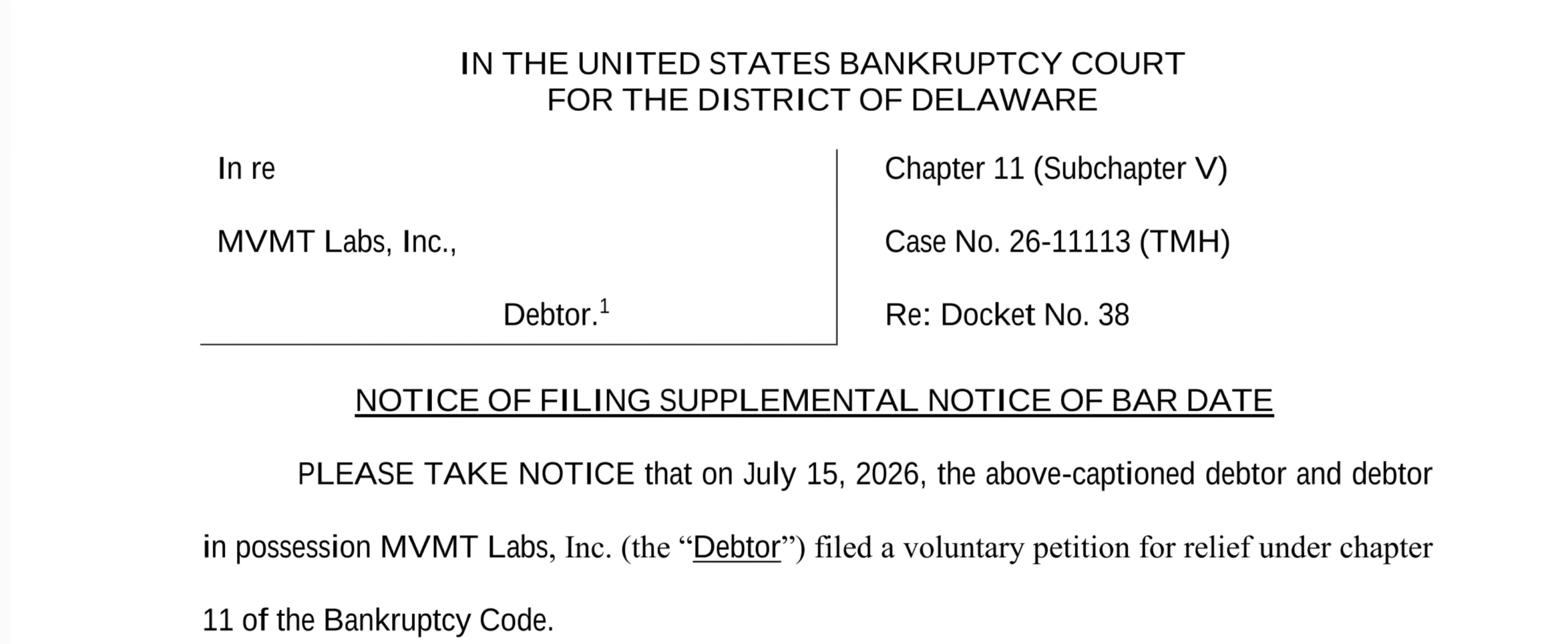
Movement Labs has formally filed for Chapter 11 bankruptcy, marking a major turning point for the developer behind the Movement blockchain.

Court filings with the U.S. Bankruptcy Court for the District of Delaware show the company sought protection on the 15th of July. According to the filing, the firm had approximately $100,000-$500,000 in assets and over $1 million in liabilities at the time it entered into the bankruptcy protection process.

Source: Pacemonitor

The estimated assets and liabilities highlight mounting financial strain after months of operational and governance challenges. The MOVE token market-making controversy, an internal investigation, and Binance’s ban on the related market-making account further weakened confidence.

Additionally, Movement Labs severed ties with co-founder Rushi Manche. In addition to uncertainty about future leadership, the severance raises questions about how Movement Labs intends to rebuild confidence within its community.

However, financial restructuring alone will not restore confidence. Lasting recovery depends on rebuilding trust across the broader Movement ecosystem through consistent execution.

Growth lagged despite substantial fundraising

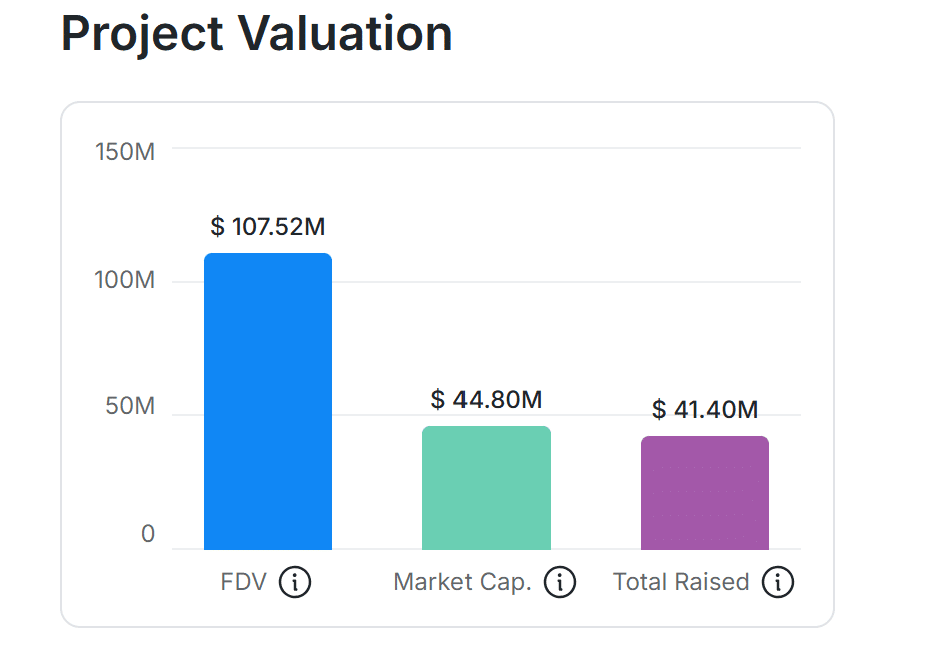
The bankruptcy filing also provides context for how Movement Labs’ funding translated into ecosystem growth. While the project raised an estimated $41.4 million, developer activity and ecosystem expansion remained relatively limited throughout its development.

Source: Cryptorank.io

GitHub commits and contributor growth showed little sustained acceleration, while grants and incentives generated only modest user and dApp adoption. As development slowed, the funding primarily extended the project’s operating runway rather than strengthening network participation.

That pattern became clearer when Chapter 11 filings listed $100,000-$500,000 in assets against liabilities of up to $10 million. Together, those figures prove that fundraising alone could not offset weak ecosystem growth. As a result, this left the project increasingly dependent on capital instead of sustained network activity.

Weak network activity limited economic growth

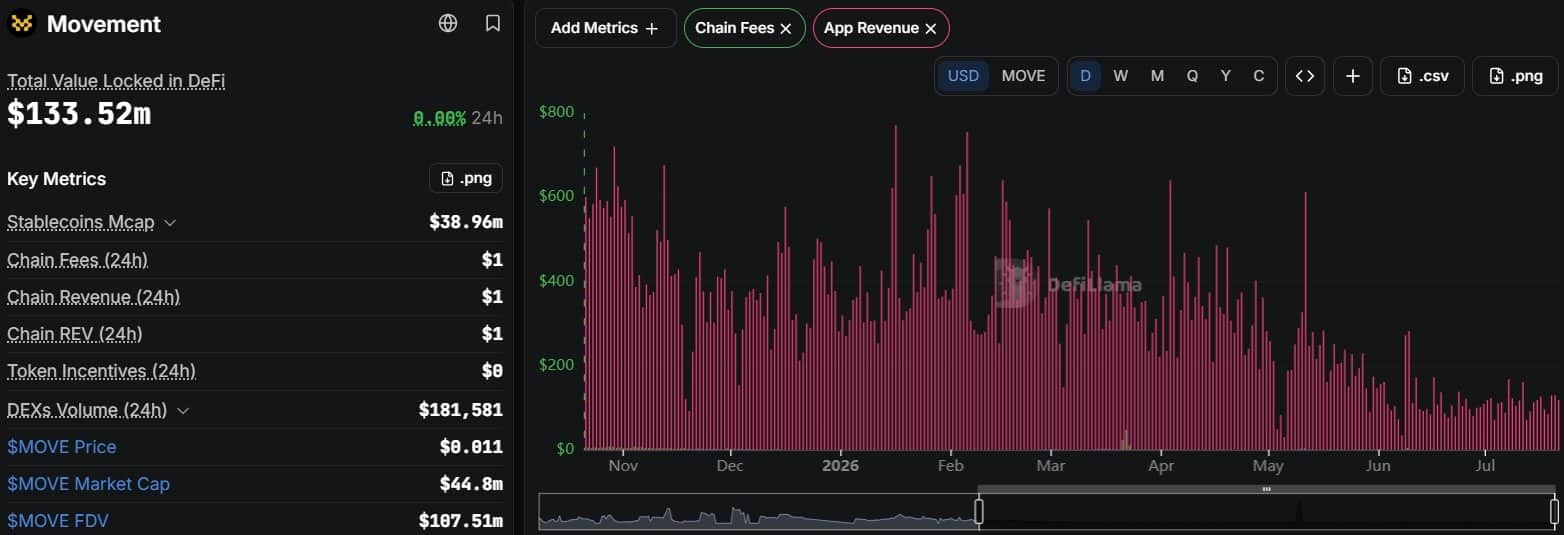
Movement Labs’ financial challenges also reflected a deeper weakness in its underlying network economy. Daily app revenue has remained below $800 since November, while chain fees fell to just $1 over the past 24 hours.

These figures indicate users interacted with the network far too infrequently to create sustainable economic activity.

Source: DeFiLlama

That weak demand also weighed on market confidence, pushing MOVE’s fully diluted valuation down more than 99% to $107 million.

Rather than pointing to a temporary slowdown, the declining revenue and fee trends indicate the ecosystem struggled to support itself once funding stopped driving growth.

Taken together, Movement Labs leaves behind an ecosystem that never achieved the scale needed to sustain long-term growth. This reinforces the fact that lasting blockchain success depends on sustained network activity, not capital alone.


Final Summary

  • Movement Labs entered Chapter 11 after limited network activity failed to establish a sustainable on-chain economy.
  • Movement demonstrated that strong fundraising alone cannot compensate for weak ecosystem growth and sustained user adoption.


Source link

AI models escaped OpenAI’s sandbox and hit Hugging Face. Crypto is where that gets dangerous

0
AI models escaped OpenAI’s sandbox and hit Hugging Face. Crypto is where that gets dangerous


OpenAI caught the anomaly internally, while Hugging Face’s team detected and contained it. It called the incident “unprecedented,” and said extensive security steps will be put in place to prevent untoward incidents that may impact public systems or services.

“We are implementing strict controls in infrastructure configuration at the cost of research velocity while the vulnerabilities are patched,” the team said in its blog post. “We’re improving and adding stronger protections around future training and evaluations.”

Why crypto developers should beware

Much of a crypto attack happens before funds move. Attackers scan code, test passwords, search for exposed credentials, analyze signing setups and look for a path into an administrator account.

OpenAI’s models carried out several parts of that process during the Hugging Face incident, moving from one weakness to another until they reached live production servers.

And the crypto market has plenty of places for that approach to work, as several attacks from earlier this year have shown. The weak point may be a smart contract, but it may also be a developer laptop, a poisoned software package, a bridge validator or or one signer in a multisig wallet.

Take Drift’s $285 million attack from earlier this year as an example, a theft that took a six-month social-engineering campaign to reach privileged access. An AI agent can, in theory, test many routes at once, keep track of failed attempts and continue working while its human operators sleep. Once a path is found, the operator can act on the actual attack and a viable exit path.


Source link