Home Blog Page 206

Bitcoin flashes 3 macro-bottom signals – But can BTC reach $70K?

0
Bitcoin flashes 3 macro-bottom signals – But can BTC reach $70K?


The market narrative is finally shifting from a local bottom to a macro bottom.

From a technical standpoint, Bitcoin’s breakout above $66,000 has sparked a wave of bullish sentiment.

Many analysts are arguing that the cycle low may already be in. While BTC was stuck consolidating between $60k- $65k, the discussion largely revolved around whether it was simply a local bottom.

Now, however, the focus is gradually shifting toward a move into the $70,000 region.

Looking at the charts, that shift isn’t entirely without merit.

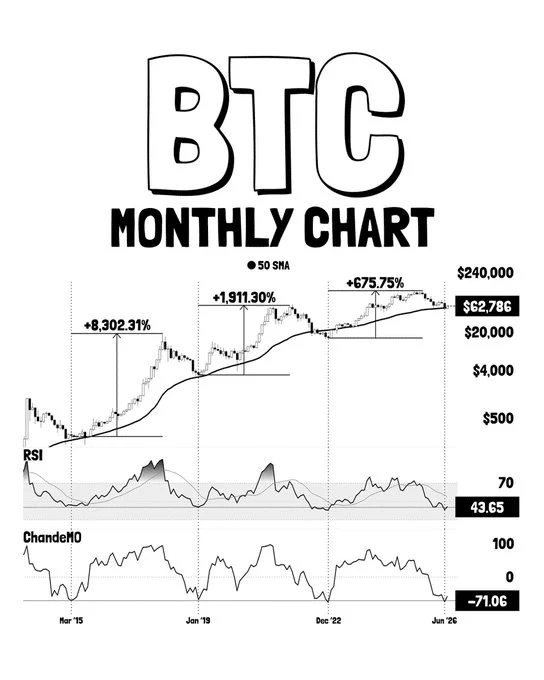
According to crypto analyst Ali Martinez, Bitcoin has once again flashed the same three technical signals that have historically coincided with macro cycle bottoms.

Those signals include the monthly RSI dropping to around 43.65, the Chande Momentum Oscillator (CMO) falling to roughly -71, and Bitcoin trading near its 50-month moving average.
BTC
Source: X

Notably, the pattern has repeated across previous cycles. 

In 2015, the setup appeared around $235 before Bitcoin [BTC] went on to rally more than 8,300%.

In early 2019, it flashed near $3,333, preceding a gain of 1,900%. The same technical cluster returned in late 2022, around $16k, shortly after Bitcoin bottomed near $15k, before the market rallied 675%. 

Interestingly, Bitcoin’s correction to $58k last month triggered this same setup once again.

So, if history is any guide, this alignment has consistently marked one of Bitcoin’s strongest long-term accumulation zones, adding weight to the idea that the market may already be transitioning from a local bottom to a macro one.

Liquidity remains Bitcoin’s biggest test 

Bullish continuation ultimately depends on liquidity, and that’s where Bitcoin’s rally could still face a key test.

From a technical standpoint, stablecoin dominance has climbed to around 13%, narrowing the gap with Ethereum’s 10%+ market dominance.

At the same time, the total stablecoin market cap has fallen by more than $10 billion over the past month, suggesting capital is still flowing out rather than back into the crypto.

Notably, on-chain data supports this trend.

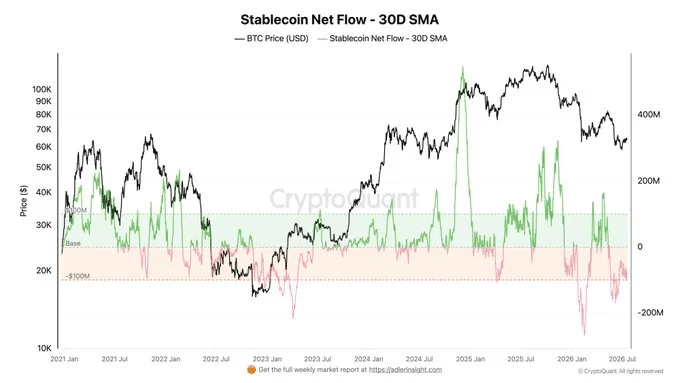
As the chart below shows, Bitcoin is holding above $65,000, but the liquidity needed to sustain the rally appears to be fading. Stablecoins have been leaving exchanges for 35 consecutive days, while Bitcoin has yet to see a meaningful pickup in spot accumulation.
BITCOIN BITCOIN
Source: CryptoQuant

In other words, price is breaking out, but liquidity isn’t following. 

Against this backdrop, the shift from a local bottom to a macro bottom may still need stronger confirmation.

While Bitcoin’s breakout above $66,000 is technically bullish. However, the lack of fresh liquidity suggests the move could struggle to sustain enough momentum for a decisive breakout into the $70k zone.


Final Summary


Source link

Crypto Clarity Act still at mercy of ethics section as Democrats balk at Trump deal

0
U.S. senators seek to block foreign adversaries from AI technology in new bill

August 7 — the fast-approaching final day before the Senate’s summer recess — is seen as a major deadline for finishing the Clarity Act this year. Crypto insiders are expecting the bill to get to the floor as soon as the beginning of next week, which would fit with what Senate Majority Leader John Thune had previously indicated. The legislation could require several days to get to a final vote.

Earlier on Tuesday, CoinDesk had reported that a White House official said Trump agreed to “the most comprehensive and wide-ranging ethics provision in history,” though the actual language he’s accepted hadn’t yet been shared with Democrats. As of press time, it was still unclear if Democrats had seen the exact language. Still, the administration argued that it had “bent over backward” to satisfy Democrats, suggesting it would be their fault if the legislation doesn’t advance.

Trump’s agreement to a crypto constraint of his own business ties raises significant questions about how his involvement would be made sufficiently remote to comply with the limit. The president and his family are deeply connected to several crypto business initiatives, including their ownership stake in World Liberty Financial. While Trump has insisted he’s not conflicted as his administration imposes crypto policies that affect his own businesses, Democratic lawmakers have openly accused him of corruption.


Source link

Freedom Fuel Reportedly Raises Prices After Selling $3.47 Gas For Trump

0
Freedom Fuel Reportedly Raises Prices After Selling $3.47 Gas For Trump


Topline

The Freedom Fuel Network, a private company that launched more than two dozen gas stations across New Jersey and Pennsylvania, is reportedly no longer selling fuel at the sharply discounted price of $3.47 per gallon, which was done in an apparent nod to President Donald Trump.

Key Facts

Several Freedom Fuel stations, including some locations in and around Philadelphia and southern New Jersey, sold gas at around $3.92 as of Monday while nearby competitors charged between $3.89 and $4.09, The Philadelphia Inquirer reported.

The average price for a gallon of gas in Philadelphia was $4.19 as of Tuesday, up from $3.95 last week, matching the statewide average, which is the costliest on the East Coast, according to AAA.

A White House spokesperson told the Inquirer that Freedom Fuel did not receive government subsidies and did not acquire gas at a lower price, noting the company’s lower prices would continue “for as long as the company chooses.”

surprising fact

Randy Brown, a senior special teams coach for the Baltimore Ravens, and former commodities trader Yoni Gontownik formed Freedom Fuel on June 23, a week before Trump promoted the stations, according to Politico. Fourteen of Freedom Fuel’s 25 locations are controlled by companies linked to Shamikh and Syed Kazmi, eight of which are leased from the investment firm Blue Owl Capital, the Associated Press reported. Both Shamikh and Syed Kazmi have reportedly faced claims of unethical business practices in recent years: In 2021, a federal judge in New Jersey ordered the Kazmis to pay more than $600,000 to a fuel supplier that alleged they stole gas.

key background

Trump, who has repeatedly promised lower gas prices, announced the Freedom Fuel Network in a Truth Social post earlier this month. Trump said the gas stations were “taking the lead” at offering lower gas prices, even as costs began to rise again as a peace deal between the U.S. and Iran unraveled. It was previously unclear what company was behind the gas stations, and some analysts warned their lower costs were unrealistic without some form of government subsidy. Patrick De Haan, GasBuddy’s head of petroleum analysis, reportedly said of Freedom Fuel’s price point: “Generally, when losses happen, somebody’s got to pay for it.”

further reading

ForbesTrump-Promoted ‘Freedom Fuel’ Discounted Gas Station Launches In Philadelphia AreaForbesU.S. Gas Prices Top $4 Again As Iran War Continues To Escalate


Source link

Jim Cramer says it may be time to trim comeback stock after 441% surge

0
Jim Cramer says it may be time to trim comeback stock after 441% surge


I have watched Seagate’s comeback story, and it has been one of the most impressive in the entire S&P 500. In fact, after the comeback, Seagate now ranks fourth in the top year-to-date S&P 500 performers according to Slickcharts

That performance is after Sandisk, Dell, and Micron. But on Friday, July 17, Jim Cramer posted on X (formerly Twitter) something you should pay attention to, and it was not a buy call.

Comeback in Seagate is impressive, even as I think it might be an excellent opportunity to trim if you don’t have much cash on hand.

Seagate Technology (STX) closed the week at $787.66, up 5.66% on the session, according to Yahoo Finance. The stock is up 186.72% year-to-date and 441.28% over the past year. You may think those are typos, but they’re not. The three-year return stands at 1,285.43%.

Cramer is not calling this a sell. No. He is calling it a trim, and the distinction matters. 

Knowing when to lock in your profits and exactly when to trim a winner is an elite skill. So Cramer is acknowledging the comeback while flagging that investors who are light on cash might use the strength to rebalance rather than hold a position that has compounded this dramatically heading into July 28 earnings.

Also Read: Seagate Technology Holdings PLC Latest News and Stories

What has driven Seagate’s extraordinary comeback

The Seagate story in 2026 is a direct function of what Artificial Intelligence (AI) infrastructure spending requires, at scale. Training and serving large language models generate enormous quantities of data.

That data needs somewhere to live, and hard disk drives remain the most cost-efficient mass-capacity storage medium available at hyperscale.

More Jim Cramer:

Seagate’s HAMR technology, which uses heat-assisted magnetic recording to pack vastly more data onto each drive, is the product innovation that elevated the company from a commoditized hardware maker into a differentiated AI infrastructure supplier.

The Mozaic 3 platform reached full qualification across all planned cloud service providers earlier in 2026, and Mozaic 4 has two customers already qualified, according to the company’s March 3 disclosures.

The financial results themselves validated the structural shift. 

  • Q3 fiscal 2026 revenue came in at $3.11 billion

  • Non-GAAP gross margin of 47%

  • Non-GAAP diluted EPS of $4.10

  • Free cash flow of $953 million

  • $641 million in debt was retired in a single quarter
    Source: April 29 Q3F26 Earnings Results. 


Source link

Crypto lobby group TDC sues Illinois to block digital asset tax

0
Crypto lobby group TDC sues Illinois to block digital asset tax

A crypto lobbying organization has sued the state of Illinois over a last-minute tax provision inserted into the state budget last month.

The Digital Chamber alleged that Illinois’ Digital Asset Tax Act violated both the U.S. and state constitutions and is preempted by a federal tax law. The lawsuit, filed Tuesday, asks a federal judge to block the Illinois state government from enforcing the tax.

The tax violates the Illinois state constitution’s uniformity and due process clauses, the Commerce Clause of the U.S. Constitution and the Internet Tax Freedom Act by specifying digital asset transactions, the suit said.

The Digital Asset Tax Act was passed and approved on short notice last month, right before the Illinois state government wrapped up its session for the year. The 0.2% tax applies to any entities that are based in Illinois or provide services with gross receipts of over $100,000. The tax takes effect in January.

TDC’s lawsuit said the Internet Tax Freedom Act alone created a rule that “electronic commerce would not be subjected to discriminatory state and local taxation.”


Source link

Bitcoin: Will a $130.5M whale move derail BTC’s push toward $70K?

0
Bitcoin: Will a $130.5M whale move derail BTC's push toward $70K?


As Bitcoin [BTC] shows relative strength, some long-term holders are starting to make moves. In fact, one whale has captured market attention after shifting away from accumulation. 

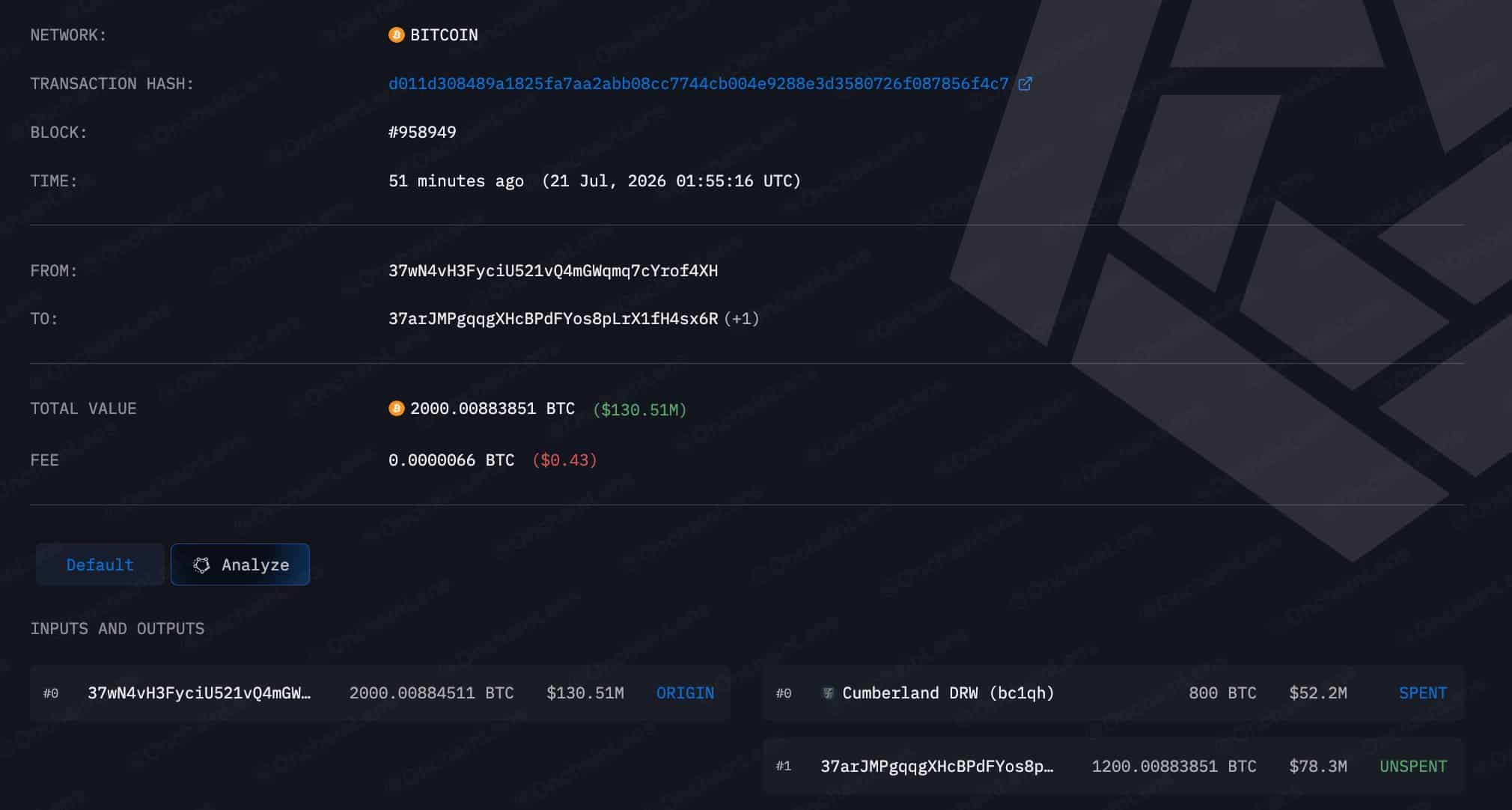
Onchain Lens reported that a whale who has been aggressively accumulating Bitcoin over the past six years finally moved his assets. According to the on-chain monitor, $130.5 million worth of Bitcoin was transferred. 

Bitcoin whale transfer
Source: Arkham

The associated wallet moved 800 BTC worth $52.2 million to Cumberland for OTC. At the same time, the wallet moved 1200 BTC worth $78.3 million to new addresses. 

The whale’s decision to move some holdings to Cumberland signaled the intention to sell. While OTC hardly directly affects the market supply, it could significantly affect market sentiment. However, the transfer of the large amount to a new address suggested the whale is not fully exiting but repositioning.

Any impact on BTC?

Usually, a major transfer from long-term holders is closely watched by market players. Despite the attention, it seems the transfer had no negative impact on Bitcoin’s price action.

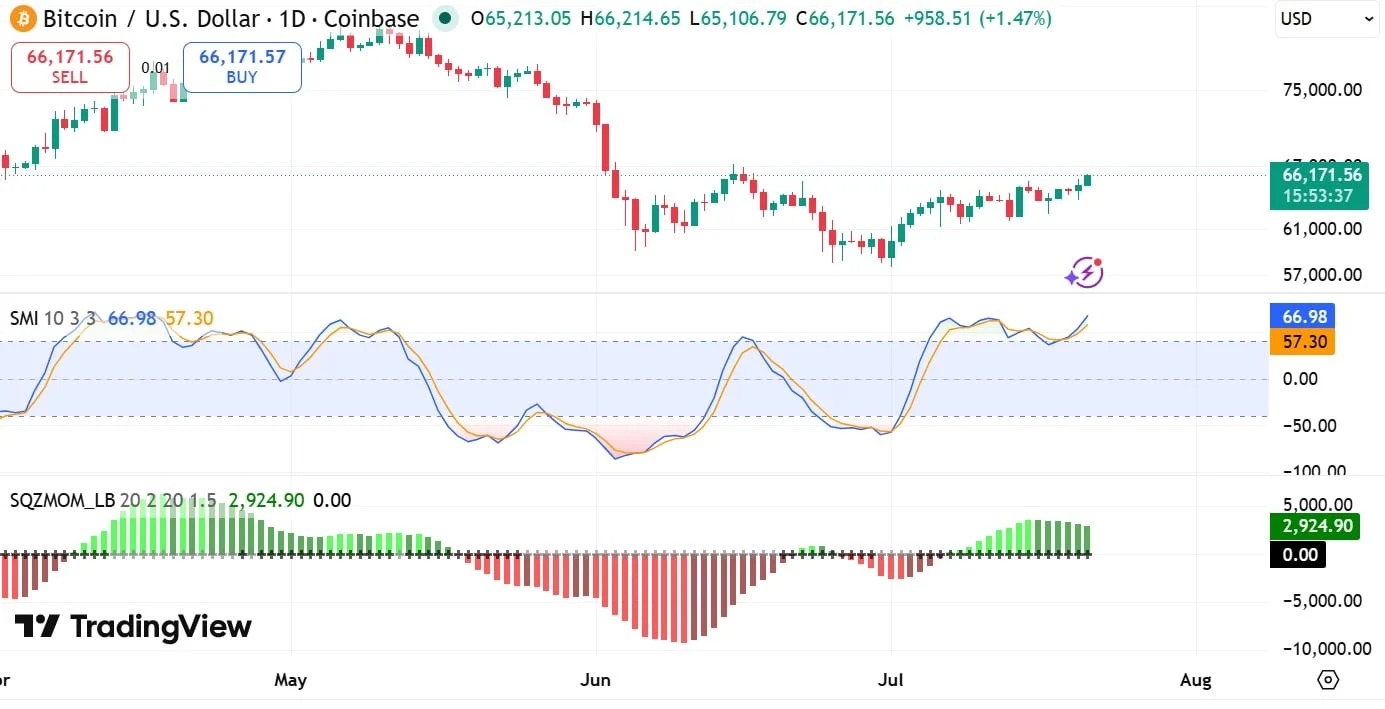
On the contrary, BTC has continued with its bullish streak, rising to a monthly high of $66,314 before a slight pullback. At press time, Bitcoin was trading around $66,195, after rising by 3.02% on the daily charts.

Bitcoin squeeze momentum indicatorBitcoin squeeze momentum indicator
Source: TradingView

With BTC holding within an uptrend since $62k a day ago, the momentum has strengthened extensively. The Stochastic Momentum Index (SMI) hiked to 67 after forming a bullish crossover two days ago.

At these levels, the current trend is relatively strong. Furthermore, the Squeeze Momentum Indicator has held and remained positive over the past week, reflecting strengthening momentum.

Often, when these indicators move in such a manner, the prevailing trend is likely to continue. If the momentum holds, Bitcoin will flip $67k and target a move above $70k.

Does Bitcoin still face rising pressure?

Although the whale transfers have had little to no impact on Bitcoin, the upward trajectory has incentivized profit takers to return.

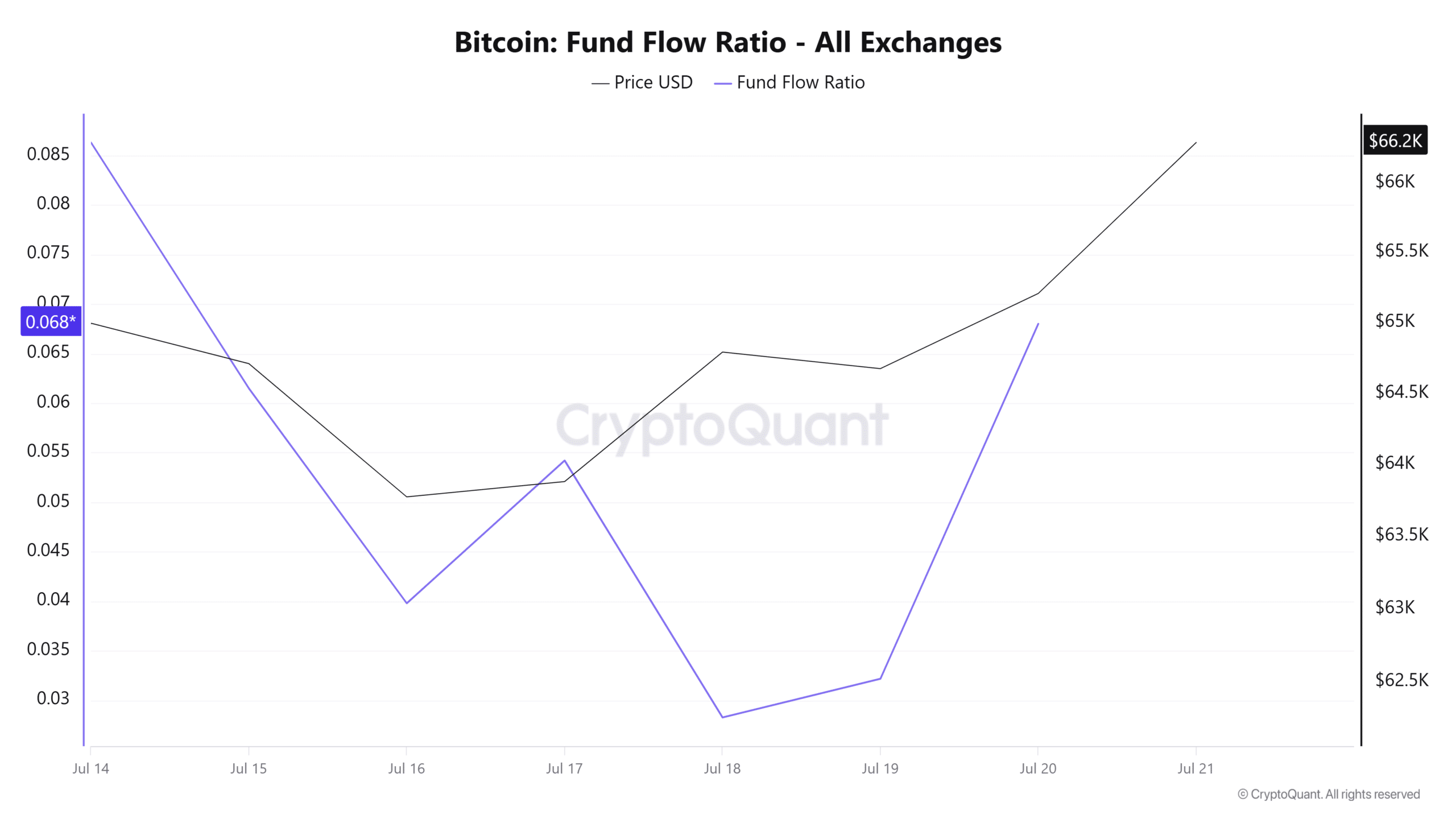
For starters, the Bitcoin Fund Flow Ratio has been on the rise over the past week, climbing to a high of $0.06 at press time.

Bitcoin fund flow ratioBitcoin fund flow ratio
Source: CryptoQuant

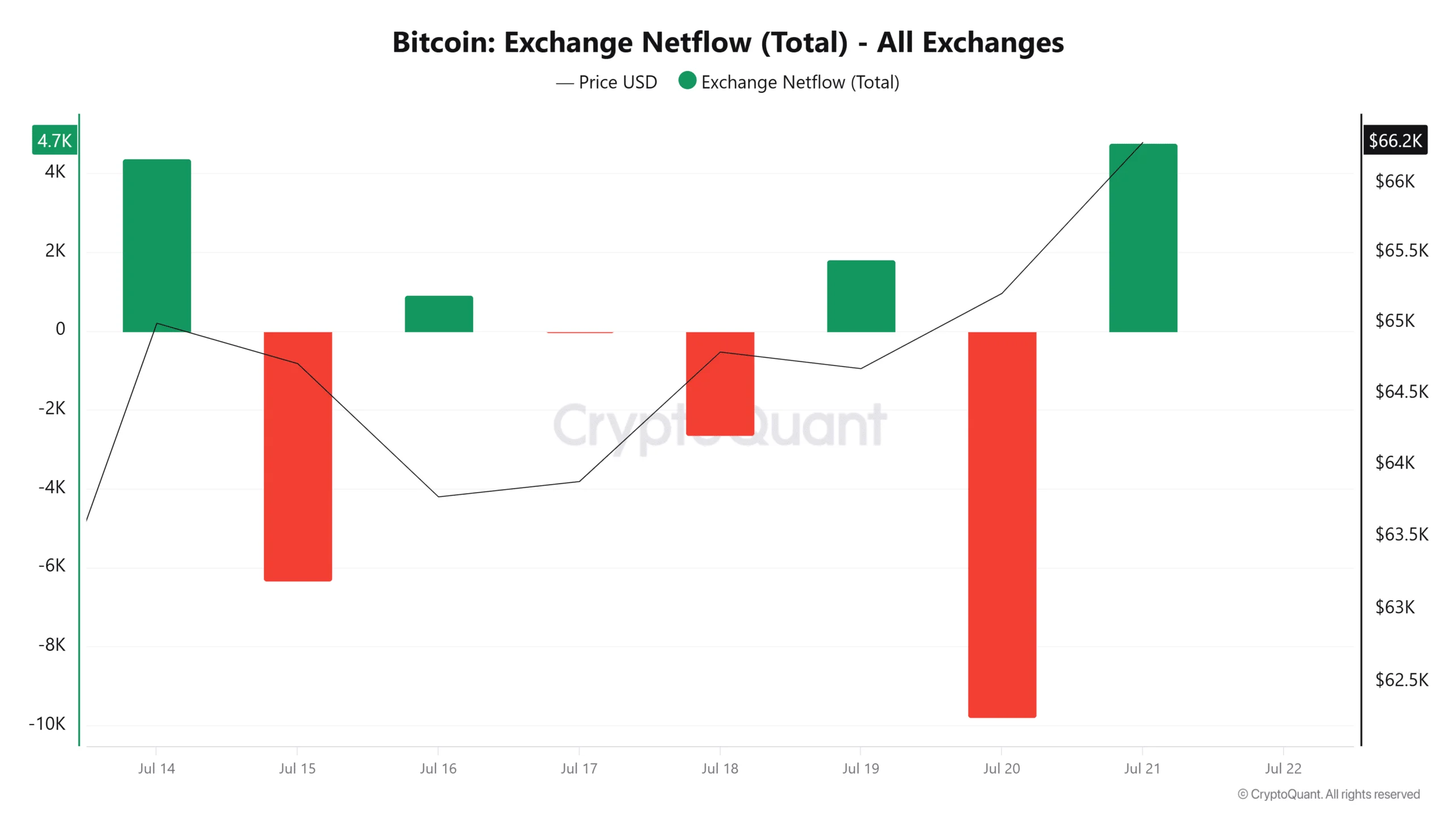
A rising Fund Flow Ratio suggests more coins have recently flowed into exchanges. Higher exchange flows increase the risk of short-term bearishness. This trend was further confirmed as Exchange Netflow turned positive, rising to 4.7K.

Bitcoin exchange netflowBitcoin exchange netflow
Source: CryptoQuant

A positive Netflow suggests more BTC has recently flowed into exchanges. Historically, increased exchange inflows have preceded a weakened market structure.

Therefore, if sellers continue to offload, the pressure could weaken momentum and likely push it to $64,800.


Final Summary

  • A Bitcoin whale moved 2,000 BTC worth $130.5 million, moving 800 BTC to Cumberland OTC and 1,200 to fresh addresses. 
  • Rising Fund Flow Ratio and positive Netflow signal growing exchange inflows, raising short‑term bearish risk for Bitcoin.


Source link

Spain just opened a door America slammed shut

0
Spain just opened a door America slammed shut


Every country that builds things eventually faces the same question about a cheaper foreign rival, and there are only two honest answers to it.

You can wall the rival out and buy yourself time, or you can let the rival in and try to learn something before it eats you.

Both answers cost money. Only one of them tells you where you actually stand.

The United States picked the wall, and picked it hard. A 100% import duty on Chinese electric vehicles took effect in September 2024, according to the Office of the U.S. Trade Representative.

A separate Commerce Department rule bars Chinese-linked vehicle software starting with model year 2027 cars and Chinese-linked connectivity hardware from model year 2030, according to the Bureau of Industry and Security.

The practical result is that almost no Chinese passenger car reaches an American driveway, and almost none will.

Europe went a different direction, and one country went furthest of all. A Spanish government report obtained by Bloomberg now spells out how far Madrid will go to keep its factories running, and the answer involves flying in Chinese workers to build the plants.

Why Spain is betting its car industry on Chinese money

Spain is not a bystander in the auto business. It is the second-largest vehicle producer in Europe behind Germany, and the sector accounts for roughly 10% of Spanish gross domestic product and 9% of national employment, according to Invest in Spain, the government’s foreign investment agency.

That is the context most American coverage skips. When a Spanish plant goes idle, the damage is not sector news. It is a national economic event.

Spain has already lived through that. Nissan walked away from Barcelona. Stellantis (STLA) and Volkswagen (VWAGY) have spent years managing underused European capacity while demand for combustion cars falls off faster than anyone budgeted for.

More Automotive:

The competition arrived anyway. Chinese brands took roughly 6% of European Union car registrations between January and April 2026, up from 3.2% from a year earlier, according to Euronews, which built the figure from registration data published by the European Automobile Manufacturers’ Association.

I ran that against the same association’s May 2026 release, which showed battery-electric cars reaching 20% of the EU market, and the pattern is not subtle. Chinese share is growing fastest inside the exact segment Europe to which has legally committed itself.


Source link