Home Blog Page 207

Bitcoin (BTC) price rally faces real test at $68,000 as ‘summer slumber’ grips crypto, analysts say

0
Bitcoin (BTC) price rally faces real test at $68,000 as 'summer slumber' grips crypto, analysts say


Spot market conditions have improved after months of weakness, with U.S. spot bitcoin ETFs shifting from persistent outflows to modest inflows. Still, the report cautioned that demand has yet to fully recover, with ETF flows and purchases by corporate bitcoin treasury companies such as Strategy (STR) remaining well below the levels seen earlier this year.

While bitcoin’s rebound has helped lift sentiment across the market after a difficult second quarter, Bitfinex cautioned that the recovery is “not yet healed.”

Bitcoin currently accounts for nearly 67% of spot crypto trading volume, up from roughly 50% a year ago, according to Bitfinex. The shift suggests investors continue to favor bitcoin over smaller tokens, a sign that traders remain defensive rather than embracing broad risk-taking.

‘Summer slumber’

Data from K33 Research paints a similar picture.

Head of research Vetle Lunde said institutional participation has continued to fade, with CME bitcoin futures open interest falling to its lowest level since 2023. Offshore perpetual futures positioning has remained largely unchanged, indicating speculative traders have been reluctant to add leverage despite bitcoin’s recent gains.

Spot trading activity has also stayed slow. Thirty-day bitcoin trading volume is running at just 62% of its annual average, according to K33, and late July has historically been the weakest period of the year. Average daily spot volume over the past week was roughly $2.3 billion, hovering near yearly lows even as prices recovered.

K33 described the backdrop as a “promising, and typical, summer slumber.”


Source link

Gold prices today, Tuesday, July 21, 2026: Gold hovers above $4,000 ahead of next week’s Fed meeting

0
Gold prices today, Tuesday, July 21, 2026: Gold hovers above $4,000 ahead of next week’s Fed meeting


Gold (GC=F) August futures opened at $4,013.40 per troy ounce on Tuesday, July 21, 2026, down 0.1% from Monday’s closing price. The price of gold moved higher this morning to $4,063.40 per troy ounce as of 8:20 a.m. ET.

Gold has traded in a tight range near $4,000 over the past week, as investors watch for updates on the Iran war and await an interest rate decision next week. The fighting in the Middle East continued after President Trump vowed revenge for the death of American soldiers. Trump is reportedly considering expanding the attacks against Iran. 

The Fed meets next week and will announce its next interest rate decision on Wednesday. According to CME FedWatch, most expect no change to the fed funds rate, but there is a 16.6% chance of a 25-basis-point rate increase.

Continued fighting in the Middle East likely raises the inflation risk, which in turn increases the chances of higher interest rates. While gold is viewed as an inflation hedge, higher interest rates can encourage lower gold prices because some investors will move into yield-bearing assets for the interest income.

The opening price of gold futures on Tuesday, July 21, 2026, was 0.1% lower than Monday’s opening price. Here’s a look at how the opening gold price has changed versus last week, month, and year:  

  • One week ago: +0.4%

  • One month ago: -6.2%

  • One year ago: +19.8%

The precious metal’s one-year gain was 95.6% on Jan. 29. 

24/7 gold price tracking: Don’t forget you can monitor the current price of gold on Yahoo Finance 24 hours a day, seven days a week. 

Want to learn more about the current top-performing companies in the gold industry? Explore a list of the top-performing companies in the gold industry using the Yahoo Finance Screener. You can create your own screeners with over 150 different screening criteria.

Learn more: Who decides what gold is worth? How gold prices are determined.

Gold has the same high-level risk as any investment: You could lose money. And, as with other investments, a loss on gold can materialize in different ways. Understanding the potential outcomes is the first step to managing your risk when investing in gold.

According to gold experts, would-be gold investors should understand these four risks:

  1. Price

  2. Speculation

  3. Opportunity cost

  4. Fraud 

Today, we’ll focus on the first two: price and speculation. 

Learn more: How to invest in gold in 7 steps

There is a price risk for investors who buy gold when the metal is nearing record high prices. “Buying high to hope for short-term higher is a tough strategy,” said Darrell Fletcher, managing director, commodities at Bannockburn Capital Markets.

Despite the high prices, there are positive dynamics in play for the precious metal. Fletcher pointed out that gold is recovering from decades of low prices, and it’s an increasingly popular diversification asset for central banks and individual investors. 

The right expectations, a long timeline, and an appropriate allocation can limit your pricing risk. “Gold should not be seen as a driver of supercharged returns — it’s there to act primarily as a stabilizer in a diversified portfolio,” explained Alex Tsepaev, chief strategy officer of B2PRIME Group.

If you are interested in learning more about gold’s historical value, Yahoo Finance has been tracking the historical price of gold since 2000. 

Thomas Winmill, portfolio manager at Midas Funds, encourages investors to view positions in gold bullion, coins, and ETFs as speculative. Gold is a commodity, and “commodity prices are dependent on macroeconomic, political, industrial, and financial factors that are unpredictable, and in some cases, unknowable.” 

Despite its recent performance, gold is an unpredictable asset. Keeping that in mind when making trading decisions could protect you from over-exposure and unrealistic expectations. 

Learn more: Thinking of buying gold? Here’s what investors should watch for.

Whether you’re tracking the price of gold since last month or last year, the price of gold chart below shows the precious metal’s change in value. 


Source link

The AI Race Between China and the U.S. Just Got More Heated

0
The AI Race Between China and the U.S. Just Got More Heated


China landed a one-two punch on America’s AI lead, and neither blow will cost users a dime. On Friday, The Verge reports that Moonshot AI unveiled Kimi K3, a 2.8 trillion-parameter model that the company claims ranks above nearly every U.S. system except OpenAI‘s GPT-5.6 Sol and Anthropic‘s Claude Fable 5. Days later, Alibaba followed with a preview of Qwen3.8, a 2.4 trillion-parameter model it calls “second only to Fable 5.”

The bigger story is the price tag. Both companies are releasing their models publicly, free for developers to download, modify and build on. Most US labs keep their best models locked up. China is giving theirs away.

It’s the biggest jolt to the industry since DeepSeek’s low-cost model rattled Silicon Valley last year, and it raises a real question for American AI companies: does pouring billions into chips and data centers still guarantee they’ll win the AI race?

China landed a one-two punch on America’s AI lead, and neither blow will cost users a dime. On Friday, The Verge reports that Moonshot AI unveiled Kimi K3, a 2.8 trillion-parameter model that the company claims ranks above nearly every U.S. system except OpenAI‘s GPT-5.6 Sol and Anthropic‘s Claude Fable 5. Days later, Alibaba followed with a preview of Qwen3.8, a 2.4 trillion-parameter model it calls “second only to Fable 5.”

The bigger story is the price tag. Both companies are releasing their models publicly, free for developers to download, modify and build on. Most US labs keep their best models locked up. China is giving theirs away.

It’s the biggest jolt to the industry since DeepSeek’s low-cost model rattled Silicon Valley last year, and it raises a real question for American AI companies: does pouring billions into chips and data centers still guarantee they’ll win the AI race?


Source link

Bitcoin’s $70K setup is here despite weak Spot demand – Here’s how!

0
Bitcoin’s $70K setup is here despite weak Spot demand - Here’s how!


The market is signaling that Bitcoin could be vulnerable to more volatility.

According to a recent Glassnode report, BTC saw strong realized profit-taking around $65k, while hot capital increased and sell-side pressure started building.

These signals suggest Bitcoin’s move toward $70k could face more resistance before a breakout. Notably, other on-chain metrics are showing a similar trend. 

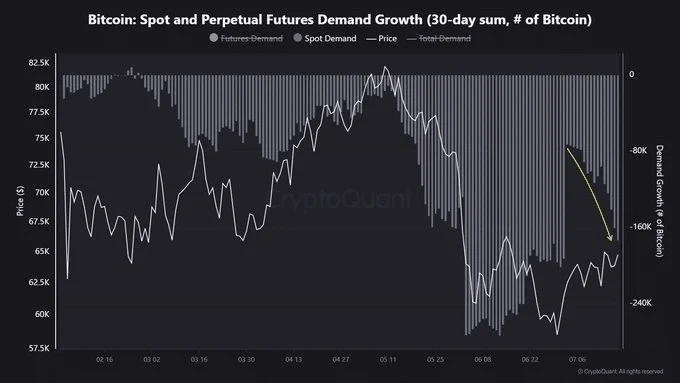
As the chart below shows, Bitcoin’s 30-day Spot demand recovered sharply to around -80k BTC in early July but has since weakened again to nearly -170k BTC.

This shows that Spot demand is losing momentum, while analysts are warning that a lack of fresh buying could increase the risk of a long liquidation event. 

Bitcoin
Source: CryptoQuant

Notably, looking at Bitcoin’s derivatives positioning, this risk doesn’t seem far-fetched.

According to CryptoQuant data, BTC’s positive funding rates have jumped over 20% in less than 72 hours, showing that bullish positioning and leverage are building up again. If Spot demand remains weak, this crowded long positioning could leave Bitcoin vulnerable to a sharp liquidation move.

This naturally reinforces Glassnode’s view that Bitcoin [BTC] could be entering a period of higher volatility. However, if Spot demand starts to recover, the narrative quickly shifts to whether bulls can flip this fakeout setup into a breakout, trap late bears, and push BTC toward the $70k level.

Bitcoin whales keep buying despite fading Spot demand 

The past 48 hours have looked like a textbook short squeeze.

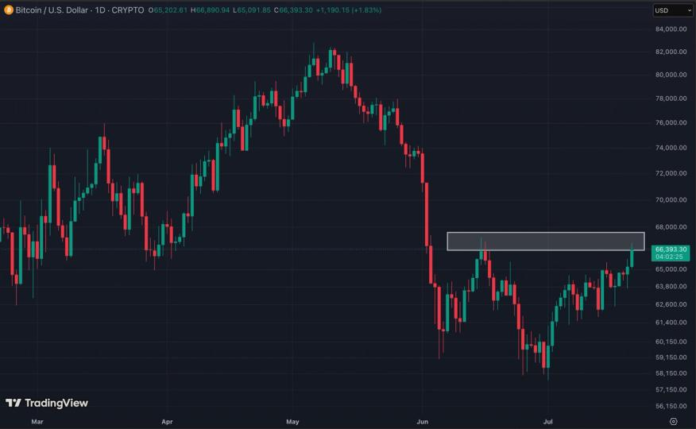
According to CoinGlass data, Bitcoin short liquidations climbed above $80 million, accounting for  90%+ of total liquidations. The move coincided with BTC reclaiming $66k, showing that bears were squeezed out as the price pushed higher.

However, with Spot bids lacking, the rally could quickly turn into a fakeout.

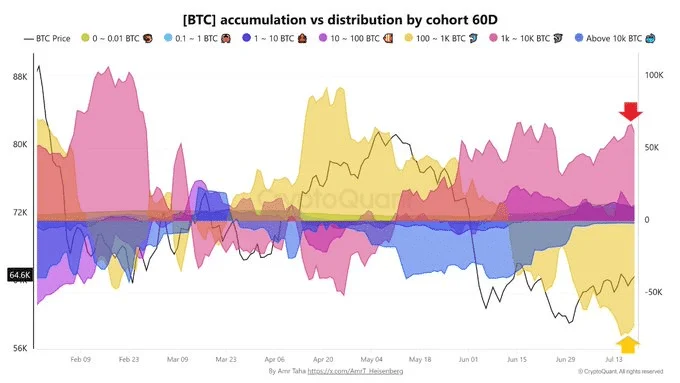
This is where the on-chain data starts telling a different story. As the chart below shows, Bitcoin whales accumulated 66,700 BTC over the past 60 days, while mid-sized holders sold 77,800 BTC. 

BTCBTC
Source: CryptoQuant

From a technical perspective, this accumulation took place while Bitcoin corrected nearly 25% to around $58k. Instead of selling into weakness, whales continued adding to their positions, signaling strong conviction despite the broader risk-off environment.

Now, with Spot demand fading, this accumulation is starting to resemble a classic STH-to-LTH transition. Historically, this phase reflects supply moving into stronger hands and has often preceded a more sustainable bullish trend.

That naturally puts Bitcoin’s derivatives positioning under the spotlight.

According to AMBCrypto, if this transition is indeed underway, the recent rise in long bets looks more like strategic positioning than aggressive speculation.

The setup therefore favors Bitcoin pushing toward $70k and squeezing late shorts, rather than the current rally turning into a bull trap.


Final Summary


Source link

White House pushes Senate Democrats to take ‘historic’ crypto Clarity Act ethics deal

0
The GENIUS Act turns 1: State of Crypto

“If Senate Democrats block this historic legislation after the administration has bent over backward to accommodate their concerns, stakeholders should make no mistake: It is the Democrats who are blocking this legislation because they were never serious about a legislative outcome,” the White House official said.

Democratic negotiators such as Senators Kirsten Gillibrand, Ruben Gallego and Angela Alsobrooks reportedly haven’t received details of the agreement with Trump, who’d met personally with Republican senators last week. But many of the Democrats have drawn a line in the sand that the ethics provision — driven primarily by Trump’s own deep crypto connections — needs to be strong.

The dispute was heightened recently by the president’s disclosures that he’d pocketed more than $1 billion last year from his crypto interests.

The White House, Republicans and their crypto industry allies are already building their case against any Democrats who don’t accept the new answer to their ethics demands. It’s unclear when they’ll get to see it.

The industry is expecting full circulation of the Clarity Act legislative language as soon as Tuesday night or Wednesday, though that expectation has been repeatedly delayed since last week.

The Senate has fewer than three weeks to finish the bill, including the ethics piece, and get it through the political gauntlet of a floor vote before lawmakers leave town for their reelection campaigns. There’s technically enough time, but even without significant further debate, it would be tight.


Source link

How to work with a credit card debt collector

0
How to work with a credit card debt collector


Not paying your credit card bill can quickly lead to costly interest charges and fees. But if you continue to leave your bill unpaid for several months, you could also run the risk of your debt being sent to collections. When debt collectors start calling to claim an unpaid debt, remember that you have protections and rights under the law. 

The Fair Debt Collection Practices Act protects you from “deceptive, unfair, and abusive debt collection practices,” according to the Federal Trade Commission. Abusive debt collection practices “contribute to the number of personal bankruptcies, to marital instability, to the loss of jobs, and to invasions of individual privacy.”

The law prohibits debt collectors from activities like calling you repeatedly or at odd hours, threatening you with violence, disclosing your personal information to third parties, and more. For example, debt collectors cannot contact you before 8 a.m. or after 9 p.m., and they cannot call you more than seven times within a seven-day period. 

Debt collectors also are not allowed to tell other people about your debt. Though they may reach out to friends and family members to find out your contact information, they cannot discuss your debt.

More resources:

If a debt collector does these things, they may be scamming you instead of actually trying to collect a debt:

  • Threatening you: Debt collectors cannot threaten to hurt you or speak to you with obscenities or profanities. They also should not threaten you by telling you that you’ll be arrested. According to the Consumer Financial Protection Bureau (CFPB), there are only a few circumstances that could lead to being arrested over a debt, such as not complying with a court order if you’re sued

  • Refusing to give information: Debt collectors are required to provide you with information about themselves and the debt they’re collecting. If you cannot get information about how to contact them, the creditor that holds your debt, how much debt you owe, or other relevant details, they may not be legitimate.

  • Asking for financial information: Debt collectors may ask you to verify information about yourself, like your name and address, but you should be cautious if they ask for financial information like your bank account number or credit card account information before you’ve confirmed who they are.

When a legitimate debt collector contacts you about your debt, they’re required to give you certain information about the debt they want to collect from you. You should receive the information when they initially contact you or within five days. 

The CFPB states the required information is designed to help you recognize whether the debt is actually yours and how you can dispute it if not. It includes:

  • Your name and mailing information

  • The creditor that’s owed the debt

  • Your account number

  • Current debt amount (including itemized information with interest, fees, payments, and more)

  • How to respond to the debt collector 

If you don’t believe the debt is actually yours, you’ll have 30 days to dispute it in writing. The CFPB has sample letters you can use for a range of different scenarios when a debt collector contacts you. For example, the agency has a sample letter to dispute the debt and to tell a debt collector to contact you only through your lawyer. 

If you’re contacted by a debt collector for a debt that you do actually owe, you should repay the debt in full or work out a plan with the debt collector.

According to the CFPB, contacting the debt collector, negotiating through a credit counselor, or even using an attorney may be useful. It’s smart to get your agreement in writing before you make a payment.

You can find nonprofit credit counselors through organizations like the National Foundation for Credit Counseling or Financial Counseling Association of America. The CFPB has resources available for finding reputable attorneys in your area.

In some cases, debt collectors may file a lawsuit against you for the money you owe — especially if you ignore their attempts to contact you. Even after the lawsuit is filed, it’s best to respond and attempt to settle or resolve the debt before a judgment is issued in court. 

If you don’t respond and the court issues a judgment against you, you may lose the ability to dispute the debt and could have your wages garnished or a lien placed against your property.


Editorial Disclosure: The information in this article has not been reviewed or approved by any advertiser. All opinions belong solely to Yahoo Finance and are not those of any other entity. The details on financial products, including card rates and fees, are accurate as of the publish date. All products or services are presented without warranty. Check the bank’s website for the most current information. This site doesn’t include all currently available offers. Credit score alone does not guarantee or imply approval for any financial product.


Source link

Claude’s Fable 5 just solved an 87-year-old math problem, and it matters for bitcoin

0
Claude's Fable 5 just solved an 87-year-old math problem, and it matters for bitcoin


But the larger pull is simpler: AI is where the speculative money and investors’ attention are now going. The capital that once chased crypto is now chasing compute, chips and model builders, and every leap in what these systems can do widens that appeal.

Each result like Fable’s finding of the Jacobian conjecture strengthens the case for pouring capital into AI, and poses a difficult conundrum for crypto investors: Why hold a token that trades as a sidecar to the AI cycle when someone can own the vehicle itself?

AI’s capability curve is steep, and the steeper it gets, the more of the market’s risk appetite it draws away from everything else, crypto included.

What the problem actually was

Think of a machine that takes two numbers and gives back two new numbers, using only adding and multiplying. The question, first asked in 1939, was whether the machine can always be run backward: given only its answer, can the original two numbers be recovered every time?

Mathematicians had a quick way to check whether a machine looked reversible. The Jacobian conjecture said that if a machine passed that check, it should always be reversible.

For 87 years, nobody could prove it was true, and nobody could find a machine that broke the rule.


Source link