Home Blog Page 208

How 40.8M staked ETH could strengthen Ethereum’s edge over Bitcoin

0
How 40.8M staked ETH could strengthen Ethereum's edge over Bitcoin


Two key divergences show why Ethereum’s [ETH] outperformance against Bitcoin [BTC] may only be beginning.

Notably, Lookonchain flagged consecutive whale accumulation, with one whale withdrawing over 74,000 ETH and another more than 10,000 ETH. The key detail? Both whales staked 100% of the ETH they accumulated, marking a clear divergence from a typical whale accumulation setup. Simply put, instead of leaving the ETH idle, they’re locking it into staking, reducing the liquid supply while signaling long-term conviction.

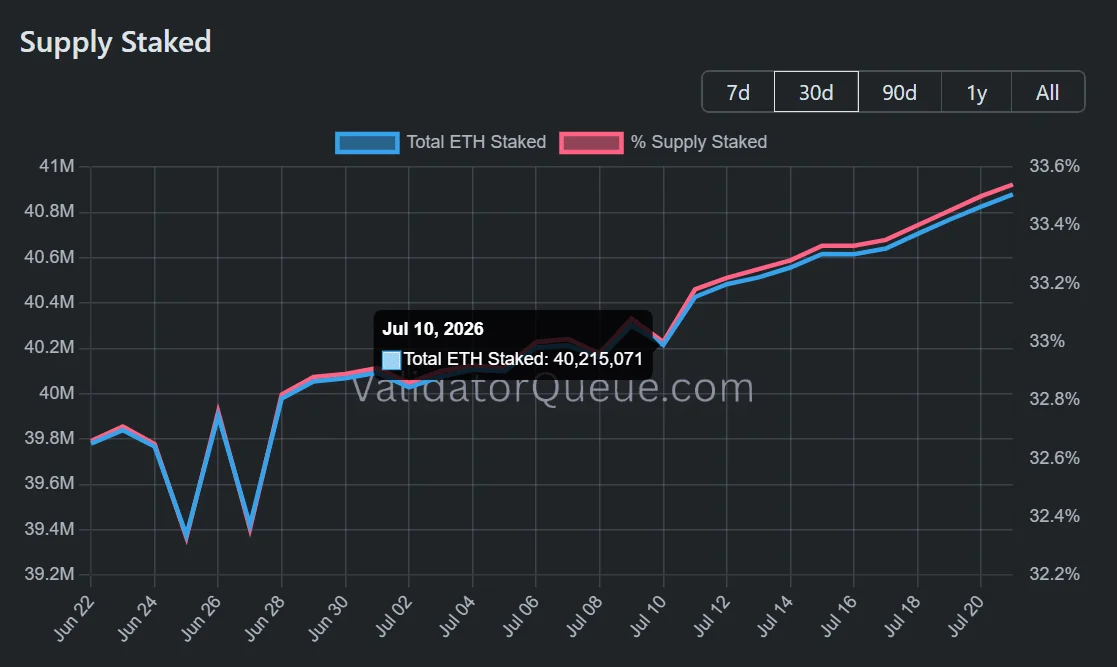
Ethereum’s staking data only reinforces that trend. As the chart below shows, the validator exit queue currently sits at zero, while the entry queue has climbed to 2.4 million ETH. At the same time, total staked ETH has climbed to a record 40.8 million, with 33.5% of the total ETH supply now sitting in staking. To put that into perspective, users have added nearly 600,000 ETH to staking in less than ten days.
Ethereum
Source: ValidatorQueue

In that context, these two whales staking 100% of their newly accumulated ETH isn’t an isolated event. 

Instead, it aligns with a broader trend of supply being locked away, further tightening liquid ETH as staking demand continues to grow. And the impact is starting to show on the technical side.

On the daily chart, the rise in ETH staking flows has lined up with ETH/BTC breaking above the 0.025 resistance level, showing that stronger supply dynamics are beginning to translate into better Ethereum performance against Bitcoin. 

Now, looking at the second divergence. While staking flows highlight long-term conviction, Ethereum’s DeFi ecosystem adds another important layer by shaping liquidity and on-chain activity across the network, creating another tailwind for Ethereum’s performance against Bitcoin.

Ethereum accumulation signals a bigger move 

Random accumulation doesn’t really mean much on its own. 

However, Ethereum’s whale accumulation is telling a much bigger story. While staking flows support long-term conviction, combining that with strong DeFi flows adds another layer of strength to Ethereum’s ecosystem. Currently, this combination could be highlighting ETH’s underlying demand.

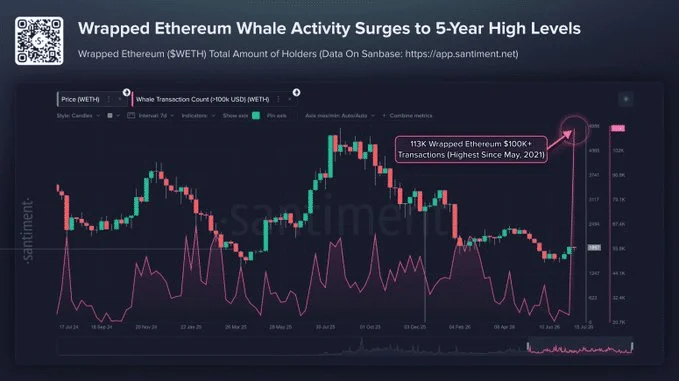
As the chart below shows, Wrapped Ethereum (WETH) recorded 113k whale transactions above $100k over the past week, marking its highest level since May 2021. This shows that large players are becoming more active on-chain. With Ethereum’s TVL also increasing by over $5 billion in less than ten days, the data points to rising liquidity and stronger activity across the Ethereum ecosystem. 
 

ETHETH
Source: Santiment

And the impact is starting to show. 

On the technical side, Ethereum just posted its strongest weekly close against Bitcoin in eleven weeks. With the ETH/BTC ratio now approaching the key 0.03 resistance zone, the ongoing supply squeeze is adding more strength to the breakout setup, setting the stage for the next leg of ETH’s outperformance against BTC.


Final Summary

  • Whales are buying ETH and locking it into staking, reducing available supply while DeFi activity continues to grow.
  • ETH/BTC is showing strength, with the ratio nearing key resistance as supply tightening supports a potential breakout.




Source link

Alphabet vs Apple: The Better Buy Before Earnings

0
Alphabet Sinks 6%, Amazon Slides 4% Amid AI Capex Anxiety Across the Hyperscalers


Quick Read

  • Alphabet’s $460B Cloud backlog and a 4% share pullback make it the sharper pre-earnings setup versus Apple’s 43 P/E after a 20% rally.

  • Google doubled CapEx to $36B and guided for $175B to $185B in 2026, while Apple authorized a $100B buyback and raised its dividend 4%.

  • Act now: the analyst who called NVIDIA in 2010 just named his top 10 AI stocks — and Apple didn’t make the cut. Grab the names FREE today.

Alphabet (NASDAQ:GOOG) reports Q2 after the bell on July 22. Apple (NASDAQ:AAPL) follows on July 30.

achinthamb

Both delivered blockbuster last quarters: Google leaned into AI infrastructure and Cloud, while Apple rode an iPhone 17 supercycle and a Services record. The setup makes this a rare moment to weigh two mega-caps running very different playbooks.

Cloud AI Carries Google. iPhone 17 Carries Apple.

Google’s Q1 FY2026 landed at $109.90 billion in revenue, up 21.79% year over year, with EPS of $5.11 versus a $2.6327 estimate. Cloud grew 63% to $20.03 billion, with backlog nearly doubling quarter on quarter to over $460 billion.

Sundar Pichai told investors, “Our AI investments and full stack approach are lighting up every part of the business.” Search grew 19%, and Gemini now processes 16 billion tokens per minute via direct API, up 60% from the prior quarter.

Apple’s March quarter came in at $111.184 billion, up 16.6% YoY, with EPS of $2.01 against a $1.94 consensus. That is Apple’s eighth consecutive EPS beat.

iPhone revenue hit $56.99 billion on iPhone 17 demand, Services set an all-time high at $30.98 billion, and Greater China rebounded to $20.50 billion. Tim Cook called it “our best March quarter ever”.

Reinvesting Machine vs. Cash Return Engine

Google is spending as if compute scarcity never ends. CapEx more than doubled to $35.67 billion in Q1, up 107.44% YoY, and 2026 guidance targets $175 billion to $185 billion. Free cash flow collapsed to $10.12 billion, down 46.63% — the tuition bill for industrial-scale AI.

Act now: the analyst who called NVIDIA in 2010 just named his top 10 AI stocks — and Apple didn’t make the cut. Grab the names FREE today.

Lens

Alphabet

Apple

Core Bet

AI compute, Cloud, Gemini

iPhone cycle, Services flywheel

Capital Move

$175B-$185B CapEx

$100B buyback

Key Risk

FCF pressure, ROI on CapEx

China exposure, tariffs

Apple runs the opposite play. It authorized a fresh $100 billion buyback and raised its dividend 4% to $0.27. The installed base sits above 2.5 billion active devices, feeding Services’ recurring flywheel. Gross margin holds near 46.9%.

The Next Reports Will Test Both Theses

Tomorrow’s Alphabet release should show whether Cloud backlog keeps building and whether the CapEx surge is converting into incremental Cloud revenue rather than depreciation.

YouTube ads at 11% growth and a declining Google Network are the softer edges. Retail is leaning in: composite sentiment rose 18.04 points over 30 days.

For Apple on July 30, the question is whether iPhone 17 demand carries through the summer and whether Greater China’s rebound sticks. Services momentum matters most for the long thesis. Reddit sentiment reads bullish at 61, but prediction market signal is thin.

Why I Lean Alphabet Into This Earnings Report

Alphabet looks better positioned. A $460 billion Cloud backlog is a contract-backed tailwind, and shares have actually pulled back 4.38% over the past month even as buzz built.

Apple looks pricier after a 20.47% run since its April 30 filing, and a 43 P/E leaves little cushion for a soft services line.

If you prize a fortress balance sheet and predictable capital returns, Apple still fits. If you want the more direct AI infrastructure bet with a catalyst tomorrow, Alphabet is the sharper setup for me.

The one scenario that would flip my view: a Cloud growth deceleration alongside another CapEx step-up. That combination would make me question the ROI narrative and send me back to Apple’s cash machine.

Act now: the analyst who called NVIDIA in 2010 just named his top 10 AI stocks — and Apple didn’t make the cut. Grab the names FREE today.

Contact editorial@247wallst.com for any questions or corrections.


Source link

Stablecoin bank Augustus raises $180 million to build a clearing bank for the AI era

0
Stablecoin bank Augustus raises $180 million to build a clearing bank for the AI era

Augustus, a startup building a federally chartered clearing bank for fintechs and financial institutions, said it raised $180 million to expand its dollar payment infrastructure as stablecoins reshape global finance.

The fundraising valued the company at $1 billion, with Tiger Global leading the round and investors such as Hummingbird, QED and the founders of Nubank, Ramp, Circle and Deel participating, the company said in a Tuesday press release.

The investment comes as banks, fintechs and crypto firms are racing to modernize the infrastructure behind cross-border payments. While much of the attention has centered on stablecoin issuers, Augustus is targeting a less visible but crucial part of the financial system: correspondent banking.

“We think distribution breaks at the clearing bank layer,” CEO Ferdinand Dabitz told CoinDesk in an interview. Legacy clearing systems are “slow, unavailable, take two days to settle and close on the weekends,” he argued.

Taking on correspondent banking

The firm is building what Dabitz described as an “AI-native” clearing bank designed around stablecoins, programmable money and always-on settlement.

Augustus doesn’t plan to issue its own stablecoin, Dabitz said. Instead, it wants to provide the banking infrastructure that lets financial institutions move money across traditional payment systems and blockchain networks.


Source link

HUD suspends disaster funding to U.S. Virgin Islands housing authority, saying mismanagement has kept $1.3 billion from hurricane survivors

0
HUD suspends disaster funding to U.S. Virgin Islands housing authority, saying mismanagement has kept $1.3 billion from hurricane survivors

The U.S. government announced Monday it suspended funding for the U.S. Virgin Islands’ housing authority after an investigation found widespread corruption, as residents still struggle to recover from two major hurricanes that hit nearly a decade ago.

U.S. Housing Secretary Scott Turner said that nine years after the U.S. territory received $1.9 billion in disaster recovery funding, it has spent only $570 million, less than a third of the funds.

He noted that a HUD investigation found “widespread financial mismanagement, inadequate fraud controls, false certifications and improper payments.” The investigation is ongoing.

“This failure has, to date, deprived Virgin Islanders of roughly $1.3 billion worth of assistance that Congress intended them to have,” stated a July 20 letter that HUD sent to the head of the U.S. Virgin Island’s Housing Finance Authority.

The director for the U.S. territory’s housing authority and its spokesperson did not immediately return messages seeking comment. The authority has the right to appeal the suspension by requesting a hearing.

In a post on X, Turner accused officials with the U.S. Virgin Islands’ Housing Finance Authority of prioritizing “kickbacks over helping families recover from disasters.”

The U.S. Virgin Islands was struck by Hurricane Irma, a Category 5 storm, in September 2017. Roughly two weeks later, Hurricane Maria, also a Category 5 storm, struck St. Croix. The U.S. territory is still struggling to recover from the storms.

In a July 20 letter to the head of the U.S. Virgin Islands’ housing authority, HUD said that its “record demonstrates that it is an abysmal steward of taxpayer funds.”

The investigation so far has found that the U.S. Virgin Islands’ housing authority has completed only two of 95 planned single-family rental rehabilitation projects and zero of 329 single and multifamily housing projects.

In addition, the authority had spent only 2% of its electrical grid recovery funding as of May, the investigation found.

Meanwhile, the Virgin Islands housing authority has spent more than half the grant funds slated for administrative costs, according to the letter.

The authority also is accused of seeking $6.2 million in disaster-related funds that the U.S. Federal Emergency Management Agency had already paid.

The U.S. government also noted that the authority’s former chief operating officer who oversaw disaster recovery programs is in federal prison after being convicted on charges including fraud and money laundering.

Turner wrote on X that the former chief operating officer inflated a lumber contract meant to rebuild hurricane-damaged homes from $3 million to $4.5 million and took a $107,000 kickback “and let the lumber rot in the sun, rendering it useless — a waste of taxpayer funds.”

In February, the executive director of the U.S. Virgin Islands’ housing authority resigned as local legislators questioned why some $4.2 million remained idle as a September deadline to use the funds looms.

At the time, Sen. Kurt Vialet accused the former director of “just sitting there with a smug look.”

“The Housing Finance Authority is not building. You can’t be upset at senators being frustrated,” Vialet was quoted as saying by the St. Thomas Source, a local news site.


Source link

Prediction: Mark Zuckerberg Will Make an Announcement on July 29 That Sends Meta Stock Soaring

0
Prediction: Mark Zuckerberg Will Make an Announcement on July 29 That Sends Meta Stock Soaring


It’s been a tumultuous year for Meta Platforms (NASDAQ: META) investors. Despite the company’s strong underlying ad revenue and user engagement metrics, the stock has been under meaningful pressure.

While the stock at one point cratered by as much as 20%, shares are now down just 2% year to date — showing some degree of resilience as capital continues rotating toward companies that are viewed as clearer artificial intelligence (AI) infrastructure winners. With its next earnings reported scheduled for July 29, I predict Meta CEO Mark Zuckerberg will take that opportunity to announce a major strategic shift that could reframe Meta’s role in the AI economy. 

Missed Nvidia in 2009? This Rare Signal Is Flashing Again. In 2009, a “Double Down” signal flashed for a little-known chipmaker called Nvidia. For the first time in years, that same “Total Conviction” signal is flashing for a company 1/100th the size of Nvidia. Continue »

Image source: Getty Images.

Meta’s AI spending is crushing its free cash flow

Meta’s stock has been under pressure this year for one reason: the scale of its AI investments. The company is deploying unprecedented sums to build data centers, design custom silicon, and procure GPU clusters to support its AI initiatives.

Those capital expenditures have compressed its free cash flow in the near term. Investors are growing increasingly concerned about the potential timeline for Meta to deliver meaningful returns on this capital, especially amid questions about how AI will be monetized across the broader tech sector.

The result is a disconnect between Meta’s operational performance and its stock price, as the market demands more visibility into how these infrastructure investments will ultimately drive sustained profitability rather than just consume it.

META Capital Expenditures (TTM) Chart
META Capital Expenditures (TTM) data by YCharts.

AI is already transformative for Meta

Over the last few years, Meta has done a respectable job of embedding AI into its advertising empire. New tools such as Advantage+ use machine learning to automate campaign optimization, audience targeting, and creative testing. This has brought measurable efficiency gains for advertisers while boosting Meta’s own average revenue per user. AI-enhanced advertising is becoming an expanding slice of the company’s overall business, underscoring Meta’s ability to integrate frontier technology directly into its highest-margin segment.

What investors may be overlooking is that this same infrastructure build-out offers the opportunity for a natural business extension: monetizing some of that data center capacity by leasing compute to external clients. Once the heavy up-front investments in power, networking, and accelerators are made, adoption rates carry high incremental margins.


Source link

USCR crypto stabilizes at $0.0022: Can the memecoin reverse Q2 losses?

0
USCR crypto stabilizes at $0.0022: Can the memecoin reverse Q2 losses?


USCR crypto, the memecoin tracking portfolio of the official U.S. crypto reserve updates, is showing signs of a recovery attempt after dropping to a two-month low. 

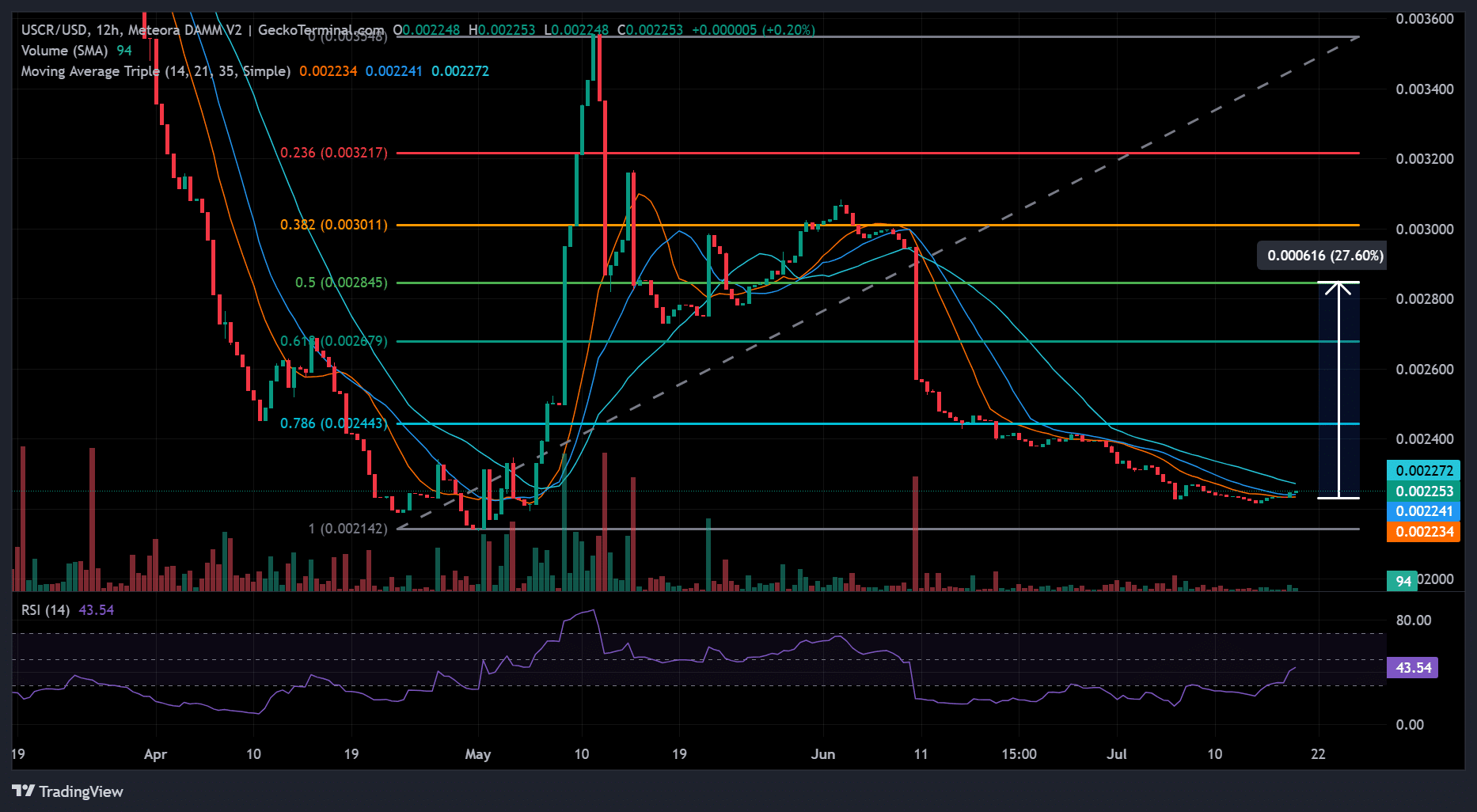
In May, the memecoin exploded by over 65% from $0.0022 to $0.0036. But it crashed hard in June and extended the losses to 37%. The pullback has eased near the May low of $0.0022.  As of writing, the memecoin was green and seemed poised to climb above key short-term moving averages.

If bulls succeed in mounting above the moving averages, further upside momentum could be possible with an immediate target at the 50% Fibonacci retracement level ($0.0028). If the recovery extends beyond the level, the next target would be the May peak of $0.0036.

In other words, a 30-60% upside potential could be feasible if the above targets are hit. 

USCR crypto
Source: USCR/USD, GeckoTerminal 

U.S Bitcoin reserve uncertainty drags USCR crypto

As mentioned earlier, the memecoin’s sentiment is linked to market sentiment and updates around the official U.S Bitcoin strategic reserve. 

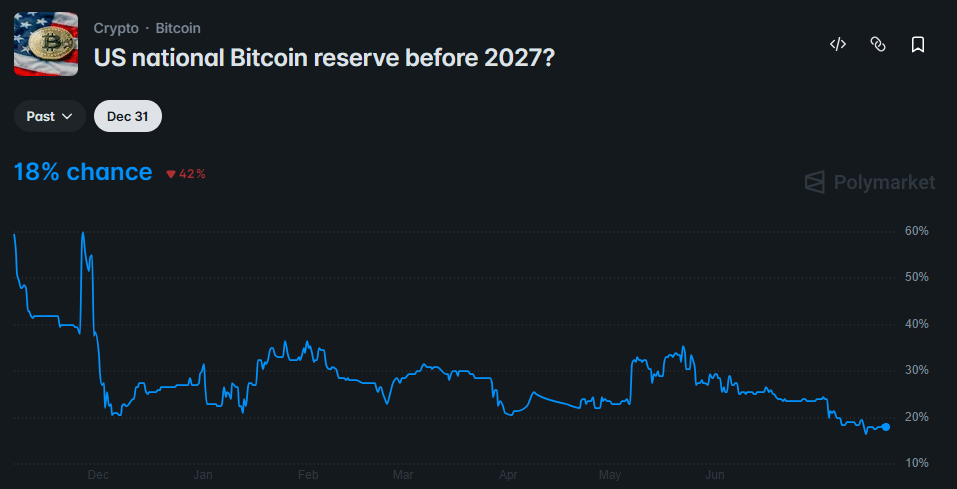
The USCR’s explosive rally in May was triggered by improved chances of a U.S BTC reserve from 22% to over 36%. This also coincided with over 21 U.S lawmakers introducing a bill to set up and formalize the BTC reserve. 

USCR cryptoUSCR crypto
Source: Polymarket 

However, the bill has not advanced beyond the committee. Congress also faces a shrinking legislative calendar, reducing its chances of passage.

Polymarket priced an 18% chance of the U.S. Bitcoin reserve being established before 2027. In fact, the odds fell to an annual low, reflecting USCR’s recent bearish trend.

Therefore, unless there is a positive update on the Bitcoin [BTC] reserve bill’s progress, the USCR’s projected recovery could remain elusive or stall.  

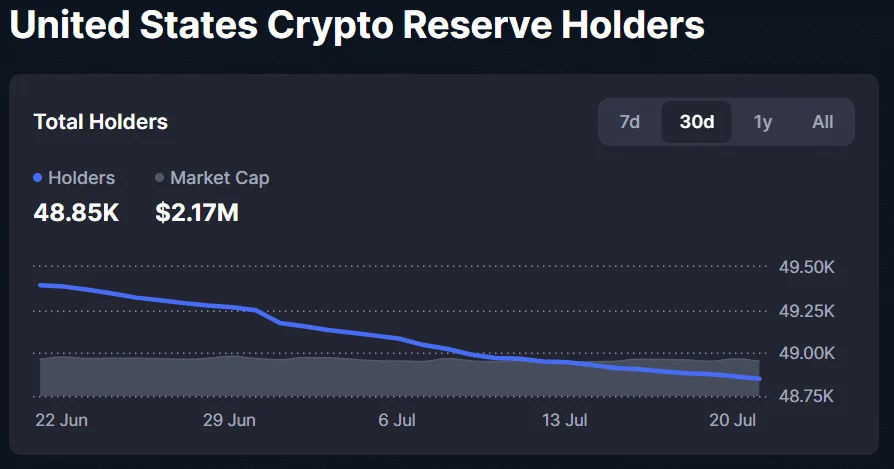
That said, despite the uncertainty around a formal legal framework for U.S crypto reserves, the memecoin still had a massive holder base. According to CoinMarketCap, USCR’s holders only dropped slightly by 4K from 54K to 48K in 2026. 

USCR crypto USCR crypto
Source: CoinMarketCap

It remains to be seen whether the strong conviction will be rewarded despite the lack of a clear path forward for a formal U.S. BTC reserve. 


Final Summary

  • USCR’s memecoin price has been relatively stable after dropping to a two-month low of $0.0022
  • USCR’s holders were 48K after declining slightly by 4K, underscoring strong conviction


Source link

Twenty One Capital CEO steps down as Tether’s plans to merge three bitcoin firms falls

0
Twenty One Capital CEO steps down as Tether's plans to merge three bitcoin firms falls

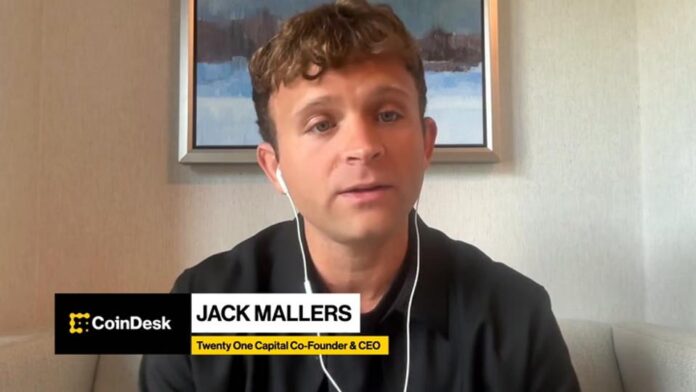
Tether-controlled Twenty One Capital (XXI) named Raphael Zagury as CEO, replacing Jack Mallers, and dropped Strike from a proposed three-way merger, the companies said.

Mallers stepped down effective July 20 to focus on Strike, the bitcoin payments firm he founded. Strike will remain independent and is no longer being considered for a business combination with Twenty One, according to a press release.

Tether, Twenty One’s controlling shareholder, confirmed the changes in a separate announcement.

Tether proposed combining Twenty One, Strike and Elektron in April, seeking to place bitcoin treasury, financial services and mining under one listed company.

Twenty One’s revised strategy will focus on acquiring operating businesses, expanding capital markets capabilities and developing bitcoin-backed lending.

XXI is little changed in pre-market trading.

CoinDesk has reached out to all three companies, but hasn’t heard back at the time of writing.


Source link