USCR crypto, the memecoin tracking portfolio of the official U.S. crypto reserve updates, is showing signs of a recovery attempt after dropping to a two-month low.
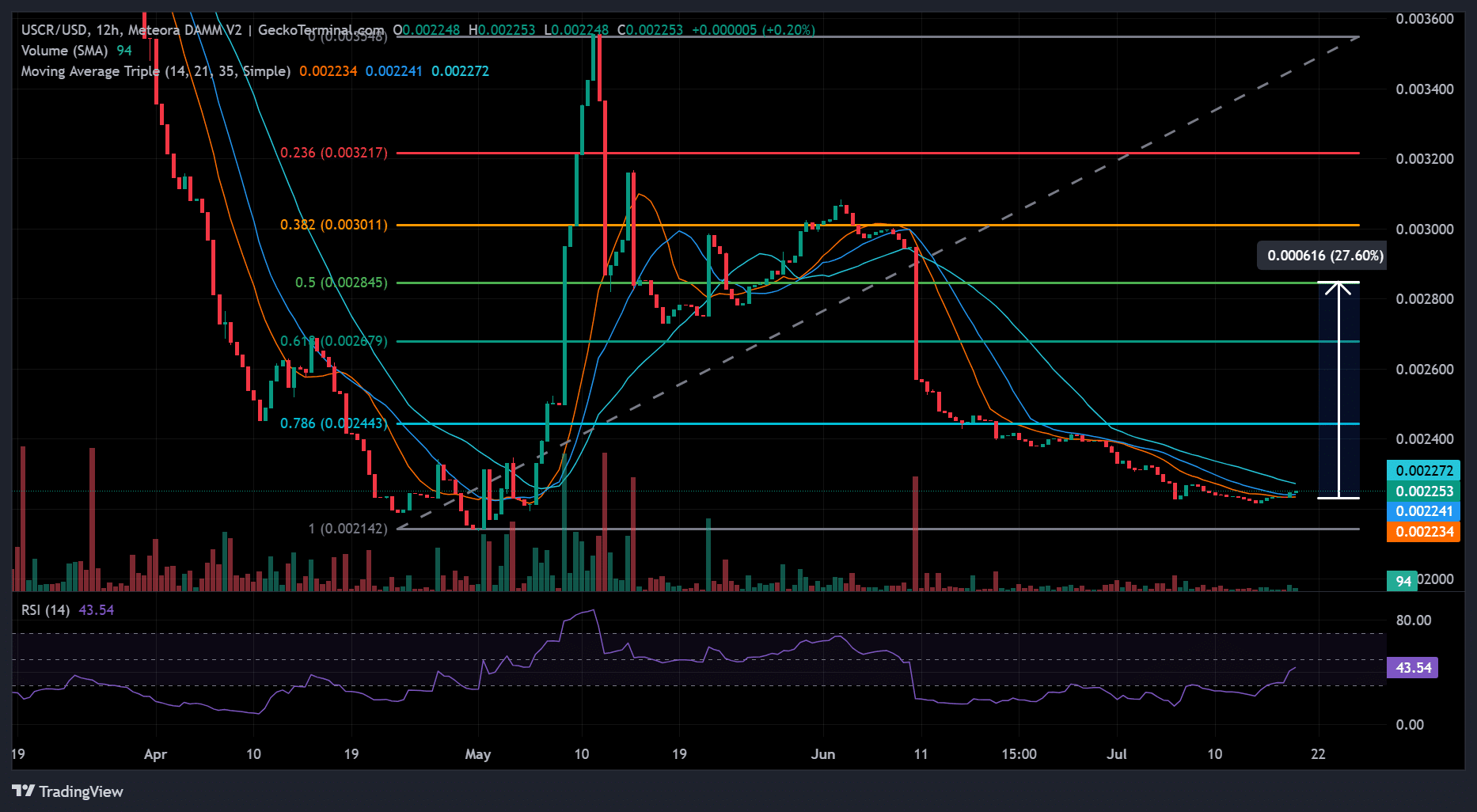
In May, the memecoin exploded by over 65% from $0.0022 to $0.0036. But it crashed hard in June and extended the losses to 37%. The pullback has eased near the May low of $0.0022. As of writing, the memecoin was green and seemed poised to climb above key short-term moving averages.
If bulls succeed in mounting above the moving averages, further upside momentum could be possible with an immediate target at the 50% Fibonacci retracement level ($0.0028). If the recovery extends beyond the level, the next target would be the May peak of $0.0036.
In other words, a 30-60% upside potential could be feasible if the above targets are hit.
Source: USCR/USD, GeckoTerminal
U.S Bitcoin reserve uncertainty drags USCR crypto
As mentioned earlier, the memecoin’s sentiment is linked to market sentiment and updates around the official U.S Bitcoin strategic reserve.
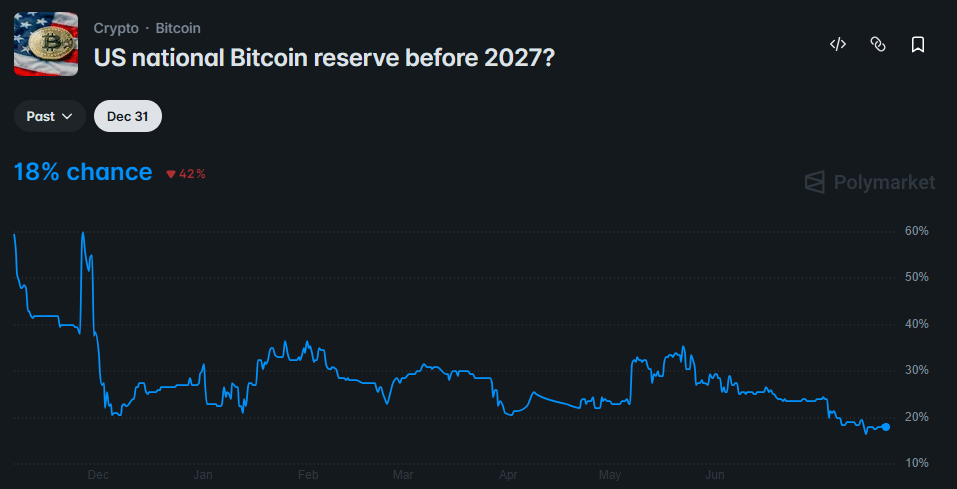
The USCR’s explosive rally in May was triggered by improved chances of a U.S BTC reserve from 22% to over 36%. This also coincided with over 21 U.S lawmakers introducing a bill to set up and formalize the BTC reserve.
Source: Polymarket
However, the bill has not advanced beyond the committee. Congress also faces a shrinking legislative calendar, reducing its chances of passage.
Polymarket priced an 18% chance of the U.S. Bitcoin reserve being established before 2027. In fact, the odds fell to an annual low, reflecting USCR’s recent bearish trend.
Therefore, unless there is a positive update on the Bitcoin [BTC] reserve bill’s progress, the USCR’s projected recovery could remain elusive or stall.
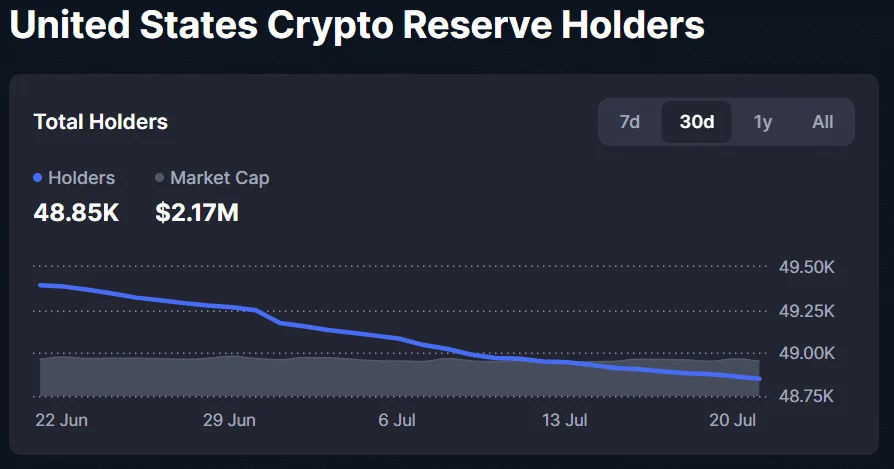
That said, despite the uncertainty around a formal legal framework for U.S crypto reserves, the memecoin still had a massive holder base. According to CoinMarketCap, USCR’s holders only dropped slightly by 4K from 54K to 48K in 2026.
Source: CoinMarketCap
It remains to be seen whether the strong conviction will be rewarded despite the lack of a clear path forward for a formal U.S. BTC reserve.
Final Summary
USCR’s memecoin price has been relatively stable after dropping to a two-month low of $0.0022
USCR’s holders were 48K after declining slightly by 4K, underscoring strong conviction
Tether-controlled Twenty One Capital (XXI) named Raphael Zagury as CEO, replacing Jack Mallers, and dropped Strike from a proposed three-way merger, the companies said.
Mallers stepped down effective July 20 to focus on Strike, the bitcoin payments firm he founded. Strike will remain independent and is no longer being considered for a business combination with Twenty One, according to a press release.
Tether, Twenty One’s controlling shareholder, confirmed the changes in a separate announcement.
Tether proposed combining Twenty One, Strike and Elektron in April, seeking to place bitcoin treasury, financial services and mining under one listed company.
Twenty One’s revised strategy will focus on acquiring operating businesses, expanding capital markets capabilities and developing bitcoin-backed lending.
XXI is little changed in pre-market trading.
CoinDesk has reached out to all three companies, but hasn’t heard back at the time of writing.
This correction was bound to happen. Such events are healthy in every market, but understanding the connection between crumbling AI stock prices and the recent margin unwind shows how bullish this is for long-term investors who can buy the dip.
Margin debt grew 53.7% year over year in May, reaching a record $1.42 trillion. It was also up by 8.5% month over month. All that margin meant that a small correction would inevitably turn into a big one — and it did.
Missed Nvidia in 2009? This Rare Signal Is Flashing Again. In 2009, a “Double Down” signal flashed for a little-known chipmaker called Nvidia. For the first time in years, that same “Total Conviction” signal is flashing for a company 1/100th the size of Nvidia. Continue »
SK Hynix (NASDAQ: SKHY) is the poster child of this development. It dropped by more than 20% over the course of two days in July. But this dip has created a tremendous buying opportunity for long-term investors, especially when the margin unwind concludes.
Image source: Getty Images.
SK Hynix’s unique position
SK Hynix is a memory maker that has benefited tremendously from the AI infrastructure build-out, but it is also a South Korean company. Not only that, but it is that country’s most valuable company.
These are important details when assessing the current margin unwind. That’s because 12 million South Korean retail traders received margin calls over the past week. That was more than 3% of South Korea’s adult population.
That type of margin pressure can accelerate losses and margin calls for investors globally. Then, it creates a feedback loop that results in more margin calls and deeper corrections until the margin unwind is complete.
Since SK Hynix is its country’s most valuable company and a major part of the AI trade, it has outsized exposure to the margin unwind.
Leveraged ETFs have made the margin unwind even worse, with these types of ETFs debuting for SK Hynix earlier this year. These ETFs must maintain fixed ratios of their holdings, so whenever an underlying stock loses value, they are forced to unwind some of their positions. If too many traders pile into leveraged ETFs while having margin accounts, it can trigger even more margin calls.
South Korea’s Financial Supervisory Service Governor Lee Chan-jin called leveraged ETFs a “gambling operation” that has increased market volatility. “We are seeing a phenomenon in which ETFs themselves are driving market swings,” he said.
A closer look at fundamentals
The dramatic margin unwind in South Korea, fueled by margin loans and leveraged ETFs, has dragged SK Hynix well away from its all-time high. International investors have also been forced to sell some of their shares.
The smartest investors will attempt to ignore short-term stock price movements and focus on fundamentals. In that light, it’s easier to see SK Hynix as a compelling long-term opportunity rather than a stock that lost more than 20% of its value over just two days.
The company’s revenue almost tripled year over year in the company’s first quarter, and its 76.7% net profit margin shows that the memory-chip maker is having no problem retaining a large share of total sales. As the AI build-out continues to heat up, big tech will need more memory chips. SK Hynix has positioned itself well for a multiyear boom, even though its stock price’s recent action suggests otherwise.
SK Hynix only trades at a forward P/E ratio of 8 and a PEG ratio under 1. Both metrics suggest the stock is undervalued, especially given its impressive financial growth and long-term tailwinds.
Don’t time the margin unwind
Eventually, the margin unwind will conclude, and investors will return to focusing on fundamentals. Big tech players delivering strong earnings this month that further validate the AI trade may be the catalyst, but investors should not time the margin unwind and try to buy at the lowest possible point.
When large swings take place, they often go both ways. A stock that lost 20% of its value in two days due to a margin unwind can easily regain that ground within a few days. When investors start to feel better about market conditions, they will gradually pile into margin and leveraged ETFs again.
While leveraged products do increase volatility, investors who focus on fundamentals and have long-term time horizons are best positioned to capitalize on megatrends like memory chips.
Should you buy stock in SK Hynix right now?
Before you buy stock in SK Hynix, consider this:
The Motley Fool Stock Advisor analyst team just identified what they believe are the 10 best stocks for investors to buy now… and SK Hynix wasn’t one of them. The 10 stocks that made the cut could produce monster returns in the coming years.
Consider when Netflix made this list on December 17, 2004… if you invested $1,000 at the time of our recommendation, you’d have $371,842!* Or when Nvidia made this list on April 15, 2005… if you invested $1,000 at the time of our recommendation, you’d have $1,244,783!*
Now, it’s worth noting Stock Advisor’s total average return is 900% — a market-crushing outperformance compared to 207% for the S&P 500. Don’t miss the latest top 10 list, available with Stock Advisor, and join an investing community built by individual investors for individual investors.
Marc Guberti has no position in any of the stocks mentioned. The Motley Fool has no position in any of the stocks mentioned. The Motley Fool has a disclosure policy.
U.K. politicians want to know the extent to which the country’s banks have choked-off cryptocurrency firms by refusing them bank accounts and introducing restrictions on crypto-related payments in a cross-party inquiry kicked off on Tuesday.
The Crypto and Digital Assets All-Party Parliamentary Group (APPG) is chaired by Ed Vaizey, a former Minister for the Digital Economy and a member of the House of Lords, and Gurinder Singh Josan, a Labour MP, according to a press release.
Ever since crypto came into being, difficulties around attaining banking relationships have made life hard for players in the space, with a systematic debanking of firms and individuals, particularly in the U.S. being referred to as “Operation Chokepoint 2.0.”
Several major U.K. banks have also introduced restrictions on crypto-related payments, the APPG said in a statement. As such, the inquiry will focus on a dearth of bank accounts for crypto businesses, including associated professional services such as insurance.
Usually, a growing cash pile is considered a bullish signal for a public company.
In Strategy’s case, its decision to add another $225 million to its USD holdings, bringing total cash reserves to $3.2 billion, should have been a positive signal for shareholders.
The logic is straightforward: the more cash Strategy has on hand, the greater its capacity to deploy capital, whether that’s buying more Bitcoin or funding other strategic initiatives.
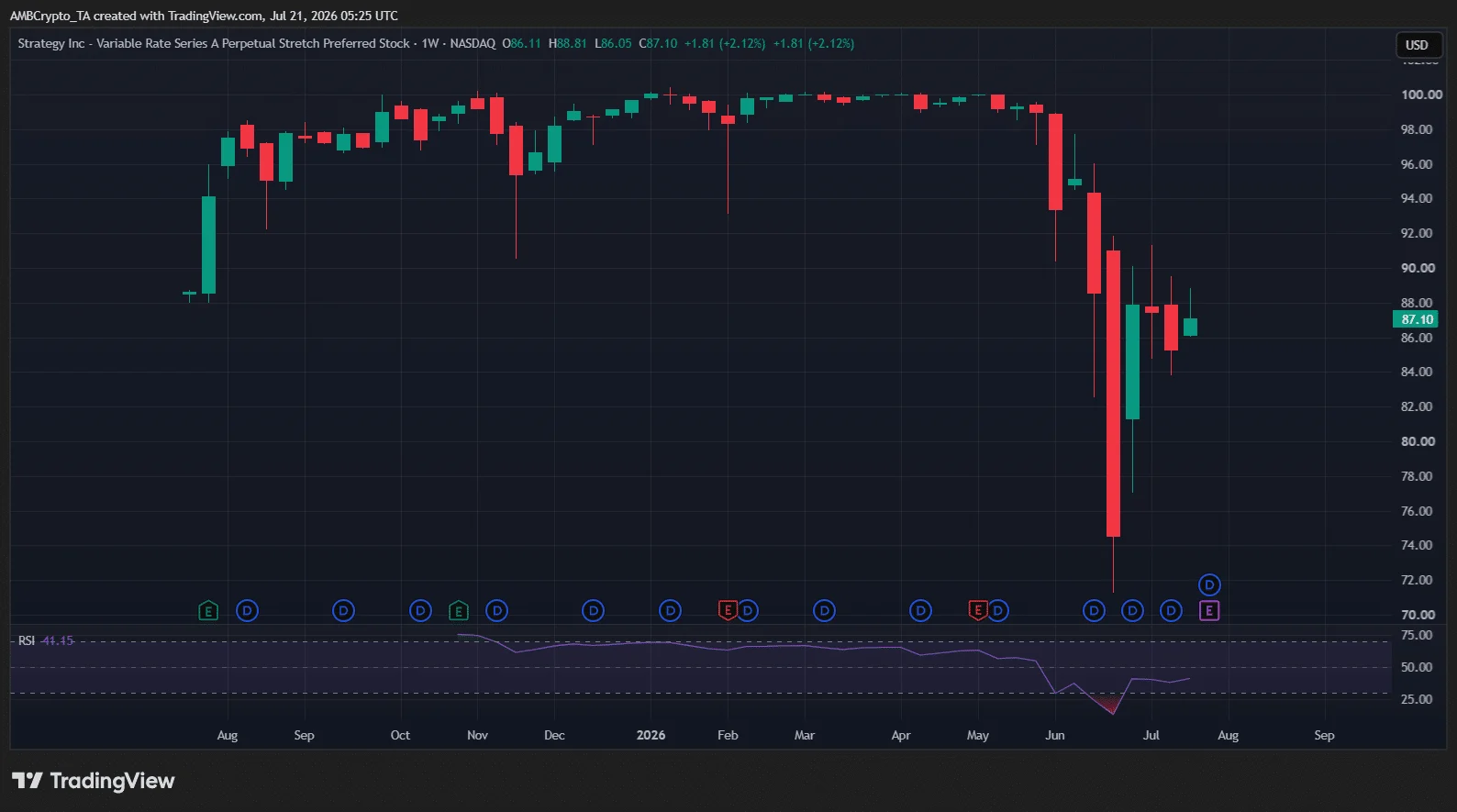
Notably, this is where Strategy’s STRC index comes into play. Technically, despite gaining 2.12% this week, STRC is still trading nearly 15% below the key $100 level.
As long as it stays below that mark, Strategy’s ability to raise fresh capital through its ATM program for additional Bitcoin purchases remains constrained.
Source: TradingView (STRC/USD)
Against this backdrop, MSTR’s decision to increase its USD reserves could be less about preparing for an immediate BTC purchase and more about reinforcing confidence in STRC.
With $3.2 billion in cash (enough to cover 22 months of dividends), the market thinks Strategy has built a sizable liquidity buffer.
If this is the strategy, it could be a signal that Strategy is prioritizing balance sheet strength and liquidity stability while waiting for better conditions to resume aggressive Bitcoin accumulation.
That said, this move hasn’t escaped market scrutiny. While it looks like a strategic pause, investors are increasingly questioning why Strategy keeps raising capital without adding to its Bitcoin [BTC] stack, raising the question: Is Strategy now at the mercy of the market?
Bitcoin’s strategy under the spotlight
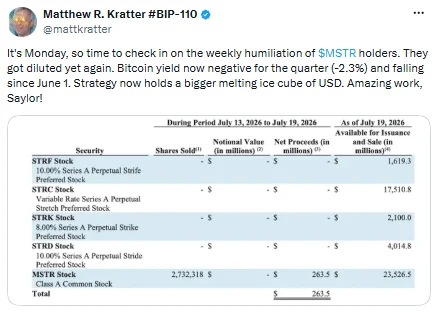
Strategy has officially skipped its Bitcoin purchase for the second consecutive week.
For years, the playbook was simple – raise capital, buy BTC, and announce the purchase on Monday. Last week, Strategy raised $263 million by selling its own stock but didn’t buy a single Bitcoin.
The week before, it raised another $467 million, and again, no BTC purchase. Instead, the company has built its cash reserves.
Why does this matter? For the market, raising capital without buying BTC is starting to look like a break from Strategy’s long-standing playbook. Critics argue MSTR shareholders continue to face dilution while Bitcoin accumulation has stalled, putting both MSTR and STRC under greater scrutiny.
As a result, investors are beginning to question whether Strategy is deliberately preserving liquidity as part of its Bitcoin bet.
Source: X
Or whether current market conditions are simply forcing its hand.
Either way, the latest $225 million addition to Strategy’s cash reserves has added to the uncertainty surrounding both MSTR and STRC.
If Strategy’s Bitcoin buying is becoming increasingly market-driven, it could mark a key shift in Bitcoin’s H2 narrative as risk-off sentiment continues to dominate.
Final Summary
Strategy added another $225 million to its cash reserves instead of buying Bitcoin.
The move has sparked a debate about the company’s next move.
U.S. electricity use is expected to reach a record 4,269 billion kilowatt-hours in 2026 and rise further to 4,399 billion kilowatt-hours in 2027, according to the U.S. Energy Information Administration.
The Trump Administration aims to quadruple U.S. nuclear capacity from roughly 100 gigawatts in 2024 to 400 gigawatts by 2050. To support that goal, the Nuclear Regulatory Commission has proposed changes intended to make environmental reviews and reactor licensing more timely and predictable.
Missed Nvidia in 2009? This Rare Signal Is Flashing Again. In 2009, a “Double Down” signal flashed for a little-known chipmaker called Nvidia. For the first time in years, that same “Total Conviction” signal is flashing for a company 1/100th the size of Nvidia. Continue »
Constellation Energy (NASDAQ: CEG) and Cameco (NYSE: CCJ) offer investors two different ways to benefit from this nuclear energy trend. Here is what $5,000 invested in each stock could be worth in 10 years.
Image source: Getty Images.
1. Constellation Energy
Constellation Energy operates the largest nuclear energy network in the U.S. Its acquisition of Calpine added dozens of natural gas and geothermal power plants, expanding the combined company’s generating capacity to about 55 gigawatts.
PJM Interconnection, which manages the electricity grid across parts of 13 states and Washington, D.C., holds an annual auction to ensure enough power plants are available when demand peaks. In its latest auction, the price reached the temporary cap of $325 per megawatt-day. PJM estimated it would have risen to $554.72 without the cap. Despite this, the auction secured 6.8 gigawatts less capacity than PJM said it needed. The shortfall suggests dependable power remains scarce, which could support higher earnings for Constellation Energy.
Constellation Energy is also locking in demand and has impressive long-term revenue visibility. The company had secured more than 5,650 megawatts through long-term clean energy agreements as of March 31. Those agreements include a 20-year deal to supply Meta Platforms with power from the Clinton nuclear plant in Illinois and another 20-year deal supporting the planned restart of the Crane Clean Energy Center in Pennsylvania for Microsoft. The company added another 176-megawatt nuclear power agreement with Walmart in June 2026.
Management expects base earnings per share, a non-GAAP measure intended to show the earnings power of Constellation Energy’s core business, to grow at an annualized rate of more than 20% from 2026 through 2029. The company is targeting growth of more than 10% in each of the three-year periods after 2029. Constellation estimates base earnings of $6.65 to $6.75 per share in 2026. Using the $6.70 midpoint, management’s growth targets would lift base EPS to about $22.56 by 2036. Assuming base earnings account for 70% of total earnings by then, total adjusted EPS could reach roughly $32.23.
Constellation Energy trades at about 21.9 times the midpoint of its 2026 adjusted earnings guidance (as of July 16). Applying a more conservative valuation of 18 times earnings would produce a share price near $580. Based on the company’s July 16 closing share price of $251.77, a $5,000 investment could grow to roughly $11,500 by 2036, excluding dividends.
The forecast’s accuracy, however, depends on Constellation Energy properly integrating Calpine, managing acquisition debt, and delivering projects tied to its long-term customer agreements. The planned restart of the Crane Clean Energy Center adds another risk because no fully closed U.S. nuclear plant has completed such a restart.
But with its operating plants, long-term contracts, and several earnings drivers, Constellation Energy appears to be a strong nuclear stock for the next decade.
2. Cameco
Cameco operates two of the world’s highest-grade uranium mines in Canada and provides uranium refining, conversion, and fuel-manufacturing services. It also owns a 49% equity stake in Westinghouse, which designs and manufactures nuclear fuel and provides maintenance, engineering support, and components for nuclear reactors.
The uranium business already has strong visibility into demand. Cameco exited the first quarter with contracts covering average annual uranium deliveries of more than 28 million pounds through 2030, with higher-than-average delivery commitments from 2026 through 2028. Cameco’s core uranium segment’s adjusted EBITDA (earnings before interest, taxes, depreciation, and amortization), a measure of operating profitability, rose 48% year over year to $423 million Canadian. Profits were driven by higher sales volumes and increased prices.
Cameco’s share of Westinghouse’s adjusted EBITDA also increased 33% year over year to $122 million Canadian in the first quarter.
However, production problems remain an important risk for Cameco. The company temporarily stopped mining at Cigar Lake in Saskatchewan in July after a problem shut down the nearby McClean Lake mill, where the mine’s uranium ore is processed. Operations restarted on July 14 and have not yet affected the company’s 2026 production forecast. Yet, the disruption showed that Cameco is exposed to problems at both its own mines and at facilities run by business partners.
Analysts now expect Cameco to earn about $1.66 per share in 2026. But its earnings estimate during the next decade could vary widely depending on uranium prices, production volumes, contract pricing, and Westinghouse’s growth.
Assuming a conservative 8% annual earnings growth, Cameco’s EPS will reach about $3.58 by 2036. Cameco trades at about 82 times trailing earnings. Assuming the valuation falls to 20 times earnings, the stock could trade near $72 by 2036. This would reduce the value of a $5,000 investment made at $87.36 per share to roughly $4,100.
In a base-case scenario, assuming Cameco’s EPS grows by 12% annually, earnings would increase from an estimated $1.66 per share in 2026 to about $5.16 per share by 2036. Applying a valuation of 25 times earnings would produce a share price near $129. A $5,000 investment made at Cameco’s July 16 closing price of $87.36 could then grow to about $7,400 by 2036, excluding dividends.
Finally, in a bullish scenario, EPS are estimated to grow by 16% annually. Then, at 30 times the estimated 2036 EPS of $7.32, the stock could reach about $220. A $5,000 investment made at Cameco’s July 16 closing price of $87.36 would then be worth roughly $12,600, excluding dividends.
The base case appears the most reasonable. The bullish case requires Cameco to sustain unusually strong growth for a commodity-linked business, while the conservative case shows how valuation compression could offset years of earnings gains.
Should you buy stock in Constellation Energy right now?
Before you buy stock in Constellation Energy, consider this:
The Motley Fool Stock Advisor analyst team just identified what they believe are the 10 best stocks for investors to buy now… and Constellation Energy wasn’t one of them. The 10 stocks that made the cut are built for long-term growth and could produce monster returns in the coming years.
Consider when Netflix made this list on December 17, 2004… if you invested $1,000 at the time of our recommendation, you’d have $371,842!* Or when Nvidia made this list on April 15, 2005… if you invested $1,000 at the time of our recommendation, you’d have $1,244,783!*
That performance is why people listen. With a track record of beating the S&P 500 by 4x, Stock Advisor offers a distinct advantage. Don’t miss the latest top 10 list, available with Stock Advisor, and join an investing community built for the long haul.
Manali Pradhan, CFA has no position in any of the stocks mentioned. The Motley Fool has positions in and recommends Cameco, Constellation Energy, Meta Platforms, Microsoft, and Walmart. The Motley Fool has a disclosure policy.
Democratic lawmakers want to hold colleges accountable for unmanageable student-loan burdens.
Sens. Elizabeth Warren and Dick Durbin are reintroducing the Accreditation Reform and Enhanced Accountability Act. It’s aimed at strengthening accountability in the system that determines whether schools can receive federal aid for students.
The bill would require the Department of Education to establish guidelines for evaluating colleges, including student-loan repayment outcomes and how much debt students take out postgrad compared to their earnings, according to a fact sheet on the legislation first viewed by Business Insider.
The Biden administration found that, between 2021 and 2024, 1.7 million student-loan borrowers were defrauded by accredited schools, which lawmakers say bolsters the need for improved accreditation measures.
The bill would also require accreditors to respond quickly to state and federal investigations regarding fraud or misconduct at schools and to increase transparency around accreditation decisions.
“We need to overhaul our accreditation system to make sure students get an education that will improve their lives, not leave them jobless and buried in debt,” Warren said in a statement.
This legislation comes after the EducationDepartment advanced its proposal to change the accreditation system, including by requiring accreditors to ensure that schools uphold free speech protections on campuses. It drew criticism from some negotiators who argued that First Amendment issues do not fall within an accreditor’s purview.
Undersecretary of Education Nicholas Kent said in a statement that the measures build on the department’s goals of “lowering costs, simplifying repayment, connecting education to workforce needs, strengthening accountability, and restoring confidence in our accreditation system.”
Following staffing cuts at the Department of Education, lawmakers have been pushing for increased oversight over the student-loan repayment system. A recent report from the Office of the Inspector General found that some of the offices hardest hit by cuts were those that collected financial aid data on schools participating in federal student aid programs.