A high-stakes crypto player connected to 1win’s Global Crypto Network received a 1.749 million USDC payout following a seven-figure wager on Paris Saint-Germain against Aston Villa in the 2026 UEFA Super Cup.
The payout was received in USDC via the Ethereum network. Both the original deposit and subsequent withdrawal are publicly traceable on-chain, providing independent confirmation of the movement of funds.
The player joined 1win through the network of one of the brand’s Global Crypto Ambassadors, following the recent launch of the 1win Global Crypto Ambassador program. The initiative was designed to build a worldwide network of crypto-native creators, community leaders and active Web3 participants, as well as to connect 1win with established crypto communities.
The latest result also follows another seven-figure bet placed on 1win earlier this summer. In July, Mia Khalifa received a total payout of $1.65 million after placing a $1 million bet on Spain to defeat Argentina in the 2026 FIFA World Cup final.
The two million-dollar wagers within weeks of each other highlight the growing presence of high-stakes players on the platform. The latest case also demonstrates the role of stablecoins in high-value iGaming transactions, with the full cycle from deposit to payout conducted in USDC and recorded on Ethereum.
The win comes as 1win continues expanding its presence among crypto-native audiences, combining its Global Crypto Ambassador program with an increasing focus on digital assets and Web3 communities.
About 1win
Founded in 2016, 1win is a crypto entertainment platform in the global gaming industry. Operating across Asia, Latin America, and Africa, 1win offers a wide range of entertainment products adapted to regional audiences. The brand has active collaborations with international public figures, including football legend Luis Suarez, martial artist Jon Jones, and Olympic champion and UFC fighter Gable Steveson. In 2026, 1win welcomed rapper Tyga, UFC legend Ilia Topuria, and reggaeton star Nicky Jam as members of the 1win VIP community.
Contact
1win Press Office, press@1win.pro
Disclaimer: This is a paid post and should not be treated as news/advice.
According to the Zillow lender marketplace, fixed mortgage rates are rising while ARM rates are falling compared to Thursday.
The average 30-year fixed rate today, Friday, August 14, 2026, is 6.65%, up 7 basis points since yesterday. The 15-year fixed loan is currently at 6.07%, 6 basis points higher than yesterday. The 5/1 ARM is 6.25%, 9 basis points lower than on Thursday.
Here are the current purchase rates, according to the latest Zillow data, for Friday, August 14, 2026:
30-year fixed: 6.65%
20-year fixed: 6.40%
15-year fixed: 6.07%
5/1 ARM: 6.25%
7/1 ARM: 6.18%
30-year VA: 6.09%
15-year VA: 5.63%
5/1 VA: 5.68%
Remember, these are national averages and have been rounded to the nearest hundredth.
Current mortgage refinance rates
These are the latest refinance rates, according to the latest Zillow data, for Friday, August 14, 2026:
30-year fixed: 6.67%
20-year fixed: 6.35%
15-year fixed: 6.03%
5/1 ARM: 6.42%
7/1 ARM: 6.36%
30-year VA: 6.02%
15-year VA: 5.90%
5/1 VA: 5.47%
Again, the numbers provided are national averages rounded to the nearest hundredth. Mortgage refinance rates are often higher than rates when you buy a house, although that’s not always the case.
Your mortgage rate plays a large role in how much your monthly payment will be. Use this mortgage calculator to see how your mortgage amount, rate, and term length will impact your monthly payments:
A mortgage interest rate is a fee for borrowing money from your lender, expressed as a percentage. You can choose from two types of rates: fixed or adjustable.
A fixed-rate mortgage locks in your rate for the entire life of your loan. For example, if you obtain a 30-year mortgage with a 6% interest rate, your rate will remain at 6% for the entire 30-year term unless you refinance or sell.
An adjustable-rate mortgage locks in your rate for a predetermined period and then adjusts it periodically. Let’s say you get a 7/1 ARM with an introductory rate of 6%. Your rate would be 6% for the first seven years, then the rate would increase or decrease once per year for the last 23 years of your term. Whether your rate goes up or down depends on several factors, such as the economy and housing market.
At the beginning of your mortgage term, most of your monthly payment goes toward interest. Your monthly payment toward mortgage principal and interest stays the same throughout the years. However, less and less of your payment goes toward interest, and more goes toward the mortgage principal or the amount you originally borrowed.
A 30-year fixed-rate mortgage is a good choice if you want a lower mortgage payment and the predictability that comes with having a fixed rate. Just know that your rate will be higher than if you choose a shorter term, and you will pay significantly more in interest over the years.
You may want to consider a 15-year fixed-rate mortgage if you aim to pay off your home loan quickly and save money on interest. These shorter terms come with lower interest rates, and since you’re cutting your repayment time in half, you’ll save a lot in interest in the long run. But you’ll need to be sure you can comfortably afford the higher monthly payments that come with 15-year terms.
Typically, an adjustable-rate mortgage might be suitable if you plan to sell before the introductory rate period ends. Adjustable rates usually start lower than fixed rates, and then your rate will change after a predetermined amount of time. However, 5/1 and 7/1 ARM rates have been similar to (or even higher than) 30-year fixed rates recently. Before getting an ARM just for a lower rate, compare your rate options from term to term and lender to lender.
Are mortgage rates decreasing?
Yes, ARM rates are falling. The average 30-year fixed rate today, Friday, August 14, 2026, is 6.65%, up 7 basis points since yesterday. The 15-year fixed loan is currently at 6.07%, 6 basis points higher than yesterday. The 5/1 ARM is 6.25%, 9 basis points lower than on Thursday.
Mortgage interest rates today: FAQs
What are mortgage interest rates doing today?
According to Freddie Mac, the average 30-year mortgage rate was 6.67% through Wednesday, down from 6.69% a week earlier. A year ago, the average 30-year mortgage rate was 6.58%.
How low will mortgage rates go in 2026?
According to the latest forecasts, the MBA expects the 30-year mortgage rate to average 6.5% through 2026. Fannie Mae predicts a 30-year rate of 6.4% through the end of the year.
How low could mortgage rates go by 2027?
Mortgage rates are likely to remain little changed in 2027. The MBA forecasts 30-year fixed rates of 6.5% for all of 2027. However, Fannie Mae is more optimistic, predicting average rates will be between 6.2% and 6.3% throughout 2027.
Stablecoin payments company RedotPay delayed a planned $1 billion U.S. IPO to deal with legal issues, Bloomberg reported Friday, citing people familiar with the decision.
The listing, initially planned for this year, is unlikely to take place before 2027, the people told the financial news organization.
“Our strategy continues to focus on global regulatory compliance and business growth,” a RedotPay spokesperson told CoinDesk via Telegram. “This week we obtained a money transmitter license in the U.S. We are preparing to launch our product in the U.S.”
The spokesperson declined to comment on the IPO plan, which emerged in February. Hong Kong-based RedotPay is said to have tapped JPMorgan, Goldman Sachs and Jeffries for the potential listing.
RedotPay, which describes itself as the world’s largest stablecoin payment card issuer, faces a $470 million lawsuit lodged by Binance in Hong Kong alleging that it poached roughly 470,000 users when both firms had an agreement. Under the accord, the crypto exchange allowed its customers to use Binance Pay funds on RedotPay to convert crypto to fiat currency. Binance filed a parallel case in Singapore.
Opinions expressed by Entrepreneur contributors are their own.
Key Takeaways
Subtraction has a ceiling: once you’ve automated the obvious, you’re left with a cheaper business, not a more valuable one.
Agents scale your execution and your blind spots equally — the more they do, the more your judgment has to be worth.
Let me be clear about where I stand. AI agents are real, and they are not hype. The market has stopped arguing about it. When AWS, Google Cloud, Microsoft, IBM, Databricks, and the major consulting firms all describe agents in nearly identical terms — systems with goals, memory, planning and autonomy — you are looking at market structure, not a marketing cycle.
I run a data and AI consultancy. I deploy these systems for Fortune 500 clients. I am not here to tell you to wait. I am here to tell you that the question almost everyone is asking is the wrong one.
The dominant pitch for AI agents is subtraction. Cut the support team. Cut the schedulers. Cut the content drafters. Replace four roles with a digital worker that runs while you sleep. The math is seductive because it is real in the short term — a solo operator genuinely can offload lead qualification, invoice checking, meeting transcription and first-draft copy to systems that cost a fraction of a salary.
But subtraction has a ceiling, and you hit it faster than you expect. Once the obvious tasks are automated, savings flatten and you are left with a business that is cheaper to run and no more valuable than it was before. Worse, you have trained yourself to see your company as a pile of tasks to be eliminated rather than a set of judgments only you can make.
The founders pulling ahead are running a different play. Microsoft studied AI users this year and found that the most effective ones were not the people completing more tasks faster. They were the people who stopped asking what tasks define their job and started asking what outcomes they were now positioned to drive. The agents handle the mechanics. The human moves up the stack to intent, taste, and judgment.
That is not a soft distinction. It is the entire game.
Automation raises the stakes on judgment; it does not remove them.
Here is the part the cost-cutting crowd misses. The more work your agents execute, the more expensive your mistakes in judgment become. A bad decision used to ship at human speed, caught by the three people it passed through on the way out. A bad decision handed to an agent ships at machine speed, across every channel, before anyone blinks.
You do not get to delegate the judgment. You get to delegate the labor — and then you are more accountable for the judgment than before, because there is no longer a layer of humans between your intent and the market.
This is why founders who treat agents as a license to disengage are setting a trap for themselves. They are scaling their own blind spots. An agent will execute a flawed strategy with perfect efficiency and total confidence. It will never walk into your office and say this feels wrong.
What to automate, and what to guard.
The discipline is not complicated, but it requires resisting the pressure to automate by default.
Automate the mechanics. Research, transcription, data retrieval, first drafts, lead enrichment, scheduling — the repeatable workflows that drain hours and require no taste. Start with one workflow, give it narrow permissions, keep a human approval checkpoint, and measure what actually changes over thirty days. The teams that win here keep the stack small and the workflow documented before adding complexity. Stable systems beat sleek demos.
Guard the judgment. The decisions about what your company stands for, which customers you will not serve, when the data is telling you something the model cannot see, what tradeoff is worth making and what line you will not cross. These are not inefficiencies to be optimized away. They are the reason your business exists rather than a competitor’s. Microsoft’s own data names the limit clearly: agents still fall short on tasks requiring deep empathy, emotional intelligence, and nuanced social understanding. That is not a temporary gap. That is your job description.
The strategic move in 2026 is to use agents to buy back the hours you were spending on mechanics, and then to spend those hours on the judgment work you were too busy to do well. Most founders will do the first half and pocket the time as savings. The ones who compound will reinvest it.
Automation is becoming a baseline, not an advantage. When every business in your category can deploy the same agents at the same cost, the agents stop being a differentiator. What remains scarce is exactly what cannot be automated: the quality of your judgment, the clarity of your intent, the taste with which you decide what is worth doing at all.
So by all means, deploy the agents. Cut the busywork. Reclaim the hours. But do not mistake a cheaper company for a stronger one. The founders who win the next few years will not be the ones who automated the most. They will be the ones who automated everything except the thinking — and then got dramatically better at the thinking.
That is the asset no agent can run while you sleep. Make sure you are still the one holding it.
Key Takeaways
Subtraction has a ceiling: once you’ve automated the obvious, you’re left with a cheaper business, not a more valuable one.
Agents scale your execution and your blind spots equally — the more they do, the more your judgment has to be worth.
Let me be clear about where I stand. AI agents are real, and they are not hype. The market has stopped arguing about it. When AWS, Google Cloud, Microsoft, IBM, Databricks, and the major consulting firms all describe agents in nearly identical terms — systems with goals, memory, planning and autonomy — you are looking at market structure, not a marketing cycle.
I run a data and AI consultancy. I deploy these systems for Fortune 500 clients. I am not here to tell you to wait. I am here to tell you that the question almost everyone is asking is the wrong one.
The dominant pitch for AI agents is subtraction. Cut the support team. Cut the schedulers. Cut the content drafters. Replace four roles with a digital worker that runs while you sleep. The math is seductive because it is real in the short term — a solo operator genuinely can offload lead qualification, invoice checking, meeting transcription and first-draft copy to systems that cost a fraction of a salary.
Hyperliquid [HYPE] recently showed strong upside momentum after establishing $53 as support.
The altcoin then climbed to a local high of $57. At press time, HYPE traded near $56.89, down 0.32% daily. However, heavy whale selling threatened the emerging recovery.
How much HYPE did the whale sell?
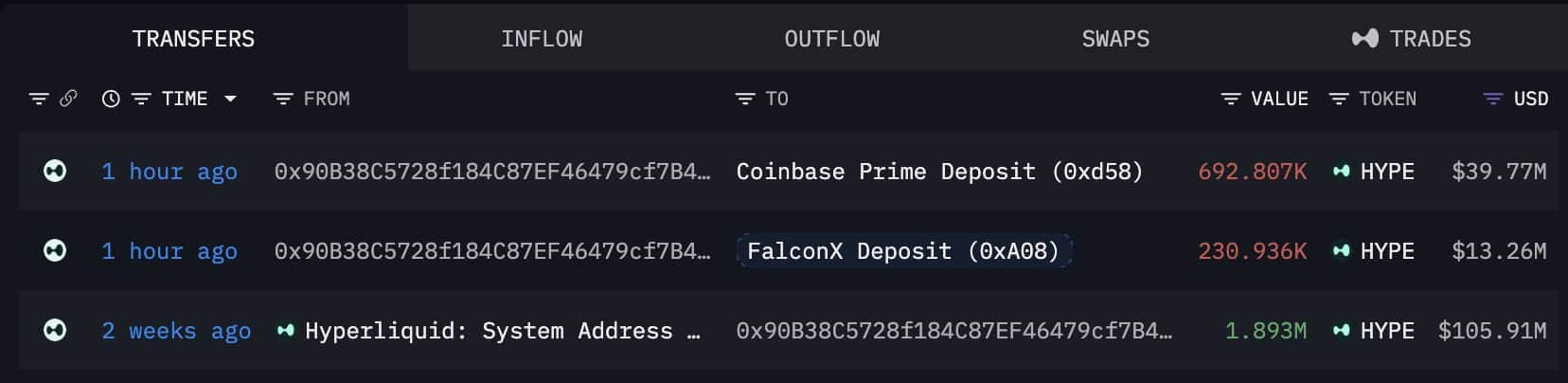
Although HYPE showed relative strength, some high-net-worth holders continued reducing their positions.
Two weeks earlier, the whale sold 1.03 million HYPE worth $57.44 million.
Across both transactions, the whale sold 1.95 million HYPE worth approximately $110.46 million. Even after those sales, the address held 969,595 HYPE worth $55.5 million.
These transfers may reflect profit-taking as Hyperliquid [HYPE] recovered from its recent decline. However, the wallet’s future intentions remained unknown.
On top of that, exchange activity showed broader selling pressure.
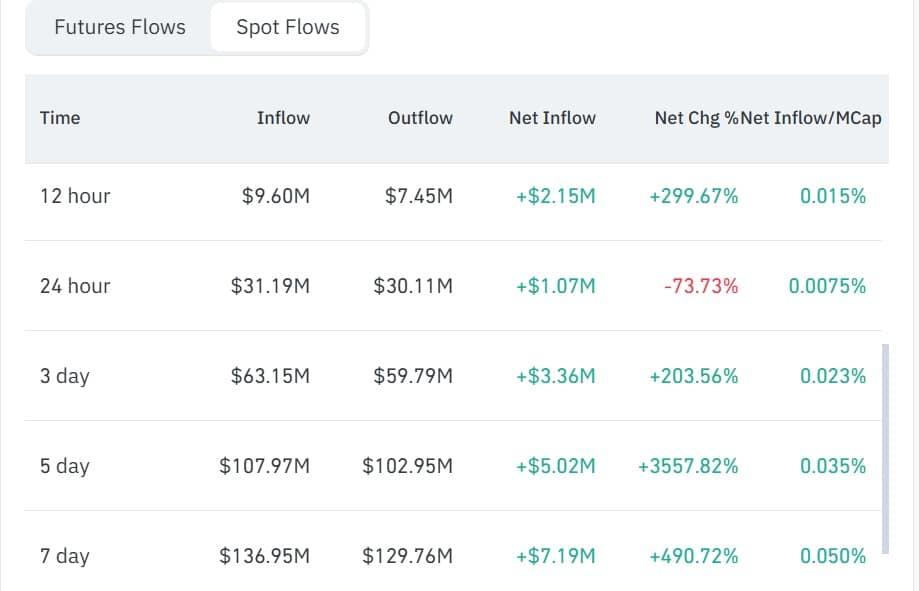
CoinGlass data showed that Spot Netflow remained positive throughout the past week. It stood near $7.19 million at press time.
Source: CoinGlass
Positive Spot Netflow suggested that more HYPE entered exchanges than left them. That exchange supply could intensify selling pressure if holders moved tokens there to sell.
Therefore, active sellers may limit HYPE’s recovery despite its improving price structure.
Can HYPE reclaim $60?
Even so, HYPE’s bullish structure appeared to strengthen.
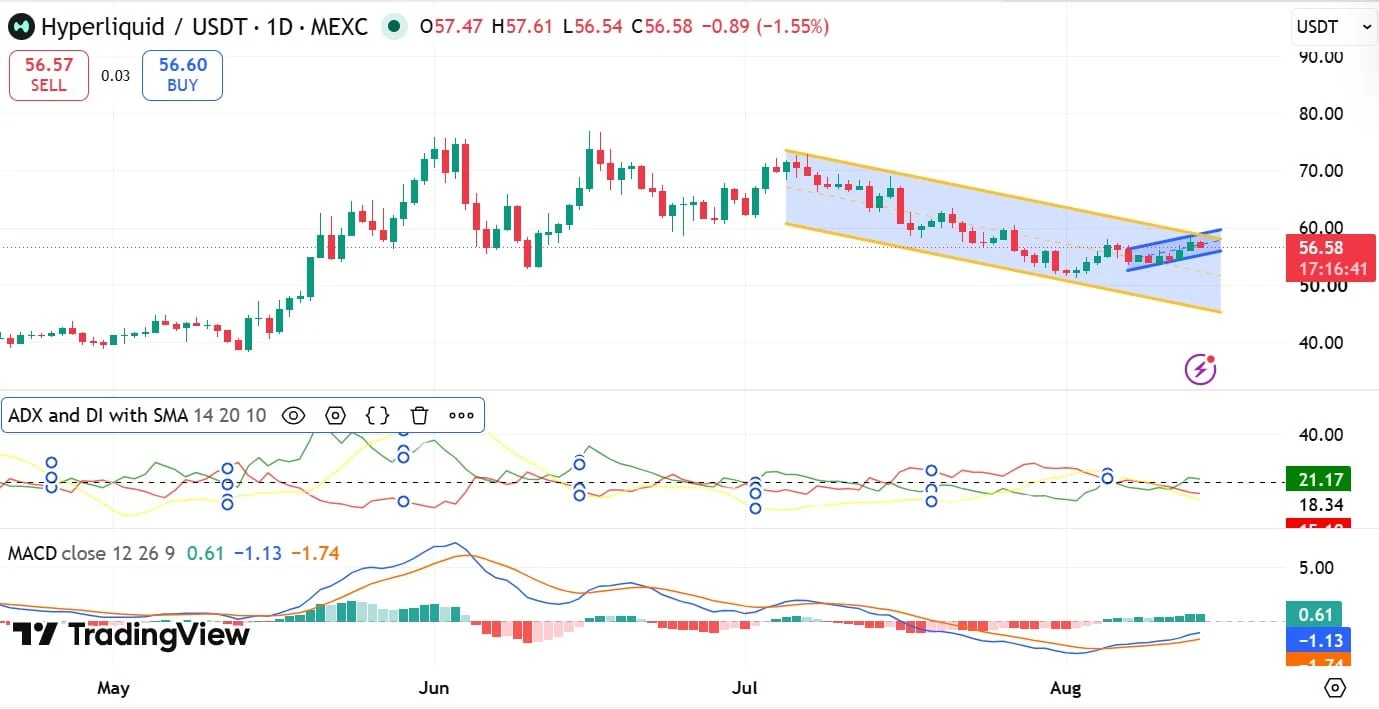
The Positive Directional Indicator [+DI] stood near 21, while the Negative Directional Indicator [-DI] held around 15. The +DI also remained above the Average Directional Index [ADX]. This setup suggested that buyers held the directional advantage.
Source: TradingView
Additionally, the MACD remained negative but moved upward. This indicated that bearish momentum had weakened. Together, the indicators supported the possibility of further upside. A sustained recovery could help HYPE reclaim $60.
However, continued whale selling could disrupt the rebound. Renewed pressure may instead push HYPE toward its $53 support.
Final Summary
A Hyperliquid whale sold another 923,743 HYPE worth $53.02 million. The whale’s combined sales reached 1.95 million HYPE worth approximately $110.46 million.
A sustained recovery could lift HYPE toward $60, while renewed selling may trigger a $53 retest.
Stride (NYSE:LRN) walked into its August 4 fourth-quarter fiscal 2026 earnings call with a brand-new face running the company. Robert E. Knowling Jr., a Stride board member since 2018, was named CEO just days before the call, stepping in to lead an online education company that grew revenue 4.7% for the year and served roughly 244,000 students. The timing puts fresh leadership in charge right as the next enrollment season kicks off, and it leaves investors weighing genuinely strong numbers against a stock the market has already priced with real doubt.
Stride (LRN) Just Got A New CEO. What Happens Next?
Bull Case: The Career Learning Engine Keeps Revving
Fiscal 2026 revenue reached $2.518 billion, up 4.7% from the prior year, while adjusted EBITDA climbed 8.2% to $617.6 million and adjusted EPS came in at $8.33. The standout was career learning, Stride’s middle and high school career-focused programs, where revenue jumped 19% to $1.04 billion as enrollments grew 14% to 110,000 students. That segment is expanding far faster than the company overall, and it is where management is putting its growth story.
Capital returns back that story up. Stride repurchased about $189 million of stock during the year, extended its buyback authorization to October 31, 2027, and still has roughly $311 million left under that program, backed by $1.034 billion in cash and marketable securities. Knowling himself has run companies before, including taking COVAD Communications public, and told investors he intends to actively consider more opportunistic buybacks once Stride’s trading window reopens at the end of October.
Bear Case: The Other Half Of The Business Is Shrinking
General education, Stride’s larger segment by revenue, moved in the opposite direction. Revenue fell 2% to $1.42 billion, and enrollments dropped 2.5% to 134,000 students. Part of that softness showed up in Texas, where the Roscoe Independent School District chose not to renew its contract for Stride’s Lone Star Online Academy, even as the company works to place affected families in its other programs. Profitability also took a hit: gross margin slipped 140 basis points to 37.8% as the company absorbed costs tied to new technology platforms, and free cash flow declined by $17.8 million to $355 million.
Management’s own tone on the year ahead carried caution, too. Because Stride moderated in-year enrollment growth during fiscal 2026, the first quarter of fiscal 2027 will face a tougher comparison, and applications were tracking slightly behind last year’s pace even as conversion rates and re-registration activity improved. Stock compensation and the tax rate are both expected to tick up next year as well.
What The Market Is Pricing In
Hedge fund interest in Stride is building, with the number of funds holding a position rising from 43 to 47 in the most recent quarter. Short interest tells a very different story, sitting at 22.92% of the float, which points to a substantial bear camp already positioned against the stock. Meanwhile, shares trade at a forward P/E of just 9.24 as of August 12, a multiple that assumes little in the way of future growth.
Where This Leaves Stride Investors
Stride enters fiscal 2027 with a career learning segment growing at a rapid clip, a shrinking general education base, and a CEO who has been on the board for years but is brand new to the job. For the growth story to keep winning out, career learning needs to keep offsetting general education’s decline while margins stabilize. For the skeptics to be proven right, the tougher enrollment comparisons and rising costs flagged for next year would need to bite harder than management expects.
While we acknowledge the potential of LRN as an investment, we believe certain AI stocks offer greater upside potential and carry less downside risk. If you’re looking for an extremely undervalued AI stock that also stands to benefit significantly from Trump-era tariffs and the onshoring trend, see our free report on thebest short-term AI stock.
Fund flows aren’t helping either. Spot bitcoin ETFs are bleeding again, with U.S.-listed funds shedding $333 million in net outflows so far this week. That reverses course from last week’s $853 million of inflows, which had hinted at returning institutional demand. On a year-to-date basis, investors have yanked over $4 billion from these funds.
Meanwhile, adding to the pressure are Treasury notes, which underpin global finance. On Thursday, a $25 billion auction of the U.S. 30-year note drew yields as high as 5.22%, according to the Treasury Department, a level some dealers called the highest since 2001. Rising long-term yields make capital costlier and raise the opportunity cost of holding non-yielding assets like bitcoin, a dynamic that compounds an already shaky backdrop.
Taken together, stalled legislation, weak ETF demand and climbing yields suggest little room for an outright rally in cryptocurrencies, leaving majors such as XRP fragile.
The payments-focused cryptocurrency has somehow managed to hold on to the $1 support, which, if breached, could prompt holders to sell their coins. A large number of traders likely accumulated coins below this level in late 2024, anticipating a
That combination helps explain why XRP’s grip on $1 and bitcoin’s hold on its multi-week range both look increasingly fragile heading into the next session.