Bitcoin’s funds are still lurching, however. U.S. spot bitcoin ETFs shed $424 million on July 13, then took back $181 million the next day. Money leaving and returning inside 48 hours is not indicative of an allocator building a position.
As such, the ether bid is narrower. Of the $53.8 million that came in on Wednesday, BlackRock’s ETHA absorbed $45.3 million and its smaller ETHB fund took $4 million, leaving the other eight products to split less than $5 million between them.
Grayscale’s original ether trust, which charges 2.5% against BlackRock’s 0.25%, has now bled $5.3 billion since launch.
Ether also picked up a demand source that did not exist three weeks ago. Robinhood Chain, the layer-2 network the brokerage switched on July 1, pays gas in ether and settles to Ethereum, and it has been clearing more than $800 million in daily decentralized exchange volume, most of it memecoin trading.
Bitcoin is steadier than its ETF flows suggest, however. Nansen data shows exchange outflows holding through the escalation in the Middle East, with no meaningful rotation into stablecoins, the move that usually marks wallets stepping back.
Funding rates are near zero, which is suggestive of the overleveraged longs that fuelled June’s liquidation cascades have already been cleared out. Bitcoin dominance is 58.3%.
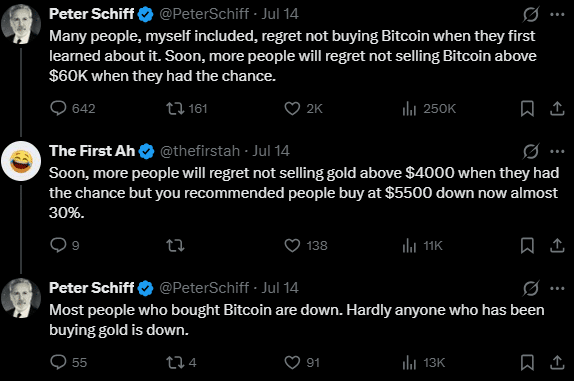
Peter Schiff, a staunch Bitcoin critic, warned investors against holding the crypto asset at current levels.
According to him, those who fail to offload their BTC stash at the current value above $60K could incur heavy losses.
Many people, myself included, regret not buying Bitcoin when they first learned about it. Soon, more people will regret not selling Bitcoin above $60K when they had the chance.
Source: X
Despite his regret, Schiff claimed that he won’t buy BTC even if its price drops 3x, noting that “$20K is way too much to pay for nothing.”
Although Schiff didn’t share the bearish catalysts that could drag BTC lower, other analysts expressed similar caution.
Why fragile macro could stall Bitcoin’s rebound
Bitcoin’s price has been up about 11% in July. It has bounced from a low of $57.8K to nearly $65K, unfazed by Strategy’s BTC sale thanks to improved macro conditions after softer CPI data this week.
However, analysts are cautious that the macro relief could be temporary, as renewed U.S-Iran escalations could dent energy markets and risk appetite again. Additionally, there has been a crypto-specific catalyst to fuel further rally, noted Bitfinex analysts.
We had not seen any Bitcoin-specific demand before the inflation print: the ETF complex sold $424.7 million on 13 July, Strategy bought nothing, and the Coinbase premium is still negative.
This meant that, on average, there was no marginal institutional demand for BTC despite the macro relief. The analysts cautioned that BTC’s relief bounce was a ‘borrowed strength.’
A rally built on a macro catalyst, with limited spot absorption and no price-agnostic bid, that had been a constant in previous uptrends for BTC, is ‘borrowed strength’ that the lender can call back.
A potential capital rotation from AI to crypto was previously viewed as a potential positive catalyst alongside the passage of the CLARITY Act. But the crypto bill has stalled, and the AI sell-off could affect crypto, per QCP Capital.
The bullish setup is not an AI unwind; it is AI stabilisation followed by a crypto-specific catalyst.
Where could Bitcoin trade next?
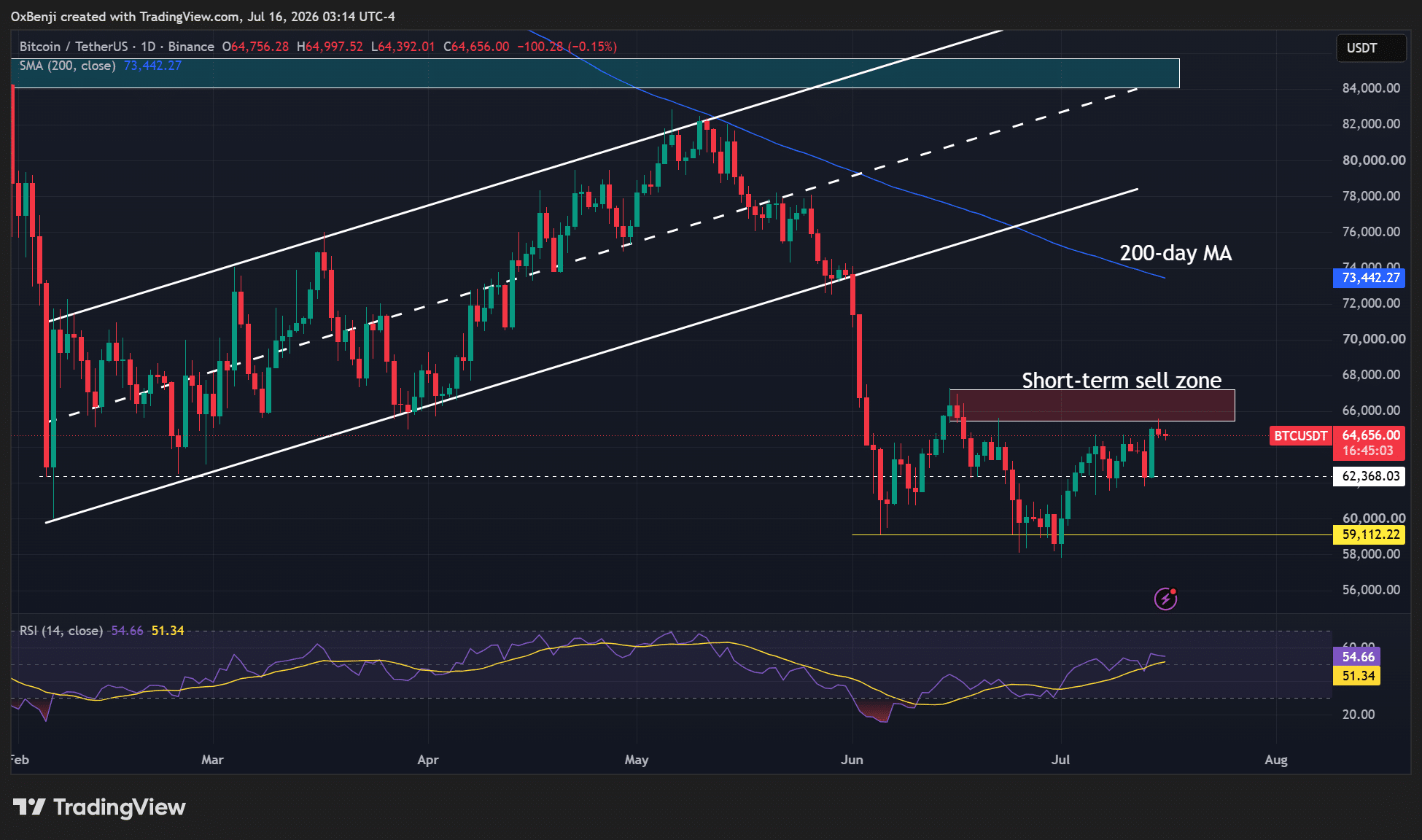
QCP projected Bitcoin [BTC] could remain range-bound within $60K-$75K, adding that there was a notable hedging against a potential dip to $55K-$58K.
Our base case for BTC is range-bound; the bull case needs lower real yields, stronger ETF inflows and regulatory progress; the bear case is a decisive break below support on continued outflows.
Source: BTC/USDT, TradingView
The price chart also painted a similar projection. The $65K-$67K was a short-term sell zone, and another overhead hurdle was at the 200-day Moving Average (MA, blue line, $73.4K). Failure to clear these obstacles could increase the chance of dipping to $60K or below.
Final Summary
Peter Schiff urged investors to sell their BTC holdings, warning that the price will drop below $60K.
His caution was warranted, as macro, regulatory, and spot BTC ETF demand were not aligned to support a sustainable risk appetite.
Deposit account rates are on the decline. The good news: You can lock in a competitive return on a certificate of deposit (CD) today and preserve your earning power. In fact, the best CDs still pay rates of 4% or higher. Read on for a snapshot of CD rates today and where to find the best offers.
Where are the best CD rates today?
CDs today typically offer rates significantly higher than traditional savings accounts. Currently, the best short-term CDs (six to 12 months) generally offer rates around 4% to 4.5% APY.
Today, Wednesday, July 15, 2026, the highest CD rate is 4.10% APY. This rate is offered by Marcus by Goldman Sachs on its 14-month CD.
The following is a look at some of the best CD rates available today from our verified partners:
Historical CD rates
The 2000s were marked by the dot-com bubble and later, the global financial crisis of 2008. Though the early 2000s saw relatively higher CD rates, they began to fall as the economy slowed and the Federal Reserve cut its target rate to stimulate growth. By 2009, in the aftermath of the financial crisis, the average one-year CD paid around 1% APY, with five-year CDs at less than 2% APY.
The trend of falling CD rates continued into the 2010s, especially after the Great Recession of 2007-2009. The Fed’s policies to stimulate the economy (in particular, its decision to keep its benchmark interest rate near zero) led banks to offer very low rates on CDs. By 2013, average rates on 6-month CDs fell to about 0.1% APY, while 5-year CDs returned an average of 0.8% APY.
However, things changed between 2015 and 2018, when the Fed started gradually increasing rates again. At this point, CD rates showed a slight improvement as the economy expanded, marking the end of nearly a decade of ultra-low rates. However, the onset of the COVID-19 pandemic in early 2020 led to emergency rate cuts by the Fed, causing CD rates to fall to new record lows.
The situation reversed following the pandemic as inflation began to spiral out of control. This prompted the Fed to hike rates 11 times between March 2022 and July 2023. In turn, this led to higher rates on loans and higher APYs on savings products, including CDs.
Fast forward to September 2024 — the Fed finally decided to start cutting the federal funds rate after it determined that inflation was essentially under control. In 2025, it announced three additional rate cuts. Today, we’re seeing CD rates steadily declining from their peak. Even so, CD rates remain high by historical standards.
Take a look at how CD rates have changed since 2009:
Understanding today’s CD rates
Traditionally, longer-term CDs have offered higher interest rates compared to shorter-term CDs. This is because locking in money for a longer period typically carries more risk (namely, missing out on higher future rates), which banks compensate for with higher rates.
However, this pattern doesn’t necessarily hold today; the highest average CD rate is for a 12-month term. This indicates a flattening or inversion of the yield curve, which can happen in uncertain economic times or when investors expect future interest rates to decline.
When opening a CD, choosing one with a high APY is just one piece of the puzzle. There are other factors that can impact whether a particular CD is best for your needs and your overall return. Consider the following when choosing a CD:
Your goals: Decide how long you’re willing to lock away your funds. CDs have fixed terms, and withdrawing your money before the term ends can incur penalties. Common terms range from a few months up to several years. The right term for you depends on when you anticipate needing access to your money.
Type of financial institution: Rates can vary significantly among financial institutions. Don’t just check with your current bank; research CD rates from online banks, local banks, and credit unions. Online banks, in particular, often offer higher interest rates than traditional brick-and-mortar banks because they have lower overhead costs. However, make sure any online bank you consider is FDIC-insured (or NCUA-insured for credit unions).
Account terms: Beyond the interest rate, understand the terms of the CD, including the maturity date and withdrawal penalties. Also, check whether there’s a minimum deposit requirement and, if so, whether it fits your budget.
Inflation: While CDs can offer safe, fixed returns, they may not keep pace with inflation, especially over longer terms. Consider this when deciding on the term and amount to invest.
Sascha Doering’s first job was in an Ikea cafeteria in Germany. He got the job to save up for his first set of wheels.
But his dream of owning a high-performance car would have to wait. He couldn’t get his license until he turned 18, so Doering bought the next-best thing: a midnight-blue Vespa with a white leather seat.
“The motivation around wheels was already there,” Doering told Business Insider. “I just needed to start with two wheels rather than four.”
He did not have the motor scooter for long. After “a few thousand kilometers,” Doering said, it was involved in a crash.
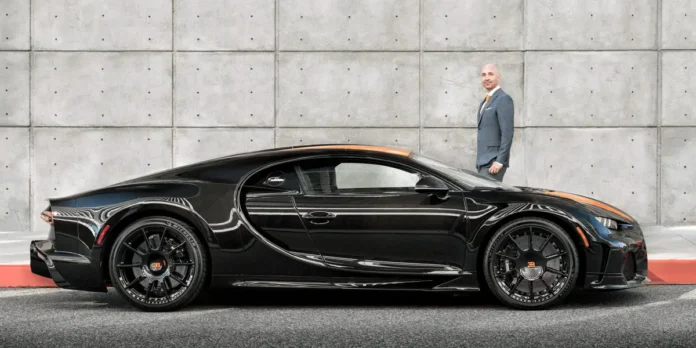
These days, he’s much closer to that childhood dream. Doering is now the chief operating officer of Bugatti Americas, where he helps sell the luxury hypercar maker’s roughly $5 million vehicles to ultra-high-net-worth customers in the US.
Selling those cars requires an unusually personal touch with some of the world’s richest buyers.
A calendar filled with clients’ kids’ birthdays
Doering said he messages clients on their kids’ birthdays.
Bugatti
Bugatti’s business is not built on volume.
Each year, the company builds 80 to 100 cars for the global market, Doering said. In a good year, around 40 of those vehicles make it to US shores — so each customer is unusually important to keep engaged.
“Personal relationships are of the utmost importance,” Doering said. “We cannot substitute clients. We cannot lose clients because they are so rare, as rare as our products are.”
So Doering says he sticks around in customers’ lives, even after they’ve chosen paint colors, upholstery options, and wheel finishes.
He told Business Insider he keeps track of some clients’ children’s birthdays and regularly speaks with others by phone. If he realizes they’re both in the same region, he’ll ask them to grab dinner.
“If a client feels so comfortable with us in this relationship after having just bought a car for $5 million, I would say that we’ve done something right,” Doering said.
Delightfully un-screened — and a little electric
Bugatti is expecting to build 250 Tourbillons. Every model is accounted for.
Bugatti
Bugatti is now preparing to produce the Tourbillon, its first hybrid and the successor to the Chiron. Earlier this month, the company inaugurated a new facility in Molsheim, France, that will support the car’s production.
The Tourbillon pairs a naturally aspirated 8.3-liter V16 engine with three electric motors, producing a combined 1,800 horsepower. Its production run is limited to 250 cars and effectively sold out, Doering said.
He said Bugatti embraces new technology, but not at the expense of the tactile experience its customers expect. He described the industry’s growing reliance on screens as sometimes “a little overkill” compared with physical controls made from materials such as titanium and crystal glass.
“Innovation, yes,” he said, “but never at the cost of emotions.”
That human-first philosophy extends to the way Bugatti develops and builds its cars.
Doering said the company did not use AI to design, develop, or produce the Tourbillon. A spokesperson confirmed to Business Insider that AI is not part of the hypercar’s production process.
“They are not utilizing AI for design purposes,” he said. “Maybe that becomes a thought in the future, but at the moment, in the Tourbillon, I don’t think it has been.”
No ‘joyrides’ — and human-made PowerPoints
Doering said he doesn’t own a Bugatti. Instead, he drives a luxury sedan.
Eugene Gologursky/Getty Images for Hamptons International Film Festival
Like Bugatti’s emphasis on making cars with humans, Doering’s approach to work is also strikingly analog.
He said he occasionally uses Anthropic’s Claude for routine tasks, but described himself as “super old school” and “terrible at AI.”
“I’m still one of the guys who writes his own story and puts his own PowerPoint together,” Doering said. “I don’t touch AI.”
He said building a presentation himself forces him to work through the analysis and storytelling rather than outsourcing the process to a tool.
He said many of those human-centric and relational approaches to his work have helped him realize that childhood dream he had when he started working in that Ikea cafeteria: he now owns an Audi A8 L, a flagship luxury sedan.
Despite his position, he said he won’t keep a Bugatti in his driveway. He drives the company’s cars alongside customers at rallies, but deliberately avoids treating them as personal toys.
“I know where my place is,” he said. “I don’t want to create a perception that the COO of Bugatti of the Americas is going for a joyride in a Bugatti.”
President Donald Trump said in January he had no plans to pardon Bankman-Fried. He has cleared Binance founder Changpeng Zhao and Silk Road creator Ross Ulbricht, along with other white-collar offenders.
Bankman-Fried ran two companies at once. FTX was a crypto exchange, which holds customer money the way a broker does and is not supposed to touch it. Alameda Research was a trading firm he also owned. He moved billions of dollars in FTX customer deposits to Alameda, which spent the money on trades, venture investments, political donations, and Bahamian real estate, while FTX’s software exempted Alameda from the rules that would have forced it to cover its losses like any other trader.
The facade was blown open after CoinDesk obtained Alameda’s balance sheet in November 2022 and found that most of what the firm counted as assets was FTT – a token FTX had created itself and could issue at will.
The collateral propping up Alameda was, in effect, something its sister company had invented. Further cracks emerged after the prominent exchange Binance said, days later, it would sell its FTT holdings, leading to a rapid collapse in FTT prices.
Customers rushed to pull their deposits, and FTX could not return the money because it was no longer there. The exchange filed for bankruptcy on Nov. 11, 2022, just over a week after the story ran.
JPMorgan (JPM) shares inched higher on Tuesday as investors cheered the largest U.S. bank’s solid Q2 earnings, featuring a 27% year-over-year increase to $58 billion. More importantly, the investment firm posted record net income of $21.16 billion, which translates to $7.7 on a per-share basis, crushing Street estimates set at $5.55 per share.
At the time of writing, JPMorgan stock is up about 20% versus its year-to-date low.
More News from Barchart
www.barchart.com
What Drove JPMorgan Profit in Q2?
JPMorgan’s impressive Q2 earnings were driven primarily by a massive $5.6 billion in one-time pretax gains from a $4.55 billion transaction involving Visa (V) shares and a $1.03 billion boost from equity investments.
However, even without these windfalls, the bank’s core business provided incredible resilience.
A sharp recovery in capital markets resulted in a 30% increase in investment banking fees to $3.28 billion, while equity trading revenue rallied a much higher 86% year-over-year to $6.03 billion in the second quarter.
These diverse revenue streams reinforce that the nation’s largest lender is firing on all cylinders — and that JPM stock is strongly positioned to navigate the broader geopolitical and macroeconomic uncertainties.
Should You Load Up on JPM Shares Today?
Looking ahead, JPMorgan’s raised guidance (net interest income NII expectation now set at $105.5 billion) signals confidence in continued momentum through the remainder of 2026.
Investors will also benefit from the increased quarterly dividend of $1.65 per share, starting in Q3.
On the flip side, however, management increased its 2026 expense forecast to $107.5 billion, and looming Basel III endgame rules may force JPM to hold billions more in capital, which could temporarily limit aggressive share buybacks.
That said, JPMorgan shares have a history of closing July with a little under 4% gain — a seasonal pattern that makes them attractive to own in the near term.
What’s the Consensus Rating on JPMorgan?
Investors could also take heart in the fact that Wall Street analysts remain bullish as ever on JPM shares for the next 12 months.
Before correcting somewhat, Gnosis [GNO] climbed by 13% in just 24 hours. In fact, it recorded a rally that hinted at whether the token can flip one of the market’s leading memecoins, BONK, by market capitalization.
Such a flip would lift Gnosis to the 100th spot among tokens by market capitalization. At the time of writing though, Gnosis held a market cap of $303.88 million against BONK’s $330.07 million.
And yet, despite it being close enough to tempt a flip, yet Gnosis may ease into consolidation and not mount it just yet.
Structural warnings surface for Gnosis
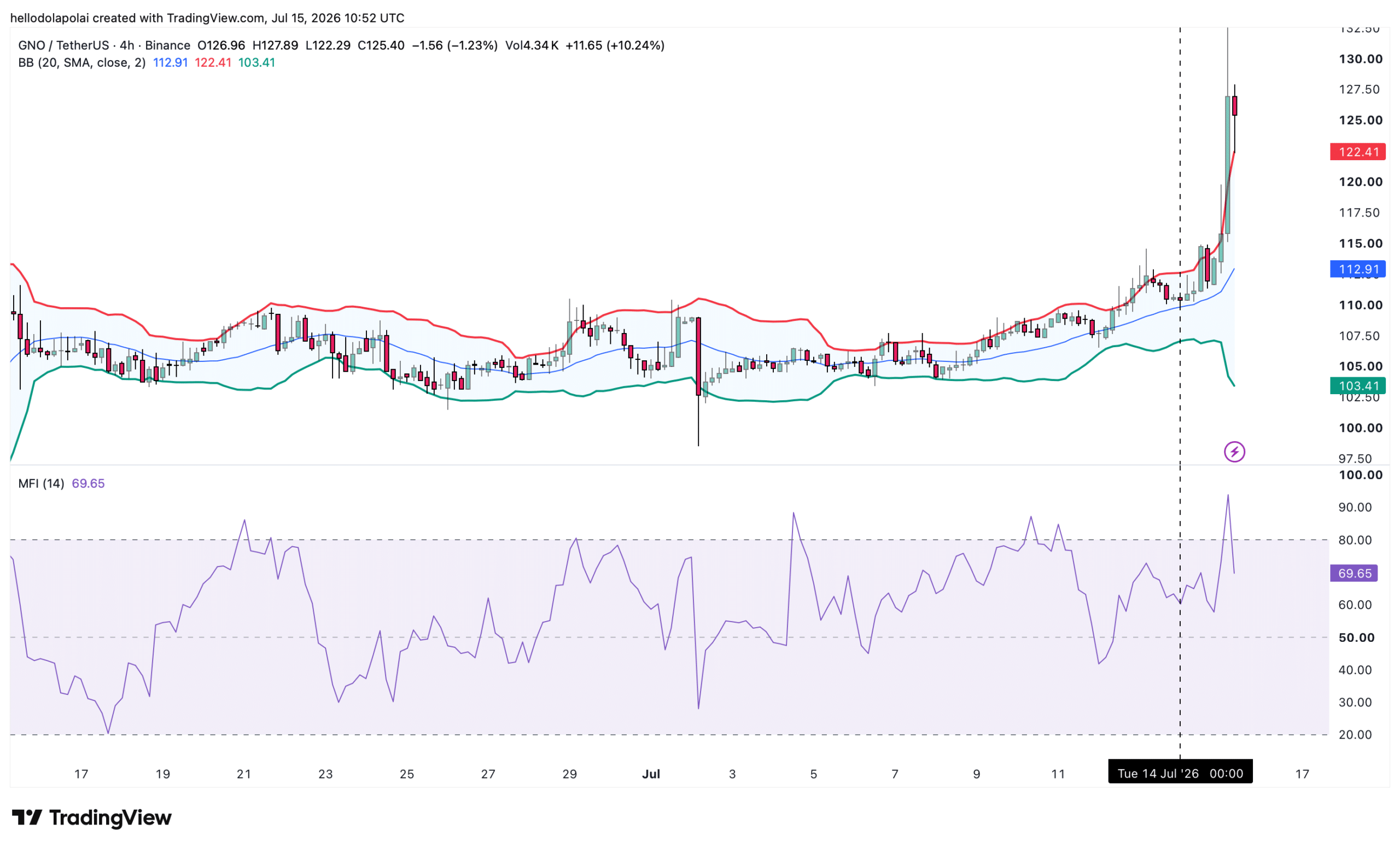
At the time of writing, indicator-based analysis suggested that Gnosis has moved into overvalued territory and may struggle to sustain its rally in the near term.
The first signal came from the price pushing into the upper Bollinger Band (BB). The indicator gauges valuation by price position as while a move above the red upper band points to overvaluation, a drop below the lower band signals undervaluation.
Source: TradingView
The price typically retreats after tagging the upper band, often sliding back towards the middle band, which sat at $112.91 in this case. Should that level hold as support, the rebound could resume from there.
Stronger sell pressure, however, could drag the price down to the green lower band at $103.41 before any renewed push towards a fresh high. Lately though, capital has continued to retreat, a sign that sellers remain active.
The Money Flow Index (MFI), which tracks capital moving in and out of an asset, plunged sharply for Gnosis too, pointing to heavier outflows than inflows.
Spot netflow steers GNO’s rally
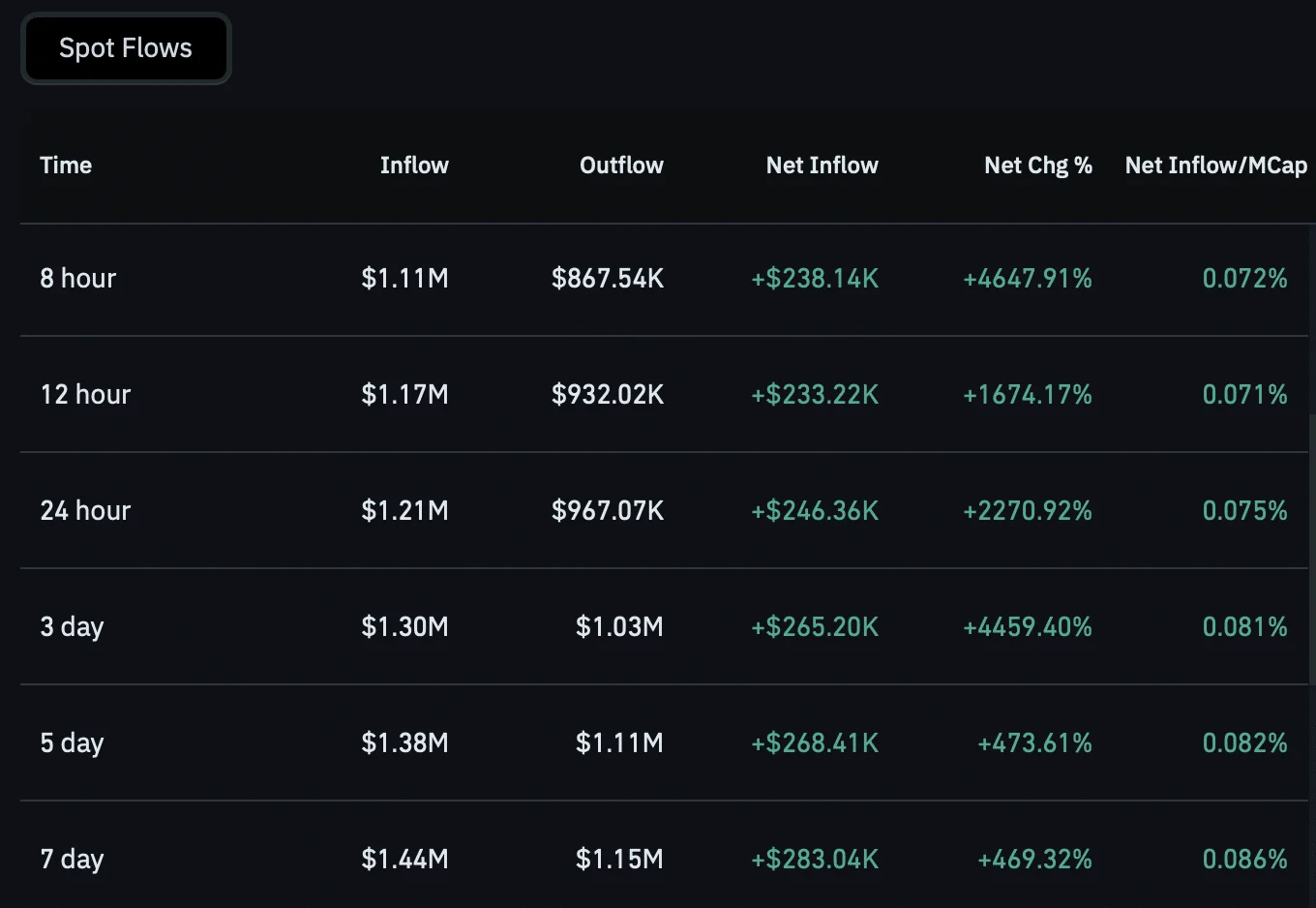
CoinGlass data revealed that spot activity has been dictating the direction of Gnosis, with derivatives playing little part in the move.
The spot read hinted at heavy profit-taking as Gnosis surged over the past day, with $1.19 million sold into the rally. Buyers failed to keep pace, tipping the balance into a net-seller market and leaving netflow near negative $246,000.
Source: CoinGlass
That reads as classic profit-taking, though a widening netflow from here would leave Gnosis with slim odds of a rebound.
A more constructive read was evident on the seven-day netflow though where sellers held only a $283,000 edge even as the price gained 17% over the same stretch. If that dynamic repeats, any decline would likely amount to a temporary pullback before the advance resumes.
What does GNO need to flip BONK?
Assuming BONK’s market cap holds at $330.07 million—unlikely in a moving market—a somewhat significant hike in the price of Gnosis would complete the flip. As it stands, closing the aforementioned gap would require GNO to climb to $125.48.
However, this move may only materialise once the price settles into a support region or reverses beforehand.
Final Summary
Gnosis needs only a small price hike to overtake BONK and claim the 100th spot by market value.
Momentum indicators indicated that any move higher may stall or pull back before a flip actually happens.